“Time spent amongst trees is never wasted time” — Katrina Mayer
With nearly 300 public parks in Albuquerque (ABQ), it’s easy to find one beautifully landscaped with mature trees providing cool shade on a hot summer or fall day. The City’s Urban Forestry division manages roughly 25,000 trees within its parks, and when ‘in town,’ these parks feel like irresistible magnets reeling Luna and I in for an hour of discovery.
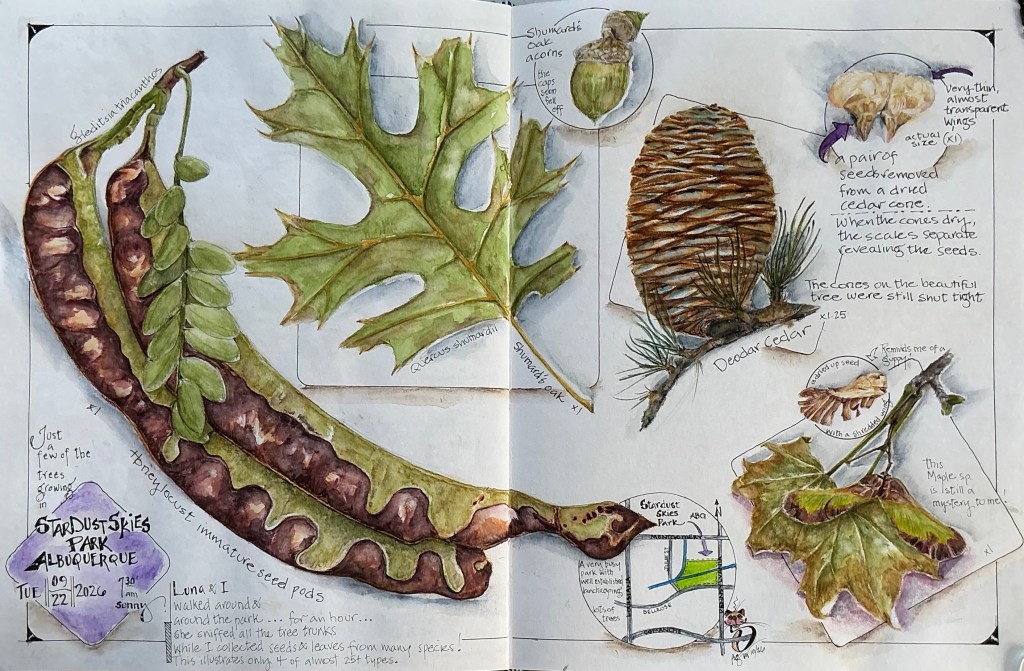
Star Dust Skies Park is one we’ve visited many times ….. as it’s just behind our dentist’s office. So on the morning of September 22nd, while Roy was “lounging” in a reclining chair discussing a tooth extraction with the Doc, Luna informed me the neighboring Park was calling.
Like many other City parks, the canopies of the abundance of mature trees seemed to touch, almost entirely eliminating the direct sunshine from penetrating the underlying lawn. Our walk-about was cool and refreshing as Luna sniffed every single tree trunk while I searched for seeds, seed pods and cones to draw.
As we moved from tree (trunk) to tree (trunk), I found myself wondering about the many non-native trees growing in the City. After all, ABQ is in the middle of a desert, in the middle of a drought (coincidentally, the 13 mile reach of the Rio Grande through town turned to sand from late May through mid-September 20261). Turns out the city has a water-wise urban forestry program; a permit must be obtained to plant a tree in a park, ensuring it is a drought-tolerant species. And growing trees in such an arid environment provides measurable annual benefits, like carbon sequestration, pollution reduction, and stormwater capture.
All of that (along with the other benefits of having established green spaces in the City) made me feel somewhat better about so many non-native trees in so many parks.
After an hour or so, it was time to head home. Both Luna and I were happy with our collections as we walked back to the dentist’s office ….. mine, a bag full of interesting and new-to-me seeds, seed pods and a few cones; Luna, a nose full of exquisite aromas describing the life and times of at least three dozen dogs who roamed Star Dust Skies Park this fine morning.
Where have you discovered Nature lately?
As always, thanks for stopping by!
1 During 2026, major stretches of the Rio Grande through the Middle Rio Grande Valley (including 13 miles through central ABQ and southward) reached historic dryness levels, running dry for approximately three months; sections drying as early as late March and June. By late August, total dry river miles across the Middle Rio Grande Valley reached 112.4 miles (from Cochiti to Elephant Butte Reservoir), surpassing previous records.
On September 3rd, water temporarily returned to the Rio Grande in ABQ, after a 650-million-gallon release was ordered from the Abiquiú Reservoir for a brief three-day research and environmental rewetting period. But it wasn’t until September 18th, that consistent late-summer rains finally brought natural flows back to the river around ABQ.
If you’ve ever passed by a barren field, a somewhat rocky yet gentle slope, or a roadside waste area and noticed one or maybe many more very tall stems rising from a rosette of large fuzzy leaves, you were likely looking at Great Mullein (Verbascum thapsus), a non-native biennial plant of the Figwort family. Standing out as sentinels on landscapes across the U.S., this now-naturalized1 species was intentionally brought to North America by early European colonists in the 1700s primarily for its medicinal properties and as a fish poison.
Two years ago while wandering down the “Trash Can” trail, just below the little rocky earthen dam stood an 8-foot tall Great Mullein. This wasn’t just any ordinary mullein though. The top 2 feet of the flower stalk was crowned with one of the most uniquely contorted, bent and folded mullein crests I’d ever seen. Magnificent!
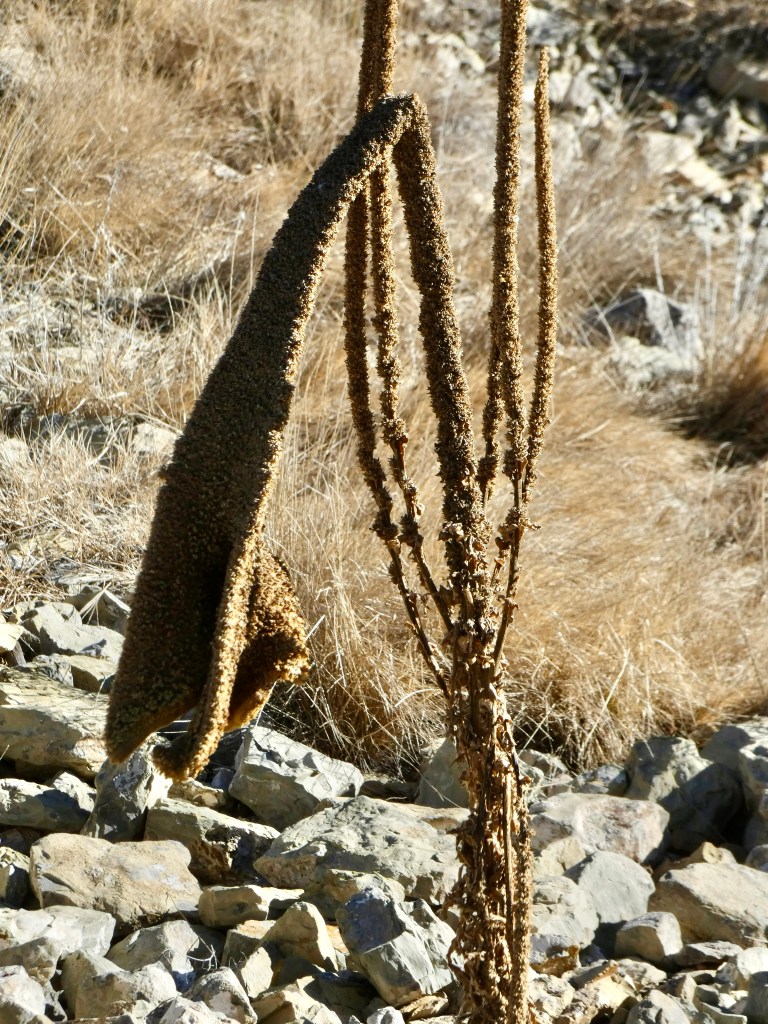
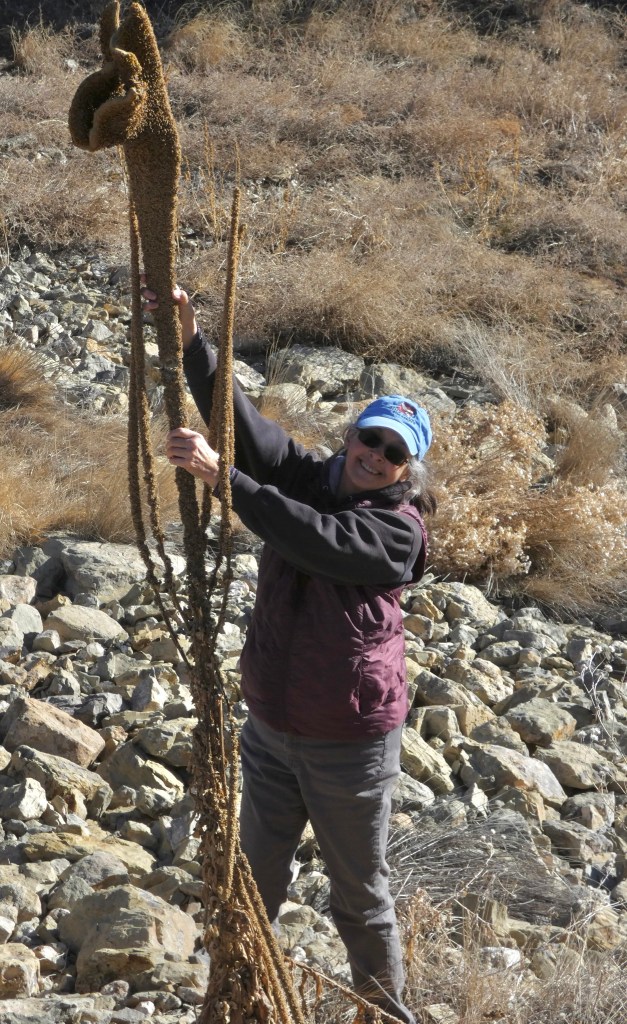
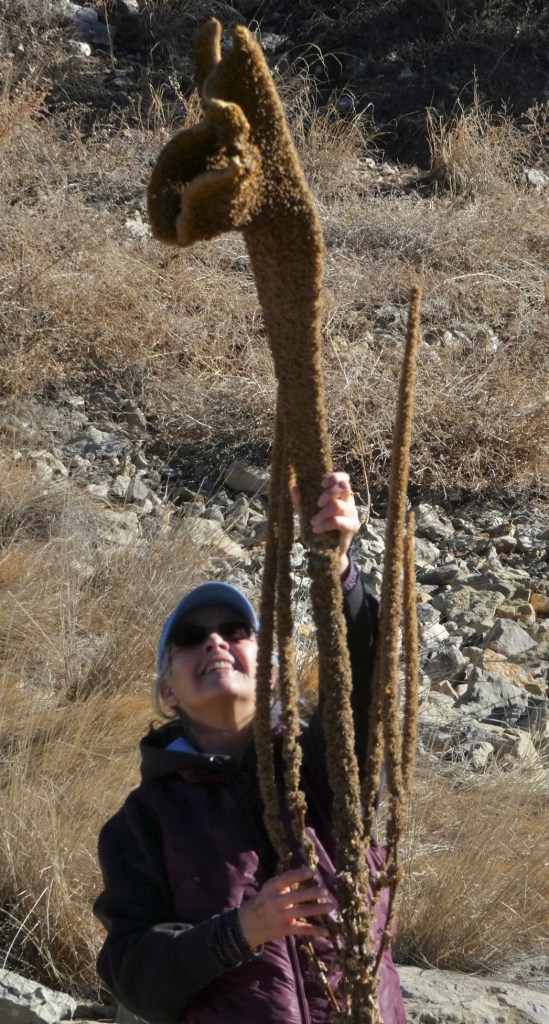
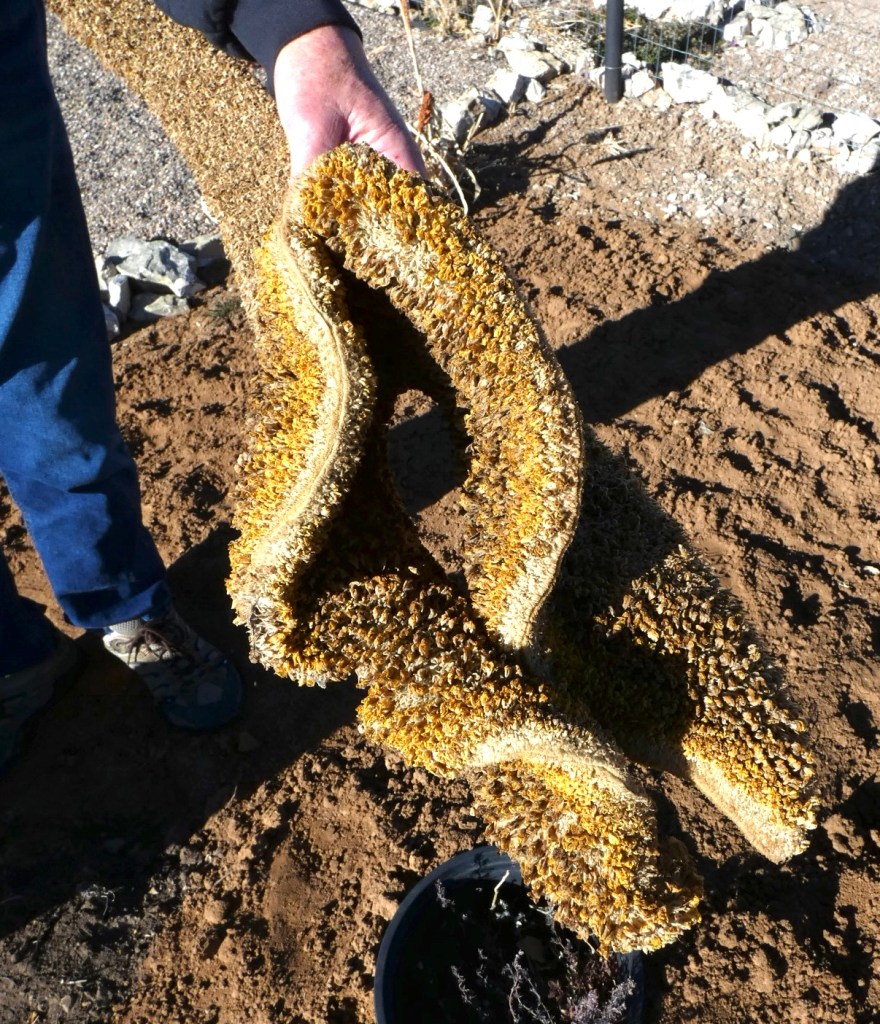
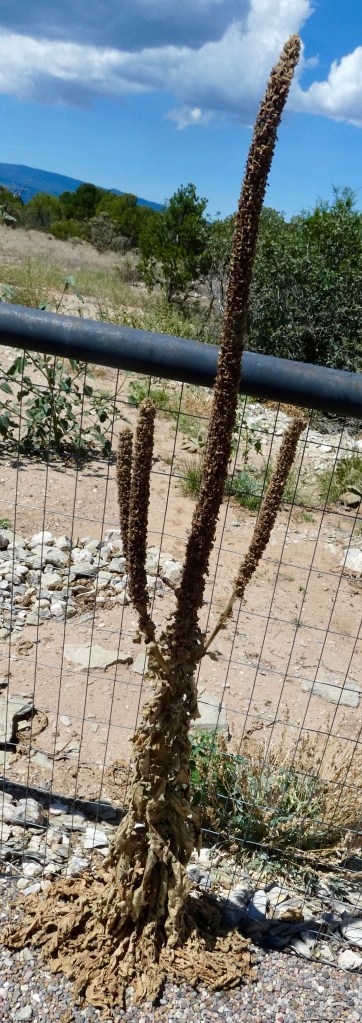
The “Trash Can” trail Great Mullein plant (long dried) with a very large, deformed flower stalk (a fasciation) that had bent from excessive weight.
The top-heavy mass, supporting scattered flowers and many hundreds of growing seed capsules had begun to dip and sway dangerously in the light Fall breeze. While watching and wondering what cause(s) of this rare and exaggerated growth, known as a “fasciation,” the heavy stalk moaned (really!). All I knew on that morning along that trail was that the stalk’s lean would soon take the entire plant to the ground.
Very happy to find this magnificent specimen!
Rushing to the rescue, I grabbed onto the lower third of the stalk, hoping to somehow rotate the top 180°. It was at that moment, when nothing moved, I realized just how heavy that flower stalk was. Then, as my eye blinked only once, the upper 2/3rds of the plant broke and came crashing down …… fasciation and all!
Trying my best to save the flower stalk from snapping off.This was a very tall plant!
Lying on the ground in a heap (mullein pieces, not me), Plan B began to materialize. Here was my chance to learn if Great Mullein “fasciates” genetically. So I collected the still-intact contorted and folded crown with its many ripened seed capsules, and proudly carried it home where it spent the upcoming winter hanging out in a 5-gallon bucket while the seeds dried, became dormant, and experienced a natural dormancy-breaking winter, preparing them for Spring planting. So certain was I that my mother plant had passed her “fasciation genes” on to her seeds, that the flowering plants of her progeny would fasciate too.
All my efforts were in vain ….. eventually the fasciated top of the flower stalk broke and crashed to the ground.
(Here’s an excerpt from my garden journal)
Spring 2025 ….. many minute seeds were scattered about our back yard.
Summer 2025 ….. 8 seeds germinated into petite 1st year rosettes
Winter 2025-2026 ….. 7 rosettes were robust enough to survive the winter
Late Spring 2026 ….. all 7 rosettes bolted, and flower stalks began growing; no sign of fasciation
Mid-Summer 2026 ….. woke one morning to find 3 had died — cause unknown (did they get too much hand watering?); only 4 flowering plants still alive; no sign of fasciation; Ladder-backed woodpeckers feasting on something inside countless seed capsules (some kind of insect?). (You can read about my mulleins’ visits from Ladder-backed Woodpeckers in my June 8, 2026 post here)
Of all the plants in our yard growing tall, with multiple flower stalks, this is the only one remaining alive at the time of this post.
Late-Summer 2026 ….. only 1 flowering plant still alive, still flowering, still plumping up seed capsules that are still feeding hungry woodpeckers (there’s so many capsules, they aren’t opening them all, so there may be seed left over for the next generation?)
Fall 2026 ……………….
Thinking back on the last two years, it seems I have a slight case of Mullein Madness, judging from my apparent obsession with the fasciation (fascinating) characteristics of Great Mullein,Verbascum thapsus! If that’s as weird as contorted flower stalks, so be it. I’ll confess to this tho….. many happy hours were not only spent watching my mullein grow, but in combing the literature and published research in search of answers to my questions while learning so much about such a remarkable plant.
Apologies in advance, but after reading the rest of this post (which is quite verbose), you too might just catch a case of Mullein Madness!
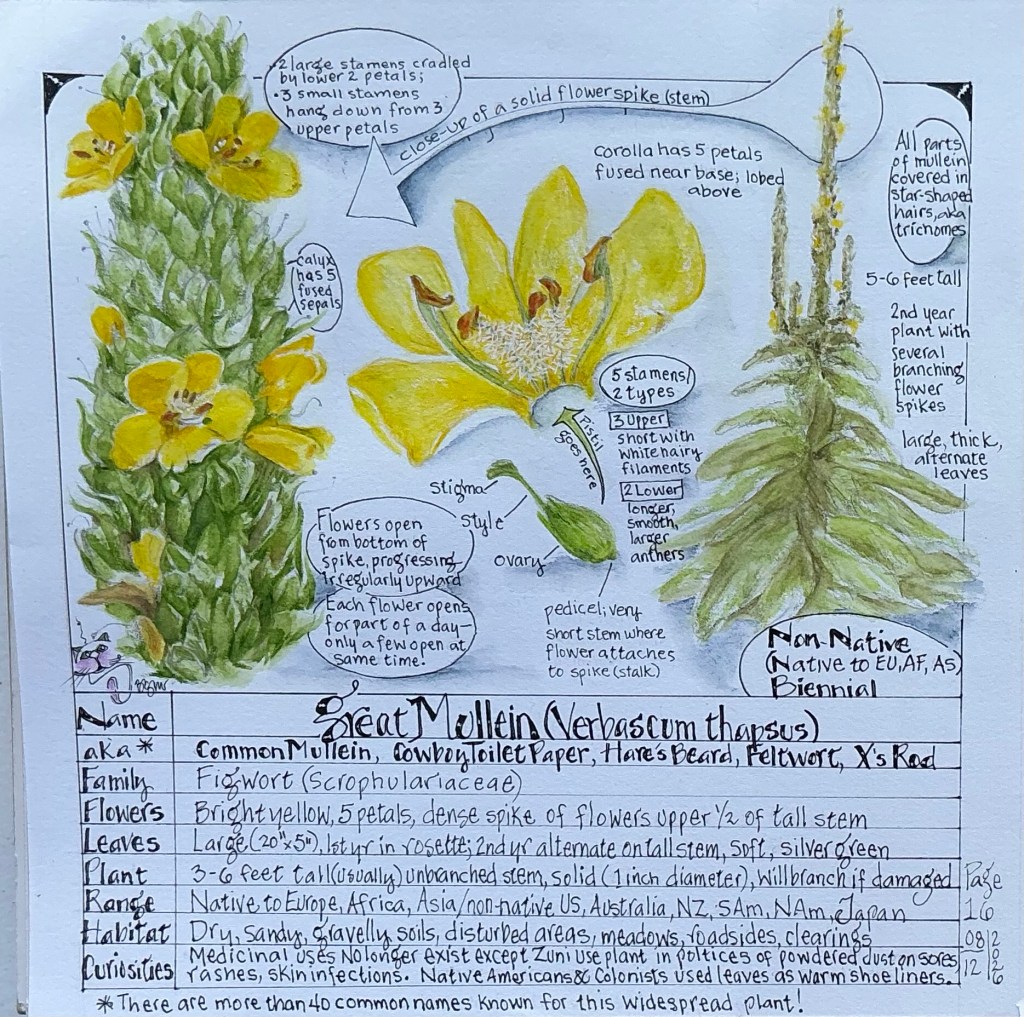
Great Mullein (Verbascum thapsus)
—aka—
greater mullein, common mullein, mullein dock, cowboy toilet paper, hig candlewick, Indian rag weed, bullock’s lungwort, Aaron’s-rod, hare’s-beard, ice-leaf feltwort, velvet dock, and flannel; woolly, velvet and blanket mullein; beggar’s, Moses’, poor man’s, Our Lady’s and old man’s blanket
Home, Sweet Home
Native to Europe, North Africa and Asia, Great Mullein is an introduced (a non-native) species in the Americas, Hawaii, Australia, New Zealand, and parts of Japan.
In the U.S., Great Mullein was imported very early in the 18th century and cultivated for its medicinal and Piscicide2 properties. By 1818, it had begun spreading so much that everyone thought it was native. By 1839, the species had spread as far west as Michigan; by 1876, it was growing in California. Today, Great Mullein is common in all 50 states. In Canada, it’s common in the Maritime Provinces, southern Quebec, Ontario and British Columbia, with scattered populations in between.
Happiness Was Watching My Mullein Grow
Life cycle: Great Mullein, a biennial (requiring two growing seasons to complete its entire life cycle), needs a winter dormancy period to flower. During its first year, a seed germinating in the spring or early summer develops a showy rosette of large leaves that grows from a taproot. After overwintering, the second year’s growth begins when a solid 1-inch diameter woody stem emerges from the rosette. This single pole-like stem, that can extend 6 feet tall or more, is covered in alternately-arranged leaves along the lower third of its length, becoming completely surrounded with a dense grouping of small flower buds that randomly bloom throughout the summer. Typically, only one stem forms, but if damaged during growth, branching may occur. After flowering and seed release the flower stalk(s) dries up and remains covered in dried brown seed capsules. Dried stalks and any seeds not scattered during fall may persist into the following spring or summer.
Habitat: Great Mullein grows in a wide variety of habitats, but thrives on well-lit disturbed soils, open meadows, and arid or overgrazed rangelands. Viable seeds, that can persist in the soil for hundreds of years, rapidly germinate in the spring soon after the ground warms up. While the mullein can also grow alongside existing plants, growth of the rosettes on bare soil is four to seven times more rapid than under vegetated conditions.
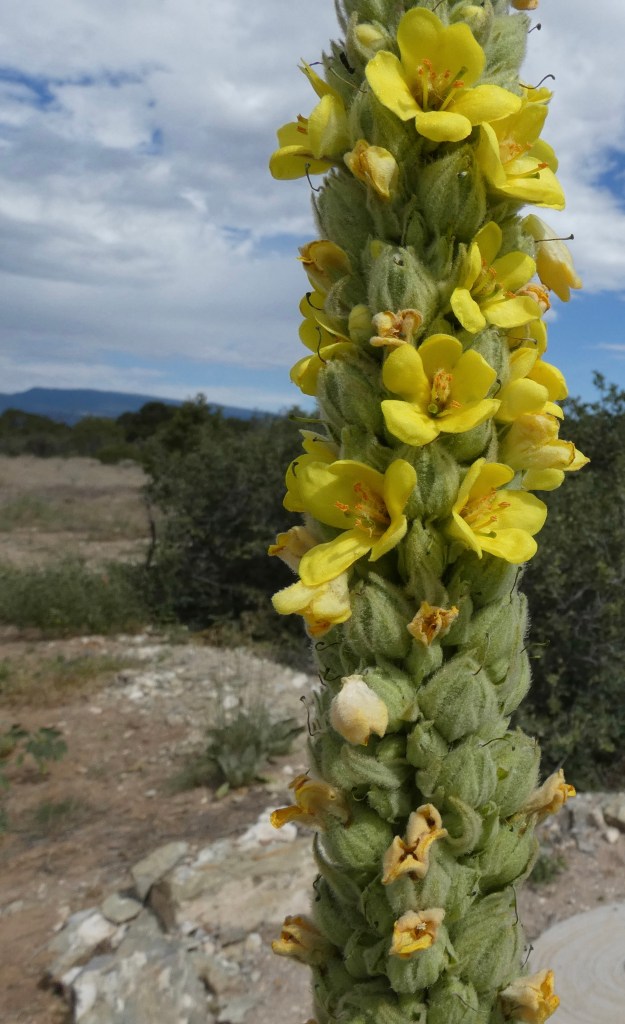
Flowers: Beneath the flower’s corolla (petals) is the deeply lobed, green calyx consisting of 5 hairy, triangular-shaped sepals. The bright golden-yellow saucer-shaped corolla (0.6–1.2 in) is formed from 5 slightly unequal petal lobes that are fused at the base. Attached on top of the petals are 5 stamens of two types: three shorter upper stamens covered in yellow/whitish hairs, and two longer lower stamens that are smooth. The pistil at the center of the flower consists of a superiorovary, a single slender green style, and a two-lobed stigma. Flowering lasts up to three months from early to late summer. Flowers begin blooming from the bottom of the tall stalk (spike) and progress irregularly upward. Each flower opens for part of a day and only a few open at the same time around the stalk. They typically open before dawn and close in the afternoon.
Great Mullein flowers. The lower flowers had closed the day before.
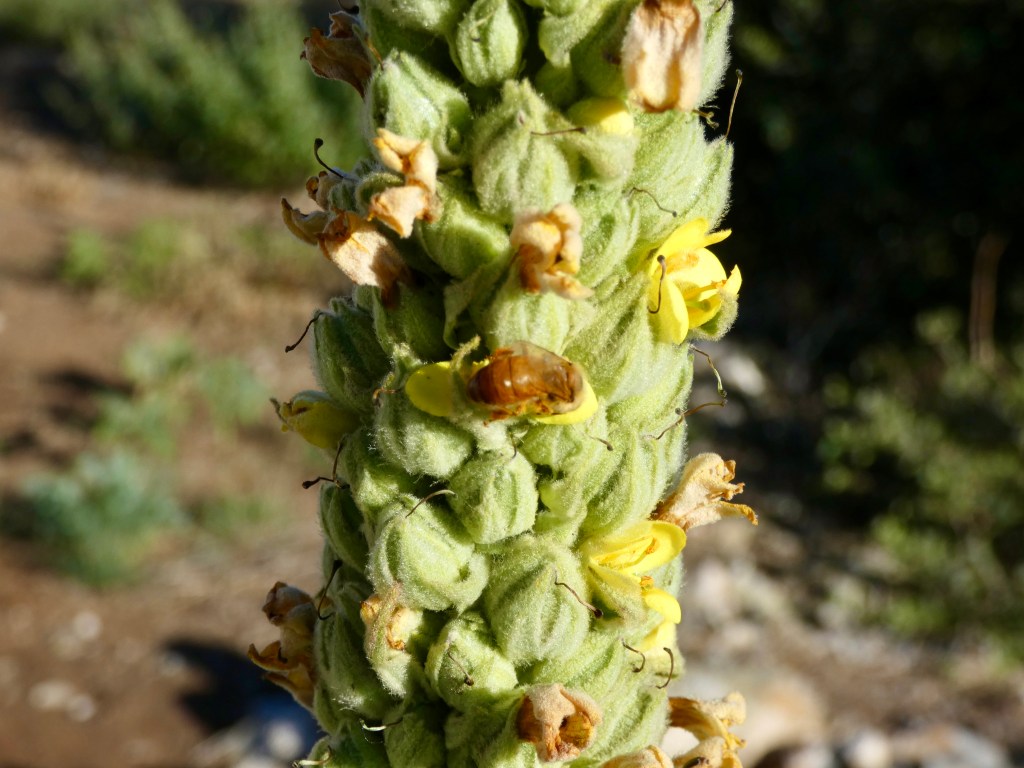
Pollination and Pollinators: Flowers are able to self-pollinate if they haven’t been pollinated by insects during the day. Even though many insects visit the flowers, only certain bees actually get the job done (such as halictid bees (usually dark black or brown, often metallic appearing sweat bees). Birds foraging for insects, such as the white-headed and ladder-backed woodpeckers, are known to feed from the seed capsules covering the flower stalk.
Seeds: Each tiny (<0.04 in) brown Great Mullein seed is marked with longitudinal ridges. Each flower produces a small, ovoid (0.24 in) capsule full of seeds that splits open with two valves when mature. Each plant produces hundreds of capsules that contain up to 700 seeds apiece, totaling anywhere between 180,000 or 240,000 seeds/plant. Seeds germinate in spring and summer on bare soil (or very close to the soil surface) when exposed to light, at temperatures between 10 and 40°C (50 and 104°F).
The seeds are generally too small for birds to feed on, although the American goldfinch has been reported to eat them.
(See the following section for more on seeds.)
Did You Know ………
They Call it Fasciation! If you’re familiar with Great Mullein, you may have noticed some flower stalks don’t always grow straight and tall. For some reason, some tops form weird shapes that may be flat or compressed, folded or ribbon-like, bulbous or crested. These plants have grown what’s called a fasciated flower stalk, the result of a rare developmental mutation. Scientists studying these unusual growths are trying to learn what triggers fasciation, but it remains a mystery. They have, however, identified several potential vectors that may disrupt normal growth:
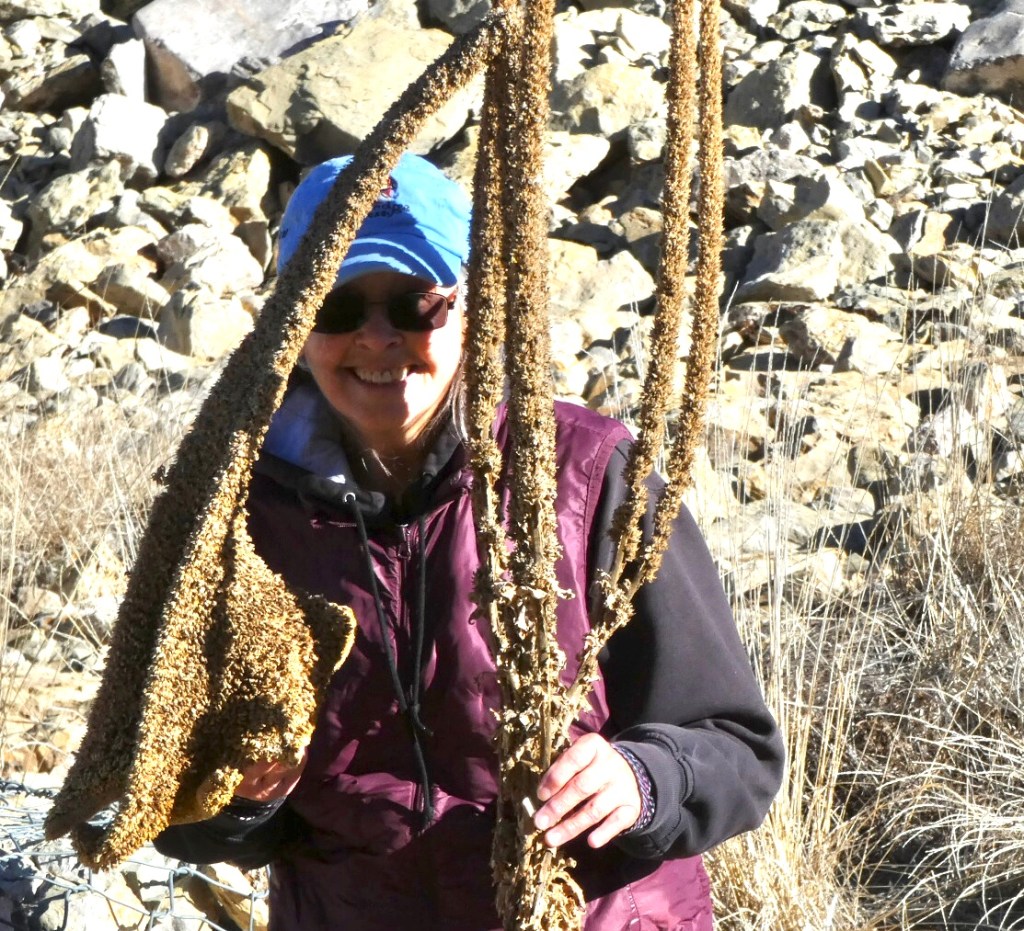
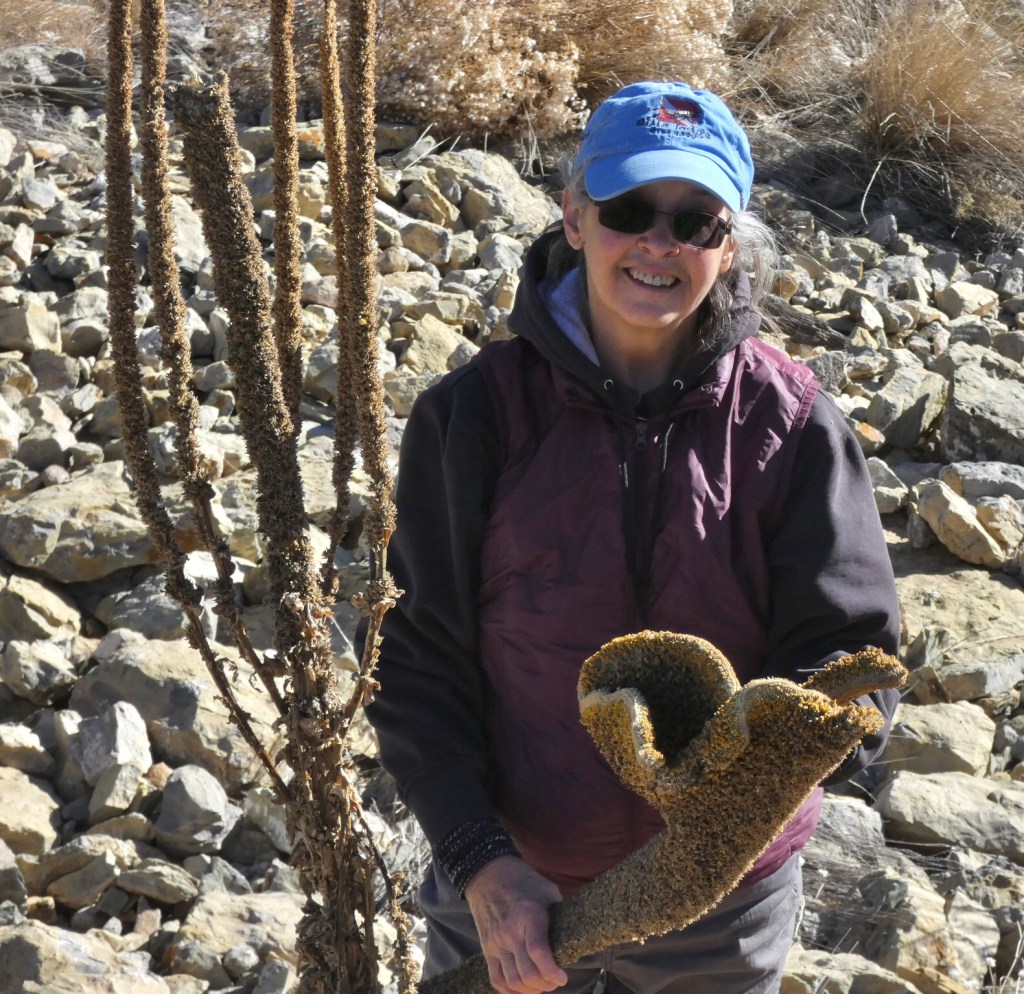
Roy holding the fasciated end of the “Trash Can” trail Great Mullein.
Pests and pathogens: Insect feeding, mite activity, or bacterial infections (like Rhodococcus fascians) can damage or trick the growth tip into abnormal widening, though some field tests found their presence on fasciated mullein as well as on normal plants.
Environmental stress: Severe weather shifts, frost, or chemical/herbicide exposure during early stalk development may shock the growing tip into expressing fasciation.
Physical injury: Mechanical damage to the growing tip is known to disrupt normal elongation, though specific studies carried out on some Great Mullein plants noted that physical damage actually reduced or did not trigger fascination.
And Now! Everything You Wanted to Know About Great Mullein Seeds
Did you know ….. some seeds that germinate in autumn may jeopardize the life of the plant? Rosettes getting a late start must grow to at least 6 inches in diameter or they are likely to die in winter. Regardless, all first year plants that do survive overwintering and go on to complete their life cycle, die at the end of their second year, with some exceptions. Under the best growing conditions, some individuals flower in the first year, only to die the same year. And some individuals, especially in the northern parts of the range, require a longer growing period and don’t flower until their third year. Curiously tho, three-year plants often produce fewer seeds than biennial and annual ones. While year of flowering and size are linked to the environment, most other characteristics appear to be genetic (fasciation is an example).
Did you know ….. decades-old seeds can readily sprout from bare ground, or after forest and range fires, long after Great Mullein plants have died. This ability to quickly grow or even colonize disturbed areas may provide some soil stability, but it does interfer with the natural succession of native species.
Did you know ….. seeds don’t disperse far from a Great Mullein flower stalk? This means plants rarely establish in new areas without human intervention. Seeds scatter naturally when winds or animals move the stem causing 75% of the seeds fall within 3 feet of the parent plant; 93% fall within 15 feet.
Did you know ….. seeds are in the fossil record? Oh My! Discoveries of Great Mullein seeds have been reported from several important geological areas on the British Isles, including:
Cromer Forest Bed geological formation (Early to the early Middle Pleistocene [2 to 0.5 million years ago]) located in coastal areas of the Norfolk region of England;
West Wittering in Sussex in fossil-bearing clay formed during the Eocene epoch around 46 million years ago; and the
Ipswichian interglacial layers falling within the Middle Paleolithic period 130,000 to 115,000 years ago.
Great Mullein Plays Host to Many Visitors
The Good, the Bad, and the Questionable Pests and Beneficial Insects, and Diseases
Represented by 29 different families!
Pests: The majority are western flower thrips (Frankliniella occidentalis), Lygus species such as the tarnished plant bug (L. lineolaris) and various genera from the spider mite family (Tetrantchidae). Other common insects that feed exclusively on Verbascum spp. in general or V. thapsus (Great Mullein) in particular are: mullein thrips (Haplothrips verbasci), mullein moths (Cucullia verbasci), and common stalk borer moths (Papaipema nebris).
Beneficial Insects include predators, pollinators and specialized herbivores, such as:
Honey bees were busy collecting pollen and nectar from my Great Mullein flowers. The flower stalks were a-buzz every morning and into early afternoon when the flowers were open.
Mullein plant bug (Campylomma verbasci) is hosted primarily in summer and permitted to feed lightly on the plant while actively preying on orchard aphids, mites, and thrips.
Leaf bug (Dicyphus hesperus) is hosted year-round as its primary habitat and food source in return for helping to manage greenhouse and agricultural pests like whiteflies and spider mites.
Minute pirate bug (Orius tristicolor) hosted solely as a platform to hunt thrips and other small pests on the foliage.
Predatory mites (Galendromus, Typhlodromus and Amblyseius spp.) hosted year-round on plant surfaces to hunt harmful plant-feeding mites.
Wool carder bees (Anthidiumspecies) hosted as a casual visitor for purposes of gathering the dense, soft/woolly hairs from the plant’s leaves to line their nesting chambers.
Bumblebees, honeybees, hoverflies, butterflies hosted as frequent drop-in visitors throughout the growing season to gather abundant nectar and pollen from the flowers in return for pollination services. Special accommodations are always arranged for the following members of this visitor group known to successfully pollinate the flowers — generalist short- and long-tongued bees, including certain bumblebee species (Bombus spp.), honeybees (Apis mellifera), and assorted solitary bees (small native, wild bees).
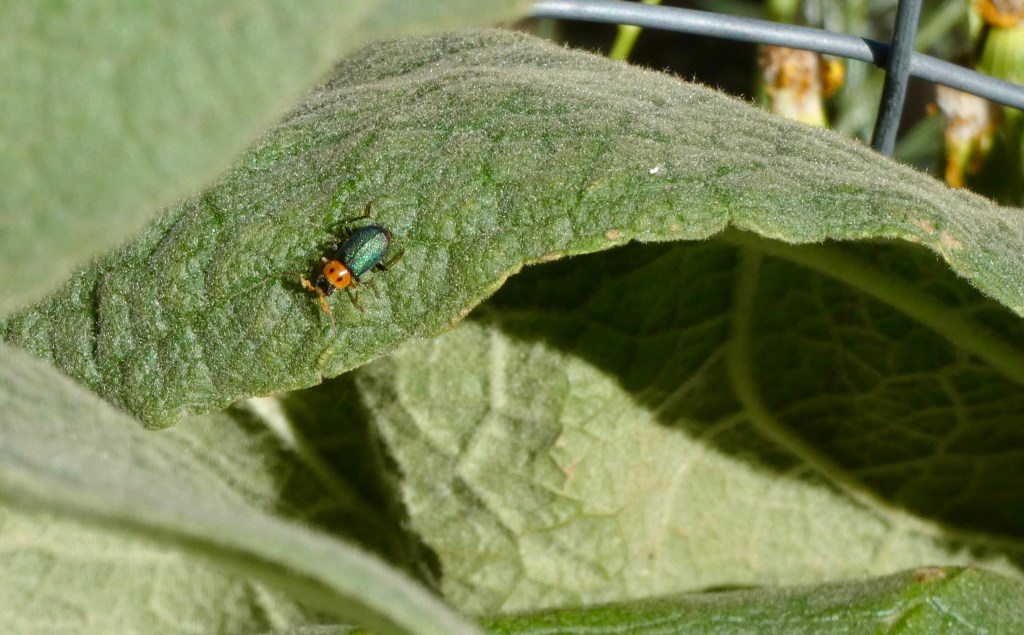
This colorful beetle is two-spotted melyrid (dollops bipunctatus), a predatory insect on mites, aphids and other harmful insects. They were common on the huge leaves on my Great Mullein plants.
Diseases reluctantly hosted by Great Mullein include cucumber mosaic virus — the cucurbit powdery mildew (Erysiphe cichoracearum), and root rot (Phymatotricum omnivorum), along with Cercospora verbasciola; Phoma thapsi; Phyllosticta verbaciola; Heterodera maroni; Meloidogyne sp.; Mycosphaerella verbasciola; Ramularia veriabilis; Septoria verbasciola; and Oidium pyrinum. These microorganisms not only impact the health of the host, but may impact other desirable plants in the area.
A Confusingly Questionable Insect —
The Voracious Mullein Seed-Eating Weevil
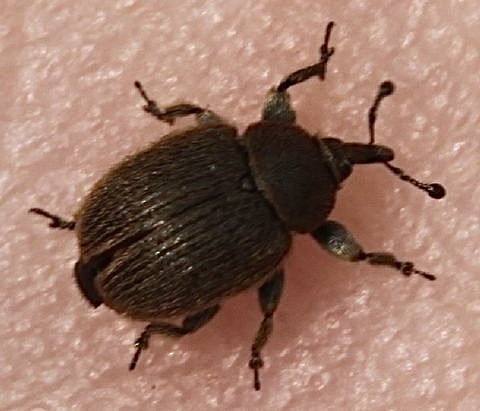
A mullein seed-eating weevil adult. They were found everywhere on all the mullein plants in the yard. Very small weevils made the plant looked like it had been covered in very fine pepper!
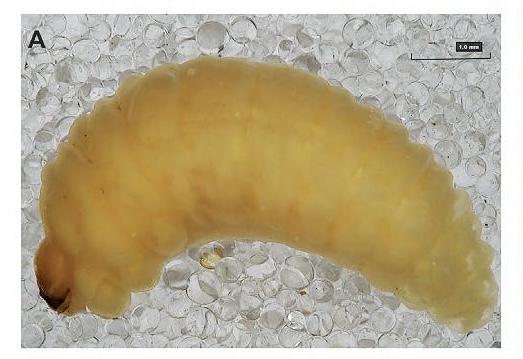
Great Mullein was clearly tricked into hosting the mullein seed-eating weevil (Rhinusa tetra syn. Gymnaetron tetrum) by this demure, sometimes brown to nearly glossy-black beetle that promised to nibble only on leaves and a few seed capsules for the entire 45 days of its adult life. Little did mullein know that this weevil was hiding a secret. When it came to the end of her days (coinciding with flower blossoming) there was only one thing left to do … deposit all 150-200 of her fertilized eggs, two-by-two, into as many flowers as possible, she does this for over an 11-day period, and then she dies. But about 1 week following egg laying, the eggs hatch into larvae (grubs) and commence consuming most of the ~700 seeds in the growing seed capsule. When they’ve about exhausted their food supply, the larvae pupate and finally emerge as adults ~25 days later. The adults remain on the host mullein, munching uninhabited seed capsules and leaves, for 45 days until the next batch of females lays their next batch of eggs, and on it goes, until ….. when the growing season winds down and winter begins to blow in, adult weevils that haven’t completed their life cycle will tuck into a dried seed capsule and hibernate. And larvae that have entered the pupa stage of their lives will remain as such, overwintering until late spring when warmer weather triggers completion of their metamorphosis and the adults can safely emerge, ready to begin feeding on 2nd year flowering mullein.
Weevil Interlude
The mullein seed-eating weevil was accidentally introduced from Europe in 1876, to control the spread of Great Mullein. But back then and for many years following, the weevil was never intentionally used for that purpose. It happened “naturally” as the weevil spread throughout North America, making its living on Verbascum spp. it found on its journey. In more modern times, and because the weevil was never formally cleared as a released biological control agent, local land management and weed programs (such as in parts of the Pacific Northwest and Wyoming) informally recognize it as an already-established bio-agent since its larvae feed extensively on the seeds of Great Mullein. In some regions where the plant is a designated noxious weed, the weevil is viewed as a helpful naturalized helper; in other states—like Colorado—it remains unapproved for intentional release due to a lack of formal ecological impact studies.
The larvae of the mullein seed-eating weevil. By researching the Great Mullein, I learned it was these grubs the Ladder-backed woodpeckers were picking from seed capsules.
Bumper-to-Bumper Weevil Interlude
It seems that using a non-native insect to control a non-native plant is effective in significantly reducing the number of Great Mullein’s viable seeds to limit the plant’s spread. It is also a risky strategy, as many biological slip-ups have occurred in the past when a population of an introduced insect, having depleted its targeted food supply, develops an appetite for other, desirable-to-native-species plants. So far in the U.S., the mullein seed-eating weevil has only feasted on seeds of two Verbascum species—the Great Mullein (its clear favorite) and the equally-alien Moth Mullein (V. blatteria). Because the population of egg-laying adult female weevils doesn’t have enough eggs to lay in all of the hundreds and hundreds of mullein flowers, it’s probably unlikely they will run short of food in the near or far future.
To Weed, or Not To Weed
And What to Do With Unruly Great Mullein
In all areas where Great Mullein has been introduced, it’s recognized as a weedy species. Considered Invasive3 across much of the U.S., Great Mullein is a state-listed Noxious4weed in Colorado and Hawaii, and in several counties in Wyoming, Nebraska and Montana. In these states it aggressively crowds out native plants in dry or open ecosystems.
In other areas of the U.S., opinions on the ecological impacts of Great Mullein vary. Some land managers primarily view it as a short-lived pioneer species on heavily disturbed ground that eventually fades as native vegetation recovers; others classify it as a persistent invasive weed based on its seed longevity. Where agricultural crops are grown, impacts are generally considered minor — the ability of Great Mullein to outcompete most crops is limited because it’s shade intolerant and doesn’t survive tilling. Where it may become invasive, individuals are easy to remove by hand, even though populations are difficult to eliminate permanently.
Control Measures that Work: Mechanical methods that control the growth and/or spread of Great Mullein are the most effective. The best means is by hand pulling and hoeing, preferably followed by sowing of native plants. Regular cultivation is known to be adequate for the control of mullein. Tractor-mounted mowers or scythes can be used to trim the plants when they begin to flower. Repeated mowing prevents the flower stalk from bolting, but if mowing is discontinued then the plant will bolt and produce flowers anyhow.
Luna standing next to the rescued fasciated flower stalk, keep watch for thieves!
Not Worth the Time or Effort: All parts of the plant are covered in dense, star-shaped hairs (trichomes). Cattle and sheep avoid grazing the plant because biting into these hairs is irritating. Goats may find the plant edible, but studies are inconclusive. Use of contact herbicides is impractical since the hairs cause the liquid to roll off. Ground herbicides when taken up by the roots will damage or kill the plant, won’t kill seeds stored in the soil from previous years, and also denude the ground creating ideal conditions for growing more mullein. It would take decades of annual applications to slow, let alone prevent, new plants from growing. The use of seed-eating chickens has been proposed for mullein control, but has not been studied.
Multi-Use Mullein
Although commonly used in traditional medicine, today there are no FDA-approved drugs made from Great Mullein. Non-medicinal uses, past and present, are curiously varied.
Traditional Medicine
Dioscorides, an Ancient Greek pharmacologist and botanist, first recommended Great Mullein 2000 years ago as a folk medicine for pulmonary diseases. Leaves were smoked to attempt to treat lung ailments, a condition that in America was rapidly transmitted to Native American peoples.
The Zuni used the plant in poultices of powdered root applied to sores, rashes and skin infections. An infusion of the root was also used to treat athlete’s foot. Any preparations meant to be drunk had to be finely filtered to eliminate the irritating hairs.
Oil from the flowers was used against catarrhs (inflamed mucous membrane(s) in an airway or body cavity) colics, earaches, frostbite, eczema, and other external conditions. Topical application of various V. thapsus-based preparations was recommended to treat warts, boils, carbuncles, hemorrhoids, and chilblains. The plant has been used in an attempt to treat colds, croup, sunburn, and other skin irritations.
Great Mullein (V. thapsus) was in the United States’ 4th edition of the National Formulary from 1916 – 1936, stipulating that fluid extracts of dried leaves and flowers of the plant was approved as a pharmaceutical drug.
Otherwise Practical and Curious Uses
Roman soldiers are said to have dipped the flower stalks in grease for use as torches.
Romans extracted a yellow dye from the flowers to color women’s hair.
In some cultures, leaves have been used as wicks.
Native Americans and colonists lined their shoes with the plant’s leaves to keep out the cold.
As with many plants, Great Mullein was linked to witches, although the relationship remained undefined. At the same time, the plant was also widely believed to ward off curses and evil spirits.
As mentioned earlier, the seeds, which contain saponins, glycosides, coumarin and rotenone, are toxic to fish and have been widely used as piscicide since the plant’s introduction to the U.S. in the 1700s. Settlers threw the seeds and even the leaves into slow-moving water, allowing the chemicals to spread and stun the fish, causing them to float to the top making them easy to catch.
In modern times, Great Mullein is treated as an ornamental plant.
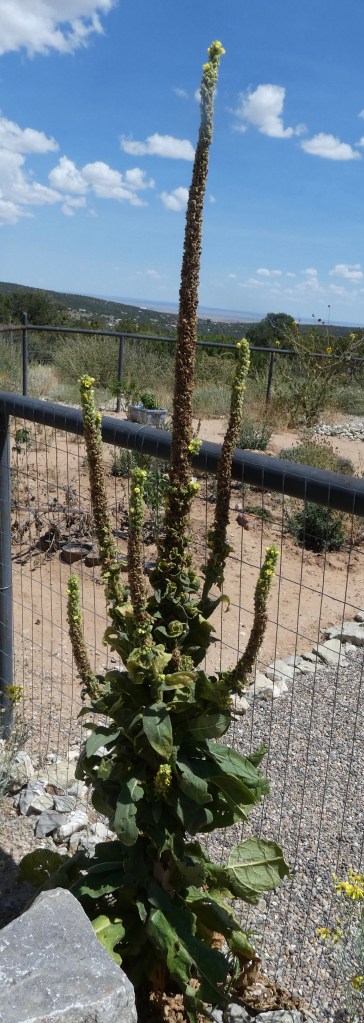
A first-year rosette turning into a 2nd year flowering plant.
Etymology
From the Greek word etymon, meaning
“literal meaning of a word according to its origin”
Scientific Name:Verbascum thapsus
Genus Verbascum: Originally described by Carl Linnaeus in 1753, Verbascum was derived from the classical Latin verbascum, used for the plant by Pliny the Elder (CE 23-79), Roman author, naturalist, scientist, etc. However, the word “verbascum” was widely believed to be and accepted as a corruption of “barbascum,” from “barba” meaning “beard.” The genus name Verbascum, back then (as it does today), refers to the dense, hairy coating on the leaves and the bearded appearance of the plant’s stamens.
Species (specific epithet) thapsus: First used by Theophrastus (BC 371-287), Ancient Greek philosopher and naturalist, for an unspecified herb from the Ancient Greek settlement of Thapsos, near modern city of Syracuse, Sicily ….. OR ….. it may have come from the ancient Tunisian city of Thapsus.
A first-year rosette turning into a 2nd year flowering plant. Would these huge leaves make excellent shoe liners!?
Common Name: Great Mullein
“Great” was used in the plant’s common name to distinguish it from other more diminutive plants of the same genus Verbascum. “Great” refers to the plant’s tall stature.
“Mullein” evolved from Middle English “moleyne,” by way of the Anglo-French word “moleine,” which came from the Latin root “mollis,” meaning “soft.”
…………………………………………………………………………………………………
Wake up Now! Unless you’ve caught a case of Mullein Madness Fever!
Regardless, hope you found this interesting!
(I promise to write a shorter post next time)
As always, thanks for stopping by!
The End!
1Naturalized – a non-native plant species brought from other regions that now reproduces and spreads on its own without human help, but doesn’t aggressively overrun native habitats.
2Piscicide – a chemical substance that’s poisonous to fish. Piscicides are primarily used to eliminate a dominant species of fish in a body of water, done as the first step in attempting to populate the water body with a different fish species. They are also used to combat parasitic and invasive species of fish.
3Invasive – a non-native species introduced to a new-to-it ecosystem where it spreads rapidly, outcompetes native species, and causes economic or environmental harm. Because it lacks natural predators or diseases in its new home, it easily takes over natural habitats, yards, farms, etc.
4Noxious – any plant legally designated by a government agency as harmful to agriculture, public health, wildlife, or property. These plants grow aggressively, spread fast, and lack natural controls. While many are non-native invasive species, some native plants can also be classified as noxious if they cause severe damage.
More than likely you’ve seen the sparrow-sized House Finch if you live almost anywhere in the U.S., southern Canada, or Mexico. The males are particularly showy with their bright red heads, throats and breasts, and their bouncy flight is sure to catch your attention. Just filling a backyard bird feeder with black oil sunflower seeds can bring a flock of 50 House Finches in to feast. They tend to dominate their favorite feeders, often chasing off competitors, after which you’ll have plenty of time to observe these finches as they sit still while shelling seeds by rapidly biting and crushing them with their large beaks.
If you aren’t familiar with House Finches, you’ve probably heard their long, twittering song, which they belt out in most neighborhoods from coast to coast. Their song, so full of excitement and energy, is usually sung from the top branch of a tall juniper or pinyon pine tree. House Finches seem to be pleading urgently for attention by clearly singing, “Talk to me PLEASE, isn’t anybody THERE!!” (At least that’s what I hear over and over again first thing every morning throughout the Spring and Summer!)
Not knowing how many broods have been reared this year, to date, it seems like we’ve enjoyed a large number of family groups around the house. Fledglings are fun to watch in flight as they constantly chase adults to beg for food. These futile attempts for free handouts strengthens their wing muscles and hones their acrobatic skills. Usually defeated, these novice students soon land in a tree and begin a long, hard practice session to learn their parents’ complex song.
Completely exhausted, they will return to a certain cholla and the nest where the adult female fed and defended them as nestlings during the first 12-20 days of their lives. Finding even one of their well-hidden nests in any of those 4 to 7 foot tall cactus “trees” is quite the prickly endeavor! Even knowing how to recognize a House Finch nest hasn’t prevented me from experiencing plentiful and painful spiny jabs. What an excellent defensive location our local birds choose for nesting.
The Nest and Nesting Habits
In as little as two days, the female builds a cup-shaped nest made of fine stems, leaves, rootlets, thin twigs, string, wool, and feathers, with similar, but finer materials for the lining. This sturdy nest, durable enough to raise up to six broods a season, measures 3-7 inches wide; the inside cup is 1-3 inches across and up to 2 inches deep.
House Finches usually build their nests in cavities in deciduous and coniferous trees, on cactus and rocky ledges, and in or on buildings using sites like vents, ledges, street lamps, ivy, and hanging planters. They will also claim nests abandoned by other birds.
A western House Finch is likely to build its nest within 60 feet of where it was the previous breeding season; eastern birds choose sites more than half a mile away from prior nests. Despite these differing habits, all nest sites have a few things in common: a sturdy base and a roof-like overhang to shelter against sun and rain.
House Finch Facts
With over 40 million House Finches across North America, they are currently one of the most widespread and common bird species across the United States, second only to the American goldfinch.
Native to the Southwest U.S. and Mexico, in 1939 a few House Finches captured in Santa Barbara, California, were sold to a New York City pet store owner as “Hollywood Birds.” Even back then, the sale of these birds was recognized as illegal under the Migratory Bird Treaty Act of 1918. To avoid prosecution under the Act, the pet store owner released the finches …. they were set free on New York’s Long Island. By the early 1940s wild nests were discovered on Long Island, and from there the spread continued.
Sometime before 1870, House Finches were introduced to Oahu from San Francisco. By 1901, they had become abundant on all the major Hawaiian Islands.
Where House Finches are an introduced species, they are considered naturalized1. They’re also considered an invasive species in some places, largely in unforested lands across the eastern U.S. where they’ve displaced the native purple finch (and even the non-native house sparrow!).
In their native range in the Southwest U.S. and Mexico, House Finches live in desert, grassland, shrubland, and open woodland environments, as well as near human dwellings and cities. The biggest House Finch flocks in the East are found in cities, and it’s much more common to find the eastern birds in habitats developed by people than anywhere else.
Depending on where they live, House Finches can appear very different. Within the 11 officially recognized subspecies, body size, beak size and shape, wing length, tail length, and coloring can all vary regionally. For example, the northeastern migratory populations have longer and more pointed wings better suited for longer flights than the western finches which tend to be permanent, year-round residents. Also, House Finches on Guadalupe Island off the coast of Baja California, Mexico, have heftier beaks than mainland birds.
The bright red (and sometimes orange or yellow) plumage on the head, throat and chest of mature House Finch males comes from compounds in their food (bird species are unable to produce red or yellow other than by diet). These pigments, called carotenoids (the same ones found in carrots and tomatoes), come from the berries and other fruits they eat. Females prefer mates with the biggest and brightest red-colored patches — a sign of a well-fed male.
House Finches are among the strictest avian vegetarians: seeds, buds, fruit, and foliage comprise 97% of their year-round diet. Most seed-eating birds not only eat insects in the spring and summer when they are abundant, but will feed bugs to their nestlings to add protein for growth. Except for the occasional fly larva, House Finches stick to a vegetarian diet.
Dealing with a pandemic for decades, these birds suffer from “House Finch Eye Disease,” a form of conjunctivitis that was first detected in Washington D.C. in the winter of 1994. Since then, the bacterial illness has expanded continent-wide causing big declines in House Finch numbers. Infected birds often have swollen or reddened eyes and may appear inactive or confused. Over time, it leads to birds becoming blind, disoriented, and vulnerable to predators. Other finch species, such as the American Goldfinch, are also affected. Because the disease is spread through social contact, it’s very important to keep bird feeders and baths clean.
The mite, Pellonyssus reedi, is often found on House Finch nestlings, particularly later in the season. However, the adult female has a clever strategy in response to these often fatal attacks. Since male chicks are more vulnerable to a mite outbreak, she will lay eggs containing females first to reduce the length of time male chicks are exposed to mites. This strategy increases the likelihood that representative numbers of both sexes will survive.
…………………………………………………………………………………………………
Share stories of your local House Finches!
Hope you found this interesting!
As always, thanks for stopping by!
1 A species is considered “naturalized” if it didn’t originally evolve in an area but has successfully adapted, established a permanent population, and is reproducing independently in the wild. These species are non-native, surviving without human help. Note: not all naturalized species are considered invasive.
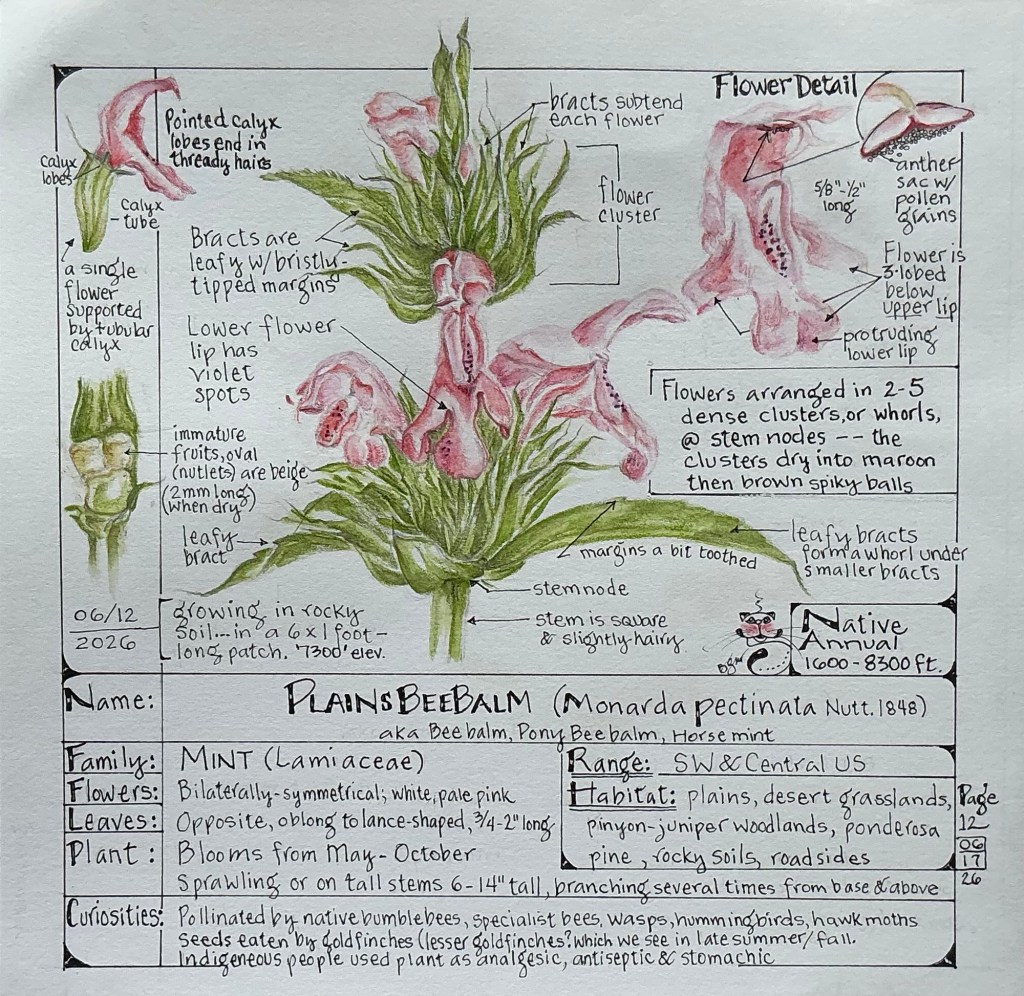
Linnaeus named the genus Monarda to honor 16th century Spanish physician and botanist, NicolásBautista Monardes (1493-1588). Monardes never went to the Americas but was able to study medicinal plants in Spain, publishing the first systematic, in-depth book on medicinal plants and remedies brought to Europe from the Americas.
The species pectinata is derived from the Latin word pecten, meaning “comb.” The suffix -ata denotes possession or resemblance — so it translates loosely to “comb-like” or “having the form of a comb,” referring to the bristle-tipped bracts that sit below flower whorls.
Monarda pectinata is commonly called Plains Beebalm (or Pony Beebalm) because of its historically recorded uses by Indigenous peoples as an analgesic and antiseptic qualities.
Ethnobotanical and Culinary Uses
Indigenous peoples used a plant infusion to treat coughs, colds, fevers, and stomach complaints related to digestion. A flower infusion was used as a wash on insect bites and stings. The plant was rubbed on the head to bring relief from headache. In addition, historic records document that groups, such as the Kiowa, used Monarda pectinata leaves as a perfume due to its strong scent, and were chewed while traveling.
The strongly aromatic smell of crushed Plains Beebalm leaves smell both savory and citrusy, similar to oregano or lemon. Sometimes called “wild oregano,” they can be eaten fresh, dried or cooked to season in salads or other foods. In spring the leaves may be boiled to make herbal tea.
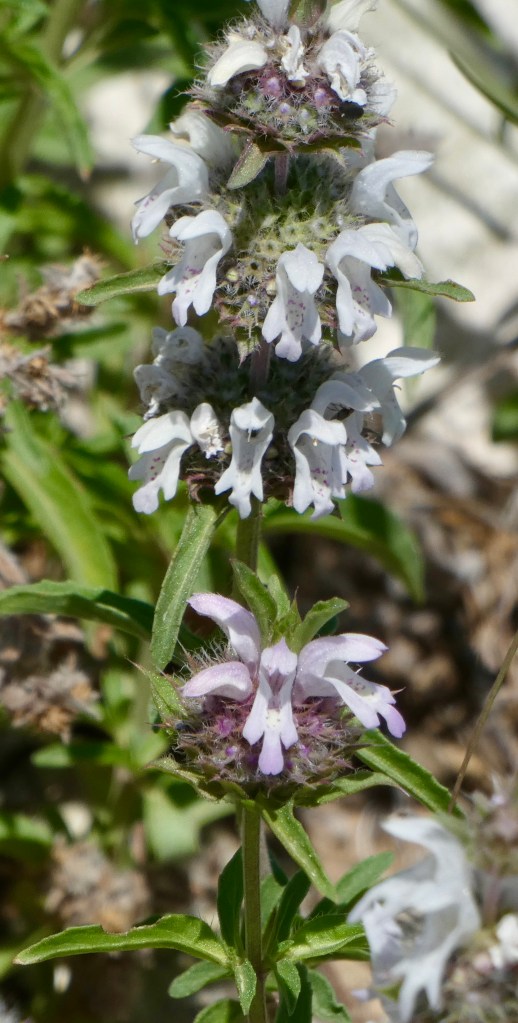
Plains Beebalm blooming in our yard, in bright sunshine and rocky soils.
Pollinators
According to the Xerces Society for Invertebrate Conservation, all Monarda species attract a number of native pollinators such as specialist bees, bumble bees, predatory wasps, hummingbirds, and hawk moths.
A Few Fun Facts
Desert Survivor: Although many Monarda species are moisture-loving, such as Wild Bergamot (Monarda fistulosa) found the along cool trails of Sandia Mountain, Plains Beebalm prefers hot, harsh, dry environments like desert washes, rocky slopes, and sandy pinyon-juniper woodlands.
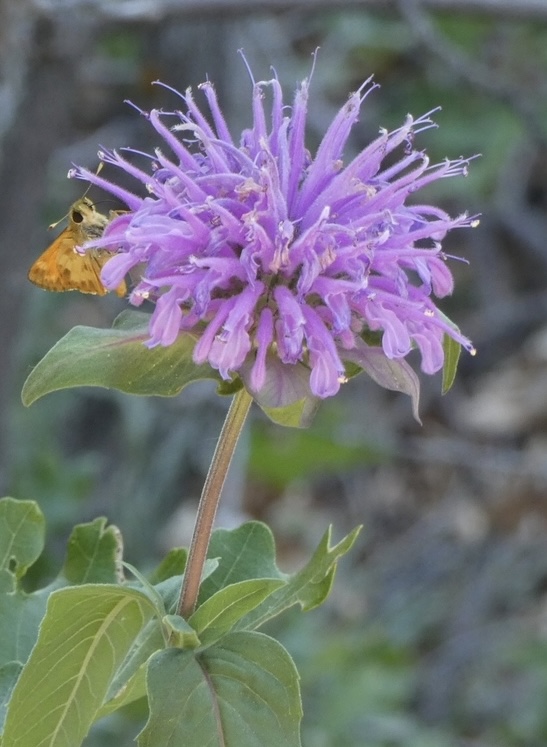
Wild Bergamot and a little skipper pollinator. Tecolote Trail, Sandia Mountain, NM. This Monarda species prefers living in moist soils under the shady canopy of white fir and ponderosa pine.
Mammal Resistant: While pollinators adore Plains Beebalm, its strong, minty-citrusy-oregano essential oils act as a natural deterrent, making the plant resistant to browsing deer and rabbits.
Pollinator Magnet: The tubular pale pink flowers of Plains Beebalm are an excellent nectar source for long-tongued native bees, butterflies, and hummingbirds, especially during the hot summer months.
Soothing Relief: Plants in the Monarda genus are commonly called “Beebalm” due to the soothing nature a wash application of the plant, especially the flowers, has on insect bites and stings — particularly bee stings. Turns out plants in the genus contain the active ingredient thymol, a natural antiseptic found in modern mouthwashes.
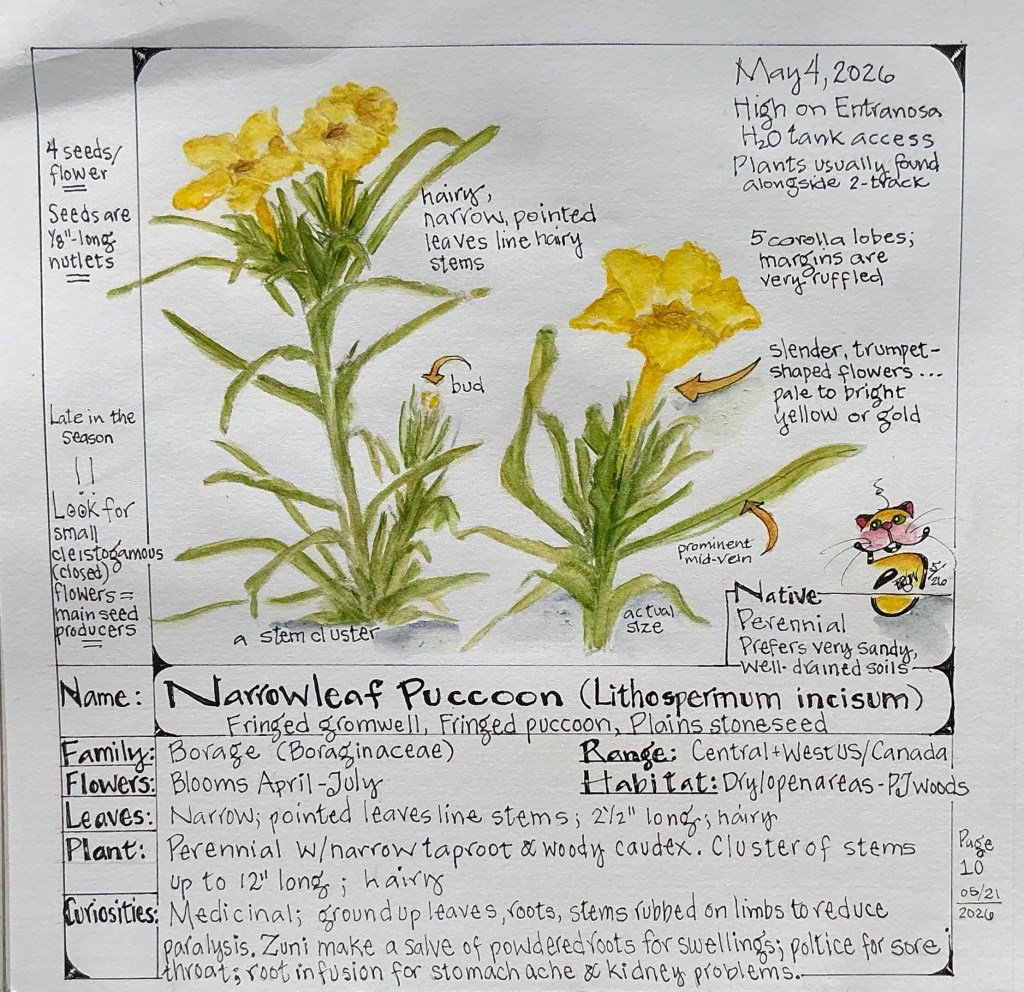
Lithospermum, the genus named by Linnaeus in 1753, is Greek for stone (“Lithos”) and seed (“sperma”), referring to the hard nutlets. And “incisum,” theLatin species name referring to the incised, fringed edges of the trumpet flowers, was named by Lehman (a German botanist) in 1818 from a specimen collected “near the rapids of theOhio” by Andre Michaux (a French botanist and explorer) in 1802.
Puccoon evolved from “poughkone,” a word the Virginia Algonquian language used for plants whose roots yield a red or yellow pigment. The roots of Narrowleaf Puccoon were historically used as dyes ranging from purple to red to yellow.
A Two-Flower Strategy
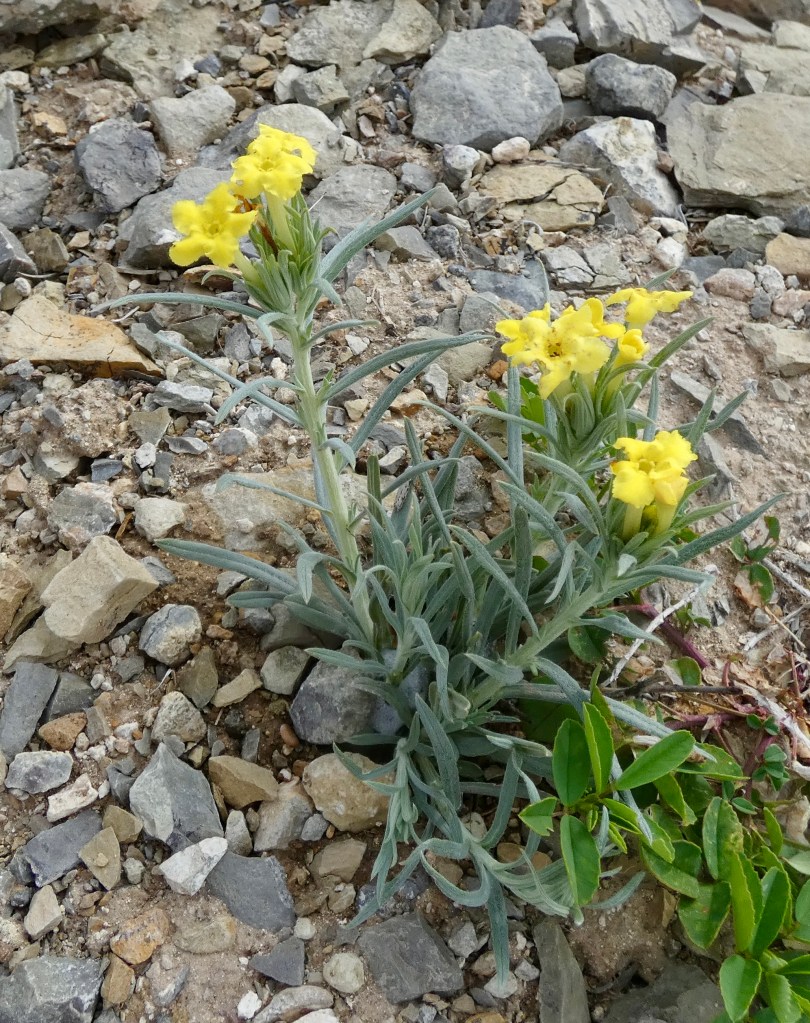
Very showy and quite lovely, the sunshine yellow trumpet-shaped flowers of Narrowleaf Puccoon are hard to miss. They often cluster at the ends of 12-20” long stems where the floral tube is ringed by five frilly petal lobes. The flowers depend on pollinators like butterflies for cross-pollination which adds genetic diversity to the few seeds they produce. Botanically speaking, these traditional, open flowers with exposed reproductive parts are referred to as Chasmogamous.
Then later in the season, the Narrowleaf Puccoon produces small, petal-less flowers that remain tightly closed. These highly fertile, self-pollinating flowers account for almost all of the plant’s seed production. Botanists refer to this type of closed, often inconspicuous flower as Cleistogamous.
An immature nutlet
The“Stone Seed” Fruit
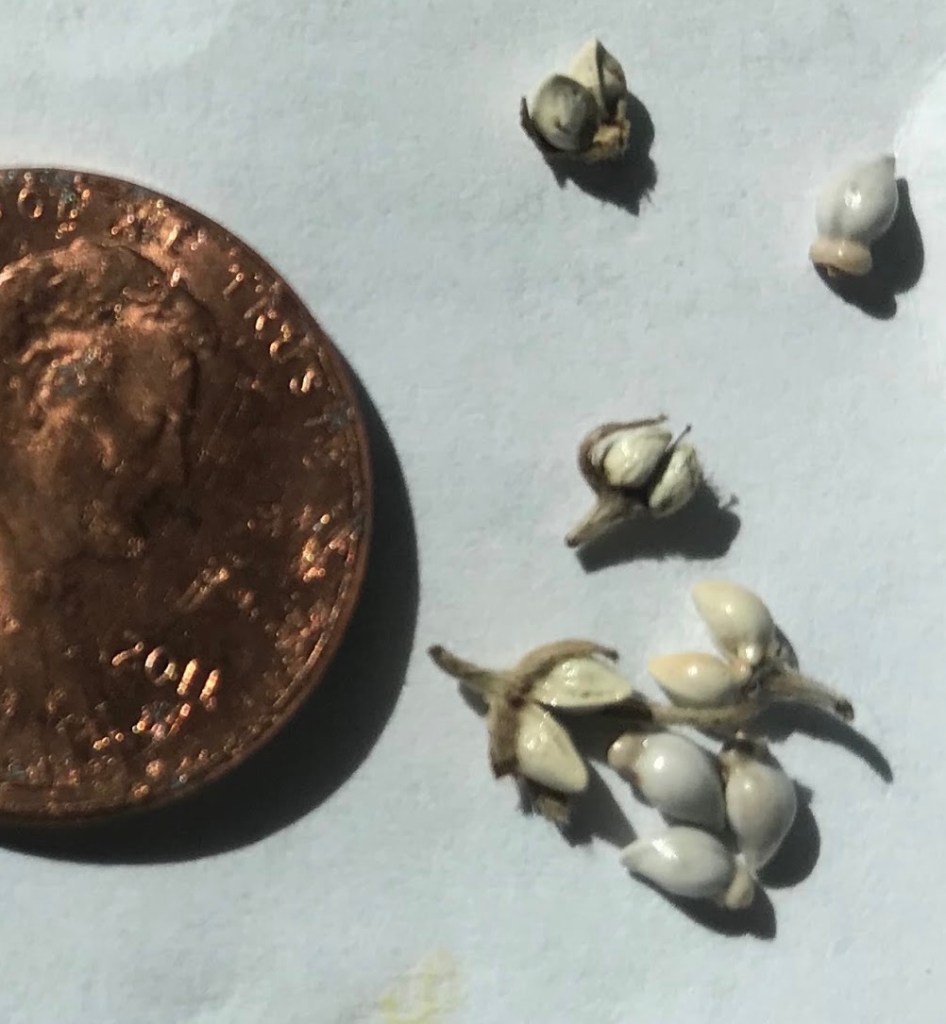
BecauseNarrowleaf Puccoon only produces the occasional fruit from its showy flowers, it takes a bit of searching around the plant’s lower leaf axils to locate a tiny group of up to four hard “stone seed” nutlets. Beginning growth inside the self-fertile, closed (Cleistogamous) flowers that are present late in the season, each egg-shaped nutlet, pitted across the surface, ripens to a shiny white.
Plant Propagation
Seed Germination – To grow Narrowleaf Puccoon from seed, nutlets should be collected in late summer. Soak them overnight in hot water then plant immediately. Because seed germination is sporadic and often disappointing, selecting a desirable location for planting is important. The plant grows best in very sandy, well drained soils found in the dry/open areas within our pinyon/juniper woodlands (though they do grow in soils with some loam or clay).
Shiny white nutlets with Penny for size Photo edited from a post by A Wandering Botanist
Root Cutting – A more successful method may be to take a 2-inch cutting of the taproot in the fall. Dip the cutting in a root stimulant and plant in a desirable location.
Suggestions for root stimulants
Powdered Hormones: Highly cost-effective, have a long shelf life and easy to use. After you moisten the root cutting, just dip it directly into the powder (e.g., Garden Safe TakeRoot) and plant.
Natural/DIY Options: Raw aloe vera gel and crushed, uncoated aspirin both contain natural growth-promoting enzymes. You can also use diluted willow bark extract, which is naturally rich in rooting hormones.
Plant Care – Narrowleaf Puccoon requires full sun and very little water, making it a good plant for xeric gardens or included with other native plants to establish a wildflower meadow.
Photo taken early May 2026 along the Entranosa access road
Medicinal Properties and a Cautionary Note
The Navajo chewed the root of Narrowleaf Puccoon for coughs and colds. They, and the Zuni rubbed the plant’s finely powdered leaves, root and stem on the body to treat paralyzed limbs. An infusion of the root was used for stomach aches and kidney problems. The plant was eaten as an oral contraceptive, and a cold infusion of the pulverized root and seed was used as an eyewash.
Although Narrowleaf Puccoon does have medicinal properties, it contains potentially toxic alkaloids. Self-treatment involving this plant is strongly discouraged.
…………………………………………………………………………………………………
If you’ve seen Narrowleaf Puccoon, did you find their highly fertile, tightly closed flowers and/or the shiny white nutlets? Have you tried growing the plant from seed or root cuttings, and were you successful?
Today is the second Monday in October ….. a day to pause and honor the deep roots, rich cultures, and enduring spirit of the first peoples of this land. Native American Day celebrates the history, contributions, and resilience of Native American tribes all across the nation.
Yesteryears
Native American Day honors all Native Americans. South Dakota led the way, officially changing Columbus Day to Native American Day in 1990 after a “Year of Reconciliation” was declared by Governor George S. Mickelson. California soon followed. In recent years, the movement has gained national momentum. Many states and cities have chosen to celebrate Indigenous Peoples’ Day on the same date. Then in 2021, President Joseph Biden issued the first-ever presidential proclamation for National Indigenous Peoples’ Day, marking a significant step in acknowledging and respecting the history and contributions of America’s first inhabitants.
Celebrating the second Monday in October is more than acknowledging the past ….. it’s a day to recognize the living cultures that continue to enrich our country’s tapestry. It’s an opportunity to move beyond stereotypes and learn about the diverse traditions, languages, and stories that have shaped this continent for millennia. Native American Day also highlights the efforts to revitalize and preserve hundreds of indigenous languages, each one a unique expression of culture and knowledge. When we celebrate Native American Day, we celebrate the incredible diversity of traditions. Instead of a single culture, there are hundreds of distinct nations, each with its own unique customs.
Storytelling and Art Making
Native Americans have a powerful storytelling tradition of oral history, where foundational stories, lessons, and legacies were and still are passed down through generations. Many of these stories of life and culture are told through artwork, from ancient pictographs (rock paintings) and petroglyphs (images cut into rocks by pecking, incising or abrading) created by the indigenous peoples that lived throughout America, the intricate beadwork of the Plains tribes, the iconic pottery of the Pueblo peoples of the Southwest, to contemporary painting and sculpture. Native art is a cornerstone of American culture.
New Mexico Rock Art
Images painted on and carved into rock that were used in ancient storytelling can be found throughout my home state of New Mexico. Many of these sites are protected and preserved by federal designation as National historic landmarks, National Parks, and by the Bureau of Land Management as Areas of Critical Environmental Concern, and as a significant part of our Archaeological heritage.
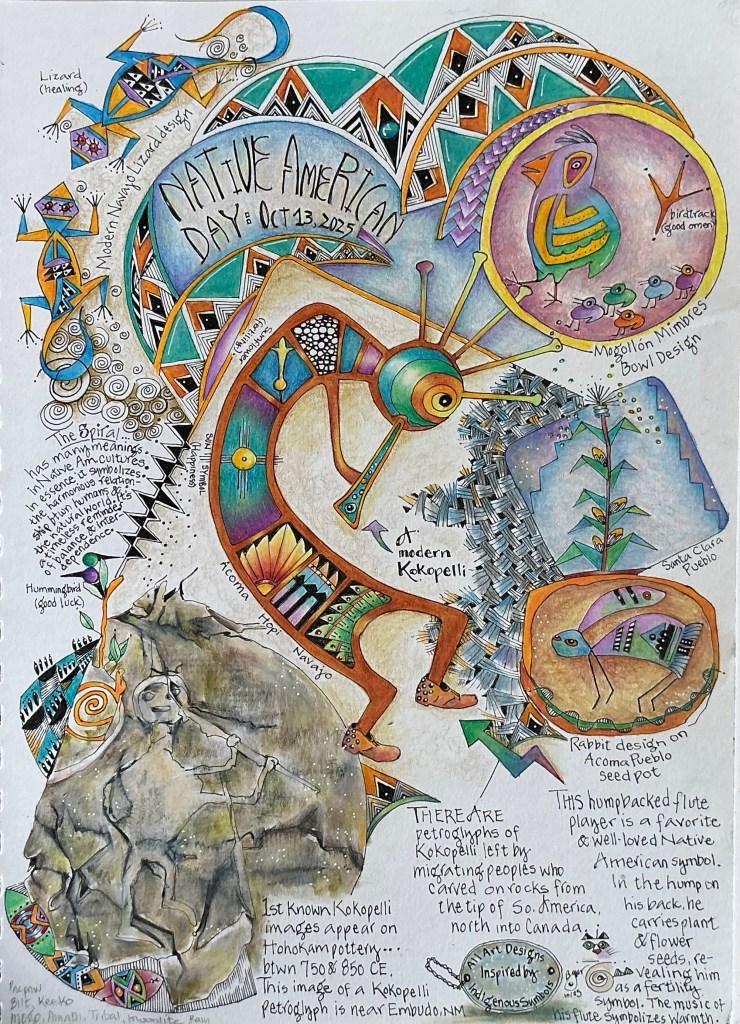
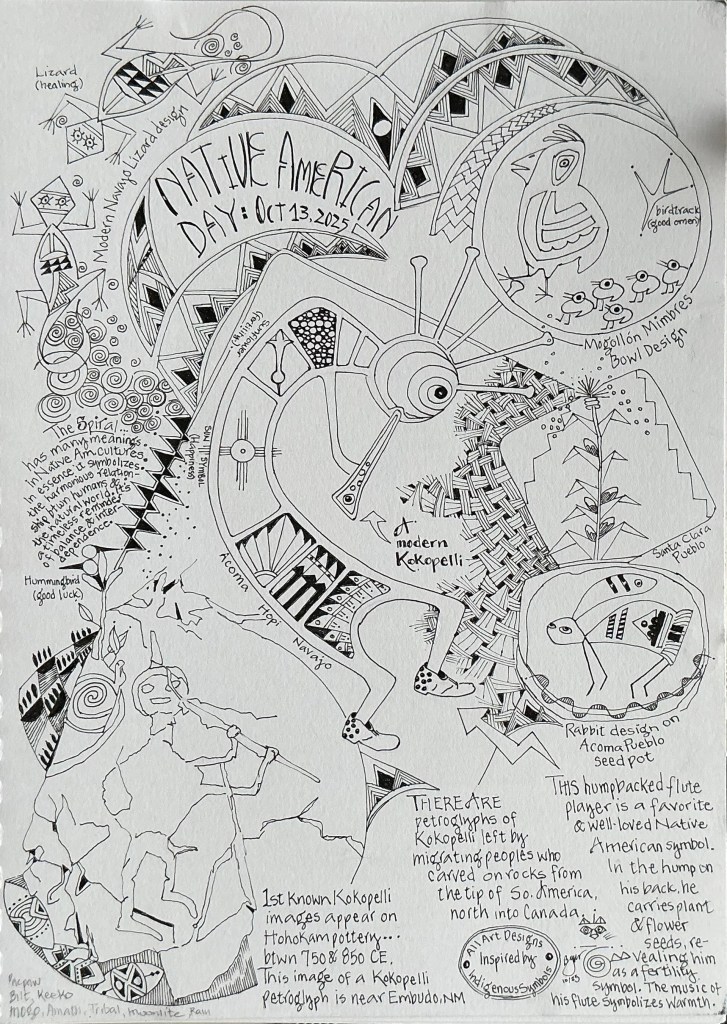
Traditional cultures and customs continue to fascinate me, and in “drawing” attention to the important contribution rock art has and continues to play, I wished to shared some of the designs (symbols) created by Native American tribes indigenous to the 4-corners region of the Southwest, with focus on those found in New Mexico. The Kokopelli symbol, the dancing flute player, is a familiar and favorite character throughout the area and has many meanings tied to fertility and harvest. The symbol depicted shows Kokopelli with a hump in his back where he carries seeds ready for planting, while he plays his flute, a symbol of warmth. He also carries a sunflower disk flower (the ‘complete’ inflorescence) to display fertility, the Sun symbol for happiness, and several crop symbols designed by the Acoma, Hopi, and Navajo.
A Kokopelli created in 2017 … on toned grey paper and colored with Prismacolors
The very first known Kokopelli images appeared on ancient Hohokam pottery, dating from between 850 and 750 C.E. The drawing of the Kokopelli petroglyph, in the bottom left of my panel, is inspired by one of these first images that was discovered near Embudo, NM.
Ideas to Celebrate Native American Day ….. Learn, listen and engage by …..
.…. reading a book by a Native American author, such as Louise Erdrich, Sherman Alexie or Tommy Orange,
….. exploring a museum or a state historic site to learn firsthand about the lives and history of the region’s tribes,
….. purchasing authentic arts, crafts, and goods from Native artists, which directly supports and helps preserve their cultural practices,
….. attending one of many community- or university-hosted talks, film screenings, or celebrations such as a powwow
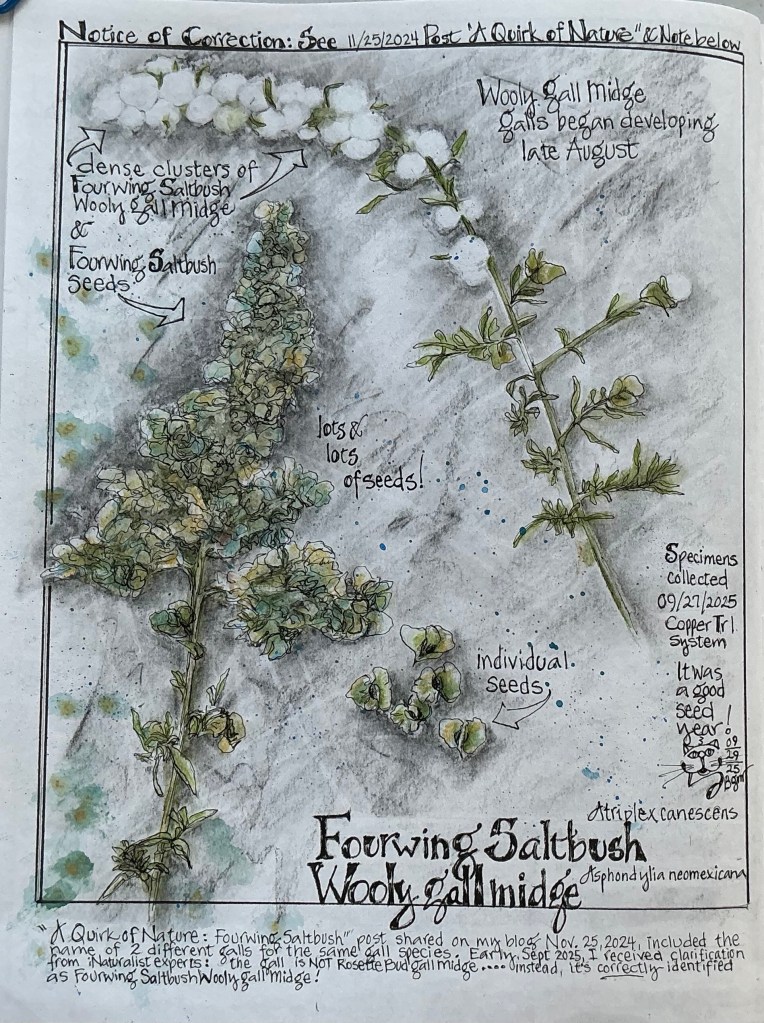
If you’re a fan of weird twists in nature (like me), and enjoyed my November 25, 2024 post, “A Quirk of Nature: Fourwing Saltbush,” you may have lost many hours of sleep wondering how I could’ve missed such an obvious mistake! You know the one. The labeling error made when naming those cottonball-like insect galls hugging the Fourwing stems.
In my confusion (or wishing to cover all options?), I seemed to believe two different midge species were somehow responsible for the same gall.
Are they Rosette Bud Gall Midge galls or Fourwing Saltbush Wooly Gall Midge galls?
Decisions, decisions.
My Quandry quite clear, it was time to consult the experts.
A short 10 months later, confirmation arrived from the iNaturalist experts in all things “Fourwing.” All the puffy galls are none other than those made by Fourwing Saltbush Wooly Gall Midges!
And the answer to my question is well timed, as the stems of the female Fourwing shrubs are once again ‘heavy’ with Wooly Gall Midge galls. Now I know! Now you also know!
Enjoy this official correction, at long last, and wishing you sweet dreams.
As always, thanks for stopping by!
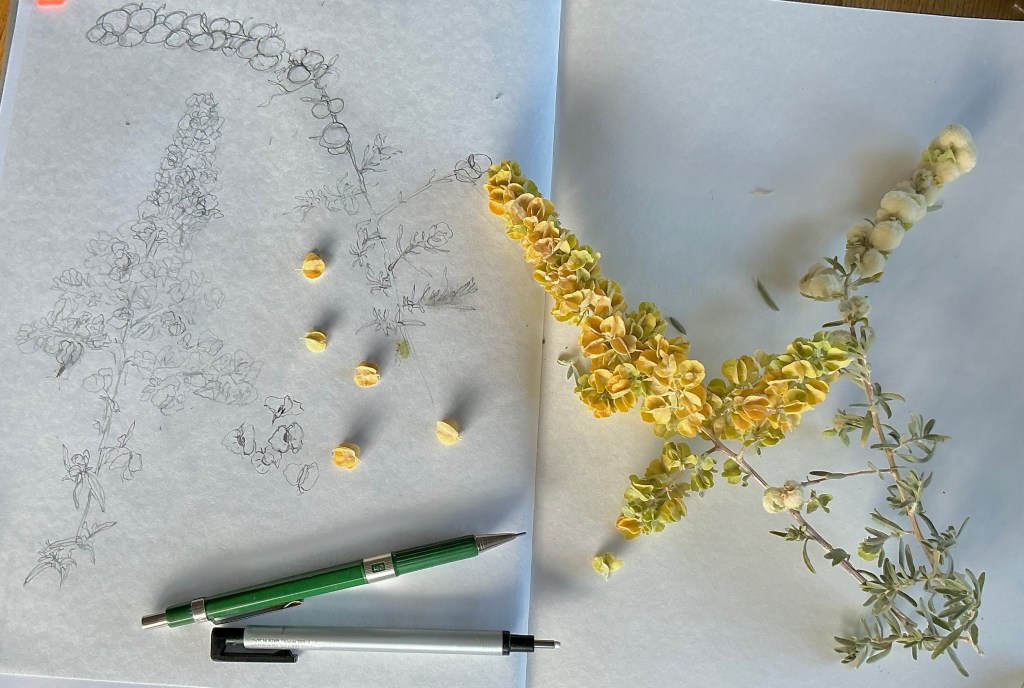
PS: My journal page was created by first sketching in graphite the two Fourwing stems, followed by outlining with loose ink lines from a Micron 005, adding a background of both soft and medium charcoal – blending with a stump, then using a Tombow Mono Zero eraser to clean up the ‘cottonballs,’ before adding watercolor pencil, color splatters, and eraser lines randomly placed through the charcoal background. A bit experimental, and lots of fun.
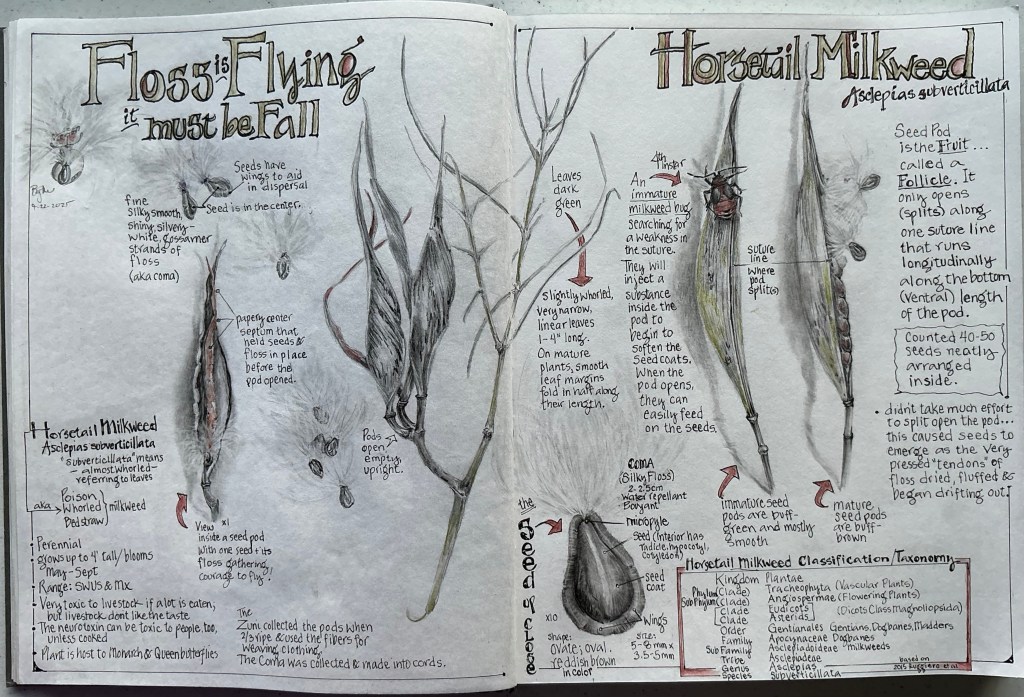
Like soft, fluffy snow! Glistening orbs of silky gossamer are floating about the neighborhood, drifting hither and yon in the gentle breeze. Suspended beneath each orb is a single reddish-brown winged seed that appears to coax its wind-propelled puff in a safe descent to the ground. But the white floss (the Coma) wants to fly, and it becomes a tug of war. As the weight of the seed overwhelms the ability (and the desire) of the floss to carry it, their brief relationship is severed. But both get their wish …. the floss flies free as the seed drops to the ground, hopefully landing in an ideal spot to overwinter and sprout next spring.
Welcome Fall!
When the air is full of Horsetail Milkweed parachutes and their ‘riders,’ I walk along the neighborhood roadways and collect a bounty of their new-crop seeds + floss to set free around our property. If they find the right soil, moisture, and light conditions for spring germination, the seeds will not only form the beginnings of a stand of these beautifully blooming, creamy-white milkweed flowers, but the plants might just play host to Monarch and Queen butterflies!
Now wouldn’t that be dandy!
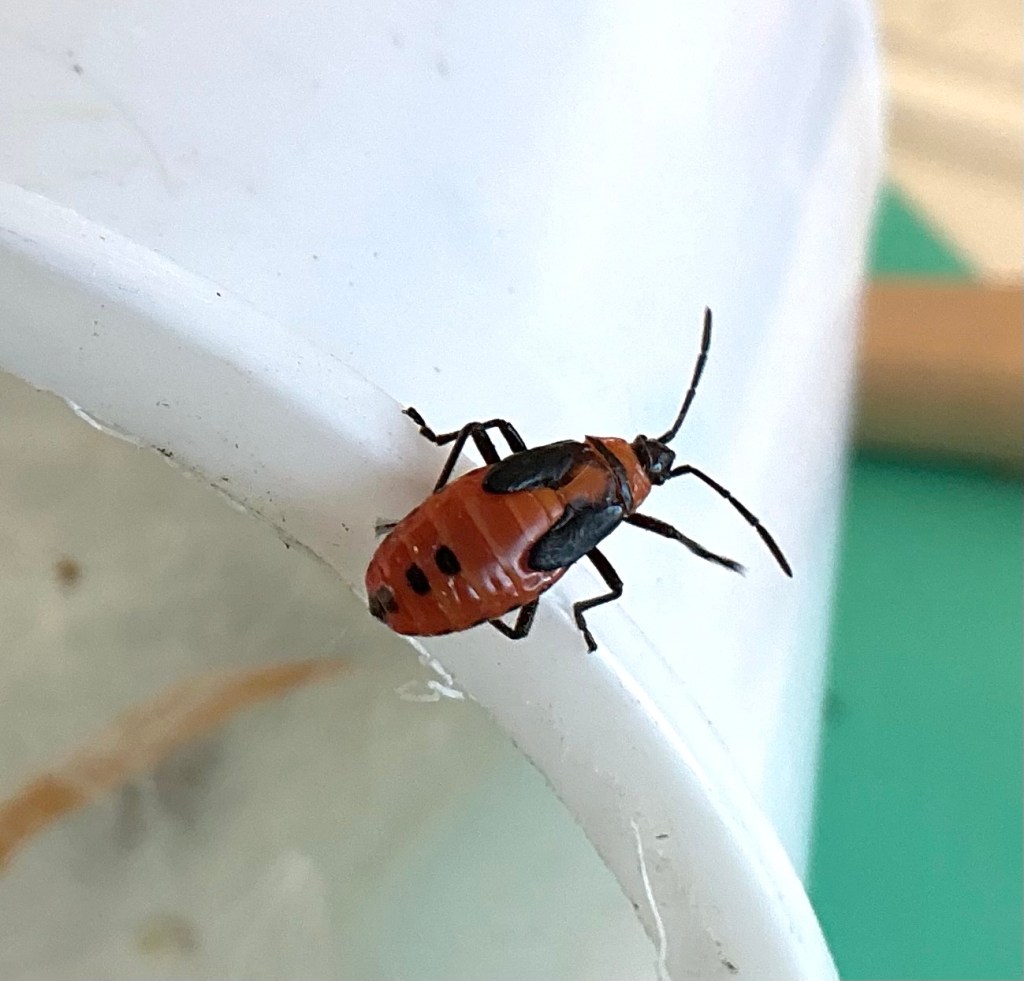
(Of course, mature seeds from new plants will undoubtedly entice a hungry crop of well-dressed Milkweed Bugs next Fall. That’s OK! They have to eat too!)
Before hint of color
My Journal Pages ……
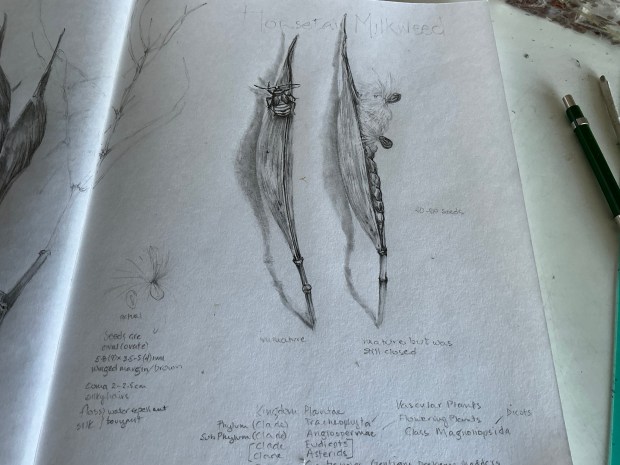
For something different, instead of using ink and watercolor, all sketches on these pages were created in graphite. The pods, seeds and the milkweed bug were sketched from my collected samples using a mechanical pencil loaded with a fine point HB lead. The touches of color were added with water soluble graphite.
Work in Progress #1Work in Progress #2
Thanks for stopping by ….. And Have a Fabulous Fall!
Ohhhhhh, what a sweet month …… August. It almost got away from me without sharing a small collection of Littles1 that reflect the inevitable shifts in nature that occur during the month. It’s always hard to imagine summer winding down; where did the time go? But as surely as butter melts on freshly baked bread, undeniably, August forms a reliable bridge between summer and autumn. It’s a time of change and transition; abundance and harvest; transformation and a period of letting go.
So before I “let go” and before the snow flies (and it will), here’s a handful of little discoveries during the month of August:
-A female Wheel Bug gone slightly astray while searching for a protected place to overwinter the eggs she’s about to lay.
-A female Soldier Beetle doing her best to attract a mate by sending out pheromones while munching late season pollen from the disk flowers of a brilliant yellow Showy Goldeneye.
-An acorn that made it to maturity, ready to drop beneath a still green-leaved Gambel Oak soon to be decked out in radiant fall colors.
-Some hot red trumpet-shaped Scarlet Gilia flowers, still irresistible to hummingbirds until migration, will all be pollinated in time for seed set and mature.
-The snowy white fruit dangling from the draping branches of Roundleaf Snowberry shrubs are ripe and ready for plucking by hungry birds flying south for the winter.
-And plump purple-black Chokecherry berries that will become a juicy dietary supplement for black bears needing to bulk up for hibernation.
Enjoy!
And as always, thanks for dropping by!
1“Littles” is part of a blog series I began posting several years ago, beginning in January 2023. The concept was inspired by Fay (thanks again Fay!) who came up with the idea for her blog madebyfay.wordpress.com