July 29, 2025

You must awake when the first rooster crows to enjoy the floral beauty of a fully flaired Blazingstar blossom. Appropriately named, these gorgeous flowers display a radiant combination of spoon-shaped petals, petal-like stamens, and hundreds of thread-like stamens, all colored in bold sulfur yellows, distinctive pale orange-yellows, brilliant star whites, or fluorescent blues, based on species. These superbly showy flowers unfurl overnight atop tall white, branching stems that resemble candelabras with narrow lobed green leaves. These large, 2” diameter flowers belong to the Mentzelia genus, plants that are all native to the Americas, and represented by 60-80 species, most found in the desert southwest.
In 1753, Carl Linneaus gave this plant its genus name, Mentzelia, after German botanist and sinologist Christian Mentzel. (Did you know a Sinologist is a specialist in the study of Chinese language, literature, and civilization? Huh!) But perhaps more fascinating and what’s always ‘captured’ my complete attention (and blue jeans) is that the Mentzelia genus fits perfectly in the Loasaceae family ….. commonly referred to as the Stickleafs.
About those leaves ……
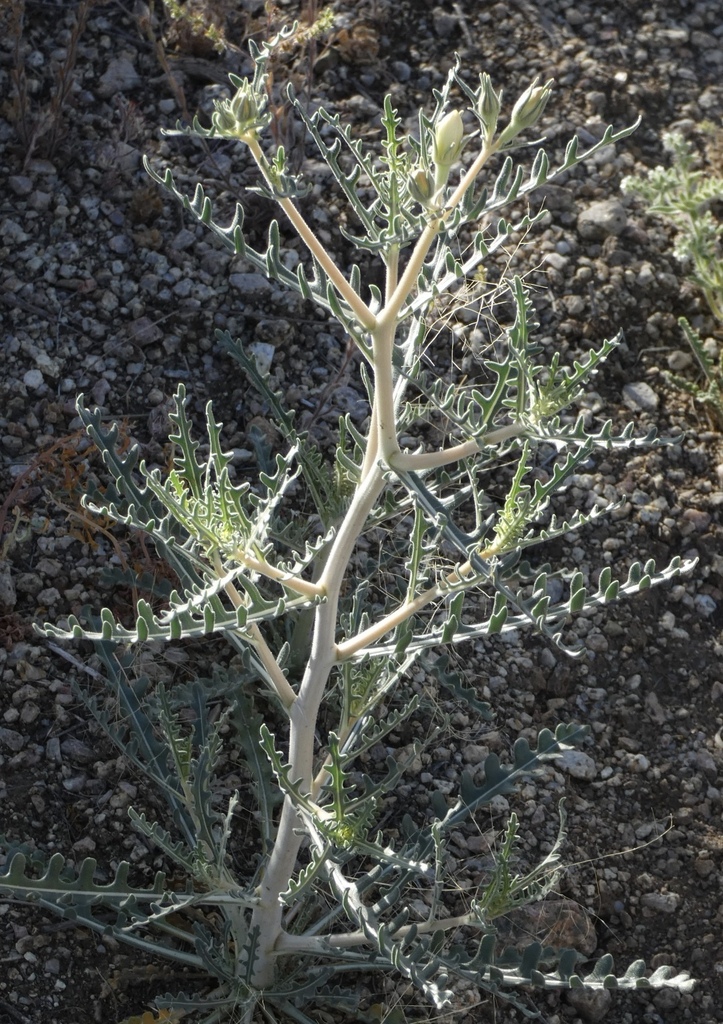
Being primarily a day-time hiker, my first encounter with a Blazingstar occurred simultaneously with a misstep into the plant. Noticing some resistance in making my escape, I looked down at the ground and discovered my jeans had a collection of stuck leaves from my boots on up. And the leaves were really stuck tight along their entire length! Removing those leaves was like peeling a banana, only tougher. Wait! Forget the banana peel. Removing those sticky leaves sounded like and felt like tugging on and separating Velcro! I was reminded of the familiar ‘ripping’ noise made when Velcro hooks are forcibly released from their loops!
Eureka!!
Nature is full of surprises. Were the Stickleafs the source of accidental inspiration for today’s handy hook-n-loop fastener, called Velcro? Almost, but not quite! As it turns out, the tiny hooks on Cocklebur seedpods inspired a Swiss engineer to develop Velcro in 1941. But not to change subjects too much …….The reasons Stickleafs could’ve been the inspiration for Velcro, is similar to the Cocklebur story, but, I think, even better. Here’s why ……
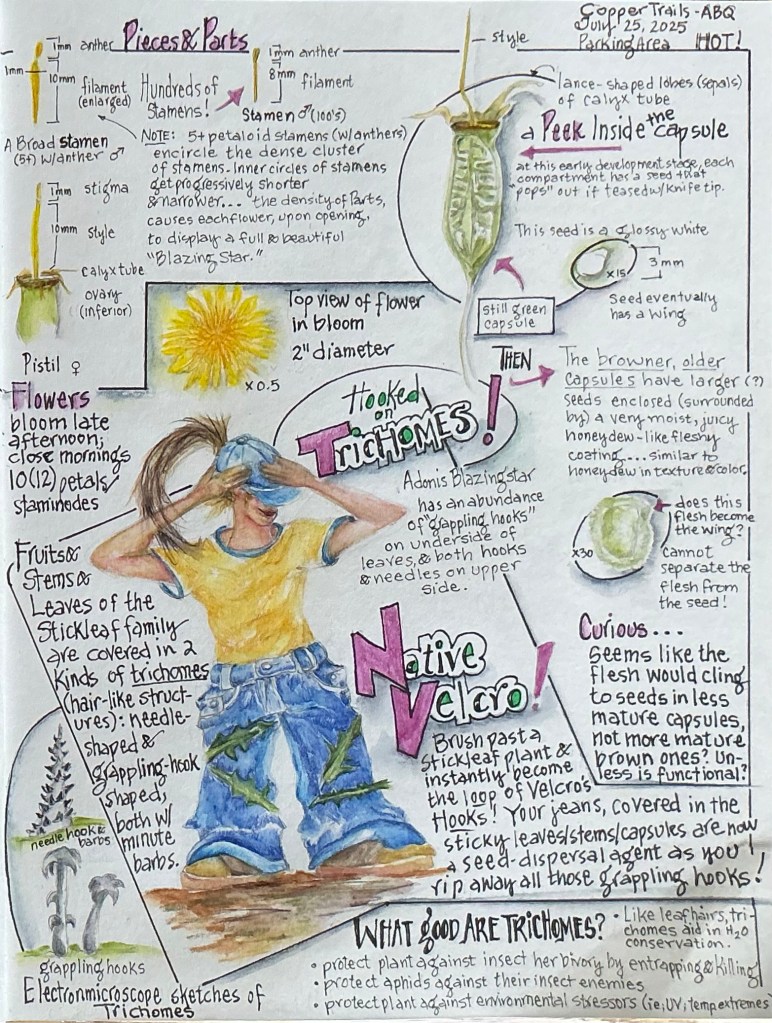
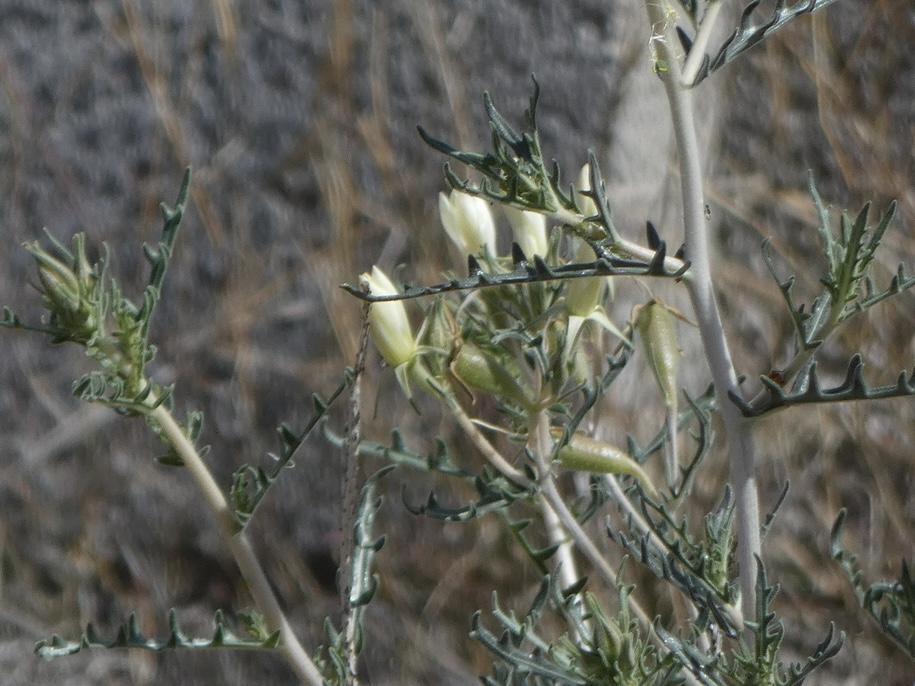
The seedpods of both plants have tiny hooks that readily adhere to clothing and fur. And it was the hooks’ tenacity for stick-to-it-tiv-ness that grew the original Velcro idea. But Stickleafs go even further in ‘reinforcing’ the fastener concept. Not only does the seed pod (capsule) of Stickleafs have a covering of tiny hooks, but both leaf surfaces and even the stems of plants in this family can have multiple types of minuscule grappling-hooks and barbed needles, called Trichomes, visible only with an electron microscope. I summarize that if the Swiss engineer was visiting America in 1941, and had the good fortune to walk into a Mentzelia plant, he undoubtedly would’ve been super inspired to develop Velcro. After all, it’s the leaves that stick fast to clothing, resemble a strip of Velcro, and hold tight, mimicking an ideal hook-n-loop fastener.
Hooked on Trichomes
And now for the curious nature of the Mentzelia genus. When coming across the Adonis Blazingstar (Mentzelia multiflora) over the past 8 years, it’s been fun to inspect the leaves, remove one and intentionally stick it to Roy’s jeans or mine. I’ve then wondered how this plant ‘sticks’ so well, and why. The time for answers arrived this month, and what I learned was fascinating. It’s all about Trichomes.
Trichome is a botanical term used to describe the small hair-like structures that occur somewhere on a plant; typically on plant leaves. Trichomes can be found throughout the plant kingdom (like on Cannabis sativa); they aren’t unique to the Stickleaf family, and are found on all species of the the Mentzelia genus. Some Mentzelia species have one type or shape of trichome; some have several types. Adonis Blazingstar has two types of trichomes – one is shaped like a grappling hook; one is shaped like a barbed needle. It’s the trichomes that grab on and hold tight. But what possible function do they serve the plant? Surely a leaf sticking to the fur of a passing animal or a person’s pant leg, while decorative, is otherwise pointless?

What Good are Mentzelia Trichomes?
Like plant hairs, trichomes aid a plant in water conservation in times of drought by reducing transpiration, and in situations of other environmental stressors, such as excessive UV light and extreme temperatures. The trichomes serve as a protective barrier between the leaf, stem, or other part of the plant, and the environment.
Trichomes can function as water collection, retention and funneling structures during a rainstorm.
The grab-and-hold nature of trichomes when they attach to fur or clothing can cause enough vibration of mature seed capsules to shake loose seeds ready for dispersal.
Trichomes are the plant’s primary defense against herbivory; not from livestock or rodents intent on munching leaves, but from insects that attempt crawling amongst the grappling hooks and barbed needles intent on causing damage. As can be seen in electron microscope images, insects have been photographed speared and hooked and killed because they were unable to escape their entrapment by trichomes.
But not all insects succumb to the fate of trichomes. Aphids are able to navigate the dense forest of hooks and needles without capture, allowing them to wreak havoc on vulnerable and tasty leaves, stems and seed capsules.
And that’s why the Mentzelia genus of the Stickleaf family is one of the natural curiosities of the plant kingdom. Maybe now, you too, are Hooked on Trichomes?
I hope you’ve enjoyed this post, and do thank you for stopping by!
And if you’re curious about how Trichomes contribute to the enjoyment and/or medicinal benefits of marijuana (Cannabis sativa), here’s what I found:
Trichomes are the primary site for cannabinoid production (i.e. compounds like THC & CBD responsible for the plant’s psychoactive/therapeutic effects.
Trichomes are the site of terpene production which gives different Cannabis strains their unique aromas/flavors.
Trichomes are the site of flavonoids known for antioxidant and medicinal properties.

 a curious nature