Give a seed the right conditions ……. enough water, sunlight, the perfect temperature ….. and this small package cannot resist emerging from its protective coat to grow into a full grown plant.
Seeds are tiny marvels of nature.
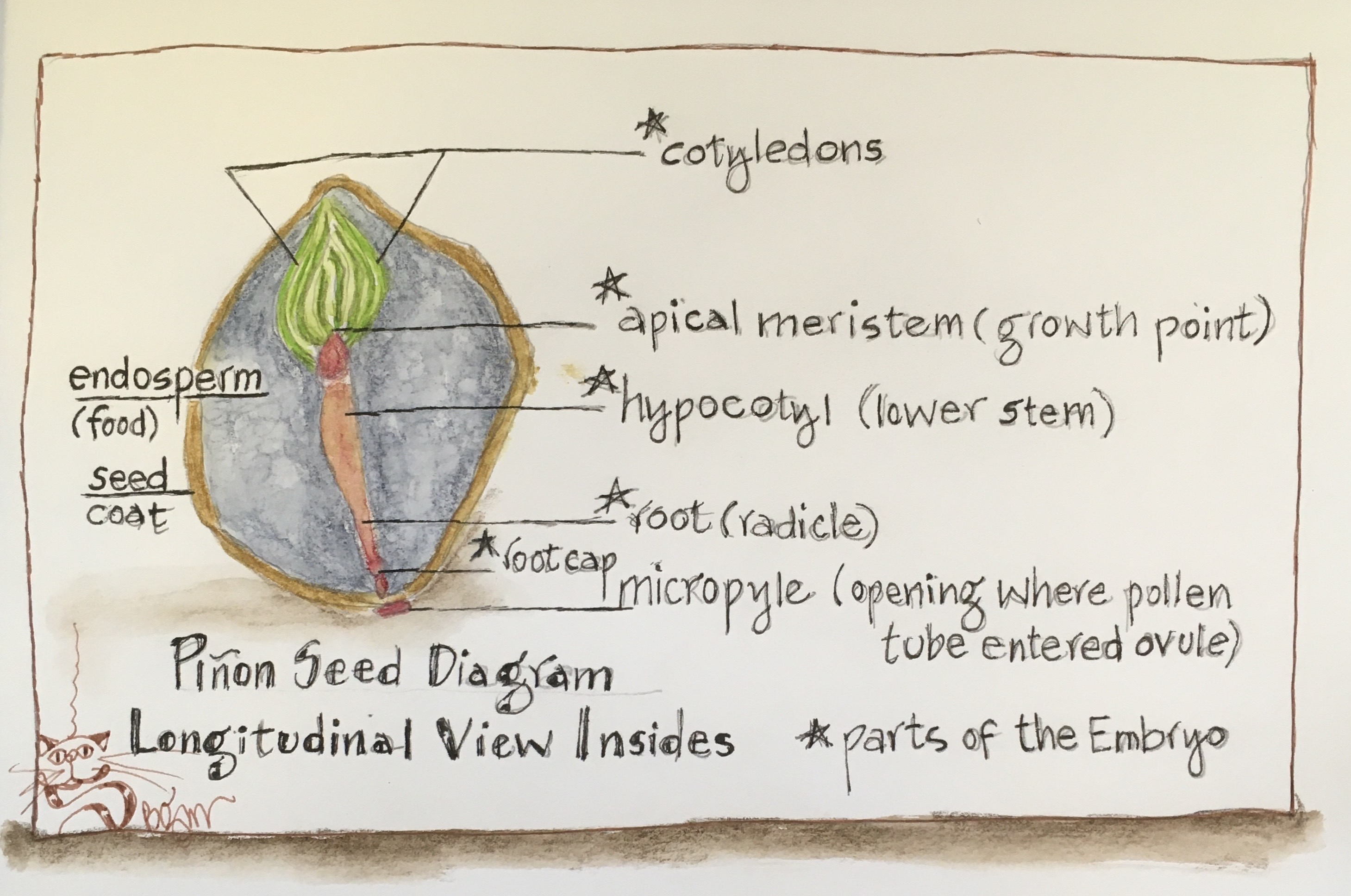
Looking inside the seed reveals a miniature pine tree!
Think about it ……. a seed is really a living baby plant (the embryo) surrounded by a cozy blanket (the endosperm) that cradles and nourishes the embryo while tucked inside the seed coat. When the coat unzips, freeing the “baby” as it begins to grow, it continues to be nourished by the endosperm until the first true leaves appear. Witnessing the process is so cool!
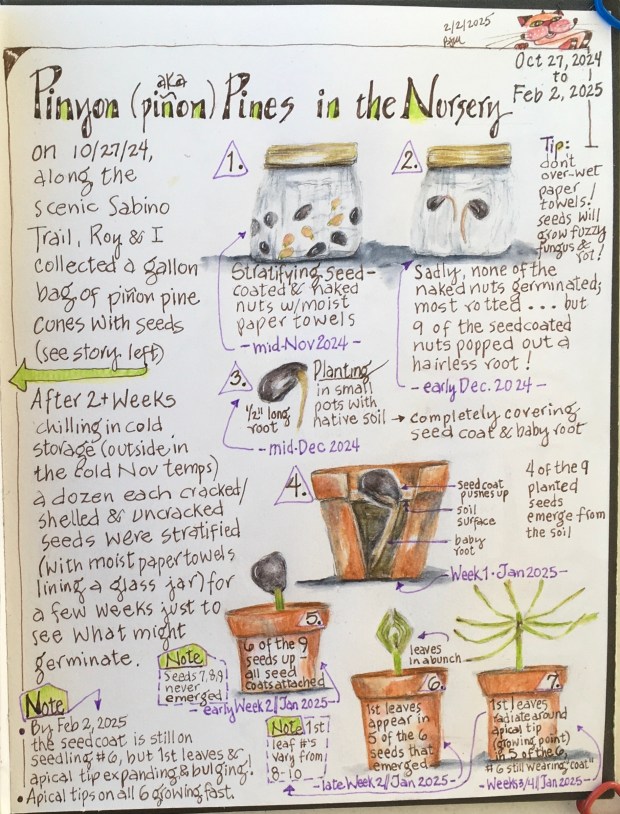
After collecting piñon seeds from last November’s foraging expedition, (Piñon or Pinyon, Piñon Seed or Pine Nut), we decided to treat a dozen or so to conditions just right to stimulate germination. But first the seeds required a short period of stratification (moisture) to help soften and crack the seed coats. Introducing moisture was done by lining a clear glass jar with damp paper towels and placing the seeds between the towels and glass to watch the action.
Post from November 2024 Seed Foraging Expedition
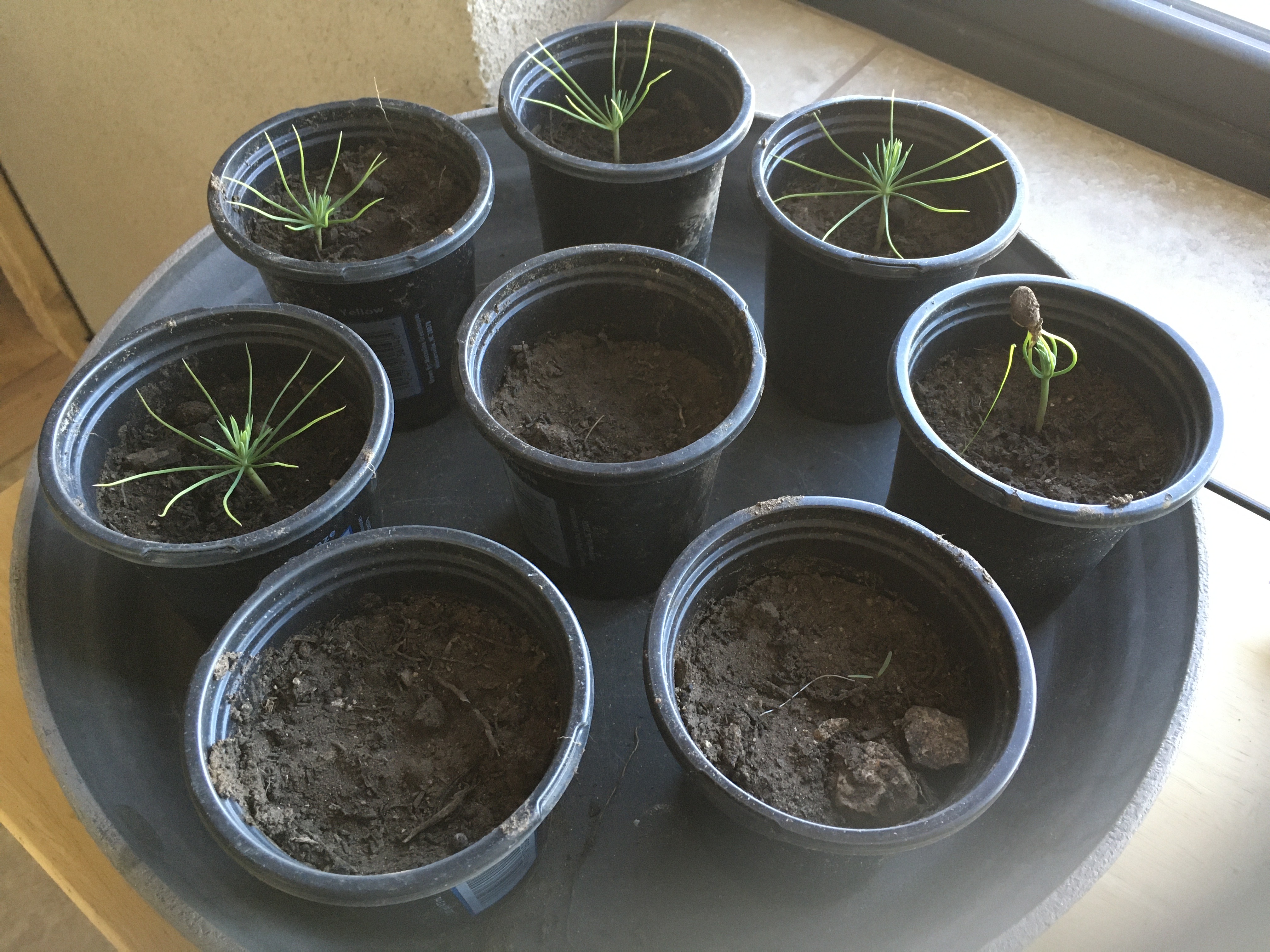
Soon embryonic roots (the radicles) successfully cracked the seed coats of nine seeds and began growing downward, as roots tend to do. In a week or so, before the embryonic leaves (cotyledons) appeared, all of the germinating embryos were planted. Six of the nine then sprouted their whorled cotyledons, followed by a growth spurt of the first true leaves, initiating the process of food manufacturing (photosynthesis).
Steps to Germination
All of the germination and seedling development details of these piñon seeds, to date, can be found in my update illustrations.
Seed germination is a fascinating process, and like the seed itself, is also a marvel of nature. Have you ever tried to germinate a seed? If not, give it a go. It’s fun, educational, and imagination provoking ….. from such a small seed comes a full-grown flowering plant!
A fallen cone from Pinus edulis. Still a few seeds remain, tucked in the lowest scales. Typically there are 2 seeds per scale; 10-30 seeds are common per cone. Seed viability is uncertain until the inside kernel is exposed.
Pine Nuts Come From Where?
Many years ago, maybe about 45 of them, Roy and I, his sister and her husband, set off on a pine nut safari in the mountains of south central Colorado. They knew of a large stand of a specific pine tree, called Pinyon (Piñon**) heavy with cones and ready to harvest. This was my first encounter with the Colorado Pinyon Pine (Pinus edulis), and my first taste of the buttery rich tear-drop shaped seeds produced by these trees. I was hooked! After 4-5 hours collecting wide open seed stuffed cones from low hanging branches and off the ground, we had to stop. Our fingers were impossibly stuck together from the cones’ copious coating of resin, definitely stickier than Super Glue! Without a solvent to dissolve this adhesive pine tar, we were in danger of losing our fingerprints.
Having made a less-than-minor dent in the harvestable nuts, ample quantities of this energy rich bounty remained for foraging wildlife, such as migrating birds like pinyon jays, deer and squirrels.
For the past 45 years I truly believed pine nuts (which are, botanically speaking, not true nuts but the edible seeds of pinyon pines) only came from stands of Colorado Pinyon Pine. When the popularity of pesto skyrocketed, I thought “wow, you couldn’t pay me enough to harvest the amount of pine nuts necessary to make even one batch!” I honestly thought that was the reason the seeds were so expensive ….. harvesting is such a tedious and labor intensive job. Alas, we never returned to harvest pine nuts, and I never made pesto until years later.
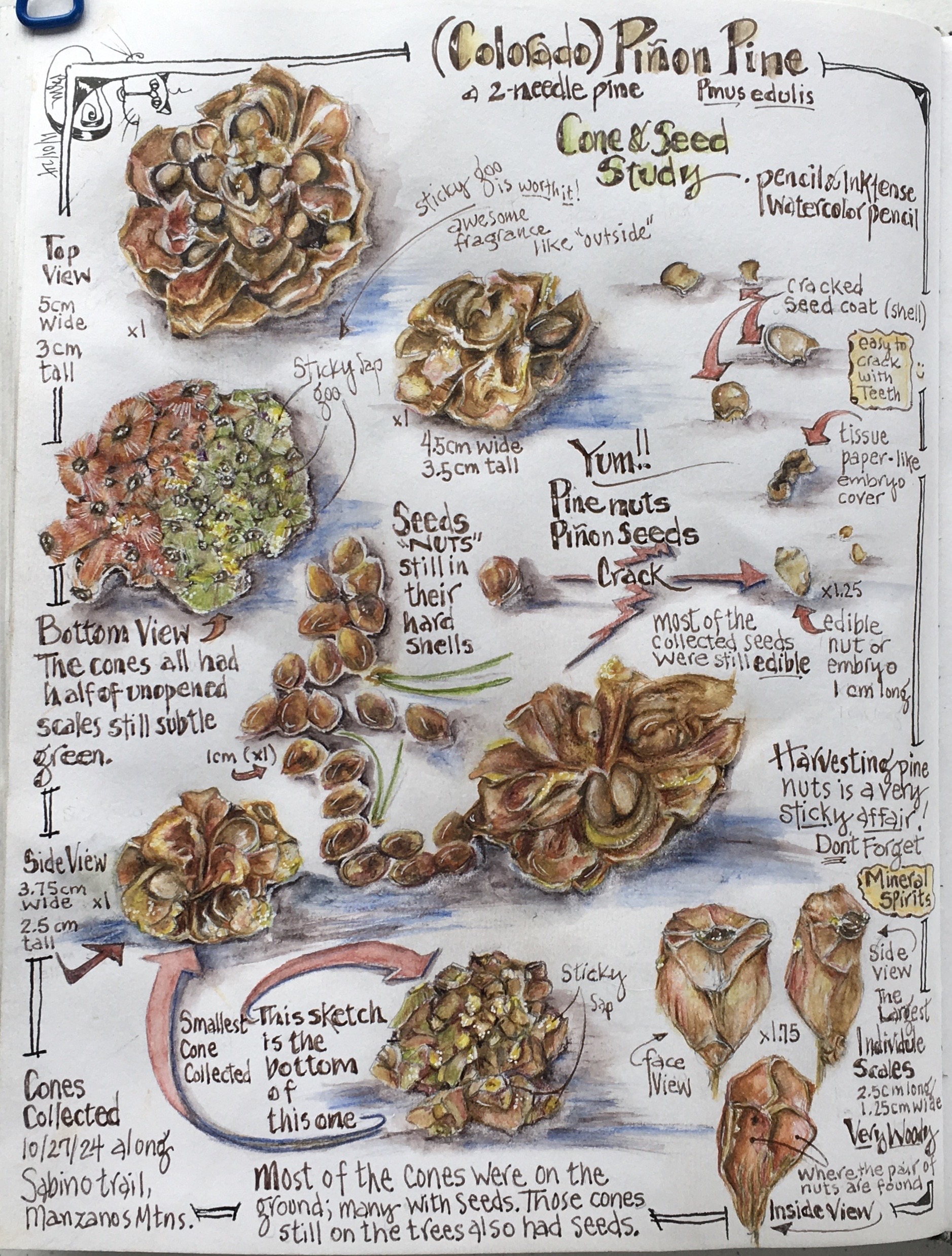
The result of my Pinus edulis cone and seed sketching exercise.
While studying a few dozen pine cones for my sketches, the seeds kept falling out and bouncing across my drawing table. This got me thinking about pine nuts and wondering how the Colorado Pinyon Pine could possibly fill the insatiable global demand! Of course by now I was well aware that this tree species is endemic in the southwest, but still ?…….
News to Me ….
Of the 126 different species of pine in the world, 29 are considered edible; 20 of which have seeds large enough to be marketed. The biggest producers and exporters are China, Russia, Mongolia, Turkey, and Pakistan, in that order. I found it interesting that China is also the largest importer of pine nuts, who’s marketing goal is to export 60% of the world’s demand.
What about the US? The pine nuts harvested from Colorado Pinyon Pine (Pinus edulis) is rated the best tasting in the world, with those produced by the One Leaf Pine (Pinus monophylla), harvested primarily from these California trees, comes in a close second. Yet, the US is a major importer of shelled pine nuts, primarily from China. But if China is the largest importer and the largest exporter of shelled pine nuts, then the pine nuts on the shelves of Trader Joe’s and Costco, labeled as imported from China, probably came from a variety of pinyon species from a combination of suppliers importing seeds to China?!
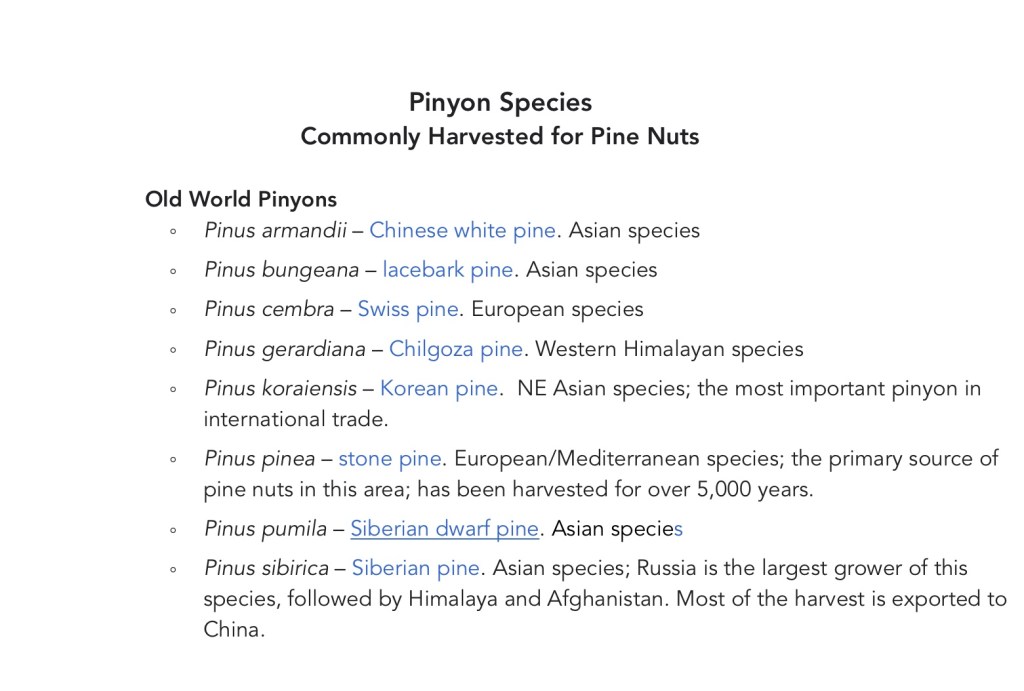
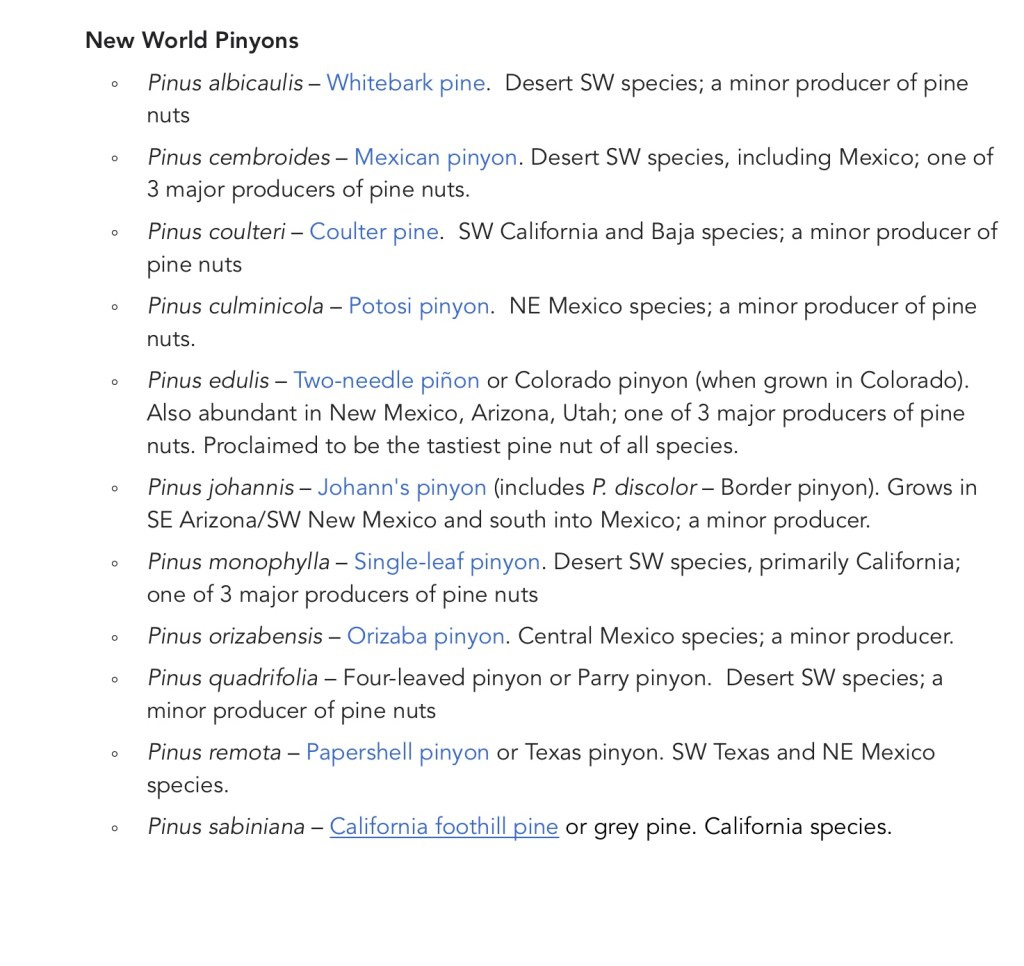
Being naturally curious about the Pinyon species that grow in various countries around the world, I included a list of 16 of the most commonly harvested trees the end of this post.
What’s the Real Reason Pine Nuts are so Expensive?
It’s said that “pine nuts are the most expensive seeds we would never buy!” (**** Check out this footnote for the 2024 costs/pound and my random calculations per serving and for a batch of pesto). Pine nuts are the second most expensive “nut” in the world, second only to the macadamia nut. Butwhy? While it’s true the seemingly exorbitant price of shelled pine nuts is directly influenced by labor costs, compounded by the annoying sticky factor, other challenges exist.
Harvesting Pine Cones
Cones are harvested by hand, directly gathering those that have fallen on the ground, and from tree branches (where the densest number congregate in the upper 1/4th of 30 foot tall trees). Another common harvesting technique is to whack the branches (which reportedly does not injure the trees [hmmmmm?]). But a faster method used in many countries is to cut off branches with cones, resulting in a number of detrimental effects to the trees (open entry points for insects and pathogens; stunted growth; stalled production; tree death).
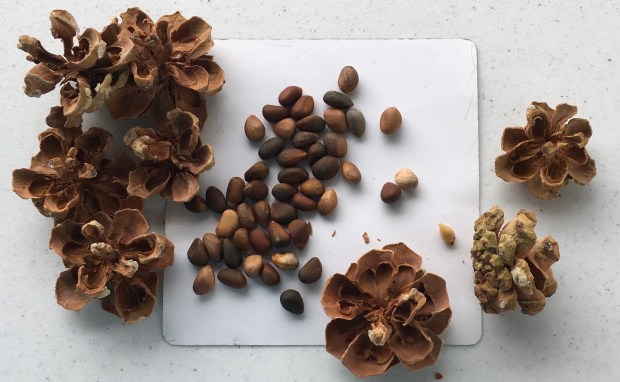
A sampling of Pinus edulis cones with hard coated seeds removed, ready for cracking. There’s a single kernel between the two lower right cones.
Pine Nuts
Once the seeds are taken out of the cones, their hard shells (seed coats) must be removed without damaging the soft edible kernels inside, the “pine nuts.” (And not every seed is viable ….. more about that below.) The shelled pine nuts must now be handled quickly and properly due to their short shelf life. It only takes a few weeks or even days in warm and humid conditions for shelled pine nuts to lose flavor, turn rancid, and completely deteriorate. Until they can be marketed for export, pine nuts must be kept frozen. Ideally, shelled pine nuts should remain frozen during export/import and until consumer purchase and consumption.
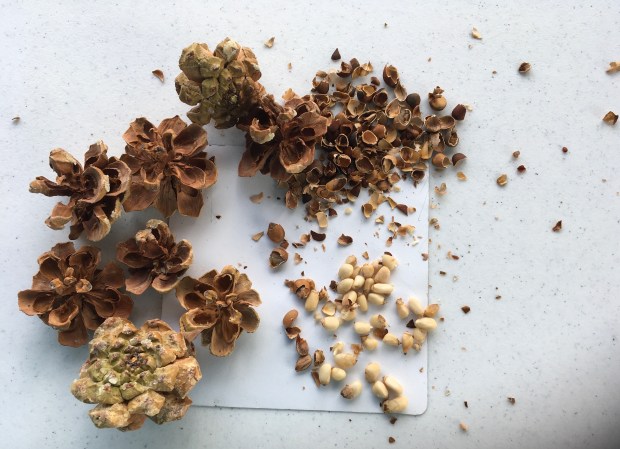
There were the remains of the Pinus edulis seeds extracted from these cones; 30 tasty kernels were viable; 20 were either missing or dried up.
Tree Characteristics
Slow growing trees and inconsistent production are several more reasons pine nuts are so expensive. Pinyon pines are notoriously slow to grow, mature (10 years) and produce a harvestable crop of cones with viable seeds (75-100 years). But pinyon pines typically live an average 350 years, and have the potential to produce tons of harvestable seeds. However, all pinyons exhibit a common characteristic called “masting,” where they may produce a bumper (harvestable) crop only once in as many as every eleven years. Good years are not predictable either, as many factors influence growth and production, with local droughts and a changing climate having the biggest impact.
Gifford Pinchot (1909), U.S. Forest Service Chief said: “Seasons of especially abundant production occur, as a rule, at intervals of from five to seven years, although heavy crops are sometimes produced for two or three consecutive years, and heavy seed years are not the same throughout the range of the tree.”
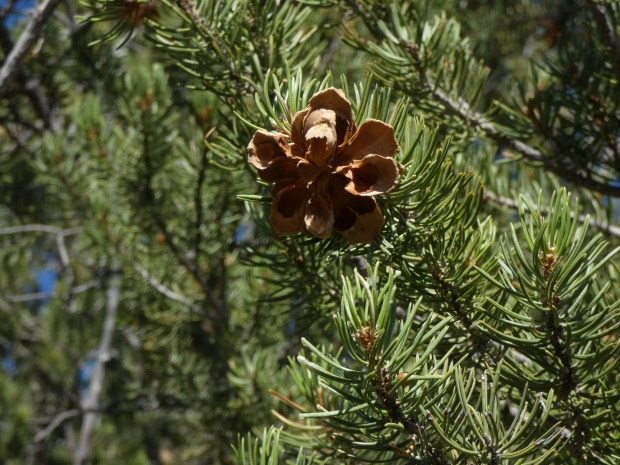
A Pinus edulis tree showing the 2 needles/fascicle densely covering the branches, and a remaining cone ready to fall..
______________________________________________________________ A Few Footnotes
**Piñon or Pinyon?
The most common common name for Pinus edulis is “Colorado” Pinyon Pine, even though the species is widespread in New Mexico, Utah and Arizona as well as Colorado. The words pinyon and piñon are usually considered interchangeable. Use of the word “piñon” (Spanish for pine nut) is tied to the seed (i.e. piñon seed or pine nut seed) and the tree (i.e. piñon pine or pine nut pine) particularly used by Native Americans in the southwest US. Because references consulted during my research were not consistent in their use of common names for Pinus edulis, to avoid (my) confusion I’ve opted to call the piñon seed (pine nut seed) a “pine nut” and the pine trees with edible seeds “pinyons.”
**** The 2024 retail market cost (shelled raw or roasted seeds) averages $40/pound
1 pound of seeds = about 4 cups (depending on seed size)
1 cup of seeds weighs about 4 ounces (price $10§)
1 ounce or 1/4 cup of seeds = 1 serving (price $2.50)
1 serving = about 167 seeds (price 1.5 cents/seed)
167 seeds = 191 calories (pine nuts are extremely high in unsaturated, heart-healthy fats and carbohydrates)
1 cup of seeds = about 668 seeds = 764 calories
4 cups of seeds = about 2,672 seeds = 3,056 calories
Number Play
Of the 50 seeds I harvested, only 30 were viable (price 45 cents)
It took me about 45 minutes to crack open the 50 seeds (this doesn’t include the time it took to collect the resin-coated cones and remove the seeds)
It would take me 67 hours to fill a 1 pound bag with 2,672 viable shelled seeds!
At $40/pound, a pine nut cracker would be paid only $0.59/hour for their labor, a wage earned back in the 1950’s and 1960’s which didn’t even come close to supporting a family then, let alone today.
Assuming a pine nut cracker makes a minimum wage of $7/hour, it would cost $468 to fill a 1 pound bag. That’s 1,170% more than the 2024 retail cost of a pound of pine nuts!
Obviously, a professional pine nut cracker is far more efficient than I was, using some form of mechanization to crack the seed coats (requiring more research on my part).
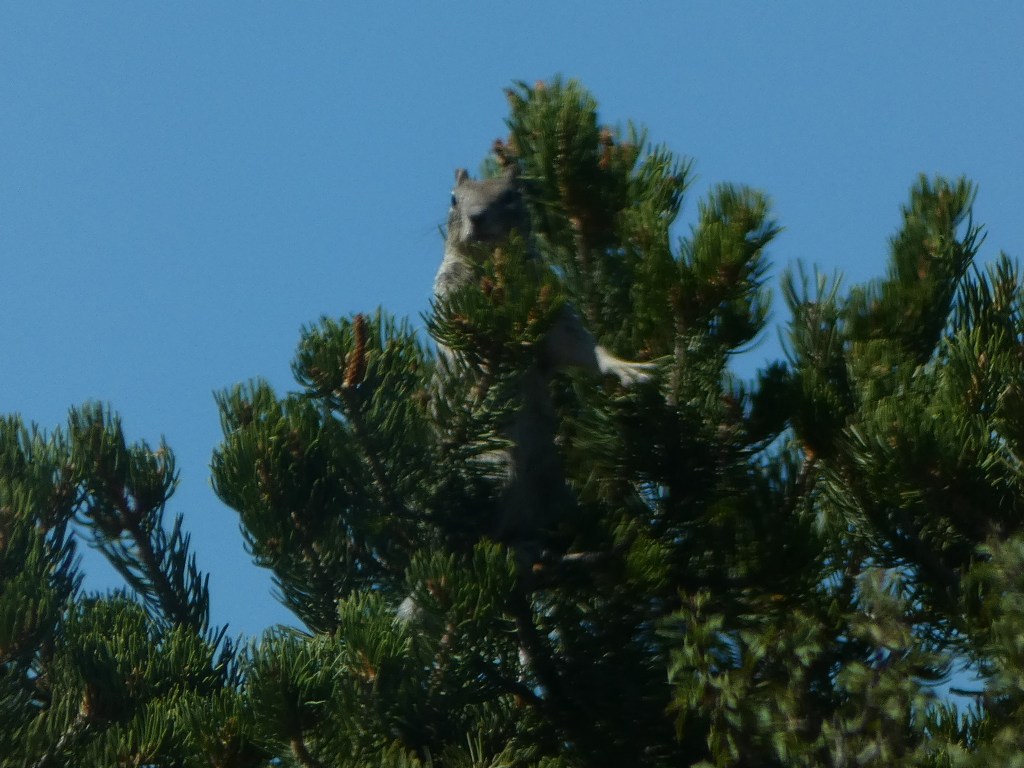
A rock squirrel high in a Pinus edulis tree, keeping watch for red tailed hawks while searching for pine nuts.
§Pesto ……. most pesto recipes I found call for the addition of 1 cup of shelled pine nuts, or 668 seeds. At 1.5 cents/seed, you’d be adding $10 of pine nuts to make one batch of pesto. Enjoy slowly!
Living in the East Mountains of central New Mexico ensures daily appreciation of hundreds and hundreds of Piñon Pines (Pinusedulis). This iconic pine, the state tree of New Mexico, has been a source of nutrient rich seeds for wildlife and indigenous peoples for millennia. It was fun learning more about this tree and the many Pinyon species that grow around the world.


 a curious nature