From Seed to Tree: The Irresistible Urge to Grow

A Pinyon Pine/Piñon Seed Update

February 7, 2025

Give a seed the right conditions ……. enough water, sunlight, the perfect temperature ….. and this small package cannot resist emerging from its protective coat to grow into a full grown plant.

Seeds are tiny marvels of nature. 
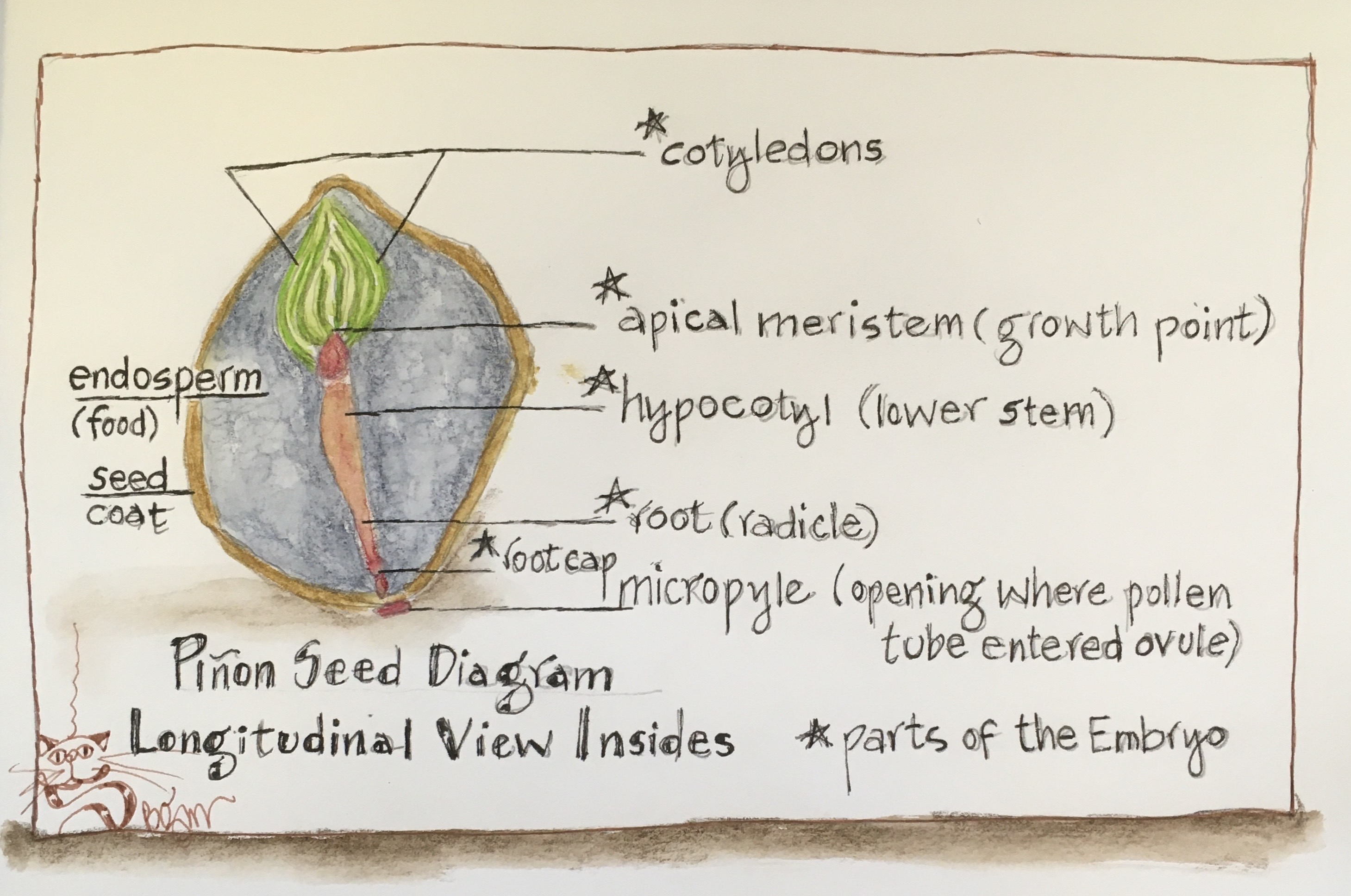
Looking inside the seed reveals a miniature pine tree!

Think about it ……. a seed is really a living baby plant (the embryo) surrounded by a cozy blanket (the endosperm) that cradles and nourishes the embryo while tucked inside the seed coat. When the coat unzips, freeing the “baby” as it begins to grow, it continues to be nourished by the endosperm until the first true leaves appear. Witnessing the process is so cool!

After collecting piñon seeds from last November’s foraging expedition, (Piñon or Pinyon, Piñon Seed or Pine Nut), we decided to treat a dozen or so to conditions just right to stimulate germination. But first the seeds required a short period of stratification (moisture) to help soften and crack the seed coats. Introducing moisture was done by lining a clear glass jar with damp paper towels and placing the seeds between the towels and glass to watch the action.
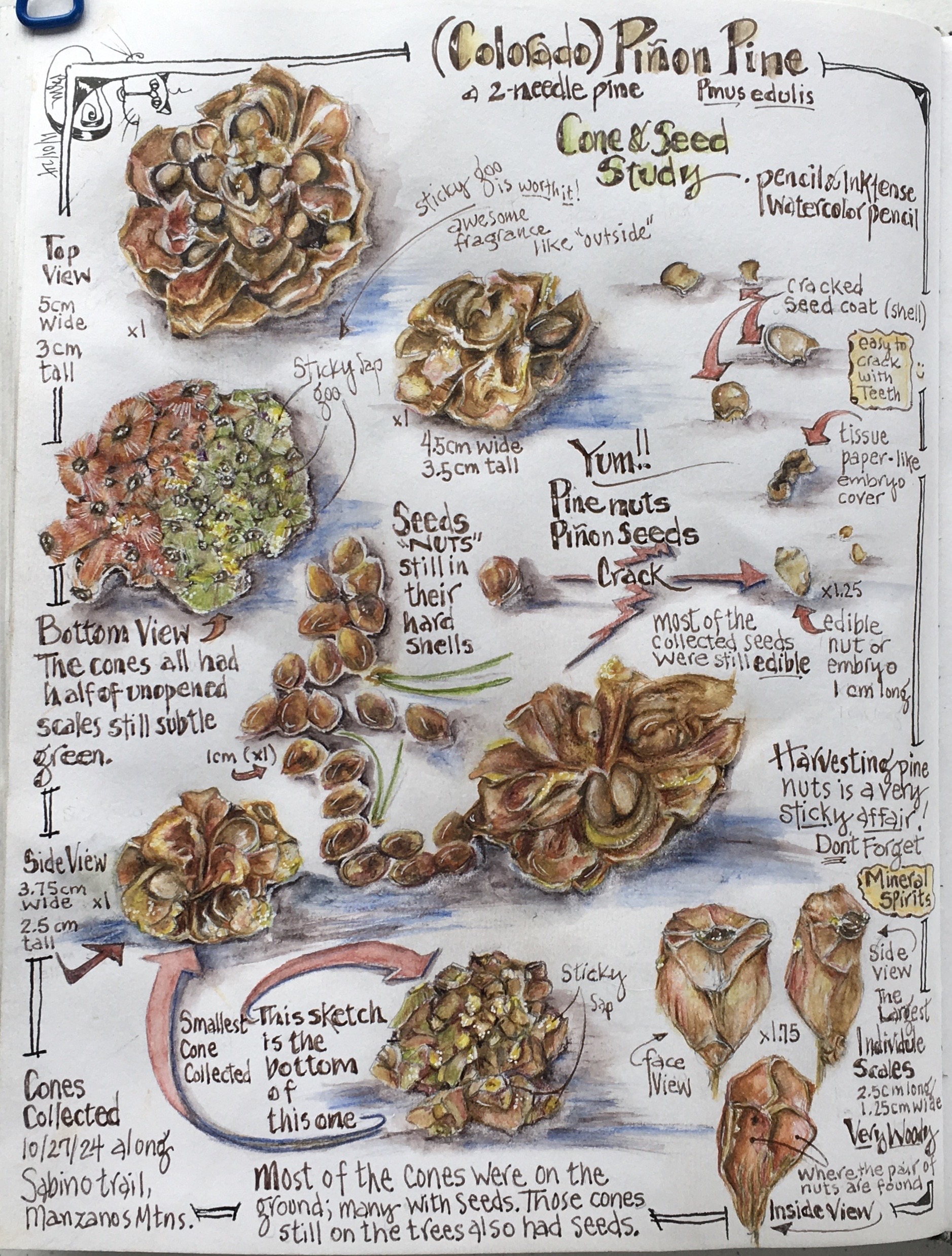
Post from November 2024 Seed Foraging Expedition

Soon embryonic roots (the radicles) successfully cracked the seed coats of nine seeds and began growing downward, as roots tend to do. In a week or so, before the embryonic leaves (cotyledons) appeared, all of the germinating embryos were planted. Six of the nine then sprouted their whorled cotyledons, followed by a growth spurt of the first true leaves, initiating the process of food manufacturing (photosynthesis). 
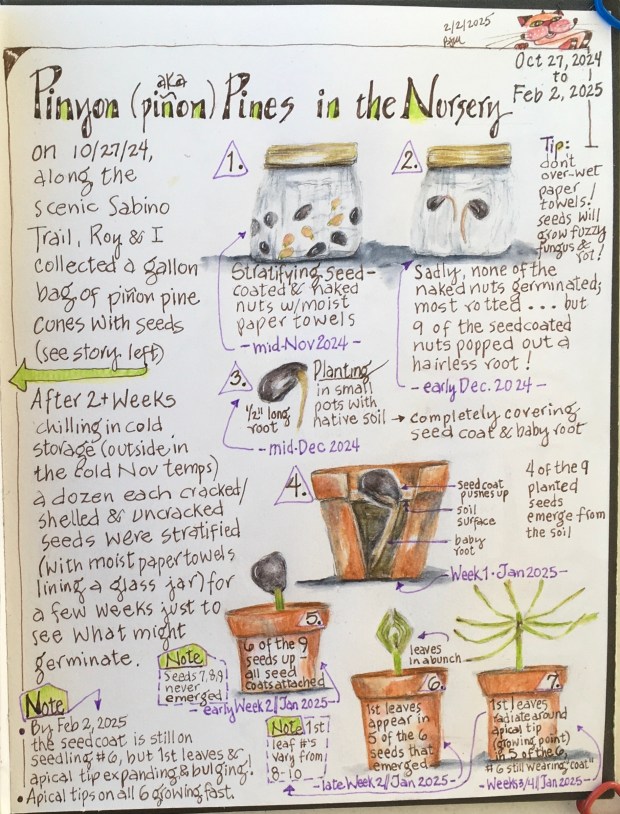
Steps to Germination

All of the germination and seedling development details of these piñon seeds, to date, can be found in my update illustrations. 

Seed germination is a fascinating process, and like the seed itself, is also a marvel of nature. Have you ever tried to germinate a seed? If not, give it a go.  It’s fun, educational, and imagination provoking ….. from such a small seed comes a full-grown flowering plant!
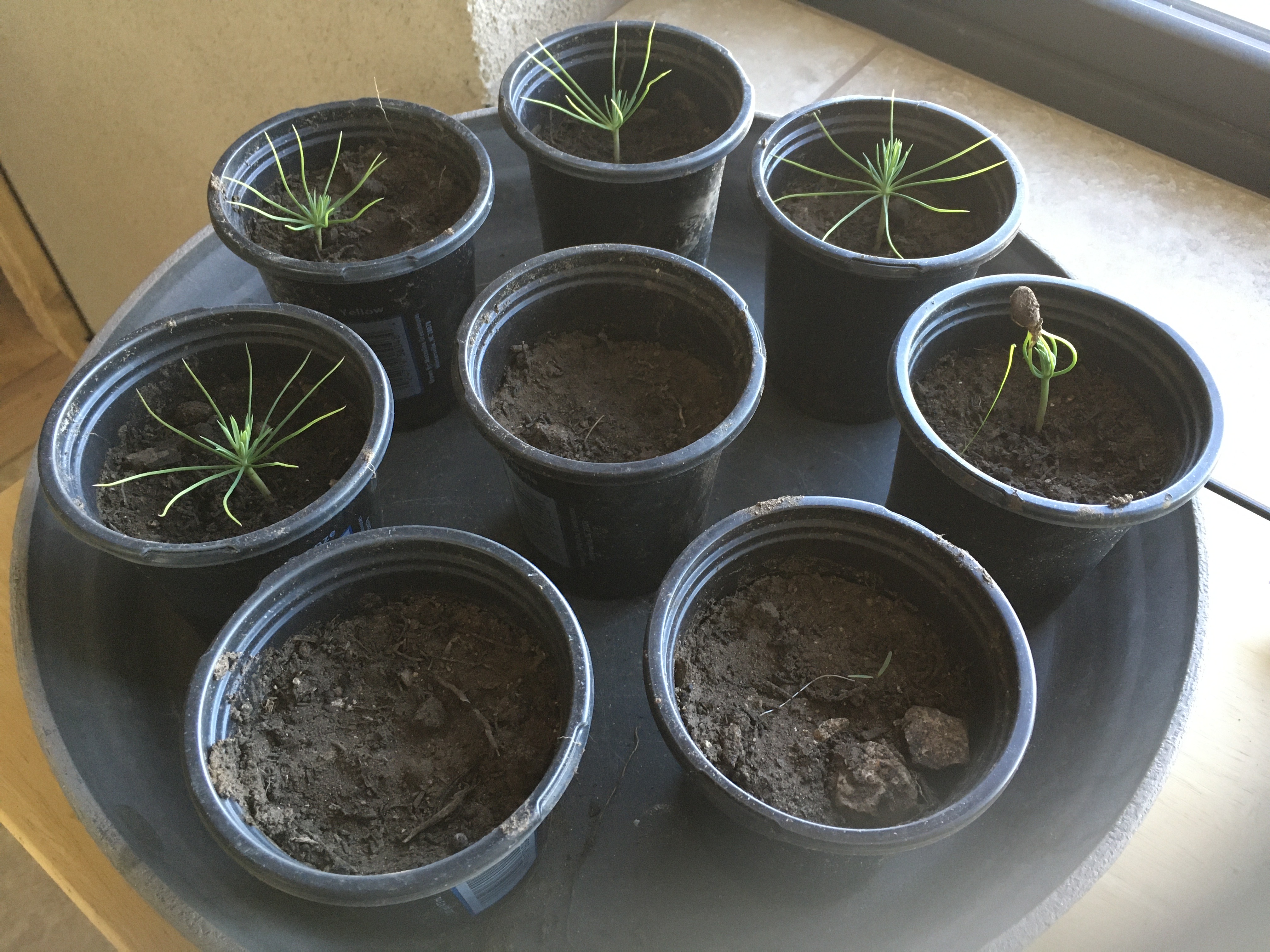
The evidence!

As always, thanks for stopping by!
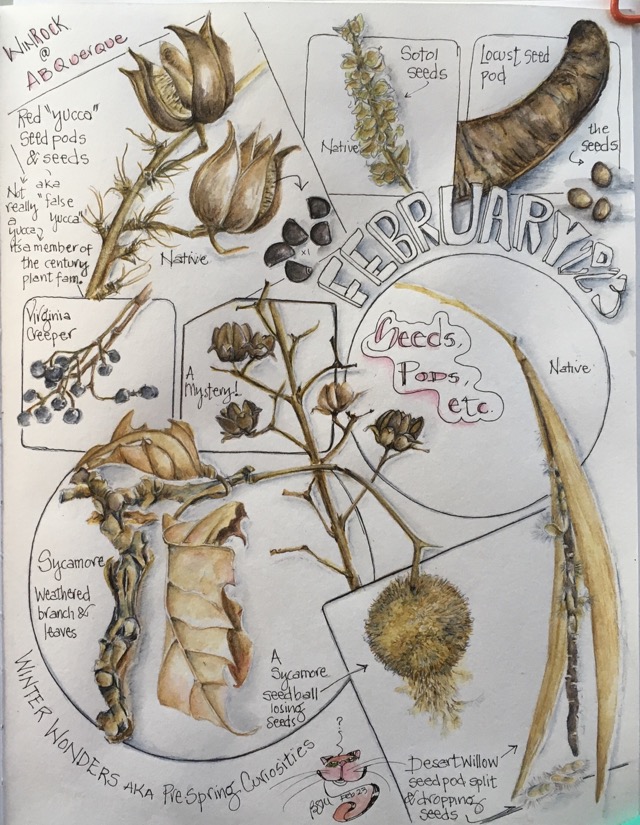
November Littles: Seeds, Pods, Silk, and Wings

December 14, 2023

As the Fall season rapidly came and went, and the first snows blanketed the landscape, I focused my hiking time (and some of my drawing hours) on collecting local native seeds. Always careful that plenty of seeds remained available for overwintering birds, I still managed to harvest hundreds from about 25 plant species.  All sorted and packaged in separate pill containers, my collection is now stored in the refrigerator at 40 degrees, until growing conditions are optimal for planting.  This treatment method is referred to as stratification.**

Why collect native seeds? All throughout the Spring, Summer and Fall, a diverse assortment of pollinators visited our locally blooming wildflowers and shrubs. Along with these butterflies, moths, bees, wasps, beetles and flies, were the insects, spiders, and birds that prey on unwary pollinators. Such an amazing show; a kaleidoscope of colors and shapes! The air was a buzz with activity. My goal is to mimic the native banquet in hopes of attracting these pollinators and predators. 

Also, seeds are absolutely fascinating. I like to think of them as gift-wrapped, living plants-to-be. Tucked neatly inside of the seed coat are food stores enough to feed the makings of a complex root system; flowers, leaves, stems, branches and even a trunk. Seeds can be tiny, some microscopic and some as large as a softball. Seeds come in a variety of shapes, colors, textures and decor both inside and out. Some seeds have “wings” to fly; some have silky or puffy “feathers” to float; some are like “lead,” heavy enough to intentionally sink under water.

So I pulled out my 10x hand lens to investigate, drawing most of the seed species in my collection. It was very cool to compare seeds of different species that are in the same family (like the composites of the Aster family and the penstemons of the Plantain family). Until creating this journal page, I’d never held the seeds of 3 different species of yucca in one hand at the same time. Observing the similarities and differences, I finally confirmed in my mind that the genus Herperaloe and Yucca are indeed in the Agave family. And then I found examples of seeds from completely different families that evolved similar dispersal mechanisms (convergent evolution). This phenomenon was visually obvious in the delicate feathery, silky, and poofy hairs or bristles attached to grass, aster, and milkweed seeds, facilitating seed dispersal by wind. 

Finally, I felt the need to draw the seeds in case they happened to spill into one big jumble while being planted! Yes, I would be clumsy enough to create chaos out of order. Should that happen, I’ll be able to sort the mess by species by referring to my field guide page.

** Seed-producing plants pass along to their seeds the specific requirements(s) necessary to break dormancy and germinate. These genetic codes determine if optimal conditions exist for seeds to sprout and hopefully grow to maturity. But key to successful germination depends on seed ripeness (in most cases). Knowing the plant species from which a seed is produced; whether the plant is an annual, biennial or perennial; habitat, moisture needs and the type of  “treatment” method(s) are all important bits of information tied to successful germination. 

I’ll have to create a future post describing the variety of treatment methods (germination patterns) inherent in the seeds.  

Are you a seed collector? If so, share your why’s and how’s!

February “Littles” Seeds, Pods, and Other Curiosities

March 13, 2023

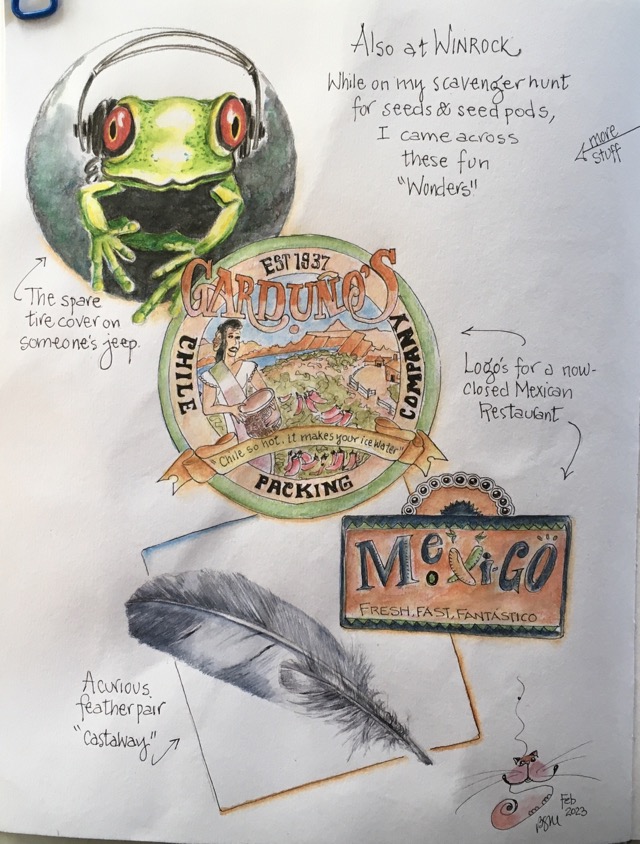
Like my January “Littles” page of the bird species that visit our feeders in winter, here’s another “Littles” to commemorate the not-quite-winter-or-spring month of February ….. Seeds and Seed Pods.  As a way to pass the time while waiting for Roy to finish up with a doctor visit, Luna and I conducted a focused scavenger hunt along a 2 mile circuit surrounding a large Albuquerque shopping mall. In no time at all, my collection bag was full.   But knowing my pages would need some local flavor and color too, I scavenged a bit longer and turned up a few more curiosities.    

Like with January’s page of birds, sketches of the species of seed pod and seeds (if collected) took less than 5 minutes each; my watercolor pencil paintings took about 10 minutes each. The restaurant logo and the frog design took a bit longer, and were done using my photos as reference. 

I’m not sure why it took nearly the entire month to decide what to do for my February “Littles.”  In hindsight, the decision should have been obvious, because I love seeds and the seemingly unlimited variety of pods.  Now I have a record of a few city seeds that will soon germinate, helping change the landscape from brown to spring green! 

Let me know what you think! I’m looking forward to March, when wildflower seedlings will be popping up which may appear in a few “Littles” boxes as well!

Thanks to “Made by Fay” for the “Littles” inspiration!


Intermission: Meet an Odd Member of the Rose Family …. The Desert (Eastern) Mountain Mahogany

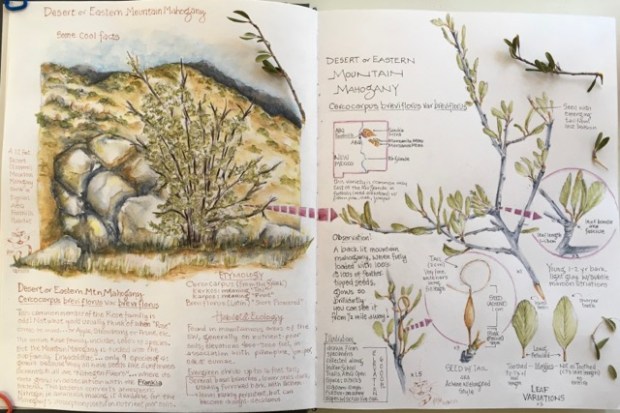
2 page journal spread

February 8, 2023

The Desert (Eastern) Mountain Mahogany is a very branchy shrub commonly found in the mid-elevation foothills of the Sandia, Manzanita, and Manzano Mountains east of the Rio Grande River in central New Mexico. This species’ formal and very appropriate name, Cercocarpus breviflorus variety breviflorus, comes from both Greek (kerkos: tail; karpos: fruit) and Latin (brevi: short; florus: flowered). As a matter of fact, the 9 species of the genus Cercocarpus all have long feathery tails that twist and turn from the tip of a single fruit, called an achene (like a sunflower seed). 

So why is this species odd? 

Well, the fruit, for one reason. Most of the thousands of rose family members have fruits called a hip (rose), pome (apple), drupe (prune), or aggregate (strawberry). And even though the strawberry is composed of numerous miniature achenes, it’s the single achene found in the mountain mahoganies that’s unusual to the family. 

To further emphasize the oddness of the Cercocarpus genera, all of its 9 species has a symbiotic relationship with a bacteria called Frankia.  And that’s an unusual characteristic of the rose family, which moved Cercocarpus and 4 other genera into the subfamily Dryadoideae. That’s all a bit technical when it comes to plant classification, and kind of skips the real reason why the Frankia bacteria is important to the survival of Desert Mountain Mahogany. Nitrogen Fixation!

Read on to learn more …..

Continue reading “Intermission: Meet an Odd Member of the Rose Family …. The Desert (Eastern) Mountain Mahogany”