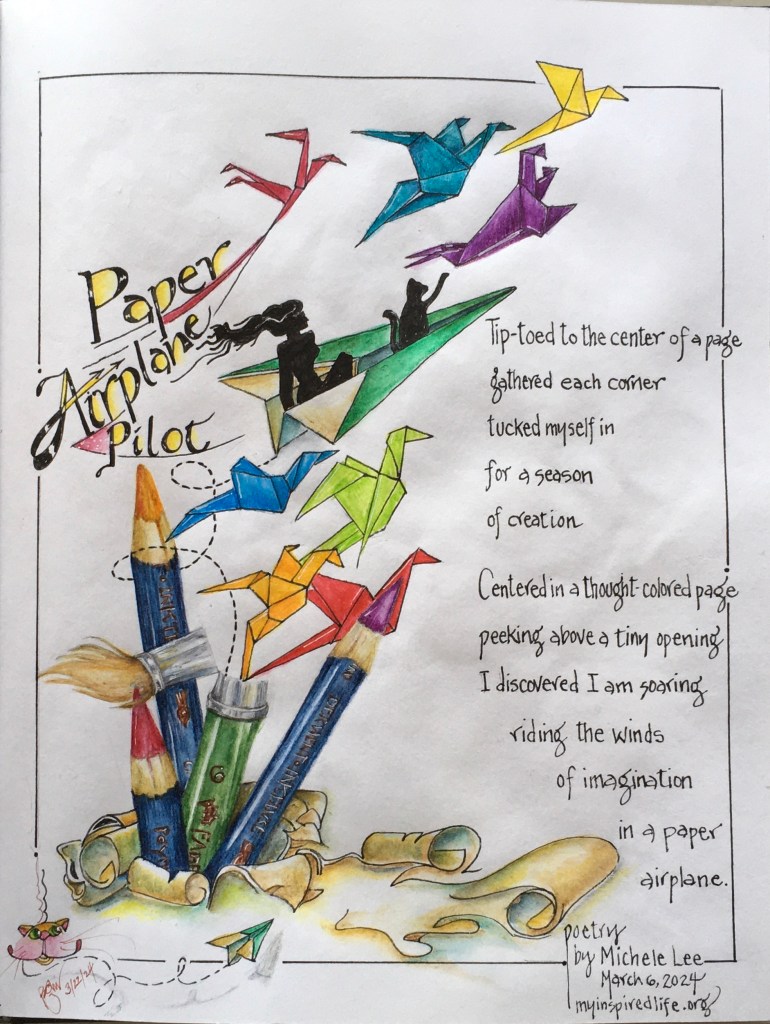
Reading this poem not only gave me the “lift” I was seeking on a dreary winter day…….. it was clear I wanted to design an illustration to further heighten the “lift” in anticipation of Spring and the new season of imaginative creation that was fast approaching!
Thanks to Michele Lee for allowing me permission to reprint her wonderful poem, Paper Airplane Pilot (March 6, 2024). Michele is a talented and prolific writer of poetry and prose, and a published author who lives in the heart of the Sonoran Desert. I look forward to her almost daily posts featuring something new and inspired on her widely-followed blog.
If you enjoyed Paper Airplane Pilot, your sure to enjoy her regular posts by becoming a subscriber to her blog, myinspiredlife.org
Seems like we’ve had tons and tons of snow this winter. And the closer we got to the official date of Spring (the equinox falls on March 19th this year), the more intense the storms became.
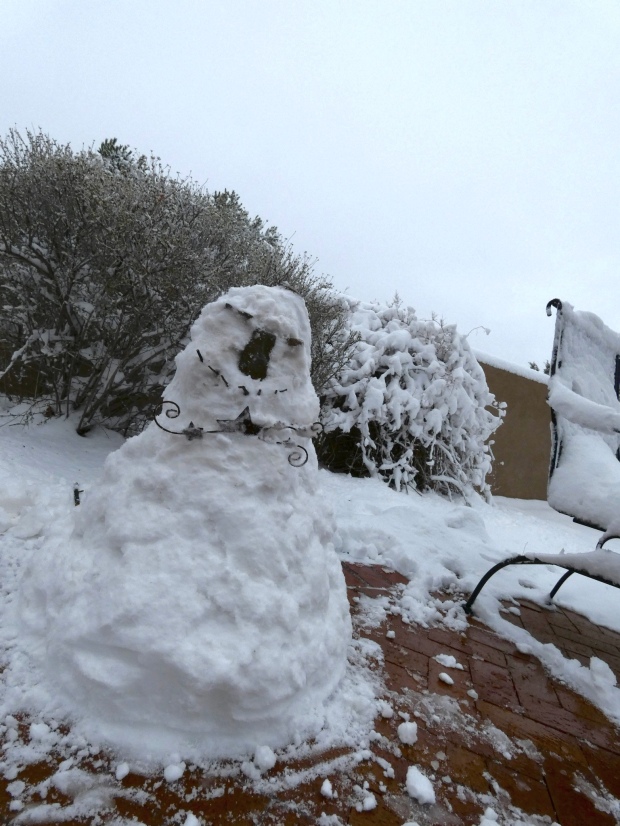
So when the forecast called for four straight days of snowstorms and piles of snow, I had an idea. ……. build a Jolly Snow Glob and journal his Life and Tymes.
Jolly Snow Glob, “Glob” for short!
Friday, March 15h was the birth day of the “Glob.” Constructed of freshly fallen snow that was the perfect combination of wet and fluffy, he seemed to hold together beautifully. If the weather forecast was accurate, he might even hold together long enough to witness the arrival of Spring.
Did he? See for yourself!
All four snow days and the 1st day of Spring …… from the beginning to the end of a Jolly Snow Glob
There are a number of different woodpecker and closely related species (sapsuckers and flickers) that frequent our Piñon-Juniper woodlands in the East Mountains of central New Mexico. These include the downy, hairy, Lewis’s, red-naped, Northern flicker, and Williamson’s sapsucker. They are always such a joy to observe, unless they’re drilling a hole in the side of the house. Their stiff tails allow them to ‘walk’ up and down tree trunks and other vertical surfaces that house insects or exude sticky sap. Their sharp bills are ideal for creating nest holes and sapwells in tree trunks. Their sharp calls, drumming, and stiff-winged flight make them easy to recognize as a member of the woodpecker group of birds.
Until mid-March we’ve never seen a Williamson’s sapsucker. Then one morning Roy was trying to catch a glimpse of a strange woodpecker on one of our old growth piñon pines. Immediately recognizing the markings of this bird were unlike any we’ve seen before, he excitedly fetched me from my studio to have a look.
Sure enough! Realizing this was likely a life list sighting for us both, the markings looked just like those illustrated in our numerous field guides. Indubitably, dear Watson! This was a Williamson’s Sapsucker (Sphyrapicusthyroideus) and he was treating us to a visit. We watched him (definitely a male, as females look completely different than the males, which is unusual for woodpecker species) working his way up and down the tree trunk. As he walked and hopped up and down the tree, he would circle the trunk and pause to lick up actively flowing tree sap from rows and rows of sapwells! Why had we never noticed so many sapwells on this tree before? Did this or other Williamson’s sapsuckers drill these shallow sapwells? Maybe another woodpecker species created them and the Williamson’s was stealing the nutritious sap? Are these new sapwells or have woodpeckers been drilling this tree for many years? Countless questions, but this handsome fellow wasn’t giving up his secrets. So we enjoyed his antics for about 30 minutes until he flew off, maybe to another piñon to lap its sap?
The next day, as we were about to pull into the garage, we spotted the Williamson’s again …… again working the sapwells up and down the piñon tree. We sat in the car and watched him while mulling over new questions, like “isn’t this the same time he was here yesterday?” “Why yes!” We closely observed his feeding pattern, beginning at about 5 feet above the ground, walking and hopping up the tree while circling the trunk, and when he reached the needled branches about 25 feet high, he would make a diving flight back down to the 5 foot height and again work his way up. This went on repeatedly for about 5 times before he flew away. Hmmmm! Why did he stop when he did? Had he licked up all the available sap for the day, and had to wait until the sap began flowing again? (I showed up later to see if he returned ….. he didn’t. Maybe my timing was off? Maybe the sap flow still wasn’t worth his trip?).Day 3, and same time/same place. This hungry bird was back lapping sap! Same up and down behaviors; same departure time.
Day 3, and same time/same place. This hungry bird was back lapping sap! Same up and down behaviors; same departure time.
Day 4, ditto
Day 5, ditto
Day 6 ……. We arrived at the same mid-morning time, and waited. And waited. And waited. The Williamson’s sapsucker was a no show. And we haven’t seen him since.
Was he only migrating through, just long enough to stock up on high energy meals? Apparently this species is widespread and fairly common throughout the Rocky Mountain West, but their breeding range begins just north of us and extends into Canada. However, we are well within the Williamson’s sapsucker’s winter range. Hope he returns again next year!
Meanwhile we’ll be watching that old growth piñon to see if the sapwells draw in other hungry birds!
Now, a few fun facts about the Williamson’s sapsucker and sapsuckers in general.
While the male Williamson’s sapsucker is silky black with a cherry-red throat, a brilliant lemon-yellow belly and bright white wing patches, the female looks totally different. This is very unusual for birds in the woodpecker group. The female has a mousy brown head, banded back and small patches of black and yellow on the belly.
The difference is so striking between the male and female, they were originally thought to be different species entirely. It wasn’t until 1873 that ornithologists realized they were the same species. Naturalist Henry Henshaw located a pair at their nest in Colorado and published his observations, thus putting an end to the confusion.
Sapsuckers get their name from their habit of drilling rows of shallow holes in tree bark. The birds come back to these holes to lick the sap that flows from these holes and to eat insects that have become caught in the sticky residue.
Early ornithologists in the West reported seeing Williamson’s Sapsuckers at sapwells in aspen trees; however, in the past 100 years, observers have seen their sapwells only in conifers, never in deciduous trees. The early reports might have been of Williamson’s stealing sap from wells made by Red-naped Sapsuckers.
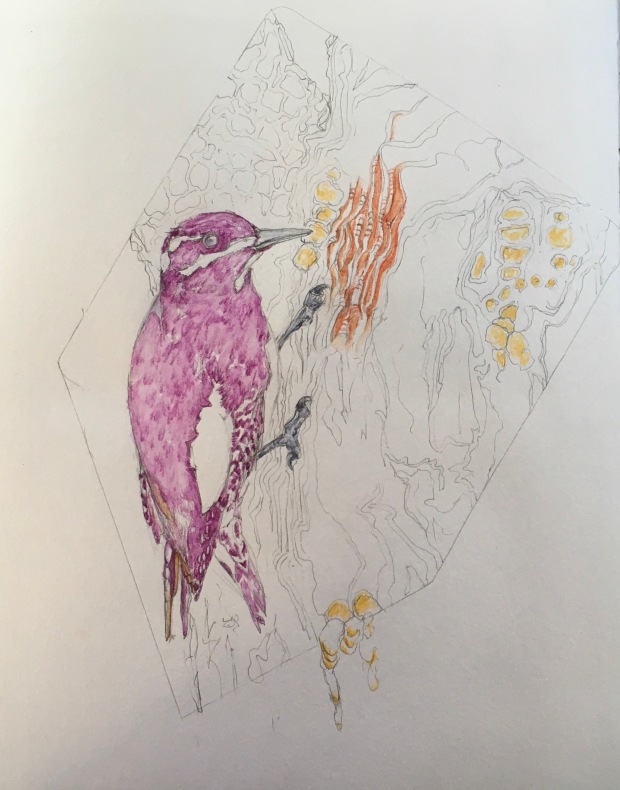
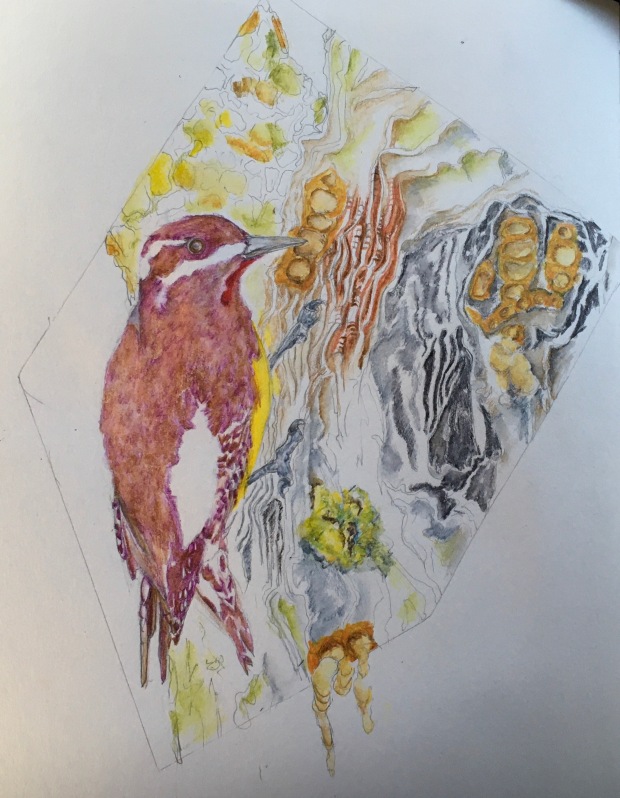
Here’s a few progress shots I remembered to capture while creating the Williamson’s clinging to the tree
Earliest coloring stages …. Laying down base colors to build up to the Williamson’s silky black back
Adding more base colors, sapwell and tree bark furrowing details
Close to final image. The black was achieved by using purples, browns, blues and greens to achieve the iridescence of his black coloring.
It’s been a few days now, and the scene continues to replay over and over in my mind’s eye. Somehow my sketch of these two birds …. one the victor, the other the victim ….. came easily and quickly, much like the time it took for the event to unfold.
Returning to our house after photographing snow scenes created by an overnight winter storm, I paused at the door, turning to admire the beautiful white landscape. Faster than an eye blink and just as quiet, a sharp-shinned hawk soared by at top speed, obviously intent on capturing one of our feeder birds!
I’ve seen this small hawk fly by a few times over the past several weeks, but the smaller juncos, finches and titmice always managed to duck for cover in the nick of time, foiling the “sharpy’s” chances of a meal. But the hawk, perhaps better skilled in his timing and approach after some practice runs, wasn’t about to miss on this day.
The spotted towhee must’ve been so focused on scratching for buried seeds that all obvious warning calls eluded him. Out in the open eating seed under one of our feeders, the towhee must’ve been too hard to resist for the sharp-shinned hawk, and fell victim to the expert predator.
Having camera already in hand, I was able to take a half dozen photos after the sharpy snatched the towhee with his long piercing talons, pinning him securely to our brick patio. As sad as it was to watch the towhee struggle against the hawk’s sure grip, it was all over for the towhee in 30-45 seconds. Then as fast as the sharp-shinned hawk had attacked, he regripped the lifeless towhee, lifting him effortlessly and flew away into the trees.
The circle of life.
“You can’t imagine anything like nature as we know it without predators.”
-Dale Jamieson
“Every living creature, big or small, plays such an important role in our ecosystem.”
-Mufasa’s memorable speech to Simba (from The Lion King)
Happy Birthday Dr. Seuss! Born in Springfield, MA in 1904, if this brilliant author, poet, and illustrator of more than 66 memorable children’s books was alive today, he would be 120 years old! That’s a lot of candles …….. and imagine the variety of fanciful characters he would still be gifting all of us “kids!”
Dr. Seuss Day is an annual celebration held on March 2nd to honor the birthday of Dr. Seuss, a famous children’s author. The day is marked by reading Dr. Seuss books and participating in educational activities.
March 2, 1904 – September 24, 1991
Seriously, is there anyone out there who’s never heard of Dr. Seuss? Born Theodore Seuss Geisel, Dr. Seuss began his career as a cartoonist early in life. With an imagination beyond compare, he began writing children’s books in the 1930’s, publishing his first, And to Think That I Saw it on Mulberry Street, (one of my first Seuss books) in 1937. Then war interrupted his career, and for a number of years he turned political cartoonist (note to self: haven’t seen those ….. must find!), returning to writing children’s books after the war.
I always have, and always will love the works of Dr. Seuss. Apparently Flambé is a fan too. And even though it’s not her birthday, I wanted to delight Kat with my best attempt at Seussian-style storytelling poetry, inspired by her favorite book (and food), One Fish, Two Fish, Red Fish, Blue Fish.
Happy Birthday Dr. Seuss!
Line work before color.
Like myself and Flambé, do you have an insatiable appetite for all things Dr. Seuss? If so, share your favorite character(s) or book(s)!
Every year, for the past several years, I’ve shared with my most excellent and talented friend and poet, Elaine, the official word prompts used by artists around the world participating in Inktober. Then inspired by these prompts, Elaine creates original poetry, many of which she shares with me.
“Toad” is one of those poems.
Inspired by her words, and my appreciation of this chubby amphibian, here’s how I thought “Toad” might be illustrated. Perhaps this combined effort would be a cute mini bedtime story Elaine could read to her grandson? I wonder!
Arrow shows where to lift next
A full page view, unfolded ….. The inside
A full page view, unfolded
A Toad is not a Frog is not a Toad
The tri-fold card style worked perfectly for the poem, allowing several of the toads to appear more than once. While illustrating the card, it was important to understand the visual characteristics separating a toad from a frog. This challenge led me down both a slippery slope leading to a marsh, and a hidden trail meandering through a nearby grassy meadow. Here’s what I discovered …..
Thanks for sharing the birthday joy!
Elaine received this Toad card in time to celebrate her Leap Year Birthday. I love that we share our creative projects with each other! There’s no finer warm and fuzzy feeling.
Happy “19th” Birthday to you, Elaine, on this year’s February 29th, Leap Year!




 a curious nature