Lanceolated Chafer- Page 13 .. The 100 Day Project (2026)

July 9, 2026

Lanceolated Chafer (Phyllophaga lanceolata)

(syn Melolontha lanceolata)

aka Brown Scarab Beetle, May (June) Beetle

The Lanceolated Chafer (Phyllophaga lanceolata) is a scarab beetle native to North America. In New Mexico (along with Colorado and Kansas) these chafers thrive in open, grassy ecosystems, including native shortgrass prairies, pastures, rangelands, and agricultural fields dominated by grasses like blue grama (Bouteloua gracilis) and others. It’s in these arid habitats that the larvae (grubs) are rarely considered major pests1. Unlike most Phyllophaga species, adults are diurnal (active during the day); females are flightless

Adults – This small to medium-sized chunky beetle, is about 0.5 to 0.7 inches (13 to 17 mm) long; females are larger than males. Their hard wing/body cover (elytra) is brown with several darker brown/grayish longitudinal marks under a coat of white bristly hairs. Their segmented abdomens are mostly a smooth grayish/white; their thorax (pronotum) is heavily covered with long brown hairs. Because of their noticeably long, magenta-colored legs, they stand tall above the ground while walking. If picked up, their legs feel clingy and prickly. Adults live only 1 – 2 months, just long enough to grab a quick bite to eat, mate, and lay eggs.

Calling All Males!

The female Lanceolated Chafer produces and uses a unique sex pheromone, l-leucine methyl ester, to attract males! Because this pheromone acts as a highly-targeted sex attractant in the wild, she is able to communicate her readiness to mate and get a rapid response. As has been demonstrated in field trials, male chafers catching a whiff of her urgent communication can’t resist the call and come flying (read the true story of my eye-witness account in my post titled The Life and Times of the Lanceolated Chafer ). Research scientists (and I) whole-heartedly believe this pheromone contributes to the species’ reproductive success in its native range. 

This was a unique discovery because the Lanceolated Chafer is the first scarab beetle ever identified to produce an amino acid-derived pheromone. (And there are over 35,000 species of scarab beetles in the world, making up one of the largest and most diverse insect families on Earth!) The pheromone is so effective at targeting male chafers that entomologists use it to monitor and manage populations of these beetles in agricultural crops and turfgrass. 

Probably a male chafer, walking along the 2-track trail

And now a note about topic organization  ….. 

As in all beetle species, it’s usually the adults that are encountered. And it was the adult stage of the Lanceolated Chafer that’s most obvious along the subdivision’s 2-track rockpile trail. That’s why information about the adults was placed first, even though it’s actually the final stage in the life cycle of the chafer. But it’s interesting to understand how all those adults came to be. So the following few sections tackle the highlights of the 1 – 3 year long larval stage, and pupal stage of their life cycle, which take place after egg laying and hatching. Afterall, the Lanceolated Chafer spends the longest parts of their lives underground.  And then, for no particular reason, I’ll end with a section on entomology.

Larval Stage – Larvae (grubs) have a translucent white to cream-colored body and a light tan to brown hard and stiff (sclerotized) head capsule.  Larvae have three pairs of well-developed legs. When at rest they do so in a C-shaped curve.

By the 3rd instar, internal organs are more visible and jaws are larger! Grubs have a voracious appetite.

Larvae live for 1 – 3 years, primarily in the upper layers of the soil profile. To protect themselves from extremes in soil temperatures, both in  summer and winter, they will burrow to depths ranging from 3 to 20 inches (7.6 to 50.8 cm), averaging 10.3 inches (26.2 cm). Larvae actually hibernate in the winter.

The three instar stages of larvae development, serves to progressively increase body size, head capsule width, and degree of sclerotization. At the end of each instar, larva take up excess air and/or water to swell their bodies. This extra pressure causes its old exoskeleton to split, allowing it to be shed (a process called ecdysis). Mature (third instar) larvae are 1.75 inches (45 mm) long with a nearly uniform body width.

Pupal Stage and Metamorphosis – When larvae are ready to move beyond the third instar, each individual builds a protective, earthen cell in the soil 8 to 12 inches (20 to 30 cm) deep where they will remain for the next 2 – 4 weeks while they undergo metamorphosis and and finally emerge as adult beetles.

Etymology 

The genus, Phyllophaga, is a generic name that comes from two Greek words ….. phyllon which means “leaf,” and phagos which means “eater.”  The specific epithet lanceolata comes from the Latin word lanceolatus, meaning lance-shaped, probably referring to the fine, lanceolate hair-like scales covering parts of the beetle’s body, such as the head (frons) and thorax (pronotum).  The etymology of the word “chafer” comes from an Old English word meaning “gnawer,” referring to the beetle’s strong jaws.

…………………………………………………………………………………………………

Hope you found this interesting!

As always, thanks for stopping by!

1  Larvae of Lanceolated chafers are considered serious pests in the humid central and eastern U.S. they cause extensive damage to agricultural crops like corn, timothy, potatoes, and various other plants in the grass (Gramineae), pea (Fabaceae), and sunflower (Asteraceae) families.

References

ageconsearch.unm.edu

bugguide.net

grokipedia.com

iNaturalist.org

insectIdentification.org

invasive.org

npsnm.org

Lunginbill Sr., P and Printer, H.R., 1953, May Beetles of the US 

The Life and Times of the Lanceolated Chafer

The Case of a Mysterious Wormy Thing

July 9, 2026

This is the third year in a row that I’ve noticed these seemingly unremarkable-looking brown beetles “hiking” along the rock pile 2-track road. They appear all at once, about mid-June, then vanish after several weeks. This year (2026) these scruffy/fuzzy beetles, know as Lanceolated Chafers (Phyllophaga lanceolata), really caught my attention, especially after finding myself at ground zero of a mass male Flash Mob1 !!! From all directions, determined (and awkwardly) flying male chafers were dodging my legs to land on top of a lone female beetle frantically struggling against an earlier arriving male. His prickly lance-like legs had pinned her to the ground so she was lying on her side unable to use her legs. While she squirmed at my feet, newly landed beetles tried to fling off the original male to claim their rights to the female. Males continued to land until there must’ve been 30 or more, with fights breaking out everywhere, on top of the female and all around my feet. Each male was jousting to be victor. 

Males arriving, fights break out

But a victor of what? Was this some sort of mating ritual? Had the female released highly potent pheromones to attract a mate? If so, how far did her “call” drift on the wind to bring together so many males at one time? Did she intend to call only one male, or was her purpose to entice a stampede? If she anticipated a herd, was her intent to mate with the first one (the fastest?) to arrive? Maybe she hoped for battles and skirmishes to ensue, where the strongest of all males would win her favor(s)? This still remains a mystery, as I couldn’t find anything in the literature to explain this behavior? 

While pondering these questions (and daring not to move my feet for fear of squishing one of the many male pile-ups), I bent over for a better look. It was then I noticed an opaque white, worm-like thing slowly emerging from the female’s abdomen! “What could this be?” ….. 

Was it a larva? Probably not ….. Female chafers don’t give live birth; they lay eggs in the soil beneath their favorite host plants (such as mallows), where they hatch into grubs that remain underground for up to two years before emerging as adult beetles. 

Five males fighting for the female (notice how much larger she is than a male). Bit of a skirmish, left side.

Was it part of or the actual female genitalia? Maybe? I’m still searching for information about that notion.

Was it part of the male genitalia that had somehow broken off inside the female during insemination? Is that even possible? Again, still searching for answers about chafer sex.

Three males with the female (notice the “wormy” thing). One male, lower left, apparently confused?

For another 5 minutes I closely observed the squirming female laying helpless on the ground fighting off numerous suitors while still displaying the wormy “thing.” As more males continued to arrive, crash-landing on other grounded males and adding to the chaos, something changed. Can’t explain what happened, but in a matter of 15 seconds all the males stopped their aggressive fighting and took flight; the female uprighted herself (regaining her dignity?), quickly walking away like the nothing unusual had just happened. I watched her go, noticing she was no longer in possession of the wormy “thing,” and couldn’t find it anywhere at or near the scene! 

The party is over. A male walking away, looking for a mallow to snack on.

After-math

Over the next several days, nary a chafer was found! Had all the males satisfied their natural desires? Had all the females become pregnant, laid their eggs and vanished? “After” doing the “math” on the days following the event, I counted only two beetles walking the 2-track road, one headed north — one headed south. Scouts? ….. Because Lanceolated Chafer adults only live 1-2 months, and because none have been seen since the last two, that may be the end of sightings for this year. While there’s still the occasional pack of ants dragging away a dead beetle to share with their colony, the legacy of adult chafers lives on. Recently-laid eggs will hatch after only 18 days into white or cream colored, C-shaped larvae. Those grubs will munch away on mallow and grass roots for the next 1-3 years until a perfectly warm mid-June day, sometime in the future, the adults emerge from the soil to complete their life cycle. 

Epilogue 

Since most chafer beetles are nocturnal (active at night), if you’ve seen an adult during the day, it may have been the Lanceolated species which are diurnal (active during the day).  And you may have unwittingly encountered any of the chafer species found in North America……. 

An exhausted male, a bit off balance, as he feeds on mallow leaves.

…….. If you’ve ever seen one or more of your carefully-tended, vigorously-growing garden plants up and die overnight, it may have been victimized by root-living chafer grubs.

…….. If you live in the central or eastern U.S., grubs may be feasting on the roots of agricultural crops, like corn, soy, or sunflowers. Headline news is sure to cover the story of devastation and financial ruin brought on by the voracious chafer beetle larvae, complete with video of farmers holding a handful of grubs dug from below the soil surface.

Have you experienced one of these close encounters?

Hope you’ve found the “Life and Times of the Lanceolated Chafer” interesting (or maybe educational, peculiar, or maybe even fascinating!?!). Let me know what you thought.

As always, thanks for stopping by!

1 A flash mob is defined as a large group of people who suddenly assemble in a public place, perform a brief, pre-arranged action (like a synchronized dance), and then quickly disperse. Flash mobs are typically organized online via social media or viral messaging for entertainment or artistic expression. I think this definition nearly perfectly fits the chafer beetle dance I was witness to on that fine mid-June morning somewhere along the 2-track rock pile trail. 

Meet an “Extreme” Creative!

April 8, 2024

After years of on-line and email chats, I was delighted when my friend Robin Atkins decided it was finally time we met in person! Bravo!

Robin and her travel buddy Lunnette, drove over 1,800 miles to Tucson to teach a Spirit Doll class to a local beading group. Then after spending 5+ days exploring Tucson and before driving home to Friday Harbor on San Juan Island, WA, they took a “short” scenic 450 mile detour …… to Tijeras, NM. This out-of-the way drive would bring them to our doorstep, and our first face-to-face meeting! While in Tijeras, we were able to spend an evening and full day getting to know each other and spent time hiking, nature sketching, and sharing each other’s art.

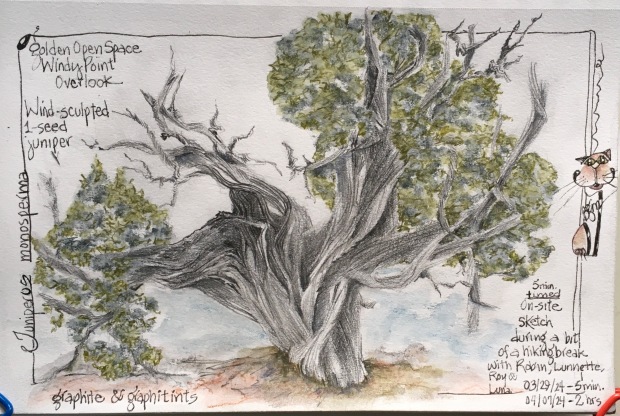
Robin snapped this photo of me sketching out at Golden Open Space. The beautiful wind sculpted juniper trees growing along the precipices of the windy observation areas are absolutely captivating (and tough). Luna thinks they’re tasty!

Meet Robin

Robin, whom I’ve always thought of as an “extreme creative,” is a fascinating, energetic, curious, passionate and bright-eyed adventurer in her early 80s. Her many interests and skills, in addition to creating uniquely designed, hand sewn and beaded Spirit Dolls, include: quilting (many with bead embellishments), thread embroidery, book making, watercolor painting, Zentangle art, nature journaling, making decorative papers, poetry, weaving, collage, crochet, felting and book author. And she shares her skills and techniques by teaching. 

This isn’t an exhaustive list by any means! As someone who seems to thrive on learning and developing new skills, Robin never stops seeking artistic challenges to take on. 

Check out Robin’s beautiful webpage and blog (http://robinatkins.com) where you can find photos and posts highlighting her current and past creative projects. 

A Short-but-Sweet Visit

We had a wonderful time getting to know each other, and what a delight to have also met Robin’s long-time friend and travel buddy, Lunnette. A retired firefighter in her mid 70s, Lunnette is also a nature journaler, calligrapher, quilter, and according to Robin, “she’s a terrific navigator, who always uses her keen sense of direction and map reading skills to keep us on the “right road,” (in both the literal and figurative sense).”

This is my finished graphite drawing of the twisted juniper I spent 5 minutes sketching.

Parting company was hard, but Robin and Lunnette needed to return home. Along their route they visited both Mesa Verde National Park and Arches National Park, soaking in more of the desert southwest sun and culture before taking on the 1,200 mile journey for Friday Harbor.

Memories!

The Circle of Life

March 17, 2024

It’s been a few days now, and the scene continues to replay over and over in my mind’s eye. Somehow my sketch of these two birds …. one the victor, the other the victim ….. came easily and quickly, much like the time it took for the event to unfold. 

Returning to our house after photographing snow scenes created by an overnight winter storm, I paused at the door, turning to admire the beautiful white landscape. Faster than an eye blink and just as quiet, a sharp-shinned hawk soared by at top speed, obviously intent on capturing one of our feeder birds! 

I’ve seen this small hawk fly by a few times over the past several weeks, but the smaller juncos, finches and titmice always managed to duck for cover in the nick of time, foiling the “sharpy’s” chances of a meal. But the hawk, perhaps better skilled in his timing and approach after some practice runs, wasn’t about to miss on this day. 

The spotted towhee must’ve been so focused on scratching for buried seeds that all obvious warning calls eluded him. Out in the open eating seed under one of our feeders, the towhee must’ve been too hard to resist for the sharp-shinned hawk, and fell victim to the expert predator.

Having camera already in hand, I was able to take a half dozen photos after the sharpy snatched the towhee with his long piercing talons, pinning him securely to our brick patio. As sad as it was to watch the towhee struggle against the hawk’s sure grip, it was all over for the towhee in 30-45 seconds. Then as fast as the sharp-shinned hawk had attacked, he regripped the lifeless towhee, lifting him effortlessly and flew away into the trees.  

The circle of life.

“You can’t imagine anything like nature as we know it without predators.”

-Dale Jamieson

“Every living creature, big or small, plays such an important role in our ecosystem.”

-Mufasa’s memorable speech to Simba (from The Lion King)