
May 9, 2026
Rose Heath (Chaetopappa ericoides)
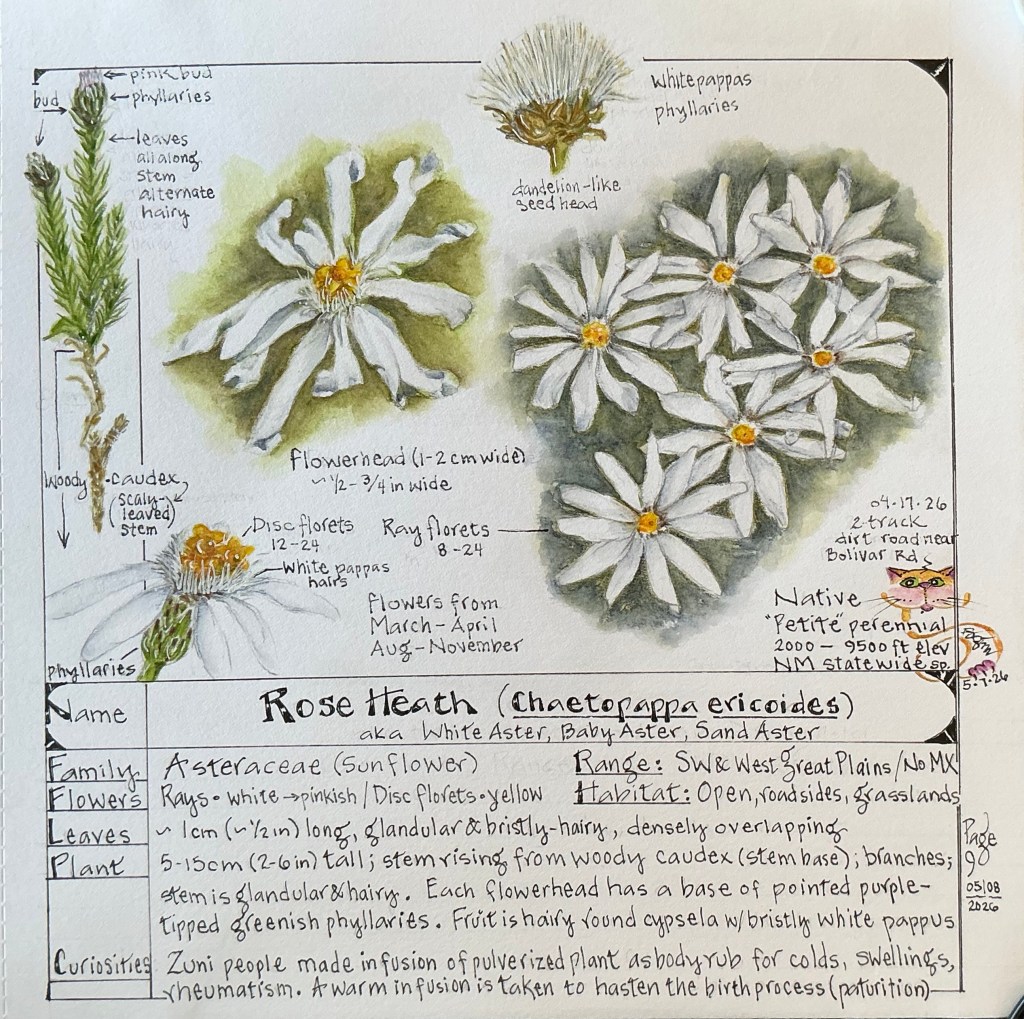
When the last Spring snow melts and the runoff soaks into the nooks and crannies of dehydrated soils, there’s a thirsty little shrub that eagerly drinks its fill. The leafy stems of this tiny shrub, so easily overlooked in the winter, rapidly grows on bare ground, around the drip line of pinyon and juniper trees, in the negative spaces between rocks and broken branches, and through beds of dried grasses. Then in a day or two a very small flower bud forms on the top of each stem, and in half a week the buds open simultaneously. What a spectacular display of brilliant white daisies ….. bouquets of light!
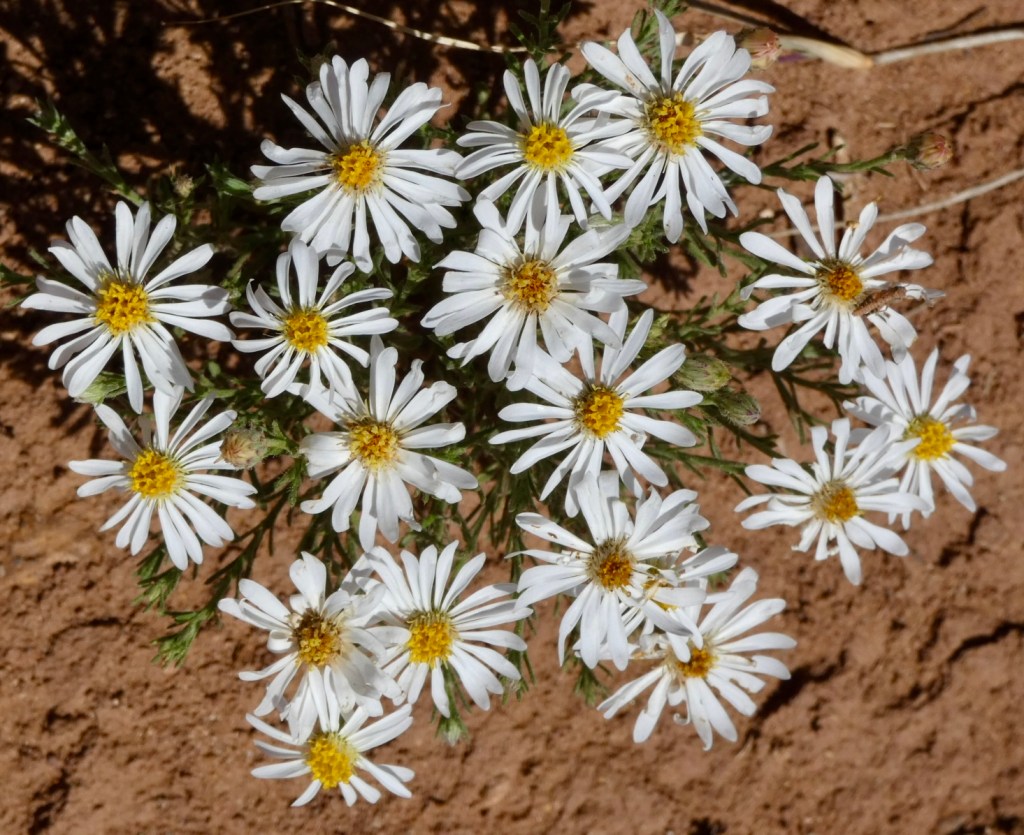
Barely ankle high, each flowerhead can have up to 24 white ray florets surrounding a rich buttery yellow center of 12-25 disc florets. And don’t fret if you notice the ray florets have curled downward in the evening. They magically unfurl to their full length by mid-morning the following day.
This annual Spring show, which takes place all across the U.S. west and western Great Plains, is brought to you by the “petite” perennial called Rose Heath (Chaetopappa eriocoides). (Widespread and common in New Mexico, Rose Heath is adaptable to a variety of soils, elevation, and drought.)
The show typically begins in late March and continues into early May. And for those craving more, flowering resumes in August and can run until November; no charge. You just have to get out there and see for yourself!
Origin and Etymology – What’s in a Name?
Origin of the Scientific Name, Chaetopappa ericoides
Augustin Pyramus de Candolle, a Swiss botanist, named this genus Inula in the early 1800s. But in 1827, it was the American botanist John Torrey, who named the species Inula ericoides, from a specimen collected by botanist Edwin James along the Canadian River during Major Stephen Long’s Expedition of 1819-1820. Since that time, the species has undergone more than a dozen name changes including Leucelene ericoides (Edward Greene in 1896) and finally Chaetopappa ericoides (Guy Nesom in 1988).
Etymology of the Scientific Name, Chaetopappa ericoides
The genus “Chaetopappa” is Greek for ‘bristly pappus’ (pappus refers to the score of tiny white bristles surrounding the disc florets; the same bristles, one per seed, that helps carry Rose Heath’s mature seeds up, up and away. The species “Ericoides,” also Greek, means ‘similar (“oides“) to Heath’ (“eric”); i.e., the plant’s tiny, overlapping leaves are similar to those of some Heaths (Ericaceae is the scientific name of the Heath Family.)
Common Name, Rose Heath
From the previous paragraph, it’s obvious where the name ‘Heath’ comes from, as Rose Heath does have stems and leaves very similar to a heath plant. But why ‘Rose?’ What I found is ‘Rose’ is Latin in origin, derived from “rosa,” referring to the flower. Because the daisy-like flowers of Rose Heath don’t resemble a rose flower, deeper diving was needed. I discovered that throughout history ‘Rosa’ and ‘Rose’ have represented love, passion, innocence, and beauty. So perhaps ……. ? If you’re familiar with Rose Heath or have seen photos of the plant in bloom, do you love or could you love its beautiful floral bouquets? I think whoever thought to call this plant by the common name ‘Rose Heath,’ must’ve loved its stunning display!
…………………………………………………………………………………………………
Have you seen this beautiful plant, Rose Heath?
As always, thanks for stopping by!
References
Stevenson, M., 1915 Ethnobotany of the Zuni Indians. SI-BAE Annual Report #30, p.55 (as referenced by iNaturalist)
swbiodiversity.org
swcoloradowildflowers.com


Not a flower I’ve seen around my neck of the woods but a lovely one. 🌼
LikeLiked by 1 person
probably way too hot! Although the range map shows Tucson! Maybe Mt Lemmon?
LikeLiked by 1 person
That is possible. 🌼
LikeLiked by 1 person
A very bright & cheery flower — and 2 blooms a year is a bonus! Interesting medicinal properties used by the Zuni people — plants are amazing! Thanks, Barb!
LikeLiked by 1 person
Thanks for commenting Karen! I love this petite shrubby composite! It must be a great year for Rose Heath; she’s popping up everywhere, including the edges of our gravel driveway! So cute!
LikeLiked by 1 person