
Shifts in Nature 

August Littles ….. 2025

September 8, 2025

Ohhhhhh, what a sweet month …… August. It almost got away from me without sharing a small collection of Littles1 that reflect the inevitable shifts in nature that occur during the month. It’s always hard to imagine summer winding down; where did the time go?  But as surely as butter melts on freshly baked bread, undeniably, August forms a reliable bridge between summer and autumn. It’s a time of change and transition; abundance and harvest; transformation and a period of letting go. 

So before I “let go” and before the snow flies (and it will), here’s a handful of little discoveries during the month of August:

-A female Wheel Bug gone slightly astray while searching for a protected place to overwinter the eggs she’s about to lay. 

-A female Soldier Beetle doing her best to attract a mate by sending out pheromones while munching late season pollen from the disk flowers of a brilliant yellow Showy Goldeneye. 

-An acorn that made it to maturity, ready to drop beneath a still green-leaved Gambel Oak soon to be decked out in radiant fall colors. 

-Some hot red trumpet-shaped Scarlet Gilia flowers, still irresistible to hummingbirds until migration, will all be pollinated in time for seed set and mature. 

-The snowy white fruit dangling from the draping branches of Roundleaf Snowberry shrubs are ripe and ready for plucking by hungry birds flying south for the winter. 

-And plump purple-black Chokecherry berries that will become a juicy dietary supplement for black bears needing to bulk up for hibernation.

Enjoy!

And as always, thanks for dropping by!

1Littles” is part of a blog series I began posting several years ago, beginning in January 2023. The concept was inspired by Fay (thanks again Fay!) who came up with the idea for her blog madebyfay.wordpress.com

If you’d like to read more of an explanation, check out my January 2023 post, Winter Birding on Sedillo Hill
The Forecast: Scattered Green Mixed With Dry Brown Dust

August 6, 2023

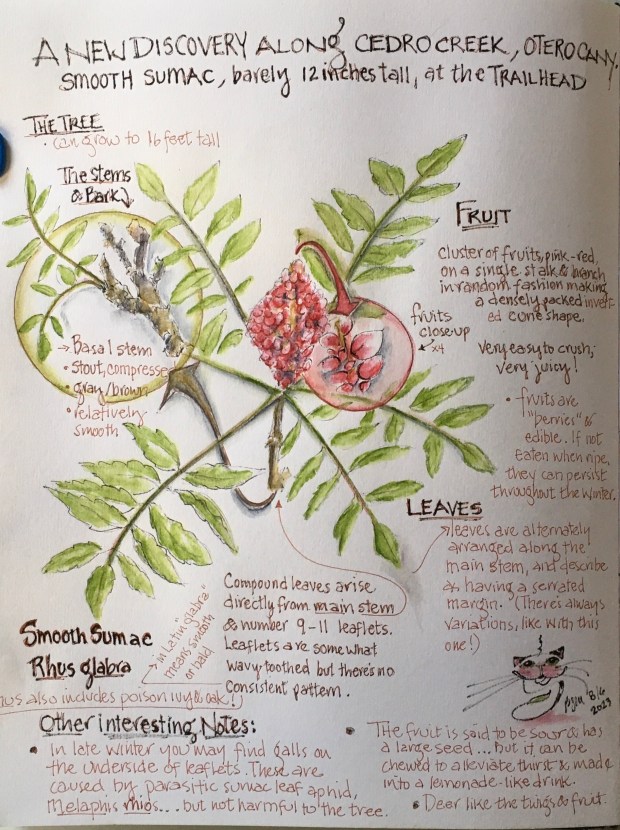
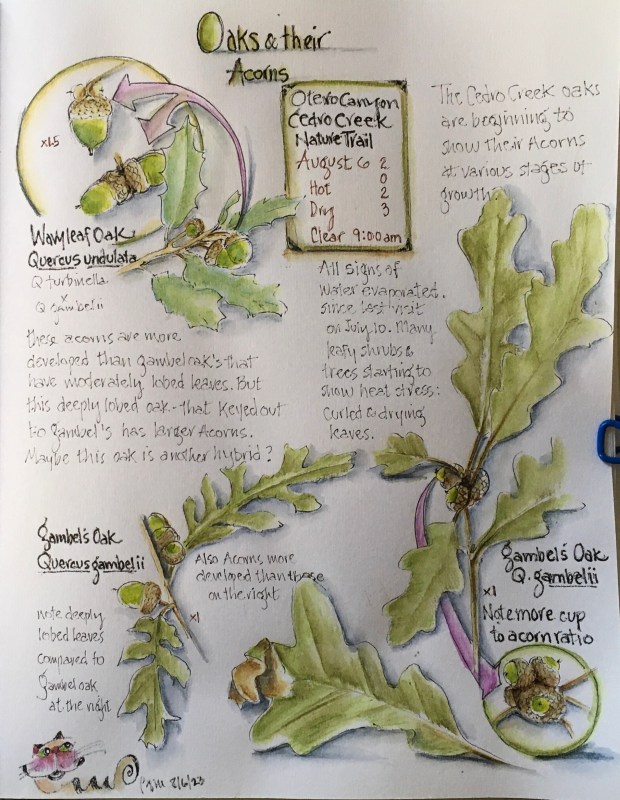
Sharing my pages from today’s short hike up Cedro Creek, on the fringes of the Manzano Mountains. The water shortage here and all around us has become dire; soils are cracked and dry and beginning to take flight with the barest puff of wind. 

Since we last hiked this area (a few days shy of a month ago), the scattered shallow pools of water have either evaporated completely or made a retreat underground, where there may be just enough water to wet the riparian area. All the tender flowering plants have disappeared; many have been able to set seed in hopes of a wetter year to come. With this premature wrap up to the summer season, the birds, bees and butterflies have moved on; hopefully up in elevation where food may still be found.

Our summer monsoon season just didn’t materialize (yet?). But despite the hot and dry conditions, we did manage to find a few leafy green shrubs. The massive cottonwoods appear to be doing well (must still be sufficient groundwater). In the cooler parts of the canyon, there are berries hanging on the 2 species of juniper trees. Acorns have begun to mature on several oak species, even though there are many that have withered; is all of this earlier than usual? 

At the trailhead, tucked in a swale where water (when it comes) can collect, I was surprised to see some very stunted smooth sumac. Already showing off their clusters of juicy red berries, the plants are barely a foot tall. This species can rapidly grow to heights of 16 feet. Maybe flowering and fruiting on such short plants is a type of survival mechanism this sumac exhibits when conditions are not favorable? I will be able to watch this little grove over the coming years and maybe answer that question.

Then further up the canyon, about 20-30 feet above the riparian area, Gambel’s and Wavyleaf oaks are growing their acorns. That’s encouraging news for the squirrels who collect and cache them in overwintering nests.

It’s been a challenging year. 

What differences in nature have you been noticing where you live? Do you think our changing climate has played a role in driving the changes? Have you observed not only negative but positive affects? I’d be very interested in knowing!

As always, thanks for following!