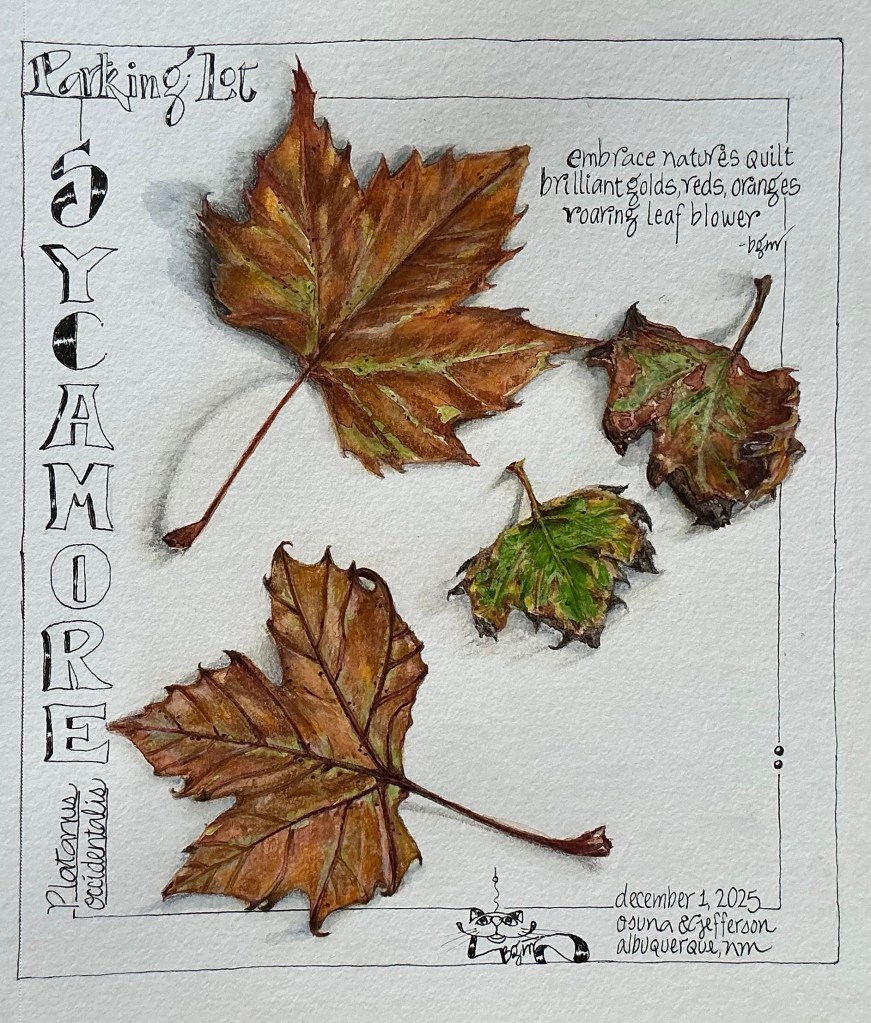
Parking Lot Sycamore

December 7, 2025

My search for still-beautiful Autumn leaves, half hanging, half fallen to the ground, took me to Albuquerque where temperatures hadn’t yet dipped below zero. Striking ‘gold’ in a large vacant parking lot next to a Disc Golf course, are at least 30 full-grown Sycamore trees with what looked to be full canopies of foliage still clinging tight. But for all the leaves yet to fall, there must’ve been 50x that number covering the ground. The morning breeze was causing the recently-fallen leaves to skid across the pavement in jerky movements, coming to rest in the parking lot’s gutters. 

It was in these ankle deep gutter piles where the range of leaf sizes, colors and patterns were found. These 1” to 10” broad, palmately veined and ragged-toothed leaves appeared locked together like pieces from a newly-opened 5000 piece jigsaw puzzle. And, oh my! The lid to the box just blew away! Now I was faced with a dizzying jumble of multi-colored golden-yellows, burnt oranges, Ruddy duck rust, fading-to-spring greens and saddle browns. It was from these ankle deep gutter piles that I collected Autumn leaves for this project.

Lost in thought, I overlooked the white noise of the city ……. traffic mostly, constantly humming and impatiently honking ……. until a painful ringing in my ears invaded the relative calm of the morning.  No longer able to think, I turned around and found an invasion of leaf blowers!  Never was there a more loudly screaming, obnoxiously noxious sound. Coming closer and closer, louder and more insistent, their ear-muffled and gas-masked operators approached without hesitation, each blowing away (to where?) every bit of the “unsightly and offending” leaf-litter in their path. 
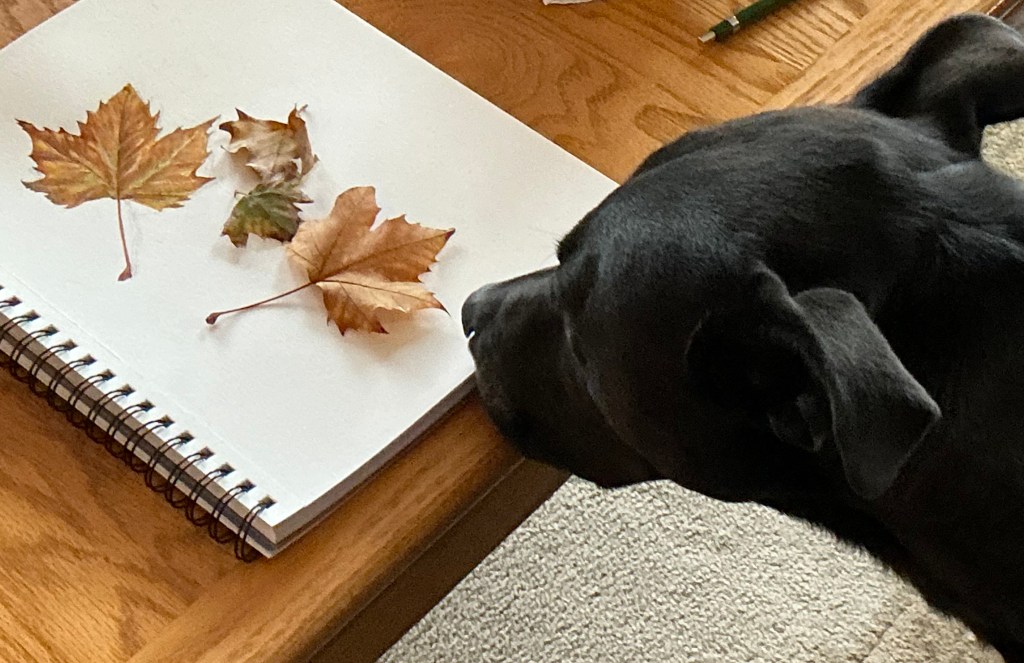
Luna approving of my Sycamore leaf selection

Dang-blasted! 

It finally dawned on me this Friday morning that the vacant parking lot only opened for use on Sunday’s. Not agreeable to working weekends, the leaf blower operators were determinedly cleaning up the “messy” lot for the regular Sunday crowd. I was in their way. 

Saving as many fallen Sycamore leaves as my collection bags could hold, and silently wishing all remaining leaves a happy landing somewhere on a nutrient-needy plot of land, I ran for the quiet of my car.

My Fallen Leaf Project

Using Sycamore leaves collected from that vacant Albuquerque parking lot, I tried my hand at a new technique; combining watercolor layers with layers of colored pencil. Using my new set of Van Gogh watercolors, I began each leaf with a layer of plain water followed by a light base layer, mixing Azo yellow medium with a touch of Yellow ochre. The bottom leaf (which was the underside of the top leaf) was duller and lighter in color, calling for a bit of Permanent lemon yellow. Allowing that layer to dry, I used various earthy colors from my set of Faber-Castell Polychromos colored pencils over the watercolor wash, mixing and matching the colors of my pencils with the actual leaf colors. This step tended to leave some areas uncolored with the pencils, so I applied another watercolor wash with Sap green, Burnt Sienna+Yellow ochre, and/or Madder lake deep+Azo yellow medium. I finished each leaf with a Dark sepia colored pencil outline, tipped the leaf margins with Dark sepia, and added shadowing first with Payne’s grey watercolor then Dark sepia colored pencil.
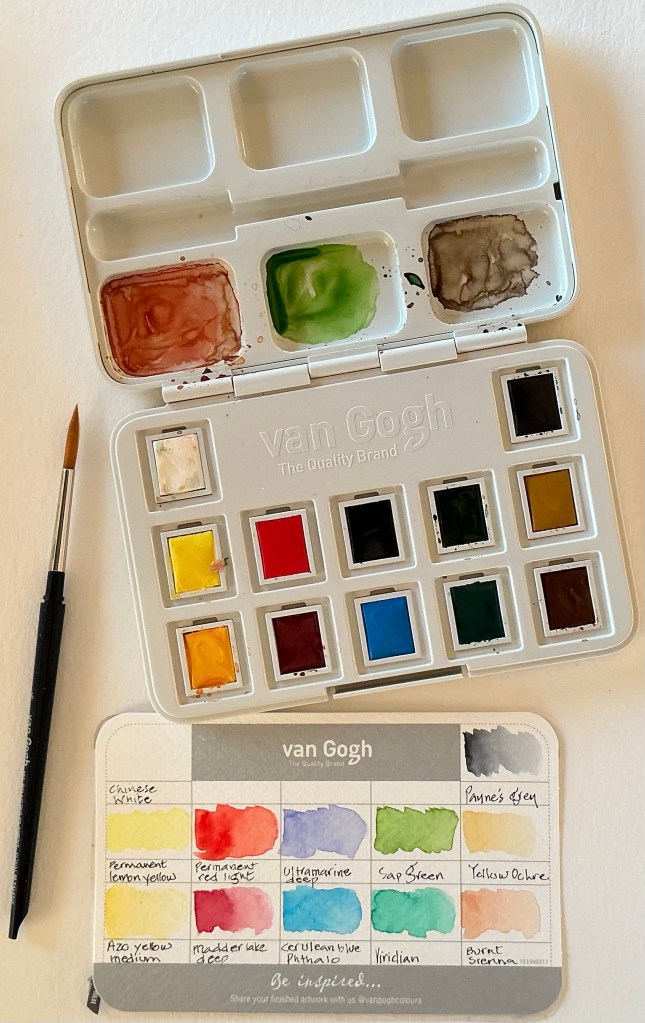
12 half-pan watercolor set and color swatch

The leaves were painted on 140# Canson XL Watercolor paper
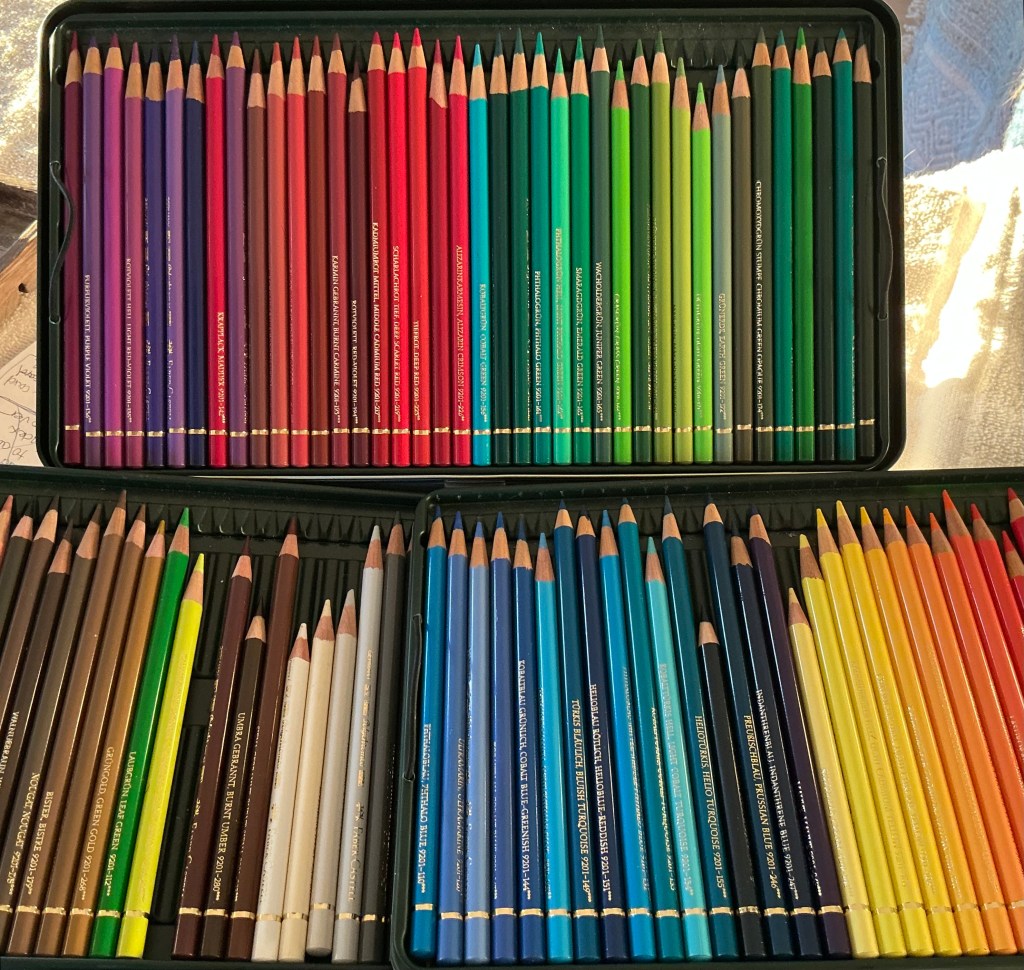
Faber-Castell colored pencil set

If you have and questions or comments, please let me know. If you use this combined media technique, any tips you’d like to share would be greatly appreciated too.

…………………………………………………………………………………………

I’d like to send a shout-out and my deep gratitude to Wendy Hollender, botanical artist/illustrator/teacher extraordinaire, who announced in her newsletter free access for over a week to 19 of her bite-sized video lessons. Designed as companions to her book, The Joy of Botanical Drawing, each lesson focused on a different botanical subject and how to artistically render them using watercolor and colored pencil combined. I’ve always wanted to learn this technique and gave it a try with her leaf examples and then mine. Incorporating both media into the same painting was very challenging and way out of my comfort zone. 

Thanks so much Wendy, for such wonderful lessons and your fabulous companion book! With lots more practice, my goal is that some day my botanical art looks as natural, skilled and professional as yours.

…………………………………………………………………………………………

As always, Thanks for stopping by!
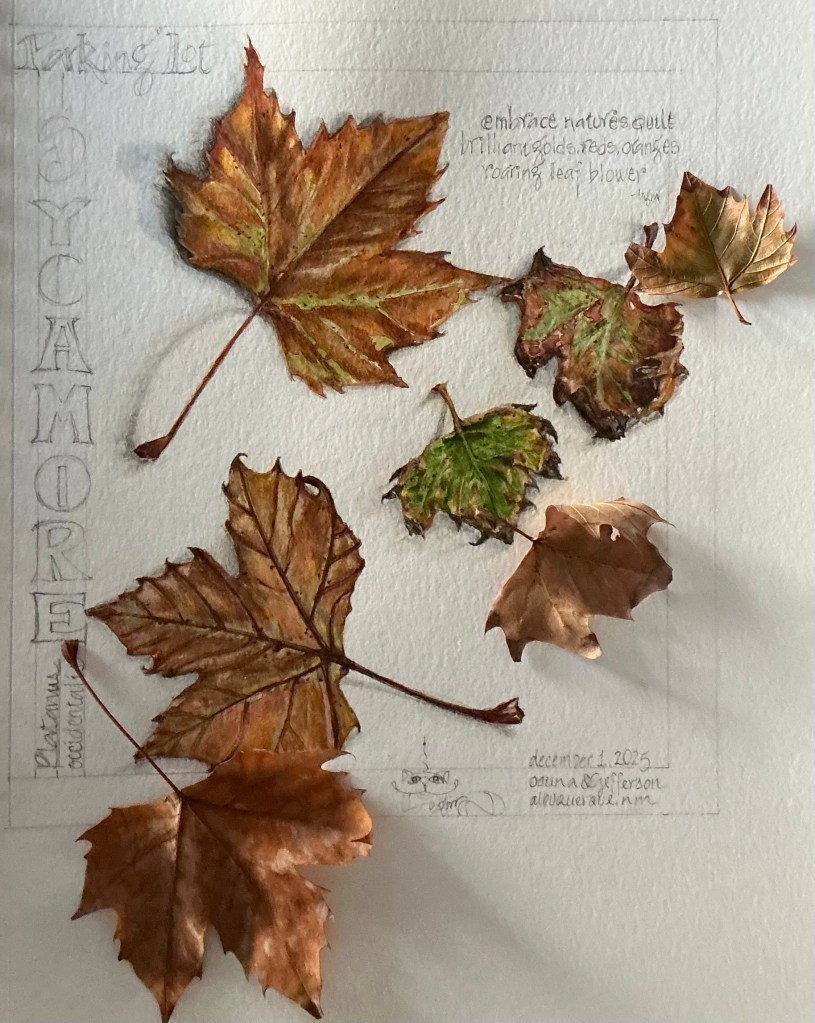
Draft final page with actual leaves lying on top

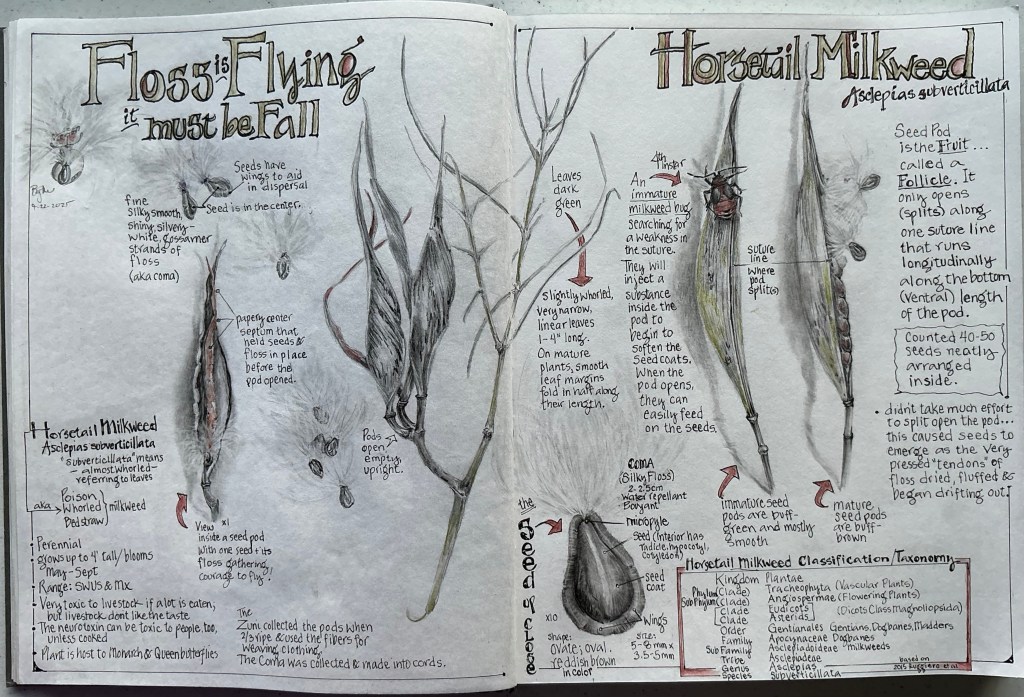
Floss is Flying 🪂  ! 

It Must be Fall …….

September 22, 2025

Like soft, fluffy snow!  Glistening orbs of silky gossamer are floating about the neighborhood, drifting hither and yon in the gentle breeze.  Suspended beneath each orb is a single reddish-brown winged seed that appears to coax its wind-propelled puff in a safe descent to the ground. But the white floss (the Coma) wants to fly, and it becomes a tug of war.  As the weight of the seed overwhelms the ability (and the desire) of the floss to carry it, their brief relationship is severed. But both get their wish …. the floss flies free as the seed drops to the ground, hopefully landing in an ideal spot to overwinter and sprout next spring.

Welcome Fall!  

When the air is full of Horsetail Milkweed parachutes and their ‘riders,’ I walk along the neighborhood roadways and collect a bounty of their new-crop seeds + floss to set free around our property. If they find the right soil, moisture, and light conditions for spring germination, the seeds will not only form the beginnings of a stand of these beautifully blooming, creamy-white milkweed flowers, but the plants might just play host to Monarch and Queen butterflies! 

Now wouldn’t that be dandy!

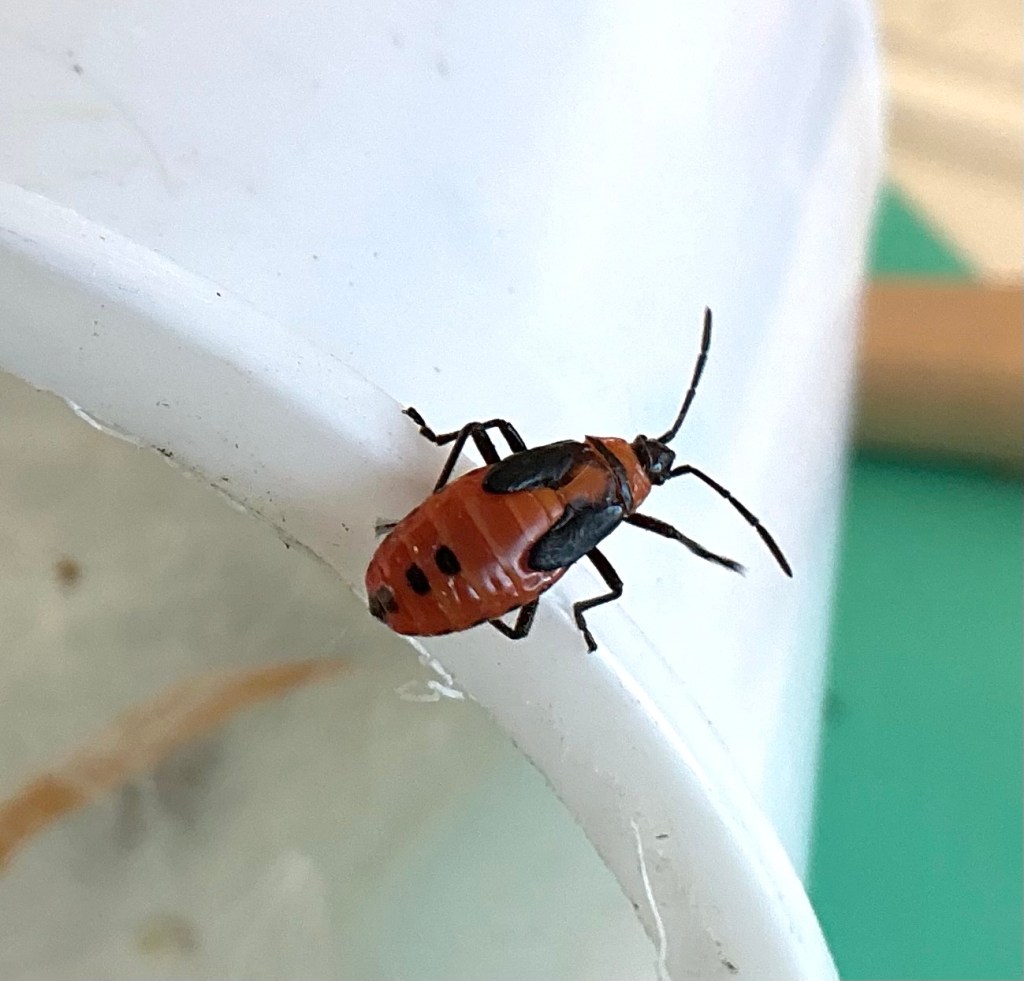
(Of course, mature seeds from new plants will undoubtedly entice a hungry crop of well-dressed Milkweed Bugs next Fall. That’s OK! They have to eat too!)

Before hint of color

My Journal Pages ……

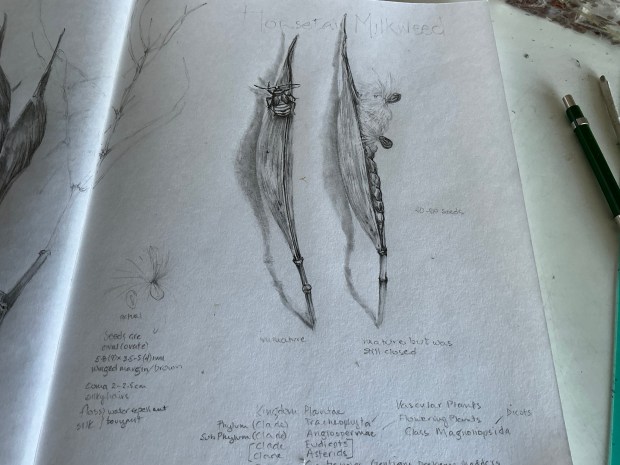
For something different, instead of using ink and watercolor, all sketches on these pages were created in graphite. The pods, seeds and the milkweed bug were sketched from my collected samples using a mechanical pencil loaded with a fine point HB lead.  The touches of color were added with water soluble graphite.

Work in Progress #1
Work in Progress #2

Thanks for stopping by ….. And Have a Fabulous Fall!

Large Milkweed Bug

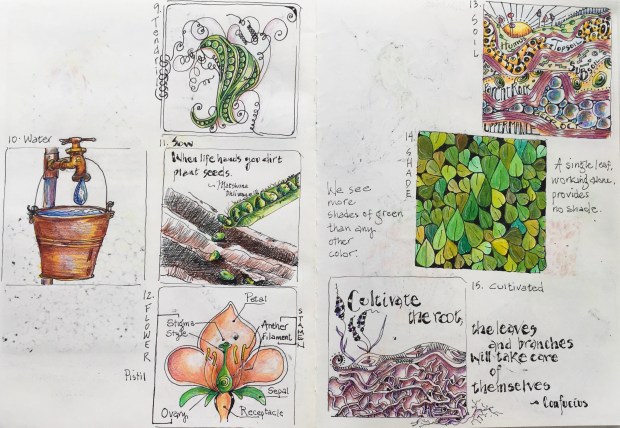
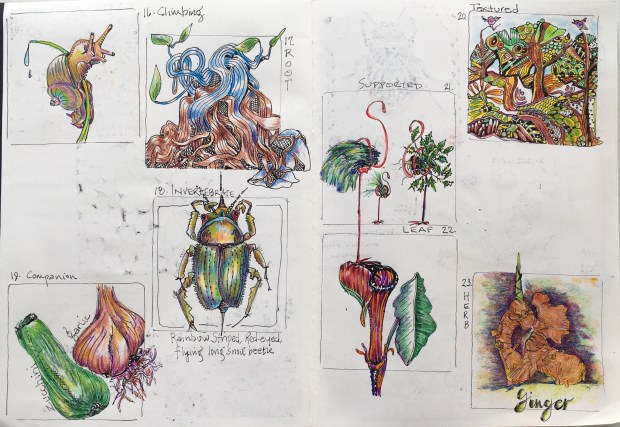
Inktober 2024 – An Inspired Garden-Themed Challenge

November 4, 2024

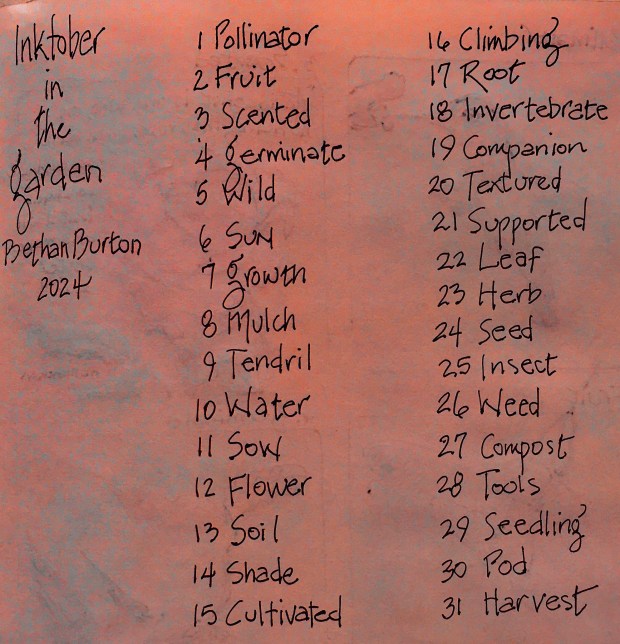
Searching for a theme to follow during Inktober 2024, I was delighted to learn one of my favorite podcasters and nature journal educators, Bethan Burton, shared her original list of 31 prompts. Named “Inktober in the Garden,” she cleverly chose each word to represent a different phase or activity encountered while gardening. To quote Bethan, the prompts are “aimed to get us thinking in different ways about the beauty of our cultivated space.” 

Living in Brisbane, Queensland, Australia, where it’s now Spring, Bethan’s garden theme was very timely for her.  However, October in central New Mexico where I live, is smack dab in the middle of Fall, so I relied on past gardening experience to create my daily ink drawings.

I hope you enjoy my 31 Inktober2024 tiles, inspired by Bethan Burton’s “Inktober in the Garden” prompts. I decided to only complete one tile/day; in the morning while sipping a cup of tea, I’d sketch a drawing with only ink (using a Pilot Varsity nib pen). Then later in the evening I added the color coaxing pigment from my limited number of Venus Spectracolor colored pencils (the remains of a 40+ year old set which constantly break and refuse to blend). 

A big thanks to Bethan for sharing her Inktober2024 prompt list, and for being a constant inspiration through her podcast Journaling with Nature, and for bringing the world-wide nature journaling community together for her annual International Nature Journaling Week, where we can explore, share and celebrate a passion for nature. To learn more about Bethan and nature journaling through her podcast, participating in future International Nature Journaling Week, sign up for her Blog and Newsletter, follow her  YouTube Channel and Instagram account, visit her website at: https://www.journalingwithnature.com


Here’s a bit more about this thing called Inktober

Inktober was originally created by Jake Parker in 2009, and since then has been deemed an annual event that takes place throughout the month of October. The rules devised for participants were, and still are, pretty simple …… Every day 1) make a drawing in ink; 2) post or share it; 3) hashtag it with #inktober; and 4) repeat.

Since 2009, there’s been an official prompt list shared every year by Jake and his Inktober group (https://inktober.com). But there are also many alternate lists generated, which participants can follow if they wish, or they can choose to work from their own prompts.  Also since 2009, participants have not only worked in only ink, but have created colored drawings. Actually any media is fair game (wonder if anyone uses collage?), as bending the simple rules seems to be the norm.  As Jake notes on the Inktober webpage, “you can do it [Inktober] daily, or go the half-marathon route and post every other day, or just do the 5K and post once a week. What ever you decide, just” remember “Inktober is about growing and improving and forming positive habits, so the more you’re consistent the better.”

And if you’re interested in participating in future Inktober events, just do it! Find a prompt list or create your own, and join the month-long party beginning each year in October! 

This concludes my 9th year of Inktober!
As always, thanks for stopping by! 

On the Cusp ….. Fall Equinox in the East Mountains

October 28, 2024

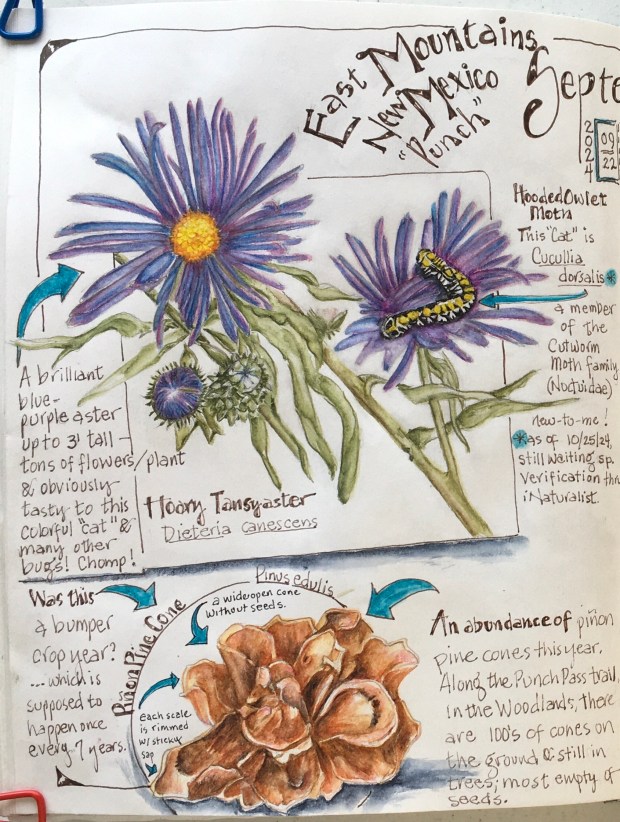
September 22nd was a morning full of new-to-me discoveries in nature. That was more than a month ago; a time when temperatures were still in the upper 80’s and flowers in full bloom. 

But plenty of hints of what was to come ….. the inevitable change in seasons ….. existed. There were seeds of spring and summer bloomers blowing in the wind; squirrels stockpiling pine nuts from recently shed cones; darkling beetles mating and laying eggs in the ground to hatch next year’s population; caterpillars feasting on energy-packed flower petals needed to spin their cocoons; the chortling chatter of sandhill cranes high overhead migrating to Bosque del Apache for the winter.   

Still it is hard to believe that today, a little more than a month later, everything has turned brown, and our first hard frost is forecasted for tomorrow morning! 

In an effort to cling to a not-so-long ago summer, this small selection of the botanical and entomological happenings on the cusp of Fall, is now a part of my nature journal.   Enjoy!

As always, thanks for stopping by!