Acorn or Gall? 

An Albuquerque Park Mystery #26

September 6, 2026

The date: August 24, 2026 

The time: 8:30 am. 

The forecast: Severe clear; calm winds; 82oF & climbing

The place: The Promenade in Albuquerque  

The destination: el Oso Grande Park (“The Big Bear”)

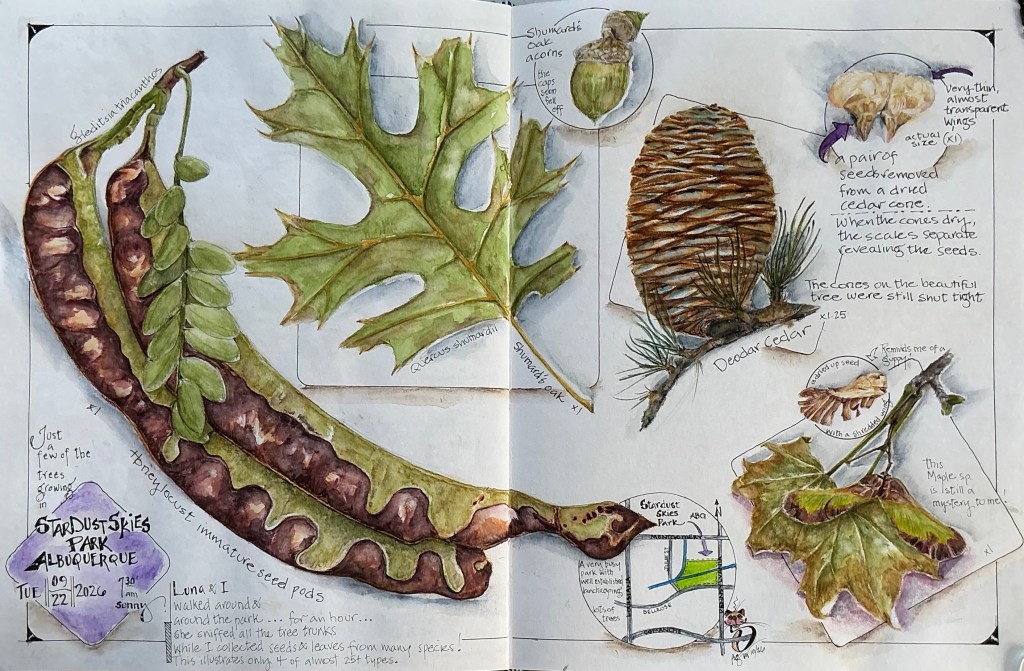
After dropping Roy off for his annual eye exam, Luna and I decided to ‘sniff’ around the neighborhood on our way to nearby el Oso Grande Park. With the chance of rain being “zip,” I was confident walking east along a half-mile stretch of the large cement ditch used to drain storm water from Embudito Canyon. Other than creatively colorful graffiti, the ditch itself had nothing interesting to offer. The hot paved walkway, mostly lined by weedy species, provided perfect habitat for scattered bushy sacred datura plants in full bloom. The many city dwellers living ditch-side allowed landscaping plants to cascade over cinderblock privacy walls — the patches of shade – welcome; sprays of pale pink to magenta desert willow flowers – pretty and fragrant.

A sweaty 20 minutes later and the shady expanse of the Park was a welcome sight. Not one to waste time, Luna anxiously led me to tree trunk #1, circling and sniffing excitedly three times ‘round. Not being able to smell the wonderfully curious aromas capturing her full attention, I spent my time looking up into the leafy canopy of this full grown deciduous tree planted years ago in memory of a once local resident.  

We moved on to tree #2, a robust conifer towering over the well-manicured green lawn, supported by another aromatic trunk recently ‘watered’ by a happy dog walking their human. Before we could check out tree #3, Luna claimed #2 by leaving her ‘calling card.’ 

And on and on we wandered and circled, until ….

…. I realized, based on our exam speed/tree (largely driven by Luna’s satisfaction meter), our Park tour of over 100 trees would take a month of Sundays! So we ramped up our pace, making  decent progress to (hopefully) ensure our timely return to fetch Roy …. then tree #26 happened! 

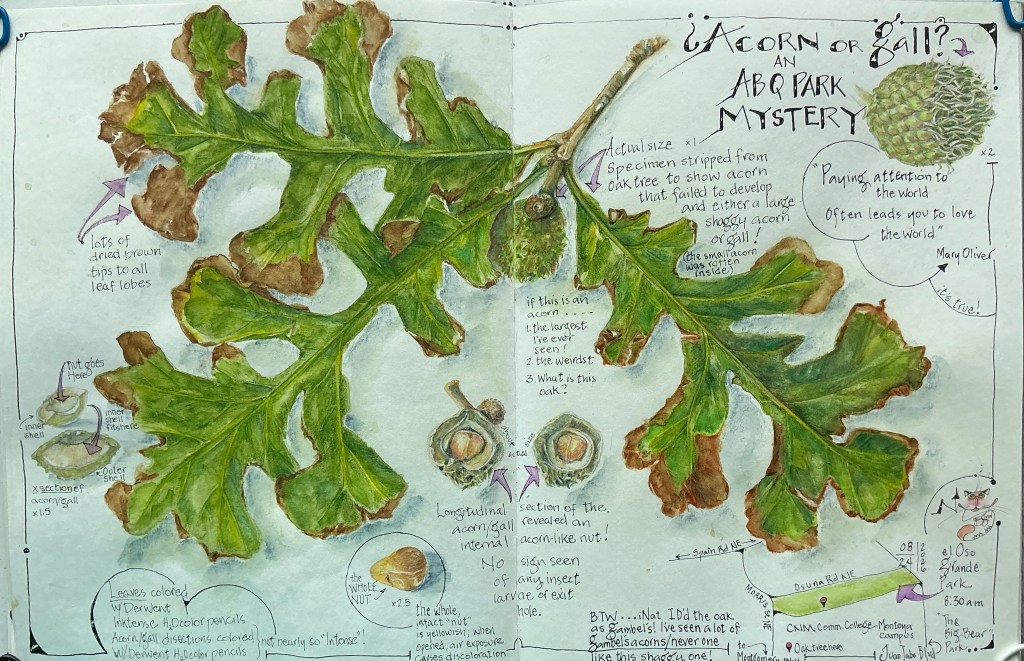
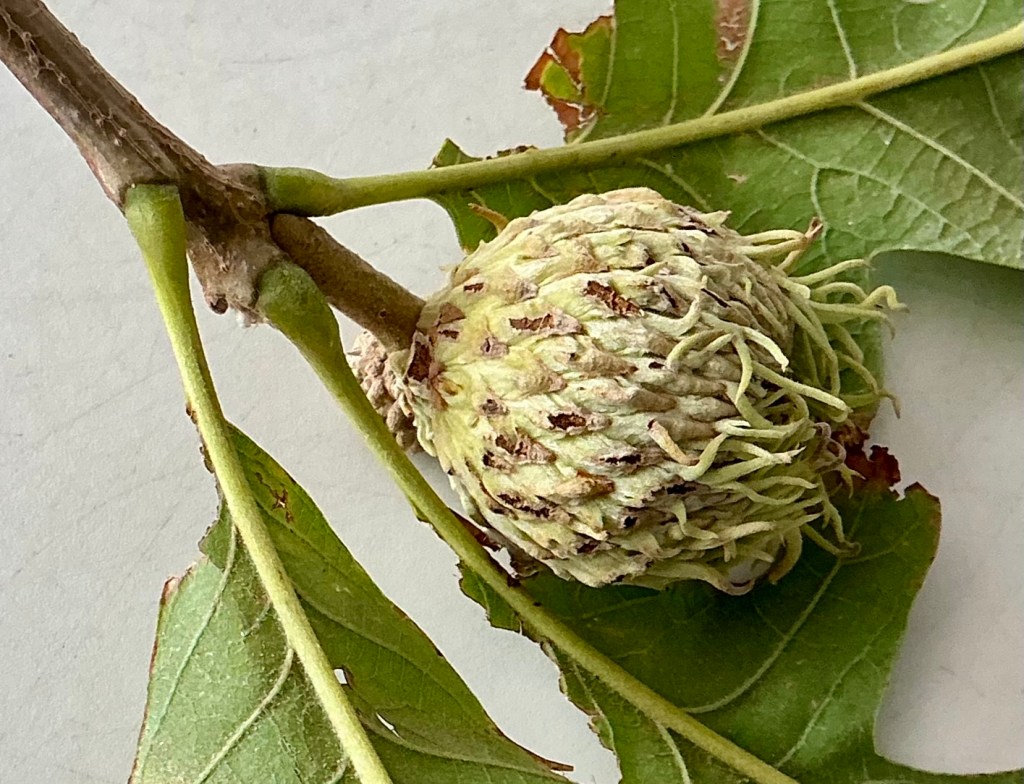
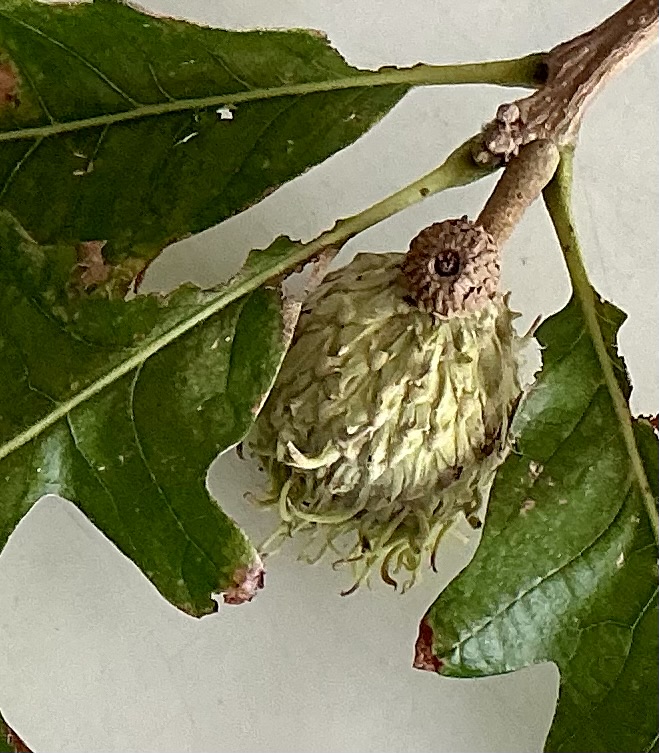
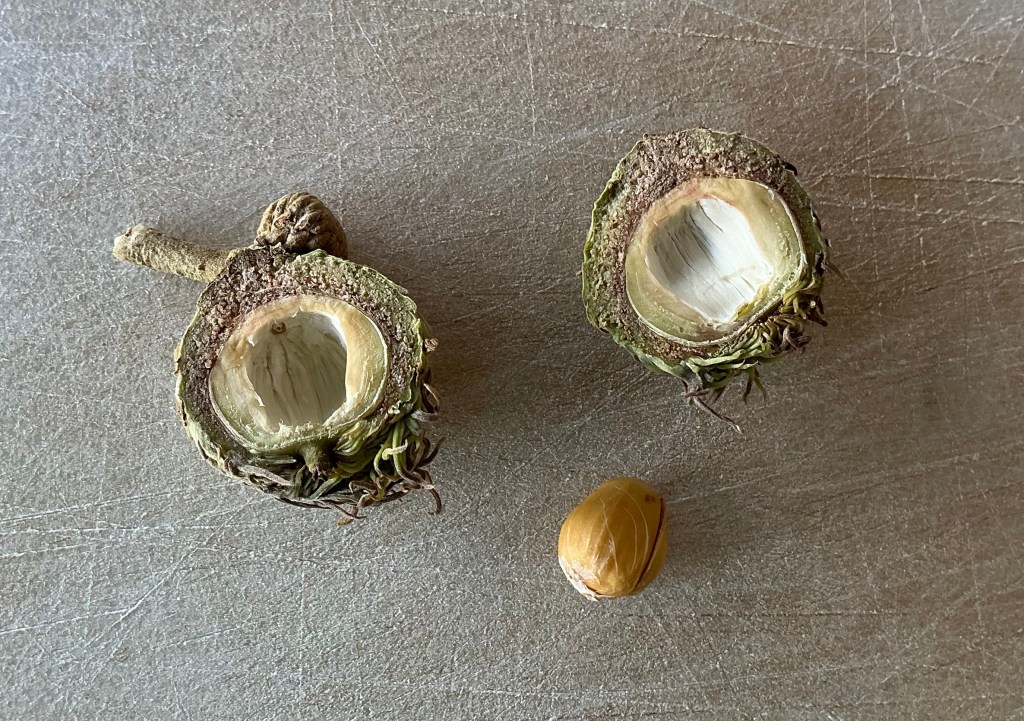
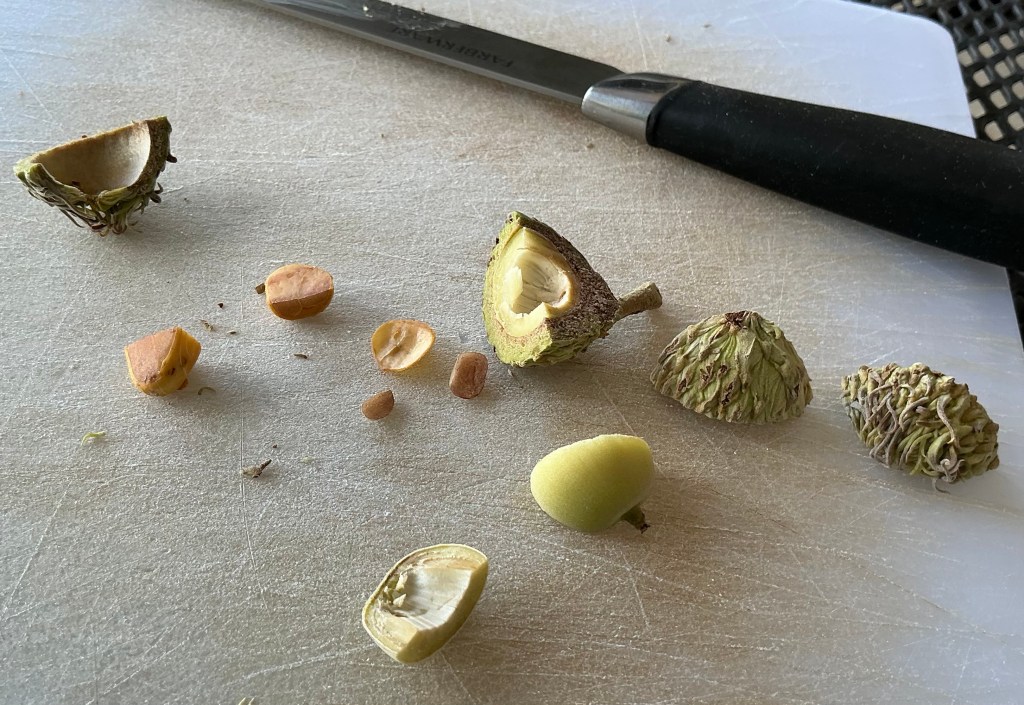
Oh! What was #26? Now it was my turn to encircle a tree, and I couldn’t stop.  In addition to the puzzled look on Luna’s sweet face, several other things were certain: 1– this very large tree was a 2– deciduous 3– dicotyledonous member of the 4– oak genus Quercus. The deeply-lobed leaves were a giveaway, even though most of each leaf’s margins were dried and crinkly. But it wasn’t the leaves catching all of my attention — it was the 1-inch diameter shaggy pale green balls growing from the ends of many leafy branches. This certainly didn’t look like any acorn I’d ever seen before …. besides, right beside this scary-looking tentacled orb was a single mini-acorn that tried but never fully developed — only the dried, withered acorn cup had partially formed before rotting. 

So what was it that sucked the life right out of that tiny failed acorn, and grew into something alien?  If this was some kind of acorn that grows on a non-native oak tree I’ve never seen before, then I had to learn more! If this was a gall, an unusually grotesque, weird and exaggerated growth stimulated by a developing wasp grub living deep inside, then I really had to learn a lot more! 

And then I collected and promptly zip-locked a specimen.

This became (and still is) An Albuquerque Park Mystery hanging like lime green ornaments all over, and also within reach from, tree #26!

P.S.

  • iNaturalist identified the tree as Gambel’s oak 
  • Never have I ever seen a Gambel’s oak acorn look like that!
  • Still waiting for an oak expert to identify the tree leaves and/or acorn/gall-thing

P.S. P.S.

  • So many questions remain
  • Upon arriving home, no wildlife observed inside zip-locked bag
  • I dissected the growth, inside and out — found what looked like an acorn nut 
  • No sign of a grub; no exit holes in the outer or inner shells

P.S. P.S. P.S.

  • Luna & I practically ran back to the eye doc’s office, arriving minutes before Roy’s exam concluded

……………………………………………………………………………………..

If you’ve seen anything growing on an oak that remotely resembles these mystery green goblins, please let me know what it may be, and what species of oak they come from! 

As always, thanks for stopping by!

P.S. P.S. P.S. P.S.

  • When “An Albuquerque Park Mystery #26” is solved, you’ll be the first to know!

Western Meadowlark – Page 8 .. The 100 Day Project (2026)

May 4, 2026

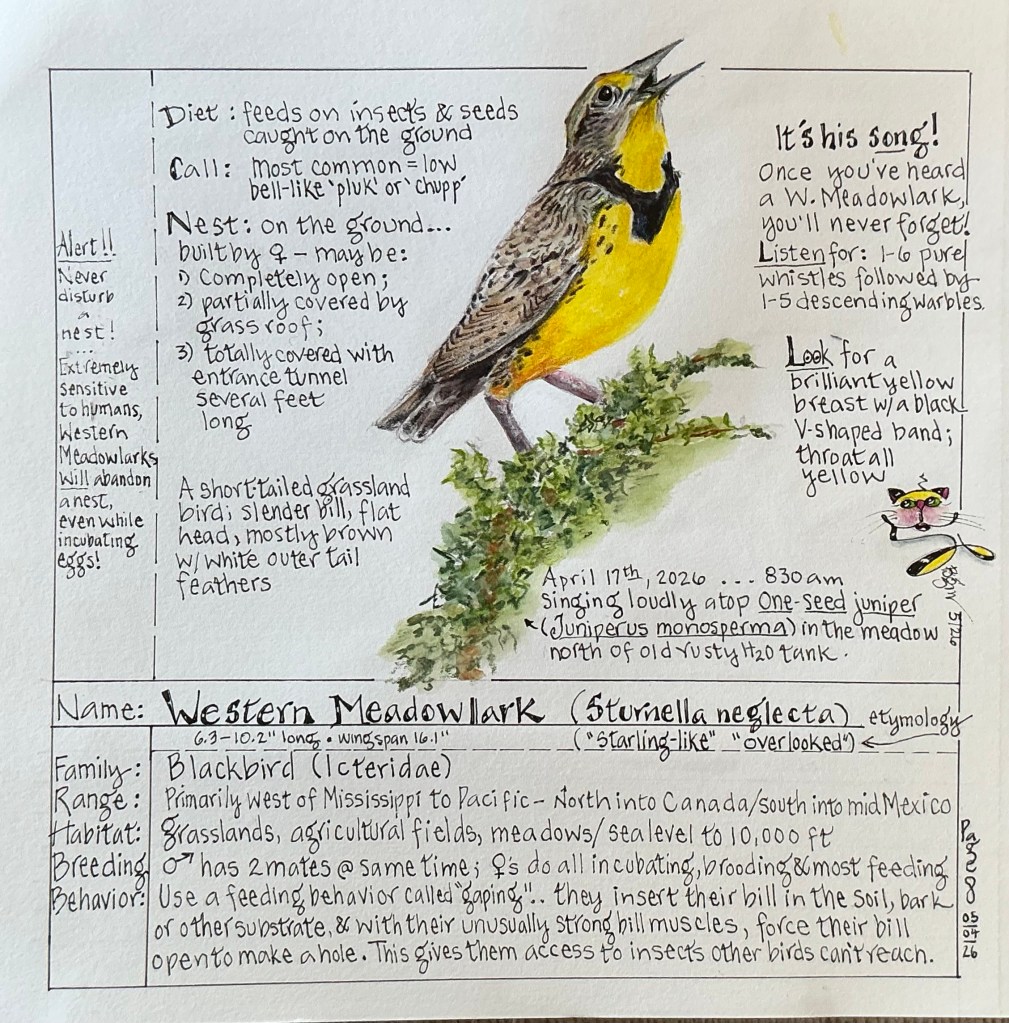
Western Meadowlark  (Sturnella neglecta)

When male meadowlarks return to the grassy meadow north of the old rusty water tank and begin singing, you know it’s Spring! 

There’s something wonderful about his song ……. At first he stutters a few practice notes; rough and rusty like the old water tank. But as daylight lengthens and temperatures warm, his song grows long, strong and melodic. Having perfected that signature song, he sings intently from sunrise to sunset, defending his territorial boundaries against all invaders. And he sings lovingly to announce his breeding readiness, enticing not just one, but two female meadowlarks to mate with him.

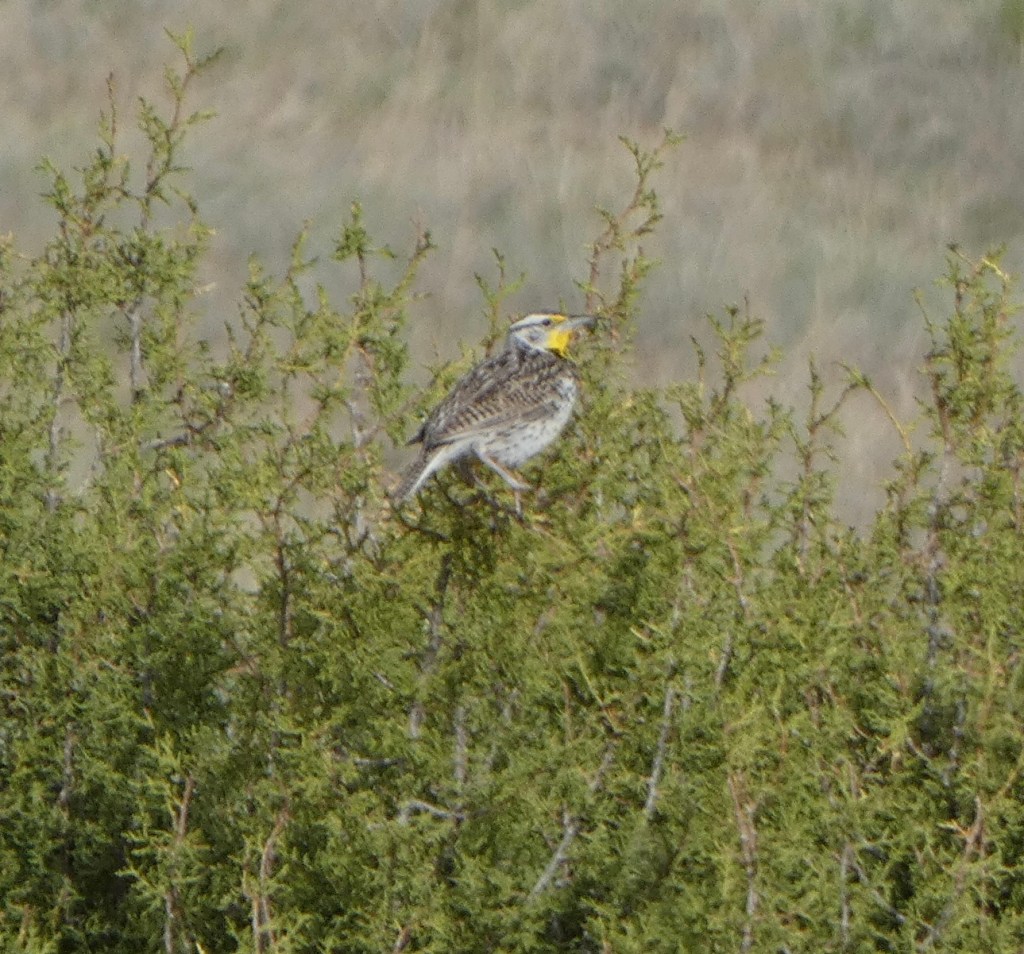
While walking the perimeter of the meadow in mid-April, it was easy to hear a male singing at the top of his lungs about 1/4 mile away. After a few moments scanning the tops of the widely scattered juniper trees with binoculars, I spotted him. (Males seem to favor these trees as perches, perhaps because they get a great view of their territory, and their voices really carry!) Able to get only 50 yards closer, I managed to take a few telephoto pics before he flew to the top of another juniper. Western meadowlarks are very skittish around people, so I held my ground and just watched and listened. It was a wonderful encounter.

Below are a few more fun facts about Western Meadowlarks, in addition to those on my illustrated page ….

If you’re lucky to see a Western Meadowlark, you’ll notice they’re a robin-sized bird but chunkier and with a shorter tail. Their flat head and long, slender bill are visible above a round-shouldered posture that nearly conceals its neck. They have short rounded wings, and a short, stiff, and spiky tail.

When flushed, Western Meadowlarks fly low, wings below the horizontal, gliding and flapping with short, stiff, quail-like wingbeats. 

Other than perching on tall trees, don’t be surprised to find males singing from atop fence posts, bushes, power lines, and anything higher than their surrounding habitat.

John James Audubon gave the Western Meadowlark its scientific name, Sturnella neglecta; Sturnella meaningstarling-like,” and neglecta because he felt most explorers (after Lewis and Clark) and settlers who traveled west of the Mississippi overlooked this common bird.

The oldest recorded Western Meadowlark was at least 6 years, 6 months old when it was found in Colorado in 1965.

…………………………………………………………………………………………………

When was the last time you went Birding? Meadowlarks are calling!

As always, thanks for stopping by!

References:   allaboutbirds.org and inaturalist.org

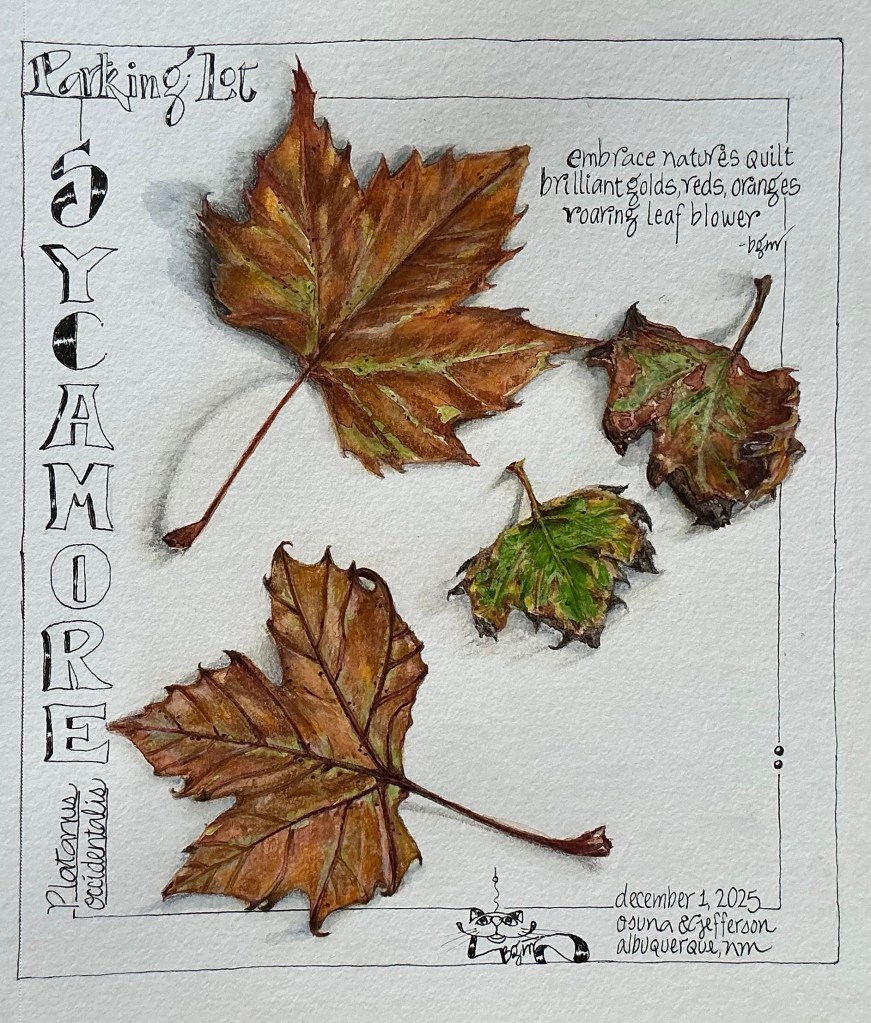
Parking Lot Sycamore

December 7, 2025

My search for still-beautiful Autumn leaves, half hanging, half fallen to the ground, took me to Albuquerque where temperatures hadn’t yet dipped below zero. Striking ‘gold’ in a large vacant parking lot next to a Disc Golf course, are at least 30 full-grown Sycamore trees with what looked to be full canopies of foliage still clinging tight. But for all the leaves yet to fall, there must’ve been 50x that number covering the ground. The morning breeze was causing the recently-fallen leaves to skid across the pavement in jerky movements, coming to rest in the parking lot’s gutters. 

It was in these ankle deep gutter piles where the range of leaf sizes, colors and patterns were found. These 1” to 10” broad, palmately veined and ragged-toothed leaves appeared locked together like pieces from a newly-opened 5000 piece jigsaw puzzle. And, oh my! The lid to the box just blew away! Now I was faced with a dizzying jumble of multi-colored golden-yellows, burnt oranges, Ruddy duck rust, fading-to-spring greens and saddle browns. It was from these ankle deep gutter piles that I collected Autumn leaves for this project.

Lost in thought, I overlooked the white noise of the city ……. traffic mostly, constantly humming and impatiently honking ……. until a painful ringing in my ears invaded the relative calm of the morning.  No longer able to think, I turned around and found an invasion of leaf blowers!  Never was there a more loudly screaming, obnoxiously noxious sound. Coming closer and closer, louder and more insistent, their ear-muffled and gas-masked operators approached without hesitation, each blowing away (to where?) every bit of the “unsightly and offending” leaf-litter in their path. 

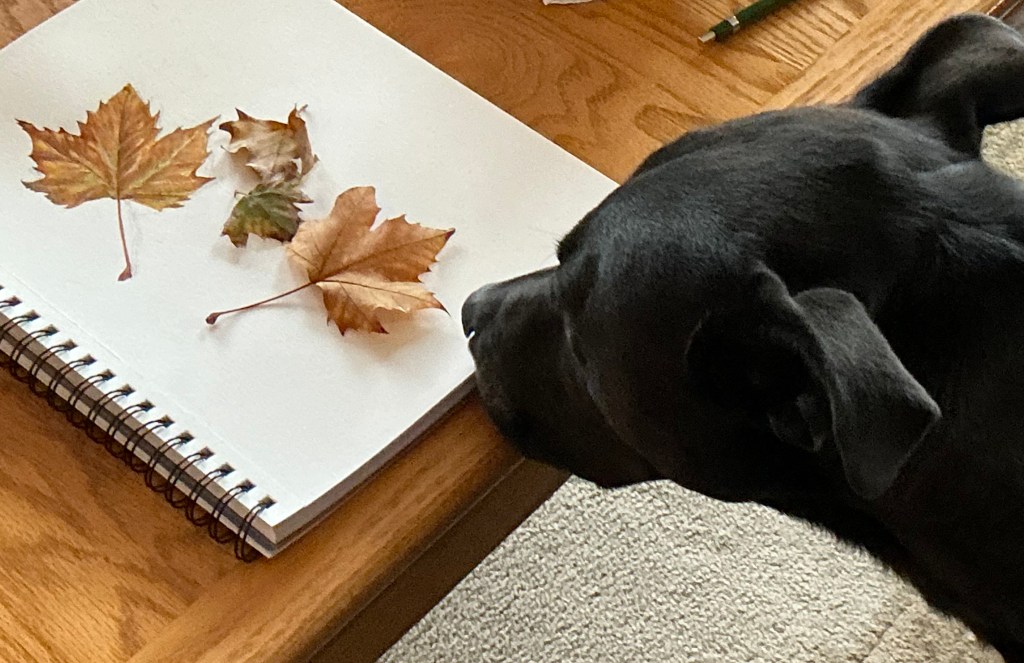
Luna approving of my Sycamore leaf selection

Dang-blasted! 

It finally dawned on me this Friday morning that the vacant parking lot only opened for use on Sunday’s. Not agreeable to working weekends, the leaf blower operators were determinedly cleaning up the “messy” lot for the regular Sunday crowd. I was in their way. 

Saving as many fallen Sycamore leaves as my collection bags could hold, and silently wishing all remaining leaves a happy landing somewhere on a nutrient-needy plot of land, I ran for the quiet of my car.

My Fallen Leaf Project

Using Sycamore leaves collected from that vacant Albuquerque parking lot, I tried my hand at a new technique; combining watercolor layers with layers of colored pencil. Using my new set of Van Gogh watercolors, I began each leaf with a layer of plain water followed by a light base layer, mixing Azo yellow medium with a touch of Yellow ochre. The bottom leaf (which was the underside of the top leaf) was duller and lighter in color, calling for a bit of Permanent lemon yellow. Allowing that layer to dry, I used various earthy colors from my set of Faber-Castell Polychromos colored pencils over the watercolor wash, mixing and matching the colors of my pencils with the actual leaf colors. This step tended to leave some areas uncolored with the pencils, so I applied another watercolor wash with Sap green, Burnt Sienna+Yellow ochre, and/or Madder lake deep+Azo yellow medium. I finished each leaf with a Dark sepia colored pencil outline, tipped the leaf margins with Dark sepia, and added shadowing first with Payne’s grey watercolor then Dark sepia colored pencil.

12 half-pan watercolor set and color swatch

The leaves were painted on 140# Canson XL Watercolor paper

Faber-Castell colored pencil set

If you have and questions or comments, please let me know. If you use this combined media technique, any tips you’d like to share would be greatly appreciated too.

…………………………………………………………………………………………

I’d like to send a shout-out and my deep gratitude to Wendy Hollender, botanical artist/illustrator/teacher extraordinaire, who announced in her newsletter free access for over a week to 19 of her bite-sized video lessons. Designed as companions to her book, The Joy of Botanical Drawing, each lesson focused on a different botanical subject and how to artistically render them using watercolor and colored pencil combined. I’ve always wanted to learn this technique and gave it a try with her leaf examples and then mine. Incorporating both media into the same painting was very challenging and way out of my comfort zone. 

Thanks so much Wendy, for such wonderful lessons and your fabulous companion book! With lots more practice, my goal is that some day my botanical art looks as natural, skilled and professional as yours.

…………………………………………………………………………………………

As always, Thanks for stopping by!

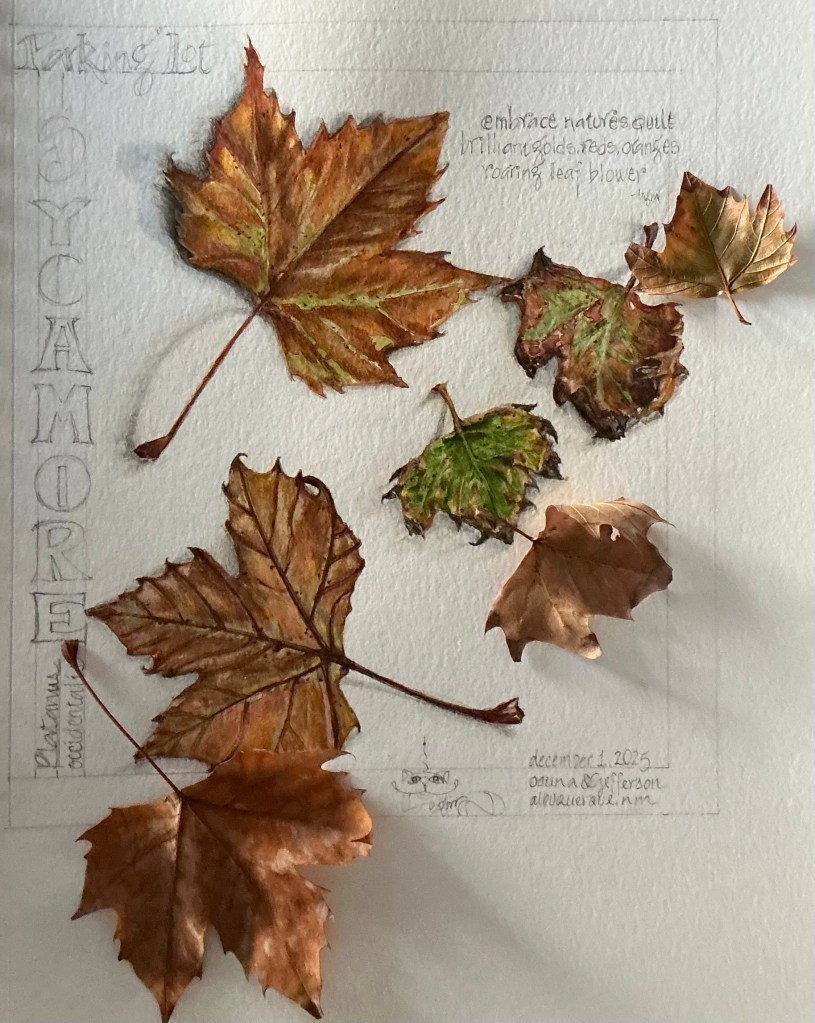
Draft final page with actual leaves lying on top

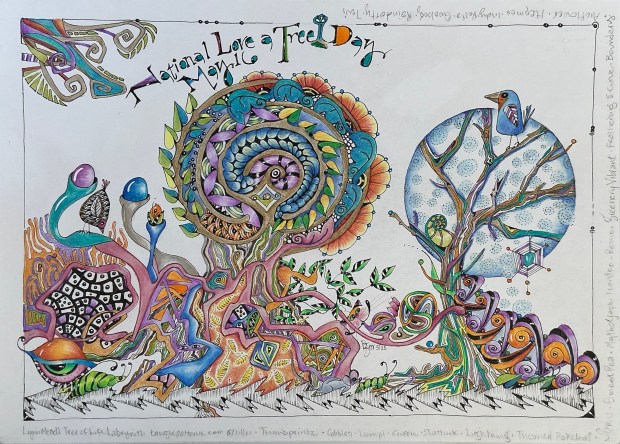
Happy National Love a Tree Day!

May 16, 2025

Zentangle Patterns: thumbprints, cobbles, Lumpi, Cruffle, Shattuck, lightning, thorned Pokeleaf, sweet pea, mythograph, Icantoo, remo, greenery vibrant, feathering s-curve, boundary, Arcflower, hepmee, Quabog, raindotty, tsui 


And many thanks to Lynn Mead for sharing her Tree of Life Labyrinth pattern. Super fun to give a whirl! The easy to follow directions can be found on tanglepatterns.com posted 08/14/2021 

Today, May 16th, just so happens to be National Love a Tree Day! It’s the official day to celebrate all of life’s joys brought to us by the trees we share this planet with. Whether you love reading in the shade or taking a bite out of a fresh fruit pie, National Love a Tree Day encourages y’all to get outside and enjoy a tree.

A Changing Landscape

We all know many tree species live many many years; some live to be several thousand years old. According to the U.S. Forest Service, about 766 million acres of forest land exists in the United States today, a number that’s held steady since 2012. But the nature of our forests has changed over the last 400 years, due to changes in management practices and demand. Population growth, rural and urban development, along with a variety of land uses (like conversion of forests to agriculture use) resulted in a steady decline of forested acres between 1630 and 1910;  a decline from 1,023 million acres to 753 million acres or 46% to 34% of the total land area in the U.S. Since that time until the present, where people choose to live and how the land is used has been constantly changing.  While some urban forests increase, other areas see a decline. Tree planting programs improve landscapes but human activities and population growth continue to impact these ecosystems.

We All Benefit from Trees

Trees provide more than just beautiful landscapes and a shady canopy on a sunny day. They play a significant role in reducing erosion and moderating the climate as well as give us oxygen. Large quantities of carbon are stored in their tissues as trees remove carbon dioxide from the atmosphere. They provide habitat and structure for strong ecosystems.

How to Observe National Love a Tree Day

This is a good day to plant a new tree native to your area, or spend some time enjoying the beauty of the trees, Take time to learn how to care for the trees you have, too, whether you live in the mountains or the desert. Write down all the reasons trees are important to you. If you have a favorite tree, or a tree you’re not familiar with, begin a little research project about that (or those) species, and journal about your findings. 

What will you do today to celebrate trees?

Happy National Love a Tree Day!

As always, thanks for stopping by!