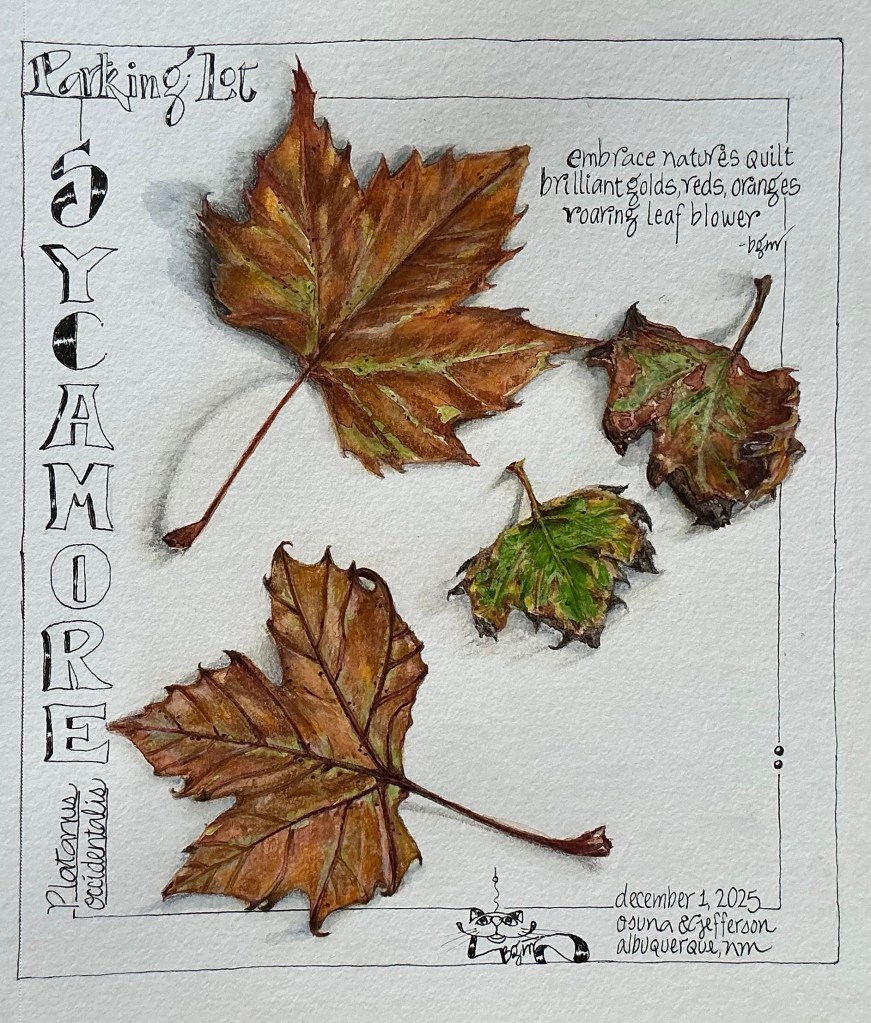
Parking Lot Sycamore

December 7, 2025

My search for still-beautiful Autumn leaves, half hanging, half fallen to the ground, took me to Albuquerque where temperatures hadn’t yet dipped below zero. Striking ‘gold’ in a large vacant parking lot next to a Disc Golf course, are at least 30 full-grown Sycamore trees with what looked to be full canopies of foliage still clinging tight. But for all the leaves yet to fall, there must’ve been 50x that number covering the ground. The morning breeze was causing the recently-fallen leaves to skid across the pavement in jerky movements, coming to rest in the parking lot’s gutters. 

It was in these ankle deep gutter piles where the range of leaf sizes, colors and patterns were found. These 1” to 10” broad, palmately veined and ragged-toothed leaves appeared locked together like pieces from a newly-opened 5000 piece jigsaw puzzle. And, oh my! The lid to the box just blew away! Now I was faced with a dizzying jumble of multi-colored golden-yellows, burnt oranges, Ruddy duck rust, fading-to-spring greens and saddle browns. It was from these ankle deep gutter piles that I collected Autumn leaves for this project.

Lost in thought, I overlooked the white noise of the city ……. traffic mostly, constantly humming and impatiently honking ……. until a painful ringing in my ears invaded the relative calm of the morning.  No longer able to think, I turned around and found an invasion of leaf blowers!  Never was there a more loudly screaming, obnoxiously noxious sound. Coming closer and closer, louder and more insistent, their ear-muffled and gas-masked operators approached without hesitation, each blowing away (to where?) every bit of the “unsightly and offending” leaf-litter in their path. 
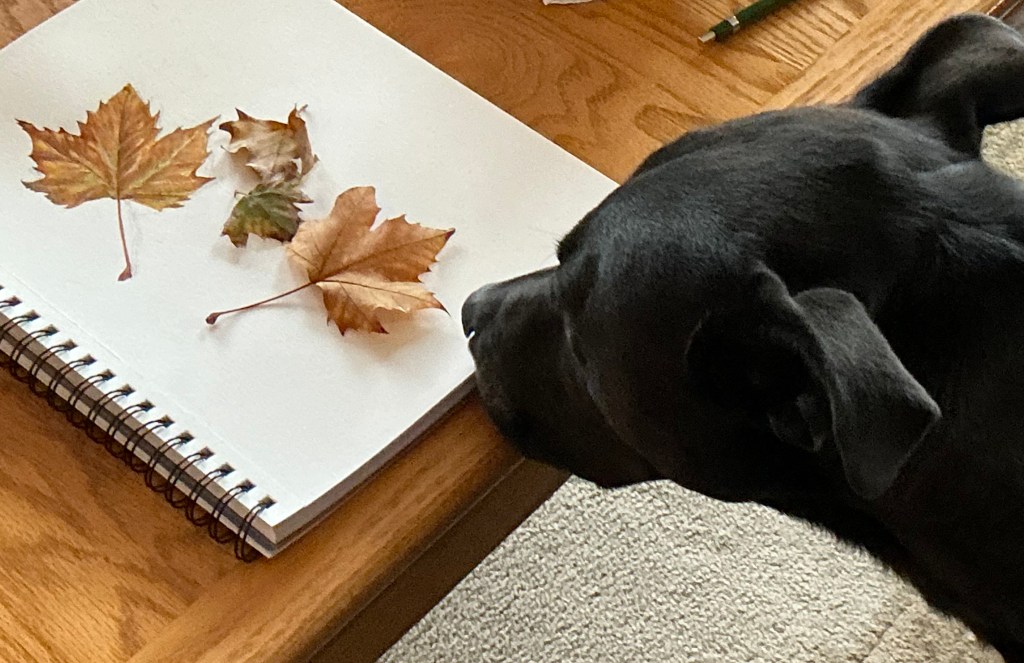
Luna approving of my Sycamore leaf selection

Dang-blasted! 

It finally dawned on me this Friday morning that the vacant parking lot only opened for use on Sunday’s. Not agreeable to working weekends, the leaf blower operators were determinedly cleaning up the “messy” lot for the regular Sunday crowd. I was in their way. 

Saving as many fallen Sycamore leaves as my collection bags could hold, and silently wishing all remaining leaves a happy landing somewhere on a nutrient-needy plot of land, I ran for the quiet of my car.

My Fallen Leaf Project

Using Sycamore leaves collected from that vacant Albuquerque parking lot, I tried my hand at a new technique; combining watercolor layers with layers of colored pencil. Using my new set of Van Gogh watercolors, I began each leaf with a layer of plain water followed by a light base layer, mixing Azo yellow medium with a touch of Yellow ochre. The bottom leaf (which was the underside of the top leaf) was duller and lighter in color, calling for a bit of Permanent lemon yellow. Allowing that layer to dry, I used various earthy colors from my set of Faber-Castell Polychromos colored pencils over the watercolor wash, mixing and matching the colors of my pencils with the actual leaf colors. This step tended to leave some areas uncolored with the pencils, so I applied another watercolor wash with Sap green, Burnt Sienna+Yellow ochre, and/or Madder lake deep+Azo yellow medium. I finished each leaf with a Dark sepia colored pencil outline, tipped the leaf margins with Dark sepia, and added shadowing first with Payne’s grey watercolor then Dark sepia colored pencil.
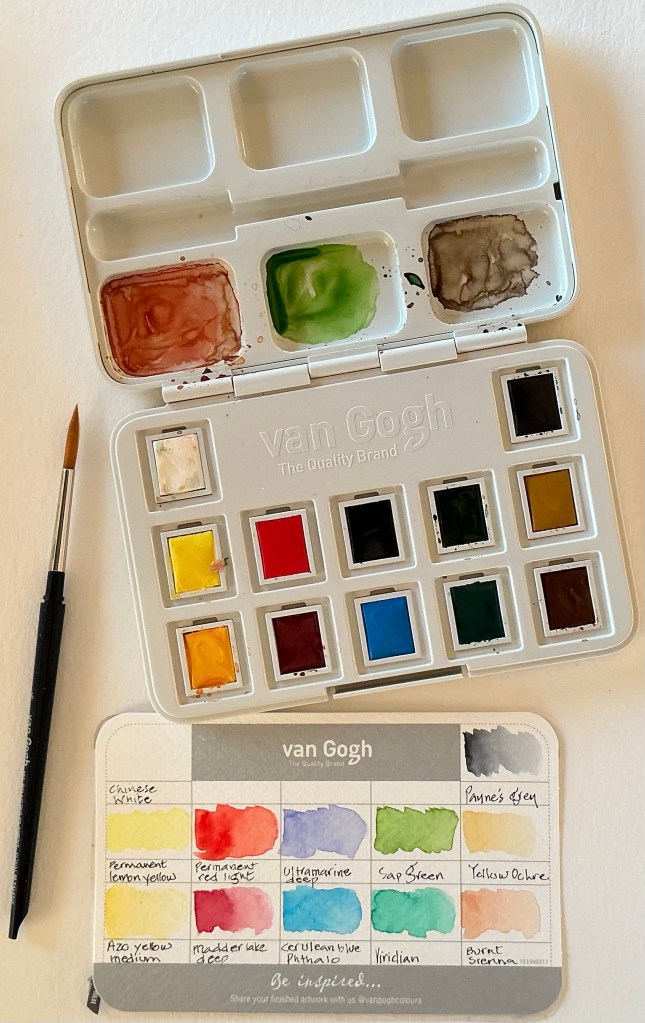
12 half-pan watercolor set and color swatch

The leaves were painted on 140# Canson XL Watercolor paper
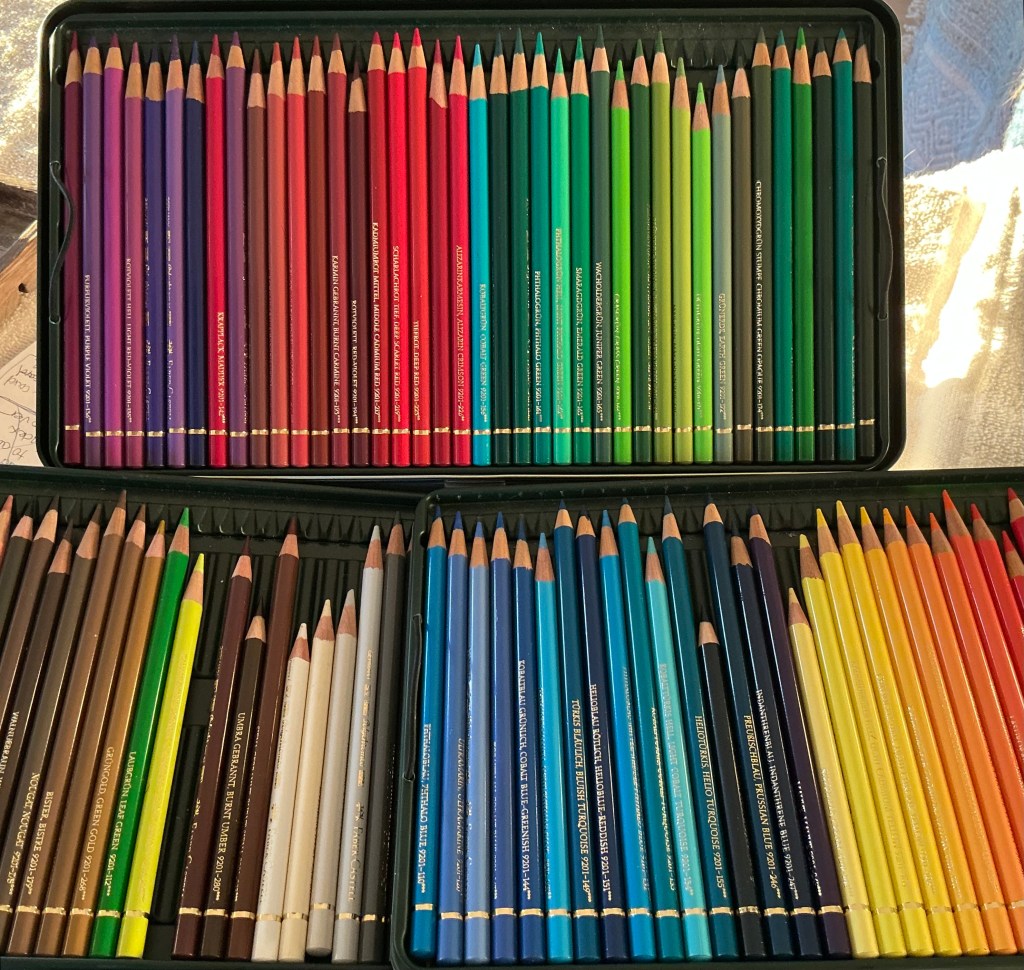
Faber-Castell colored pencil set

If you have and questions or comments, please let me know. If you use this combined media technique, any tips you’d like to share would be greatly appreciated too.

…………………………………………………………………………………………

I’d like to send a shout-out and my deep gratitude to Wendy Hollender, botanical artist/illustrator/teacher extraordinaire, who announced in her newsletter free access for over a week to 19 of her bite-sized video lessons. Designed as companions to her book, The Joy of Botanical Drawing, each lesson focused on a different botanical subject and how to artistically render them using watercolor and colored pencil combined. I’ve always wanted to learn this technique and gave it a try with her leaf examples and then mine. Incorporating both media into the same painting was very challenging and way out of my comfort zone. 

Thanks so much Wendy, for such wonderful lessons and your fabulous companion book! With lots more practice, my goal is that some day my botanical art looks as natural, skilled and professional as yours.

…………………………………………………………………………………………

As always, Thanks for stopping by!
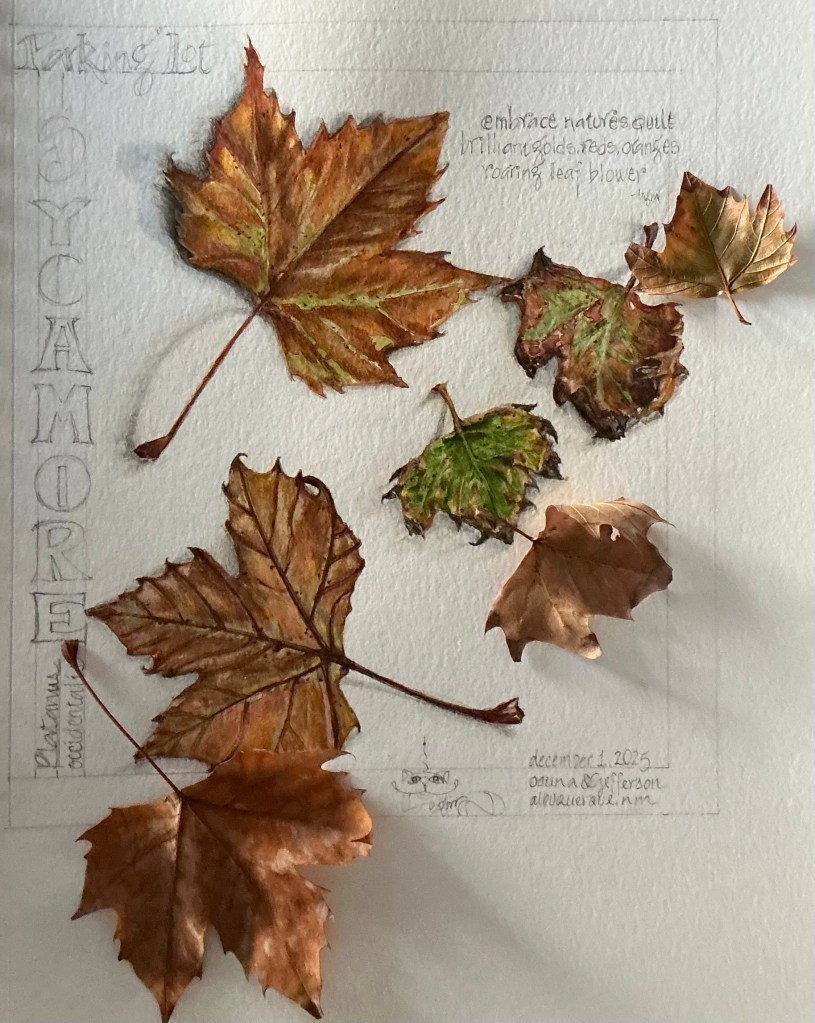
Draft final page with actual leaves lying on top

Nature’s Colorful Fall Patchwork ….. The Beauty of Gambel Oak Leaves

November 12, 2024

It’s late October, mid-Fall in the Manzano Mountains, perhaps a week before the first snow of the season. The Gambel Oak covering hillsides and mountains somehow sense a change in the air.  Seemingly overnight every leaf on every oak shrub and tree magically transformed from their summer greens to royal rusty reds, gleaming golden yellows, and shocking sunset oranges. As I look across the landscape and marvel at the sight, I can’t help wondering, “How do they know?”

The spectacle is short lived. Over the next few weeks, these gorgeously painted leaves slowly change to crispy beige brown, fooling the observer into believing they can’t face another winter; that every single oak shrub and tree just gave up and died! Thinking that was the case my first winter in central New Mexico, I was fooled. But since then I’ve learned a lot about the life cycle of Gambel Oak, and have come to appreciate the persistence of all those crispy browns covering up the otherwise barren nakedness of chaotically jumbled branches. 

There’s a lot that can be said about Gambel Oak (Quercus gambelii), but this post focuses on

The Leaves of Quercus gambelii 

The most interesting thing about this oak species’ leaves is no two are alike. Even though each leaf looks different from its neighbor, they do all have common characteristics that distinguish its leaves from other oak species. For example, All Gambel Oak Leaves …….

  • are lobed (but the number of lobes varies from side-to-side of a leaf’s mid-vein; depth of lobes varies on a single leaf and between leaves; lobes can be gently concave to acutely angled).
  • are flat and leaf margins are smooth (if leaves appear somewhat wavy and/or exhibit some serrated margins and/or points on the lobe tips, this is not a true Q. gambelii, but likely a hybrid of Gambel Oak and Shrub Live Oak (Q. turbinella) resulting in Wavyleaf Oak (Q. undulata), very common where ranges converge). 
  • are different lengths and widths, and leaf sizes are random along each branch, with large leaves adjacent to small ones adjacent to tiny ones adjacent to gigantic ones, etc.
  • change color in the Fall, eventually becoming beige brown and crispy (but color patterns on individual leaves and throughout a shrub/tree are wildly various; some leaves turn one color, while others become a mixture of greens, reds, yellows and/or oranges).
  • that are brown/crispy persist on the shrubs/trees throughout late Fall and Winter, then drop all at the same time in Spring when buds begin to open.
  • that are fresh have little 5-star hairs on the undersides, while the upper surface is smooth and leathery.
  • are relatively free of insect damage, with the exception of the occasional oak gall or insect nibbles (perhaps due to their leathery texture on the upper surface and hairy texture on the undersides?).

Every Fall I observe and collect Gambel Oak leaves. They make great subjects for my nature journal! Because every leaf looks different, the easiest way to depict the various shapes is to trace their outlines directly onto my journal pages. Then with leaves in hand, I can use my Inktense watercolor pencils to paint within the outlines, spending most of my effort on their beautiful colors.

I hope you’ve enjoyed my page of Gambel Oak leaves. Do you share nature with oaks? If so, which species, and are their leaves all the same or different somehow? Do you record your observations in a nature journal too? I’d love to know!

As always, thanks for stopping by!

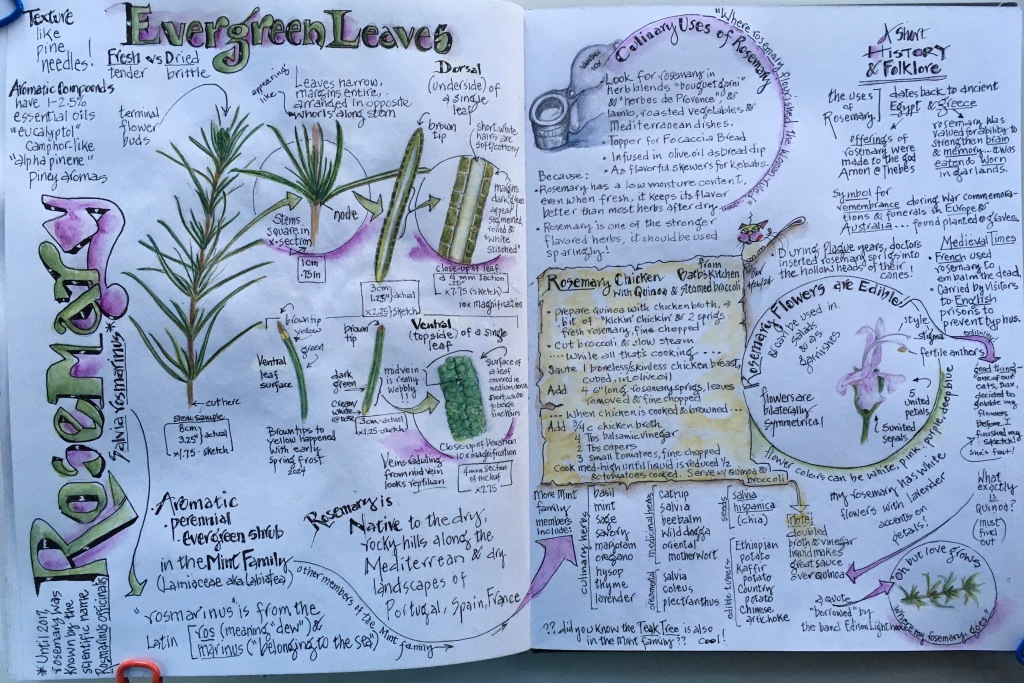
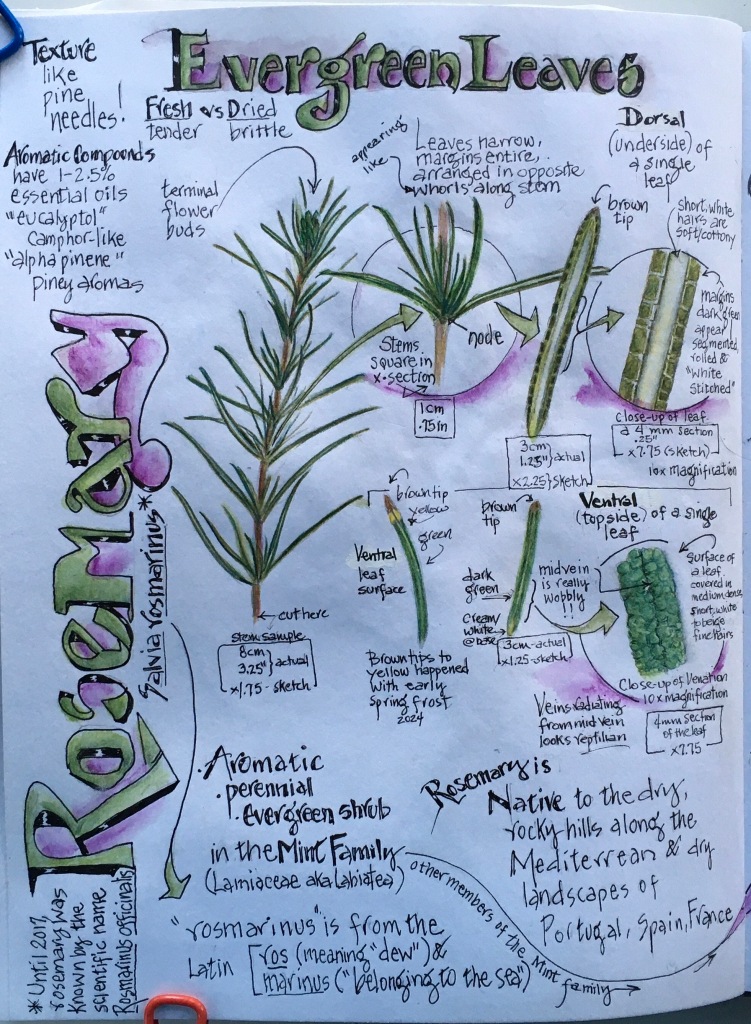
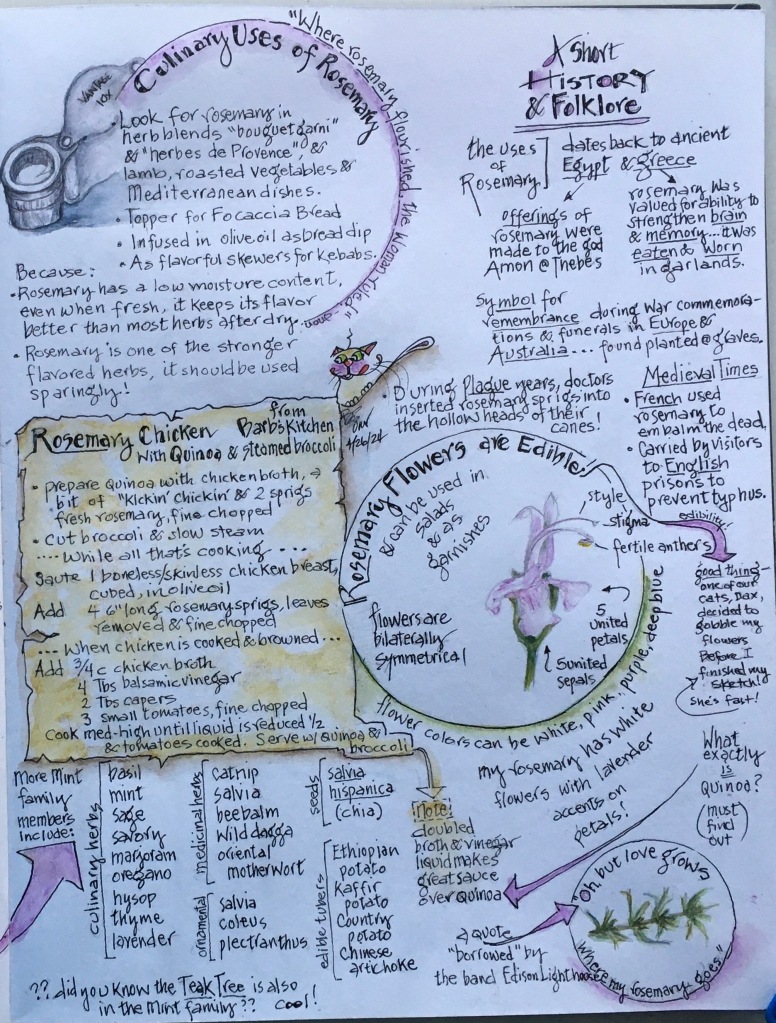
Rosemary …. Next Up in my Herb Series


April 27, 2024


When trying to pin down exactly what’s so special about Herbs, a deliciously aromatic group of plants, I was stumped.  Well, maybe not stumped, exactly. There are so many reasons to fall in love with Herbs, and picking one feature or even one Herb that’s especially special is nearly impossible. Best known for their culinary flavor enhancements, can you imagine pickles without Dill, pesto without Basil, salsa without Cilantro? What’s a dark chocolate circular pattie without Peppermint, or a cookie cutter man without Ginger?  


Herbs excite memories, calm the mind, reduce inflammation. Does the aroma of sage conjur thoughts of Thanksgiving? Does a sprig of lavender make you sleepy? Does bold yellow turmeric soothe arthritic joints?


And many Herbs are decorative and lovely to look at, form beautiful shrubs, have gorgeous flowers

But I keep coming back to the aroma. It’s hard to resist crushing the leaves of herbs like thyme or mint between my fingers. The essential oils released into the air and lingering on my fingers causes me to take a deep breath, inhaling the fragrance, embedding the aroma in my brain, resulting in a memory I can recall over and over again. 

Herbs are Special!

The Rosemary plant (actually a mini shrub) in my yard always invites my attention, and just this week it welcomed spring by coming into full bloom!

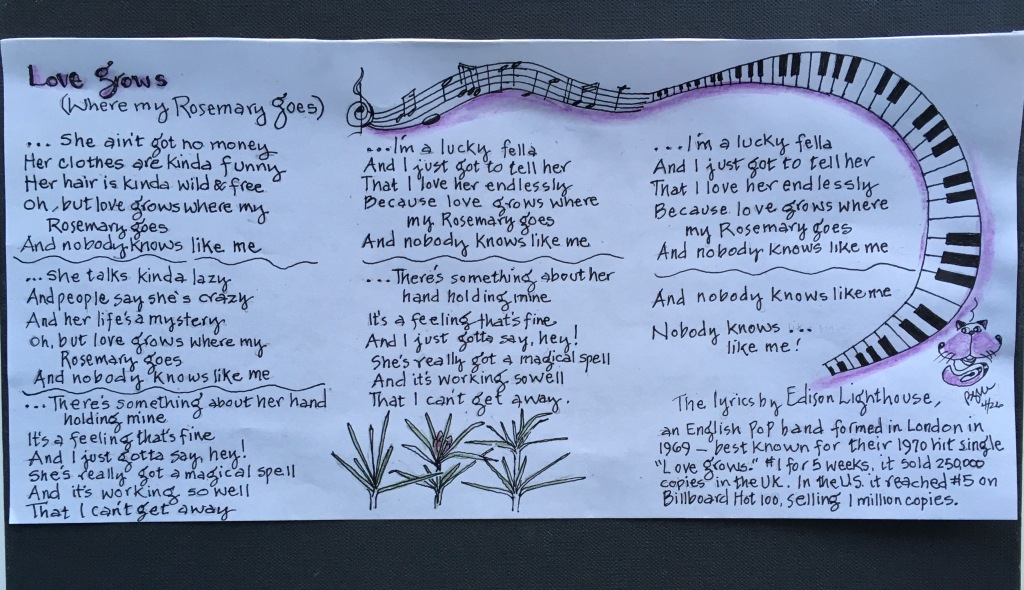
Who remembers this?! Now I can’t get it out of my head!

Do you have a favorite Herb? Why is it special? How do you use it?
Please share! And thanks for stopping by!