Pass the Mustard, Please!     Happy National Pretzel Day

April 26, 2025

Pretzels! Who doesn’t love pretzels? 

Put down that can of chips or box of square crackers and show your love for one of the most versatile snacks ever …… the Pretzel! Whether you like the snap of crispy twists or prefer them soft and chewy, grab your favorite and join the National Pretzel Day celebration today, April 26th.
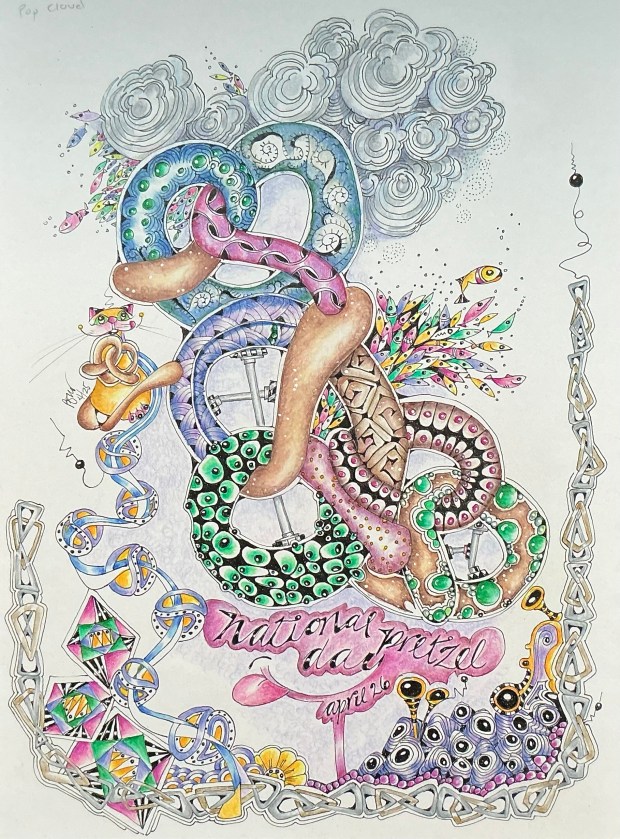
Zentangle patterns: Wakka, Triptd, Naf, Bzings, Wob, Shattuck, Aleuba, Tunnel Vizion, Reverse Lollywimple, Taco/Tearce, Tentoculus, Therefore, Tofube, Seedwayzxtra,Spangle, Strutz, Pop Cloud, Raindotty

Just where did this addictive snack come from? 

Pretzel historians offer a few origin stories, but usually share the most likely and often told legend from the Roman Empire. Apparently in 610 A.D., an Italian monk wanted a way to reward his child students for memorizing their prayers. Instead of baking loaves of morning bread, the Monk twisted thin strips of the dough into symmetrical loops by intertwining or knotting the two ends before folding them back on each other (today’s familiar “pretzel loop”). The shape he made was said to resemble a child with his arms crossed in prayer. The Monk called his invention ‘pretiola’ meaning ‘little rewards’.

From then on, these soft ‘little rewards’ became popular in Austrian bakeries and in all of Germany, and so on throughout the world. 

Not being satisfied with baking only soft pretzels, in 1850, Julius Sturgis bought a hard pretzel recipe from a local tramp (wonder why a tramp would have such a recipe? Thoughts?).  After baking and baking, and perfecting the recipe, it was clear to Julius the hard pretzel was a success. The pretzel’s popularity quickly spread, inspiring many other bakers in central Pennsylvania to make their own versions of the hard pretzel. But the original ‘Sturgis’ hard pretzel was a keeper. In 1861, the Julius Sturgis Pretzel Bakery, located in Lititz, Pennsylvania in the heart of Pennsylvania Dutch Country, became the first commercial pretzel bakery in America.

Naturally, die-hard fans of the warm/soft pretzel weren’t won over by the overwhelming appeal of the hard/crispy version. With the soft pretzel market still alive and growing, by the 20th century soft pretzels became very popular not only in Philadelphia, but in Chicago and New York as well.

The Pretzel of Today 

How many shapes and flavors of pretzels can you think of? Here’s my lists ……. 

Hard pretzel shapes: traditional loop, thick and thin; stick shapes, both thin and in thick rods; twisted, clockwise and counterclockwise; round rings with and without knots; thick stumpy bite-sized nuggets, filled and unfilled; chip shaped and waffle shaped. 

Hard pretzel flavors: salted, cinnamon sugar, peanut butter, peanut butter and jelly, honey mustard, cheese, honey wheat, honey butter, ranch, ranch and jalapeño, garlic, sea salt caramel, sour cream and onion, and buffalo wing.

And for soft pretzels …… it’s all about the dipping sauces and coatings:  Of course there’s yellow mustard, garlic mustard, melty cheese, melty beer cheese. But there’s also chocolate dipped, aioli, truffle hot sauce, buffalo ranch, cinnamon sugar, and marinara.

Can you add more?

Pretzel Fun Factz!

  • Pennsylvania is the center of American pretzel production for both hard and soft pretzels, producing 80% of the nation’s pretzels.
  • Today, the average Philadelphian consumes about twelve times as many pretzels as the national average.
  • Philadelphia opened a privately run “Pretzel Museum” in 1993.
  • The annual United States pretzel industry is worth over $550 million.
  • The average American consumes about 1.5 pounds of pretzels per year.

How will you celebrate National Pretzel Day 2025? Here’s a few ideas …..

  • Enjoy a bag of your favorite hard pretzels, and gift one to a friend.
  • Visit your local bakery or even the mall to sample their selection of warm soft pretzels.
  • Try a game of “Toss the Ring” with ring-shaped pretzels.
  • Go on a pretzel scavenger hunt.
  • Host a pretzel and beer party for your neighborhood.
  • Bake a batch of soft pretzels for the party and have everyone bring their favorite dipping sauce.

And now ……… 

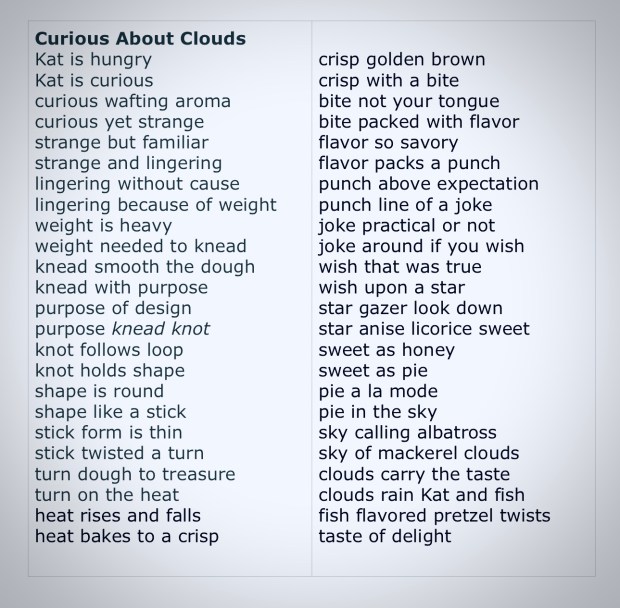
Curiously, Flambé has been following my post with fascination. Always hungry, could it be she’s developing pretzel cravings? What baker, in their right mind, would ever scent a batch with eau de fish? If a pretzel maker thought mackerel flavored twists  would ever be popular, they might just be crazy (or not?). Becoming more famished by the minute, Kat insisted on explaining her ‘irrational’ excitement in a “Blitz” poem (a style created by Robert Keim.1). She felt this poem style not only suited all the twists and turns found in a properly-constructed pretzel loop, it best expressed the twisting and turning pathway her mind took to explain herself and help us “get it!”  What do you think?
1 Shout out to Michele Lee, My Inspired Life blog post dated 04/05/2025, for sharing her amazing Blitz poem and providing the rules to create one too. Thanks Michele!

As always. Thanks for stopping by! 

Here are the guidelines for the Blitz poem, created by Robert Keim:

  • Line 1 should be one short phrase or image (like “build a boat”)
  • Line 2 should be another short phrase or image using the same first word as the first word in Line 1 (something like “build a house”)
  • Lines 3 and 4 should be short phrases or images using the last word of Line 2 as their first words (so Line 3 might be “house for sale” and Line 4 might be “house for rent”)
  • Lines 5 and 6 should be short phrases or images using the last word of Line 4 as their first words, and so on until you’ve made it through 48 lines
  • Line 49 should be the last word of Line 48
  • Line 50 should be the last word of Line 47
  • The title of the poem should be three words long and follow this format: (first word of Line 3) (preposition or conjunction) (first word of line 47)
  • There should be no punctuation

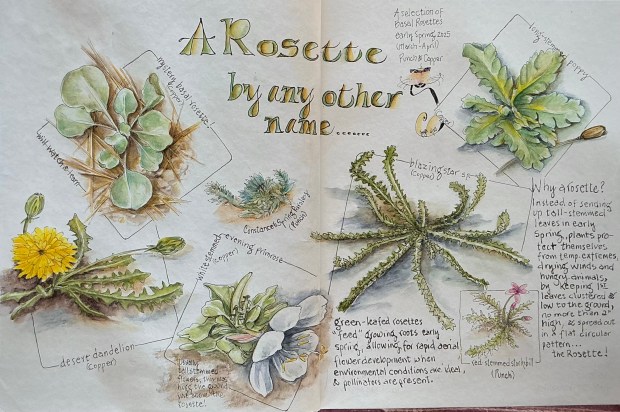
A Rosette by any other name …….

April 23, 2025

A selection of basal rosettes that popped out of the ground this Spring.

Have you ever noticed a dandelion? Oh sure …… you’ve seen hundreds, probably thousands of those ubiquitous sunburst yellow flowers blanketing a lawn or brightening an abandoned field. But before all that brilliance magically appears, have you ever looked below all those flower stalks? Have you ever noticed a dandelion before it blooms?

It’s early Spring in the mountainous areas of central New Mexico, and it seems like the high desert is slow to bloom this year. Anxious to spot even a hint of green during this transition time is always challenging, but if you look closely …….. Tucked beneath dry grasses and piled-high tumbleweed skeletons wedged next to swelling cholla you’ll find the green. Clusters of new leaves hugging the ground no more than an inch high, are beautifully arranged in a circular pattern like the unfolding petals of a rose.  

Rosettes!

Rosette arrangements are found throughout nature,1 but in the flowering plants they are particularly common in the following families: Asteraceae (like dandelions), Brassicaceae (like cabbage), and Bromeliaceae (like pineapple). Many other families display the rosette morphology too. The needle sharp leaves of yucca and the bayonet-shaped leaves of century plant (in the Agave family) form tall rosettes. The intricate leaves of wild spring parsley (a tiny member of the Parsley family) and the petite red-stemmed stork’s bill (Geranium family) both form ground-hugging rosettes. 

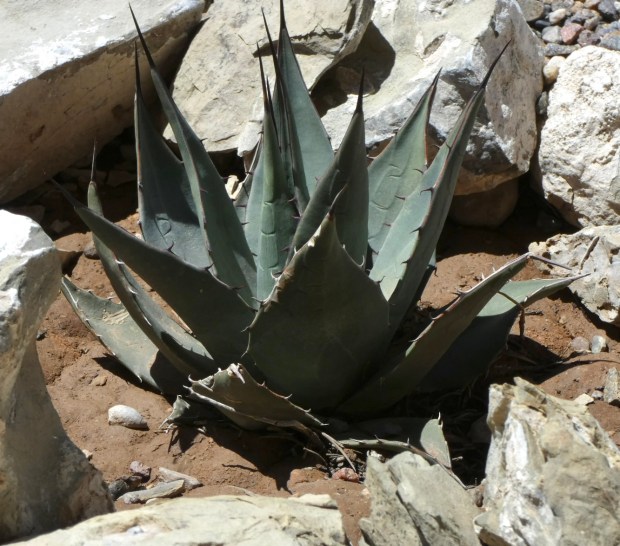
A century plant displaying a beautiful basal rosette.

Where Rosettes Form

Basal Rosettes grow close to the soil at or near the plant’s crown (the thick part of the stem where the roots attach). Their structure is an example of a modified stem in which the internode gaps between the leaves do not expand, ensuring all the leaves stay tightly bunched together and at a similar height.  A protective function of a basal rosette makes it hard to pull from the ground; the leaves come away easily while the taproot is left intact (have you ever tried to pull a dandelion without snapping off the root?). Generally speaking, basal rosettes improve a plant’s odds at survival. For example, overwintering rosettes, like the basal leafy growth produced in year #1 of the 2-year life span of giant mullein, protect the plant and its roots from extreme cold temperatures. Emerging Spring rosettes, like those found in long-stemmed poppy, also protect the plant from late winter frosts. Basal rosettes are also more protected from changes in microclimate, gravity, wind, browsing, and mechanical damage if they are closer to the ground than tall leafy stems would be. help in water balance and conservation, especially important during periods of drought. 

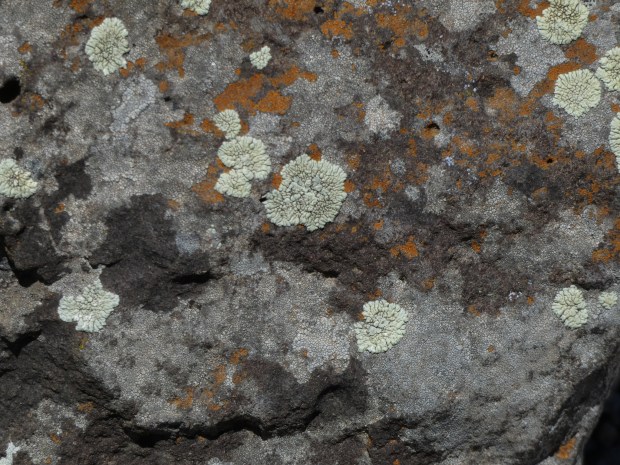
Lichen that has form small rosettes on rock.

But don’t only look down. Another form of rosette occurs when the internodes (those areas between leaves) along a stem are shortened, bringing leaves closer together as in lettuce and some succulents.2. And although not as common as basal rosettes, some plants form rosettes at the terminal or top end of their often naked stems, branches, or even trunks. One plant that does this is the native sedum called wild stonecrop. The top of the plant stems usually terminate in whorls or three fleshy leaves. Another example is the Hawaiian screwpine, which has a terminal rosette of sword-shaped leaves which sits atop an erect trunk, often supported by prop roots.

Know Your Local Rosettes

A number of desirable and undesirable (weedy) plant species produce rosettes, particularly basal rosettes.  Being able to identify a species that pops up in the Spring by its rosette is so helpful in preventing a removal mistake by inadvertently digging them up. Many weedy, non-native plants gaze first at their world through rosette “eyes.” But not all plants with rosettes are undesirable. Do you know your local rosettes by their other names?

………………………………………………………………

1  Rosettes are found throughout nature, not just in the flowering plants.  Here’s some examples you may have seen or heard of:  

In bryophytes and algae, a rosette results from the repeated branching of the thallusas grown by plant, resulting in a circular outline. Lichens also grow rosettes.

Tiny wasps and midges can induce the development of galls that become leafy rosettes.

Jaguars, leopards and other feline species display rose-like markings on their fur, referred to as rosettes.

Malaria parasites are known to form spontaneous rosettes in uninfected red blood cells.

Neural rosettes in the human brain are being studied to learn how new cells are born.

It is unknown why the Rosette-Nosed Pygmy chameleon, at home in the mountains of Tanzania, has evolved a distinctive, rosette-shaped, fleshy protrusion on the end of its nose.

The Rosette nebula, named for its rosette-like appearance, is a beautiful collection of gas and dust 5,200 light-years from Earth in the constellation Monoceros the Unicorn, and stretches about 130 light-years across.

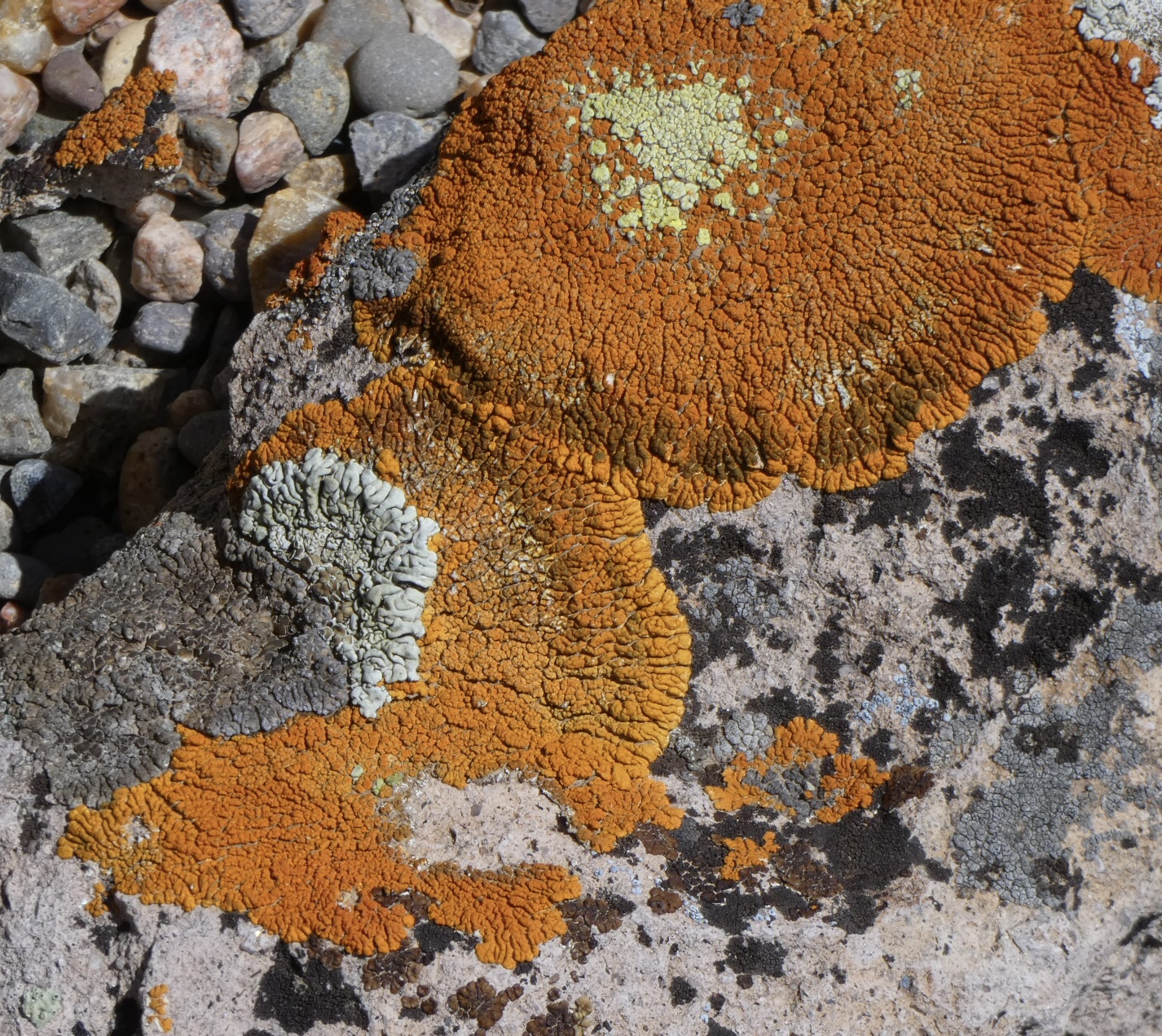
A gorgeous lichen decorated rock from Colorado. Note the rosette patterns of growth (the thallus)

  The horticultural definition of a succulent describes a drought-resistant plant where the leaves, stems, or roots have become fleshy and their tissues are able to store water. Succulents include aloe, euphorbia, sedum, the garden favorite hen-and-chicks, and bromeliads. But horticulturalists do not include cacti in the succulent group. huh? Even though cacti are frequently found in books describing succulents based the definition of a succulent, succulents are not cacti. In agreement with that last statement are many botanical and other scientific experts. (Can this get any more confusing?). So basically some experts are lumpers, while other are splitters.  Which are you? 

Basal rosette of a yucca in the NM foothills.

P.S. Cacti have stems that are thickened fleshy water-storing structures, and are considered to be a stem-succulent group of plants. Are there any cacti species that develop leafy rosettes? Because the spines are the leaves, greatly modified, in all my rabbit-trailing thru the internet and perusal of my collection of botanical references I’ve yet to see any spines forming whorled/rosette-like patterns. If you have, please contact me immediately!

……………………..……………..😂…………………………………………

Are you ready to explore the wide diversity of rosette forming plants in your neighborhood? Get on out there before those circularly-arranged leaves become disguised by an overabundance of gorgeous wildflowers! 

As always, thanks for stopping by!  And Happy Earth Day (week)!

A Brief Escapito ….. Lamy, NM

April 21, 2025

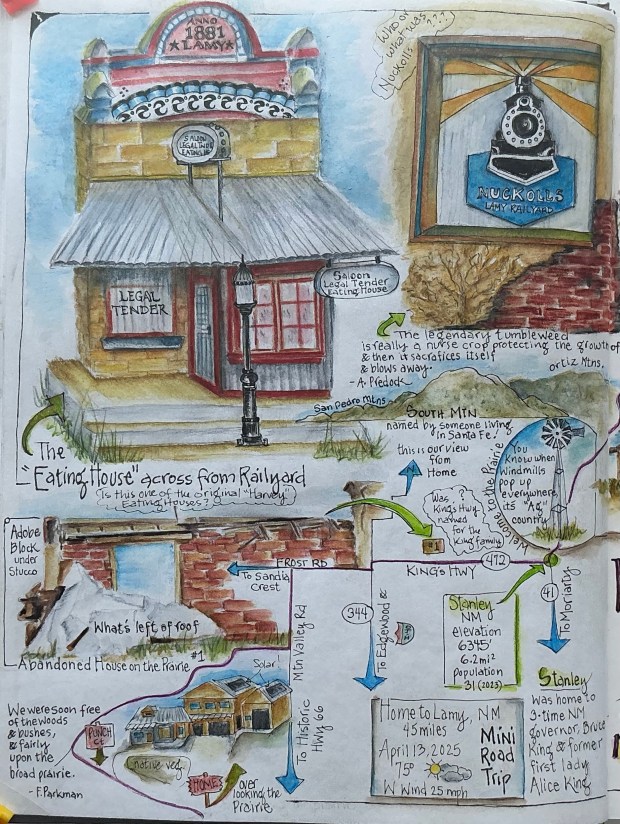
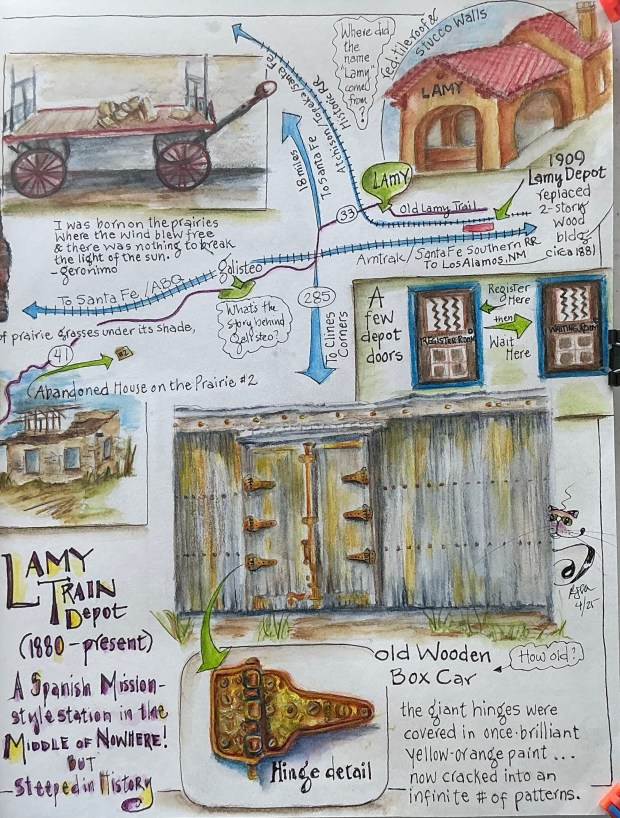
Woke one windy Spring morning about a week ago and decided it was time for a mini roadtrip …. 45 miles NNE, to visit the historic village of Lamy, New Mexico. Years ago (1991) when we lived in El Dorado (a sprawling subdivision southeast of Santa Fe), Lamy was a short 8 mile drive away. As seems true to our nature, we hardly ever visit someplace so close to home. So we didn’t. (Go figure.) But last Fall, the ABQ Urban Sketchers spent a morning exploring and sketching in and around Lamy. Unable to join them then, I promised myself that Roy and I would definitely make our own trip Lamy. So we did ….. and had a great time! Here’s a collection of my sketches and a lot of present day and historic facts about this little railroad community, many discoveries were anticipated; a few were complete surprises!

Lamy, New Mexico, preface: What’s in a Name?

Sometime during the last half of the 19th century, Galisteo Junction was renamed “Lamy” to honor the first archbishop of Santa Fe (1853). Jean-Baptiste Lamy played a major role in the development of the region, including establishment of educational and medical facilities. 

Lamy, part 1: Today

….. Location, Location, Location: Such a quaint little village, we found Lamy properly nestled in the foothills of the Sangre de Cristo Mountains, a beautiful range of mountains within the southernmost reach of the Rockies. Primarily a railroad town, Lamy boasted a population of 329 at its peak in the 1930s. Today, Lamy has a mere 93 residents, and continues to experience an annual population decline. With an “Eating House,” Saloon and a Museum, not to mention the historical Train Station, Lamy makes for a fine tourist destination and twice-daily Amtrak stop with shuttle service to and from Santa Fe, only 18 miles away.

….. The Lamy Railroad and History Museum: Dedicated to preserving local history and heritage, this museum emphasizes the railroads and their impact on the area. The museum is housed in the historic “Legal Tender” building, formerly the “Legal Tender Saloon and Restaurant.” But before that, it was the Pflueger General Merchandise Store (built in 1881) and attached Annex Saloon (built in 1884). Because this building complex is quite old, it has been listed on the National Register of Historic Places. If you’re planning a trip to Lamy, note the restaurant and museum are only open Thursday through Sunday, are run as a non-profit, and the waitstaff are volunteers.

Lamy, part 2: The Way-Back Yesteryears

….. Pre-Columbian Inhabitants: An archaeological site known today as The Lamy Junction Community, consists of 14 small Coalition Period1 (AD 1200-1325) pueblos and other structures. Occupying the SE facing slope, northwest and above the Rio Galisteo, the site was discovered by Adolph Bandelier on June 29,1882. Bandelier noted in his journal “a group of small house ruins” west of the depot at Lamy. Excavation of the area began in 1915, resuming in the 1930s and again in August 1981.  Archaeologists reported almost all of the pueblos and other structures were similar to each other, having 10-20 rooms each and built of adobe and some stone. The largest structure, however, was probably 60 rooms in size and two or even three stories tall in places.

Today this historic site is located near the junction of US Highway 285 and Santa Fe County Road 33, the dead end spur road that passes through Lamy. The location of these roadways makes sense. Over the last century, or probably longer, Lamy Junction has been a crossroads for several roadbeds that crisscross the site: between Lamy and Galisteo, Lamy and Clines Corners, Galisteo/Clines Corners and Santa Fe. Although the history of these roads and their associated artifacts have yet to be studied, it’s clear from archaeological excavations of The Lamy Junction Community, the disturbance from construction, frequent use, and maintenance of these old roadbeds impacted artifacts from the prehistoric site and surrounding area. Also, when the tracks were laid in the early 1880s for the Atchison, Topeka and Santa Fe Railway, the ideal grade ran within the bed of the Rio Galisteo southeast of the Community. Railroad construction required relocating the river to the east, placing it on the far side of the railroad grade; actions impacting prehistoric artifacts in these areas.

Note to self: Because we came to Lamy to learn about the 1880s train station, I only discovered the area was occupied more than 1800 years ago during my follow-up research into Lamy! Yes ….. we will return and try to find this prehistoric Community, now owned by Santa Fe County. 

1Coalition Period (AD 1200-1325) was a time of significant changes in the Pueblo culture of the Rio Grande Valley, which included The Lamy Junction Community of the Galisteo Basin. During this time of increasing population and intensified agriculture, expansion into new areas like the Pecos River Valley occurred. In addition, the growing population began living in larger pueblos.

Lamy, part 3: The Not So Way-Back Yesteryears

….. The Lamy Railroad and Train Station (aka Depot): When plans were made for the Atchison, Topeka, and Santa Fe railroad (aka the “Santa Fe”) to run from Atchison, KS to Santa Fe, NM, and then west to California, civil engineers didn’t take into account the challenging terrain surrounding Santa Fe. A direct run to and stop at Santa Fe was not going to happen. So about 145 years ago the line was built through Lamy. But because rail transport was still desired by Santa Feans, a spur line was built north of the Lamy Railroad Junction that could carry freight and passengers into the city. Now Plan “B” logically placed the train station in Lamy, and in 1881 a two-story wood frame building was constructed for that purpose. For 28 years that structure served as the official train station for the “Santa Fe” until a freight depot was needed. This prompted the construction of a new train station, allowing the original 1881 station to be converted into the much needed freight depot, which was in operation into the 1940s. The new train station, a one-story Mission-style red tile roofed/stucco sided structure, built in 1909, was opened to passengers upon completion. This station is still in operation, and is the one we visited.

Lamy, part 4: Growing a Railroad Town

….. El Ortiz: East of the depot, the famed Fred Harvey Company constructed a hotel named El Ortiz in 1910. Started by English immigrant Fred Harvey in the 1870s, the company that took his name ran a series of highly efficient Eating Houses along the “Santa Fe” rail lines, guaranteeing quick, quality meals. These eateries at set stations were necessary stops because dining cars on passenger trains were uncommon west of the Mississippi. The eateries were so successful, that a partnership was formed between Fred Harvey and the “Santa Fe” to branch out into the hotel business. Many hotels were located in trade and business centers, but other Harvey Houses like El Ortiz were built to develop tourism in Lamy. Hotel El Ortiz no longer exists. After a 1930s fire destroyed partial sections of the building, it was completely brought down in them1940s. 

Note to self: when we revisit Lamy, must find the original location of El Ortiz. Is there anything remaining?

….. A secret destination: Lamy was commonly the first stop for staff and their families arriving to New Mexico on their way to the secret city of Los Alamos. 

Lamy, part 5: Flashbacks of Yesterday

….. the Santa Fe Detour: Today, Amtrak Southwest Chief passengers headed to the state capital still detrain at the 1909 Lamy Station, where they can read interpretive displays about the past, visit historic buildings and the museum, walk around old train cars and engines, and maybe have a bite to eat at the Legal Tender, before catching the shuttle transporting them the remaining 18 miles to Santa Fe.

Well, that’s about all for now. Hope you enjoyed this virtual tour of Lamy, NM

As always, thanks for stopping by!

A Honey of a Prize!

Meet the Honeydew Gall-Wasp Gall

April 4, 2025

It’s Spring

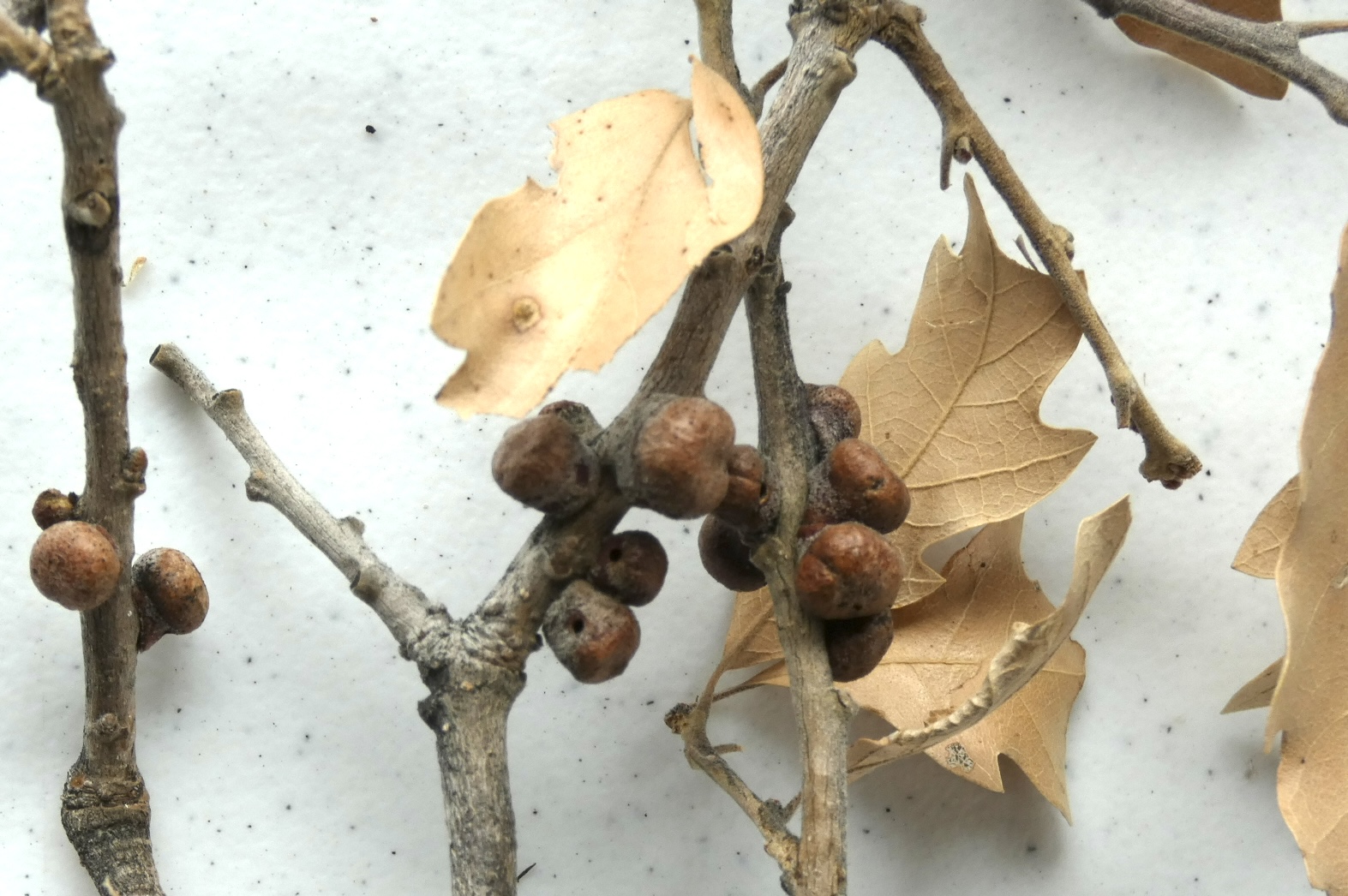
When the urge to nature journal is too hard to resist, but everything around you is still brown, crispy and covered in dust, I begin looking for any curious phenomena suitable for rabbit trailing (even rabbit tracks work!). The other day while hiking a steep hill, I was looking for sign the oaks were close to breaking bud. Spotting a string of little dark red beady objects lining many of the mostly leafless stems of am oak was certainly encouraging. From a distance they appeared to be swelling leaf buds; at least their color seemed right. But an up-close inspection revealed my hopeful find as last December’s vacated “homes” occupied by oak gall wasp larvae. Having never seen this species of stem gall before, naturally this would be a perfect most curious phenomenon to tackle. And that’s just what I did!

The Honeydew Gall-Wasp Gall

Arriving back home with a small collection of oak stems crowded with tightly packed galls (resembling miniature bread loaves), my work began. Assuming the host oak was a Gambel’s (Quercus gambelii), I began my search of stems galls on that species. Carefully scouring the literature the genus appeared to be Disholcaspis, but none of the species seemed a good match. So after many days in quandary, I consulted my favorite oak gall ID specialist, firing off a lot of questions, written descriptions and photos. Patiently awaiting his reply, I continued to find more resources to review. Gall wasps have a complex life cycle, and their galls are a challenge to identify. 

After 2 weeks a welcome reply arrived from the specialist.  Boy did I feel silly, knowing I should’ve known better! The oak host was not a Gambel’s but a cross between Gambel’s and Shrub Live Oak (Q. turbinella) which produces a hybrid called Wavyleaf oak (Quercus x undulata). Correcting my mistake was key to identifying the stem gall! Picky little wasps, huh? Happy the specialist agreed the genus is Disholcaspis, the obvious species responsible for the gall was turned out to be D. spissa; the Honeydew Gall-Wasp ….. making my discovery the Honeydew Gall-Wasp Gall!

Lesson Relearned  

When nature journaling, despite how excited you may be to find answers, it’s always, always best to slow down, breathe, carefully observe, ponder, question, make connections, and enjoy the journey ahead of the destination! 

Some Gall Descriptions and A Prize!

Outside appearance: Young galls of this wasp are yellowish and hairy. Mature galls have beige-brown to weathered grey sides, are black on top, and have a dull matte surface. They can have a round to ovoid to a rectangular ‘bread-loaf’ like shape. Texture appears mealy-granular. Galls sit snugly directly on the stems (sessile), and singly or in clusters of long compact chains that form all around the stems of host oak species. 

Inside the gall and back outside again: Each gall has one thin walled cell or chamber (known as monothalamous) that sits above the bottom of the gall. This is the larval chamber and is imbedded in dense cellular tissue that becomes a pulpy flesh with age. While the larvae are actively feeding and growing, they produce a copious amount of sticky-sweet honeydew that accumulates on the top of the gall. All of this honeydew attracts hordes of hungry ants and yellowjackets. The ecological importance of these secretions is unmistakeable; it provides a high energy food source for the insects. And while the ants and yellowjackets feed, they inadvertently protect the gall, like little bodyguards, from parasites and predators intent on infecting or eating the growing larvae inside. And another interesting ecological thing ….. the reason the tops of the galls are black and not the same color as their sides, has to do with a fungus called black sooty mold. The sugary secretions produced by the larvae accumulate in quantities too irresistible to the sooty mold. Colonies of the fungus develop rapidly on the honeydew giving the gall tops a dusty or powdery black color. So honeydew is the perfect medium for black sooty mold to complete its life cycle.

What about that Prize? Read on to learn more! Close-up inspection of the galls I collected, and there were about 25, revealed all but one had a single exit hole in a side just below its crusty red-black top. I learned the adult wasps emerge from these stem galls by late December; sometimes waiting for warmish temps until mid January. What happened to the adult wasps in the one gall without an exit hole? Because the gall had a sooty top, implying the larvae had been eating, growing and secreting honeydew, maybe the larvae died at some point or failed to develop into an adult? Had to know! Cutting the gall to find out wasn’t easy. The outer crust fell away first, then using steady knife pressure on the punky innards, the gall popped open, like a box of ‘Cracker Jacks!’ And there, near the bottom of the package, was a single sealed chamber. Carefully I was able to tease out the contents with fine pointed tweezers until out blurped the Prize! An intact cream colored gooey looking larvae, followed by a small puddle of viscous liquid. Even though the larvae filled up most of the chamber, there wasn’t any sign it was alive. And after an hour, when there still wasn’t any movement …. well, darn, I felt he must’ve died sometime before morphing into adult form. But peeking inside the gall did answer the question about the absence of an exterior exit hole.

And now an interesting note about these types of cynipid oak gall wasps: On my diagram, I used the term ‘agamic’ which is a formal label included with the genus/species name (i.e. Disholcaspis spissa ‘agamic’). This means these wasps have an asexual all female population that emerges from galls in late fall/early winter to lay fertilized eggs without needing to mate with males. Then a bisexual generation follows where adults emerge from galls in late winter/spring/early summer. This is the typical 2 generation annual life cycle of cynipid gall wasps, where the galls developed from each generation usually look very different and even occur on different parts of the host plant (on stems vs leaves). It’s interesting that nothing is known about the bisexual generation of D. spissa, but the asexual generation is common, well documented and abundant.

Known host oak species for D. spissa: Look for these galls on Shrub live oak (Quercus turbinella), Wavyleaf oak (Quercus x undulata), Mexican blue oak (Q. oblongifolia), Arizona white oak (Q. arizonica), and Shinnery oak (Q. havardi). 

******************************************************************************************

Hope you found my post interesting. Have you ever been curious enough about plant galls to look inside? Recalling the first time I saw a gall, I had no clue what it was and why it was precariously clinging to a plant leaf. It was round and hard, and reminded me of a tiny rusty red ping-pong ball. Was there something inside? Would it be squishy, alive, have teeth and bite, or perhaps whatever it was was dead and oh so smelly? Maybe it was some weird kind of flower bud, or a fruit lost under the leaf? Despite being a bit nervous, I needed to know what, if anything was inside. So I cut it in half, and in the center of the ball, suspended on hundreds of delicate threads, was a tiny, wormy creature twisting and turning and wriggling to music only it could hear! That was over 45 years ago, and to this day I still find galls irresistible!

As always, thanks for stopping by!

A Few References

Russo, Ronald A.: (2021) Plant Galls of the Western United States, section on tree galls; oak galls of the SW, page 173. 

Weld, LH: (1957) New American Cynipid Wasps From Oak Galls https://www.gallformers.org/gall/948

Up Close and Conversational .. ‘Glorieta’ Southwestern Orangetip Butterfly

April 2, 2025

New Mexico Orangetip butterflies

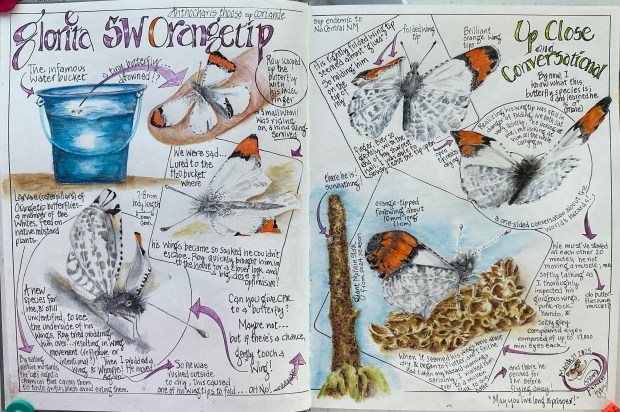
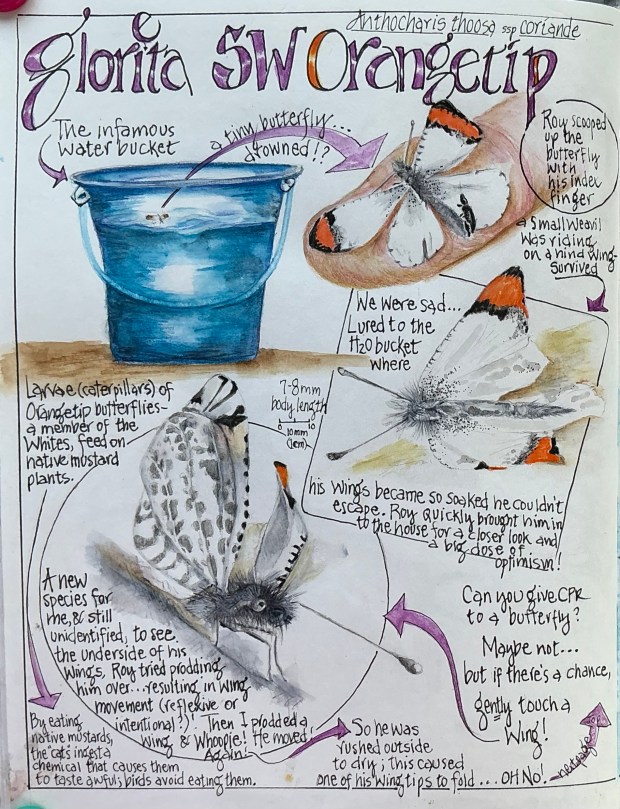
The ‘Glorieta’ Southwestern Orangetip (Anthocharis thoosa ssp coriande), are only known to occur in the central and north central counties of New Mexico. This recently recognized form of A. thoosa was described by M. Fisher and Scott in 2008, from specimens collected near Glorieta Pass southeast of Santa Fe1 (which just northeast of our home).

The Orangetips are classified in the Family Pieridae/Subfamily Pierinae ….. commonly called the Whites. In NM there are 16 known species of Whites, including the non-native European Cabbage White.  After a wet winter, plentiful males compete for hilltop display locations while females search surrounding areas for the choicest of native plants in the mustard family (Brassicaceae) on which to lay their eggs. When the eggs hatch, the larvae (caterpillars) voraciously devour the leaves of their host mustard plants, until they’ve grown to over 1,000 times in size!  Because this family of butterflies is common in desert habitats, to withstand drought conditions some species have the ability to suspend development during their pupal stage (when they are in their chrysalis), a mechanism called pupal diapause. And if winter rains do not cause favorable conditions for their larval hosts (the mustard plants), they can remain in pupal diapause for several years.   

The White’s preference for mustard plants may not be about taste. It’s thought that chemicals contained in these host plants make butterflies in this group unpalatable. Entomologist, “Mike Toliver has witnessed only one attack by a bird on members of this group in more than 60 years of observation.”1

1https://peecnature.org/butterflies-of-new-mexico/whites-pieridae-pierinae/

A Very Close Encounter

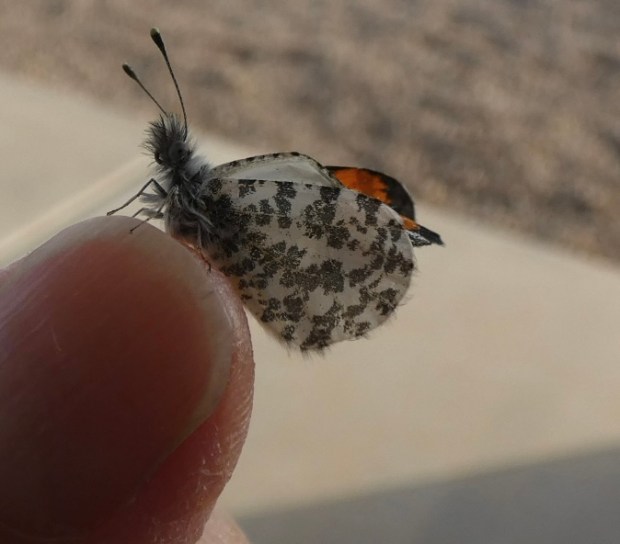
Early one morning (a few days ago), Roy discovered a miniature butterfly afloat, upside down, in a water bucket left outside overnight. Looking very drowned, Roy scooped him up with the tip of his index finger and brought him inside the house for my inspection. Excited and sad all at once, I snapped a few photos, having never seen this species before.  Because this little guy had such striking marks and color, finding him in the online New Mexico butterfly field guide was easy.  This beauty was a ‘Glorieta’ Southwestern Orangetip (Anthocharis thoosa ssp coriande)!

Roy was about to turn him over to take a look at the flip side when one of the wings fluttered a bit. Not believing our eyes, I gently prodded him, and sure enough! He seemed alive! But just how much alive we didn’t know.

Rushing this tiny guy outside where his wings might dry, he slowly became more active. Unfortunately the tip of a still damp forewing folded over and stuck like glue making it impossible to synchronize those wings  …. he didn’t seem remotely interested in taking flight. Not to be defeated, he then crawled up to the tip of my pinky finger, looked me in the eyes, raised one of his six legs politely asking for help. Gathering my courage and willing any clumsiness ‘be gone’ from my fingers, I held my breath while using the edge of my longest fingernail to slowly and carefully separate the fold. Taking my time to tease up the delicate tip millimeter by millimeter, this butterfly never moved a muscle (do butterflies have muscles?). After what seemed like hours the wing unfolded, popping back into alignment without any apparent damage! 

“The Talk”

He didn’t fly tho, so I sat with him for about 20 minutes as he perched on my finger. During my ultra close inspection of his eyes (you know I love eyes, and his were sultry grey and gorgeous), punk-rock style hairdo, and brilliant orange tipped wings, he seemed content while I carried on a lengthy one-sided conversation warning him of the world’s dangers. 

Somewhat convinced he believed and would abide by my every word, I walked him over to a large mullein stalk, where he walked off my finger to enjoy a sunbath (hopefully to prepare to take wing). He wasn’t in much of a hurry tho. About an hour later and checking to see if the coast was clear, off he flew.  That beautiful Glorieta Southwestern Orangetip butterfly was free!

All-in-all, it was an exciting encounter! 

What exciting encounters are you experiencing during this change of seasons? 

As always, thanks for stopping by!

Welcome New and Returning Subscribers

Many Hearty Thanks, Sharing Creative Ideas, Answering the ‘Kat’ Kwestion

April 1, 2025

Completing my 15th sketchbook, and beginning the next one is always cause for celebration!  To do so, Kat and I thought it would be especially fitting to shout-from-the-treetops enthusiastically, THANK YOU! Thank you all, my loyal subscribers, for coming along on my interesting, hopefully educational, sometimes crazy, always curious nature journaling adventure. 

Zentangle patterns used: LoveBuzz, Membranart, Frostz, Chatoo, Sea Urchin, Toku, Rosie, Calibree

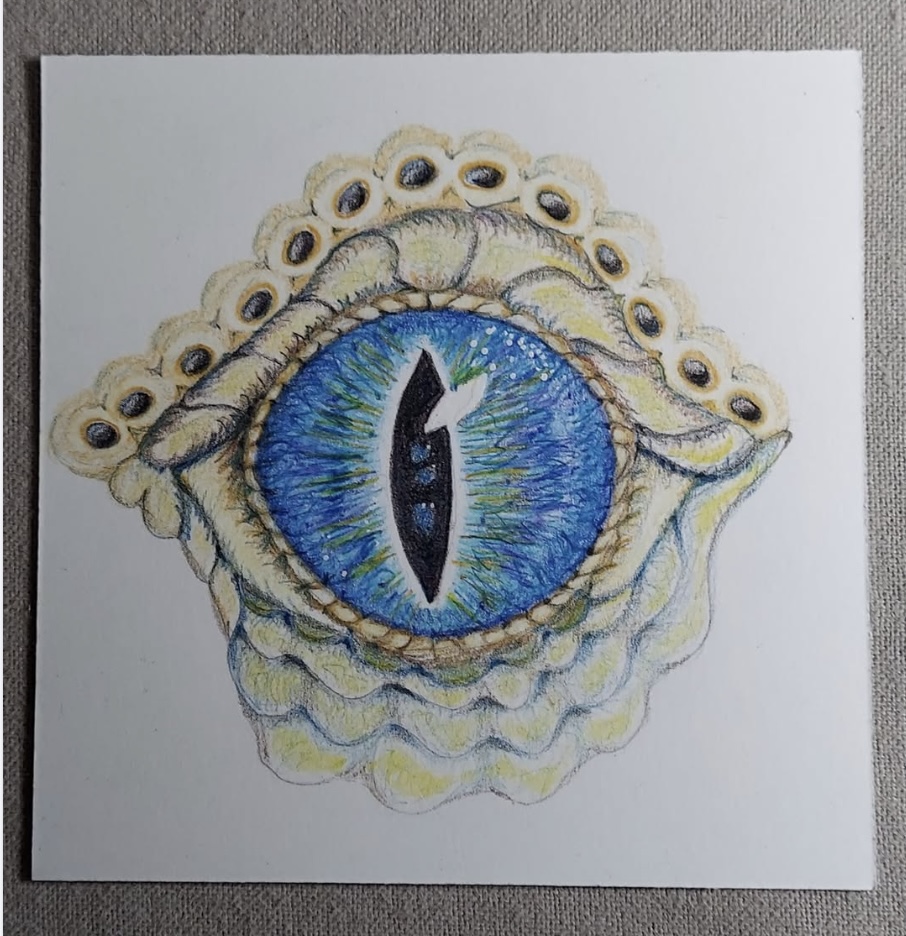
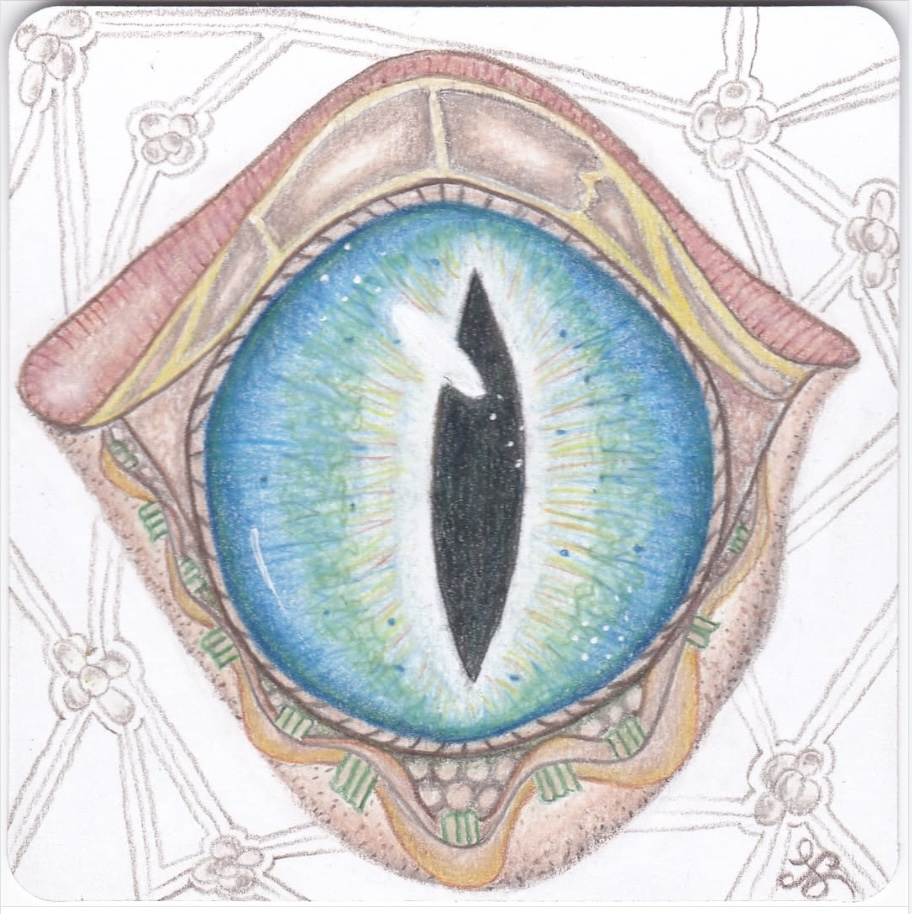
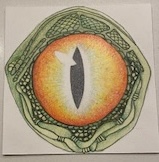
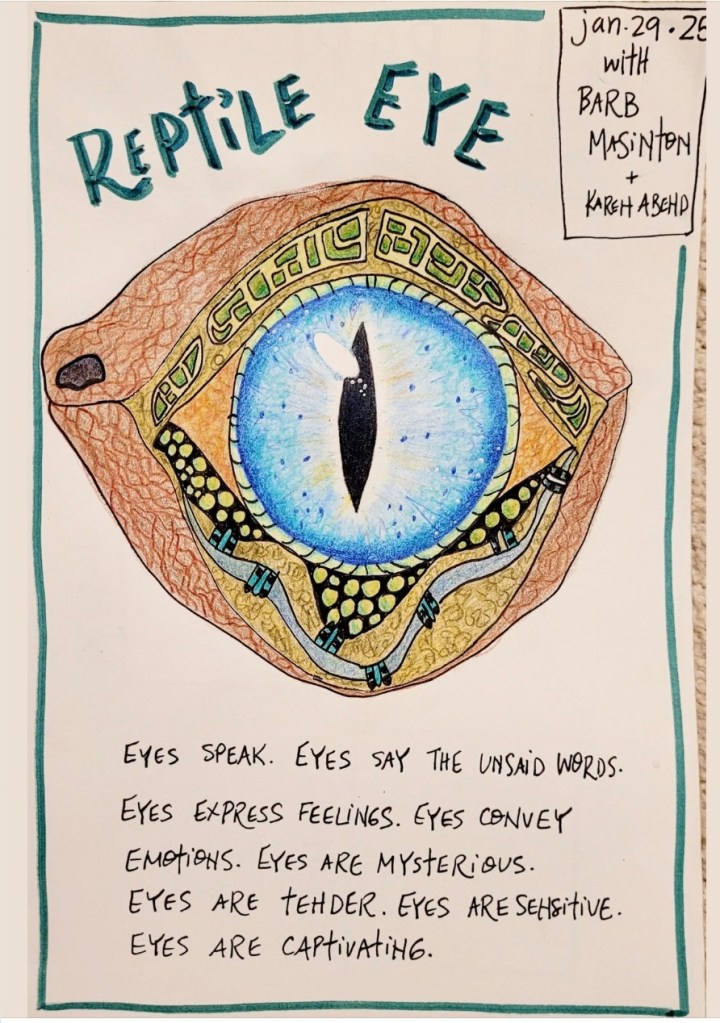
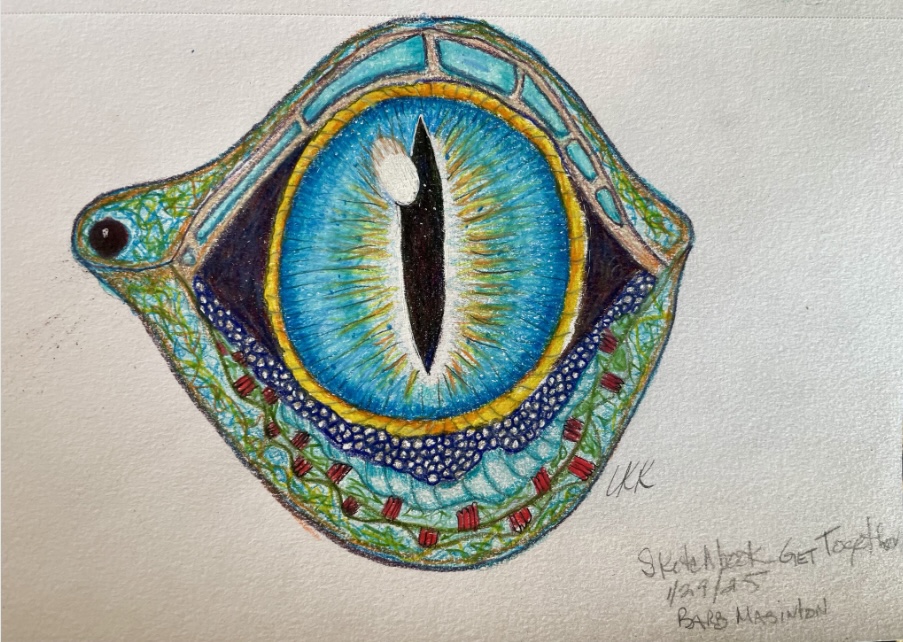
My recent webinar class, “Create a Colorful Reptile Eye1,” sponsored by Host Karen Abend (of Sketchbook Revival fame), generated many new subscribers to my web page and blog, “A Curious Nature.” Wow! And Thanks so much. A special thanks to those who attended the live and/or recorded class. I loved seeing so many colorful lizard eyes (a sampling below). They were incredible! 

Sharing the Wonder of Nature

With all the past and current activity on my blog, I feel so fortunate and very encouraged to carry on. Even though new postings have been random lately, there’s lots of works-in-progress soon to be shared. Meanwhile, comments including what you like about my posts and what you’d like to see more of, are always appreciated.  What inspired you to subscribe to this blog? If it’s just enjoy, that’s perfect! Or maybe you’d like tips to develop a regular or even a daily creative practice, how can I be more encouraging? I’d love to know if you are an active nature journaler or tangler, or express yourself by creating art in other ways, such as through music, poetry, or storytelling. Send me your ideas by commenting on this or any future posts. I’ve created my webpage and blog because of my insatiable curiosity about the natural world. It’s extraordinarily fun to go beyond learning what the names of flowers, animals, rocks, and clouds are. The excitement of wondering and discovering answers for all the why’s, who’s, when’s, and how’s is so rewarding. Sharing is my joy!

Explaining Kat

Thinking new subscribers may be puzzled by my constantly mentioning Flambé or Kat or both, now might be a good time for explanation and background (and perhaps provide a refresher for those who’ve been following along from day 1 of my blog):

In 2014, a young stray calico cat showed up one day on our doorstep when we (Roy and I) lived in Oriental, North Carolina (U.S.A.). This little wild miss seemed to magically appear from our backyard woods, perhaps in search of a meal or a friend. She sat and meowed for a few minutes, but when we opened the door, she ran away.  Efforts to get close to her when she returned several times during the week were futile. Then one day she vanished and never returned. Not knowing what may have happened to this pretty kitty, Roy thought a nice remembrance of her visit would be to add a small cat sketch to my next drawing. A dandy idea!“But only one drawing,” I thought? It was at that moment that Flambé appeared on my creative doorstep, and has never left!

Flambé, aka Kat, is always smiling, popping in and out of all my art, regardless if the piece is imaginatively & whimsically tangled or a serious nature study. Along with forming the best part of my signature “chop,” she’s the heroine of some pretty wild and crazy tangled misadventures, sometimes pushing Kat’s 9-lives threshold to satisfy her insatiably curious nature (and appetite). Flambé adores being noticed, whether she hides inside the story, or shows up front and center. She makes everything creative more fun.  Flambé may be just “Kat,” but she’s my inspiration for and reminder about the value of komic relief, and makes the perfect konstant kompanion!  

Whew! That’s all for now. Hopefully your questions about this blog, inspiration and Kat have been answered. If you’re craving to learn answers to other related topics, let me know.  Meanwhile, Flambé and I wish you an exciting and creative remainder of the year ….. have times full of happiness, creativity, and memorable adventures, but most of all laughter and fun!

Hope to hear from you soon, and as always, thanks for stopping by!   

Meow!

1Unfortunately, the class or recording are no longer available for viewing. But I may have another live demo class some day in the future.  If so, you can be sure the announcement will show up on my blog.