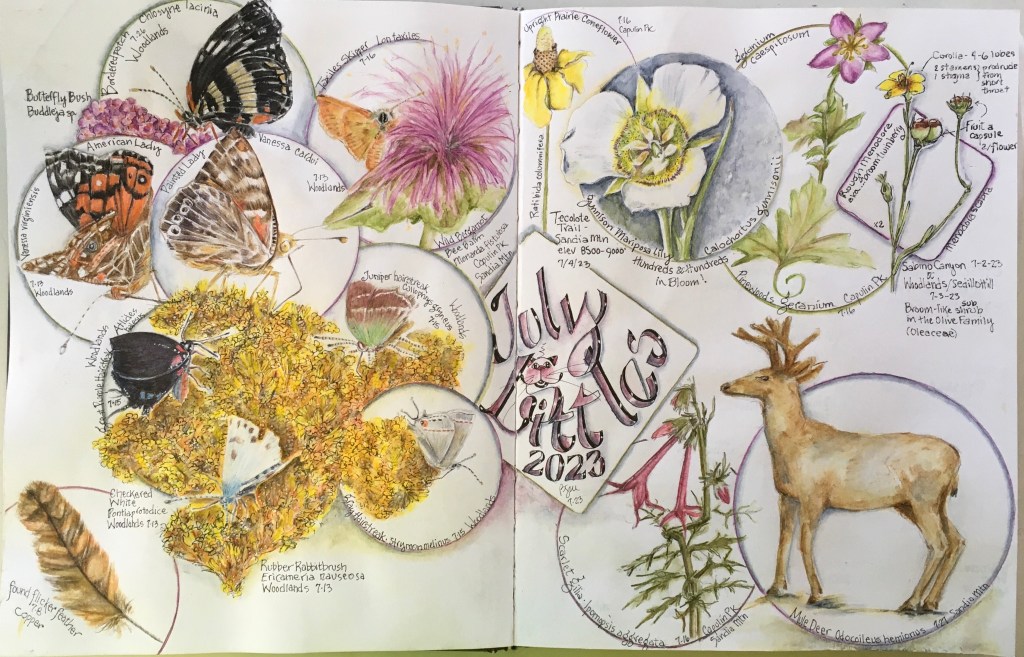
June’s hot, dry weather slipped stealthily into July as we became mired in one of those infamous heat domes for weeks. Our rabbitbrush shrubs, usually late summer bloomers, burst into piles of brilliant yellow flowers a full month before normal, and for the first week of their premature bloom, not a single pollinator was in sight. I was so concerned the over abundance of nectar would dry up, pollen would blow haphazardly away, and seeds wouldn’t form. Then one morning I woke to find hundreds of butterflies, weevils, flies and bees flitting, crawling and buzzing about, nearly covering the shrubs completely in a pollination frenzy! How did they know? Where did they come from? What a relief for me, but it must’ve been an unimaginable relief for all of those pollinators that happened upon our oasis in the desert.
And so it went, all month…. bursts of early blooms rapidly completing their floral life cycles, thanks to urgently feeding pollinators.
This is how I remember July, with everything in bloom at once, the air full of pollen and pollinators. It was quite a sight!
Once again, a big shout-out to “Made by Fay” for the inspiring “Littles” idea! Stay tuned for the next installment of “Littles.”
Welcome back to my nature journaling blog! Today I’m excited to introduce my grandniece, Alivia Rapp. Livi, who is a very creative 15 year old, and the daughter of one of my brother’s daughters, came to visit for 3-1/2 days with “Grandpa Bob” (that’s my brother).
Livi with her new love …. A Greater Short-horned Lizard
During the past year, Livi and I have been chatting online about her art, her storytelling skills and her keen imagination in character development which she has honed through many years of daily practice. Then last year, enrolled in a beginning art class where she quickly demonstrated her artistic skills, her teacher bumped her into the advanced class. It was obvious Livi was in her element! She excelled in all of her art assignments which included still life and nature studies, portraits and perspective drawing, using a wide variety of tools such as pencil, pen, watercolor, acrylic, and colored pencil. Her first love of Anime and fantasy storytelling showed in her work too, and one of her creations was awarded a ribbon at her local spring fair. Congratulations Livi!
Now back to nature journaling. Every morning, Livi and I (equipped with sketchbooks and pens), Bob and Roy (carrying daypacks with water), set out for a bit of hiking and sketching nature discoveries along 3 different trails. Roy and I picked trails at different elevations with different habitat zones and views, knowing we’d have a variety of sketchable subjects. We weren’t disappointed!
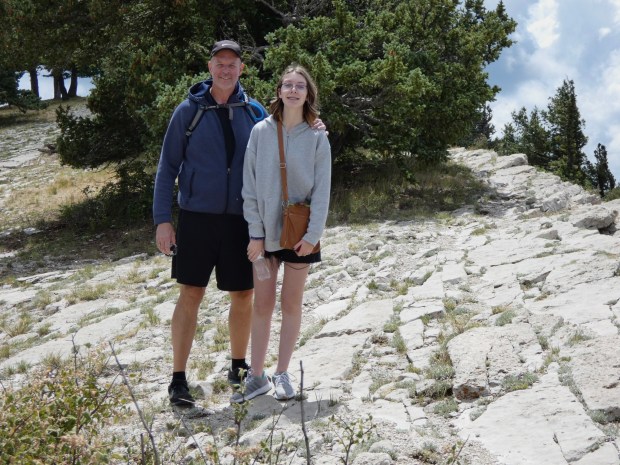
My brother, Bob and granddaughter Livi on the Sandia Mountain Crest Trail
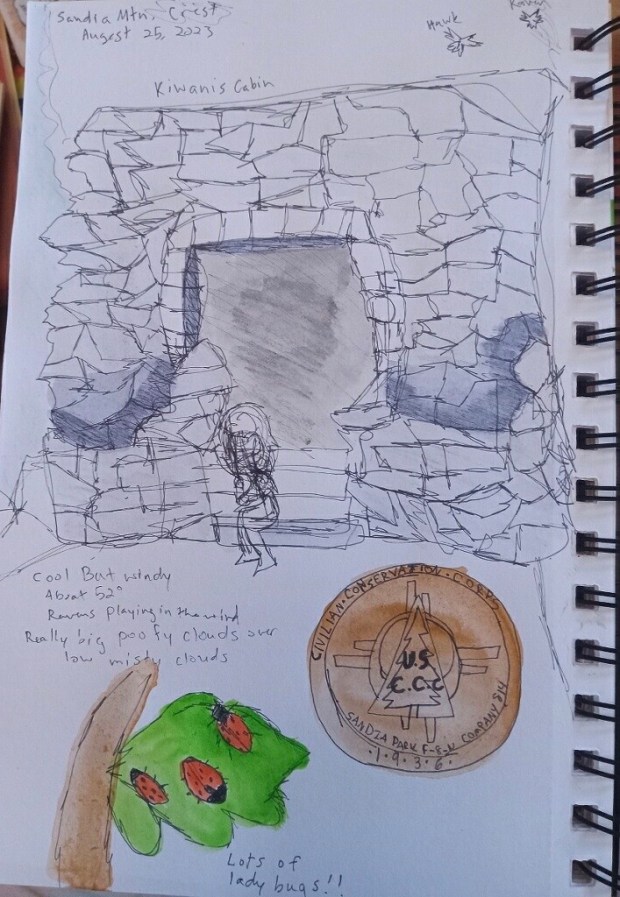
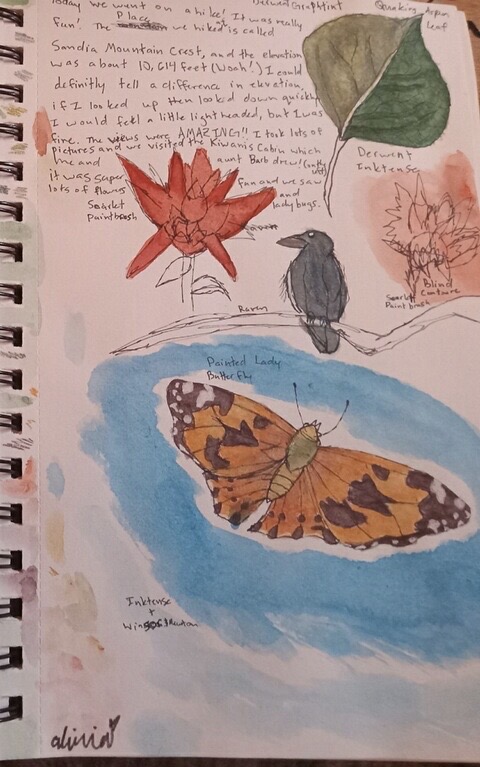
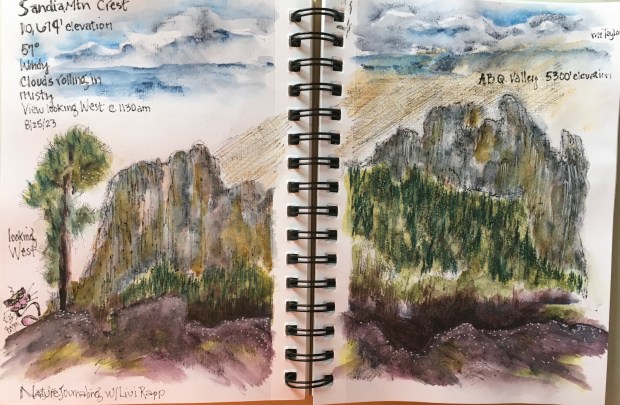
Hike #1 took us to the top of Sandia Mountain (10,679’) where we enjoyed many spectacular views of Albuquerque and the Rio Grande Valley a mile below, as we passed through a high elevation conifer forest on our way to the Kiwanis cabin. So many sketching opportunities ….. we each tackled the cabin, and Livi added a few of the 50+ lady beetles she discovered, then created a page with a raven, painted lady butterfly, a red paintbrush flower and aspen leaf. I chose a view, some wildflowers and the charming “Snack bar” marker (haha). Back at home we completed our sketches, adding watercolor pencil, with Livi being careful to note the names of my supplies she tried out.
The Kiwanis Cabin and CCC construction plaque; a few of the lady beetles Livi discovered near the trailhead
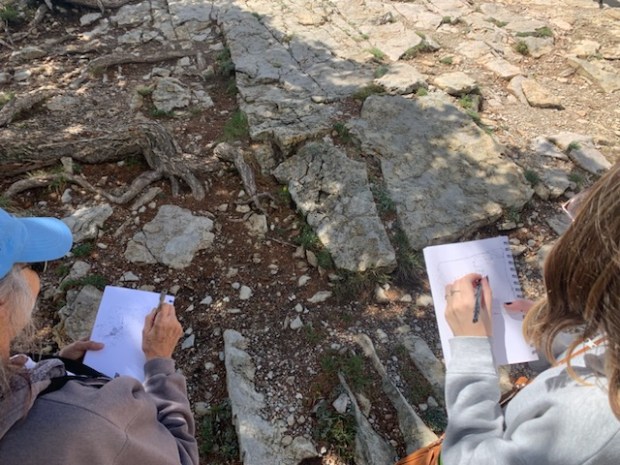
Livi and Barb hard at work sketching the Kiwanis Cabin
Livi’s wildlife composition along the Sandia Mountain Creat Trail
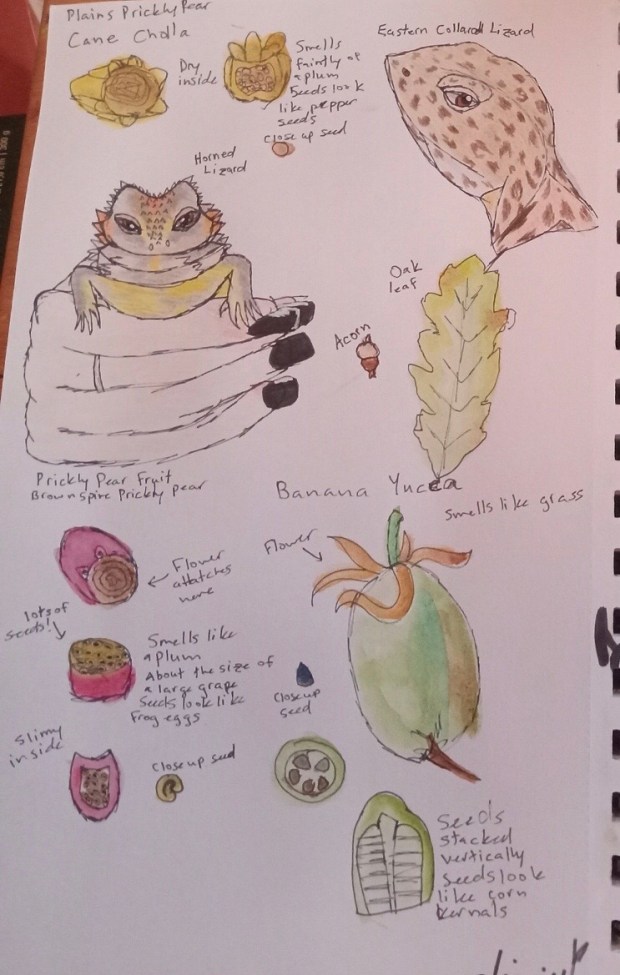
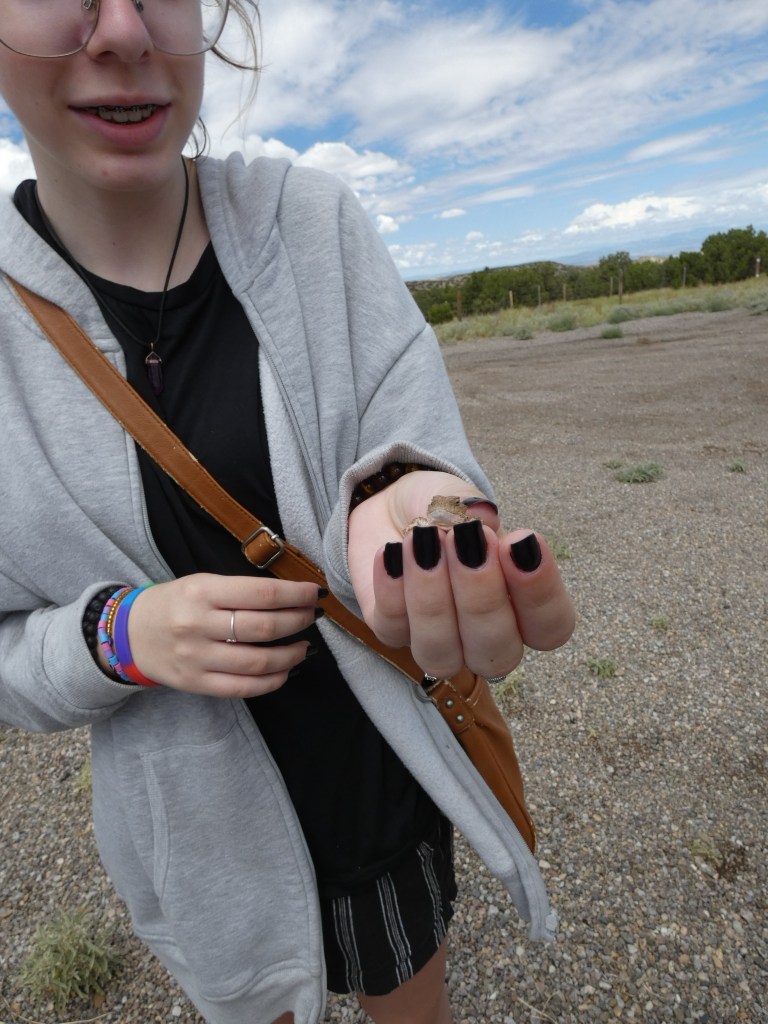
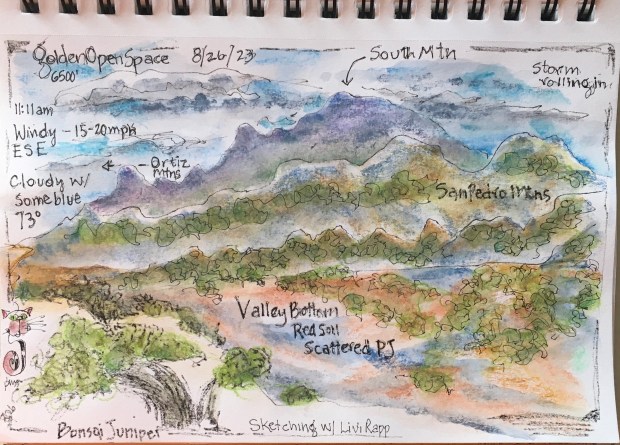
Hike #2 and we all hiked the upper loop trail at Golden Open Space which sits at about 6300’. The scenery and views were some of Bob’s favorites, so Livi and I spent about 5 minutes sketching one of the prettiest looking East towards the Ortiz and San Pedro Mountains and South Mountain. Then a great surprise discovery along the trail ….. an Eastern Collared Lizard! That was the first collared lizard Roy and I had ever seen at Golden, and after a few photos he decided to rise up on his tippy-toes and run like the wind! Then our second surprise …. we nearly stumbled over a beautifully ornate Greater short-horned lizard ….the lizard referred to by many as a “horny toad.” Before he could get away, Roy was able to snatch him up, roll him over on his back so he could get a belly rub that put the lizard to sleep. Sort of. Then after being entertained by a few erratically running fire engine red velvet ants, we had our 3rd great surprise, thanks to Livi’s eagle eye! A baby greater short-horned lizard that was trying to escape our view was also snatched up by Roy, and also became very sleepy. So cute. Livi was so glad we didn’t encounter any tarantulas, but declared that she loves the horned lizards! Back at home we finished our landscape sketches, and created pages illustrating the lizards. As an exercise in comparison, Livi dissected then sketched a few prickly pear “tunas” (the fruit) and a dried fruit from one of the chollas. She also cut into a large banana yucca fruit ….. which reminded her of a cucumber. Very interesting and fun!
Livi’s sketch of the San Pedro Mountains, colored with pan pastels
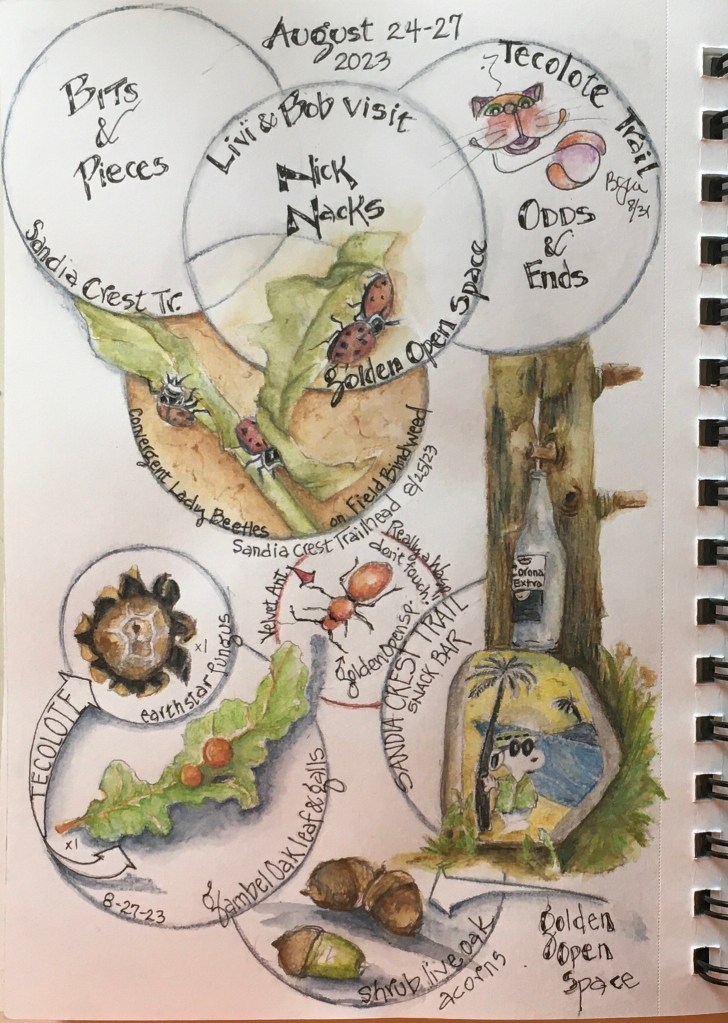
Golden Open Space was full of surprises! Livi’s journal page illustrating just a few!
Livi holding the baby greater short-horned lizard she found.
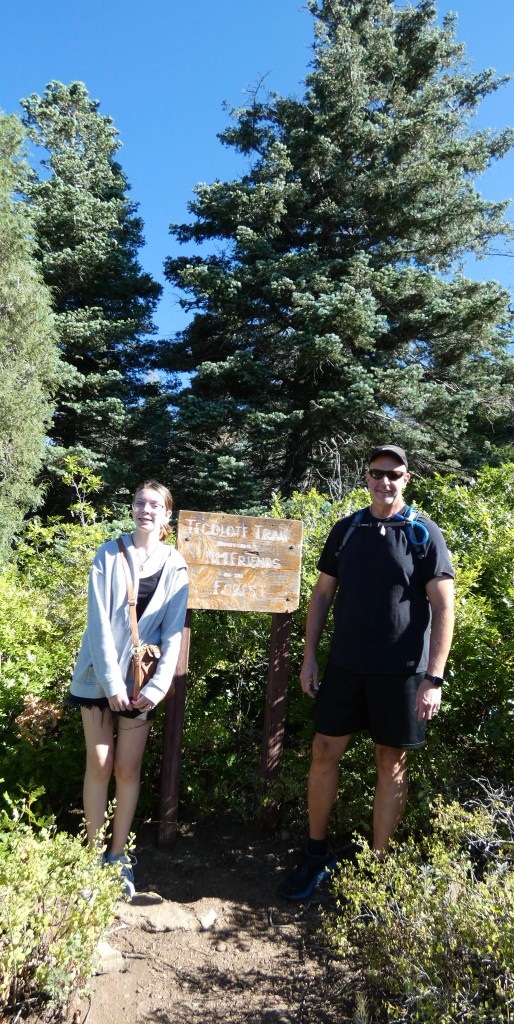
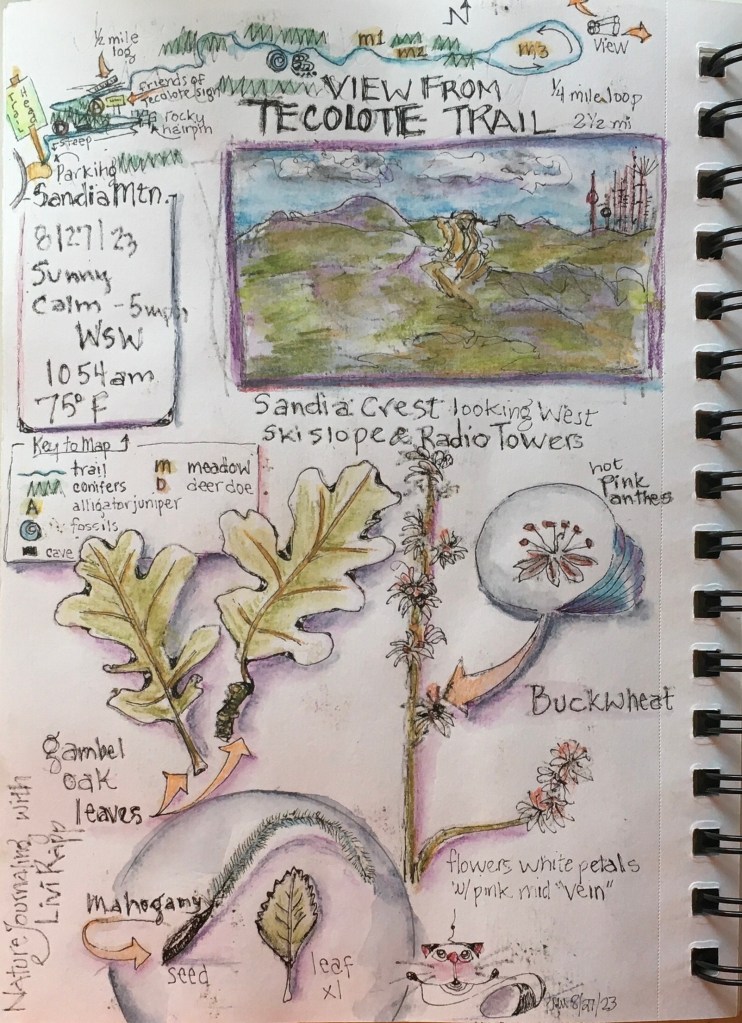
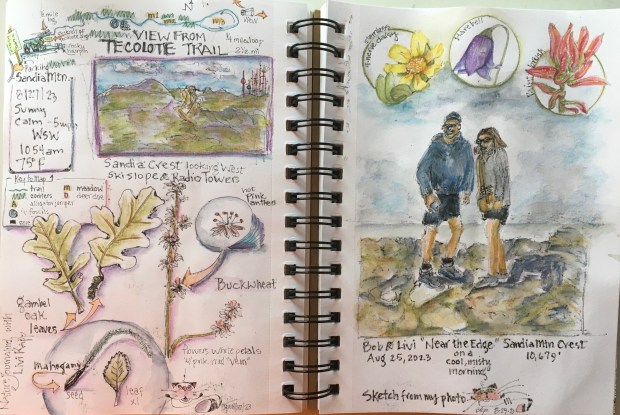
Hike #3 and we were back up Sandia Mountain and hiked the out-and-back 2.5 mile Tecolote Trail which sits at about 8500’ elevation. We had more beautiful views of the valleys below and the Sandia Mountain ski slope (which we sketched), and identified quite a few wildflowers, trees and shrubs. On the way down the trail we were surprised by a lovely mule deer doe as she quietly and carefully picked her way through the forest. Back at home we completed our sketches which included a wildflower drawing of a buckwheat plant, the seed and a leaf of an alder leaf mahogany shrub, and several sketches of oak leaves which we each tried as a blind contour drawing and a contiguous line drawing. Hey, they looked pretty good too! Back at home we rested, exhausted by our artistic efforts. But after Livi returned to her home near Seattle, she completed all of her pages and shared them with me.
Livi and Bob about to embark on the Tecolote Trail
Livi’s journal page with on location sketching exercises
Roy and I had fun sharing our love of New Mexico with Bob and Livi. And I especially loved getting to know Livi and sharing my love of nature journaling with her! Livi and I will definitely be staying in touch throughout the school year as she begins grade 10 and a new session of the advanced art class. I can’t wait to see shat she learns and creates!
Thanks for wanting to come visit and sketch, Livi …. and thanks to Grandpa Bob for bringing you along. It was awesome!
Here’s my sketches from the 3-1/2 days. I loved every minute!
Until next time ……. Take a friend nature journaling!
Incredible Super Full Blue Moon viewing last night!!! In case you missed it, here’s an out-of-this-world photo Roy snapped last night from our home shortly after moonrise (7:45 pm MT). I found it hard to tear myself away from this beautiful view.
In case you missed it ….. not to worry. You’ll have plenty of time to prepare for the next Super Full Blue Moon that will rise in January 2037 (and will reappear in March 2037!).
Until then, here will be another opportunity to view a Super Full Moon (that won’t be “Blue”) on September 29th, making the 4th Supermoon in 2023 (#1: July 3rd; #2: August 1st; and #3: August 30). And get ready to view the next Full Blue Moon (that won’t be “Super”) on August 19, 2024.
Oh my …. This Blue Moon stuff is getting confusing (for me) so I sorted this all out again. Here’s a mini refresher:
There are 2 Types of Blue Moons
Calendrical or Monthly Blue Moon – when 2 Full Moons occur in a calendar month, the 2nd one is referred to as “Blue.” The next monthly Full Blue Moon will rise on May 31, 2026
Seasonal Blue Moon – when 4 Full Moons occur in a season, the 3rd one is referred to as “Blue.” The next seasonal Full Blue Moon will rise on August 19, 2024
While revisiting this information, I uncovered a few more Blue Moon legends and superstitions to share :
In Eskimo folklore, it was believed that the Blue Moon reflects the sadness of the Moon needing to keep his distance from his lover, the Sun. The Moon was thought to be afraid of overshadowing the Sun with his reflected glory. This need to stay apart made this mythical Moon sad, or “Blue.”
There are other color meanings that relate to nature, such as the blue hues of sea and sky. These colors are considered to be unifying and tranquil, representing loyalty and trust …..as in a “true blue” friendship.
And a few superstitions associated with the Blue Moon …..
Gazing upon a Blue Moon will bring you abundance and good fortune; and
Turning a coin over in your pocket during a Blue Moon will bring you good luck!
Keep on reading to learn more about the August 30th Super Full Blue Moon, blue whales, bluefin tuna, bluebirds, Flambé’s labyrinth challenge and ear worms!
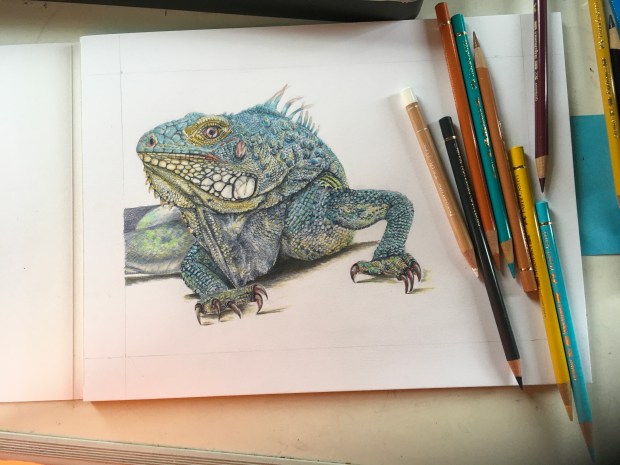
Another pure, 100% colored pencil piece to go with my “Ribbit!” Tree frog posted August 2nd. Had so much fun with the frog, instead of putting away my Polychromos, I allowed the crazy music to play, and let my pencils dance.
Work in progress
This little iguana took about 12 hours after my initial sketch. My materials consisted of a dozen or so Faber-Castell oil based Polychromos colored pencils, and a sheet of 9×12” Canson 120lb mixed media white paper.
A little more shading and he’s finished!
There’s something looking back at him, stage left! What do you suppose it could be?
Little brother of tree frog #1 is now hopping in to wish you happy hump day!
Another pure, 100% colored pencil piece. Polychromos still lying about, needing exercise. These charming frogs are loads of fun.
This little 6×7” finished piece took about 6 hours after my initial sketch. My materials consisted of a dozen or so Faber-Castell oil based Polychromos colored pencils, a sheet of 9×12” Canson 120lb mixed media white paper, and more Three Dog Night tunes with, of course “Jeremiah Was a Bullfrog” still is my favorite.
After sitting idle for many months, The Felix was begging for a short adventure! So we loaded up and off we headed …… north into high elevation Colorado, to enjoy some cool temps and breathtaking scenery.
A quick 822 mile loop in 4-1/2 days met all of our goals plus we enjoyed afternoon thunderstorms and a few rain showers.
Follow the link below to read about our trip as I narrate my daily journal pages.
Was it just 2 days ago when I posted “this year’s monsoons didn’t materialize.”??????? This is headed our way! The skies are grumbly, full of lightning, big fat rain beginning to drop. Wow! This is what we had seconds before posting. We’re that little blue dot east of the big red!
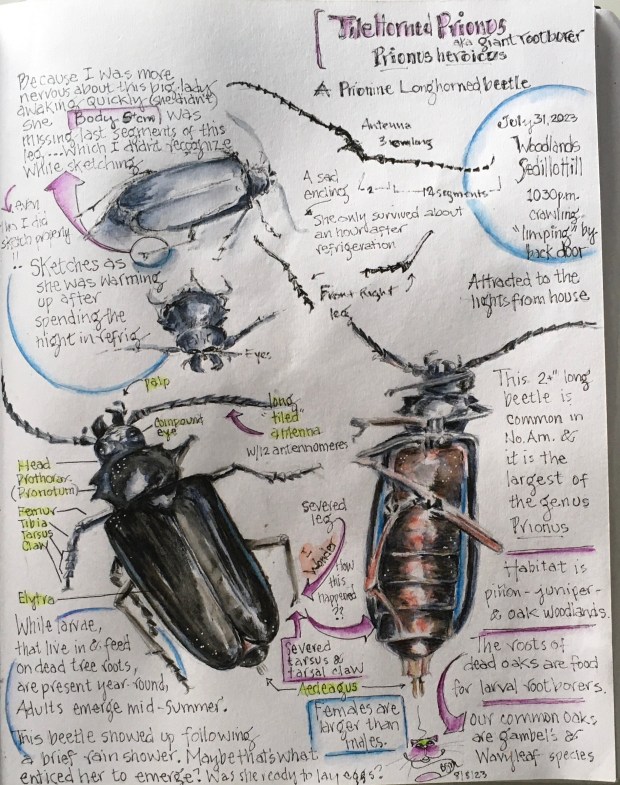
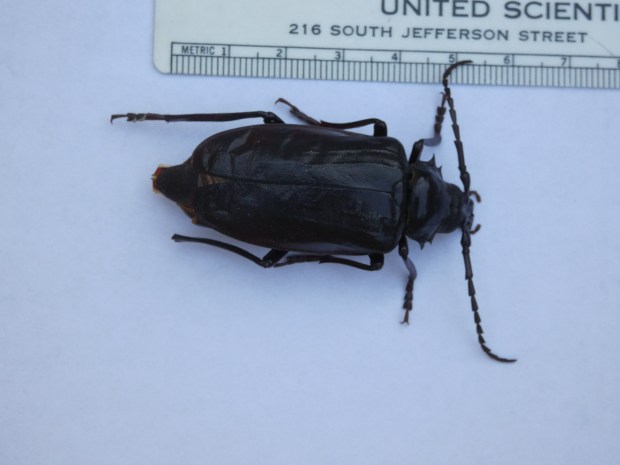
And if that isn’t enough excitement ….. Big Bug Alert! you should’ve seen this giant root borer that paid us a visit a few days ago!
Ok! I’m posting quickly before the lightning wipes out the Wifi on Sandia Mountain.
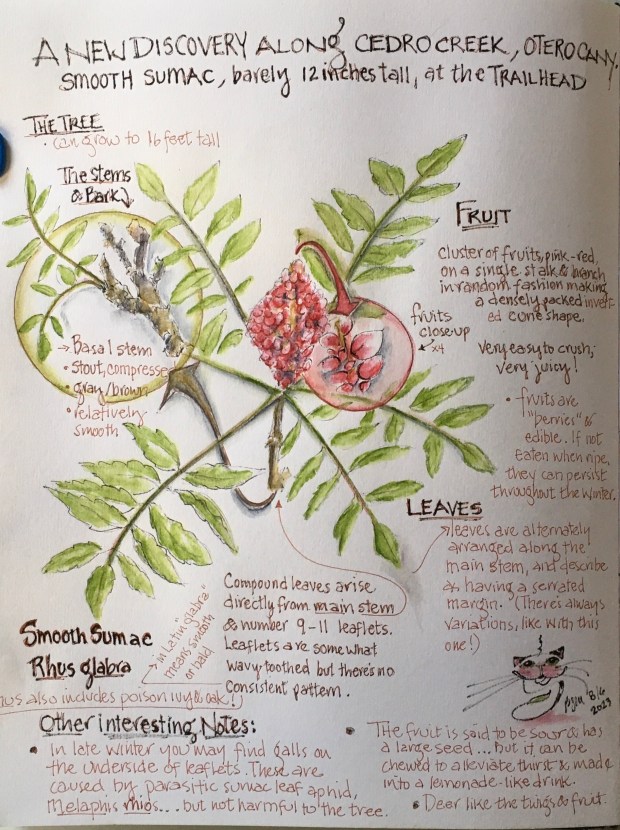
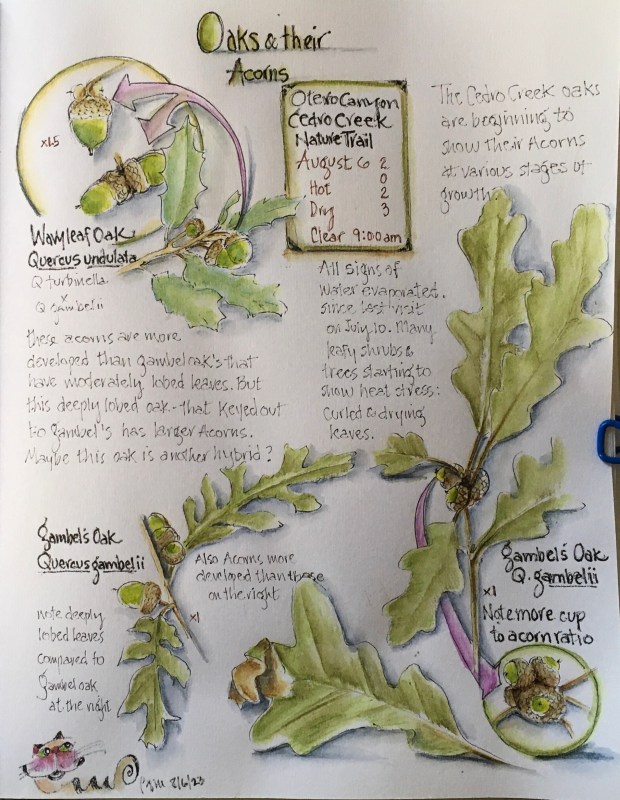
Sharing my pages from today’s short hike up Cedro Creek, on the fringes of the Manzano Mountains. The water shortage here and all around us has become dire; soils are cracked and dry and beginning to take flight with the barest puff of wind.
Since we last hiked this area (a few days shy of a month ago), the scattered shallow pools of water have either evaporated completely or made a retreat underground, where there may be just enough water to wet the riparian area. All the tender flowering plants have disappeared; many have been able to set seed in hopes of a wetter year to come. With this premature wrap up to the summer season, the birds, bees and butterflies have moved on; hopefully up in elevation where food may still be found.
Our summer monsoon season just didn’t materialize (yet?). But despite the hot and dry conditions, we did manage to find a few leafy green shrubs. The massive cottonwoods appear to be doing well (must still be sufficient groundwater). In the cooler parts of the canyon, there are berries hanging on the 2 species of juniper trees. Acorns have begun to mature on several oak species, even though there are many that have withered; is all of this earlier than usual?
At the trailhead, tucked in a swale where water (when it comes) can collect, I was surprised to see some very stunted smooth sumac. Already showing off their clusters of juicy red berries, the plants are barely a foot tall. This species can rapidly grow to heights of 16 feet. Maybe flowering and fruiting on such short plants is a type of survival mechanism this sumac exhibits when conditions are not favorable? I will be able to watch this little grove over the coming years and maybe answer that question.
Then further up the canyon, about 20-30 feet above the riparian area, Gambel’s and Wavyleaf oaks are growing their acorns. That’s encouraging news for the squirrels who collect and cache them in overwintering nests.
It’s been a challenging year.
What differences in nature have you been noticing where you live? Do you think our changing climate has played a role in driving the changes? Have you observed not only negative but positive affects? I’d be very interested in knowing!
A pure, 100% colored pencil piece. Sometimes I have to dust off my Polychromos, play some crazy music, and let the joy happen! What an awesome way to calm my mind as the pencils work their magic.
This little 6×7” finished piece took about 8 hours after my initial sketch. My materials consisted of a dozen or so Faber-Castell oil based Polychromos colored pencils, a sheet of 9×12” Canson 120lb mixed media white paper, and hours of Three Dog Night (of course “Jeremiah Was a Bullfrog” was, and still is my favorite).











 a curious nature