Chaos Never Dies Day is an annual holiday observed on November 9th that reminds us that chaos and disorder are natural and inevitable parts of life. The day encourages us to embrace the chaos and find humor, creativity, and resilience in the face of uncertainty and unpredictability. It’s a time to let go of perfectionism, embrace imperfection, and enjoy the ride.
Flowing from Flambé’s depiction of the chaotic world that lives between her pointy ears, emerges 16 simple continuous line shapes. Can you find them all?
(If you’d like a little help finding these shapes, the answers can be found at the end of this post. But only peek after you’ve given the illustration a thorough looking over.)
Of course, Kat has embedded herself within the chaos; her discovery makes for 17 total shapes.
Flambé’s thoughts on Chaos to Creativity OR an attempt to interpret her scratched lines on paper, in the above illustration.
A few of my elementary thoughts about Chaos and Chaos Theory
Now that Flambé has delighted and (most likely) confused you on the Nature of Chaos, allow me to reflect on my first exploration into the fascinatingly mind bending subject of Chaos Theory. Having never given much thought to the Theory, per se, I’ve always pictured “chaos” as something hectic and uncontrollable. A state of unruliness, mayhem, or disarray liken to natural disasters, mob pandemonium, mass shootings. Sound familiar? We’ve all likely been witness to an unfathomable situation and declared our world to be in “complete and utter chaos!” But there’s more, a lot more to Chaos Theory, where it is encountered and how it affects us.
When my reference list of lesser known Annual Days revealed November 9th is celebrated every year as “Chaos Never Dies” day, I was appalled. I mean, really; who wants to live in a world of ever-present and everlasting chaos?
But from the description of this Day, it appeared there was a positive side to chaos, piquing my curiosity. Anything that can make us laugh and inspire creativity has to be awesome! So began my last few weeks of intense study and pouring over countless YouTube videos to learn about Chaos Theory.
The more I read and viewed educational videos proclaiming to explain Chaos Theory in easy-to-understand language, the more confusing it seemed. The language was English, but the concepts seemed abstract to me …….. well, they were just plain chaotic! (This caused me to laugh!). It would be easy to spend a lifetime trying to “get it.” I’ll just have to keep learning!
So far, I learned about many familiar and new terms associated with Chaos Theory. These include the Butterfly Effect (highly central to Chaos Theory) which shows the connection between disorderly and highly organized things, like how the flap of a butterfly’s wings can lead to a string of events that can form a hurricane! It’s complex, but emphasizes (among many things) that we can’t know the consequences of seemingly simple systems due to unpredictable variables. That leads to Heisenberg’s Uncertainty Principle, Feedback Loops, Fractals, Probabilistic and Deterministic modes, etc.
Are you still with me?
In a nutshell, Chaos Theory “provides a scientifically quantifiable but simultaneously poetically suggestive way of looking at how almost everything in life is connected to everything else.”
We live in a “chaotic” world, and how we react and/or adapt to its unpredictability and complexities matters. But as someone (?) once said, “Embracing unpredictability sparks creativity.” What does Chaos spark in you?
The images of all Continuous Line drawings and their order of emergence.
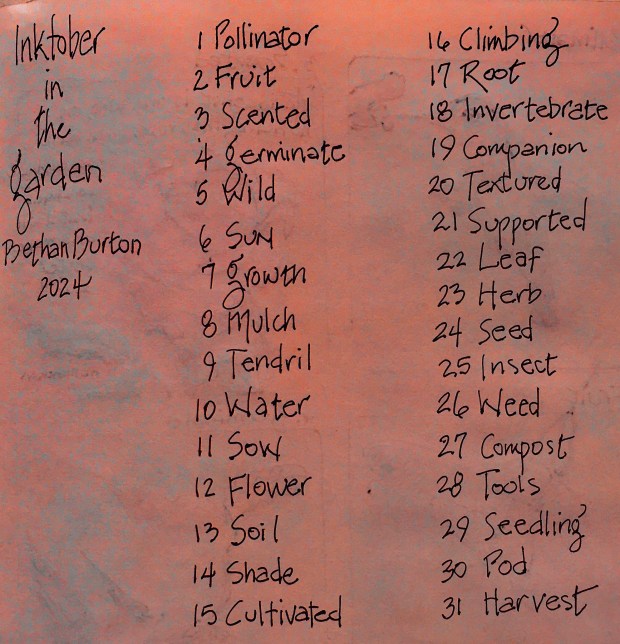
Searching for a theme to follow during Inktober 2024, I was delighted to learn one of my favorite podcasters and nature journal educators, Bethan Burton, shared her original list of 31 prompts. Named “Inktober in the Garden,” she cleverly chose each word to represent a different phase or activity encountered while gardening. To quote Bethan, the prompts are “aimed to get us thinking in different ways about the beauty of our cultivated space.”
Living in Brisbane, Queensland, Australia, where it’s now Spring, Bethan’s garden theme was very timely for her. However, October in central New Mexico where I live, is smack dab in the middle of Fall, so I relied on past gardening experience to create my daily ink drawings.
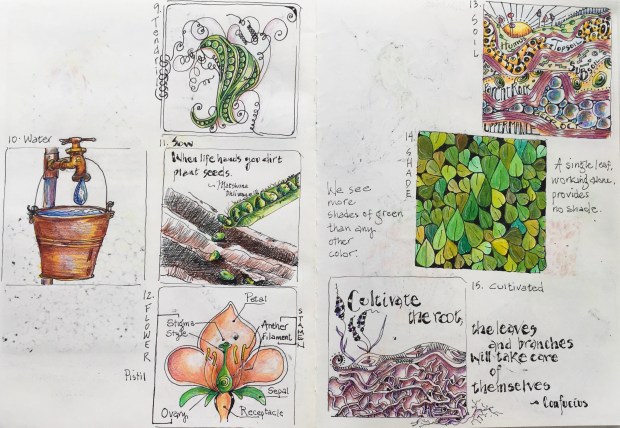
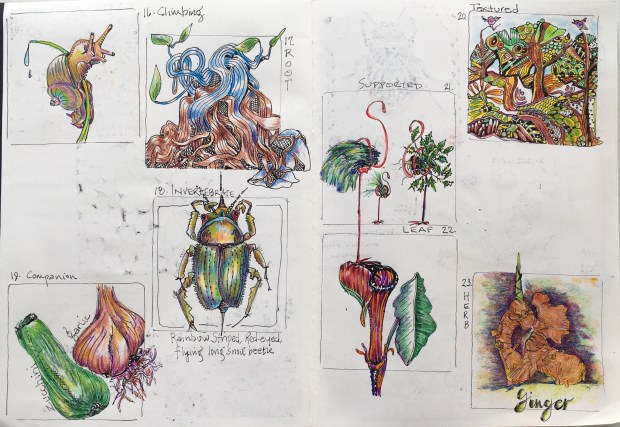
I hope you enjoy my 31 Inktober2024 tiles, inspired by Bethan Burton’s “Inktober in the Garden” prompts. I decided to only complete one tile/day; in the morning while sipping a cup of tea, I’d sketch a drawing with only ink (using a Pilot Varsity nib pen). Then later in the evening I added the color coaxing pigment from my limited number of Venus Spectracolor colored pencils (the remains of a 40+ year old set which constantly break and refuse to blend).
A big thanks to Bethan for sharing her Inktober2024 prompt list, and for being a constant inspiration through her podcast Journaling with Nature, and for bringing the world-wide nature journaling community together for her annual International Nature Journaling Week, where we can explore, share and celebrate a passion for nature. To learn more about Bethan and nature journaling through her podcast, participating in future International Nature Journaling Week, sign up for her Blog and Newsletter, follow her YouTube Channel and Instagram account, visit her website at: https://www.journalingwithnature.com
Here’s a bit more about this thing called Inktober
Inktober was originally created by Jake Parker in 2009, and since then has been deemed an annual event that takes place throughout the month of October. The rules devised for participants were, and still are, pretty simple …… Every day 1) make a drawing in ink; 2) post or share it; 3) hashtag it with #inktober; and 4) repeat.
Since 2009, there’s been an official prompt list shared every year by Jake and his Inktober group (https://inktober.com). But there are also many alternate lists generated, which participants can follow if they wish, or they can choose to work from their own prompts. Also since 2009, participants have not only worked in only ink, but have created colored drawings. Actually any media is fair game (wonder if anyone uses collage?), as bending the simple rules seems to be the norm. As Jake notes on the Inktober webpage, “you can do it [Inktober] daily, or go the half-marathon route and post every other day, or just do the 5K and post once a week. What ever you decide, just” remember “Inktober is about growing and improving and forming positive habits, so the more you’re consistent the better.”
And if you’re interested in participating in future Inktober events, just do it! Find a prompt list or create your own, and join the month-long party beginning each year in October!
This concludes my 9th year of Inktober! As always, thanks for stopping by!
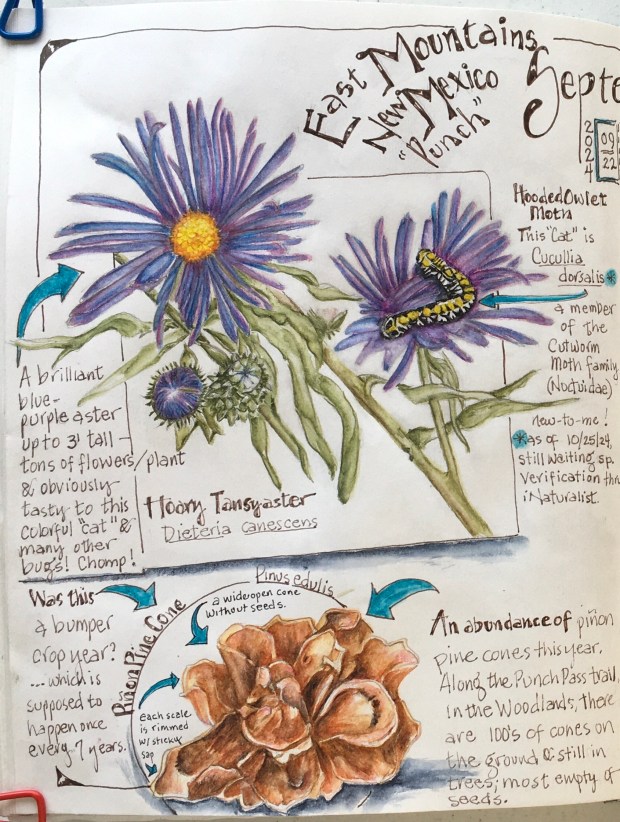
September 22nd was a morning full of new-to-me discoveries in nature. That was more than a month ago; a time when temperatures were still in the upper 80’s and flowers in full bloom.
But plenty of hints of what was to come ….. the inevitable change in seasons ….. existed. There were seeds of spring and summer bloomers blowing in the wind; squirrels stockpiling pine nuts from recently shed cones; darkling beetles mating and laying eggs in the ground to hatch next year’s population; caterpillars feasting on energy-packed flower petals needed to spin their cocoons; the chortling chatter of sandhill cranes high overhead migrating to Bosque del Apache for the winter.
Still it is hard to believe that today, a little more than a month later, everything has turned brown, and our first hard frost is forecasted for tomorrow morning!
In an effort to cling to a not-so-long ago summer, this small selection of the botanical and entomological happenings on the cusp of Fall, is now a part of my nature journal. Enjoy!
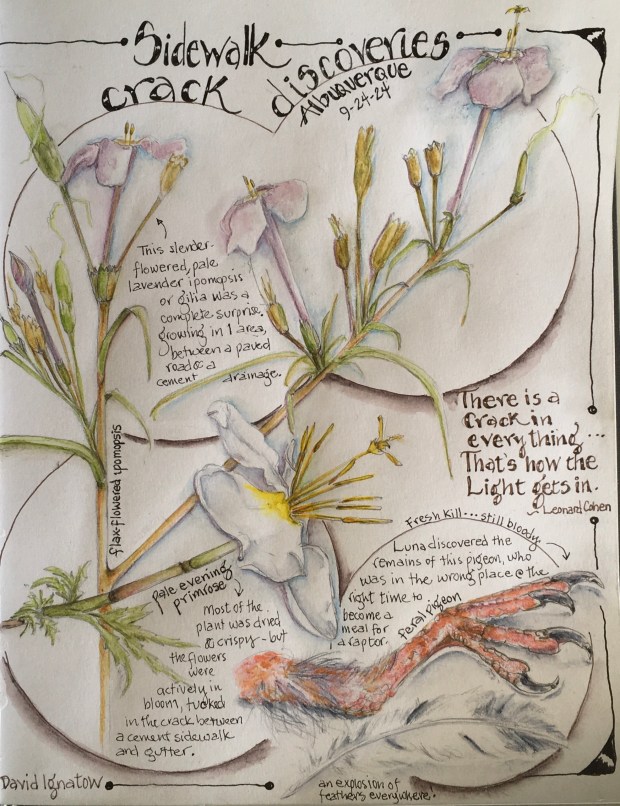
Roy had a doctor’s appointment one morning in late September, at an office right off busy I-25, near the ABQ airport. Instead of hanging out in the sterile waiting room, Luna and I spent our time exploring the areas surrounding the office, just to see if there was anything worth observing.
For 2 miles, we wandered about the not quite urban/suburban/industrial/residential neighborhood ….. me looking for a sketchbook entry; Luna sniffing out messages left just for her by visiting dogs, squirrels, or bunnies.
Interesting discoveries seemed lacking, until Luna caught whiff of something irresistible. Tugging hard on her end of the leash, she urged me to run with her as she zeroed in on the source of the smell.
By a parking lot light, on the pavement next to a cement curb was an explosion of feathers, but Luna kept leading me on to something better. There! Lying on the curb was a still wet and bloody bird foot barely connected to what remained of the thigh. All clues pointed to the very recent drama, where a raptor (possibly a red-tailed hawk) had swooped in and nabbed the hapless victim (a feral pigeon), killed and then ate his prey from the platform atop the parking lot light. The inedible remains fell to the ground as a group of 2 dozen “relieved-it-wasn’t-me” pigeon friends looked on.
Quickly solving most of this puzzle in the time it took to pry the pigeon foot from Luna’s mouth, gave me the idea of sketching not only the foot, but to look for other unlikely nature discoveries in this urban/suburban/industrial/residential neighborhood setting.
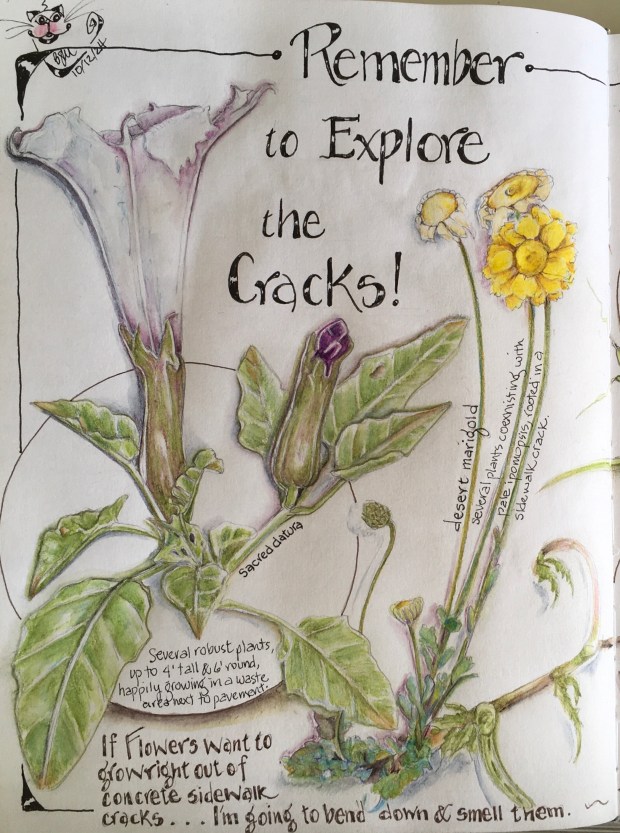
Mentally armed with a keener power of observation and purpose, we retraced our earlier route with excitement! Now it was obvious an abundance of interesting and beautiful plants were growing from every sidewalk crack and along crumbled pavement edges throughout the ‘hood. How had I missed seeing these beauties?
And that’s how my idea for this 2-page layout was born, along with a reminder that finding bits of nature doesn’t have to occur at a botanical garden, wildlife preserve or national park. Nature is everywhere. If you just slow down and really look, even in the most unlikely places like sidewalk cracks, there’s always something to discover. So Remember to Explore the Cracks too and let me know what you find!
Photo display correction has been made in this second post, which has the identical in text as the first post presented earlier in the morning, please disregard the first post and apologies for any confusion. Barb
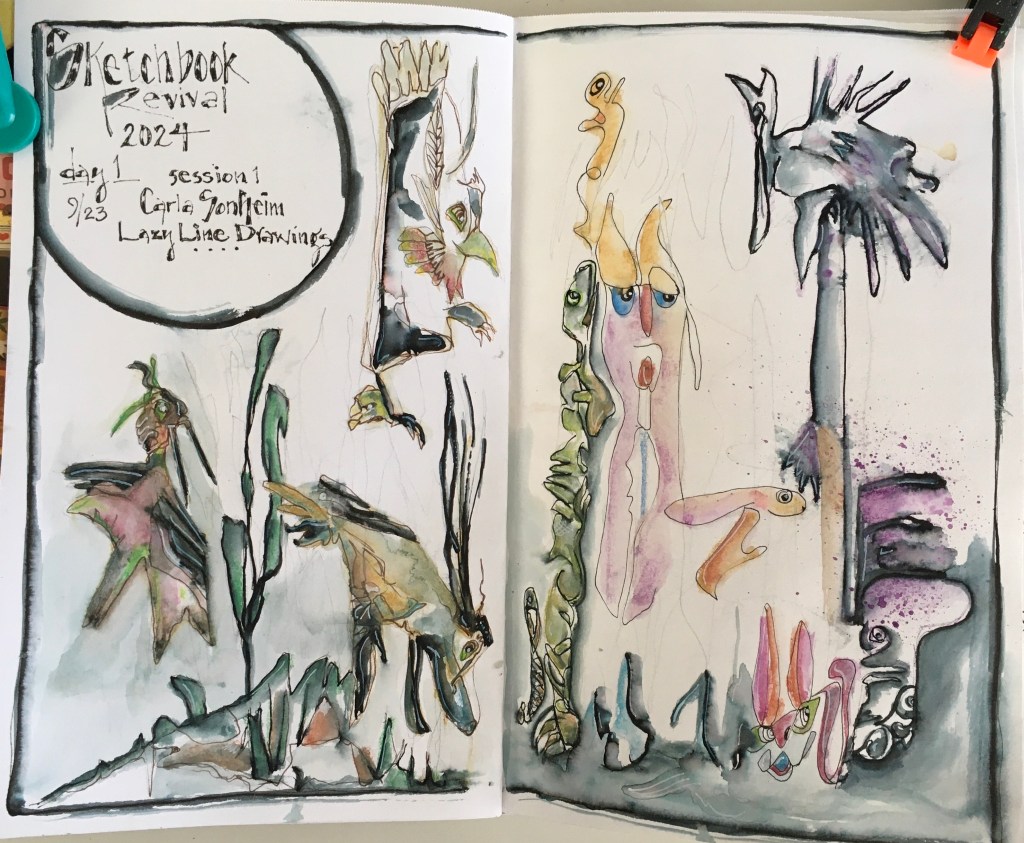
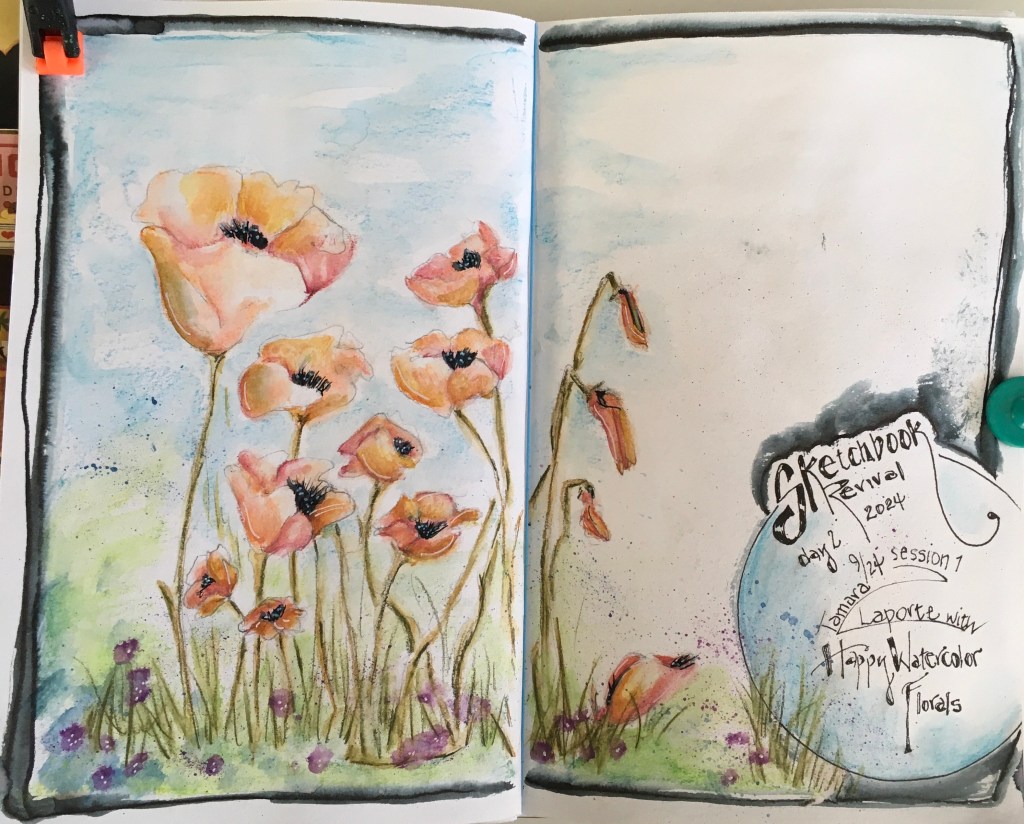
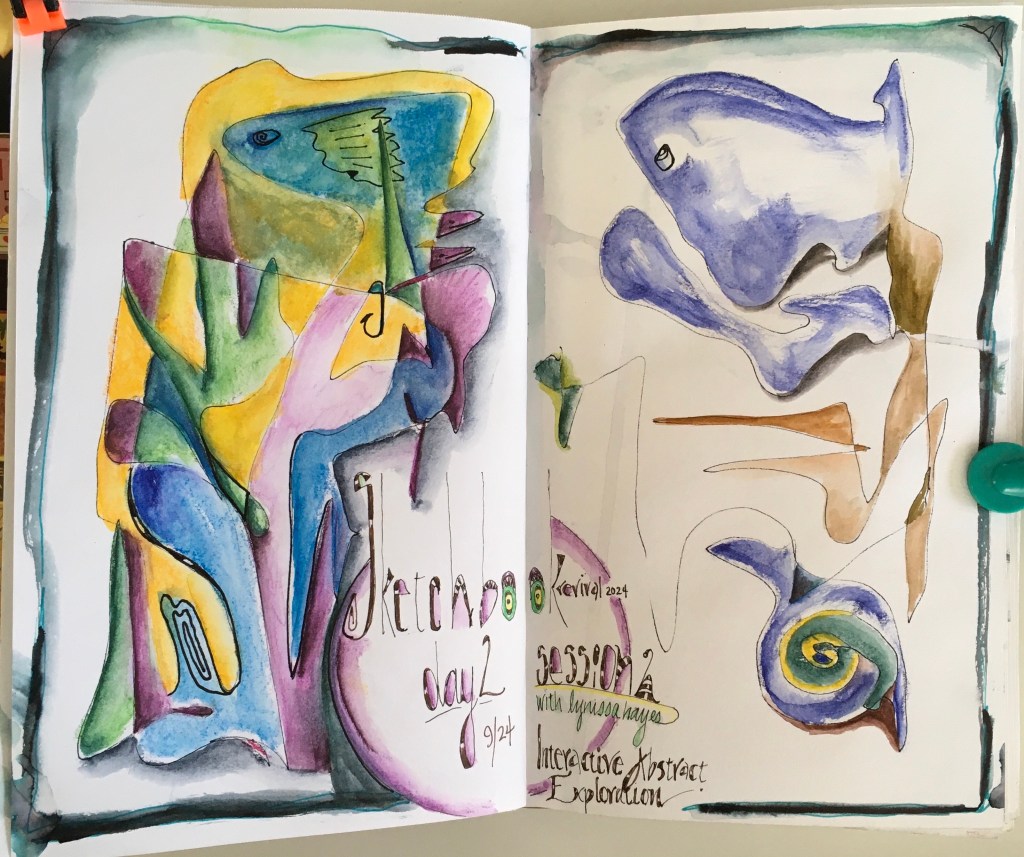
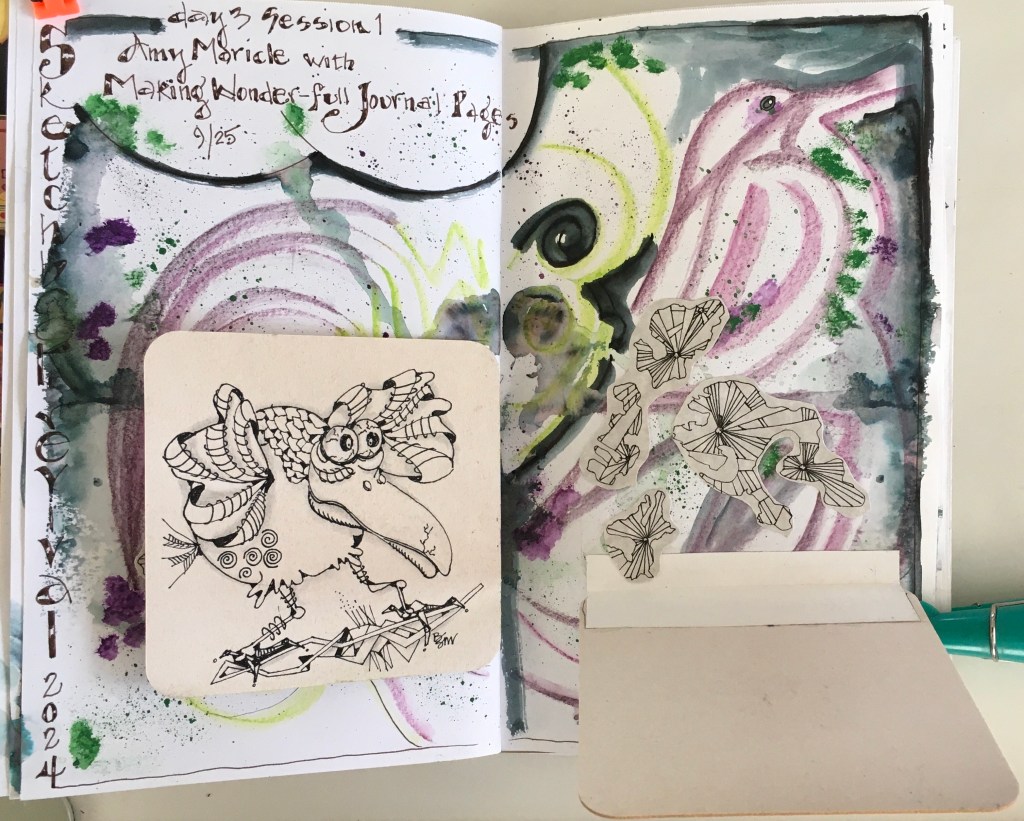
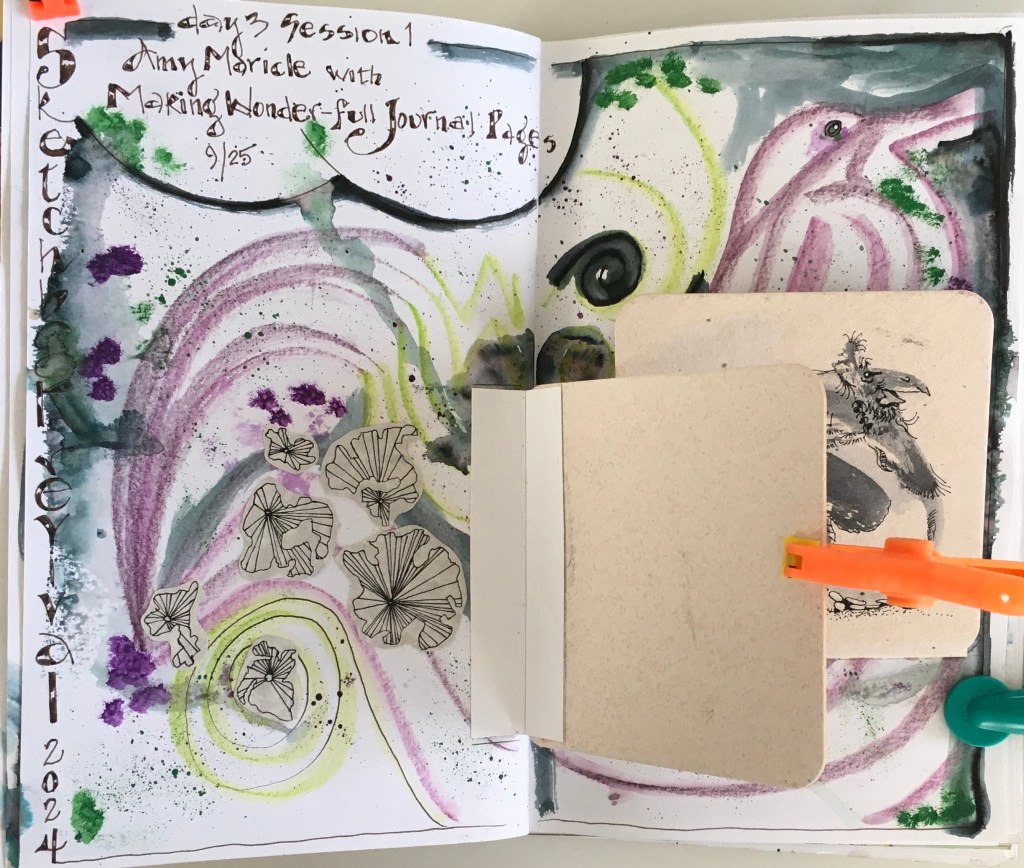
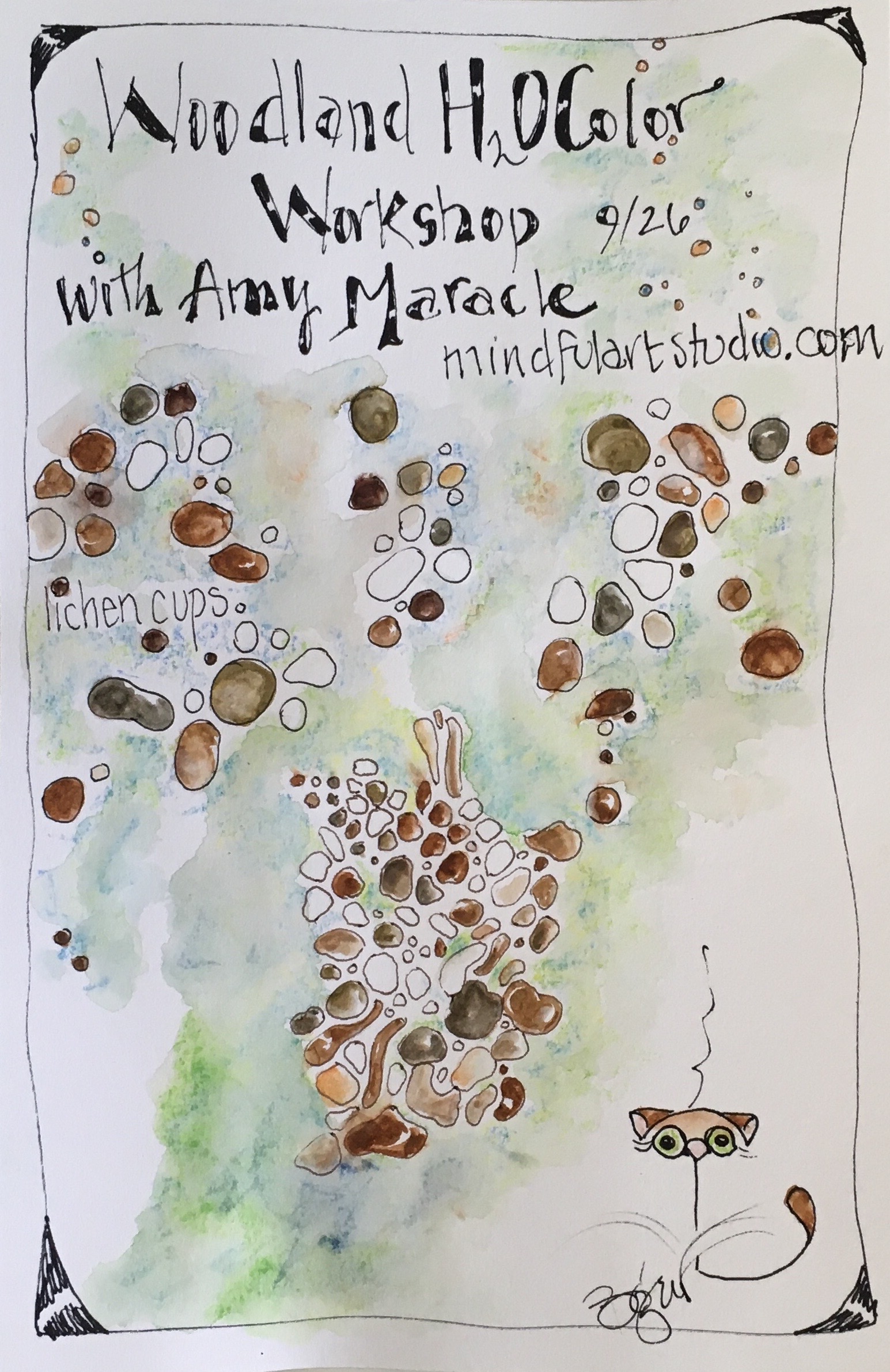
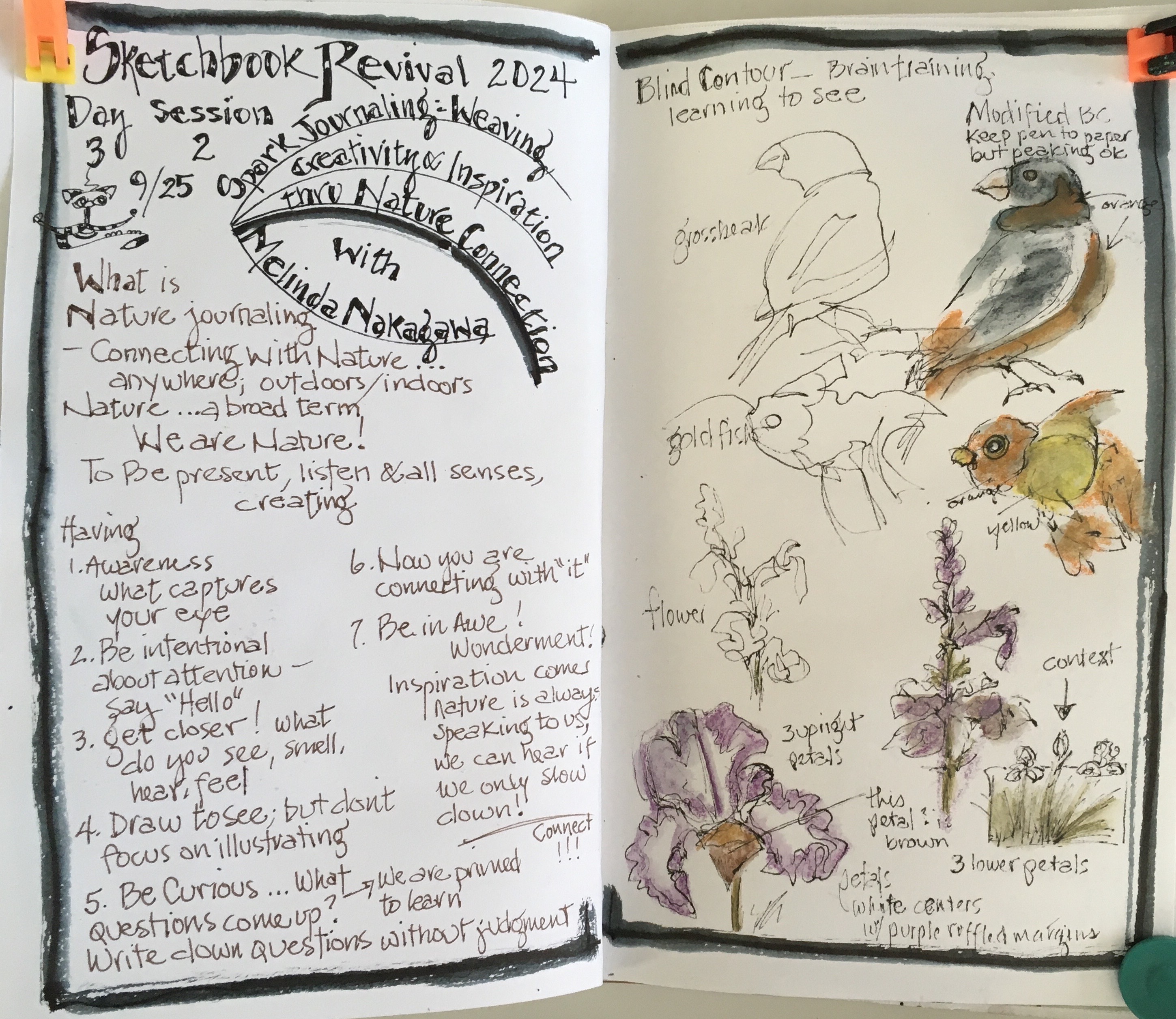
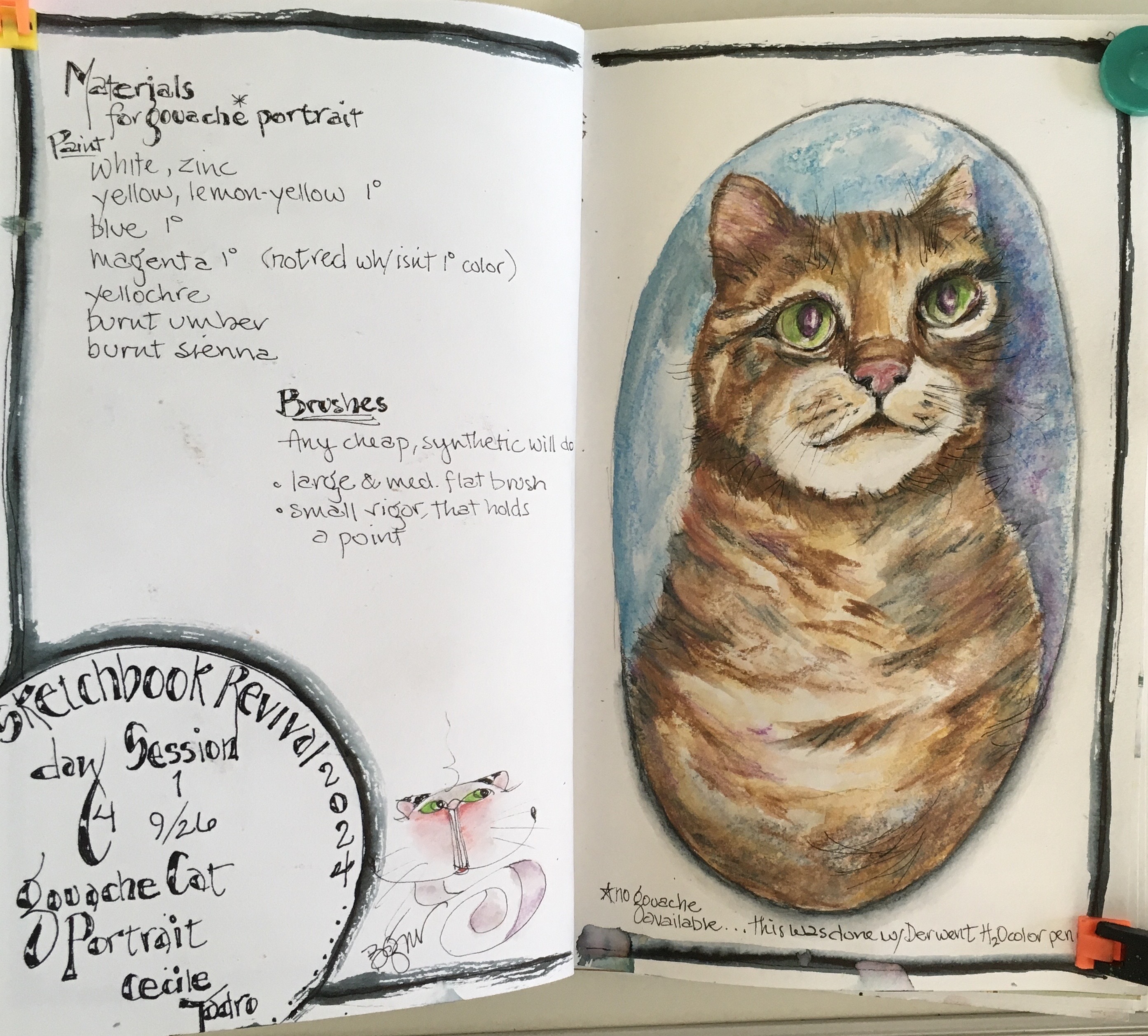
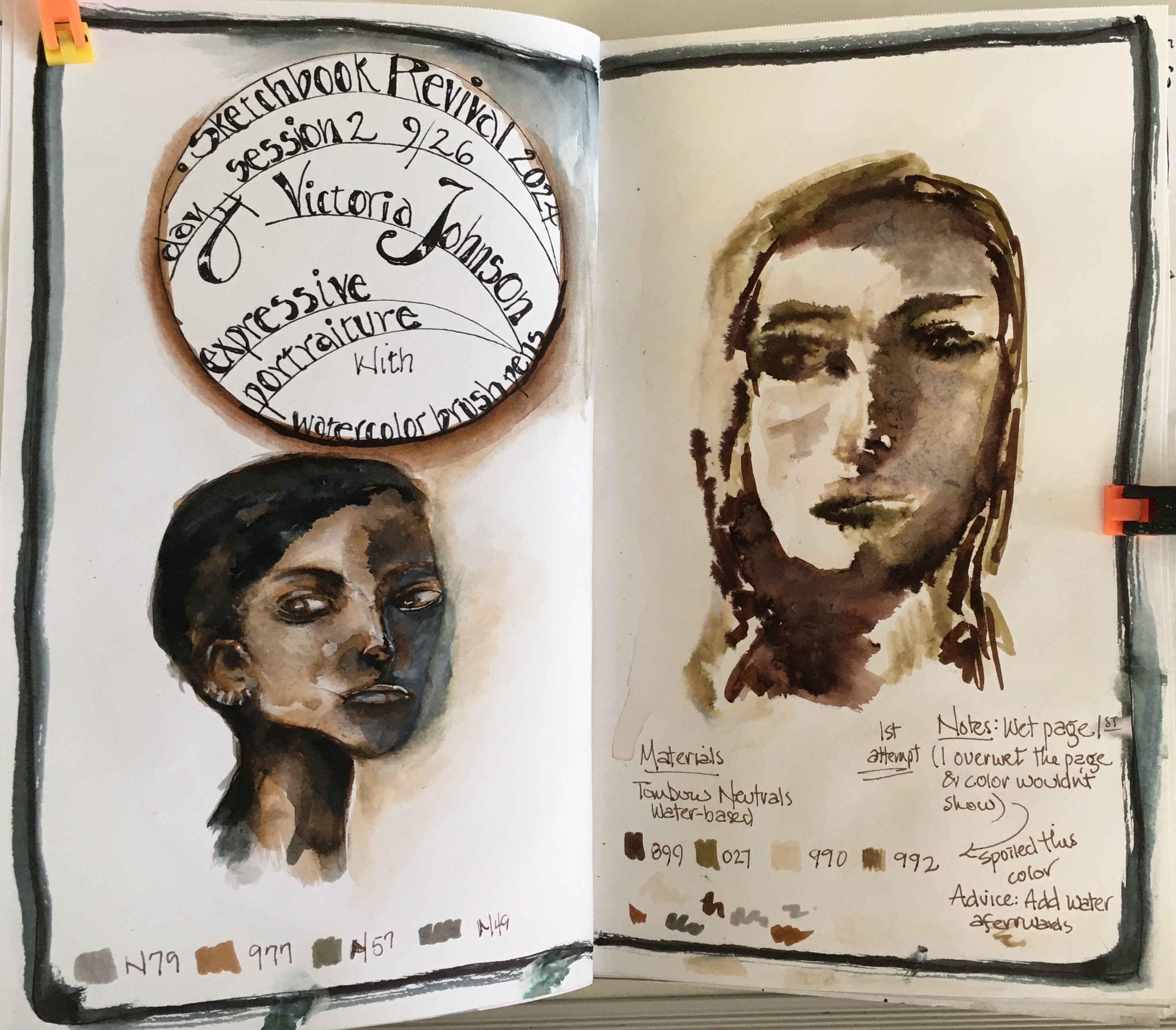
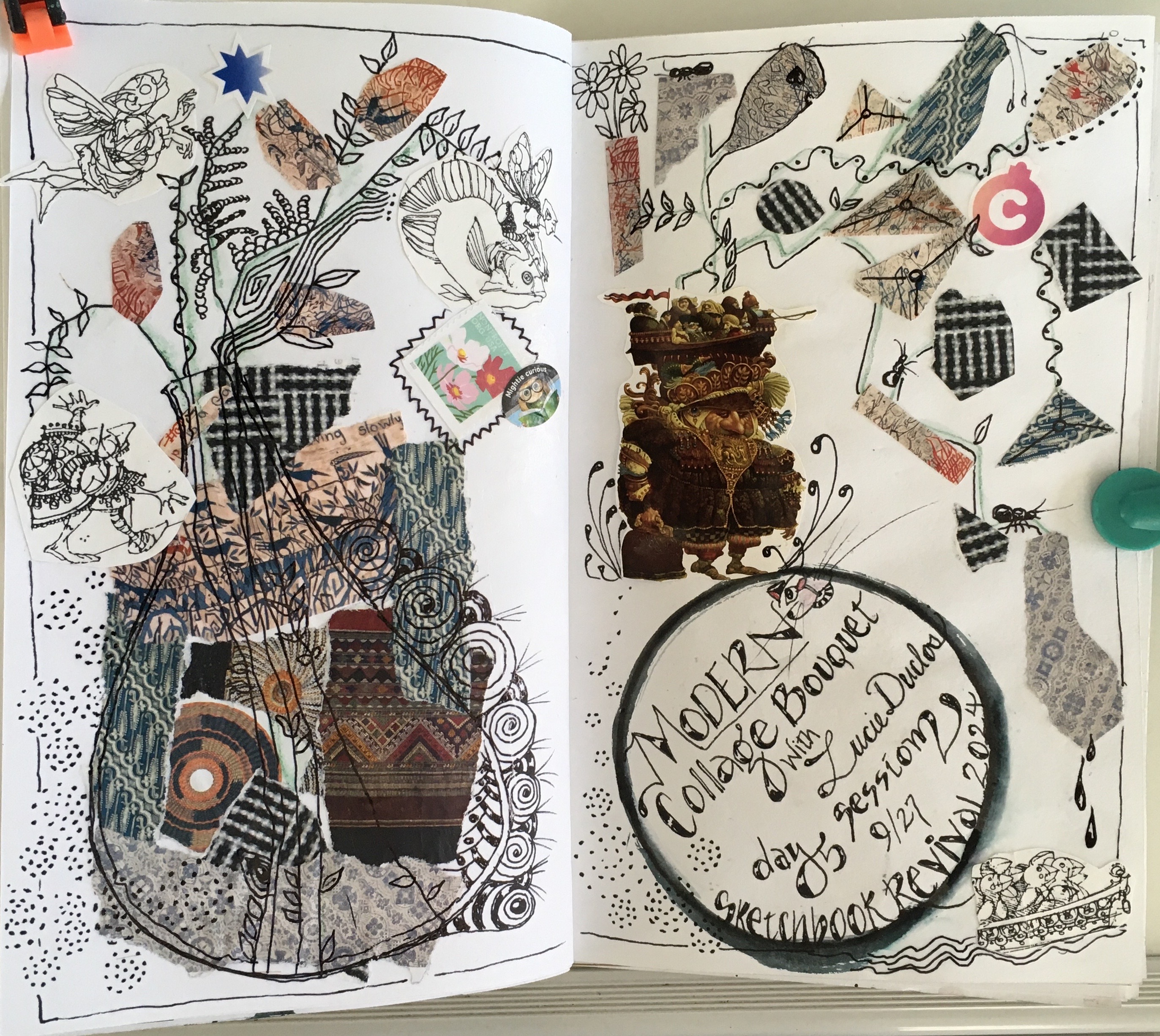
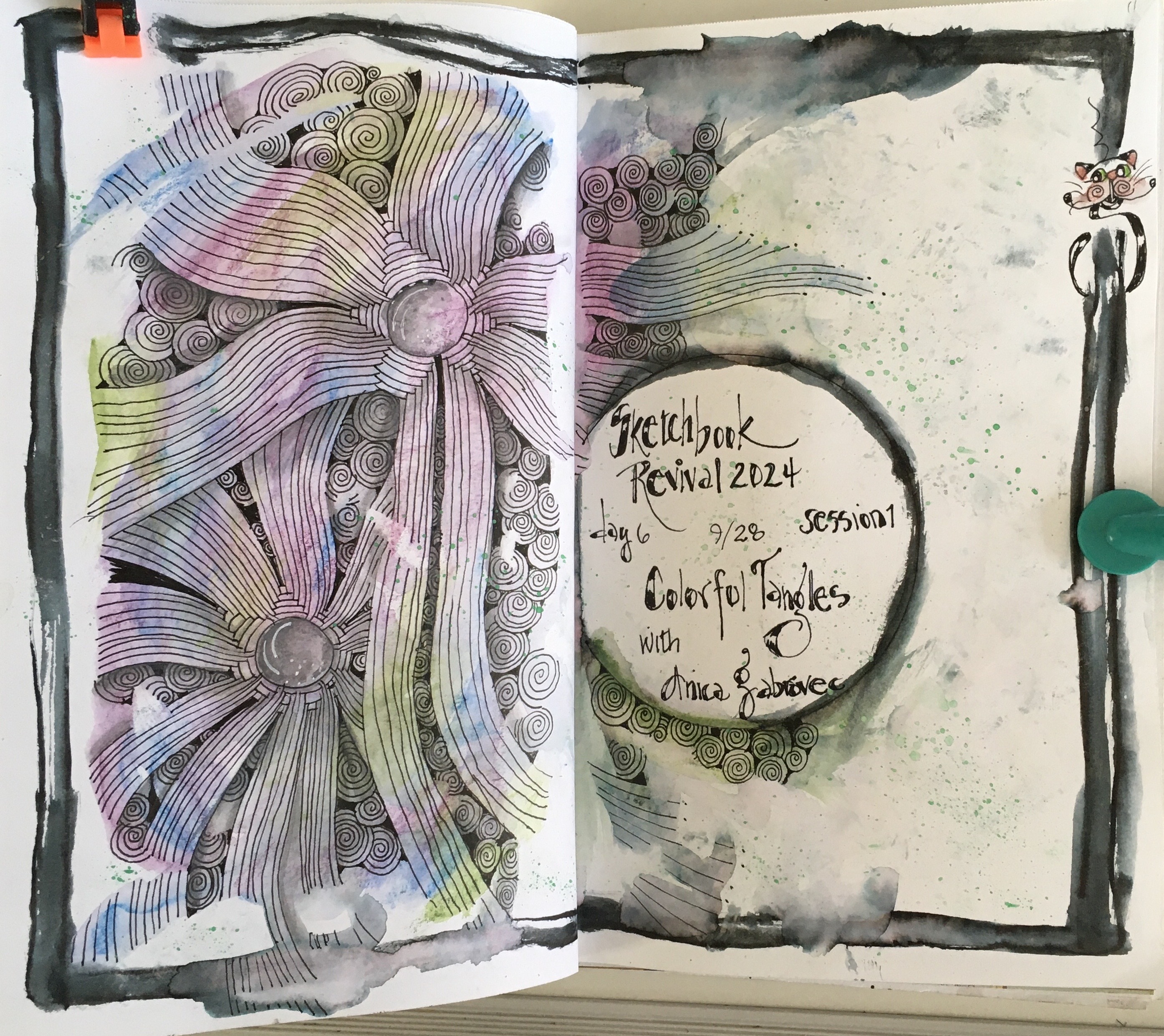
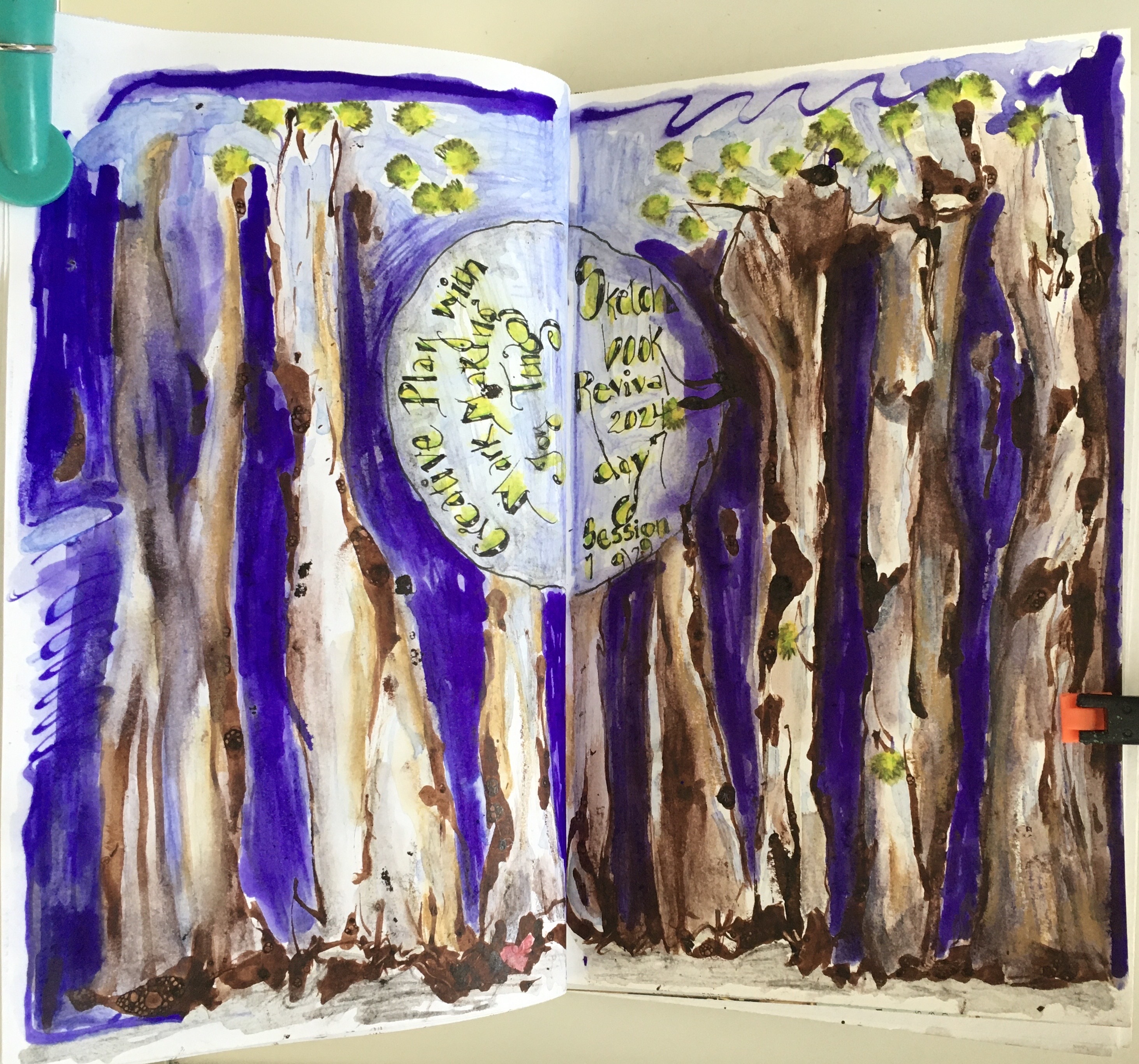
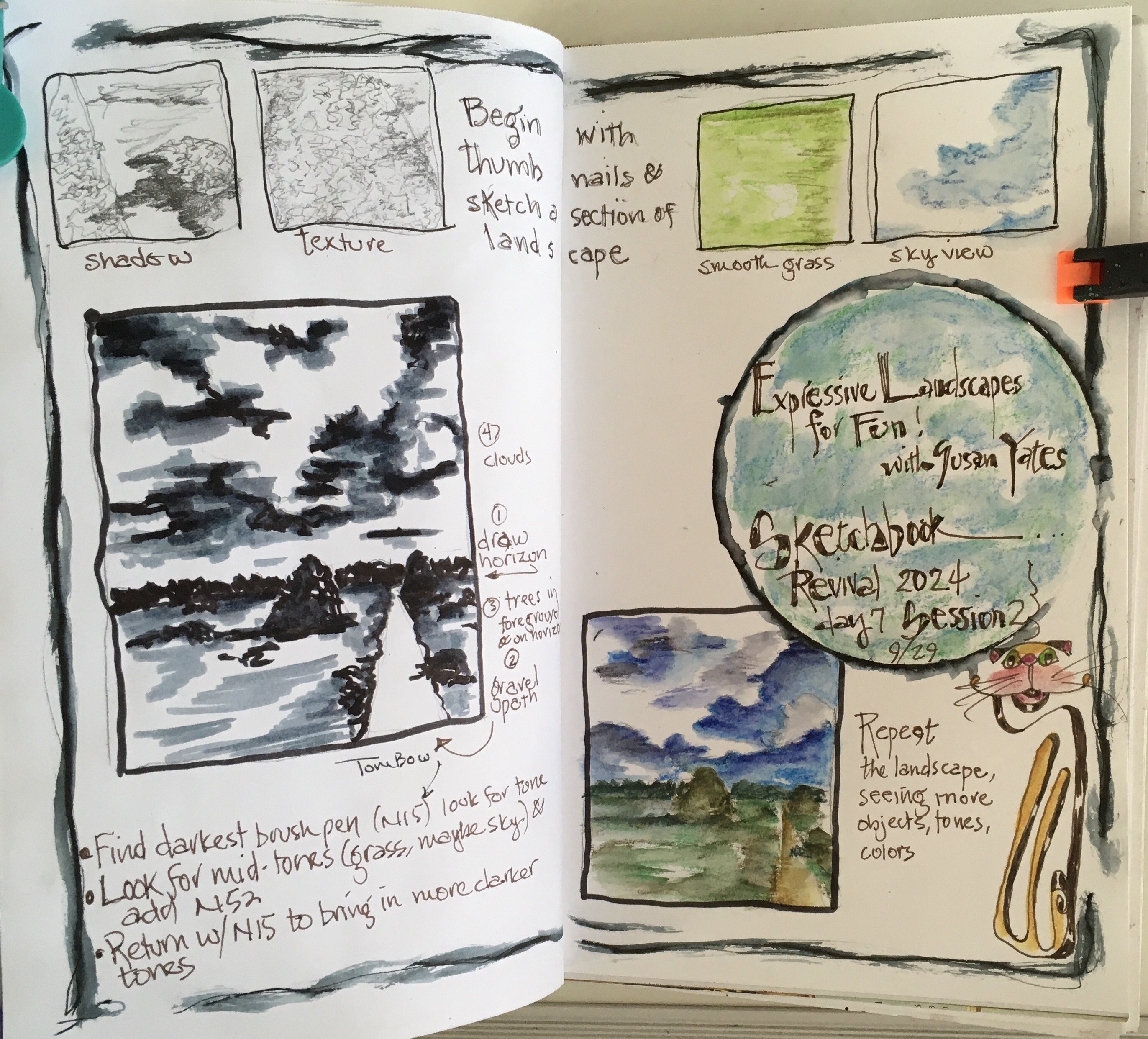
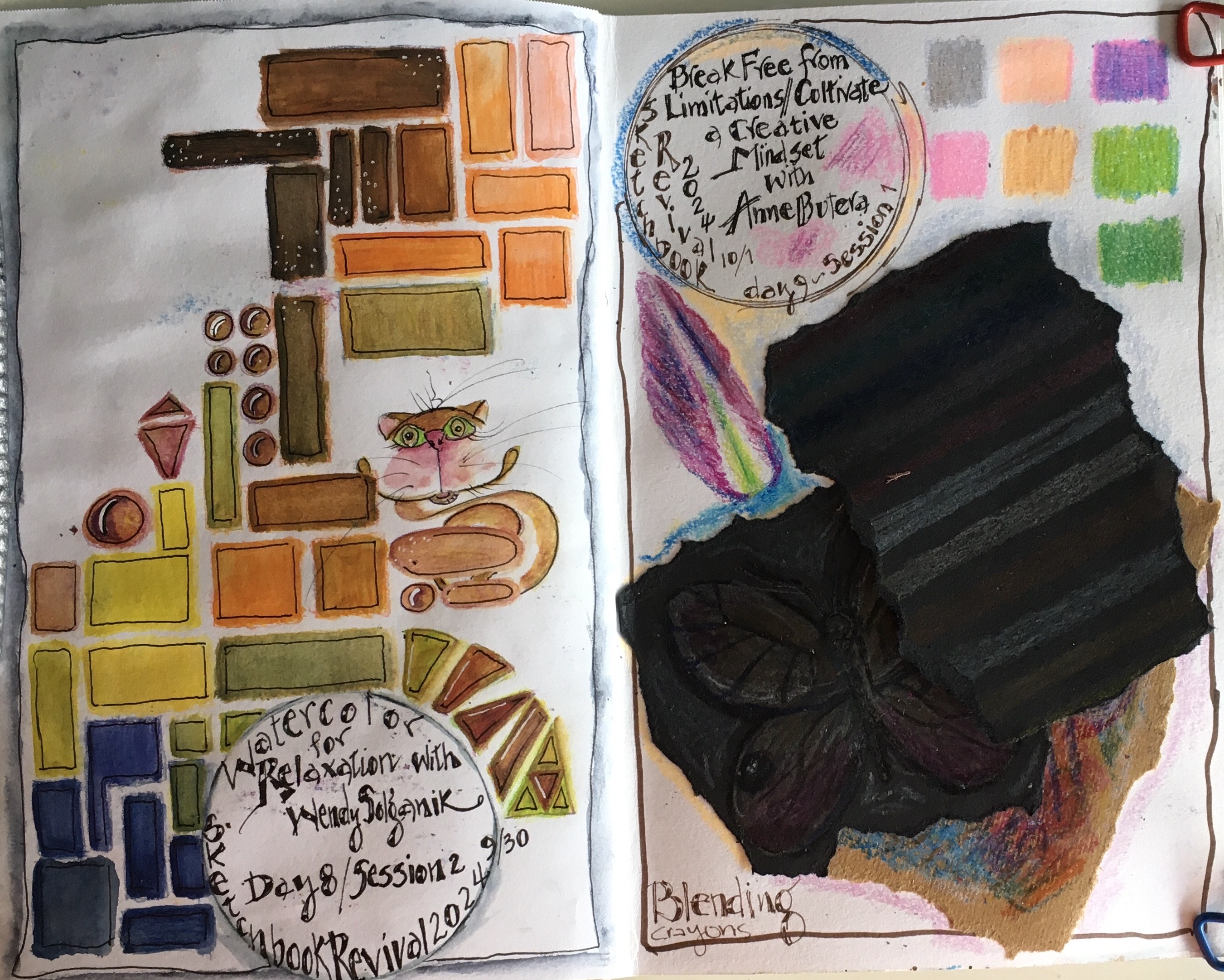
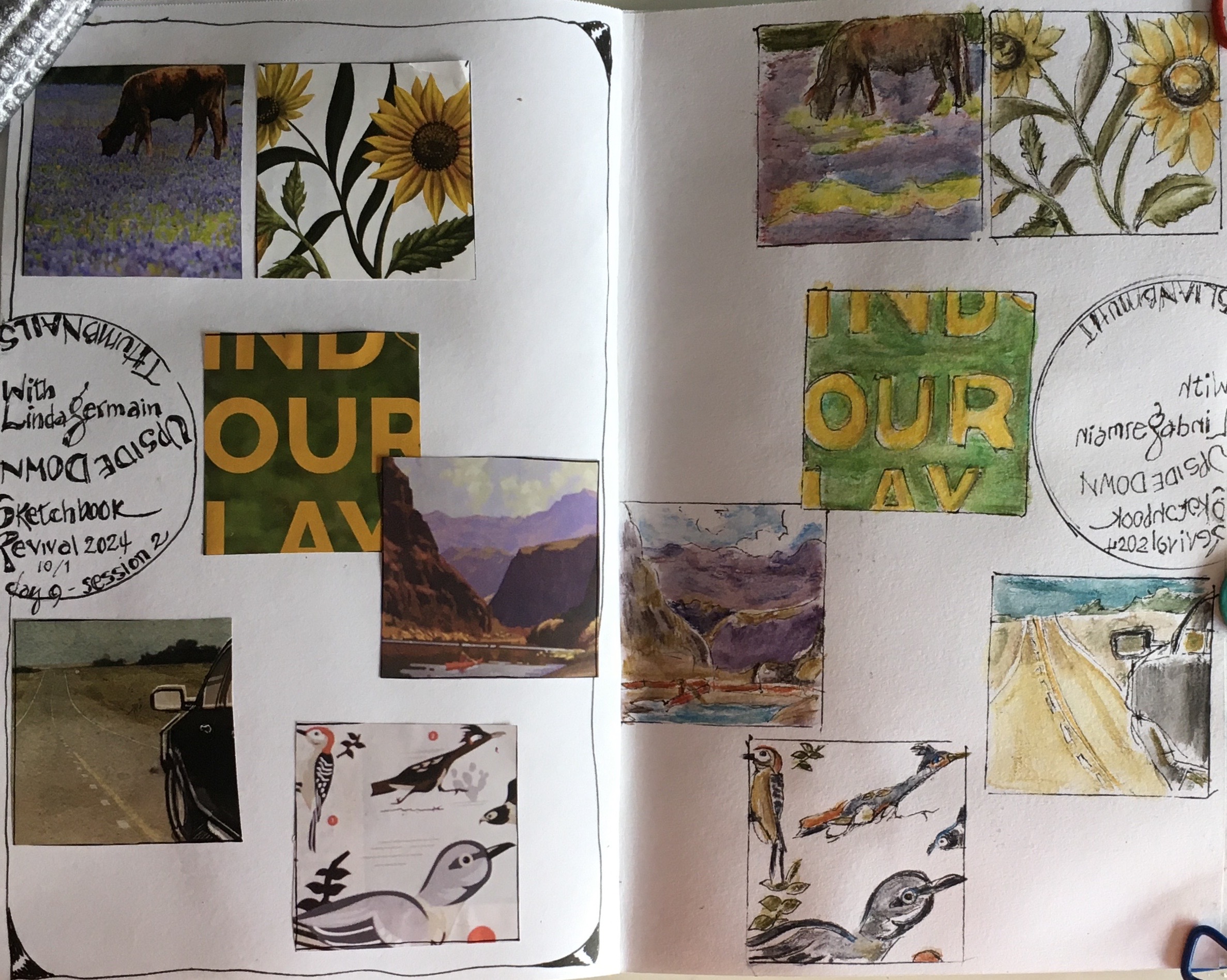
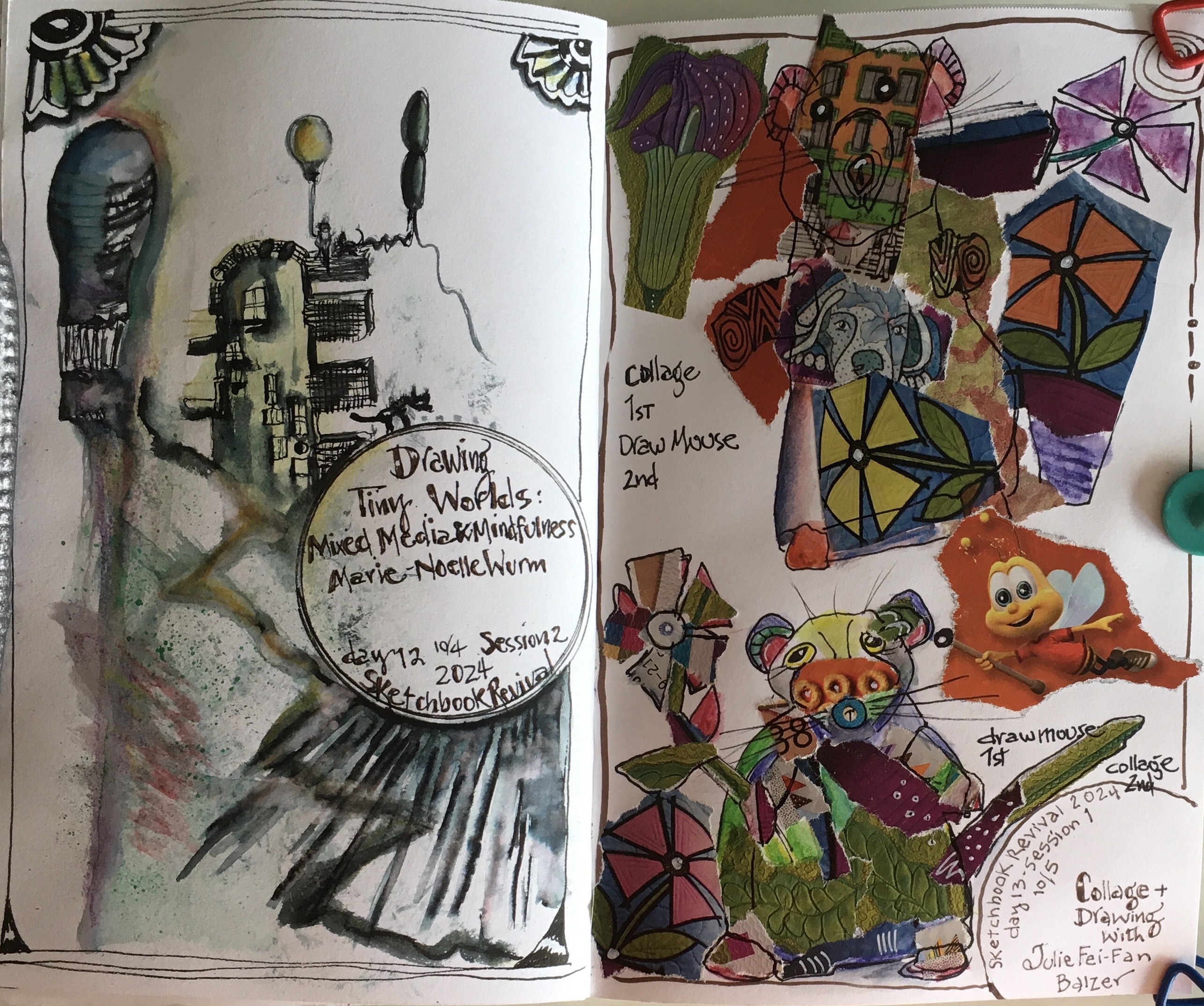
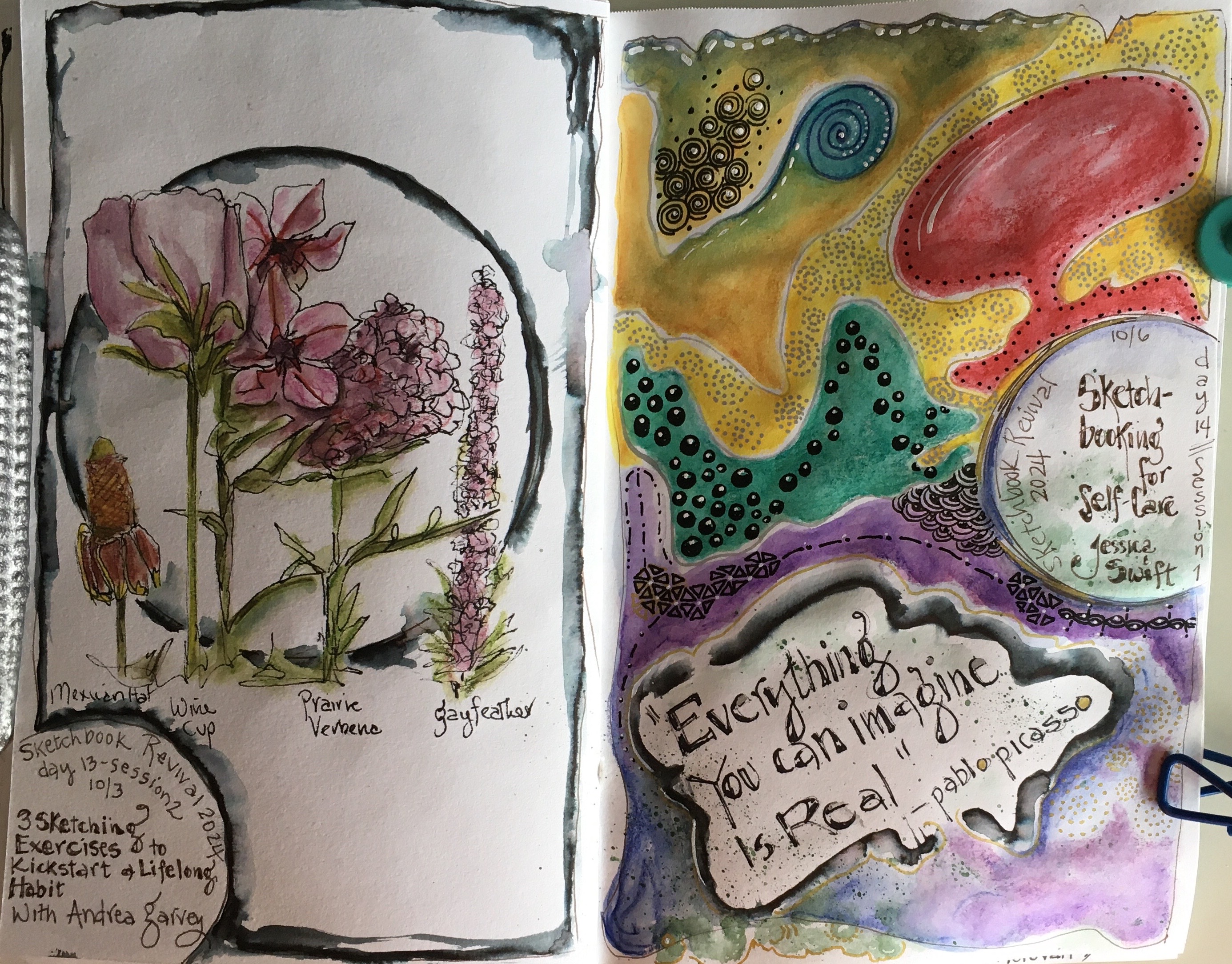
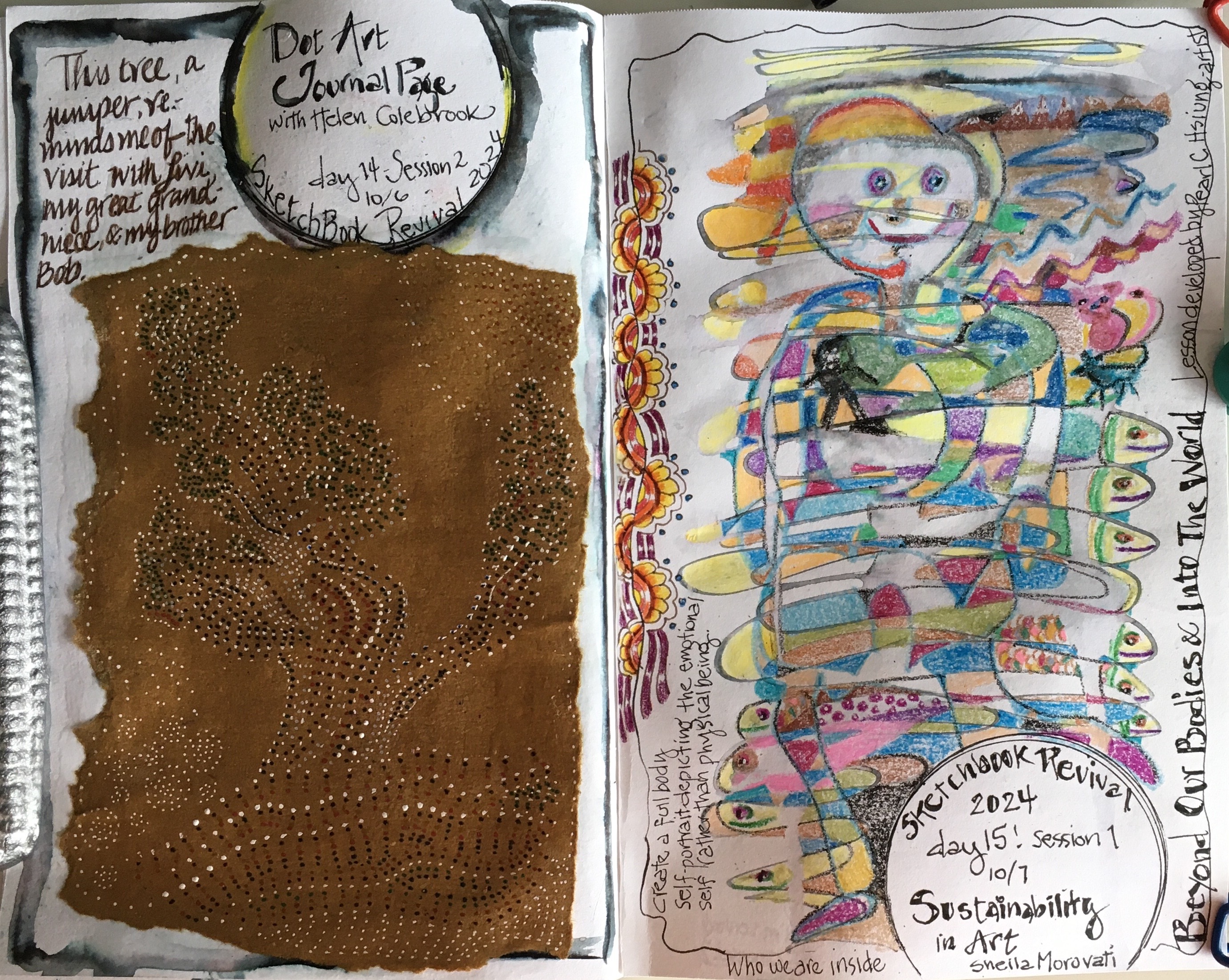
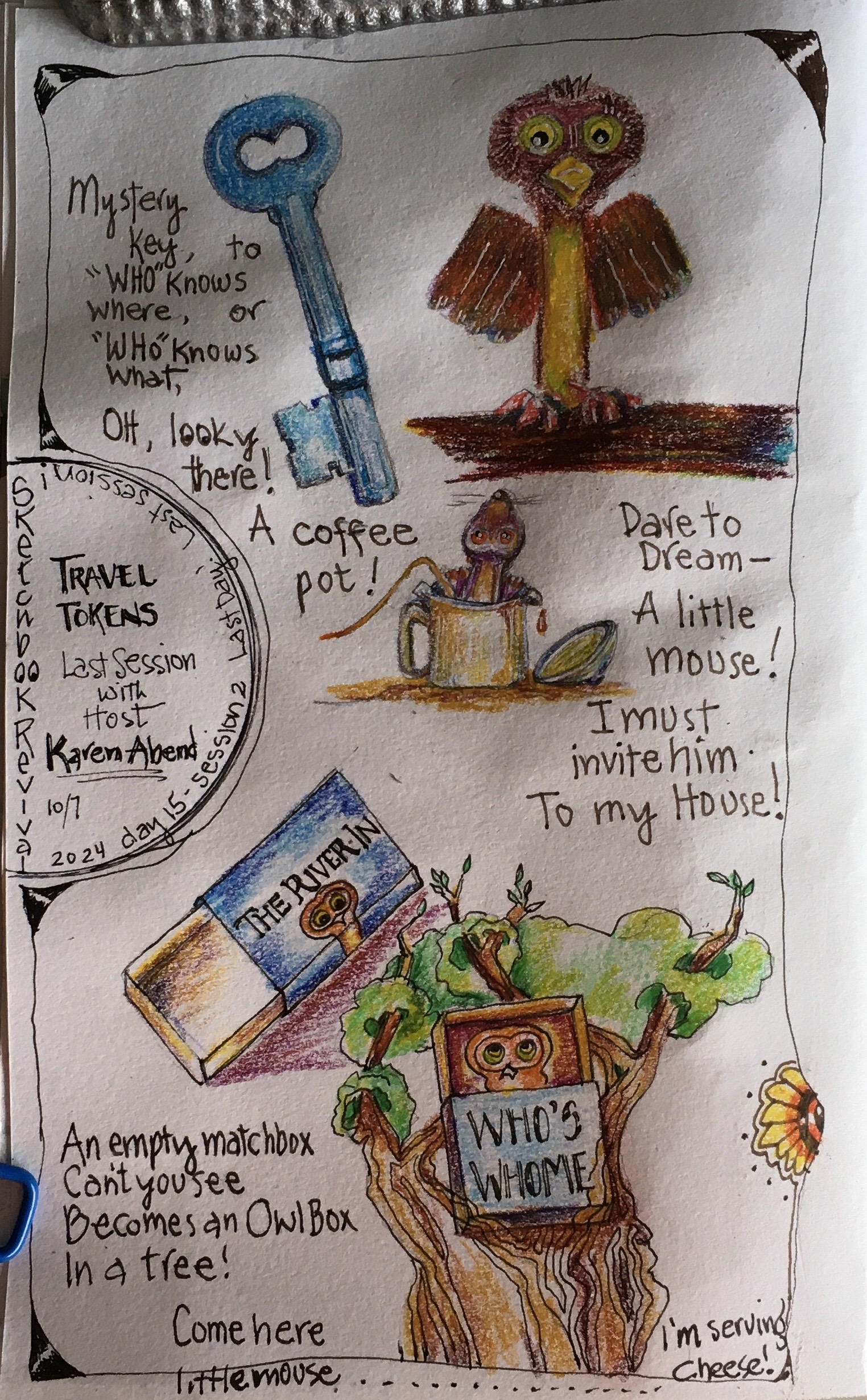
September 23 – October 7, 2024 For the last 7 years, I’ve participated in the annual, 2-week long sketching/drawing, painting and mixed media event, Sketchbook Revival, founded and hosted by a talented sketchbook artist, Karen Abend. Every year, Karen brings together a cast of creative artists for a mega on-line teaching marathon. Each day, 2 1-hour recorded sessions are available to hundreds of participants from around the world, providing an opportunity to interactively learn a skill or technique designed to begin or expand on a regular sketchbook practice. These sessions may include book binding, mark-making, collage, creating imaginary characters, urban sketching, composition, landscapes, flowers, mammals and bird painting, people or pet portrait drawing, nature journaling, Zentangle, map making, story telling, textiles, and on and on! Techniques shared by instructors involve a wide-variety materials, like watercolor, gouache, acrylic, markers, pencil and pen, colored pencil, and many forms of mixed-media.
The whole fun event is designed to stretch your creative comfort zone by experimenting with art supplies and new approaches to art making, and encourages play. And as incredible as it sounds, all you need to participate is your time and whatever materials you have on hand. Otherwise, it’s totally free! Wowza!
Not every session needs to be done (and this year there were 30 sessions in 15 days); I usually find time to complete about half of them. But this year I did all but one session (and may even complete the one skipped). From the very diverse cast of artists/instructors, I was able to learn new tips, techniques, approaches, and was invites to try new art supplies that would be useful in my regular sketchbooking and nature journaling practice.
Hopefully you’ll enjoy my 2024 Sketchbook Revival “play!” Not all are great or even good (a few are downright awful!) but it was so much fun! Maybe something from my collection will have you laughing, or maybe even entice you to give Sketchbook Revival 2025 a whirl!
That’s all for Sketchbook Revival 2024. Let me know what you think!
September 23 – October 7, 2024 For the last 7 years, I’ve participated in the annual, 2-week long sketching/drawing, painting and mixed media event, Sketchbook Revival, founded and hosted by a talented sketchbook artist, Karen Abend. Every year, Karen brings together a cast of creative artists for a mega on-line teaching marathon. Each day, 2 1-hour recorded sessions are available to hundreds of participants from around the world, providing an opportunity to interactively learn a skill or technique designed to begin or expand on a regular sketchbook practice. These sessions may include book binding, mark-making, collage, creating imaginary characters, urban sketching, composition, landscapes, flowers, mammals and bird painting, people or pet portrait drawing, nature journaling, Zentangle, map making, story telling, textiles, and on and on! Techniques shared by instructors involve a wide-variety materials, like watercolor, gouache, acrylic, markers, pencil and pen, colored pencil, and many forms of mixed-media.
The whole fun event is designed to stretch your creative comfort zone by experimenting with art supplies and new approaches to art making, and encourages play. And as incredible as it sounds, all you need to participate is your time and whatever materials you have on hand. Otherwise, it’s totally free! Wowza!
Not every session needs to be done (and this year there were 30 sessions in 15 days); I usually find time to complete about half of them. But this year I did all but one session (and may even complete the one skipped). From the very diverse cast of artists/instructors, I was able to learn new tips, techniques, approaches, and was invites to try new art supplies that would be useful in my regular sketchbooking and nature journaling practice.
Hopefully you’ll enjoy my 2024 Sketchbook Revival “play!” Not all are great or even good (a few are downright awful!) but it was so much fun! Maybe something from my collection will have you laughing, or maybe even entice you to give Sketchbook Revival 2025 a whirl!
That’s all for Sketchbook Revival 2024. Let me know what you think!
Sometimes short adventures become the most memorable.
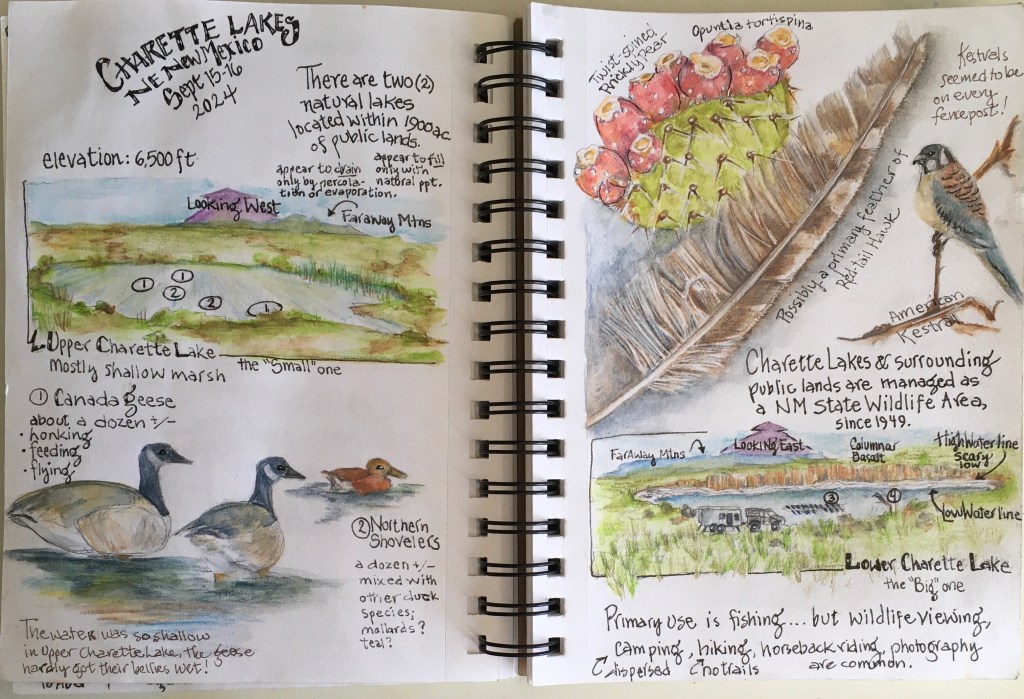
After pouring over our NM map, looking for new places to camp, based on a recommendation from good friends we decided to visit Charette Lakes. Located within the grasslands of NE New Mexico, this would be our kind of country. About time to check out the Shortgrass Prairie.
Planning to be gone 4-5 days, and as long as we were headed to Charette, why not also visit Clayton Lake State Park and Kiowa National Grasslands! The weather certainly looked good for a week, allowing easy access on backcountry 2-track dirt roads.
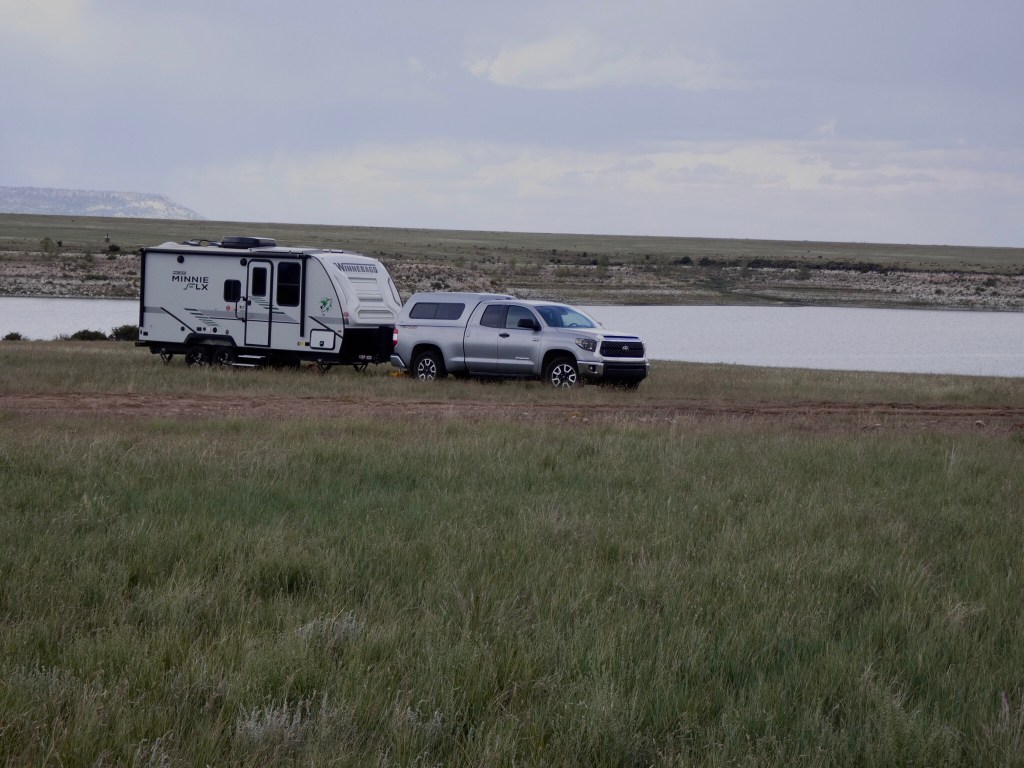
Felix at home just west of Lower Charette Lake
Charette Lakes
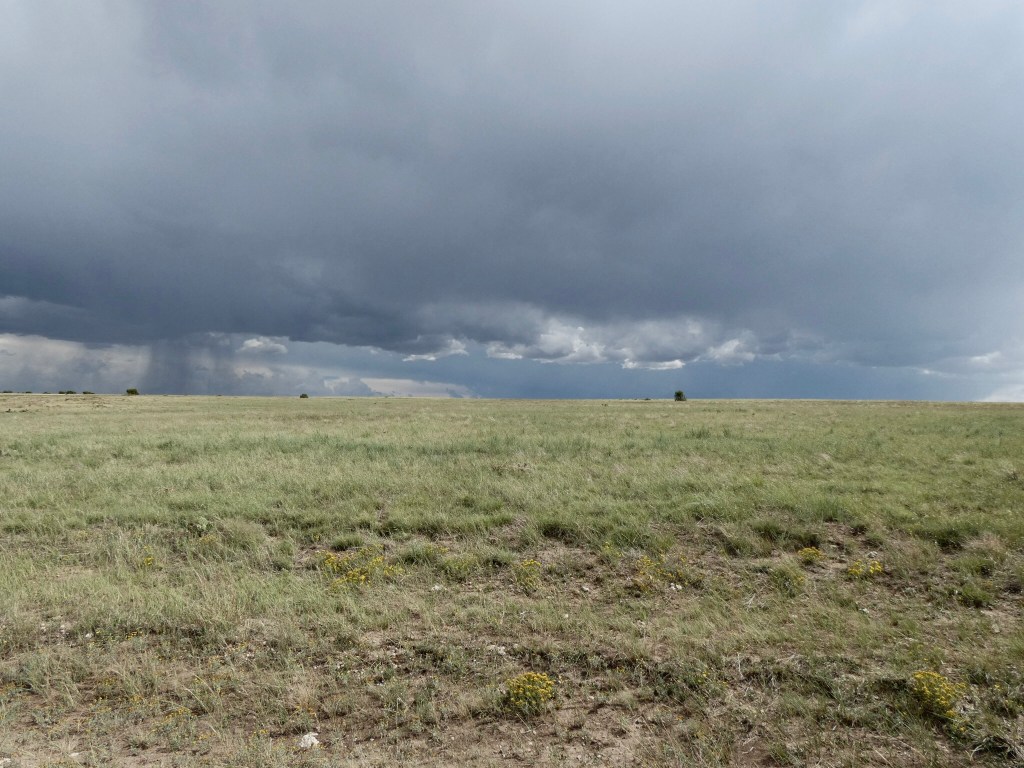
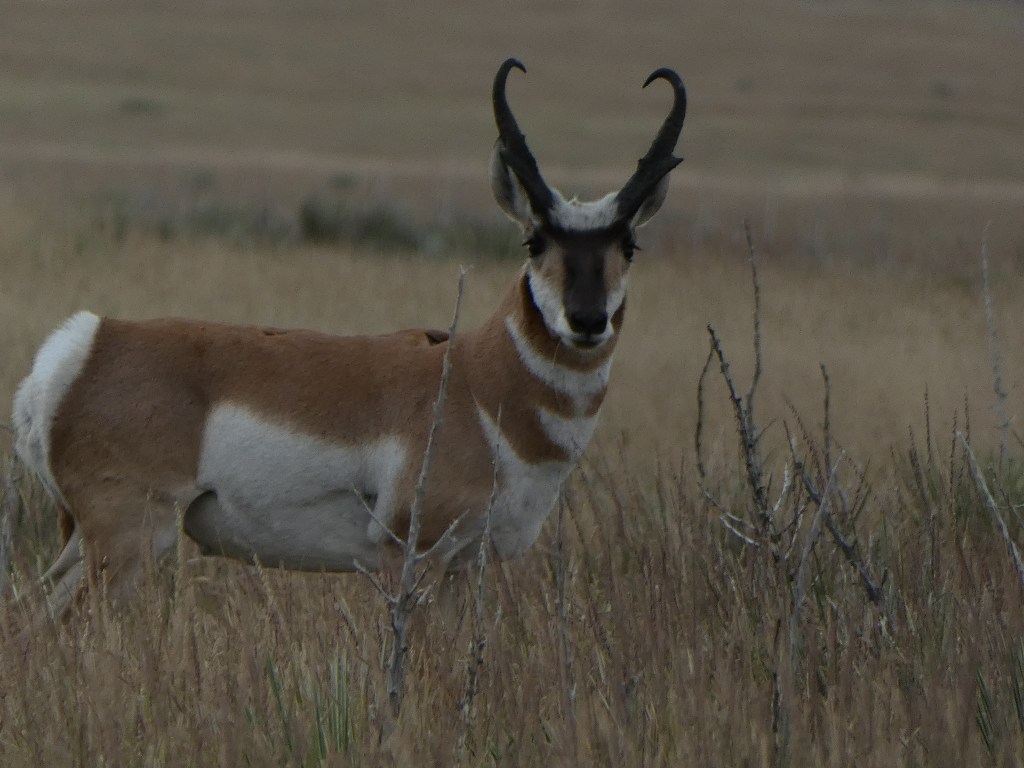
Arriving at Charette Lakes mid-day allowed plenty of time to set up camp with a view of the Lower (larger) lake, before heading off, on foot, to wander these lush grasslands. It seemed like Spring ….. so many wildflowers in bloom! Late afternoon saw a mass exodus of fisherpeople, and by 5:30 pm we pretty much had the entire area to ourselves! Hiking about some more, we encountered a small group of pronghorn, gazed skyward as hungry migratory ducks and Canada geese flew in to Upper Charette Lake, observed a number of beautiful kestrels, and enjoyed the antics of a coot flotilla on the lower lake.
The wind blew, the rains poured, but we managed several hikes across the short grass prairie surrounding Charette Lakes
By 6:00 pm we got caught in a downpour! Wait! This wasn’t supposed to happen! But the rain and gusty winds persisted until morning, as heavy gray clouds continued to roll by.
We found most of the migratory birds on and feeding at Upper Charette Lake. Mostly marshy and shallow, this small lake had more food for hungry birds than the larger and deeper Lower Charette a lake.
After rechecking the weather forecast, it seemed like this storm was headed north, well out of the area we planned to visit next ….. Clayton Lake State Park, in the extreme NE corner of NM, bordering TX.
We shook out our rain gear, toweled off the dog, packed up Felix and headed out, dropping down the basalt escarpment we ascended yesterday, thankful this section of steep decline was paved.
Clayton Lake State Park
Excited to see more of the grasslands and the famous Dinosaur Trackways, a historic landmark site managed by the State Park, we approached from Raton, NM, very close to the Colorado border. Traveling about 50+/- miles SE (leaving the rain behind), the surrounding shortgrass prairie was dotted with a number of resting volcanoes, including Capulin (managed by the National Park Service).
Our route from Charette Lakes to Clayton Lake State Park and Dinosaur Trackways passed through more shortgrass prairie habitat adjoining a cluster of Forest Service-managed grasslands (Kiowa in NM; Rita Blanca in TX; Cimarron in KS; Comanche in CO), remnants of the vast “sea” of grasslands that used to be.
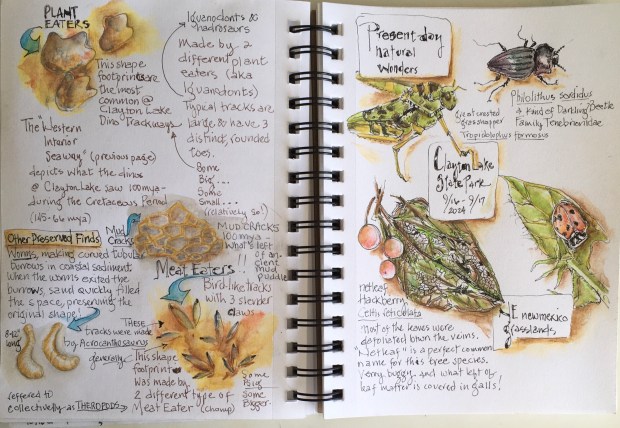
Arriving at Clayton Lake SP about noon, we quickly parked Felix, then walked the 1/4 mile to the Dino Trackways! Very, very cool. It’s hard to imagine that 100 million years ago this area of NM/TX was a beach along the western side of a great inland sea! Paleontologists believe the dinosaur tracks were made by both plant and meat eaters that migrated north and south along this sandy beach. The tracks showed the plant eaters likely moved about in herds as they foraged for food. There were also foot long tube worm tunnels and some pretty interesting mud cracks preserved in today’s hard sandstone.
At Clayton Lake State Park we learned about the 100 million years old dinosaur tracks uncovered during the construction of the Clayton Lake emergency spillway, found some wind-stunted and deformed plants lining the the earthen dam, discovered a new grasshopper and beetle, and enjoyed watching terns perform aerobatic stunts over the lake.
Dinner time and it began raining (what!), varying from drizzle to deluge, we started to have second thoughts about tomorrow’s access into Mills Canyon on the Kiowa National Grasslands. But the radar showed this area wasn’t getting rain, and we felt it was worth a try (as long as we were so close!).
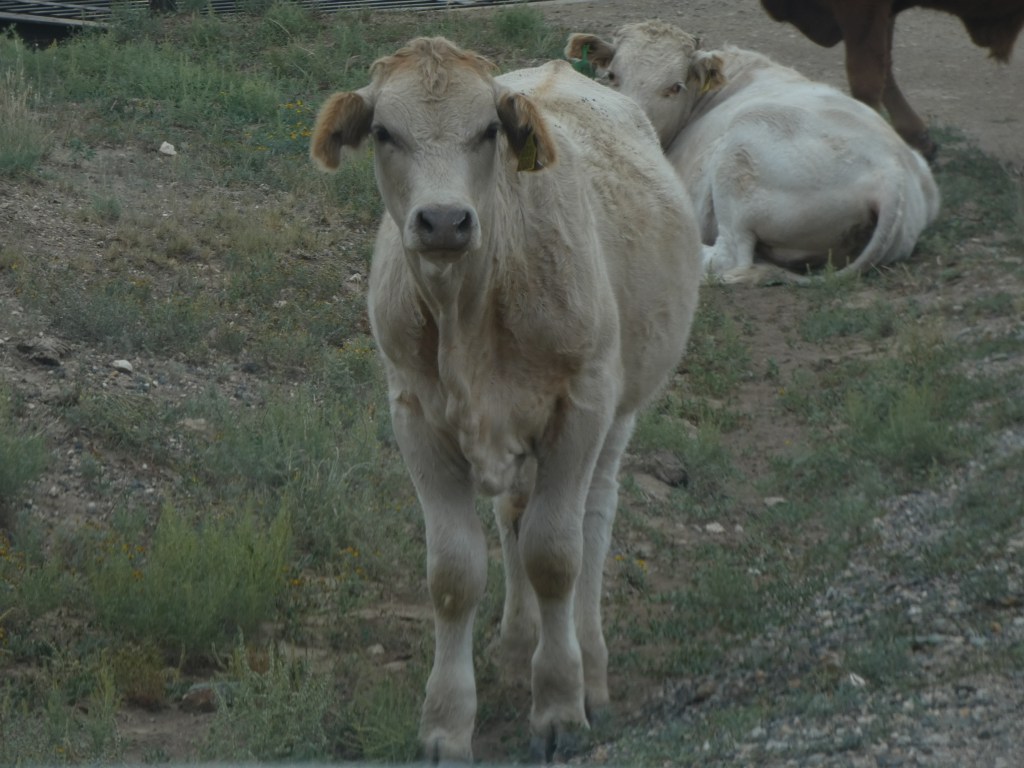
One of many cows that graze the grasslands on allotments that often span private, State and Federal lands.
Clayton Lake to Mills Canyon (Kiowa NG)
Early morning sunrise was gorgeous, then from who-knows-where, storm clouds rumbled in, and kept coming nearly the entire way to the Kiowa. But nearing our arrival, the clouds cleared out and things looked promising; so much so that we agreed to try our luck.
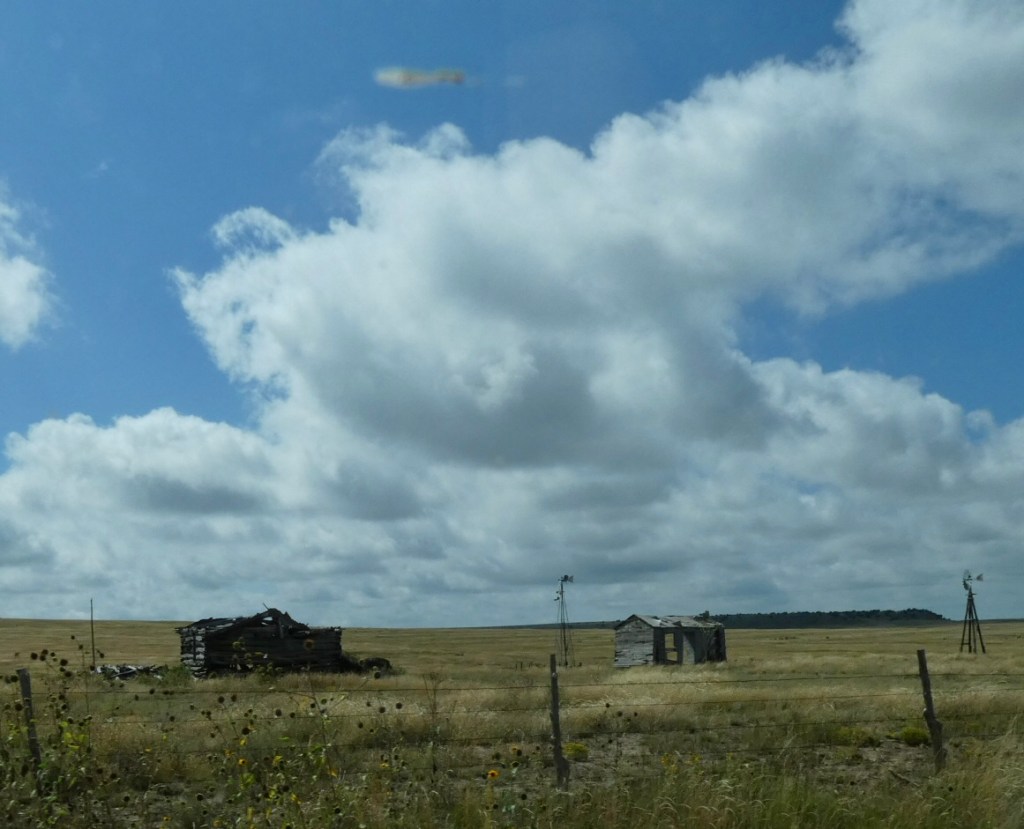
Long abandoned and “melting” into the soil, the shortgrass prairie saw its share of homesteaders back in the middle to late 1800s.
The Grasslands boundary was six miles off the pavement, on dirt and gravel ranch roads. Once on the Grasslands 2-track access to the campground our luck nearly ran out. Down down down the road went, saturated with the last several days of pouring rain. But we didn’t really know this, and began the descent. It wasn’t 200 slippery yards later, Roy’s executive decision to reverse course probably saved us being stranded somewhere for days! As he began backing Felix up the sloppy slick road, conditions somehow felt worse. Felix had a mind of his own and began weaving all over the place, half the time getting stuck in the ruts we made during our descent.
What looks like a lonely landscape is actually lush and thriving grasslands thanks, in part, to an abundance of rain this year. And Wow! Did it ever rain!
Finally after 30 minutes of careful maneuvering, Roy managed to coax the RV back to the Grasslands boundary. Our relief to be back on somewhat solid ground overshadowed our disappointment in not being able to visit this dramatic canyon area. But we were safe even though both the truck and Felix were coated above the axles with 6-8 inches of mucky sticky clay.
So, with this area and any other likely destinations soaking wet, and only being 3 hours from home, we agreed to end this crazy camping trip, promising ourselves to return another day. Turns out the decision was wise, as we drove through one downpour after another on the way home! (The rain was so hard at times, visibility was zip! But the good news was it rained so hard that most of that mucky sticky clay got washed away.)
The End…..
And that was the ending to a short, yet memorable trip. Of course by the time we got home, the clouds had cleared totally, and we haven’t had a drop of rain since! Go figure!
A pronghorn wary of our presence, passing with a herd between Upper and Lower Charette Lakes.
World Smile Day is an annual celebration of the simple yet powerful act of smiling and spreading joy to others. It was created by commercial artist Harvey Ball in 1999 to honor the iconic smiley face he created in 1963. On this day, people are encouraged to perform acts of kindness and make others smile, both in person and through social media. World Smile Day is celebrated on the first Friday in October.
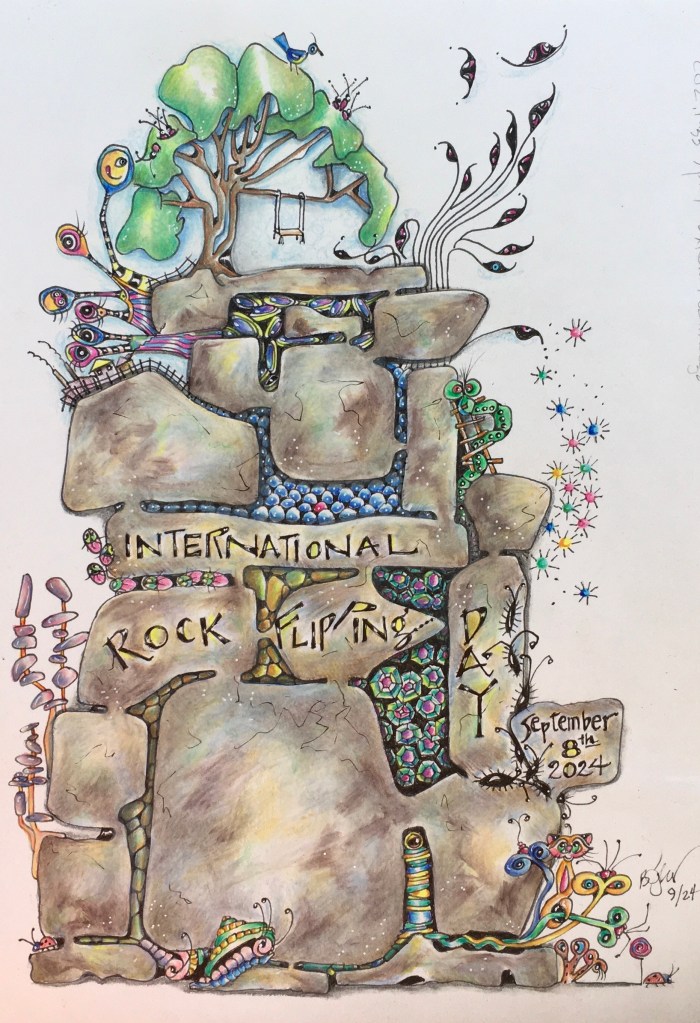
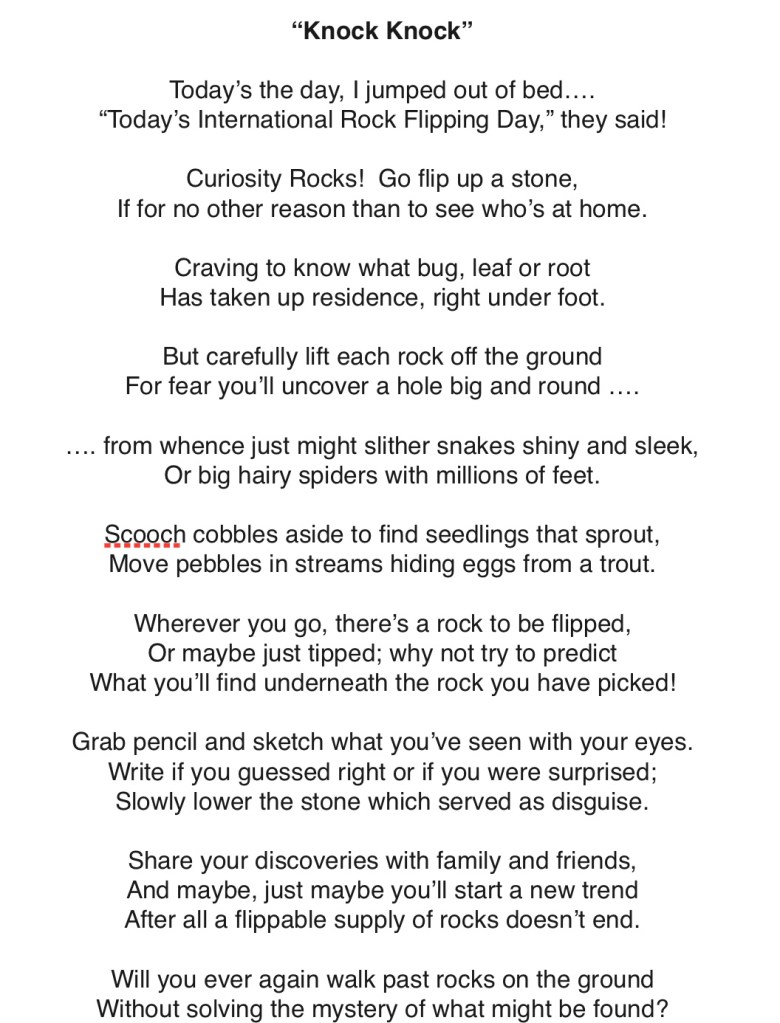
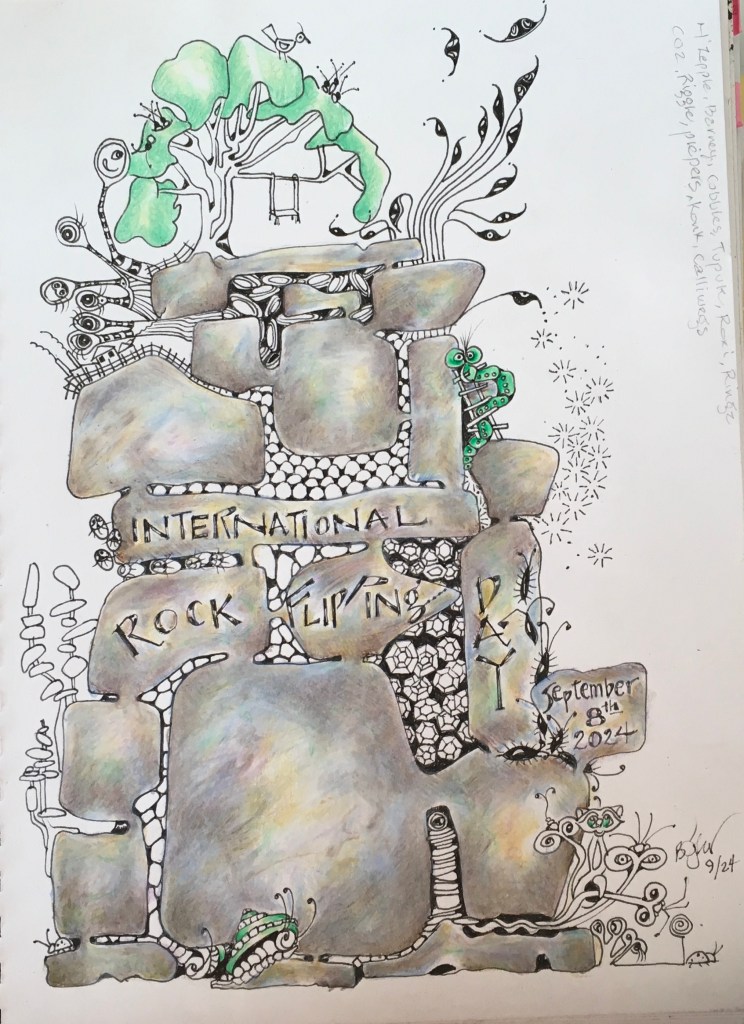
Unbeknownst to me …… until right now! Hitting me like a ton of rocks, I just learned that every second Sunday in September each year marks a worldwide celebration known as
International Rock Flipping Day
Today is a day to encourage people to explore and learn about the natural world by flipping over rocks to see what creatures and other organisms live underneath them. Participants share their findings and observations with others to promote curiosity and appreciation for the environment.
If no one was at home, tell me about your flipped rock(s)!
Bring out your Inner Child!
I don’t care what town you’re born in, what city, what country. If you’re a child, you are curious about your environment. You’re overturning rocks. You’re plucking leaves off of trees and petals off of flowers, looking inside, and you’re doing things that create disorder in the lives of the adults around you. – Neil deGrasse Tyson
A few more …..
As with other phases of nature, I have probably loved the rocks more than I have studied them. – John Burroughs
If it weren’t for the rocks in its bed, the stream would have no song. – Carl Perkins
The problem is not scientifically illiterate kids; it is scientifically illiterate adults. Kids are born curious about the natural world. They are always turning over rocks, jumping with two feet into mud puddles and playing with the tablecloth and fine china. – Neil deGrasse Tyson
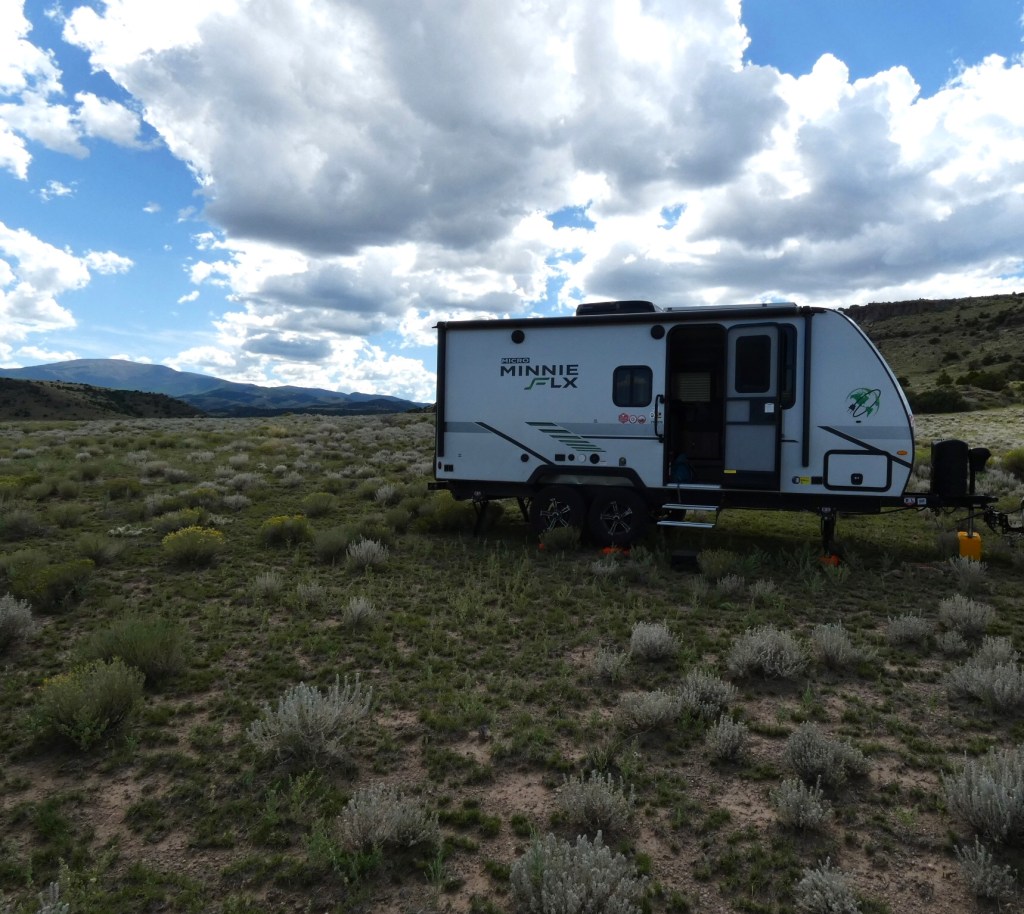
Felix parked along the Old Spanish Trail route, south central Colorado
With no defined route or objective, we decided it was high time we hitch up the trailer (Felix) and tote it north just to see what’s going on in south central Colorado this time of year. As we made our way through the San Luis Valley, we found acres of lush greenery topping almost-ready-to-harvest potatoes. Alfalfa was nearing its second cutting. Carrots had already been shipped to market. The wildlife refuges were patiently awaiting the arrival of migratory birds. And the last of the summer tourists were excitedly boarding the Cumbres and Toltec Scenic Railroad in Antonito, for the 64 mile steam engine journey to Chama, NM.
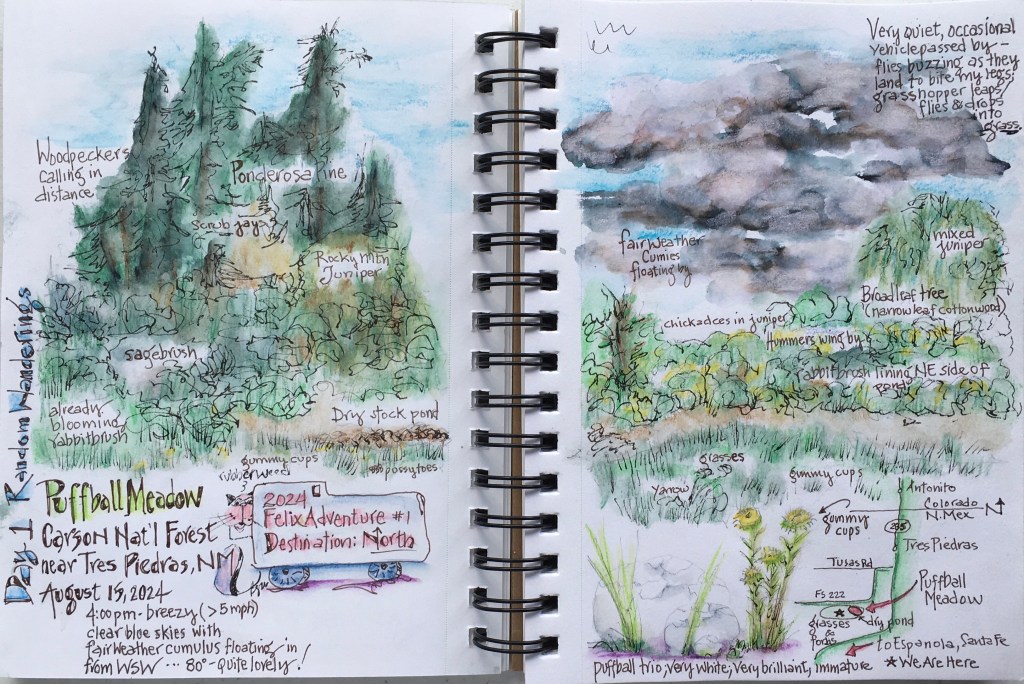
Day 1. Our first stop was in northern New Mexico, just south of Tres Piedras, Carson NF. An unlikely dispersed camping spot that I nicknamed “Puffball Meadow.” A nice level spot adjacent to a dry stock pond. The meadow was full of fist sized puffball fungi, and a coyote paid us a visit during the night.
We enjoy boondocking on our public lands managed by the US Forest Service and Bureau of Land Management. Having a trailer that’s self-contained, we can easily find lovely off-the-grid areas to set up camp. And thanks to our solar panels (and lots of sunny days) and large water tank, we can stay out for up to 5 days without needing refills. This allows us to explore lesser visited areas, which suits our tastes beautifully!
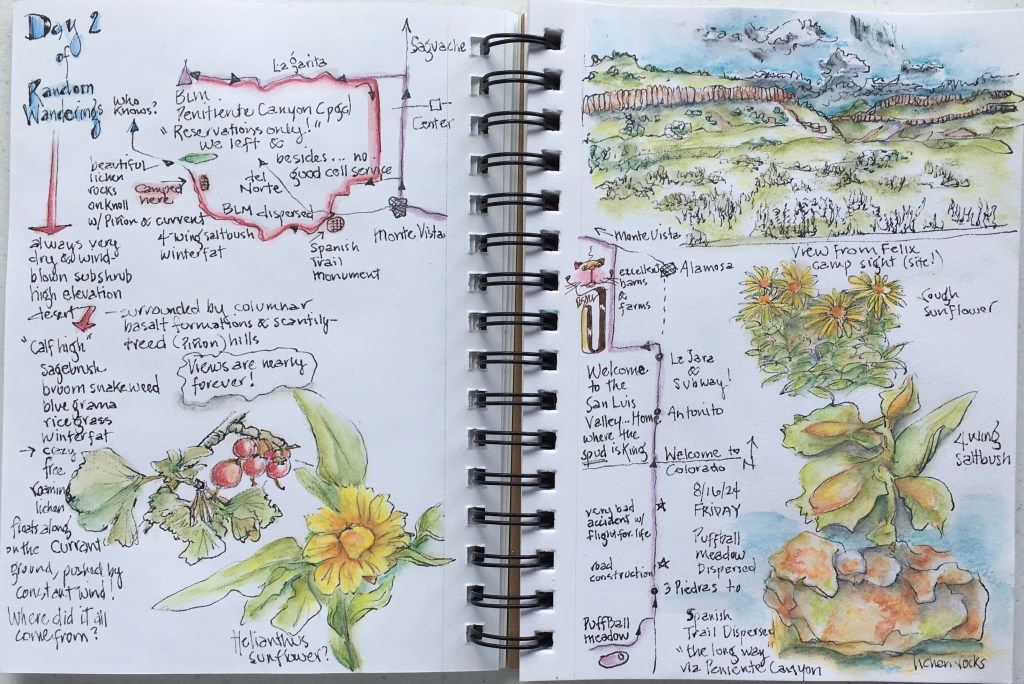
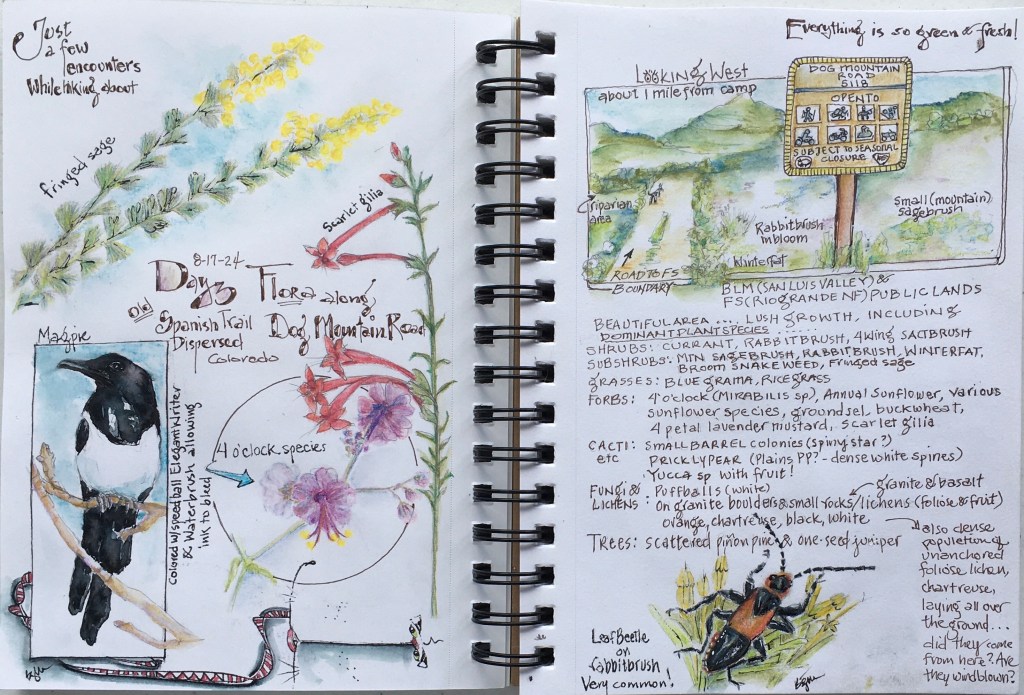
Day 2. Made it to the San Luis Valley, Colorado. Wandered around until we found a wide open area of dispersed camping in the vicinity of the Old Spanish Trail. Lots of wildflowers blooming, and plenty of hiking opportunities.
But I think one of the best things about random travel is the spare time …… we drive for 3-4 hours, find a place to camp ….. then the rest of the day involves hiking, wildlife watching, nature journaling, collecting drawable items, photography, more sketching, identifying the unknowns, reading, napping, and a bit of ukulele strumming! Perfection!
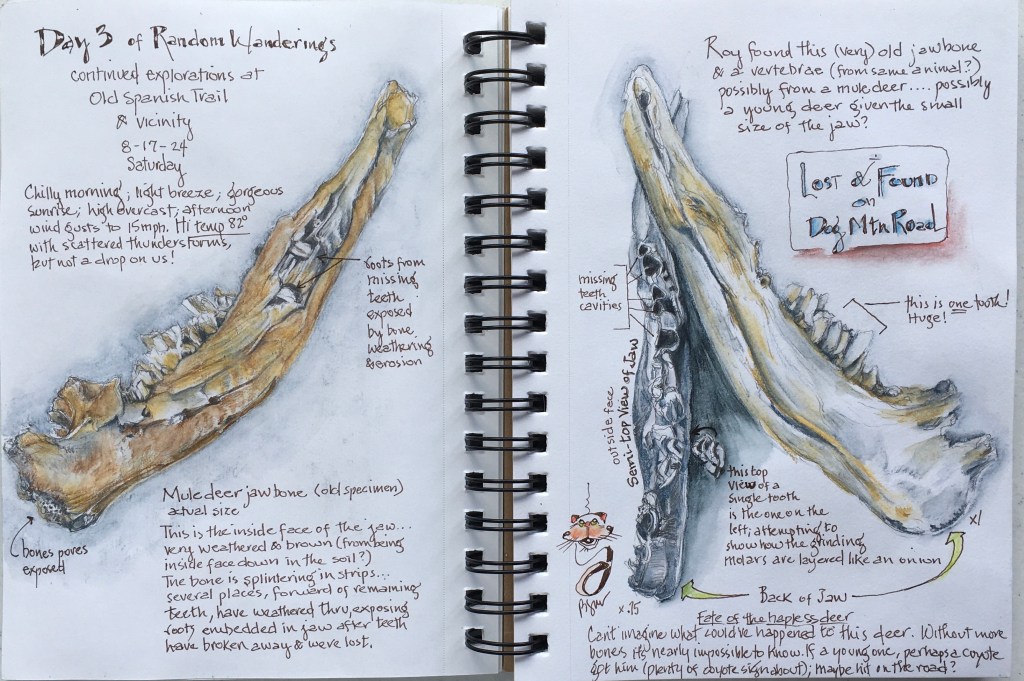
Day 3. We enjoyed the area so much, Roy suggested we stay for another day! And then he found this weathered mule deer jaw bone. Day 3, continued. Magpies! Can’t understand why these gorgeous birds don’t come south at least as far as Albuquerque and East Mountains.
Although the 6-day trip wasn’t remarkable, it was good to get away. Scattered about this post are my journal pages highlighting Days 1 to 5.
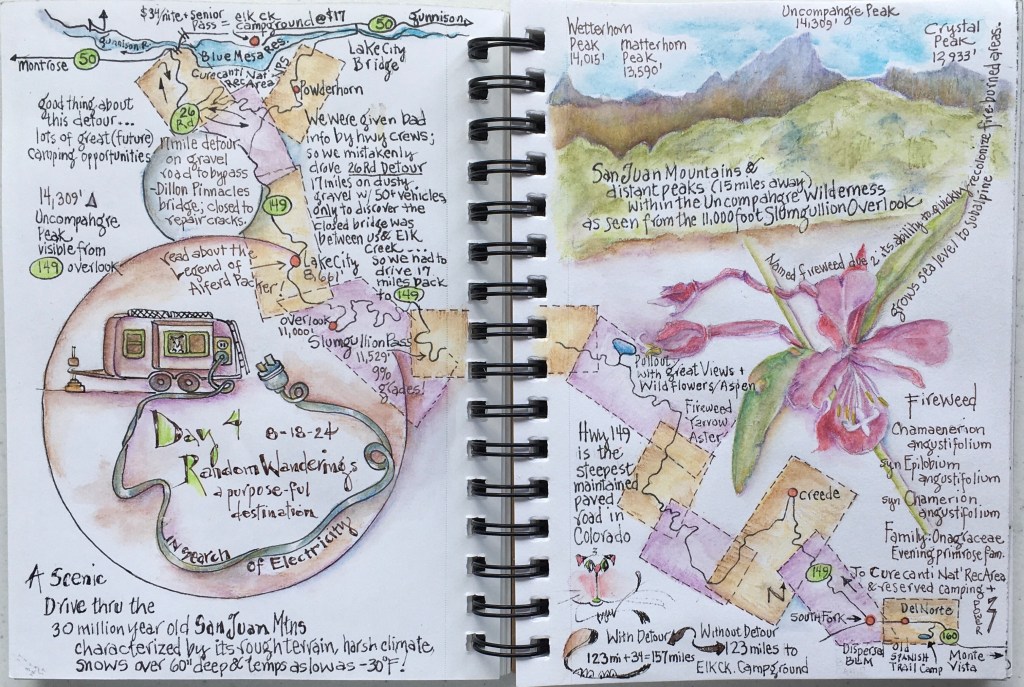
Day 4. Our travel route as we made our way to a campground to charge our battery and top off our water tank. An inconvenient, unplanned for detour led to future camping possibilities.
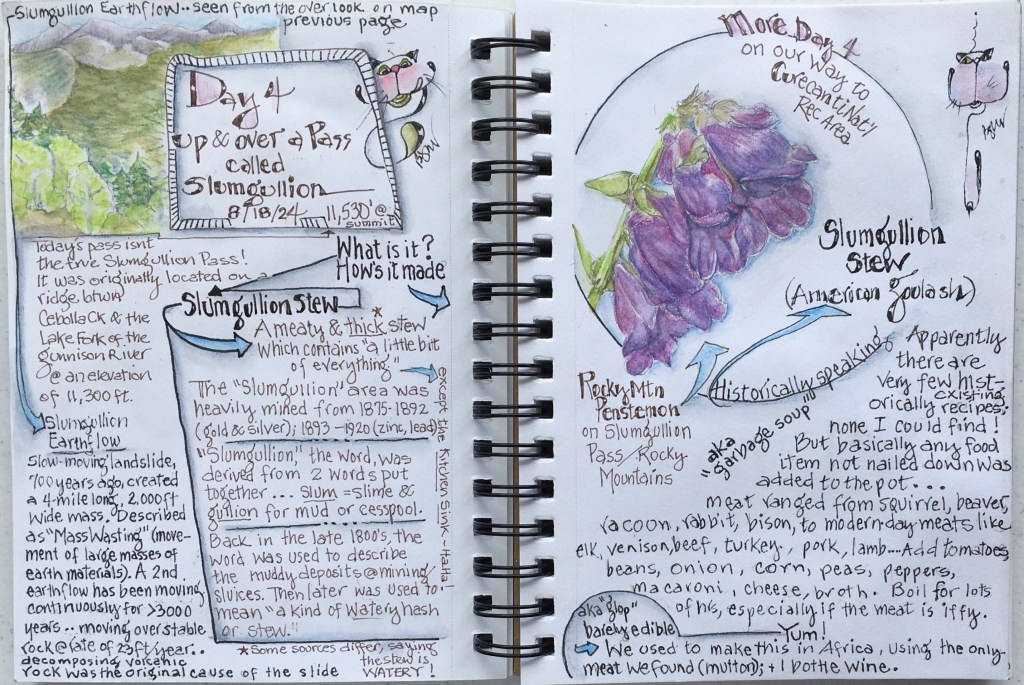
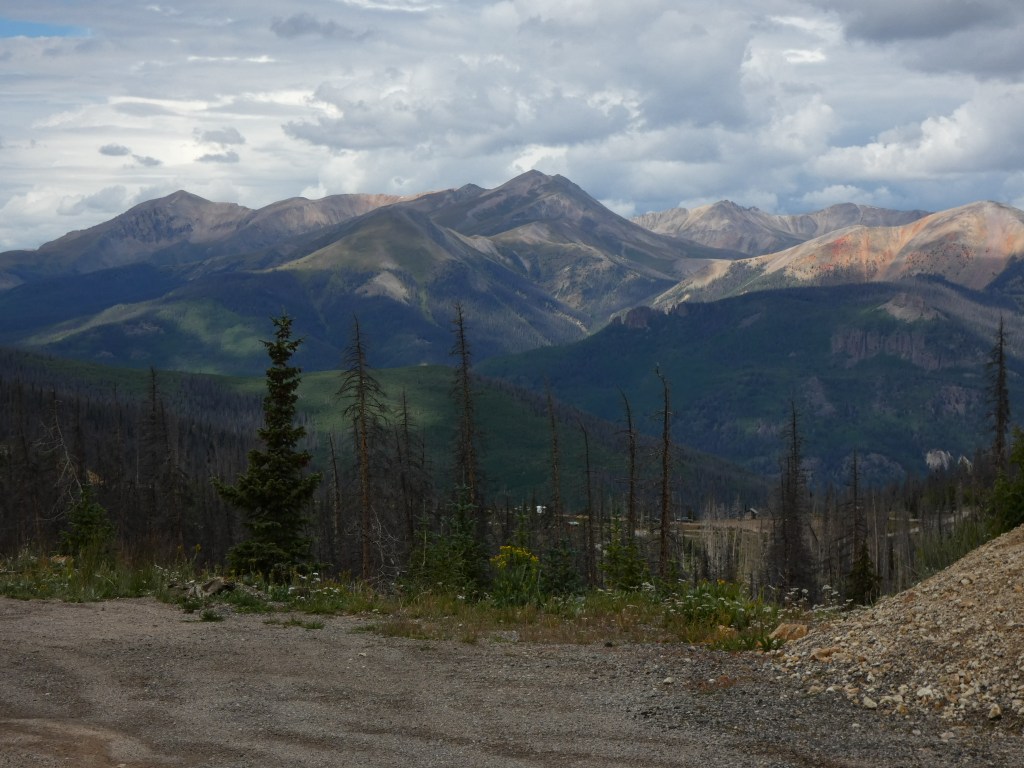
On Day 4, we decided to make our way up and over Slumgullion Pass (11,530 ft) on our way towards Gunnison Country. Not having been this way in years, we really enjoyed the crisp mountain air and spectacular views up and over the Pass. The villages of Creede and Lake City have grown swollen with tourist amenities and summer cabins dotting the once open meadows. As we got closer and closer to Lake City, we couldn’t help recall the story of Colorado’s notorious cannibal, Alferd Packer. Wanting to reread the tale as we passed near Cannibal Plateau and Deadman’s Gulch, the crime scenes, here’s what I found:
BriefBackground: Alfred Packer (newspaper misspelling as “Alferd” Packer, which stuck) (1842-1909) was a prospector who set out for Colorado gold fields in 1873. By the winter of 1874, he reached the rugged San Juan Mountains with a party of five men where they became lost and stranded during one of the worst winters on record. The men, with only had 3-4 days provisions quickly consumed and no firearms, were forced to cook their rawhide moccasins. Places where “snow had blown away from patches of wild rose bushes,” ….. they “were gathering buds from these bushes, stewing them and eating them.”
When the snow finally crusted over, Packer, the only man to survive the ill-fated trip, walked out of the mountains after 60 days. He told a story about the demise of his fellow prospectors, and how he managed to survive by eating them. His story involving cannibalism became legend, and continues to be passed down to today! (Whether the story is true or not will never be known, but it makes for colorful history.)
Based on historical records and news reports, Alferd Packer was tried several times for murder and cannibalism (even though the act of cannibalism wasn’t considered illegal in the US). Convicted of these heinous crimes, Judge M.B. Gerry supposedly uttered this famous quote while handing down the sentence in Packer’s first trial ……
“Stand up yah voracious man-eatin’ sonofabitch and receive yir sintince. When yah came to Hinsdale County, there was siven Dimmycrats. But you, yah et five of ’em, goddam yah. I sintince yah t’ be hanged by th’ neck ontil yer dead, dead, dead, as a warnin’ in reducin’ th’ Dimmycratic populayshun of this county. Packer, you Republican cannibal, I would sintince ya ta hell but the statutes forbid it.”
This is the quote I’d grown up hearing many times, over and over and over! It makes for good reporting, but is a ways from the actual sentence and what Judge Gerry sounded like while reading it (nope, he didn’t talk like Yosemite Sam!). Here’s what the record shows:
“Alfred Packer, the judgment of this court is that you be removed from hence to the jail of Hinsdale County and there confined until the 19th day of May, A.D. 1883, and that on said 19th day of May, 1883, you be taken from thence by the sheriff of Hinsdale County to a place of execution prepared for this purpose, at some point within the corporate limits of the town of Lake City, in the said country of Hinsdale, and between the hours of 10 A.M. and 3 P.M. of said day, you, then and there, by said sheriff, be hung by the neck until you are dead, dead, dead, and may God have mercy upon your soul.”
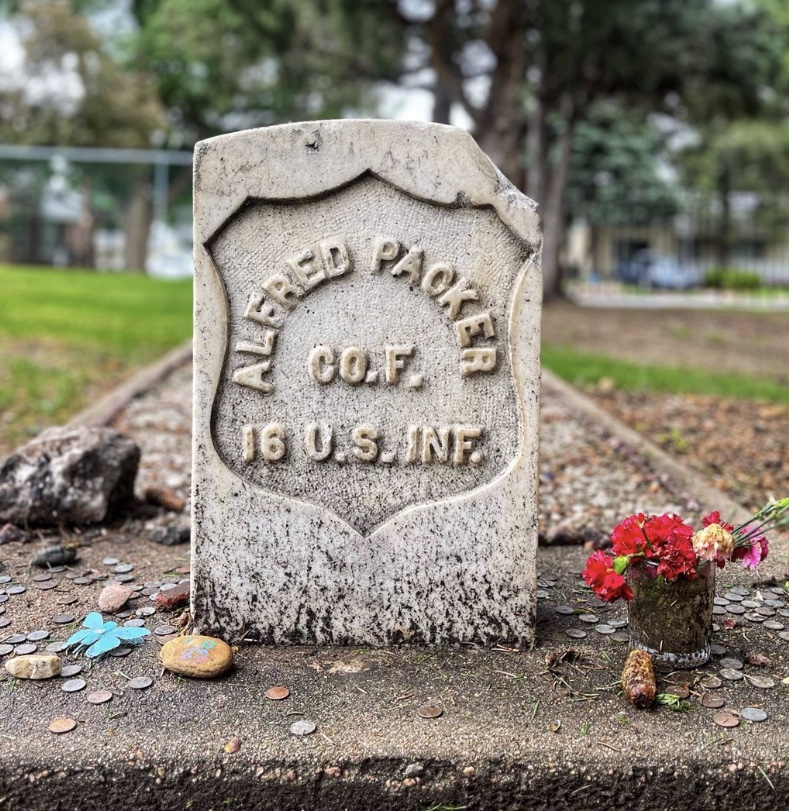
Alfred Packer tombstone in Littleton Cemetery where he was originally buried in 1909. Today, he now lies back in Hinsdale County, near Lake City.
Alferd Packer never did hang. It’s quite a detailed story following his first trial, including a jail escape, nine years on-the-lam, and recapture. There was a second trial in 1885 where he was charged for only one murder; after serving only 16 years of his 40-year sentence, he was released and died peacefully one year later at the age of 60. He was buried in Littleton, Colorado where his tombstone properly reads Alfred Packer.
Day 4. Supplemental information about that strange name “Slumgullion.” Is it a stew? Is it a drink? Is it the sludge that puddles below an 1870 sluice box? Day 5, on our way back to Old Spanish Trail (because we liked it so much). Discovered a new-to-me plant; after a bit of checking with iNaturalist, learned it was Black Henbane, but not before handling all parts of this very poisonous noxious weed!
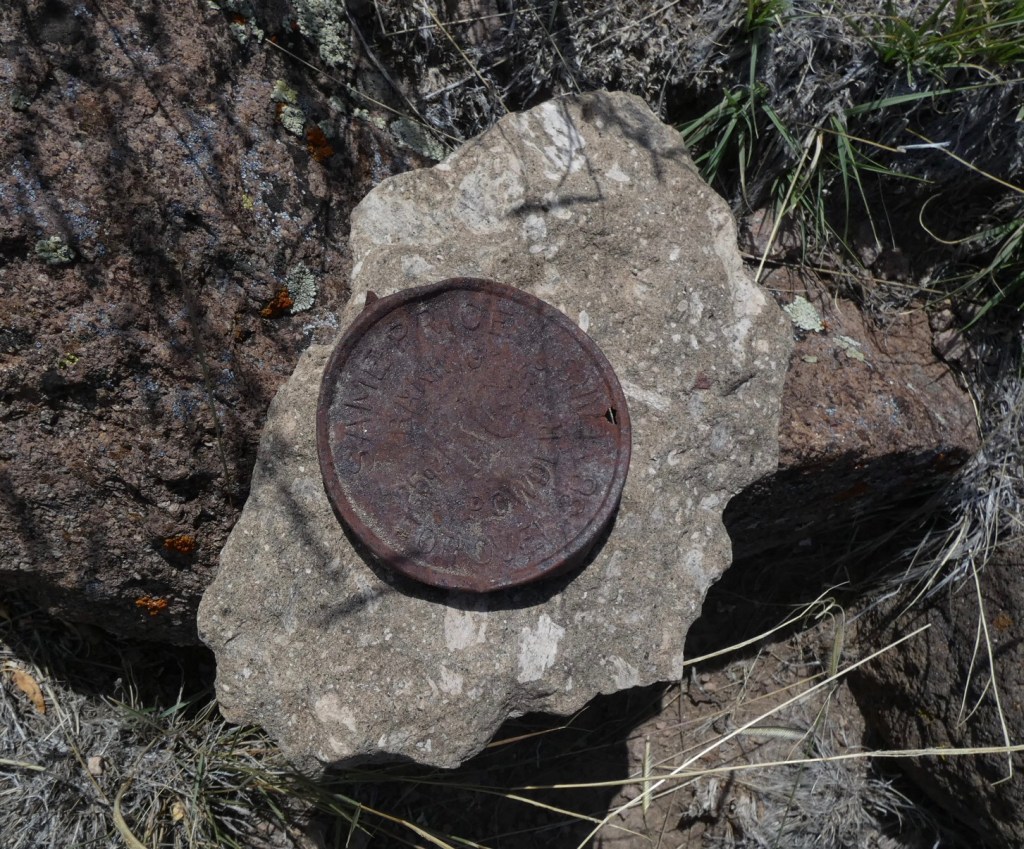
A short comment on the KG Baking Powder tin lid we found near our trailer. It was old and rusted, but very readable. The tin and its contents were probably long gone. Tried to find any information on the KG brand; sure curious about the age of the lid. If you’ve heard of this brand, please let me know.
KG Baking Powder tin lid we found near Old Spanish Trail.
Day 6. Headed for home. Hope you enjoyed my travel journal.
San Juan Mountains …… up and over Slumgullion Pass. The view of the 700 year old earth flow.



















 a curious nature