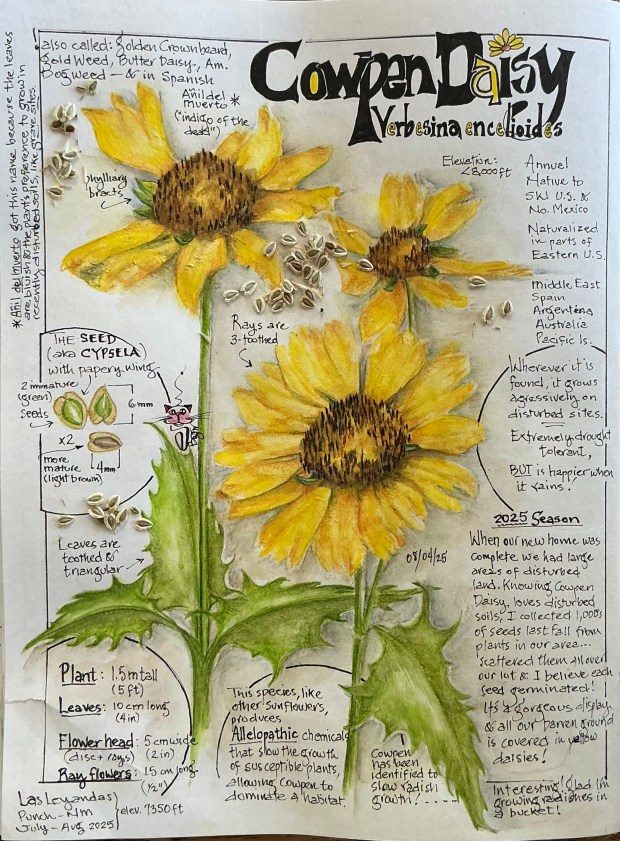
While compiling last week’s post about the happy Cowpen Daisy party taking place outside our back door, it was no surprise to find way more interesting info about this sunflower than could ever fit on my journal page. Decisions …… decisions! To keep the August 5th illustrated page relatively uncluttered, I decided to include just the botanical basics (mostly), focusing on Cowpen Daisy flowers, leaves and seeds.
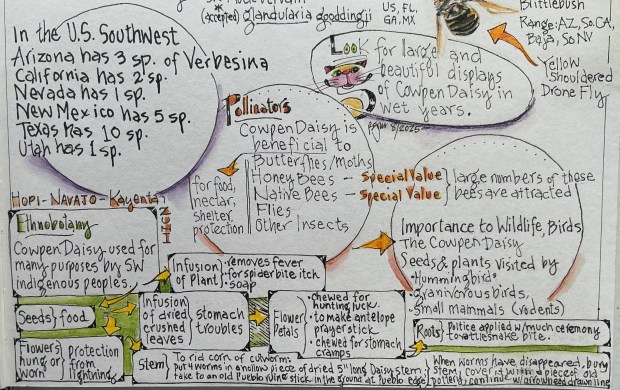
Then the past week I found my nature journal wide open to a blank page, ‘begging me’ for another Cowpen Daisy entry ….. “What about all those interesting info bits?” she asked. Replying* to my journal with a hearty, “OK,” I proceeded to locate and gather my rabbit-trailing notes. This scavenger hunt reminded me just how many pages there were; so many fascinating things about the Cowpen Daisy I wanted to remember and share. Decisions …… decisions! How to keep this next post to one page? By limiting the topics to only three, was it possible?
Barely! (after some clever editing, not a single word dropped off the page)
A little bit closer view for those without a microscope!
P.S. By the way, you may have noticed I’ve indicated this post is Part 2 of what’s now become my Cowpen Daisy series. Unless I start journaling on larger than 8” x 11” paper, there’s likely to be more Parts in store. And this multi-part series resulted in a minor edit to last week’s post, not titled “One of the Happiest Sunflowers Ever! The Cowpen Daisy; Part 1 ….. Can There Be Too Many Sunflowers?” In case you missed it, please check it out here.
*Yes, you read that right; I talk with my nature journals. Don’t you? After all, we do spend quite a bit of time together!
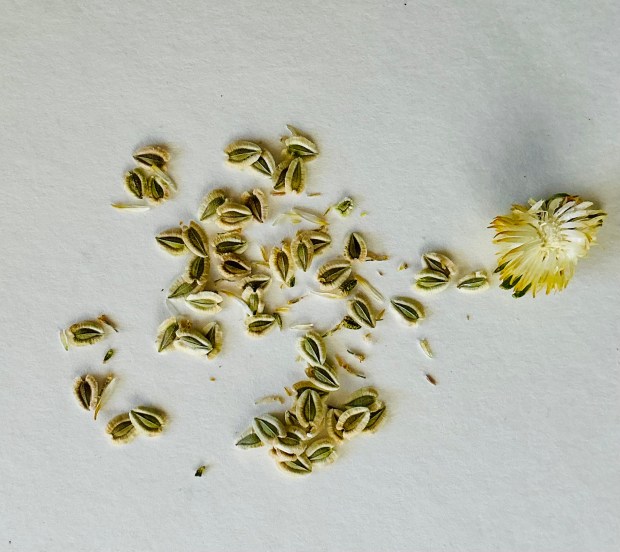
It was the Fall of 2024. A small cluster of Cowpen Daisies (Verbesinaencelioides) flourishing on the severely disturbed ground surrounding our new home was going to seed. Waiting several weeks until the migratory birds ate their fill, I spent an hour or so collecting as many remaining dried seeds (cypselas) as possible, stuffing full two quart-sized ziplock bags. About 1/3 of the seeds I scattered around the house where they would overwinter on the ground. The rest were poured into large pill vials that were labeled with species name, location, and date, then placed in the refrigerator to simulate cold storage until Spring.
Cowpen Daisy cypselas (seeds) 08/04/2025 at Punch
It was late April 2025. The chances of heavy frost seemed a distant memory. My fingers crossed, I chose a sunny 42 degree morning to liberate those refrigerated seeds from 6 months of cold storage, and scattered them in disturbed areas not seeded last Fall. Then I waited like an expectant parent, watching for signs of germination, worrying that runoff from late season snows might wash away my scattered seeds, expecting that flocks of migratory birds would gobble them all up, and hoping for gentle rain showers to swell those thousands of seed coats to aid those tiny embryos in growing their first roots (radicles) and first leaves (cotyledons).
Then early June 2025. Success! Cotyledons were literally popping up everywhere, which meant the radicles were already expanding into the soil. They were especially crowded where I’d scattered all the cold storage seeds, and germination was obvious where seeds had been scattered the Fall of 2024. By early July, those Cowpen daisies were crowding out many of the other native species I’d also seeded in the same areas.
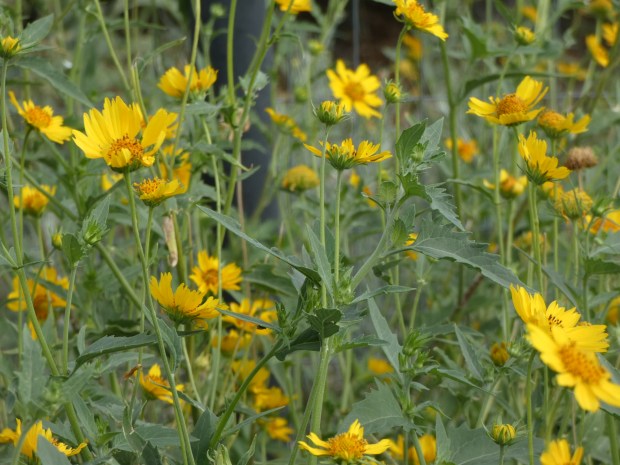
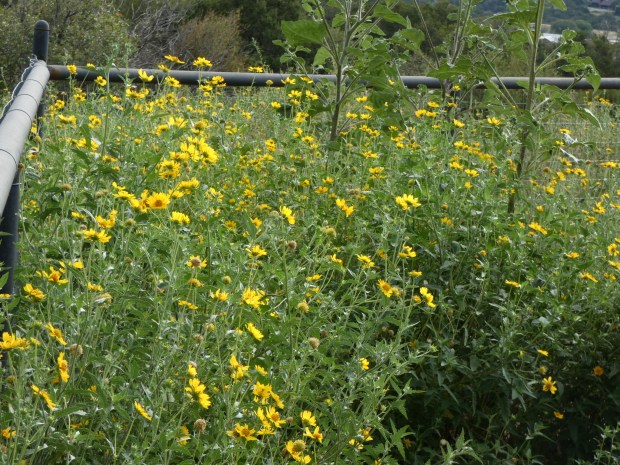
Backyard and overflow Cowpen Daisies, robust growth after Fall 2024 seeding (08/03/2025)
And now it’s early August 2025, and what a dazzling show! Even though the sunflower yellow flowers of Cowpen Daisy are small (2” wide), there are up to 75 long-stemmed flowers on each plant that can grow from 4-5’ tall! They are so dense, the backyard fence is hardly visible, our walking paths are totally draped with 4” long leaves, and if there’s a rattlesnake lurking around under our massive Cowpen Daisy canopy, we’d probably (hopefully) hear him well before he slithered into view!
Goals and Lessons Learned
I’ve learned a lot by parenting these Daisies; from the best time to scatter seed (in the late Spring following cold storage) and where (not so close to other desirable natives or pathways), to managing the mass of growth (by organizing through selective removal). Our initial goal of seeding and growing native plant species was to attract and help feed wildlife (pollinators, reptiles, rodents, birds and mammals), and we are optimistic that achieving this goal long-term seems realistic with the success we’ve had to date. However, because so many of our native plants are losing the battle against habitat loss caused by invasive species encroachment and takeover, land development, and climate change, we will continue to explore ideas to expand our initial goal to address the habitat situation. As we gain insight about the best native plants to grow to help restore our disturbed soils, we will learn and share with our neighbors those species that: are drought tolerant; aid in building soils; are effective at invasive weed suppression; provide wildlife benefits; and increase plant diversity.
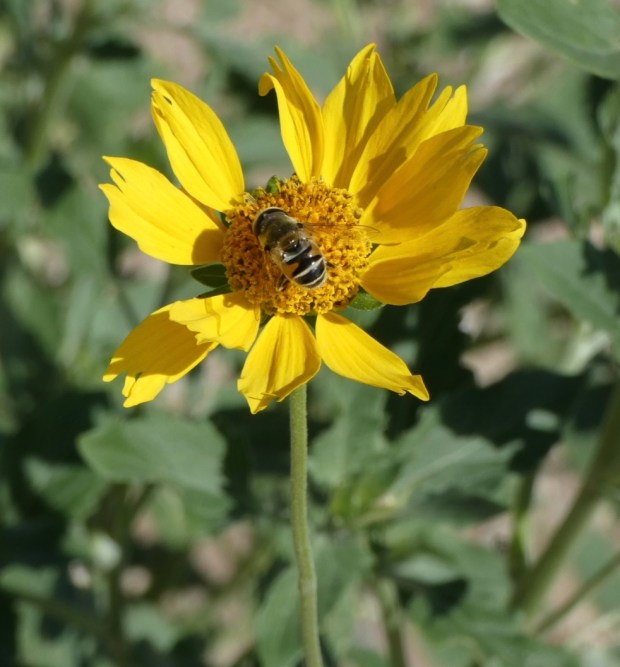
Cowpen Daisy and pollinator 08/01/2025 at Punch
Happy – Happy – Happy! Will I be collecting Cowpen Daisy seed again this Fall? You bet! Having all that sunshine yellow around our home is thrilling. Every morning all those thousands of sunflower faces looking East towards a new day are about the happiest sight ever! And having such wild, uninhibited growth of a native annual out our back door has been ideal for observing the pollinators that benefit from the abundant nectar and pollen, enjoying the aerial acrobatics of several phoebe families that have been feasting on those pollinators, and promises to be a perfect spot for bird watching this Fall when all those cypselas ripen into high protein food.
Can’t wait!
Do you ‘know’ a special native plant? How about a native butterfly garden? Are you a bird watcher? Maybe you enjoy the occasional deer, coyote, or bobcat wander through your yard? Please share your favorite wildlife encounter!
As always, thanks for stopping by!
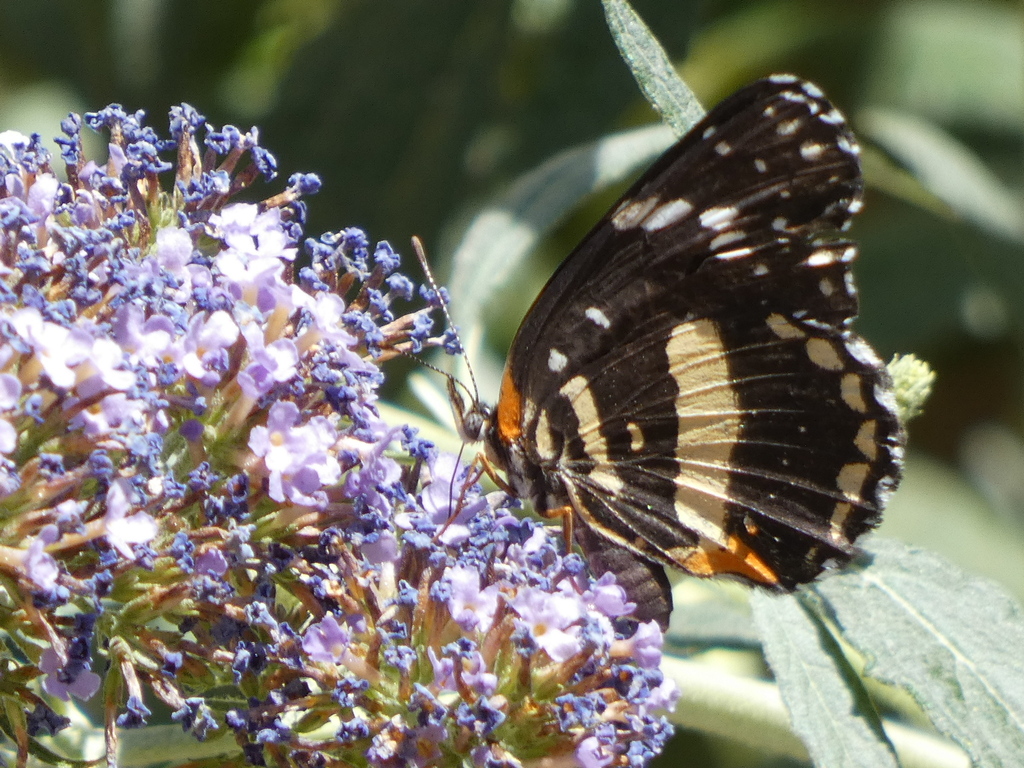
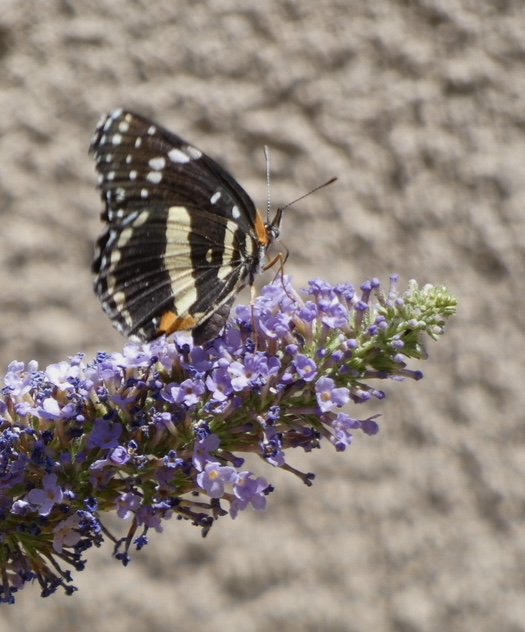
Bordered Patch (my photo/2023 – on butterfly bush)Bordered Patch catBordered Patch (my photo taken 2023These dandy little butterflies, the Bordered Patch, often choose the Cowpen Daisy as their larval host. (The butterfly nectaring on butterfly bush flowers are from my home collection)
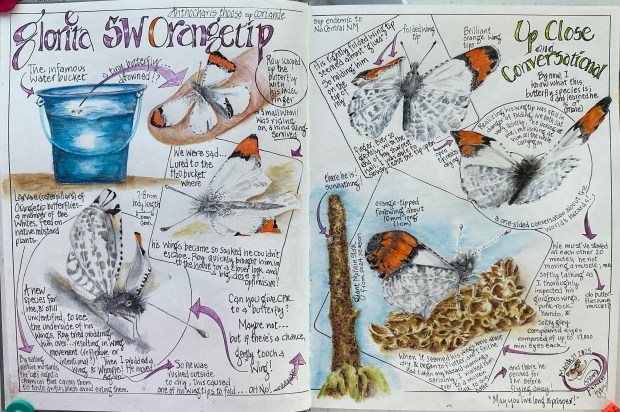
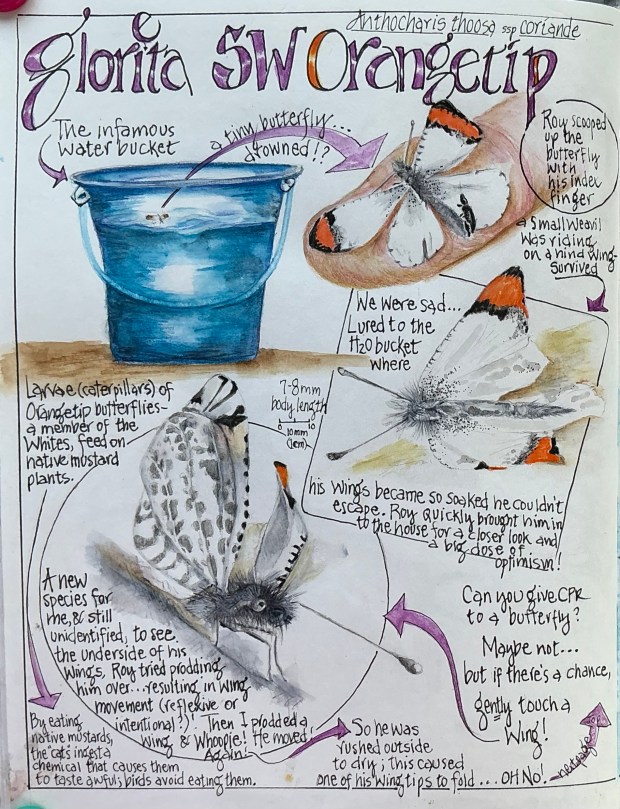
The ‘Glorieta’ Southwestern Orangetip (Anthocharis thoosa ssp coriande), are only known to occur in the central and north central counties of New Mexico. This recently recognized form of A. thoosa was described by M. Fisher and Scott in 2008, from specimens collected near Glorieta Pass southeast of Santa Fe1 (which just northeast of our home).
The Orangetips are classified in the Family Pieridae/Subfamily Pierinae ….. commonly called the Whites. In NM there are 16 known species of Whites, including the non-native European Cabbage White. After a wet winter, plentiful males compete for hilltop display locations while females search surrounding areas for the choicest of native plants in the mustard family (Brassicaceae) on which to lay their eggs. When the eggs hatch, the larvae (caterpillars) voraciously devour the leaves of their host mustard plants, until they’ve grown to over 1,000 times in size! Because this family of butterflies is common in desert habitats, to withstand drought conditions some species have the ability to suspend development during their pupal stage (when they are in their chrysalis), a mechanism called pupal diapause. And if winter rains do not cause favorable conditions for their larval hosts (the mustard plants), they can remain in pupal diapause for several years.
The White’s preference for mustard plants may not be about taste. It’s thought that chemicals contained in these host plants make butterflies in this group unpalatable. Entomologist, “Mike Toliver has witnessed only one attack by a bird on members of this group in more than 60 years of observation.”1
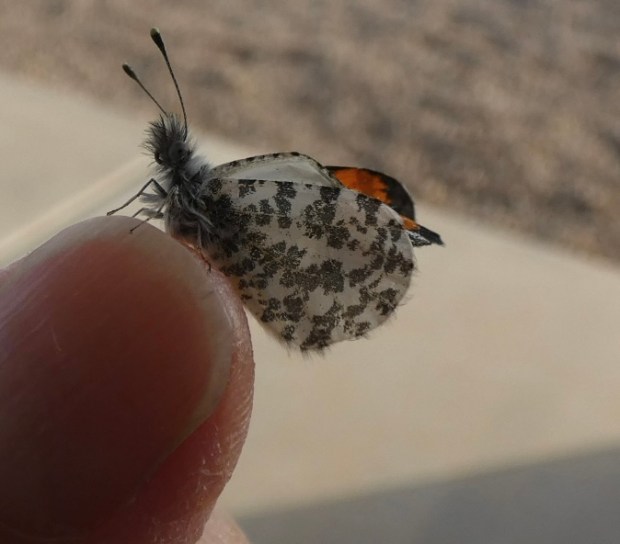
Early one morning (a few days ago), Roy discovered a miniature butterfly afloat, upside down, in a water bucket left outside overnight. Looking very drowned, Roy scooped him up with the tip of his index finger and brought him inside the house for my inspection. Excited and sad all at once, I snapped a few photos, having never seen this species before. Because this little guy had such striking marks and color, finding him in the online New Mexico butterfly field guide was easy. This beauty was a ‘Glorieta’ Southwestern Orangetip (Anthocharis thoosa ssp coriande)!
Roy was about to turn him over to take a look at the flip side when one of the wings fluttered a bit. Not believing our eyes, I gently prodded him, and sure enough! He seemed alive! But just how much alive we didn’t know.
Rushing this tiny guy outside where his wings might dry, he slowly became more active. Unfortunately the tip of a still damp forewing folded over and stuck like glue making it impossible to synchronize those wings …. he didn’t seem remotely interested in taking flight. Not to be defeated, he then crawled up to the tip of my pinky finger, looked me in the eyes, raised one of his six legs politely asking for help. Gathering my courage and willing any clumsiness ‘be gone’ from my fingers, I held my breath while using the edge of my longest fingernail to slowly and carefully separate the fold. Taking my time to tease up the delicate tip millimeter by millimeter, this butterfly never moved a muscle (do butterflies have muscles?). After what seemed like hours the wing unfolded, popping back into alignment without any apparent damage!
“The Talk”
He didn’t fly tho, so I sat with him for about 20 minutes as he perched on my finger. During my ultra close inspection of his eyes (you know I love eyes, and his were sultry grey and gorgeous), punk-rock style hairdo, and brilliant orange tipped wings, he seemed content while I carried on a lengthy one-sided conversation warning him of the world’s dangers.
Somewhat convinced he believed and would abide by my every word, I walked him over to a large mullein stalk, where he walked off my finger to enjoy a sunbath (hopefully to prepare to take wing). He wasn’t in much of a hurry tho. About an hour later and checking to see if the coast was clear, off he flew. That beautiful Glorieta Southwestern Orangetip butterfly was free!
All-in-all, it was an exciting encounter!
What exciting encounters are you experiencing during this change of seasons?



 a curious nature