March “Littles” ….. Looking for Spring Amidst March Madness

April 3, 2023

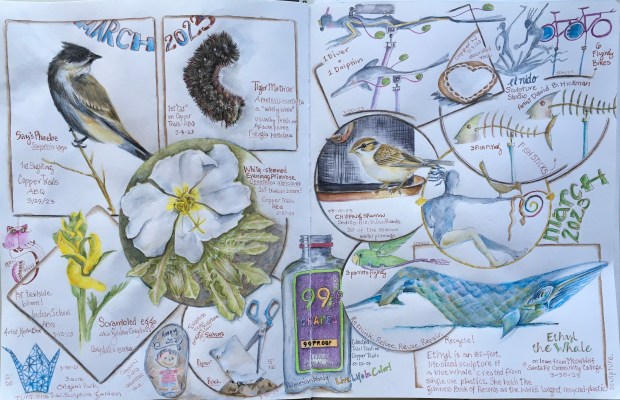
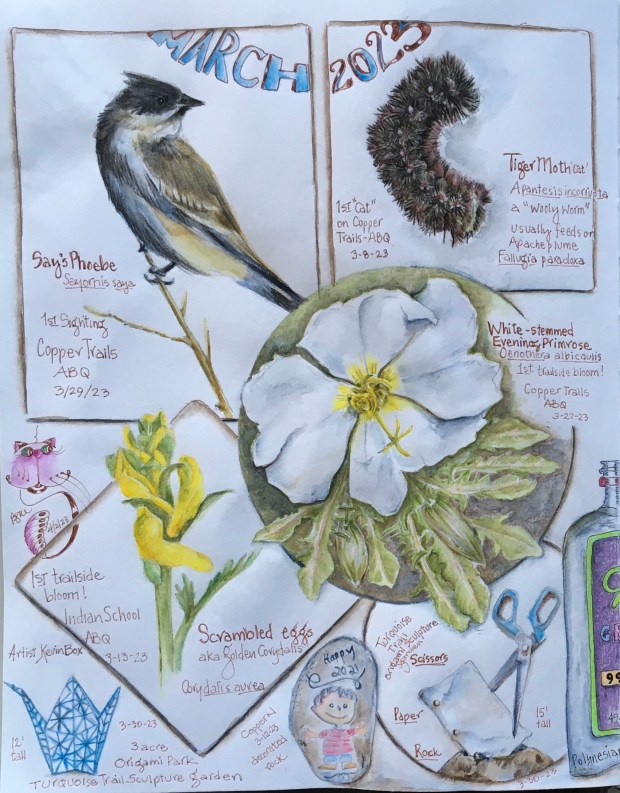
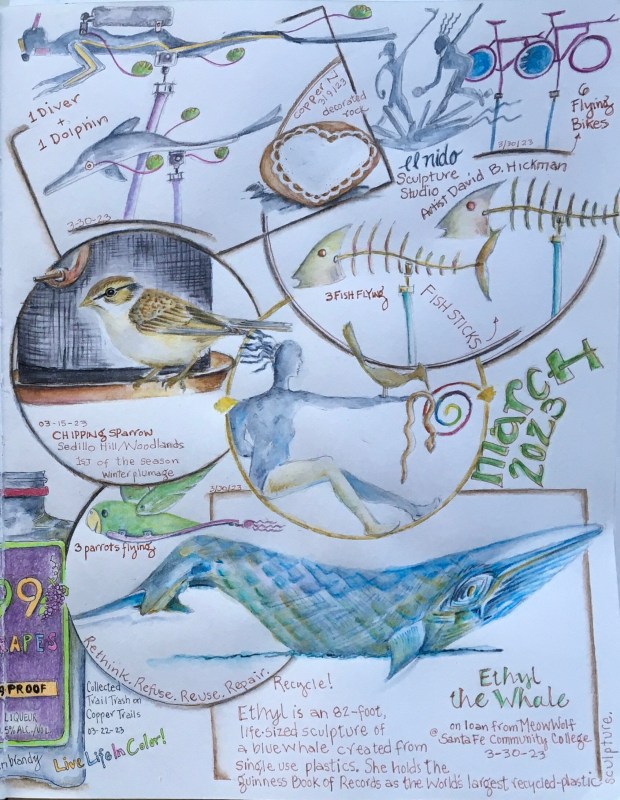
March came in like a passive lion, allowing a few signs of Spring to peek through. My collection of nature snippets and decorative trail rocks was going well, until ……. Before long we were once again shoveling drifts and piles of snow, dumped on New Mexico thanks to California’s 13 atmospheric rivers that flowed from coast to coast. This was looking like the winter that would never end.

It was truly and literally “March Madness” out there. So, in the spirit of the crazy seasonal weather, an emergency road trip became necessary to search for some “Littles” filler. And I knew the perfect route to take …..

The Turquoise Trail Scenic Byway winds around the Ortiz Mountains and Cerrillos Hills, while passing through the historic mining towns of Golden, Madrid (MAH-drid) and Cerrillos (sir-REE-yoose). Today, there’s minimal mining taking place in them there hills. Today it’s all about art, and there’s some really weird stuff on display out there.

From Golden to just north of Cerrillos, the hillsides are adorned with metal sculptures like a Trojan horse, three boned fish on sticks, a scuba diver fleeing a curious dolphin, two-story tall origami made of folded metal, butterflies as big as pterodactyls, a squadron of green parrots, and a fleet of racing bicycles. You have to look around every bend in the road ….. they’re all there, and more!

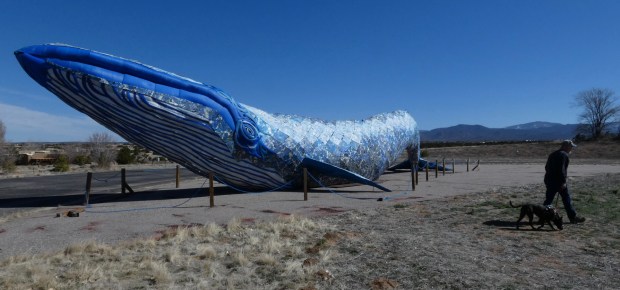
It was fun “collecting” these images for my March “Littles” collection, but I needed one more. We had heard the story of Ethyl the Whale somehow living out of water, somewhere in Santa Fe. Sounded like the perfect weird addition to that blank spot on my page.

And there she was! Around the back side of the Santa Fe Community College, in a large, flat field was Ethyl, the 82-foot long blue whale sculpted out of single use plastics. Ethyl is HUGE! She not only holds the Guinness Book of Records for the World’s largest recycled plastic sculpture, she also delivers an important message about the health of our oceans.

Well, there you have it; my eclectic assortment of “Littles” to remember this March of 2023. Let me know what you think! I’m already looking forward to true Spring in April. Wildflowers should be popping up everywhere and maybe a few more bugs will make an appearance for my April “Littles.”

Thanks again to “Made by Fay” for the “Littles” inspiration!

Meet a Teeth Clacking, Jaw Grinding, Squealing and Woofing Peccary of the Desert Southwest….. the Javelina  

March 21, 2023

Another species we searched for while visiting the Sonoran Desert surrounding Tucson last December, was the javelina. Certainly this elusive little pig-like critter was nearly everywhere we went, as attested to by the thousands of hoof prints echoing their presence. And many of those hoof prints were fresh! Certainly there must’ve been squadrons of javelina hiding behind every mesquite tree around the next countless bend in the trail? 

But alas …. we never saw, heard or even sniffed out a single javelina. All we could do was record (and sketch) the herd of hoof prints, and then research this animal in the following months. Oh boy, did we really miss such a fascinating encounter.

Back at home, several months later, our friend Jim Silva was happy to share one of his javelina skull mounts for study and sketching. I’m thinking we may have been lucky not to have met up with a herd of their clacking canines during our travels! 

Maybe another time?  

Meanwhile …. If you’ve got a thirst for javelina knowledge, or just want to see my journal sketches, read on!

Continue reading “Meet a Teeth Clacking, Jaw Grinding, Squealing and Woofing Peccary of the Desert Southwest….. the Javelina  “

Coues …..Elfin Deer of the Desert Southwest

March 17, 2023

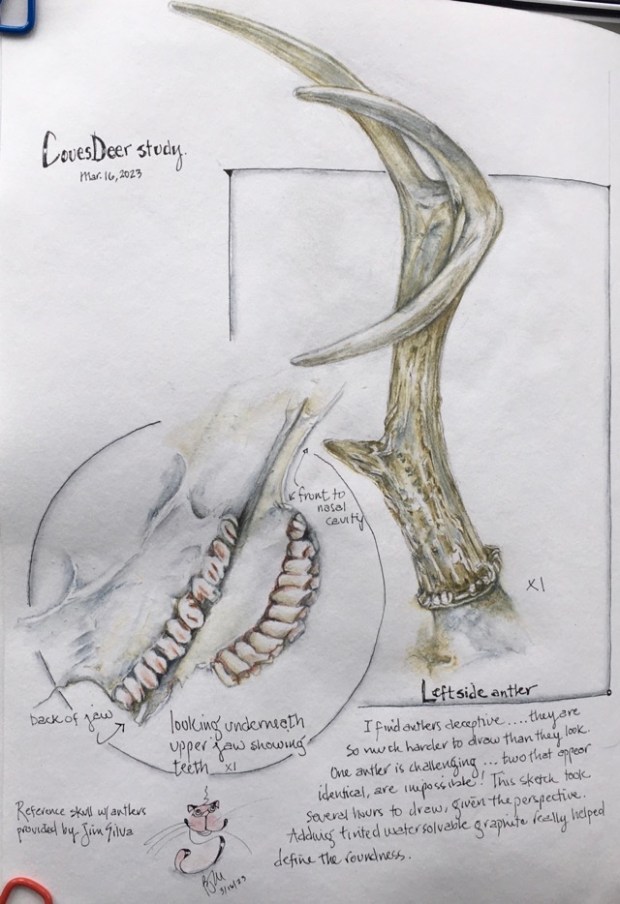
Even though we didn’t see any mammals while visiting the Tucson region last December, we knew they must’ve seen us! But little (pun intended) did we know, a diminutive elfin deer, the Coues Whitetail, was probably among the mix of critters observing us as we explored the area.

This tiny deer, with its oversized ears and flashing tail, is a native species found in the mountainous desert regions of the extreme Southwest and south into Mexico. 

A good friend, Jim Silva, who has hunted this species in southwest New Mexico, shared one of his skull mounts with me. Since sketching the skull and an antler, I’ve learned a bit about the Coues deer, including the highlights included on my journal pages.

“Coues” is most properly pronounced “cows” (but more commonly pronounced “cooz”), is also known as the Arizona Whitetail or Fantail.  Having lived in eastern North Carolina for a number of years, we are well familiar with the Eastern Whitetail, a small enough deer when compared to our local Mule Deer.  But it’s hard to imagine a deer smaller than the Eastern Whitetail.  Now we’re ready to return to the mountains of the Southwest and search for the Coues deer! Maybe late spring when there’s a chance of seeing a few fawns too!

What’s on your nature agenda for this spring? Ours is filling up fast!

Until next time! 


February “Littles” Seeds, Pods, and Other Curiosities

March 13, 2023

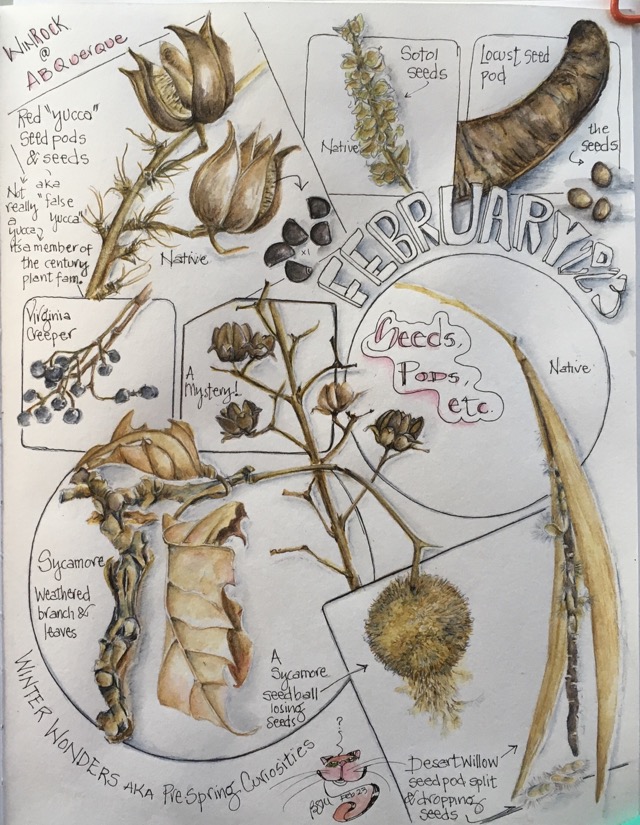
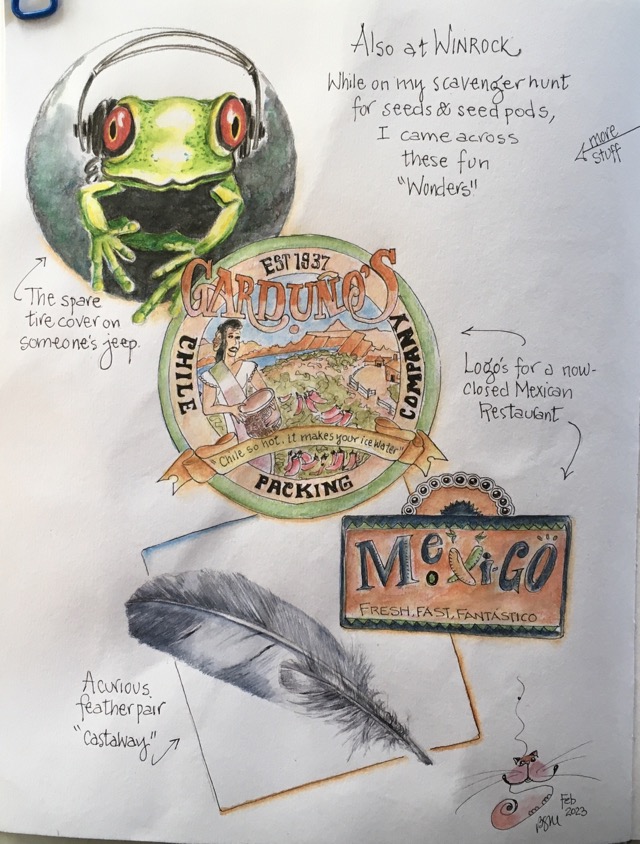
Like my January “Littles” page of the bird species that visit our feeders in winter, here’s another “Littles” to commemorate the not-quite-winter-or-spring month of February ….. Seeds and Seed Pods.  As a way to pass the time while waiting for Roy to finish up with a doctor visit, Luna and I conducted a focused scavenger hunt along a 2 mile circuit surrounding a large Albuquerque shopping mall. In no time at all, my collection bag was full.   But knowing my pages would need some local flavor and color too, I scavenged a bit longer and turned up a few more curiosities.    

Like with January’s page of birds, sketches of the species of seed pod and seeds (if collected) took less than 5 minutes each; my watercolor pencil paintings took about 10 minutes each. The restaurant logo and the frog design took a bit longer, and were done using my photos as reference. 

I’m not sure why it took nearly the entire month to decide what to do for my February “Littles.”  In hindsight, the decision should have been obvious, because I love seeds and the seemingly unlimited variety of pods.  Now I have a record of a few city seeds that will soon germinate, helping change the landscape from brown to spring green! 

Let me know what you think! I’m looking forward to March, when wildflower seedlings will be popping up which may appear in a few “Littles” boxes as well!

Thanks to “Made by Fay” for the “Littles” inspiration!


Winter Birding on Sedillo Hill: January 2023


East Mountains, Tijeras, New Mexico elevation 7,300 ft

February 15, 2023

The design for today’s post was inspired by sketchbook artist Fay. I came across her blog (see link below) while searching for nature journalers who are active in creating art and who also share some unique approaches to page layout and composition.  “Littles” is the name Fay has given to one of her unique approaches.  This is where she lays out several pages full of empty boxes with the goal to fill up a box a day for an entire month.  Not only does this encourage a daily drawing and painting practice, but it’s her way of creating a record of what she’s observed for an entire month.  “Littles” reminds me of a hyper-compressed perpetual journal.

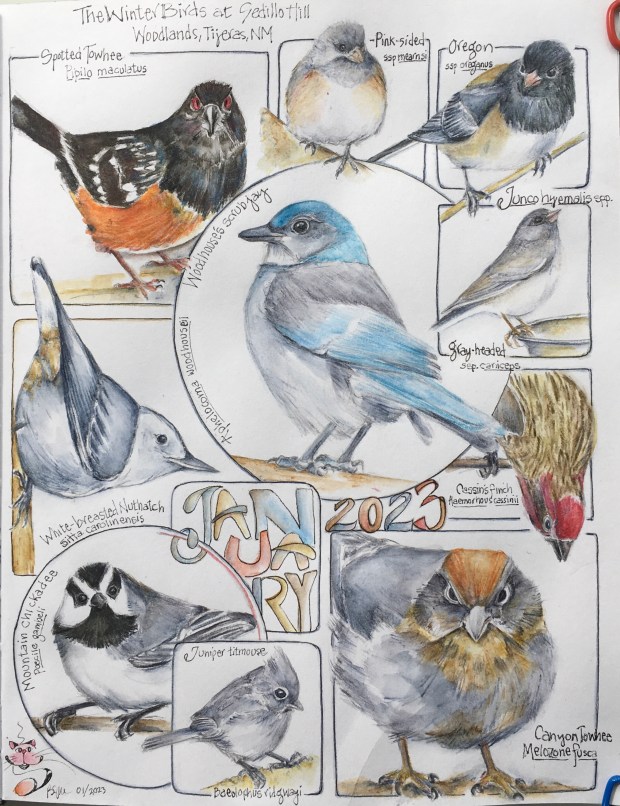
After seeing Fay’s blog post with all her miniature drawings and paintings, I knew this would be fun to try, and I had to learn more.  So we chatted and Fay encouraged me to give “Littles” a go.  And I did …… with a “little” twist!  I’ve been thinking of ways to keep a visual record of the birds visiting our feeders during the winter.  And I needed an approach with minimal fuss, without feeling each bird needed a detailed description. Ta da! 

So here’s my “Littles” page of the bird species that visit our feeders in January.  I kept my sketches to less than 5 minutes each; my watercolor pencil paintings took about 10 minutes each. My sketches were done using my own reference photos, and relied heavily on my many hours of observing these species’ poses and behaviors.

Let me know what you think! I just may create a “Littles” page for our February birds. Maybe by March, when all of our snow has melted, hints of new spring growth may appear in a few “Littles” boxes as well!

Oh and …… Follow Fay!  Her blog “Made By Fay” can be found at the link below.  If you enjoy my posts, I will guarantee you’ll love what Fay does.  She is an extraordinary visual storyteller, and enjoys drawing what she sees from her home state of Washington and on her travels about. 

https://madebyfay.wordpress.com


Intermission: Meet an Odd Member of the Rose Family …. The Desert (Eastern) Mountain Mahogany

2 page journal spread

February 8, 2023

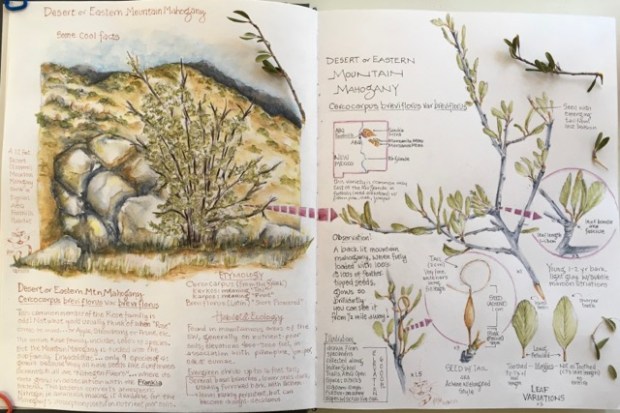
The Desert (Eastern) Mountain Mahogany is a very branchy shrub commonly found in the mid-elevation foothills of the Sandia, Manzanita, and Manzano Mountains east of the Rio Grande River in central New Mexico. This species’ formal and very appropriate name, Cercocarpus breviflorus variety breviflorus, comes from both Greek (kerkos: tail; karpos: fruit) and Latin (brevi: short; florus: flowered). As a matter of fact, the 9 species of the genus Cercocarpus all have long feathery tails that twist and turn from the tip of a single fruit, called an achene (like a sunflower seed). 

So why is this species odd? 

Well, the fruit, for one reason. Most of the thousands of rose family members have fruits called a hip (rose), pome (apple), drupe (prune), or aggregate (strawberry). And even though the strawberry is composed of numerous miniature achenes, it’s the single achene found in the mountain mahoganies that’s unusual to the family. 

To further emphasize the oddness of the Cercocarpus genera, all of its 9 species has a symbiotic relationship with a bacteria called Frankia.  And that’s an unusual characteristic of the rose family, which moved Cercocarpus and 4 other genera into the subfamily Dryadoideae. That’s all a bit technical when it comes to plant classification, and kind of skips the real reason why the Frankia bacteria is important to the survival of Desert Mountain Mahogany. Nitrogen Fixation!

Read on to learn more …..

Continue reading “Intermission: Meet an Odd Member of the Rose Family …. The Desert (Eastern) Mountain Mahogany”

Intermission: Winter Wind Rattlers

2023 journal page with a few of the actual seed pods scattered about

January 18, 2023

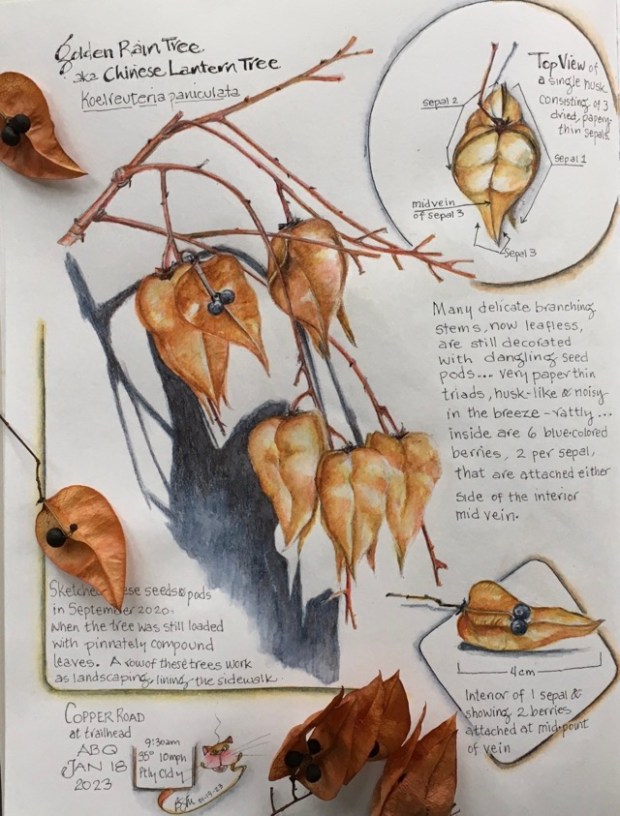
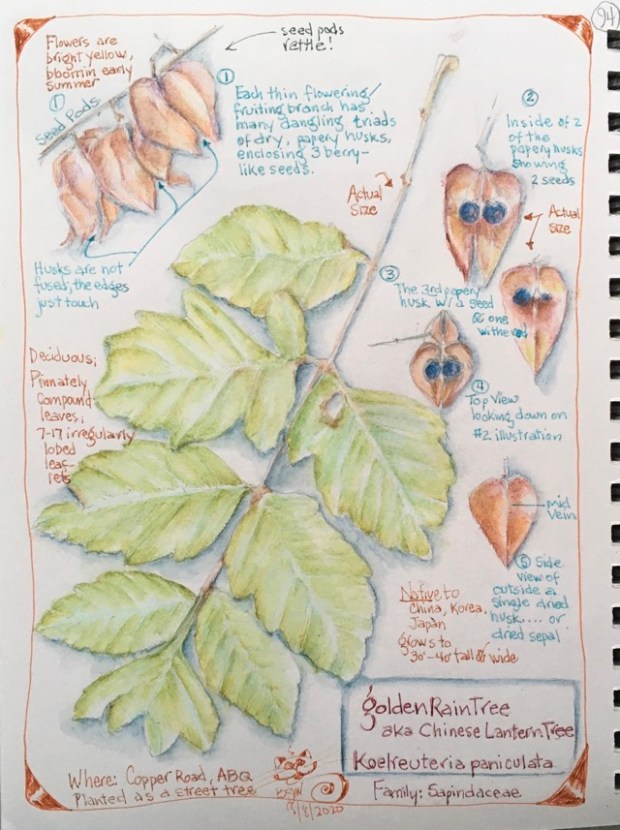
Not wild, but wildly rattling in the wind? Not snakes, but the showy seed pods from a row of Chinese Lantern trees, hanging on for dear life throughout our numerous winter wind events.

We frequently park near 8 of these non-native trees used as sidewalk landscaping, just before the Copper trailhead. After wondering for several years what these medium sized trees are, in September 2020, discovering the answer, I drew them out …… seed pods, leaves and all.

Searching for something wintery to add to my journal this year, these hardy seed pods called loudly. It was hard to resist!

Browsing my 2020 journals, I came across my first drawing. Always fun to see if and how my technique has changed. Can you detect the differences?

2020 journal page

What’s nature displaying in your world right now?


Intermission: Townsend’s Solitaire Comes Calling

January 11, 2023

Who doesn’t love birds? Watching them, listening to them, photographing them, and in my case drawing them. And it’s especially exciting when a new visitor comes calling. When the bird is the first I’ve ever sighted, automatically becoming a new addition to my life list!

There I was, working away on one of my Sonoran Desert posts, when I glanced up from my sketchbook and noticed an unfamiliar bird standing tall under our big juniper tree. Not one of the hundreds of dark-eyed juncos that feast all winter below our feeders. Definitely larger than the comical juniper titmice and noisy mountain chickadees that pop in and out conducting their continual grab-a-seed-and-dash maneuvers. Hmmmmm ….. a bit larger than our resident canyon and spotted towhees, but slimmer than the Woodhouse’s scrub jay. An American robin? A western bluebird? Certainly similar, but not quite; certainly a member of the thrush family?

Turned out he was one of the thrush species …. not the robin or bluebird, but the beautifully sleek Townsend’s Solitaire. For a brief moment he seemed to be evaluating the quality of juniper berries lying beneath the tree. Not wanting to spook him, I watched in muted excitement, then dared to make a move for my camera. He stayed just long enough to bend over for a bird’s-eye look, promptly dismissing our berry crop, and off he flew. Somehow, while juggling my field guide, binoculars and camera, I managed to snap a photo to confirm my sighting with iNaturalist. Confirmed! How cool was that!

It was a great day!

I’ve watched every day since to see if this one or more Townsend’s Solitaires drop by. No luck yet, but now I know they’re around. Maybe I’ll catch them this Spring breeding, nesting, but more likely singing and calling from the treetops while defending their territory full of delicious juniper berries!

What’s nature displaying in your world right now?


Intermission: Searching for Spring

January 14-15, 2023

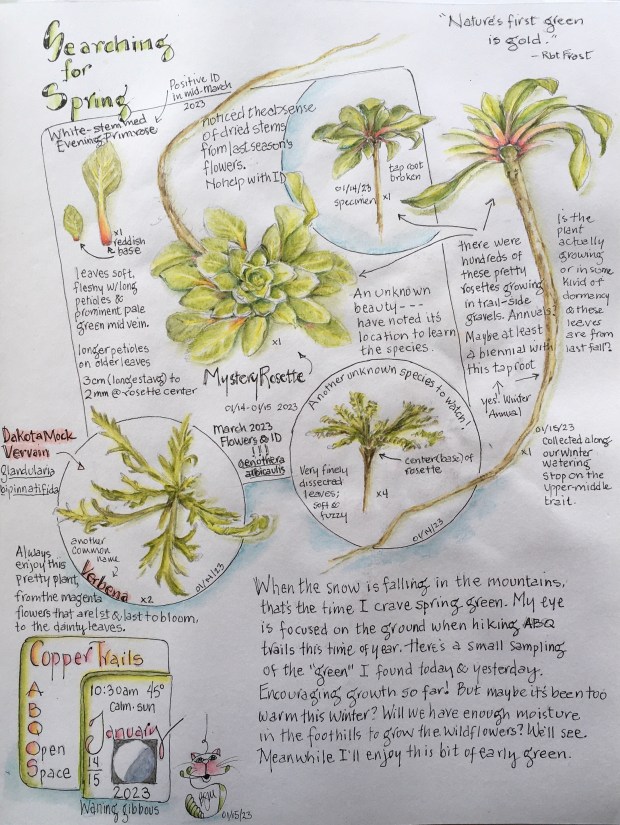
Right now I’m watching it snow …… again. Logic tells me this moisture is so necessary for our drought-stressed juniper and piñon pine that provides year-round food and cover for a host of birds and mammals that call the East Mountains home. Our annual and perennial wildflowers, oaks and native shrubs depend on winter rains and snows to flourish in the growing season. So I say, “bring it on, Mother Nature!”

But by January and February I do tire of brown. My animal brain needs of a shot of “Spring Green” this time of year. Just a little bit to carry me through the winter; a tiny bit in anticipation of full-blown Spring is just the ticket!

This is why we take regular trips down our mountain to enjoy the Albuquerque foothills. It’s amazing the difference a 2,000 foot change in elevation can make in nearly everything.

Now don’t get me wrong. I love living at 7,300 feet, in the shadow of majestic Sandia Mountain, and in the winter we sometimes experience days of cloud cover and fog. So down the mountain we go, in search of sun, warmth, and Spring Green.

And to my delight, here’s what I found! “Nature’s first green is gold.” And indeed it is!

What’s nature displaying in your world right now?


Keeping it Hot-n-Spicy! Happy Holiday Season

December 25, 2022

A little holiday red and green from the desert southwest.
Flambé and I send you warm season’s greetings from our home base in beautiful New Mexico to wherever you may live on planet Earth.
May all your 2023 New Year’s Resolutions come true.

A little sampling from the Sonoran Desert, SE Arizona

Thanks to all for following my first full year of posts. Flambé Kat and I are excited to share our (mis)adventures with you during 2023!