The Gall! A Curiosity of Oak Galls, Revisited …… Part III

August 27, 2024

Webster’s had it “right on” when describing the Ubiquitous Plant Gall!

gall /ga:l/  1. something irritating; rude. 2. not able to understand a behavior is unacceptable.

—-the boldness of these guys; the sheer gall and effrontery; the chutzpah; the unmitigated gall; What gall!

“Yeah ….. What Gall is This?!”  

That was the question uppermost on my mind when a slight breeze wafting down the trail lifted a fresh oak leaf revealing four slightly wonky vase-shaped growths. One was squatty and pale;  three were colored with alternating bands of cadmium yellow and deep vermillion. All four galls were attached to the underside of the leaf, hanging upside down, so whatever might’ve been inside is out.

After 5 minutes of inspection ….. poking and prodding, and peering inside the tiny vases ….. I took some photos to post on iNaturalist to figure out this little mystery. It didn’t take long before my discovery was identified! These are galls of the parasitic cynipid wasp called Feron caepula, formed this Spring on a new leaf of Shrub Live Oak (Quercus turbinella).
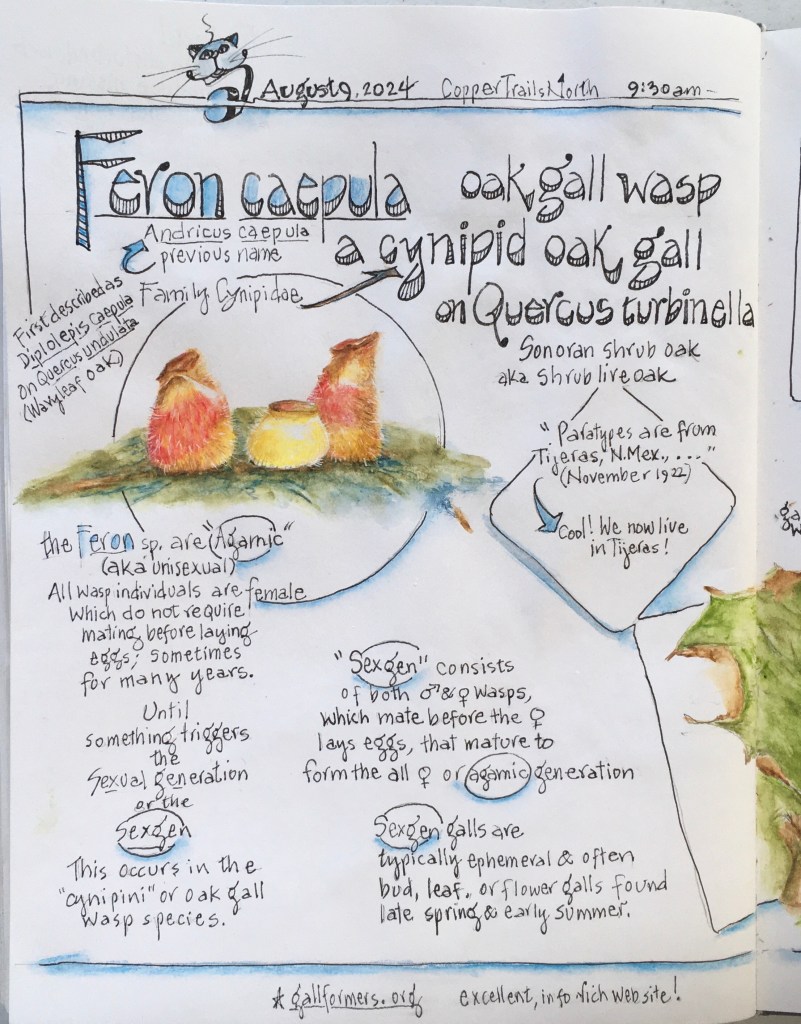
Originally identified in a 1926 field report as a new species, Diplolepis undulata, this species’ name was reestablished as Feron caepula in a report published in 2023. Ordinarily I choose to only cite a field report, but decided to make an exception in this case for several reasons…… the description of this new species was helpful in better understanding my specimens, and……. one of the paratypes used to describe the new species came from Tijeras, NM (which happens to be my home!). So the entire 1926 field report* (surprisingly short) by LH Weld is added below.
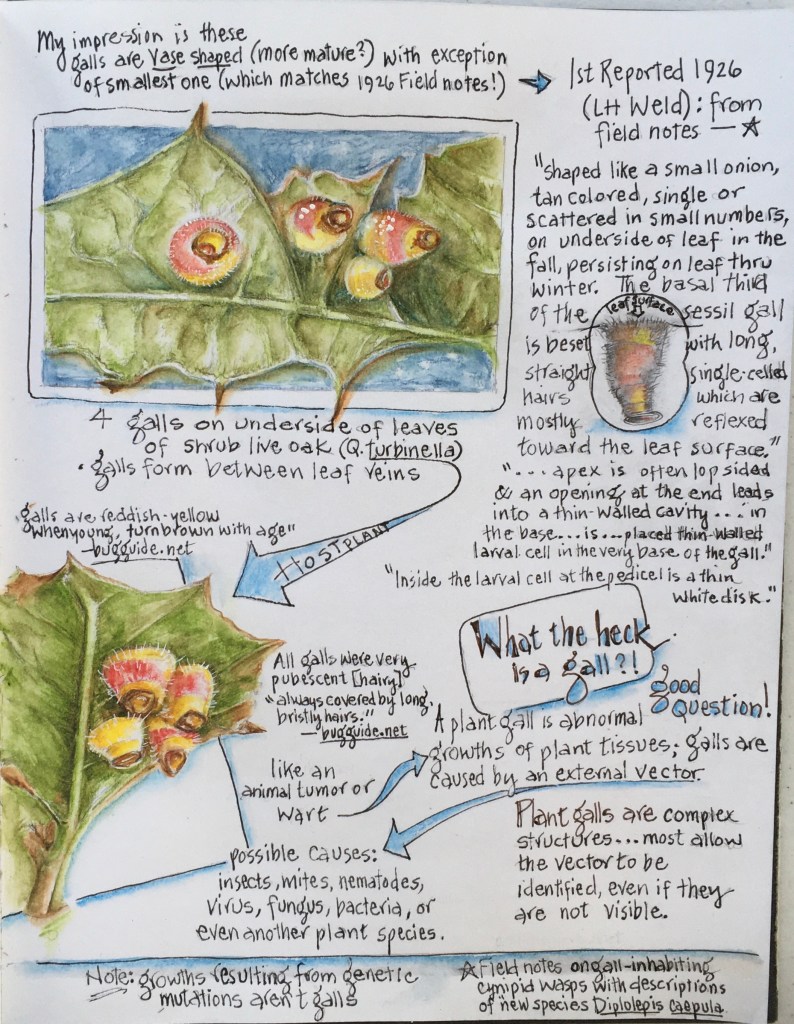

Supplement to the Nature Journal Pages

A Curiosity of Oak Galls, Revisited …… Part III

Curious about plant galls for decades, I finally began reading and experimenting to learn a bit about the inner world of oak galls. Throughout the winter of 2020-2021, I enlisted Roy’s help to collect about 100 nickel diameter, reddish-brown galls hanging on oak leaves like holiday decorations.  Not knowing what to expect, I cut into a bunch of these galls and found tiny squirming grubs (larvae) – one/gall.  The grubs seemed to be suspended by a complex network of stringy plant tissue radiating from each larva at the center to the inner gall shell. It reminded me of a snow globe frozen in time!  Of course I had to know what these guys would become. So I placed about half of the galls into glass jars, and the other half went into jars without their protective gall home. In a few weeks the jars were full of the smallest wasps ever! Wasps! Little parasitic cynipid gall wasps active and ready to be released back into the wild to do what these wasps do! (Rest assured, they were releases in the same area where the galls were collected.)

A few years later, I was once again smitten by these tiny wasps and their galls, and learned more about their life cycle and other facts about galls in general.  You can read all about my earlier experiences (and my efforts with experiments) in 2021 and 2023 at this post “No Small Galls this Fall! Oak galls, then and now, the sequel”.

Back to the Present

Here it is 2024, and while hiking the Albuquerque foothills, a new (to me) and colorful gall form appeared hanging beneath an oak leaf. My curiosity piqued. It was high time I gained some insight about the life cycle of cynipid gall wasps. Paraphrasing numerous expert sources, my attempt to interpret and understand what has been described the one of the most complicated life cycles known in the animal kingdom, still seems confusing. Maybe it’s been hard to wrap my mind around Parthenogenesis (asexual reproduction)***….. a key component of a cynipid gall wasp’s life cycle. By taking my time (over a month), and after many written and diagrammatic iterations, I stitched together a description that works.  If you’re curious, read on!
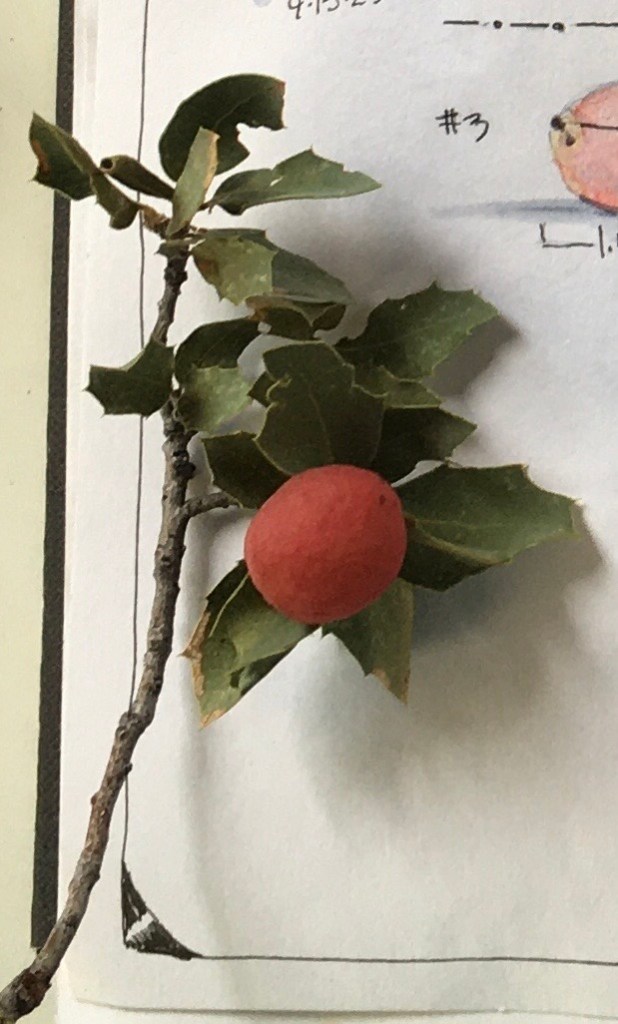
One of the oak galls collected late 2020 …. On Shrub Live Oak (aka Sonoran Live Oak)

Where do Oak Galls Come From, and Why?

Every year in late-Spring and through early Summer our shrub live oaks (Quercus turbinella) are a-buzz with a cloud of nearly microscopic cynipid gall wasps that have emerged from a hundreds and hundreds of leaf galls. These often weird looking abnormalities begin forming during an oaks’ accelerated growth period in the Spring. “But where do galls come from and why?”

It’s Complicated!

In the case of cynipid gall wasps, the majority of more than 1400 known species* parasitize oaks, while a much smaller number favor rose and chestnut as host plants. Where and how a gall forms on a host plant, along with the gall’s size, shape and coloring is vector-specific. This gall uniqueness makes it possible to identify what species of insect, such as a cynipid gall wasp (or other external vector like a mite or virus or nematode or fungus or virus or bacteria) was responsible for each gall.

The life cycle of cynipid gall wasps alternate between asexual and sexual generations. This process, called Cyclical Parthenogenesis, is both fascinating and baffling. Typically, the gall formed by the females of the sexual generation (sexgen) shows itself in late winter/early spring, and is on a different part of the oak (such as a twig or stem) than the later asexual (or agamic) generation (agamic galls usually appear on actively growing plant tissues).  The following is what appears to happen during the  ………………
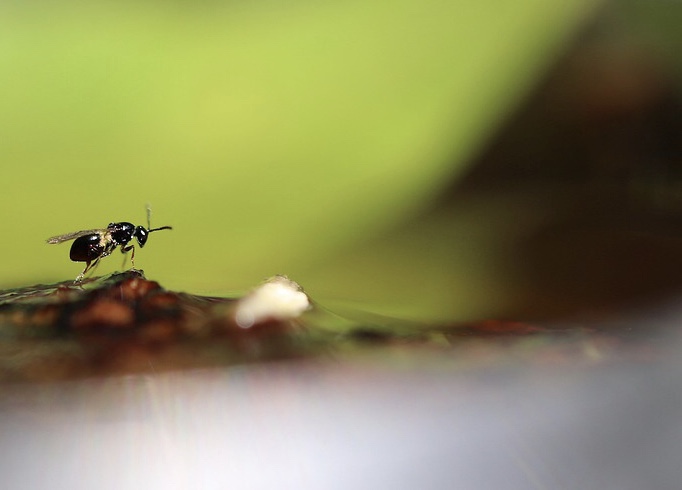
Photo of Cynipid gall wasp (courtesy Pixabay)

Lifecycle of a Cynipid Gall Wasp

The Asexual (Agamic) Generation

When the weather warms in late winter, an all-female generation of cynipid gall wasps emerge from galls which developed and became dormant the previous year, well before the cold and snow set in. This asexual generation of wasps initiates late Spring/early Summer gall development by inserting (with its ovipositor) an egg along with a maternal secretion from the venom gland, into a swollen leaf bud of the host oak. Egg laying takes place as the growing (meristematic) tissues inside the bud rapidly develop. The egg quickly hatches, and the larva begins feeding, all the while exuding specialized growth hormones that stimulate exaggerated tissue growth resulting in structures (the galls) that are visibly different from normal plant tissues. It’s during the Spring/Summer that developing galls are readily seen, often on the undersides of new leaves.
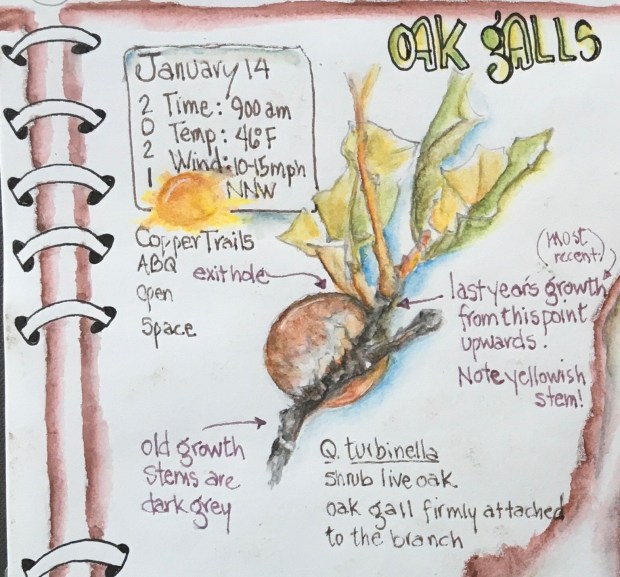
Portion of journal page from 2021

The safely hidden larva continues to eat the nutrient-rich plant tissues forming inside the gall and grows quickly until it develops into a pupa. After a few weeks in this pupal stage, an adult cynipid gall wasp has formed. Still tucked away, the adult (which is either a male or female) chews a small hole in the gall and emerges to mate. 
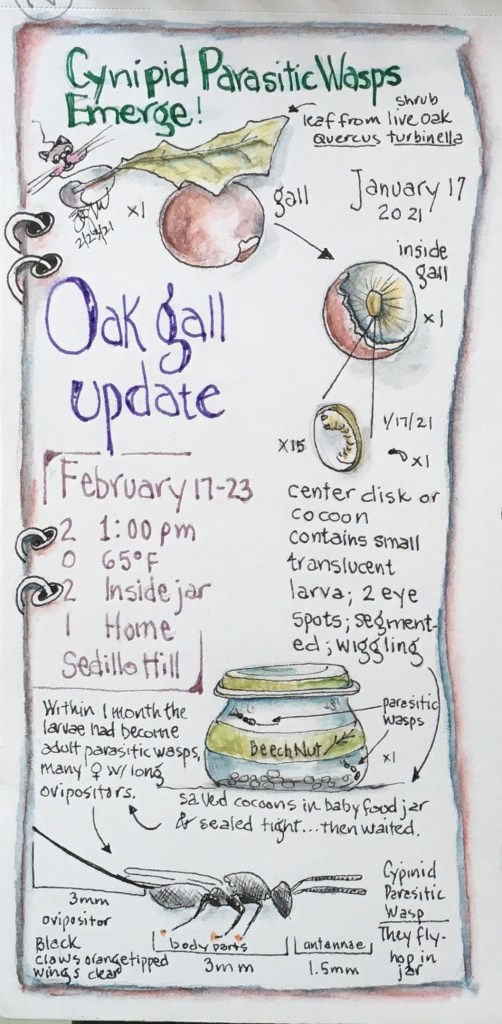
Another journal page from 2021

The Sexual Generation (aka “Sexgen”)

With the business of mating taken care of, and with no mouth parts to eat, the males quickly die, followed soon by the females. However, before the females die, they deposit one or more eggs on a leaf or within a twig or stem of the host plant. Before the plant’s growing season concludes, the eggs have hatched, larvae have eaten and grown within their individual galls, and have pupated in preparation for over-wintering. Depending on the length and/or severity of winter where these cynipid gall wasps live (and they can live nearly anywhere worldwide), the dormancy period may last from three-five months. 

And now …. back to the emergence of the Asexual or agamic generation (the females), in an on-going cyclic loop that is the life cycle of the cynipid gall wasp. 

A Supplement to the Supplement!

Types of Galls

Leaf galls

  • Form on leaf blades or petioles (leaf stems)
  • Most common galls appear on the upper or lower leaf surface, on or between leaf veins.
  • Galls may look like leaf curls, blisters, nipples or hairy, felt-like growths.
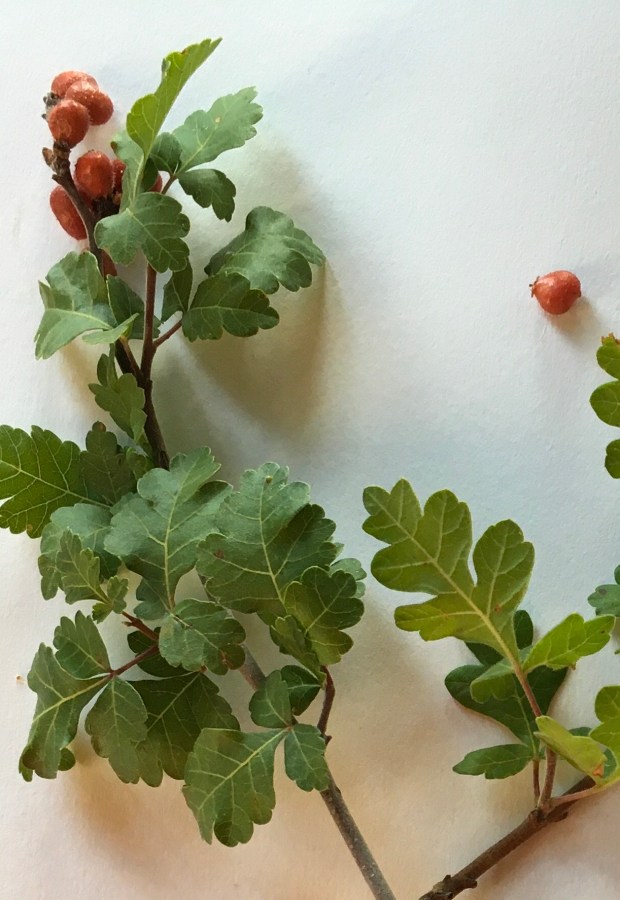
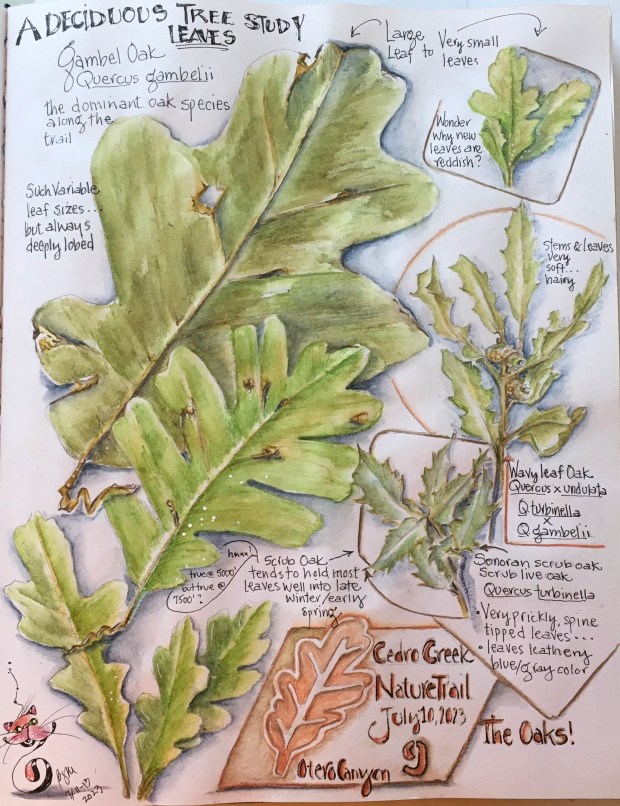
Oak galls on Gambel Oak

Stem and Twig Galls

  • Deformed growth on stems and twigs. 
  • Range from slight swelling to large knot-like growth. 
  • When seen, may be peppered with many tiny holes where the adult gall wasps have emerged.

Bud or Flower Galls

  • Deformed size and shape of buds or flowers. 

Fun Facts

  • Galls are growing plant parts and require nutrients just like other plant parts.
  • A gall keeps growing as the gall former feeds and grows inside the gall. 
  • Once galls start to form, they continue to grow even if larvae die.
  • Most galls remain on plants for more than one season.
  • Galls are usually not numerous enough to harm the plant and control is not warranted.
  • Gall numbers vary from season to season. 
  • Typically, plant galls become noticeable only after they are fully formed.
  • The asexual generation (agamic) galls are reported more often because they are larger and persist longer than the sexual generation (sexgen) galls.
  • Mature plant tissues are usually not affected by gall-inducing organisms.
  • Iron gall ink, which was the most common ink used from the Middle Ages to the 19th century, was used in line drawings by DaVinci, Van Gogh, and Rembrandt, and in the writing of many historical documents like the US Declaration of Independence.

It’s been so helpful to study the life cycle of these tiny parasitic cynipid wasps, if for no other reason than to admit my understanding remains basically rudimentary, and I must keep my Curiosity alive!

As always, thanks for stopping by!

………………………………………………………………………………………………………………

*Field report from 1926 by LH Weld

Diplolepis caepula, new species

Host. — Quercus undulata [Wavyleaf oak, Quercus x undulata]

Gall. — Shaped like a small onion, tan-colored, single or scattered in small numbers on under side of leaf in the fall, persisting on the leaf through the winter. The basal third of the sessile gall is beset with long straight single-celled hairs which are mostly reflexed toward the leaf surface. The conical apex is often lop sided and an opening at the end leads into a thin-walled cavity in which are a few scattered hairs and in the base of which is the transversely placed thin-walled larval cell in the very base of the gall. Inside the larval cell at the pedicel is a thin white disk.

Habitat. — The type is selected from a series from galls collected November 14, 1921, near Hillsboro, N. Mex., the flies emerging April 5-25, 1922. Paratypes are from Tijeras, N. Mex., and of the adults cut out of the galls on November 1 some lived in a pill box until December 28. Other paratypes are from Blue Canyon west of Socorro, adults being cut out of the galls on January 2.  ….. Similar galls were seen on Q. grisea at Magdalena, N. Mex.

  • LH Weld: (1926) Field notes on gall-inhabiting cynipid wasps with descriptions of new species”

Reference: https://gallformers.org

**The 1400 known species of cynipid gall wasps have been identified worldwide, with an estimated total of more than 6,000 species.  In the U.S. there are over 2,000 known species of gall-inducing insects, including 750+ cynipid wasps (500 of which are found in just the West). Worldwide, entomologists have estimated that there are over 210,000 gall-inducing insects yet to be identified!

*** Parthenogenesis is a form of asexual reproduction where an egg develops into a complete individual without being fertilized. The resulting offspring can be either haploid or diploid, depending on the process and the species. Parthenogenesis occurs in invertebrates such as water fleas, rotifers, aphids, stick insects, some ants, wasps, and bees. Bees use parthenogenesis to produce haploid males (drones) and diploid females (workers). 

Some vertebrate animals, such as certain reptiles, amphibians, and fish, also reproduce through parthenogenesis. Although more common in plants, parthenogenesis has been observed in animal species that were segregated by sex in terrestrial or marine zoos. Two Komodo dragons, a bonnethead shark, and a blacktip shark have produced parthenogenic young when the females have been isolated from males.

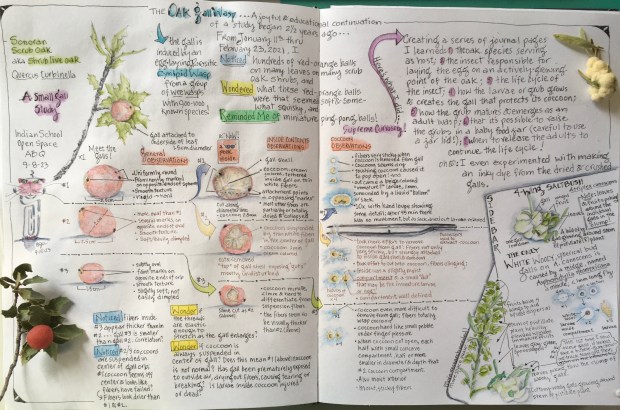
Nature Sleuthing Resumes ….. Sunflowers and Fibonacci; Natural Spirals

November 26, 2023

After a well deserved rest from Inktober and from my self-imposed pressure to create something every day from a list of random prompts, I’m happy to be out again nature sleuthing. Curiosities in nature sometimes stare us in the face. But more often than not making discoveries require keen observational skills, noticing something new to you, and an ability to look for clues to a mystery with wide open eyes.  

Double page post with an extra add on; all art work done with Graphgear 1000 loaded with 0.3mm 2B lead and all inked lettering done with Faber-Castell Pitt Artist Pen Fineliner, 0.3mm.

It was during a hike on an unseasonably warm day that I paused to admire the dried flower heads from one of the late blooming sunflowers. Have you ever noticed how they look like another kind of sunflower? Papery textured “petals” circle a central disk where a few weeks ago it was crammed full of puffy parachute-topped seeds. After the seeds become airborne, all that’s usually left is a slicked off surface punctuated with dots arranged in spirals radiating out from the center.

Click the link below to read more ………

Continue reading “Nature Sleuthing Resumes ….. Sunflowers and Fibonacci; Natural Spirals”

No Small Galls this Fall! Oak galls, then and now, the sequel…..

September 16, 2023

This is a little story about a fascinating discovery I made over 2-1/2 years ago, when in the second winter of the pandemic and in dire need of a belly laugh, our usually drab brown landscape appeared dotted with little reddish colored orbs. An insatiable curiosity sprinkled with a smidge of fantasy led me to some surprising answers to many questions, which continue to pop up to this day.

Open my full blog post and take a small detour with me into the recent past.  Learn how observations, connections and similarities in nature ensure there’s always dots to connect and mysteries to solve, no matter how many times you travel the same path.

Continue reading “No Small Galls this Fall! Oak galls, then and now, the sequel…..”

Fading Flowers Reveal Leafy Greens ….. Cedro Creek

July 14, 2023

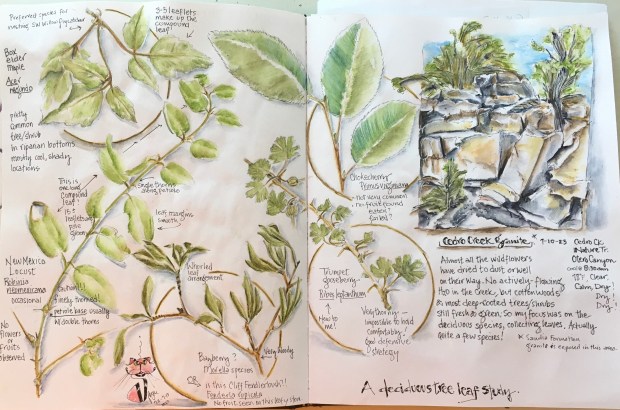
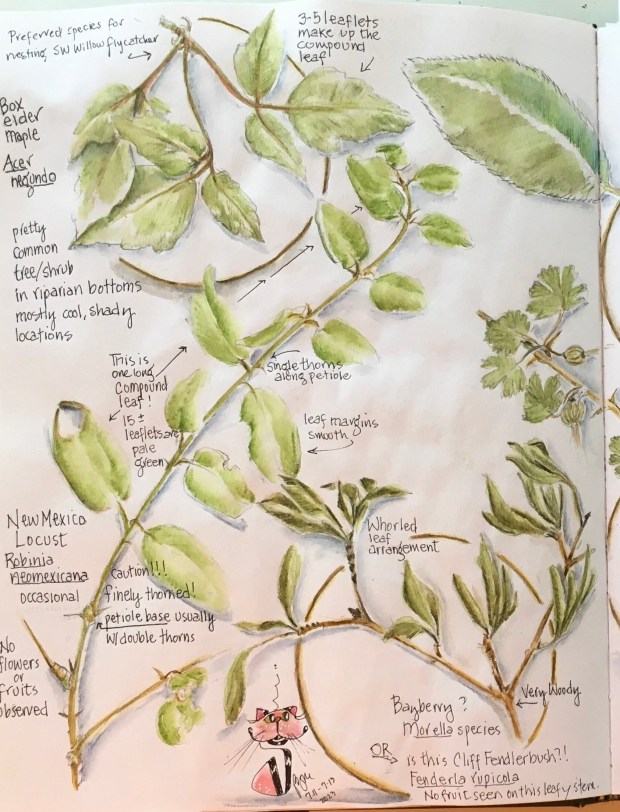
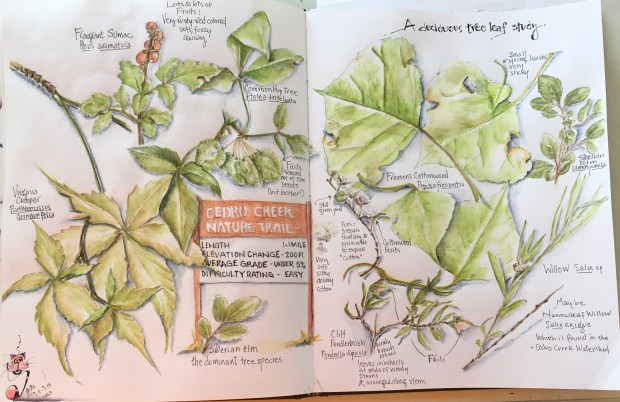
Learning the deciduous Trees and Shrubs shading Cedro Creek Nature Trail ….. Grab n Go Nature Journaling

The timing and location of our daily hikes are being influenced by the extreme summer temperatures we’re experiencing throughout central New Mexico, and throughout the desert southwest. Whew! Even at 7300-8300’ elevation, 95-100F has become the norm, with no relief (or moisture) in sight.  I don’t even want to think about Albuquerque temperatures; over 100F before noon, and soaring. 

Because hiking in the Albuquerque foothills, at any time of the day, is out of the question, we’ve begun revisiting some our favorite mountain trails. But even tho these areas are higher in elevation, and shadier, it’s still plenty hot. That means if we set out between 7-8am, we can still manage a few miles before our water, like all the creeks, runs dry. 

A few mornings ago, we decided to hike Cedro Creek Nature Trail, a rocky but easy dirt path under the shade of big cottonwoods. Expecting to find some water in the creek (there was none), I was hoping to find some interesting wildflowers (which had all withered and dried). The further along the trail we hiked, my focus quickly changed from wildflowers to other natural elements. 

Geology is always interesting in these mountain drainages, and Cedro Creek is no exception. The overlying shales and limestones have long ago eroded to reveal large granite boulders that showed signs of erosion from long ago flowing water. That’s a nice thought!

And then there were so many varieties of deciduous trees and shrubs; their leafy greens not only provided relief from the heat, but became a visual treat as we explored the riparian areas alongside the dry creek bed. 

As my curiosity about the diversity of tree and shrub species began to grow, so did the air temperature. Not wanting to become reduced to a sweaty puddle in the middle of the trail, and sensing a swarm of drooling, biting gnats and flies giving me a hungry eye, I resorted to collecting leaf and branch samples using a Grab n Go technique. By the time we got back to the car, I had 3 large ziplocks stuffed with over a dozen species of tree and shrub leaves and some fruits.  

Back at home, in the comfort of my cool studio, I began my detailed study of these leaves (and the few bugs that managed to hitch a ride). Three days and several gallons of iced tea later, I had completed the 5 journal pages in this post.  

That iced tea was deliciously cool, but not as cool as learning what’s growing overhead along Cedro Creek!

Until next time ……. be curious

Cypsela! The Sunflower Seed

July 9, 2023

Buckle in …… 

In my last blog post, Fascinating Fasciations, I shared my discovery of an extremely malformed Rush Skeletonplant. While researching this much branched and dainty member of the plant family, Asteraceae (which includes asters, sunflowers and daisies), I became entangled in the winding and seemingly never-ending number of rabbit trails on my journey, until finding myself on a surprising detour. Totally absorbed in the subject of plant malformations, and learning a lot of cool stuff about Rush Skeletonplant along the way …….

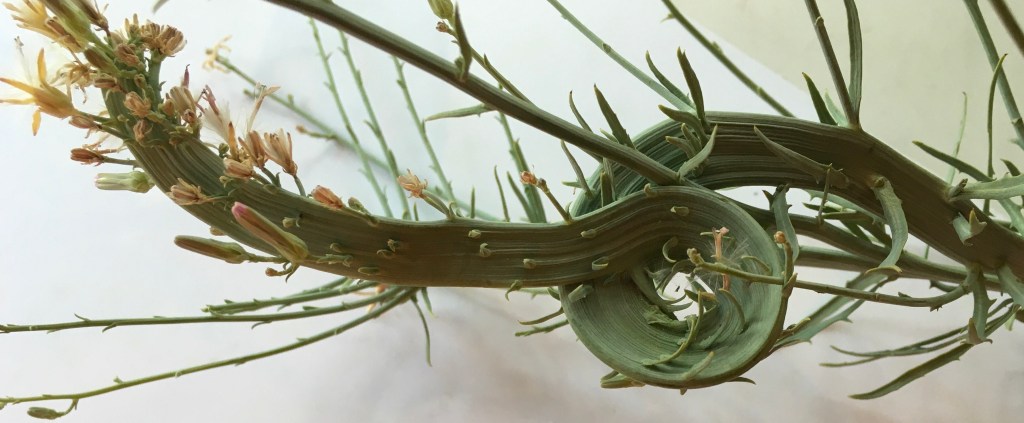
The weirdly wild fasciated Rush Skeletonplant

………. I tripped and fell flat on my face (only figuratively!). One of the published research papers appeared to be in error …… regarding the seed (aka fruit) name of this plant. Known to me for decades by the name “Achene,” the researchers had labeled the seed “Cypsela.” And not only did they call seed of Rush Skeletonplant a “Cypsela,” but they used this name when referring to all the seeds of the Aster family! 

What! No Way! Who was responsible for this name change? When did this happen? Why oh Why

Continue reading “Cypsela! The Sunflower Seed”

Fascinating Fasciations …… Malformations in the Plant World

July 2, 2023

It was early morning, but already a hot 85F as we hiked the dry, dusty trails of the Albuquerque foothills. With a few exceptions, late June’s wildflower display is all but gone, replaced by an abundance of seeds ready to drop, blow away, or feed hungry chicks. While the “stage” resets for the next Act, the Summer Monsoons, plants in the Sunflower-Daisy-Aster family (Asteraceae) still dot the quickly browning landscape with bright yellows, whites, and shades of purples.  One of the most curious plants now making a showing is Rush Skeletonplant (Lygodesmia juncea). 

Perfectly adapted to the desert environment with its chaotic tangle of blue-green mostly leafless stems, is Rush Skeletonplant. Spindly stems, standing up to 18” tall, are topped with 1-2 petite pale lavender-pink flowers. These tiny delicate beauties may not be as showy as your garden variety sunflower, but when closely examined you’ll find typical characteristics of the family, including 4-6 strap shaped ligulate florets each with a protruding hot pink anther tube surrounding a double lobed stigma. Short lived, the florets quickly transform into dandelion-like seed heads.

So there we were, hiking along, wishing for even the gentlest of breezes to keep the biting gnats from crawling into our ears and mouths, when out of the corner of my eye …… Weirdness Extreme! A wildly malformed Rush Skeletonplant.

Continue reading “Fascinating Fasciations …… Malformations in the Plant World”

Geeking Out …… Total Bliss ….. Sunflowers!

June 12, 2023

David Lukas, naturalist, presented an amazing 2 hour video workshop on the largest family of flowering plants, the family Asteraceae1, commonly called Sunflowers, Daisies, and Asters.  Not only are they the largest family, they are also the most successful …. from a botanical and evolutionary perspective. That was the hook! I needed to know more!

Disclaimer! The following post is lengthy and covers many botanical things about sunflower “flowers” I wished to remember. If you decide to take this deep dive with me, prepare to be amazed. And if you make it all the way to the end, congratulations! But beware ….. you’ll develop an irresistible urge to stop and investigate every roadside sunflower on your next trip to town!  Are you ready ……?

Continue reading “Geeking Out …… Total Bliss ….. Sunflowers!”

Meet a Teeth Clacking, Jaw Grinding, Squealing and Woofing Peccary of the Desert Southwest….. the Javelina  

March 21, 2023

Another species we searched for while visiting the Sonoran Desert surrounding Tucson last December, was the javelina. Certainly this elusive little pig-like critter was nearly everywhere we went, as attested to by the thousands of hoof prints echoing their presence. And many of those hoof prints were fresh! Certainly there must’ve been squadrons of javelina hiding behind every mesquite tree around the next countless bend in the trail? 

But alas …. we never saw, heard or even sniffed out a single javelina. All we could do was record (and sketch) the herd of hoof prints, and then research this animal in the following months. Oh boy, did we really miss such a fascinating encounter.

Back at home, several months later, our friend Jim Silva was happy to share one of his javelina skull mounts for study and sketching. I’m thinking we may have been lucky not to have met up with a herd of their clacking canines during our travels! 

Maybe another time?  

Meanwhile …. If you’ve got a thirst for javelina knowledge, or just want to see my journal sketches, read on!

Continue reading “Meet a Teeth Clacking, Jaw Grinding, Squealing and Woofing Peccary of the Desert Southwest….. the Javelina  “

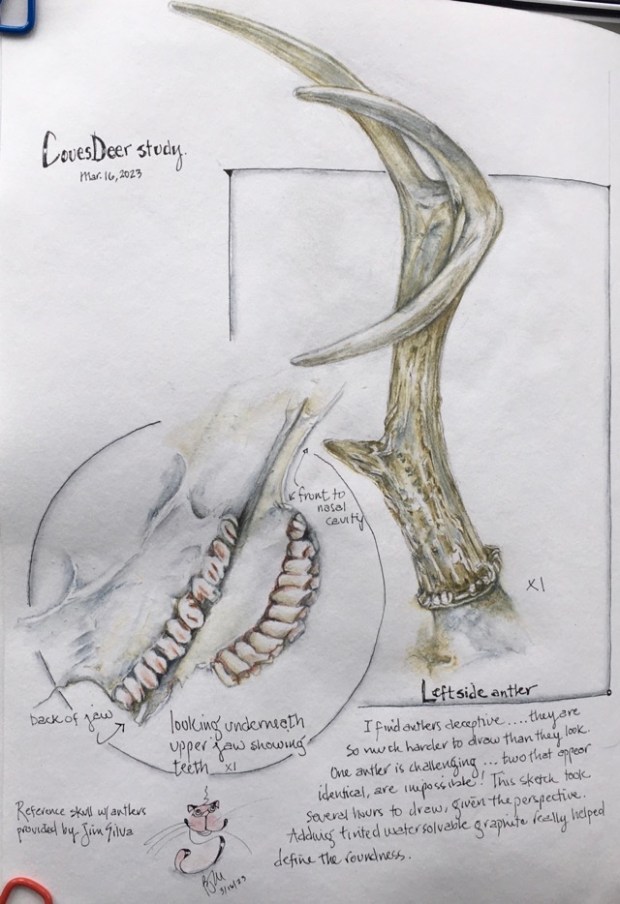
Coues …..Elfin Deer of the Desert Southwest

March 17, 2023

Even though we didn’t see any mammals while visiting the Tucson region last December, we knew they must’ve seen us! But little (pun intended) did we know, a diminutive elfin deer, the Coues Whitetail, was probably among the mix of critters observing us as we explored the area.

This tiny deer, with its oversized ears and flashing tail, is a native species found in the mountainous desert regions of the extreme Southwest and south into Mexico. 

A good friend, Jim Silva, who has hunted this species in southwest New Mexico, shared one of his skull mounts with me. Since sketching the skull and an antler, I’ve learned a bit about the Coues deer, including the highlights included on my journal pages.

“Coues” is most properly pronounced “cows” (but more commonly pronounced “cooz”), is also known as the Arizona Whitetail or Fantail.  Having lived in eastern North Carolina for a number of years, we are well familiar with the Eastern Whitetail, a small enough deer when compared to our local Mule Deer.  But it’s hard to imagine a deer smaller than the Eastern Whitetail.  Now we’re ready to return to the mountains of the Southwest and search for the Coues deer! Maybe late spring when there’s a chance of seeing a few fawns too!

What’s on your nature agenda for this spring? Ours is filling up fast!

Until next time! 


A Festive Anniversary Week in the Sonoran Desert. Part 7: Snowbirds

December 11-17, 2022

The much anticipated finale, Snowbirds, and wrap-up to a grand anniversary week celebration in and around Tucson, AZ, follows!

Despite an unexpected snow the evening of our arrival, we never seemed to slow down, taking in as many sights and good eats as humanly possible. …… Open the full post for a recap of our week, and a bit about some of the birds we found while traveling around.

Continue reading “A Festive Anniversary Week in the Sonoran Desert. Part 7: Snowbirds”