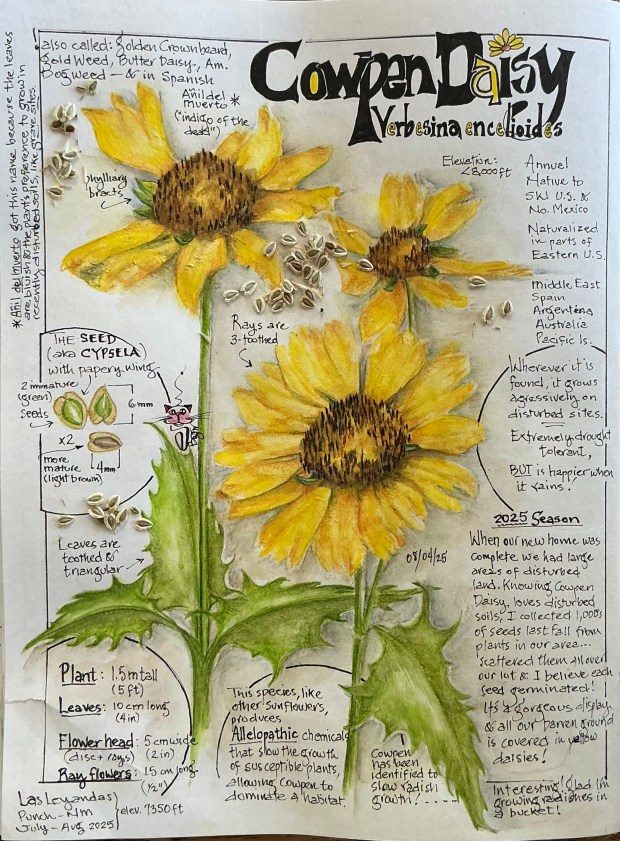
While compiling last week’s post about the happy Cowpen Daisy party taking place outside our back door, it was no surprise to find way more interesting info about this sunflower than could ever fit on my journal page. Decisions …… decisions! To keep the August 5th illustrated page relatively uncluttered, I decided to include just the botanical basics (mostly), focusing on Cowpen Daisy flowers, leaves and seeds.
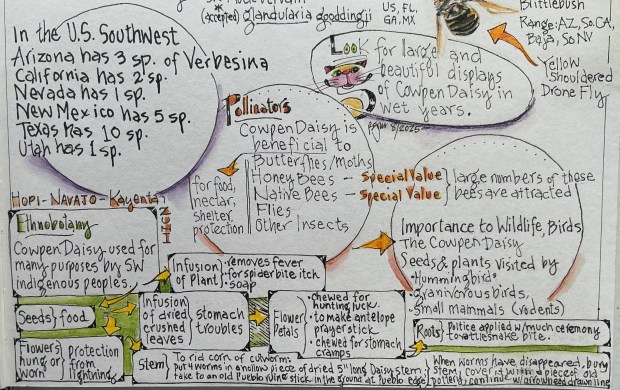
Then the past week I found my nature journal wide open to a blank page, ‘begging me’ for another Cowpen Daisy entry ….. “What about all those interesting info bits?” she asked. Replying* to my journal with a hearty, “OK,” I proceeded to locate and gather my rabbit-trailing notes. This scavenger hunt reminded me just how many pages there were; so many fascinating things about the Cowpen Daisy I wanted to remember and share. Decisions …… decisions! How to keep this next post to one page? By limiting the topics to only three, was it possible?
Barely! (after some clever editing, not a single word dropped off the page)
A little bit closer view for those without a microscope!
P.S. By the way, you may have noticed I’ve indicated this post is Part 2 of what’s now become my Cowpen Daisy series. Unless I start journaling on larger than 8” x 11” paper, there’s likely to be more Parts in store. And this multi-part series resulted in a minor edit to last week’s post, not titled “One of the Happiest Sunflowers Ever! The Cowpen Daisy; Part 1 ….. Can There Be Too Many Sunflowers?” In case you missed it, please check it out here.
*Yes, you read that right; I talk with my nature journals. Don’t you? After all, we do spend quite a bit of time together!
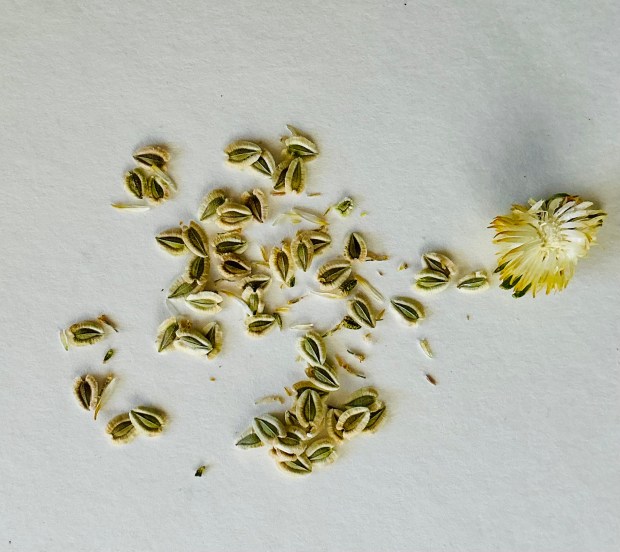
It was the Fall of 2024. A small cluster of Cowpen Daisies (Verbesinaencelioides) flourishing on the severely disturbed ground surrounding our new home was going to seed. Waiting several weeks until the migratory birds ate their fill, I spent an hour or so collecting as many remaining dried seeds (cypselas) as possible, stuffing full two quart-sized ziplock bags. About 1/3 of the seeds I scattered around the house where they would overwinter on the ground. The rest were poured into large pill vials that were labeled with species name, location, and date, then placed in the refrigerator to simulate cold storage until Spring.
Cowpen Daisy cypselas (seeds) 08/04/2025 at Punch
It was late April 2025. The chances of heavy frost seemed a distant memory. My fingers crossed, I chose a sunny 42 degree morning to liberate those refrigerated seeds from 6 months of cold storage, and scattered them in disturbed areas not seeded last Fall. Then I waited like an expectant parent, watching for signs of germination, worrying that runoff from late season snows might wash away my scattered seeds, expecting that flocks of migratory birds would gobble them all up, and hoping for gentle rain showers to swell those thousands of seed coats to aid those tiny embryos in growing their first roots (radicles) and first leaves (cotyledons).
Then early June 2025. Success! Cotyledons were literally popping up everywhere, which meant the radicles were already expanding into the soil. They were especially crowded where I’d scattered all the cold storage seeds, and germination was obvious where seeds had been scattered the Fall of 2024. By early July, those Cowpen daisies were crowding out many of the other native species I’d also seeded in the same areas.
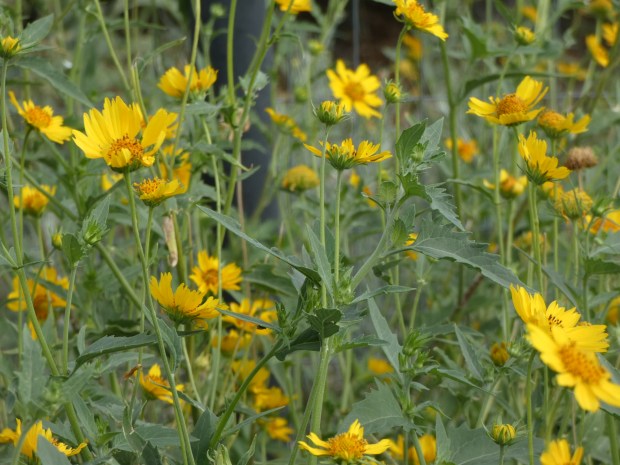
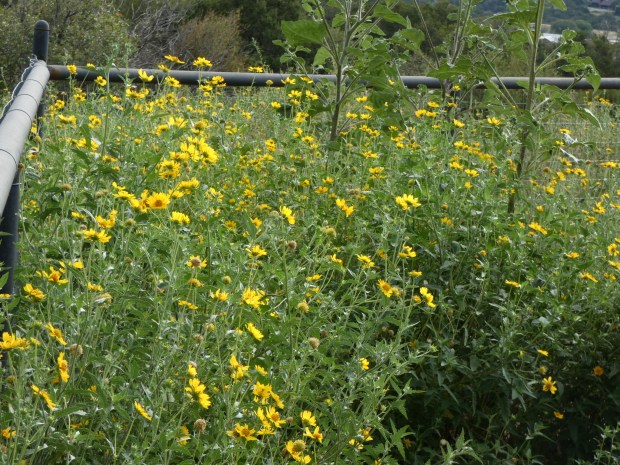
Backyard and overflow Cowpen Daisies, robust growth after Fall 2024 seeding (08/03/2025)
And now it’s early August 2025, and what a dazzling show! Even though the sunflower yellow flowers of Cowpen Daisy are small (2” wide), there are up to 75 long-stemmed flowers on each plant that can grow from 4-5’ tall! They are so dense, the backyard fence is hardly visible, our walking paths are totally draped with 4” long leaves, and if there’s a rattlesnake lurking around under our massive Cowpen Daisy canopy, we’d probably (hopefully) hear him well before he slithered into view!
Goals and Lessons Learned
I’ve learned a lot by parenting these Daisies; from the best time to scatter seed (in the late Spring following cold storage) and where (not so close to other desirable natives or pathways), to managing the mass of growth (by organizing through selective removal). Our initial goal of seeding and growing native plant species was to attract and help feed wildlife (pollinators, reptiles, rodents, birds and mammals), and we are optimistic that achieving this goal long-term seems realistic with the success we’ve had to date. However, because so many of our native plants are losing the battle against habitat loss caused by invasive species encroachment and takeover, land development, and climate change, we will continue to explore ideas to expand our initial goal to address the habitat situation. As we gain insight about the best native plants to grow to help restore our disturbed soils, we will learn and share with our neighbors those species that: are drought tolerant; aid in building soils; are effective at invasive weed suppression; provide wildlife benefits; and increase plant diversity.
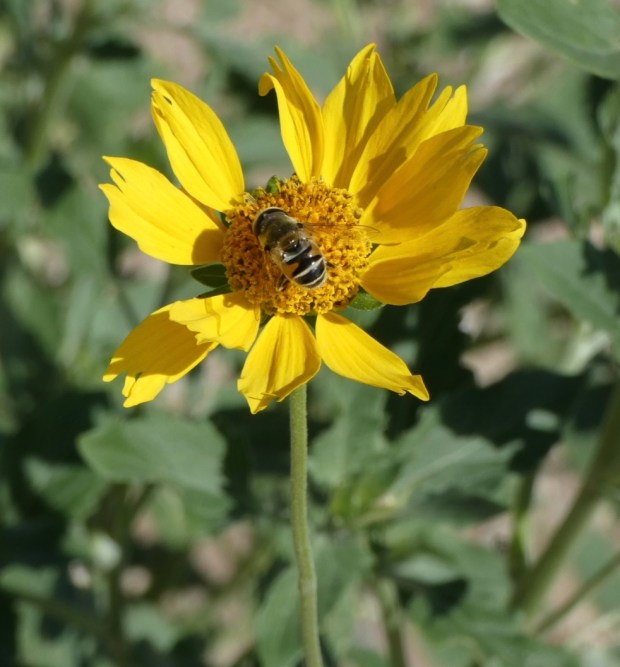
Cowpen Daisy and pollinator 08/01/2025 at Punch
Happy – Happy – Happy! Will I be collecting Cowpen Daisy seed again this Fall? You bet! Having all that sunshine yellow around our home is thrilling. Every morning all those thousands of sunflower faces looking East towards a new day are about the happiest sight ever! And having such wild, uninhibited growth of a native annual out our back door has been ideal for observing the pollinators that benefit from the abundant nectar and pollen, enjoying the aerial acrobatics of several phoebe families that have been feasting on those pollinators, and promises to be a perfect spot for bird watching this Fall when all those cypselas ripen into high protein food.
Can’t wait!
Do you ‘know’ a special native plant? How about a native butterfly garden? Are you a bird watcher? Maybe you enjoy the occasional deer, coyote, or bobcat wander through your yard? Please share your favorite wildlife encounter!
As always, thanks for stopping by!
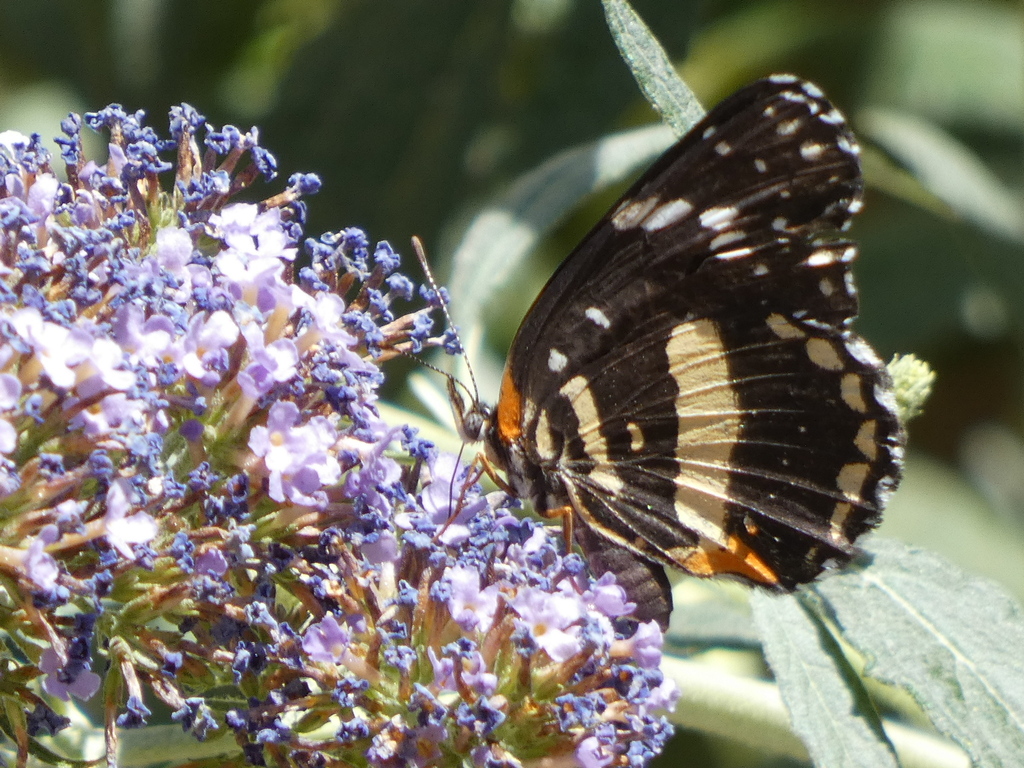
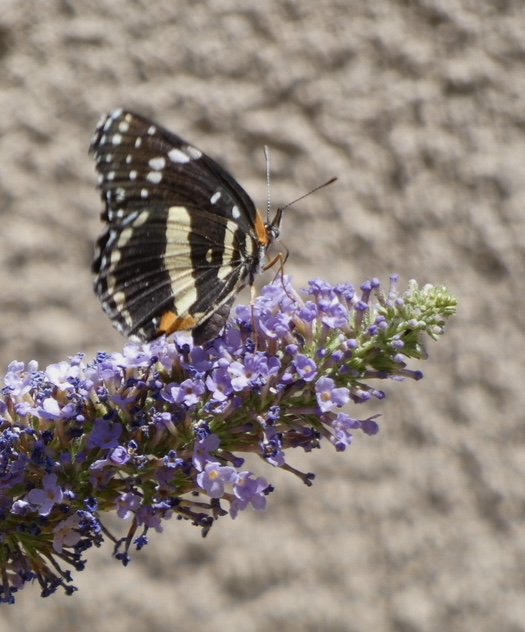
Bordered Patch (my photo/2023 – on butterfly bush)Bordered Patch catBordered Patch (my photo taken 2023These dandy little butterflies, the Bordered Patch, often choose the Cowpen Daisy as their larval host. (The butterfly nectaring on butterfly bush flowers are from my home collection)
A few years ago I stumbled across this plant while walking around our neighborhood. Being immediately awed by its richly-colored petals skirting an upright cylinder or cone, I knew it would be a perfect addition to our high elevation (7,300 feet) landscape. My idea was to wait until the flowers on the cone faded and collect some seed to scatter in our yard. After repeated trips hoping to find evidence of seed, I was skunked. Either I missed the dispersal event, or this plant was 100% sterile. On the outside chance there were microscopic seeds embedded in the cone, I resorted to cone collection. Fast forward to the next spring …… every spot I’d planted those cones was barren; nothing had sprouted; zero; zip.
Fast forward again to early July 2025. This wildly blooming plant was growing vigorously in many of the dry disturbed openings and roadside areas throughout our new neighborhood! Time to learn more about such a charming member of the sunflower family called Mexican Hat.
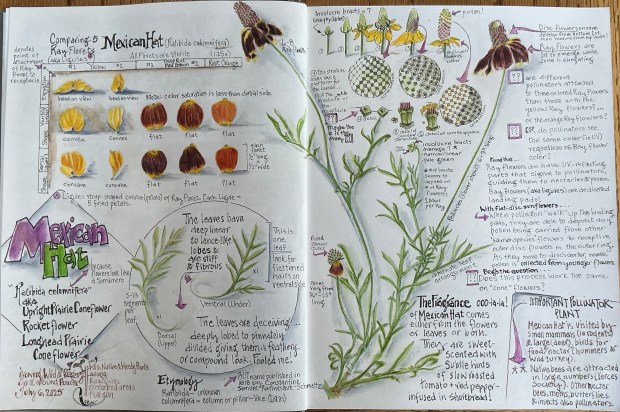
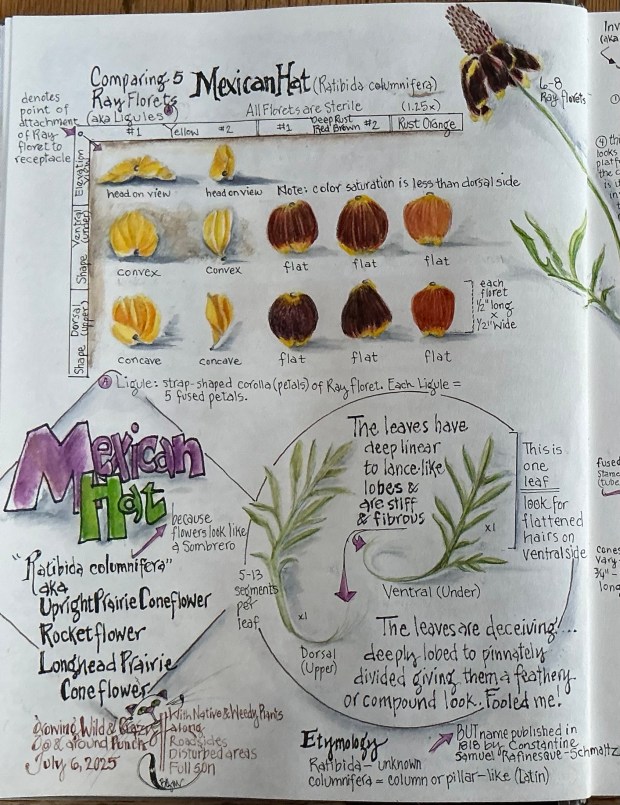
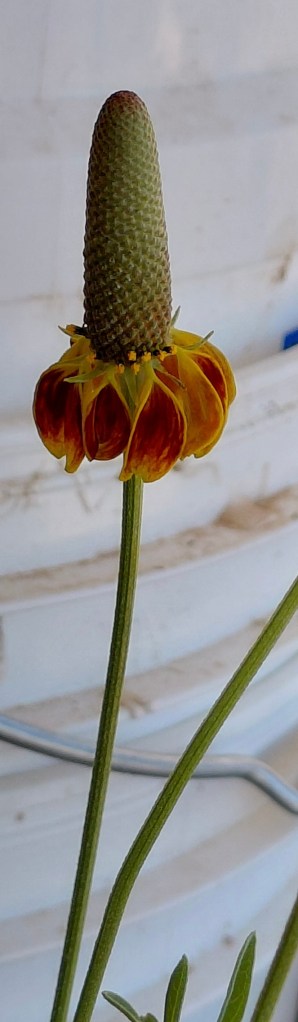
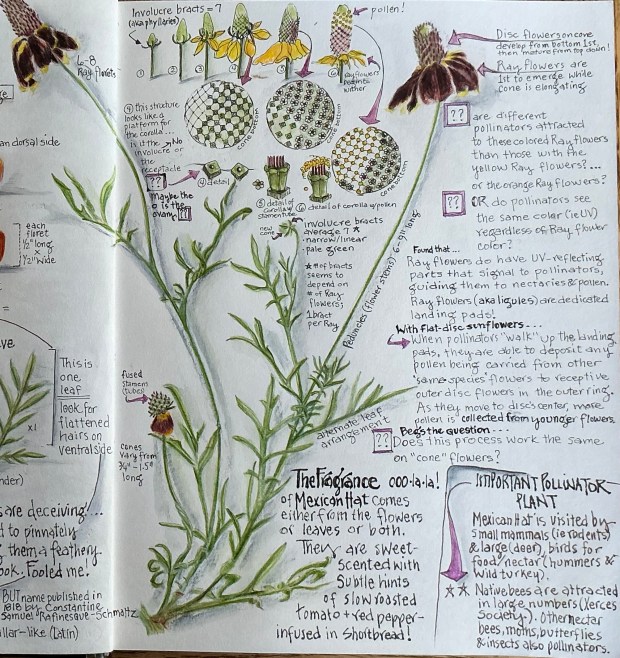
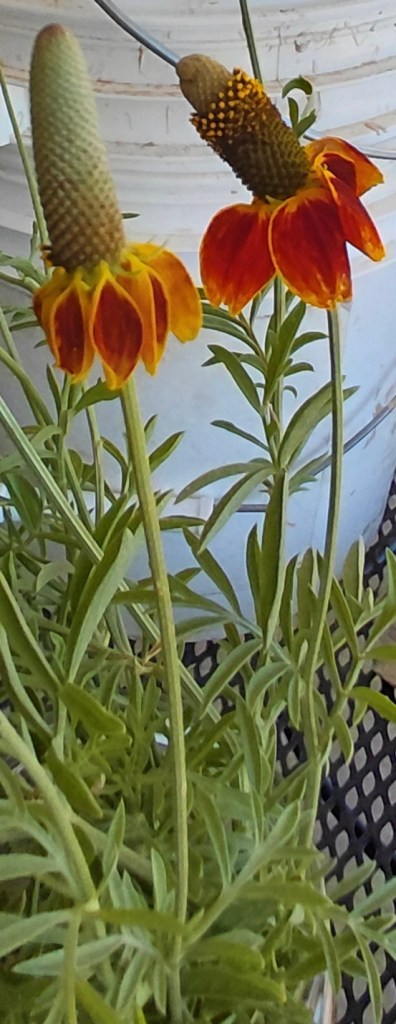
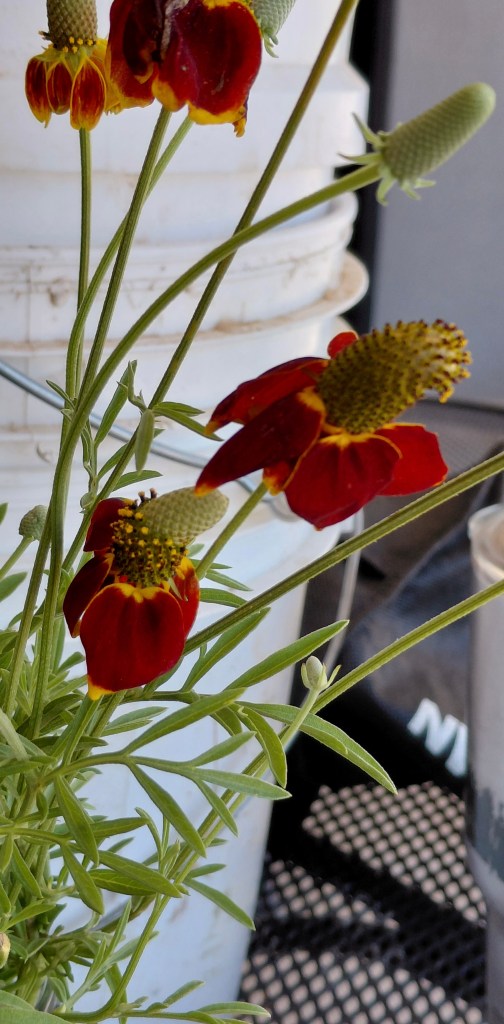
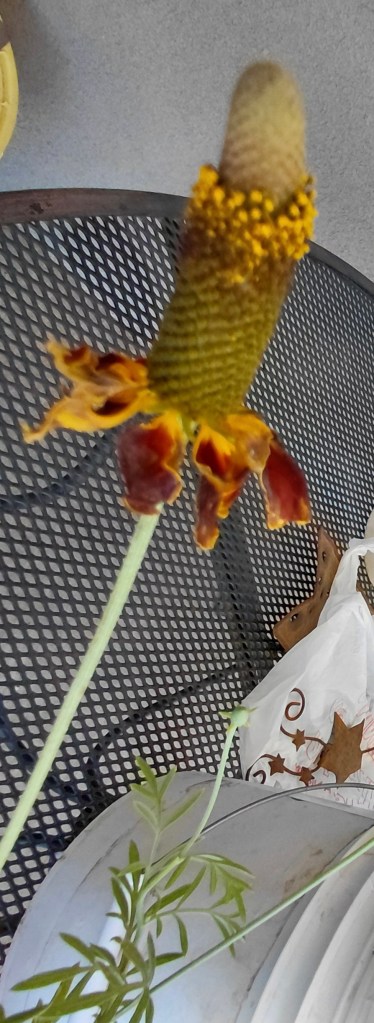
Mexican Hat (Ratibidacolumnifera), also commonly known as rocketflower, and both upright and longhead prairie coneflower, is a native perennial found across the Lower “48” (U.S.), southern Canada and northern Mexico at elevations ranging from 5,000-7,500 feet. Its Ray flowers come in a dazzling sunshine yellow, along with a soft velvety royal purple-brown, an intensely deep rust-red brown, and rusty oranges – all with some measure of sunshine yellow marginal accents. Each Disc flower (those tiny spots that spiral, Fibonacci fashion, around the upright cone) has 5 fused pale-green petals (the Corolla). The Corolla surrounds 5 fused purple/red oxide-colored Anthers (the pollen structures of the Stamens). The Anthers are shoved up through the Corolla by the developing Style (the stalk of the Pistil) where they burst into 5 sunshine yellow pollen “strands” resembling a hairdo of long, twisted, windblown dreadlocks! The shockingly beautiful colors unfailingly lure many insects hungry for pollen and/or nectar.
The entire Capitulum (the densely packed flowerhead of a composite “flower”) continually waves in the slightest of breezes as it perches atop the long stiff and naked stem (the Peduncle) of the flowerhead. Below the Peduncle are the many branched feathery-like, deeply lobed leaves. These leaves seem to be the primary source of a curiously fascinating fragrance. After handling the plants for several days, I began thinking of the aroma as being cautiously sweet-scented with subtle hints of slow roasted tomato + red pepper-infused homemade shortbread cookies! I’m looking for a recipe!
All “said and done,” Mexican Hat can grow from 8 inches tall to over 3 feet!
Benefits of and Curiosities About Mexican Hat
Special Value to Native Bees – According to The Xerces Society for Invertebrate Conservation, Mexican Hat is recognized by pollination ecologists as attracting large numbers of native bees.
Food Source for Wildlife Species – In addition to being an important source of pollen and nectar for native bees, Mexican Hat also attracts many other insects like butterflies and moths, and hummingbirds sip its sweet nectar. Wildlife that feast on its seeds include small song birds, wild turkey and rodents. Even white-tailed deer will eat the foliage, despite its reported deer-resistant qualities.
Supports Native Pollinators, Attracts Beneficial Insects, and Promotes Biological Diversity – Mexican Hat is a adaptable and resilient wildflower species, able to endure extended periods of drought, hot and cold temperatures, and diverse habitat and soil conditions. Because of these characteristics, and because the species is a self-seeder, Mexican Hat provides food and cover for wildlife, is a reliable source of pollen for at-risk native bees, and makes an excellent choice for sustainable gardening, habitat and soil restoration, and prairie conservation efforts. And not to be overlooked, Mexican Hat attracts beneficial insects like lady beetles and lacewings that help control garden pests like aphids and caterpillars, and makes a valuable contribution to natural pest management strategies.
Many Uses; the Ethnobotany of Mexican Hat – North American indigenous peoples prepared the leaves, stems, flowers and/or the cones in certain ways to treat specific ailments suffered by people and animals. By creating washes, by boiling, physically rubbing and crushing, decoctions, concoctions and infusions were used to treat chest pains, wounds, stomach aches, fevers, headaches, urinary problems, rattlesnake bites and to induce vomiting. Mothers wishing to wean their babies had crushed leaves rubbed on their breasts. Horses with urinary problems were hand fed the entire plant as a cure, and sheep that are “out of their minds” are given a cold infusion.
The cones were used as baby nipples. Leaves and flowerheads were boiled to make a pleasant tasting tea.
A Symbolic Meaning and Familiar Visual of Mexican Hat – In Mexican culture, this wildflower is often associated with traditional celebrations, ceremonies and festivals. Mexican Hat is a symbol of joy, abundance and cultural heritage. The common name “Mexican Hat” was given to this wildflower because it reminds many of the shape of a traditional Mexican sombrero.
Origin of the Scientific Name Ratibidacolumnifera – The Etymology of the genus name Ratibida was published in 1818 by Constantine Samuel Rafinesque-Schmaltz (1783–1840). Even to this day, the meaning of Ratibida is a mystery. It’s well known that Rafinesque-Schmaltz often assigned unexplained names to plants. Oh, and be aware that around 60 sites online use the spelling “Ratidiba” rather than Ratibida. So if poking around the internet for more information about Mexican Hat or any of the other prairie coneflowers, don’t be fooled by the typo!
The species epithet columnifera is a Latin name meaning “bearing columns.” This refers the tall cylindrical or cone-shaped flowerhead (Capitulum) which is the support structure (the Receptacle) for the numerous Disc flowers, the 7 Ray flowers, and the 7 small leafy bracts (Phyllaries).
Loving My Mexican Hat!
Early this spring I purchased 2 Mexican Hat plants for our garden. I’m happy to report they are doing great and loaded with 10-20 yet-to-mature pale green cones. Wonder what color the Ray petals will be?
I’m also planning to collect seed again this year, after learning the best time is early Fall when the cones look like they’re withering. Wish me luck!
Hope you enjoyed my exploration of this marvelous native perennial member of the sunflower family. Even though in a previous post I made a thorough plunge into the sunflower family, I learned even more putting this post together.
As the Fall season rapidly came and went, and the first snows blanketed the landscape, I focused my hiking time (and some of my drawing hours) on collecting local native seeds. Always careful that plenty of seeds remained available for overwintering birds, I still managed to harvest hundreds from about 25 plant species. All sorted and packaged in separate pill containers, my collection is now stored in the refrigerator at 40 degrees, until growing conditions are optimal for planting. This treatment method is referred to as stratification.**
Why collect native seeds? All throughout the Spring, Summer and Fall, a diverse assortment of pollinators visited our locally blooming wildflowers and shrubs. Along with these butterflies, moths, bees, wasps, beetles and flies, were the insects, spiders, and birds that prey on unwary pollinators. Such an amazing show; a kaleidoscope of colors and shapes! The air was a buzz with activity. My goal is to mimic the native banquet in hopes of attracting these pollinators and predators.
Also, seeds are absolutely fascinating. I like to think of them as gift-wrapped, living plants-to-be. Tucked neatly inside of the seed coat are food stores enough to feed the makings of a complex root system; flowers, leaves, stems, branches and even a trunk. Seeds can be tiny, some microscopic and some as large as a softball. Seeds come in a variety of shapes, colors, textures and decor both inside and out. Some seeds have “wings” to fly; some have silky or puffy “feathers” to float; some are like “lead,” heavy enough to intentionally sink under water.
So I pulled out my 10x hand lens to investigate, drawing most of the seed species in my collection. It was very cool to compare seeds of different species that are in the same family (like the composites of the Aster family and the penstemons of the Plantain family). Until creating this journal page, I’d never held the seeds of 3 different species of yucca in one hand at the same time. Observing the similarities and differences, I finally confirmed in my mind that the genus Herperaloe and Yucca are indeed in the Agave family. And then I found examples of seeds from completely different families that evolved similar dispersal mechanisms (convergent evolution). This phenomenon was visually obvious in the delicate feathery, silky, and poofy hairs or bristles attached to grass, aster, and milkweed seeds, facilitating seed dispersal by wind.
Finally, I felt the need to draw the seeds in case they happened to spill into one big jumble while being planted! Yes, I would be clumsy enough to create chaos out of order. Should that happen, I’ll be able to sort the mess by species by referring to my field guide page.
** Seed-producing plants pass along to their seeds the specific requirements(s) necessary to break dormancy and germinate. These genetic codes determine if optimal conditions exist for seeds to sprout and hopefully grow to maturity. But key to successful germination depends on seed ripeness (in most cases). Knowing the plant species from which a seed is produced; whether the plant is an annual, biennial or perennial; habitat, moisture needs and the type of “treatment” method(s) are all important bits of information tied to successful germination.
I’ll have to create a future post describing the variety of treatment methods (germination patterns) inherent in the seeds.
Are you a seed collector? If so, share your why’s and how’s!




 a curious nature