
Welcome Autumn
November 4, 2026
Autumn’s arrival seemed subtle this year. Almost as if Summer refused to let go.
But the oaks could sense occasional overnight temperature dips despite persistent daytime highs in the low 90s. Finally, by mid-October the seasonal shift began, with the first sign of change appearing in oak leaves along the Sabino Open Space loop trail. Tenaciously clinging to their branches, those dill-pickle-green leaves showed hints of banana-peel yellows, tangelo oranges, and toasty caramel browns. A week later the trail was bathed in a brilliant golden glow!
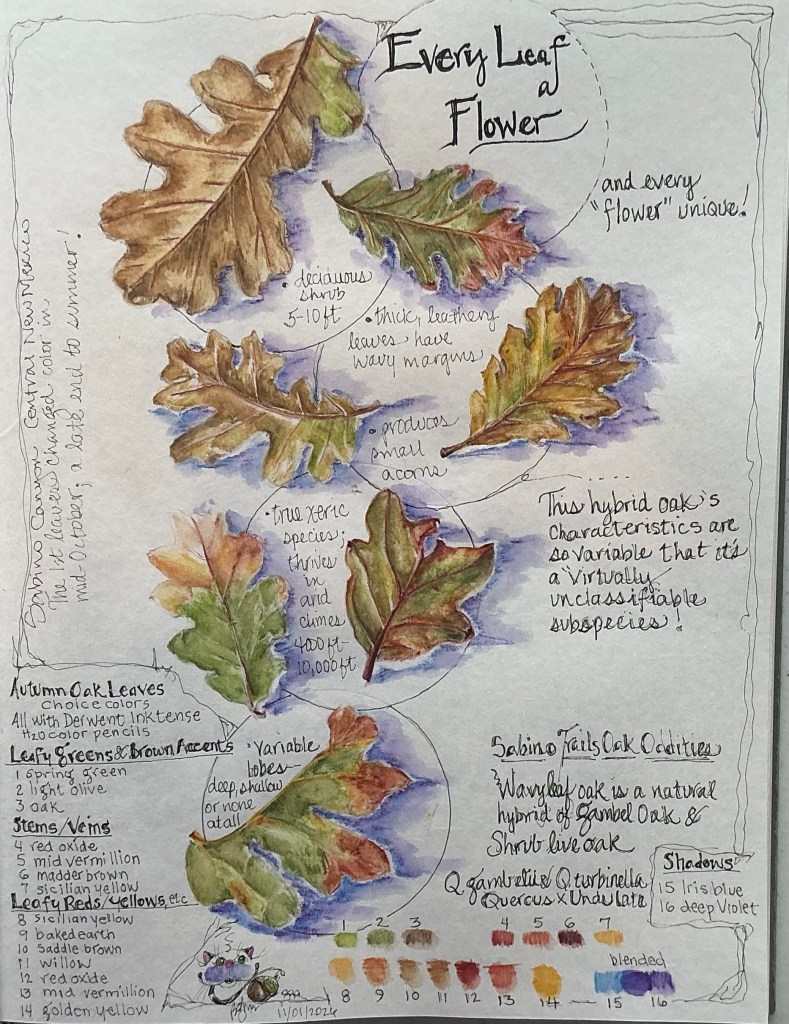
There are two distinct oak species growing in scattered locations within and surrounding the Open Space: Gambel Oak (Quercus gambelii) and Shrub Live Oak (Q. turbinella). And then there’s a weird-looking third oak which looks like a mash-up of the other two species — the Wavyleaf Oak (Quercus x undulata). According to botanists, Wavyleaf is a hybrid of the larger, deciduous, deeply-lobed Gambel’s and the smaller, evergreen, prickly-tipped Shrub Live Oak. The progeny of this merger is a consistently inconsistent-looking shrubby plant making its identification a visual guessing game.
What’s so eye catching when walking among Wavyleaf Oak, is the variability of leaves — not only between separate shrubs, but between leaves growing on the same plant. No two leaves are alike, even if they are side-by-side. And as is true of a naturally occurring botanical hybrid, called a nothospecies, leaves may more closely resemble one parent than the other, or may appear anywhere in between. A unique feature of this hybrid seems to be the wavy leaf margins, a characteristic not present within either parent. But what I’ve noticed is the amount of margin waviness varies from extreme to hardly visible. Maybe there’s something else going on?
What I learned was that the freely interbreeding nature of Q. gambelii and Q. turbinella that produces Quercus x undulata – the Wavyleaf Oak, also freely backcrosses with one or both parents, populations referred to as variable hybrid swarms or complexes rather than a single uniform genetic line. Maybe all this backcrossing results in plants with leaves more similar to one parent or the other? Maybe, over time, if enough back-and-forth crossing occurs, a brand new botanically-distinct and stable oak species will result? Maybe that’s already happened somewhere since these plants hybridize and backcross freely across their native range from Colorado and Utah down to Texas and northern Mexico.
All of this is very mind boggling!
Back to my small collection of Wavyleaf Oak leaves, all different looking and exhibiting variable coloring. Hmmmmm …… does all this crossing and backcrossing cause leaves to change from green to Fall colors differently and at different rates? And what’s with the patterns?
As always, thanks for stopping by!
A Definition and a few other Notes:
- Nothospecies – a botanical term for a hybrid species formed by the direct hybridization of two separate species (rather than crossing other hybrids)
- Quercus x undulata represents a complex group of natural hybrids involving Quercus gambelii (Gambel oak) and several other scrub or white oak species—most notably Quercus turbinella (Shrub Live Oak), Quercus grisea (Gray Oak), and others in the southwestern United States and Mexico.
- The multiplication sign (×) in Quercus × undulata explicitly designates it as a nothospecies (hybrid species) rather than a pure, primary species, though it was originally described by John Torrey in 1828 pro specie (as a distinct species) before its hybrid swarm nature was better understood.
- I have confirmation, by species experts working through the iNaturalist database, stating my specimens collected within the Sabino Open Space and surrounding areas are Quercus × undulata, hybrids from Q. gambelii and Q. turbinella. (I’ve not asked any questions about backcrossing though.)


