
June 1, 2026
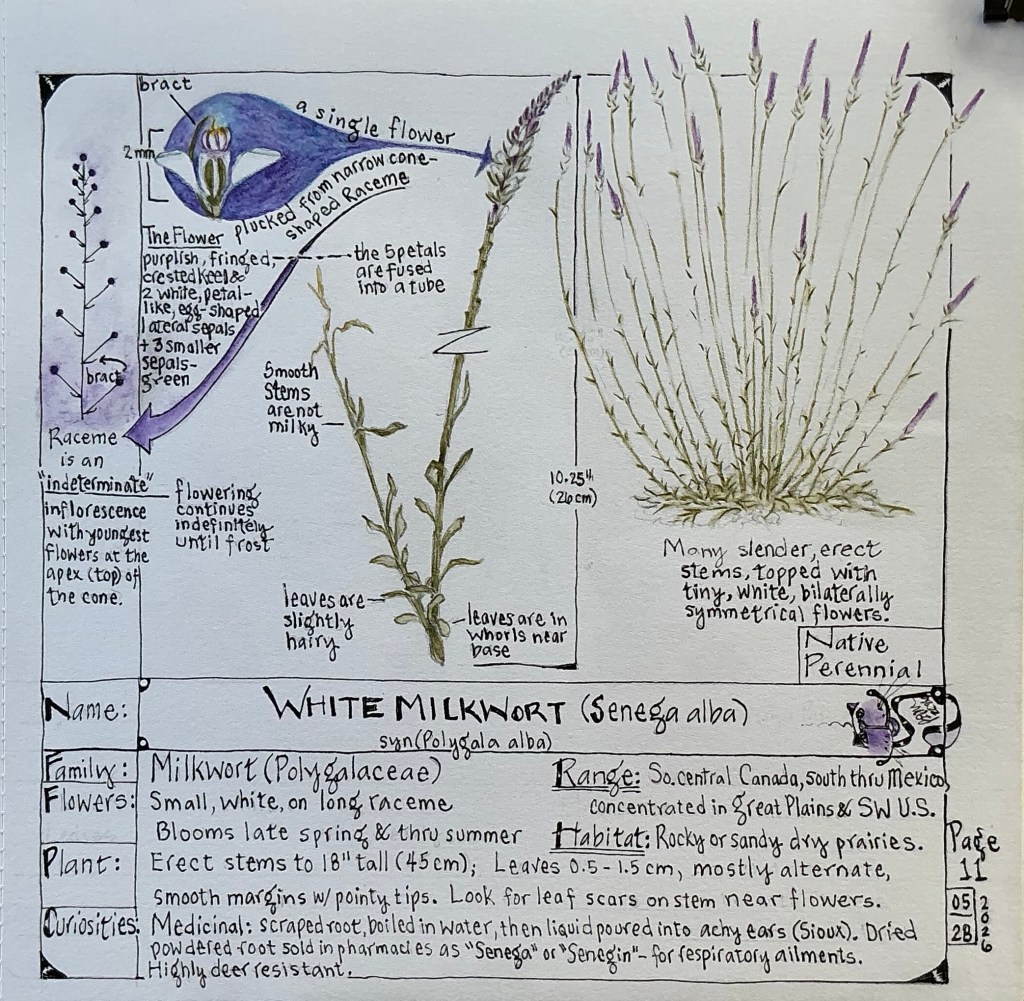
White Milkwort (Senega alba (Nutt.) J.F.B. Pastore & J.R. Abbott)
(synonymous with Polygala alba Nutt.)
A Light Touch
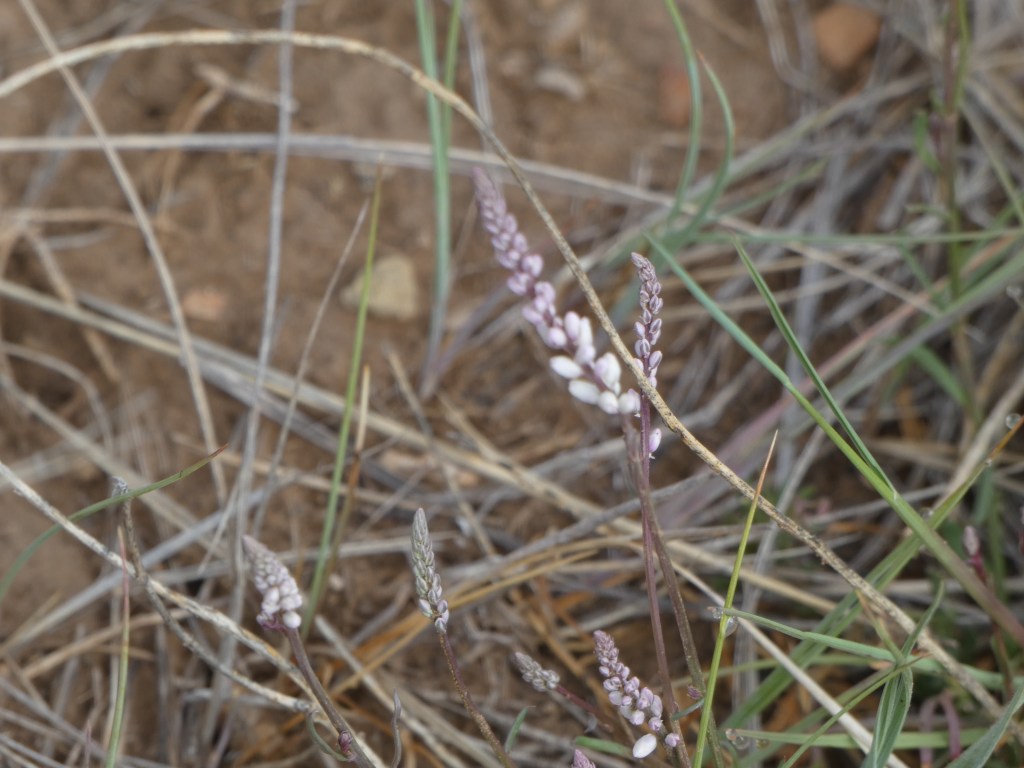
It was a beautiful morning for a walk along one of the neighborhood’s 2-track dirt roads. I was searching for late blooming Spring wildflowers when something lightly brushed against my leg, bringing me to a full stop. There, at my feet, gently swaying in the quiet breeze were a dozen+ foot tall, nearly naked, skinny green stems topped with lavender and white cones. Not wishing to crush these delicate stalks, I noticed there were five other groupings nearby, all growing in the road’s old tire depressions. Upon closer inspection, I recalled having seen this plant before in the yard of our previous home, but they had fewer and shorter stems, and larger (?) flower cones. Still, this was the white milkwort species (back then known as Polygala alba; today called Senega alba) I identified four years ago. It was the larger size and delicate nature of these plants at my feet – that puzzled me.
Here’s what I learned:
- The stems, which are ridged, can grow to 18” tall. They branch from a basal caudex (a root-like thickened stem, often found underground, from which branching/stems grow …… and the more extensive the caudex, the more above ground stems form.
- You can roughly age this perennial milkwort by counting the number of vertical stems. Typically there’s one stem on seedlings and one-year old plants; as many as 30 stems have been counted on much older (many, many years old) plants.
- Even though the official flowering period ends late summer, if mid-summer/early fall rains (our monsoon season) are plentiful, another bloom period peaks and can continue into November. It’s been reported that when old flowers are removed from these milkworts (deadheaded), the plants will bloom continuously for up to four years! Obviously, those plants are not impacted by winter frosts.
- The 90% of the pollinators visiting white milkwort are small to medium solitary or semi-solitary bees. Where we live (desert southwest), many of these ground-nesting bees are floral specialists, and based on research dating back to the early 70s, green metallic bees highly favor this native plant’s flowers for nectar and pollen. And with extended bloom times prompted by monsoons, this helps benefit these and other bee species. Unfortunately, the timing and intensity of our monsoons is no longer predictable and is likely causing unfavorable conditions for extended flower bloom and the bees.
- Always be prepared to encounter a plant that tickles!
Classification and an Etymological Quandary
To learn the story about the old and new scientific names for white milkwort, and why being a botanist way back when and today is so challenging, read the next section on Etymology. It really is quite fascinating!
Etymology
Way back in the day (say, the early 1800s), when Thomas Nuttall, a English botanist, ornithologist, geologist and explorer, needed an unforgettably descriptive binomial name for a new species he’d discovered, “Polygala alba Nutt.” was his choice. The genus “Polygala,” which was originally assigned by Linnaeus to a group of plants with similar-looking flowers, is Greek for milkwort — meaning “much milk; ” the species name “alba” is Latin for “white, bright or clear.”
Thomas, logically picked “alba” as the species name for his new discovery, because the plant had white flowers. However, he apparently chose the “Polygala” genus based on an ancient belief that nursing mothers (and cows) that ate the milkwort plant experienced increased lactation. However, Polygala alba doesn’t have either milky sap or any plant parts with milk! After diving deeper into the Polygala genus as a whole, I couldn’t find any that ooze a milky substance.
The changing nature of botanical classification: It wasn’t until recently (2023 to be exact) that the official report announcing the transfer of 18 Polygala species to Senega, including Polygala alba to Senega alba, was published by botanists J.F.B. Pastore & J.R. Abbott. This change was based on a number of scientifically-researched plant characteristics, which addressed deviations in seed, fruit, and floral anatomy between Senega and true Polygala species. Now I know I need a bigger microscope!
In case you’re curious (I certainly was) there are no Senega milkworts (today referred to as American milkworts, formerly classified under Polygala) with a milky sap. So, despite their family (Polygalaceae) and originally assigned genus name (Polygala), these plants exude a clear, watery sap when their stems are broken.
Why “Senega” was selected as the genus name for all American milkworts: The genus name “Senega” comes from the Seneca Native American tribe. The first use of the name in the English language was in the 1730s; the Seneca snakeroot plant was given the scientific name Polygala senega, to honor the tribe’s traditional use of the root as a remedy for snakebites and respiratory issues.
…………………………………………………………………………………………………
Hope you found this interesting!
As always, thanks for stopping by!
References


Lovely plant for pollinators that reminds me of the look of lavender! So glad you noticed this one as it reached out to “tickle” you!
LikeLiked by 1 person
Oh wow, Karen! Your keen sense of observation just knocked my socks off …. Yes! The cone shaped stem topper also reminds me of lavender! Thanks for that comment! My lavender stems are a bit stiffer than the milkwort stems, and I’m also glad this milkwort made me giggle! Have an awesome day!
LikeLiked by 1 person