Happy Birthday Dr. Seuss! Born in Springfield, MA in 1904, if this brilliant author, poet, and illustrator of more than 66 memorable children’s books was alive today, he would be 120 years old! That’s a lot of candles …….. and imagine the variety of fanciful characters he would still be gifting all of us “kids!”
Dr. Seuss Day is an annual celebration held on March 2nd to honor the birthday of Dr. Seuss, a famous children’s author. The day is marked by reading Dr. Seuss books and participating in educational activities.
March 2, 1904 – September 24, 1991
Seriously, is there anyone out there who’s never heard of Dr. Seuss? Born Theodore Seuss Geisel, Dr. Seuss began his career as a cartoonist early in life. With an imagination beyond compare, he began writing children’s books in the 1930’s, publishing his first, And to Think That I Saw it on Mulberry Street, (one of my first Seuss books) in 1937. Then war interrupted his career, and for a number of years he turned political cartoonist (note to self: haven’t seen those ….. must find!), returning to writing children’s books after the war.
I always have, and always will love the works of Dr. Seuss. Apparently Flambé is a fan too. And even though it’s not her birthday, I wanted to delight Kat with my best attempt at Seussian-style storytelling poetry, inspired by her favorite book (and food), One Fish, Two Fish, Red Fish, Blue Fish.
Happy Birthday Dr. Seuss!
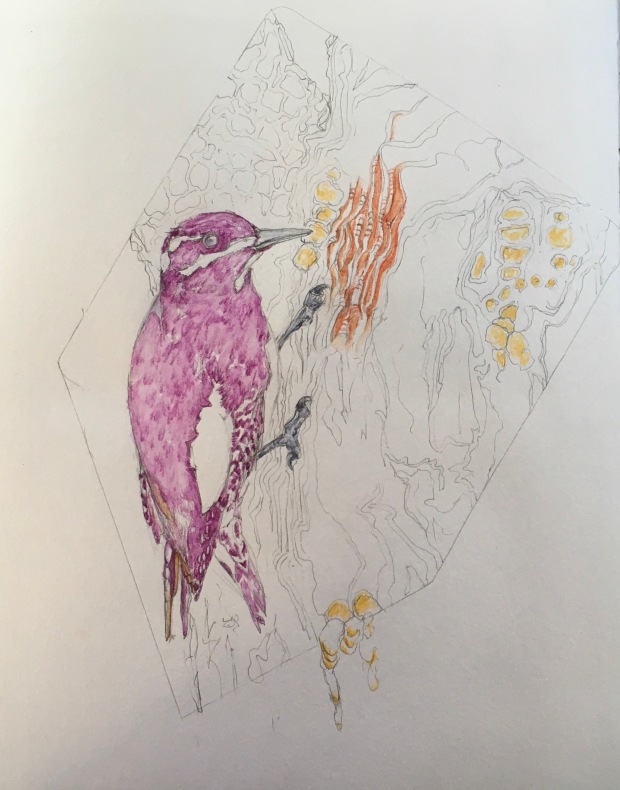
Line work before color.
Like myself and Flambé, do you have an insatiable appetite for all things Dr. Seuss? If so, share your favorite character(s) or book(s)!
Every year, for the past several years, I’ve shared with my most excellent and talented friend and poet, Elaine, the official word prompts used by artists around the world participating in Inktober. Then inspired by these prompts, Elaine creates original poetry, many of which she shares with me.
“Toad” is one of those poems.
Inspired by her words, and my appreciation of this chubby amphibian, here’s how I thought “Toad” might be illustrated. Perhaps this combined effort would be a cute mini bedtime story Elaine could read to her grandson? I wonder!
Arrow shows where to lift next
A full page view, unfolded ….. The inside
A full page view, unfolded
A Toad is not a Frog is not a Toad
The tri-fold card style worked perfectly for the poem, allowing several of the toads to appear more than once. While illustrating the card, it was important to understand the visual characteristics separating a toad from a frog. This challenge led me down both a slippery slope leading to a marsh, and a hidden trail meandering through a nearby grassy meadow. Here’s what I discovered …..
Thanks for sharing the birthday joy!
Elaine received this Toad card in time to celebrate her Leap Year Birthday. I love that we share our creative projects with each other! There’s no finer warm and fuzzy feeling.
Happy “19th” Birthday to you, Elaine, on this year’s February 29th, Leap Year!
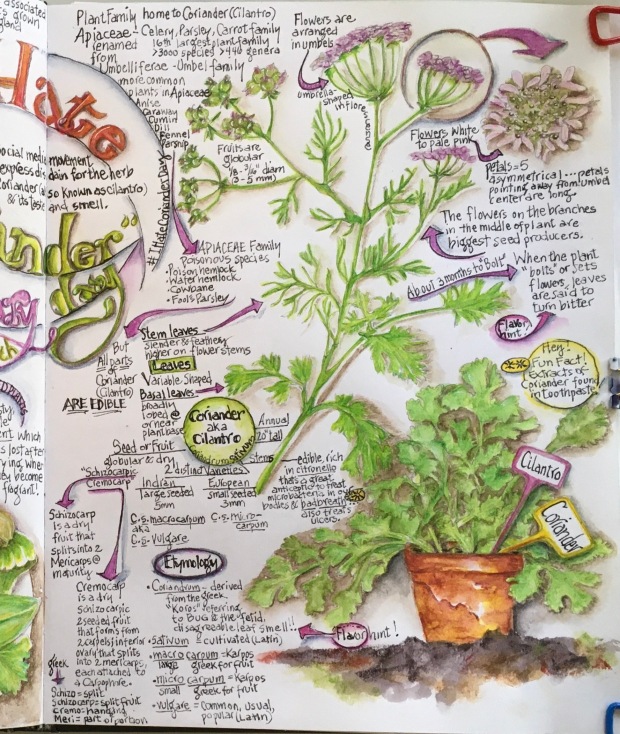
Honest …. You can’t make up this stuff! You’ve got to wonder what the person or persons who began the National social media movement, “I Hate Coriander” Day, have against an innocent little herb.
“National I Hate Coriander Day, celebrated annually on February 24th, is a social media movement to express disdain for the herb coriander (also known as cilantro) and its taste and smell.”
“Hate” is such a strong word under any circumstances, but to “hate” an herb? … What do these Coriander “Haters” find offensive about the look of this bright green leafy plant? What is it about the taste and/or smell of Cilantro that elicits such a strong reaction? Now I’m not a Coriander (aka Cilantro) addict ….. a bit now and then as garnish or to flavor a fresh salsa is perfectly fine with me. I’ve even grown Coriander in my garden and marveled at the plant’s growth rate, intense leaf and stem coloring, bouquets of delicate flowers and abundance of seed. So my curiosity was definitely piqued when I came across this peculiar National Day. Just what is it that has and keeps these people all riled up over Coriander?
Coriander – The Plant
Not to be confusing, but Coriander and Cilantro are actually the same thing, Coriandrumsativum. However, in the U.S. we tend to refer to the leaves and stems as Cilantro; the seeds (whole raw or toasted, or ground) as Coriander. But because the National Day is about hating Coriander, I’ve made a leap in assuming they hate the entire plant, including the roots, stems, leaves, flowers and seeds (all of which are edible; all of which are eaten).
The plant is an annual that grows up to 20” tall. The bright green leaves are variable in shape, broadly lobed at the base of the plant, and slender and feathery higher on the stems. Flowers are arranged in umbels (like a wind blown, inside-out umbrella), are white to pale pinkish-mauve. Each asymmetrical flower has longer petals pointing away from the center of the umbel than those pointing inwards. And each flower produces a dry globular fruit (schizocarpic cremocarp) about 1/8 – 3/16” diameter, which splits when mature into 2 mericarps, each mericarp with a single seed.
Coriander – The Seed
The name, Coriander, is the common name used around the world, for the seed of Coriandrumsativum. There are two cultivated varieties of Coriandrum sativum grown around the world. Although the plants of both varieties appears the same, it’s the seed where the visible differences occur. C. s. var microcarpum is the small-seeded variety found in temperate climates, such as in Europe and the U.S. Its seeds are about 3 mm in diameter, round, and very potent as a spice. C. s. var macrocarpum (aka C. s. var vulgare) is the large-seeded variety found in hot, subtropical areas of Asia and India. It’s seeds are 5 mm in diameter, football shaped and have a very delicate flavor.
If you’ve ever grown Coriander from seed, you probably planted one seed at a time, being careful to follow the spacing instructions on the package. Then when your seeds germinated, sending up those first immature leaves (cotyledons), you noticed that for each seed planted there are 2 little plants! “What the heck?” you say. When you sowed the seeds in each well-spaced spot, you obviously planted an entire globular fruit (both mericarps at once) resulting in the germination of both seeds!
Is There a Consensus of Opinions on Leaf Taste and Aroma?
Nope! Opinions are far from consensual. As a matter of fact, they are frequently polar opposites. Coriander has been described as the “Marmite”*****!!! of herbs; either you love it or hate it. This great analogy reflects how strongly people do feel about flavors of their food.
Opinions on leaf taste and aroma: The good – tart, lemon-lime, fragrant, pleasant, distinctive, spicy hot, peppery, aromatic. The bad – bitter, stinky, unpleasant, nasty, fetid. And the bleh – The leaves smell and taste like dish soap!
Is There a Consensus of Opinions on Seed Taste and Aroma?
Again, Nope! But curiously, most of the opinions about seed taste and aroma were fairly positive, provided the correct variety of C. sativum was properly prepared and used. For example, all seeds contain 1% volatile essential oils, but the quality of oils is different between the two varieties. For some reason the smaller European variety seeds (C. s. var microcarpum) have far superior essential oils resulting in far superior flavor and yield when compared to the larger India variety seed (C. s. var macrocarpum). The larger India variety seeds are preferred as a spice, both whole and ground.
Opinions on taste and aroma of fresh or dried seeds: Spicy, earthy, cumin-like, orange peel, aromatic, dried seeds have full flavor, fresh seeds are undesirable.
Opinions on taste and aroma of toasted seeds++, whole or ground: Fruity, Fruit Loops, lemony, floral, mild perfumy, aromatic, bitingly pungent, delightful bouquet, distinctive flavor.
Now it’s your turn! Where do you stand on the issue of Coriander; it’s taste and smell? Are you celebrating today’s National “I Hate Coriander” Day? Or are you a regular Coriander Connoisseur, savoring the taste, smell and texture in all of your favorite dishes, from sauces and marinades, curries, meats and seafood, stews, to pastries and desserts?
***!!! Marmite! Invented, made and sold in England, this stuff is a sticky, dark brown paste made from fermented yeast. It has a very salty and powerful (understatement) flavor, and is frequently slathered on toasted breads like jam. If you haven’t experienced Marmite, perhaps you’ve dared to taste its equally unappetizing knockoff, “Vegemite,” found all over Australia? If you’ve tasted either or both (wow, you’re tough), what was your reaction? If you’ve never had the culinary pleasure, consider this fair warning! Wonder if there’s a social media group that’s declared “International I Hate Marmite (Vegemite) Day?” I would happily eat a bushel basket of cilantro greens, than dare give these yeasty products another go. (No offense to the marmite and/or vegemite lovers of the world.)
++Toasting Coriander Seed: In a non-stick skillet, over medium-high heat, add the seeds. Keeping the skillet in constant circular motion. When the seed’s aroma is released, toasting is complete! Cool completely and grind with mortar/pestle or in a small electric grinder. Store ground coriander in a cool (refrigerated) location, away from light and moisture. It’s best to toast and grind seeds in small amounts, on an as needed basis, to experience the full flavor.
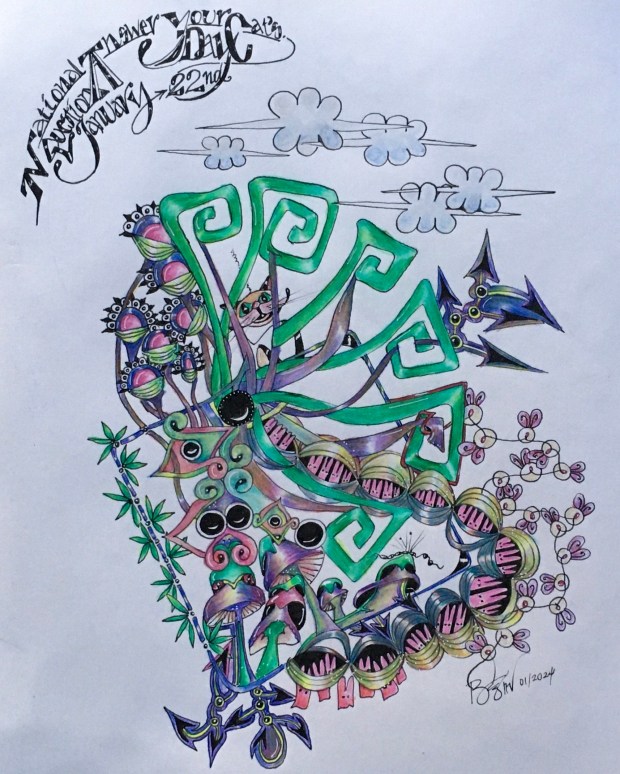
Since January 22nd, which happened to be National Answer Your Cat’s Question Day, Flambé has been asking non stop questions about almost everything, impatiently expecting instant answers. Meeee-owwww! Have I released the FrankenKat? Like a child who’s just discovered speech, and must know answers to all the Who’s, What’s, When’s, Where’s and the Why-Why-Why’s in her world, Flambé is tireless. Maybe there’s a National Teach Your Cat to “Google“ Day? While that may take some of the pressure off of me, wouldn’t that be like plugging in FrankenKat, supercharging then enabling an entire new race of Feliscatus to evolve and take over Earth? Interesting scenario, but highly unlikely. A species without thumbs could never rise to such power! (Or could they?)
Ok, I’m way off track. Back to my chatty Kat.
A few days ago, Flambé asked a hilarious (to me) question and before busting out in an uncontrollable belly laughing episode, I asked her to repeat the inquiry. Maybe my ears had tricked me? So Kat asked very seriously again, “What’s a Tater Tot?” !!!!
Suppressing my laughter (still), I was relieved to know not a thing was wrong with my hearing. Without answering her question, I said, “As it just so happens, you’ve stumbled upon a remarkable coincidence. Today happens to be National Tater Tot Day; let’s search for answers together!”
And this is what we learned:
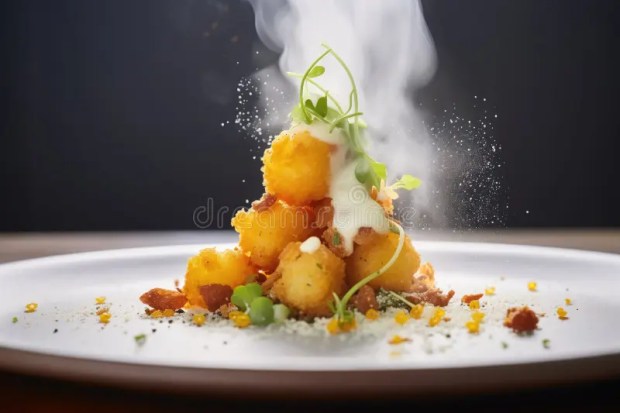
Yummmmmm! Tots and Ketsup! Royalty-free image from Dreamtime
National Tater Tot Day is a food holiday celebrating the popular snack made from grated and fried potatoes. It is observed annually on February 2nd and is a day to indulge in Tater Tots in all of their crispy, golden, and delicious glory.
The True Story Behind the Tater Tot
The year was 1953. The location was Ontario, Oregon. The owners of Ore-Ida, F. Nephi Grigg and Golden Grigg, we’re cooking up something new. Inspired by mountains of leftover slivers of cut-up potatoes, instead of always disposing of this “waste,” they began experimenting with these still edible bits of spuds. Finding tasty seasonings and using flour as a binder, the slivers were sliced into even smaller bits and all ingredients were combined into a mash. The mash was then pushed (extruded) through holes creating a shredded potato mixture that was deep fried. Tater Tots were born ……..
…….. But they were born without an official name. So what to do?
The Griggs decided to hold a naming contest. Out of all the entries received, the winner was Clara Lay Orton, who came up with the now famous name “Tater Tots.” Loosely translated as “baby potatoes,” Tater Tots were sold for the first time under their new name in 1956. Since then many other manufacturers have tried to copy the Ore-Ida recipe, calling their tots names like tater treats, tasti-taters, potato rounds, potato toes, potato nuggets, potato crunchies, spud puppies, and taytoe tubes. Ore-Ida calls these imposters “imi-taters!”
Not only edible, but wildly popular around the world!
Tater Tots were an instant success (and a profitable money maker for the Griggs) around the world, becoming all the rage in the United States. Statistics show that in the U.S. alone, Americans consume 70 million pounds of tots in a year which is equivalent to 3.1 billion individual cylinders. This also translates to gobbling up 192,000 pounds a day of those mashed up little potato slivers once destined for the rubbish heap. Potatoes are one of the most consumed foods in the States, so it’s no wonder Tater Tots were such a huge success. Deeply ingrained in the American identity, Tots “rank as one of the most commonly consumed meals in almost every household in the U.S.” This irresistible invention may actually be considered a delicacy loved and consumed by millions of people.
A Stylish Tater Tot Tower served at fine restaurants around the world! Royalty-free image from Dreamtime
Skeptical at best …….
Flambé continued asking countless questions, but mostly questioned the use of the questionable “delicacy” label. So to satisfy her curiosity (and hopefully her appetite) it was time to conduct our own taste test. Tumbling out a few dozen frozen tubes onto a baking sheet, I popped them in a hot oven to cook. After waiting the recommended 18-21 minutes, they emerged quite crispy on the outside; soft and steamy on the inside.
A little nibble of a naked Tot told us both that a condiment of some type might enhance the flavor. The choices are many ….. from ketchup to cider vinegar, honey mustard to barbecue sauce, ranch to blue cheese dressing, and even hummus, spinach/artichoke or jalapeño dip. Maybe merely more iodized, pink or kosher salt from a shaker or perhaps a touch of soy? Flambé had to try her favorite, Thai fish sauce on one of her Tots; canned salmon oil on another. But, alas, it was clear our condiment(s) of choice covered up the shredded potato taste of our Tater Tots. And Kat finally came to realize there’s a reason potatoes aren’t a staple or even a minor ingredient found in feline fare…… she was purrr-fectly happy to flick away the Tots and devour the fish sauce-coated salmon fillets, declaring, “Now this is a true delicacy!” And with both her appetite and curiosity well satisfied, Flambé headed to bed for a well deserved katnap.
So while Flambé is snoozing, run on down to your local grocer, buy a bag, and cook up a generous batch of Ore-Ida’s finest in celebration of lNational Tater Tot Day. Let me know how they turned out. And while indulging your inner child, consider these questions:
–Are you a Tater Tot greenhorn, tenderfoot (newbie), dabbler, devotee,connoisseur? -Do you prefer your Tater Tots piping hot, right out of the oven, or with a condiment? -How many condiments have you tried and what are your favorites? -Based on your experience, what’s the strangest Tot topping you’ve ever had? -Have you ever been to a dinner party where the appetizers include Tater Tots with little toothpicks and a dip buffet, or perhaps Totchos sprinkled with cheese over a bed of spicy jalapeños? -Have you ever been to a dinner party, maybe even the same one just mentioned, where the main course is a Tot Casserole, Tot-Ka-Bobs, Chicken Tot Pie, or a Tot-Tofu Stirfry? Have you ever been caught up in Tater Tot Mania or have had your fill & are readyto surrender?
Skewered Tater Tots and Veggies! “Tot-Ka-Bobs”, the healthy alternative! Royalty-free image from Dreamtime
Final Thoughts (Finally!)
If you just can’t bring yourself to acknowledge today as National Tater Tot Day, preferring your spuds in other more healthful ways, feel free to celebrate National Groundhog Day (did he see his shadow where you live?) or World Play Your Ukulele Day …… both fall on February 2nd! Hmmmmmmmm ….. Maybe I’ll compose a little ballad in honor of the Tot, and spend today strumming it on my uke!
Footnote: After examining my Zentangle tribute to the Tater Tot, Flambé tried to sneak in another question, “Do koalas crave or even like Tater Tots?” But I reminded her that today we’ve barely had enough time to answer her first question, let alone two. And until National Teach Your Cat to “Google“ Day becomes a thing, she will just have to remain curious! Tot-Tot Until Next Time!
Final Footnote: Kat said the blueberry smothered Tater Tots with a side of whipped swirls, at center stage in my Zentangle tribute might just sway her to give Tots another try. I’m thinking that might appease her sweet tooth!
Who knew? Apparently Flambé knew! And once she informed me of her January pick of celebratory “Days,” I knew …,,, and then wondered why this came as a surprise! After all, cats are insatiably curious, and Flambé is no exception. It’s just that we don’t always speak the same language …… her “mee yow” can be hard to understand, and my reply, “whah aht” must sound like Greek to Kat.
“National Answer Your Cat’s Question Day is a day dedicated to playfully imagining that your cat is asking you questions and answering them in a fun and creative way. It’s a lighthearted celebration that encourages pet owners to engage with their cats.”
So when we woke this morning, someone must’ve gifted us a fully-functional universal interspecies translator because Flambé was speaking my language, and I hers! Instead of her usual “mee-yow-yow-yow,” what I clearly heard was “feed me now, but not that dry kibble, a gravy soaked chow with juicy morsels to nibble.”
While uttering and sputtering my flabbergasted reply, Kat hopped matter-of-factly into my arms. Looking me right in my left eye she said, “I have always spoken clear and precise English, as did my mother and her mother before her. It’s you who have stubbornly refused to listen. But it’s about time you reciprocate. Let’s celebrate NationalAnswer Your Cat’s Question Day with this burning question ……. “
“Why are there so many rabbits in my yard?”
Of all the questions I could’ve imagined Kat asking on this wondrously unbelievable January 22, this one didn’t even rank in the top 100! But wishing to make amends for my years of misunderstanding, I not only acknowledged the exponential growth of bouncing and burrowing bunnies, but plunged through the literature in search of an answer. Here’s what I shared with Flambé:
“There’s nothing more exciting to a rabbit than a yard full of intentionally or carelessly cast away debris and other things. Rabbits don’t see your trash as junk. Instead they view your yard rubbish as building materials for constructing their underground burrows and nests.”
“Unless you change your rubbish disposal habits, you’ll continue to grow your collection of fuzzy yard rabbits!” I emphatically explained to Flambé. “And much much more sooner, way way before later, underground crowding will force hiring a relocator to relocate the billions and billions of bunnies, and you haven’t got anywhere near enough money!”
Kat sighed with dismay, “I’ll lose all of my friends. But I agree that it’s time for my bad habits to end.” If it’s fine for a few fuzzy rabbits to stay, I’ll take away all unused rubbish today, ok?” And she purrrrred and purrrrred.
How could I look into those big emerald green eyes and deny Kat a few furry friends? So I said. “Of course it’s ok, especially on such a fun celebratory day.”
And we spent the remainder of the day gabbing about this and that;
we had a wonderful time!
What’s your favorite cat, real or imaginary? Do you speak “cat?” Does your cat speak to you? How did you celebrate National Answer Your Cat’s Question Day?
Did you know?! Today, and every year January 5th rolls around, is National Bird Day! Whoo! Hoo! Or should I say “Tweet!” Have you hugged a bird today?
“National Bird Day, celebrated on January 5th, is a day dedicated to the conservation, preservation, and appreciation of birds. It aims to raise awareness about the importance of birds and their habitats, and encourage people to take action to protect them.”
Back Story
(or Why this seemingly random information nugget has popped into this blog post, and what happened to those fascinating Full Moon stories?)
Since my Full Moon project came to a close in November, I’ve been pondering over my list of ideas that might become a fun project. With elbows propped on my drawing table and chin cupped between the palms of my hands, my eyes and mind began slowly drifting outside to a winter scene where patches and drifts of snow had collected from our last storm. Readjusting my focus to the bird feeder right outside my studio window, I watched as 15-20 dark-eyed juncos engaged in minor skirmishes, competing for seed. Birds on the feeder and the ground ravenously plucked and scratched for tasty morsels before they were stolen by another hungry junco.
That’s when it hit me …… the constant activity at the feeder, every day, brought to mind the number of holidays, events and sometimes solemn to whacky occasions we the people have designated to commemorate and celebrate. The published lists (official? who knows) are long, cover every day of the year, and often include a dozen (more or less) International, National, State and Local happenings/day!
The topics are boundless; some familiar (Valentine’s Day), some hilarious (National Pass Gas Day), some educational (Learn Your Name in Morse Code Day); some raise awareness about a cause (National Save the Eagles Day), while some satisfy your appetite (National Curried Chicken Day) ….. your thirst (National Green Juice Day) …. your sense of play (National Fruitcake Toss Day) … your sense of self (Measure Your Feet Day).
Apparently, if you can think it, there’s a “Day.”
So here goes ….. I’ll be tackling a “Day” a month during 2024, that is likely to make a good fit for my Nature Journal. Then Flambé, not to be left behind dog paddling in a sea of flounder, has agreed to play too. Kat will pick a “Day” each month where the event is more light-hearted, laughable, fantastical.
And there you have it! Scattered among my regular nature journal pages and Flambés Misadventures will be our interpretations of a few dozen of the hundreds of notable events we think are worthy of recognizing this and in future years!
Enjoy! What’s your favorite (backyard) bird? Oh and please share how you celebrated National Bird Day!
What comes to mind when you see a group of pigeons perched on electrical wires high above your head, or when a large flock or band of these birds suddenly flushes from under a highway overpass to escape a winged predator, or when you’re walking through a grocery store parking lot full of discarded food scraps and must shoo away pigeons to avoid stepping on them?
click the link below for the entire post, and learn if you believe this large bird is a pest or a prize
As the Fall season rapidly came and went, and the first snows blanketed the landscape, I focused my hiking time (and some of my drawing hours) on collecting local native seeds. Always careful that plenty of seeds remained available for overwintering birds, I still managed to harvest hundreds from about 25 plant species. All sorted and packaged in separate pill containers, my collection is now stored in the refrigerator at 40 degrees, until growing conditions are optimal for planting. This treatment method is referred to as stratification.**
Why collect native seeds? All throughout the Spring, Summer and Fall, a diverse assortment of pollinators visited our locally blooming wildflowers and shrubs. Along with these butterflies, moths, bees, wasps, beetles and flies, were the insects, spiders, and birds that prey on unwary pollinators. Such an amazing show; a kaleidoscope of colors and shapes! The air was a buzz with activity. My goal is to mimic the native banquet in hopes of attracting these pollinators and predators.
Also, seeds are absolutely fascinating. I like to think of them as gift-wrapped, living plants-to-be. Tucked neatly inside of the seed coat are food stores enough to feed the makings of a complex root system; flowers, leaves, stems, branches and even a trunk. Seeds can be tiny, some microscopic and some as large as a softball. Seeds come in a variety of shapes, colors, textures and decor both inside and out. Some seeds have “wings” to fly; some have silky or puffy “feathers” to float; some are like “lead,” heavy enough to intentionally sink under water.
So I pulled out my 10x hand lens to investigate, drawing most of the seed species in my collection. It was very cool to compare seeds of different species that are in the same family (like the composites of the Aster family and the penstemons of the Plantain family). Until creating this journal page, I’d never held the seeds of 3 different species of yucca in one hand at the same time. Observing the similarities and differences, I finally confirmed in my mind that the genus Herperaloe and Yucca are indeed in the Agave family. And then I found examples of seeds from completely different families that evolved similar dispersal mechanisms (convergent evolution). This phenomenon was visually obvious in the delicate feathery, silky, and poofy hairs or bristles attached to grass, aster, and milkweed seeds, facilitating seed dispersal by wind.
Finally, I felt the need to draw the seeds in case they happened to spill into one big jumble while being planted! Yes, I would be clumsy enough to create chaos out of order. Should that happen, I’ll be able to sort the mess by species by referring to my field guide page.
** Seed-producing plants pass along to their seeds the specific requirements(s) necessary to break dormancy and germinate. These genetic codes determine if optimal conditions exist for seeds to sprout and hopefully grow to maturity. But key to successful germination depends on seed ripeness (in most cases). Knowing the plant species from which a seed is produced; whether the plant is an annual, biennial or perennial; habitat, moisture needs and the type of “treatment” method(s) are all important bits of information tied to successful germination.
I’ll have to create a future post describing the variety of treatment methods (germination patterns) inherent in the seeds.
Are you a seed collector? If so, share your why’s and how’s!
Keep on reading to learn more about the November 27th Full Beaver Moon, concluding a “Full” year of named Moons. It’s been a fun trip around the Sun learning about the different names of each Full Moon and interesting facts describing our only natural satellite that lights up the night sky with her smiling face. Flambé has looked forward to the rising of every Full Moon, happy to share her cautious to exciting encounters with the cast of characters that name each month’s Moon. Follow the link below to read Kat’s conversation with a sleepy beaver who is about to fulfill her naming obligation for another year.
After a well deserved rest from Inktober and from my self-imposed pressure to create something every day from a list of random prompts, I’m happy to be out again nature sleuthing. Curiosities in nature sometimes stare us in the face. But more often than not making discoveries require keen observational skills, noticing something new to you, and an ability to look for clues to a mystery with wide open eyes.
Double page post with an extra add on; all art work done with Graphgear 1000 loaded with 0.3mm 2B lead and all inked lettering done with Faber-Castell Pitt Artist Pen Fineliner, 0.3mm.
It was during a hike on an unseasonably warm day that I paused to admire the dried flower heads from one of the late blooming sunflowers. Have you ever noticed how they look like another kind of sunflower? Papery textured “petals” circle a central disk where a few weeks ago it was crammed full of puffy parachute-topped seeds. After the seeds become airborne, all that’s usually left is a slicked off surface punctuated with dots arranged in spirals radiating out from the center.