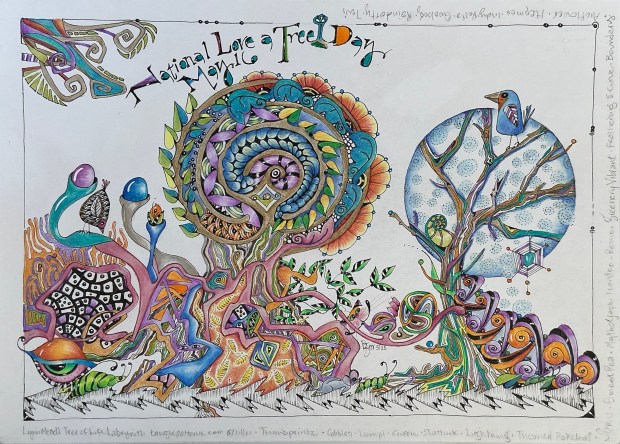
And many thanks to Lynn Mead for sharing her Tree of Life Labyrinth pattern. Super fun to give a whirl! The easy to follow directions can be found on tanglepatterns.com posted 08/14/2021
Today, May 16th, just so happens to be National Love a Tree Day! It’s the official day to celebrate all of life’s joys brought to us by the trees we share this planet with. Whether you love reading in the shade or taking a bite out of a fresh fruit pie, National Love a Tree Day encourages y’all to get outside and enjoy a tree.
A Changing Landscape
We all know many tree species live many many years; some live to be several thousand years old. According to the U.S. Forest Service, about 766 million acres of forest land exists in the United States today, a number that’s held steady since 2012. But the nature of our forests has changed over the last 400 years, due to changes in management practices and demand. Population growth, rural and urban development, along with a variety of land uses (like conversion of forests to agriculture use) resulted in a steady decline of forested acres between 1630 and 1910; a decline from 1,023 million acres to 753 million acres or 46% to 34% of the total land area in the U.S. Since that time until the present, where people choose to live and how the land is used has been constantly changing. While some urban forests increase, other areas see a decline. Tree planting programs improve landscapes but human activities and population growth continue to impact these ecosystems.
We All Benefit from Trees
Trees provide more than just beautiful landscapes and a shady canopy on a sunny day. They play a significant role in reducing erosion and moderating the climate as well as give us oxygen. Large quantities of carbon are stored in their tissues as trees remove carbon dioxide from the atmosphere. They provide habitat and structure for strong ecosystems.
How to Observe National Love a Tree Day
This is a good day to plant a new tree native to your area, or spend some time enjoying the beauty of the trees, Take time to learn how to care for the trees you have, too, whether you live in the mountains or the desert. Write down all the reasons trees are important to you. If you have a favorite tree, or a tree you’re not familiar with, begin a little research project about that (or those) species, and journal about your findings.
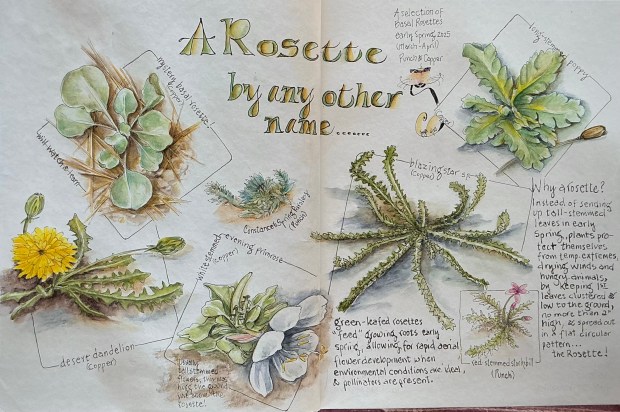
A selection of basal rosettes that popped out of the ground this Spring.
Have you ever noticed a dandelion? Oh sure …… you’ve seen hundreds, probably thousands of those ubiquitous sunburst yellow flowers blanketing a lawn or brightening an abandoned field. But before all that brilliance magically appears, have you ever looked below all those flower stalks? Have you ever noticed a dandelion before it blooms?
It’s early Spring in the mountainous areas of central New Mexico, and it seems like the high desert is slow to bloom this year. Anxious to spot even a hint of green during this transition time is always challenging, but if you look closely …….. Tucked beneath dry grasses and piled-high tumbleweed skeletons wedged next to swelling cholla you’ll find the green. Clusters of new leaves hugging the ground no more than an inch high, are beautifully arranged in a circular pattern like the unfolding petals of a rose.
Rosettes!
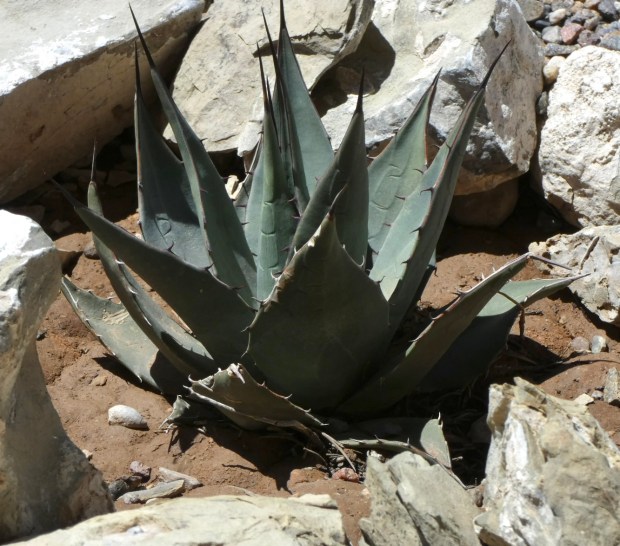
Rosette arrangements are found throughout nature,1 but in the flowering plants they are particularly common in the following families: Asteraceae (like dandelions), Brassicaceae (like cabbage), and Bromeliaceae (like pineapple). Many other families display the rosette morphology too. The needle sharp leaves of yucca and the bayonet-shaped leaves of century plant (in the Agave family) form tall rosettes. The intricate leaves of wild spring parsley (a tiny member of the Parsley family) and the petite red-stemmed stork’s bill (Geranium family) both form ground-hugging rosettes.
A century plant displaying a beautiful basal rosette.
Where Rosettes Form
Basal Rosettes grow close to the soil at or near the plant’s crown (the thick part of the stem where the roots attach). Their structure is an example of a modified stem in which the internode gaps between the leaves do not expand, ensuring all the leaves stay tightly bunched together and at a similar height. A protective function of a basal rosette makes it hard to pull from the ground; the leaves come away easily while the taproot is left intact (have you ever tried to pull a dandelion without snapping off the root?). Generally speaking, basal rosettes improve a plant’s odds at survival. For example, overwintering rosettes, like the basal leafy growth produced in year #1 of the 2-year life span of giant mullein, protect the plant and its roots from extreme cold temperatures. Emerging Spring rosettes, like those found in long-stemmed poppy, also protect the plant from late winter frosts. Basal rosettes are also more protected from changes in microclimate, gravity, wind, browsing, and mechanical damage if they are closer to the ground than tall leafy stems would be. help in water balance and conservation, especially important during periods of drought.
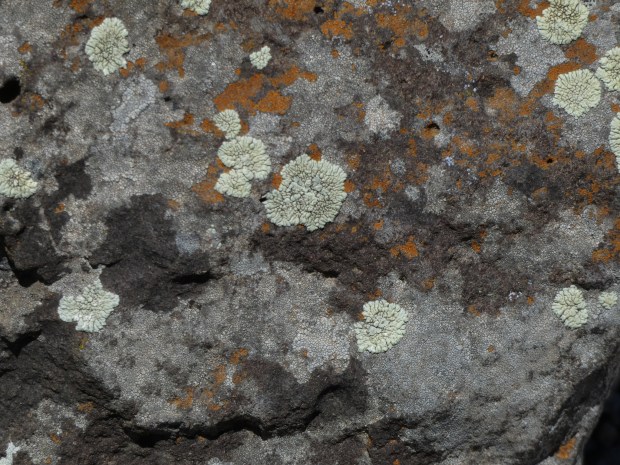
Lichen that has form small rosettes on rock.
But don’t only look down. Another form of rosette occurs when the internodes (those areas between leaves) along a stem are shortened, bringing leaves closer together as in lettuce and some succulents.2. And although not as common as basal rosettes, some plants form rosettes at the terminal or top end of their often naked stems, branches, or even trunks. One plant that does this is the native sedum called wild stonecrop. The top of the plant stems usually terminate in whorls or three fleshy leaves. Another example is the Hawaiian screwpine, which has a terminal rosette of sword-shaped leaves which sits atop an erect trunk, often supported by prop roots.
Know Your Local Rosettes
A number of desirable and undesirable (weedy) plant species produce rosettes, particularly basal rosettes. Being able to identify a species that pops up in the Spring by its rosette is so helpful in preventing a removal mistake by inadvertently digging them up. Many weedy, non-native plants gaze first at their world through rosette “eyes.” But not all plants with rosettes are undesirable. Do you know your local rosettes by their other names?
………………………………………………………………
1Rosettes are found throughout nature, not just in the flowering plants. Here’s some examples you may have seen or heard of:
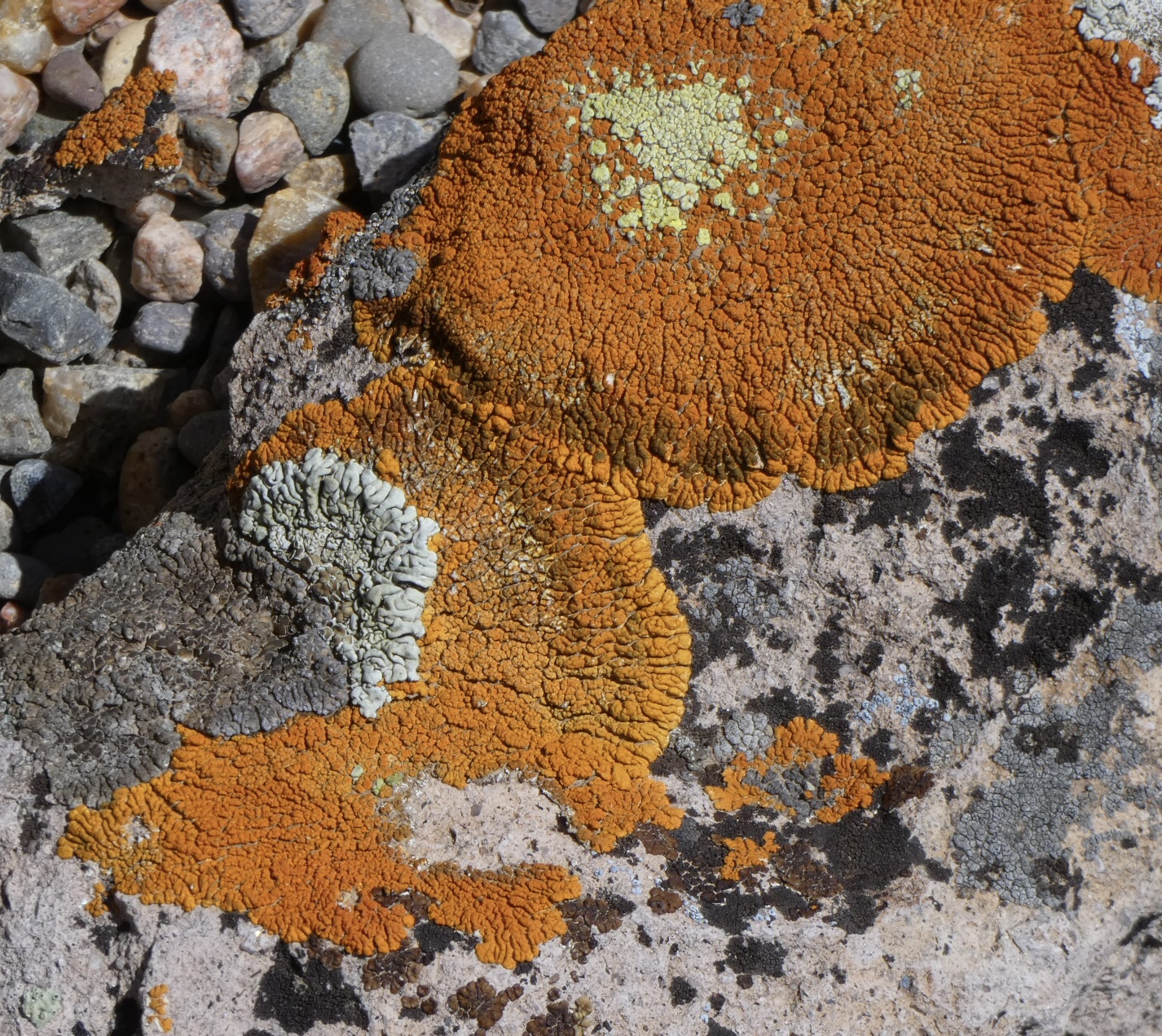
In bryophytes and algae, a rosette results from the repeated branching of the thallusas grown by plant, resulting in a circular outline. Lichens also grow rosettes.
Tiny wasps and midges can induce the development of galls that become leafy rosettes.
Jaguars, leopards and other feline species display rose-like markings on their fur, referred to as rosettes.
Malaria parasites are known to form spontaneous rosettes in uninfected red blood cells.
Neural rosettes in the human brain are being studied to learn how new cells are born.
It is unknown why the Rosette-Nosed Pygmy chameleon, at home in the mountains of Tanzania, has evolved a distinctive, rosette-shaped, fleshy protrusion on the end of its nose.
The Rosette nebula, named for its rosette-like appearance, is a beautiful collection of gas and dust 5,200 light-years from Earth in the constellation Monoceros the Unicorn, and stretches about 130 light-years across.
A gorgeous lichen decorated rock from Colorado. Note the rosette patterns of growth (the thallus)
2 The horticultural definition of a succulent describes a drought-resistant plant where the leaves, stems, or roots have become fleshy and their tissues are able to store water. Succulents include aloe, euphorbia, sedum, the garden favorite hen-and-chicks, and bromeliads. But horticulturalists do not include cacti in the succulent group. huh? Even though cacti are frequently found in books describing succulents based the definition of a succulent, succulents are not cacti. In agreement with that last statement are many botanical and other scientific experts. (Can this get any more confusing?). So basically some experts are lumpers, while other are splitters. Which are you?
Basal rosette of a yucca in the NM foothills.
P.S. Cacti have stems that are thickened fleshy water-storing structures, and are considered to be a stem-succulent group of plants. Are there any cacti species that develop leafy rosettes? Because the spines are the leaves, greatly modified, in all my rabbit-trailing thru the internet and perusal of my collection of botanical references I’ve yet to see any spines forming whorled/rosette-like patterns. If you have, please contact me immediately!
……………………..……………..😂…………………………………………
Are you ready to explore the wide diversity of rosette forming plants in your neighborhood? Get on out there before those circularly-arranged leaves become disguised by an overabundance of gorgeous wildflowers!
As always, thanks for stopping by! And Happy Earth Day (week)!
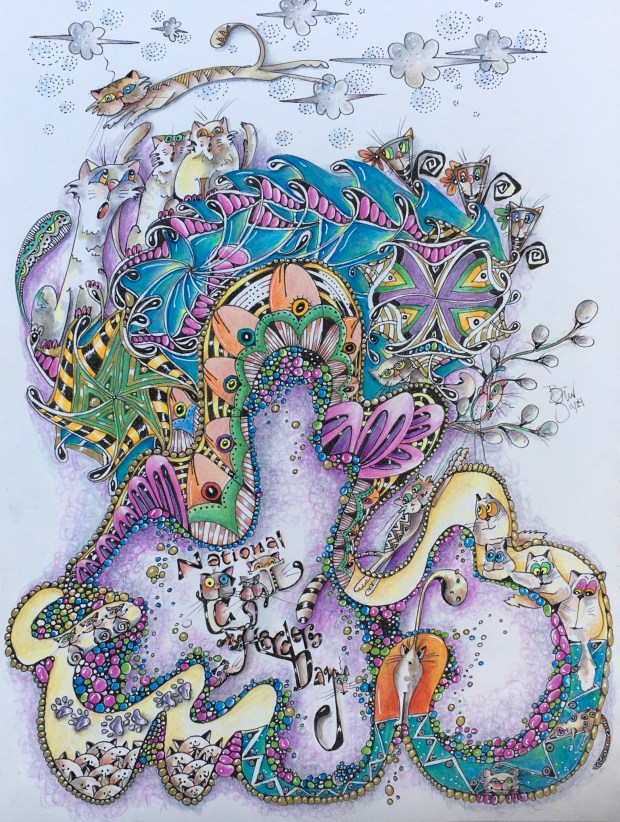
You don’t have to be a cat lover to celebrate National Cat Herders Day. The only requirement is to know someone or even be that someone who’s attempted to accomplish a complex task by controlling the uncontrollable, organizing the disorganized, or bringing to order a disorderly cast of characters, akin to like trying to herd cats*. From parents and teachers to project managers and team leaders, this humorous observance pays tribute to those willingly and persistently taking on the challenge of controlling difficult or chaotic situations. Show the love and appreciation for people in your life, and quite possibly yourself, who take on any impossible or frustrating task with patience and humility.
Zentangle patterns used: Choir, Ease, Windflower, KittyKitty, Fragment oA6, Apichu, Budlite, Cat-kin, CD Joy, Cloudy Day, Raindotty
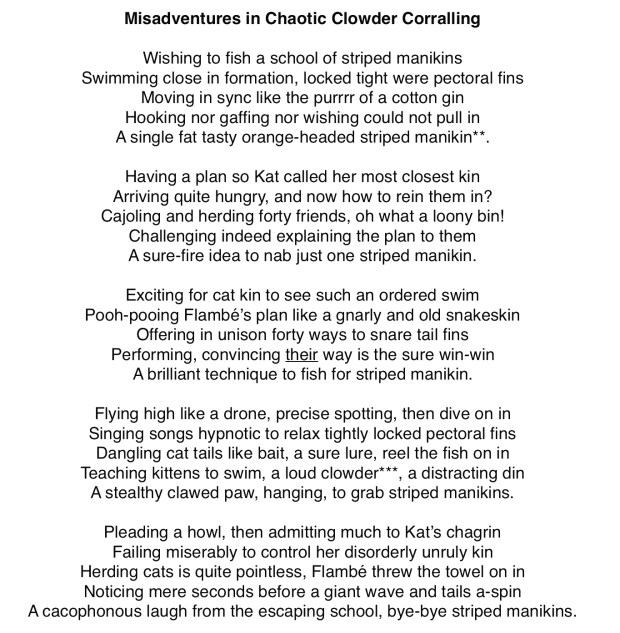
*The origin of the phrase “like herding cats” likely came from the opening scene of Monty Python’s Life of Brian (1979). In this scene, shepherds are discussing sheep and the topic strays to cats: “Can you imagine a herd of cats waiting to be sheared?”
___________________________________
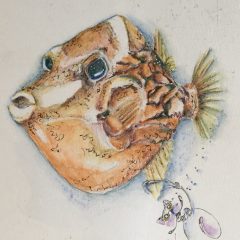
**A fish manikin is a form carved from wood or foam by taxidermists used to mount a trophy fish. Flambé’s school of striped manikins all looked like trophies to her! If only she could’ve herded her cat kin into an attentive and cohesive group long enough to teach them her sure-fire plan for breaking up that school of fish …….. maybe, just maybe she would’ve had a striped manikin to Mount on the wall of her den!
___________________________________
***A clowder is a real thing! It’s what “they” call a group of cats. Honest. But then being naturally curious like my sidekick, Flambé, I wanted to know how many cats are needed to make a clowder. Here’s what I learned:
“Three or more cats make up a clowder, which makes sense. After all, three is a clowd—er, crowd. Jokes aside, this is mainly because the word “pair” covers pretty much any group of two, and if a cat is by themselves, then they’re just … a cat.”
But that doesn’t explain how these feline groups are ever formed ……. after all, wouldn’t that be a frustrating endeavor and quite nearly impossible …… exactly like Herding Cats?
I’ll let you be the judge, but please let me know!
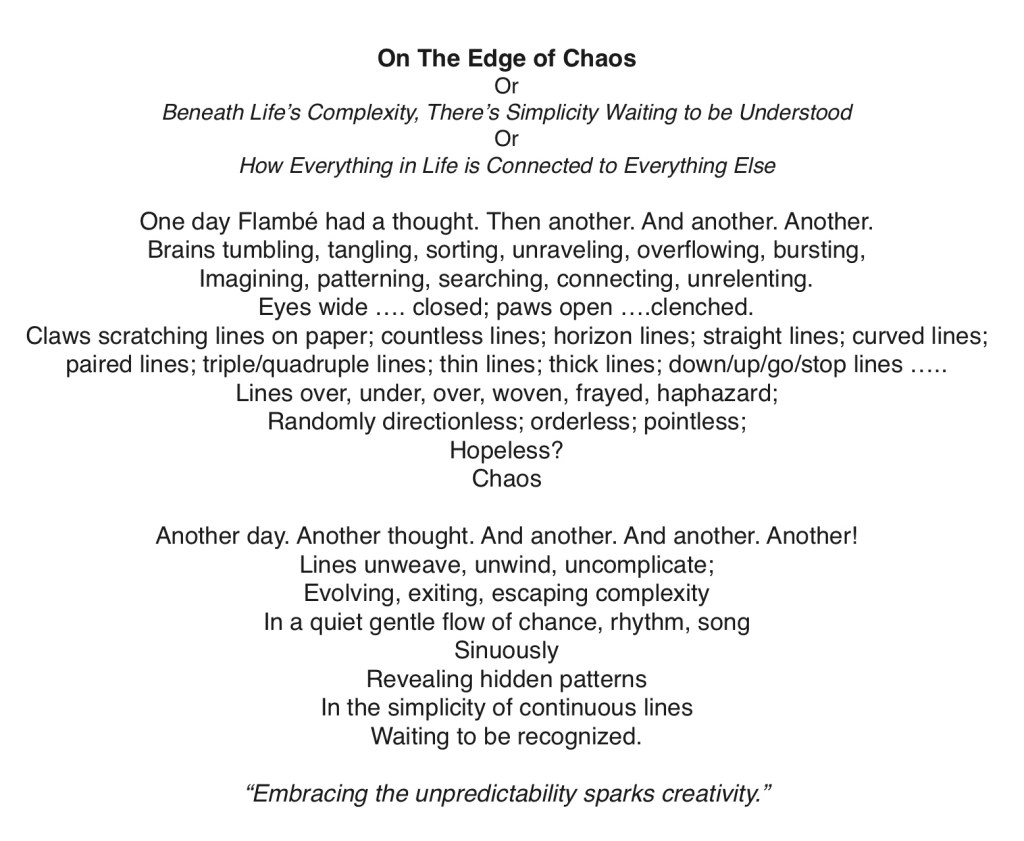
Chaos Never Dies Day is an annual holiday observed on November 9th that reminds us that chaos and disorder are natural and inevitable parts of life. The day encourages us to embrace the chaos and find humor, creativity, and resilience in the face of uncertainty and unpredictability. It’s a time to let go of perfectionism, embrace imperfection, and enjoy the ride.
Flowing from Flambé’s depiction of the chaotic world that lives between her pointy ears, emerges 16 simple continuous line shapes. Can you find them all?
(If you’d like a little help finding these shapes, the answers can be found at the end of this post. But only peek after you’ve given the illustration a thorough looking over.)
Of course, Kat has embedded herself within the chaos; her discovery makes for 17 total shapes.
Flambé’s thoughts on Chaos to Creativity OR an attempt to interpret her scratched lines on paper, in the above illustration.
A few of my elementary thoughts about Chaos and Chaos Theory
Now that Flambé has delighted and (most likely) confused you on the Nature of Chaos, allow me to reflect on my first exploration into the fascinatingly mind bending subject of Chaos Theory. Having never given much thought to the Theory, per se, I’ve always pictured “chaos” as something hectic and uncontrollable. A state of unruliness, mayhem, or disarray liken to natural disasters, mob pandemonium, mass shootings. Sound familiar? We’ve all likely been witness to an unfathomable situation and declared our world to be in “complete and utter chaos!” But there’s more, a lot more to Chaos Theory, where it is encountered and how it affects us.
When my reference list of lesser known Annual Days revealed November 9th is celebrated every year as “Chaos Never Dies” day, I was appalled. I mean, really; who wants to live in a world of ever-present and everlasting chaos?
But from the description of this Day, it appeared there was a positive side to chaos, piquing my curiosity. Anything that can make us laugh and inspire creativity has to be awesome! So began my last few weeks of intense study and pouring over countless YouTube videos to learn about Chaos Theory.
The more I read and viewed educational videos proclaiming to explain Chaos Theory in easy-to-understand language, the more confusing it seemed. The language was English, but the concepts seemed abstract to me …….. well, they were just plain chaotic! (This caused me to laugh!). It would be easy to spend a lifetime trying to “get it.” I’ll just have to keep learning!
So far, I learned about many familiar and new terms associated with Chaos Theory. These include the Butterfly Effect (highly central to Chaos Theory) which shows the connection between disorderly and highly organized things, like how the flap of a butterfly’s wings can lead to a string of events that can form a hurricane! It’s complex, but emphasizes (among many things) that we can’t know the consequences of seemingly simple systems due to unpredictable variables. That leads to Heisenberg’s Uncertainty Principle, Feedback Loops, Fractals, Probabilistic and Deterministic modes, etc.
Are you still with me?
In a nutshell, Chaos Theory “provides a scientifically quantifiable but simultaneously poetically suggestive way of looking at how almost everything in life is connected to everything else.”
We live in a “chaotic” world, and how we react and/or adapt to its unpredictability and complexities matters. But as someone (?) once said, “Embracing unpredictability sparks creativity.” What does Chaos spark in you?
The images of all Continuous Line drawings and their order of emergence.
World Smile Day is an annual celebration of the simple yet powerful act of smiling and spreading joy to others. It was created by commercial artist Harvey Ball in 1999 to honor the iconic smiley face he created in 1963. On this day, people are encouraged to perform acts of kindness and make others smile, both in person and through social media. World Smile Day is celebrated on the first Friday in October.
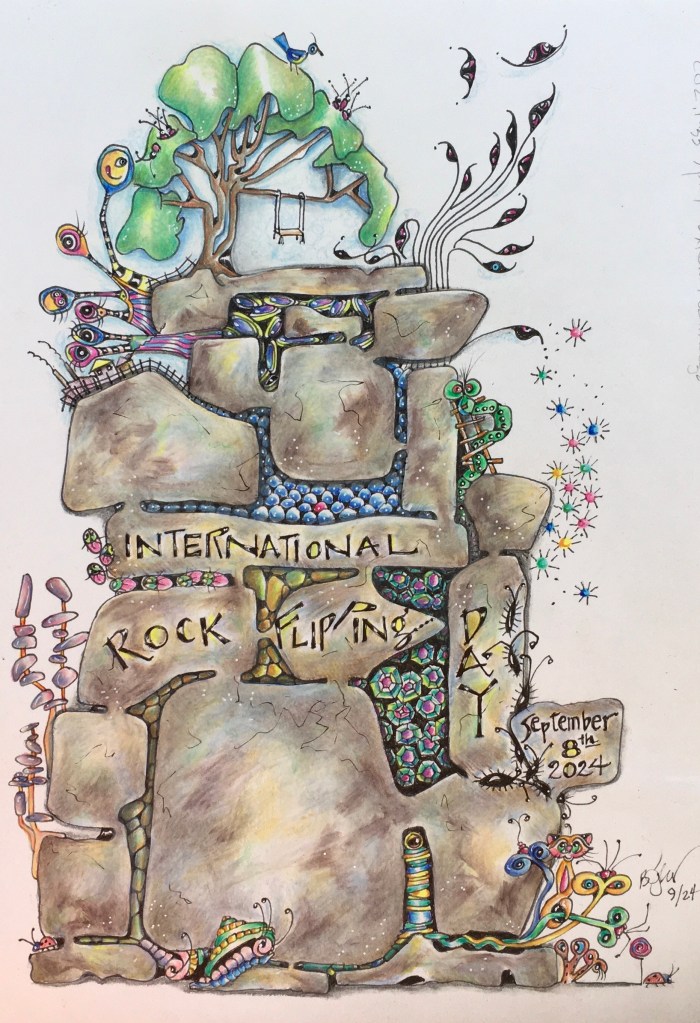
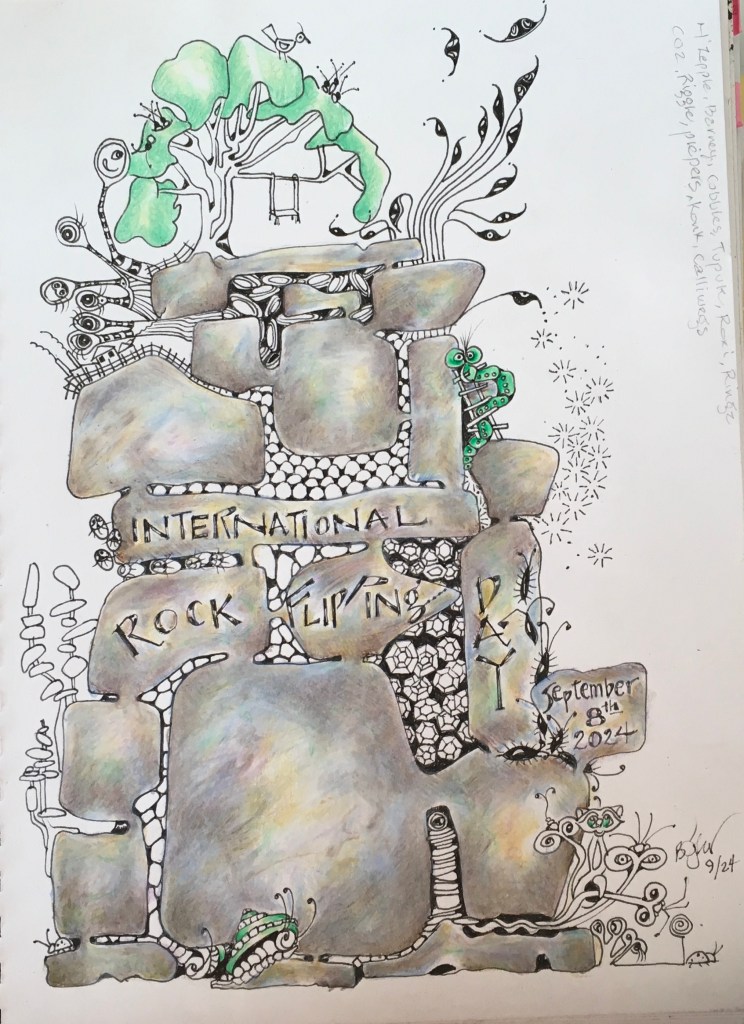
Unbeknownst to me …… until right now! Hitting me like a ton of rocks, I just learned that every second Sunday in September each year marks a worldwide celebration known as
International Rock Flipping Day
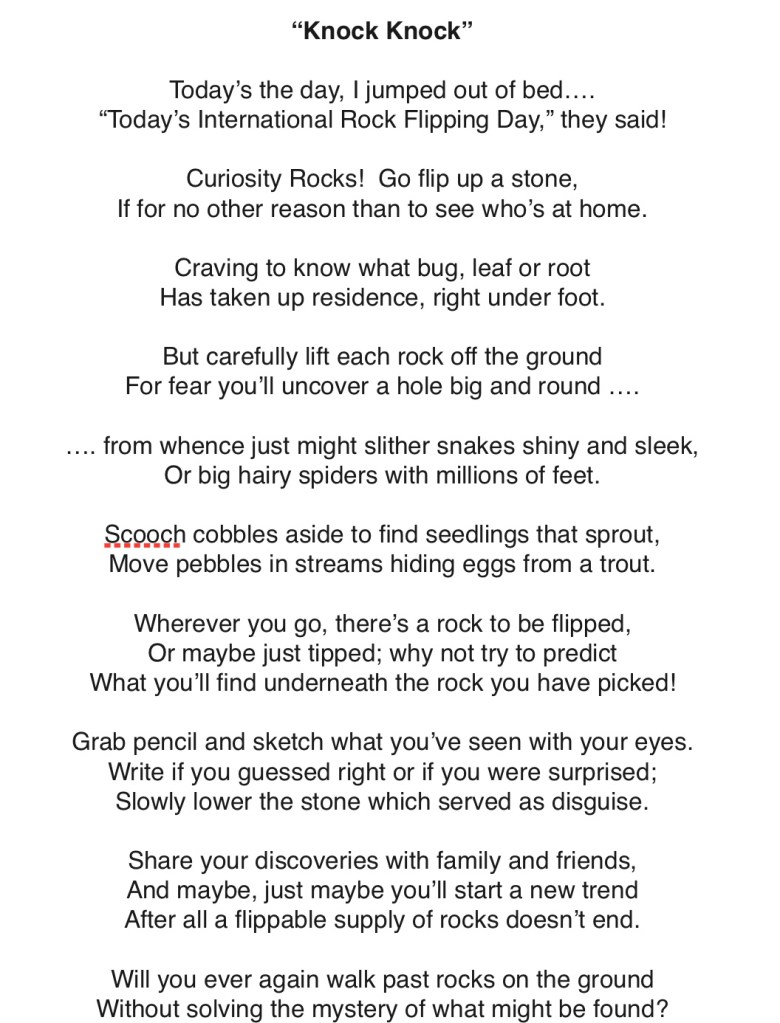
Today is a day to encourage people to explore and learn about the natural world by flipping over rocks to see what creatures and other organisms live underneath them. Participants share their findings and observations with others to promote curiosity and appreciation for the environment.
If no one was at home, tell me about your flipped rock(s)!
Bring out your Inner Child!
I don’t care what town you’re born in, what city, what country. If you’re a child, you are curious about your environment. You’re overturning rocks. You’re plucking leaves off of trees and petals off of flowers, looking inside, and you’re doing things that create disorder in the lives of the adults around you. – Neil deGrasse Tyson
A few more …..
As with other phases of nature, I have probably loved the rocks more than I have studied them. – John Burroughs
If it weren’t for the rocks in its bed, the stream would have no song. – Carl Perkins
The problem is not scientifically illiterate kids; it is scientifically illiterate adults. Kids are born curious about the natural world. They are always turning over rocks, jumping with two feet into mud puddles and playing with the tablecloth and fine china. – Neil deGrasse Tyson
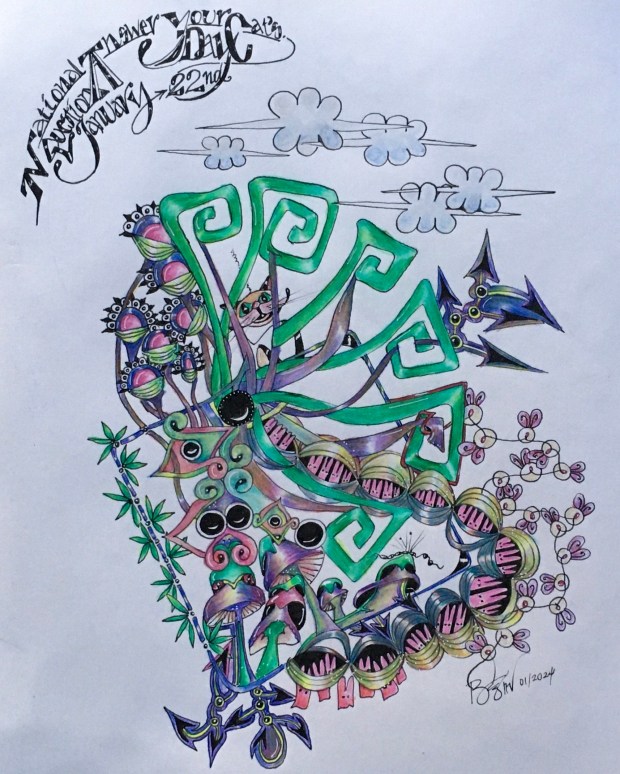
Since January 22nd, which happened to be National Answer Your Cat’s Question Day, Flambé has been asking non stop questions about almost everything, impatiently expecting instant answers. Meeee-owwww! Have I released the FrankenKat? Like a child who’s just discovered speech, and must know answers to all the Who’s, What’s, When’s, Where’s and the Why-Why-Why’s in her world, Flambé is tireless. Maybe there’s a National Teach Your Cat to “Google“ Day? While that may take some of the pressure off of me, wouldn’t that be like plugging in FrankenKat, supercharging then enabling an entire new race of Feliscatus to evolve and take over Earth? Interesting scenario, but highly unlikely. A species without thumbs could never rise to such power! (Or could they?)
Ok, I’m way off track. Back to my chatty Kat.
A few days ago, Flambé asked a hilarious (to me) question and before busting out in an uncontrollable belly laughing episode, I asked her to repeat the inquiry. Maybe my ears had tricked me? So Kat asked very seriously again, “What’s a Tater Tot?” !!!!
Suppressing my laughter (still), I was relieved to know not a thing was wrong with my hearing. Without answering her question, I said, “As it just so happens, you’ve stumbled upon a remarkable coincidence. Today happens to be National Tater Tot Day; let’s search for answers together!”
And this is what we learned:
Yummmmmm! Tots and Ketsup! Royalty-free image from Dreamtime
National Tater Tot Day is a food holiday celebrating the popular snack made from grated and fried potatoes. It is observed annually on February 2nd and is a day to indulge in Tater Tots in all of their crispy, golden, and delicious glory.
The True Story Behind the Tater Tot
The year was 1953. The location was Ontario, Oregon. The owners of Ore-Ida, F. Nephi Grigg and Golden Grigg, we’re cooking up something new. Inspired by mountains of leftover slivers of cut-up potatoes, instead of always disposing of this “waste,” they began experimenting with these still edible bits of spuds. Finding tasty seasonings and using flour as a binder, the slivers were sliced into even smaller bits and all ingredients were combined into a mash. The mash was then pushed (extruded) through holes creating a shredded potato mixture that was deep fried. Tater Tots were born ……..
…….. But they were born without an official name. So what to do?
The Griggs decided to hold a naming contest. Out of all the entries received, the winner was Clara Lay Orton, who came up with the now famous name “Tater Tots.” Loosely translated as “baby potatoes,” Tater Tots were sold for the first time under their new name in 1956. Since then many other manufacturers have tried to copy the Ore-Ida recipe, calling their tots names like tater treats, tasti-taters, potato rounds, potato toes, potato nuggets, potato crunchies, spud puppies, and taytoe tubes. Ore-Ida calls these imposters “imi-taters!”
Not only edible, but wildly popular around the world!
Tater Tots were an instant success (and a profitable money maker for the Griggs) around the world, becoming all the rage in the United States. Statistics show that in the U.S. alone, Americans consume 70 million pounds of tots in a year which is equivalent to 3.1 billion individual cylinders. This also translates to gobbling up 192,000 pounds a day of those mashed up little potato slivers once destined for the rubbish heap. Potatoes are one of the most consumed foods in the States, so it’s no wonder Tater Tots were such a huge success. Deeply ingrained in the American identity, Tots “rank as one of the most commonly consumed meals in almost every household in the U.S.” This irresistible invention may actually be considered a delicacy loved and consumed by millions of people.
A Stylish Tater Tot Tower served at fine restaurants around the world! Royalty-free image from Dreamtime
Skeptical at best …….
Flambé continued asking countless questions, but mostly questioned the use of the questionable “delicacy” label. So to satisfy her curiosity (and hopefully her appetite) it was time to conduct our own taste test. Tumbling out a few dozen frozen tubes onto a baking sheet, I popped them in a hot oven to cook. After waiting the recommended 18-21 minutes, they emerged quite crispy on the outside; soft and steamy on the inside.
A little nibble of a naked Tot told us both that a condiment of some type might enhance the flavor. The choices are many ….. from ketchup to cider vinegar, honey mustard to barbecue sauce, ranch to blue cheese dressing, and even hummus, spinach/artichoke or jalapeño dip. Maybe merely more iodized, pink or kosher salt from a shaker or perhaps a touch of soy? Flambé had to try her favorite, Thai fish sauce on one of her Tots; canned salmon oil on another. But, alas, it was clear our condiment(s) of choice covered up the shredded potato taste of our Tater Tots. And Kat finally came to realize there’s a reason potatoes aren’t a staple or even a minor ingredient found in feline fare…… she was purrr-fectly happy to flick away the Tots and devour the fish sauce-coated salmon fillets, declaring, “Now this is a true delicacy!” And with both her appetite and curiosity well satisfied, Flambé headed to bed for a well deserved katnap.
So while Flambé is snoozing, run on down to your local grocer, buy a bag, and cook up a generous batch of Ore-Ida’s finest in celebration of lNational Tater Tot Day. Let me know how they turned out. And while indulging your inner child, consider these questions:
–Are you a Tater Tot greenhorn, tenderfoot (newbie), dabbler, devotee,connoisseur? -Do you prefer your Tater Tots piping hot, right out of the oven, or with a condiment? -How many condiments have you tried and what are your favorites? -Based on your experience, what’s the strangest Tot topping you’ve ever had? -Have you ever been to a dinner party where the appetizers include Tater Tots with little toothpicks and a dip buffet, or perhaps Totchos sprinkled with cheese over a bed of spicy jalapeños? -Have you ever been to a dinner party, maybe even the same one just mentioned, where the main course is a Tot Casserole, Tot-Ka-Bobs, Chicken Tot Pie, or a Tot-Tofu Stirfry? Have you ever been caught up in Tater Tot Mania or have had your fill & are readyto surrender?
Skewered Tater Tots and Veggies! “Tot-Ka-Bobs”, the healthy alternative! Royalty-free image from Dreamtime
Final Thoughts (Finally!)
If you just can’t bring yourself to acknowledge today as National Tater Tot Day, preferring your spuds in other more healthful ways, feel free to celebrate National Groundhog Day (did he see his shadow where you live?) or World Play Your Ukulele Day …… both fall on February 2nd! Hmmmmmmmm ….. Maybe I’ll compose a little ballad in honor of the Tot, and spend today strumming it on my uke!
Footnote: After examining my Zentangle tribute to the Tater Tot, Flambé tried to sneak in another question, “Do koalas crave or even like Tater Tots?” But I reminded her that today we’ve barely had enough time to answer her first question, let alone two. And until National Teach Your Cat to “Google“ Day becomes a thing, she will just have to remain curious! Tot-Tot Until Next Time!
Final Footnote: Kat said the blueberry smothered Tater Tots with a side of whipped swirls, at center stage in my Zentangle tribute might just sway her to give Tots another try. I’m thinking that might appease her sweet tooth!
Who knew? Apparently Flambé knew! And once she informed me of her January pick of celebratory “Days,” I knew …,,, and then wondered why this came as a surprise! After all, cats are insatiably curious, and Flambé is no exception. It’s just that we don’t always speak the same language …… her “mee yow” can be hard to understand, and my reply, “whah aht” must sound like Greek to Kat.
“National Answer Your Cat’s Question Day is a day dedicated to playfully imagining that your cat is asking you questions and answering them in a fun and creative way. It’s a lighthearted celebration that encourages pet owners to engage with their cats.”
So when we woke this morning, someone must’ve gifted us a fully-functional universal interspecies translator because Flambé was speaking my language, and I hers! Instead of her usual “mee-yow-yow-yow,” what I clearly heard was “feed me now, but not that dry kibble, a gravy soaked chow with juicy morsels to nibble.”
While uttering and sputtering my flabbergasted reply, Kat hopped matter-of-factly into my arms. Looking me right in my left eye she said, “I have always spoken clear and precise English, as did my mother and her mother before her. It’s you who have stubbornly refused to listen. But it’s about time you reciprocate. Let’s celebrate NationalAnswer Your Cat’s Question Day with this burning question ……. “
“Why are there so many rabbits in my yard?”
Of all the questions I could’ve imagined Kat asking on this wondrously unbelievable January 22, this one didn’t even rank in the top 100! But wishing to make amends for my years of misunderstanding, I not only acknowledged the exponential growth of bouncing and burrowing bunnies, but plunged through the literature in search of an answer. Here’s what I shared with Flambé:
“There’s nothing more exciting to a rabbit than a yard full of intentionally or carelessly cast away debris and other things. Rabbits don’t see your trash as junk. Instead they view your yard rubbish as building materials for constructing their underground burrows and nests.”
“Unless you change your rubbish disposal habits, you’ll continue to grow your collection of fuzzy yard rabbits!” I emphatically explained to Flambé. “And much much more sooner, way way before later, underground crowding will force hiring a relocator to relocate the billions and billions of bunnies, and you haven’t got anywhere near enough money!”
Kat sighed with dismay, “I’ll lose all of my friends. But I agree that it’s time for my bad habits to end.” If it’s fine for a few fuzzy rabbits to stay, I’ll take away all unused rubbish today, ok?” And she purrrrred and purrrrred.
How could I look into those big emerald green eyes and deny Kat a few furry friends? So I said. “Of course it’s ok, especially on such a fun celebratory day.”
And we spent the remainder of the day gabbing about this and that;
we had a wonderful time!
What’s your favorite cat, real or imaginary? Do you speak “cat?” Does your cat speak to you? How did you celebrate National Answer Your Cat’s Question Day?










 a curious nature