High on the Views: Camping Above the Rio Grande

June 6, 2025

Such an awesome-inspiring place to spend a Spring week in New Mexico!
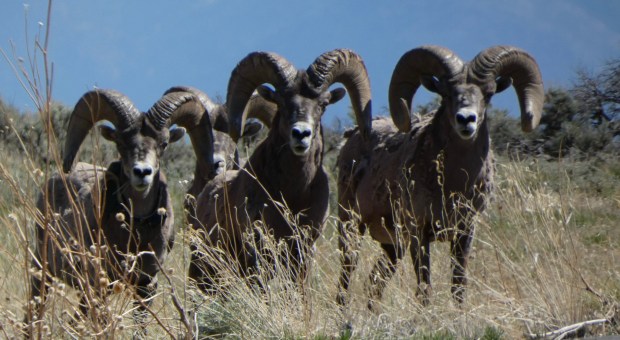
Three of the five big boys! Rocky Mountain Big Horn Sheep.

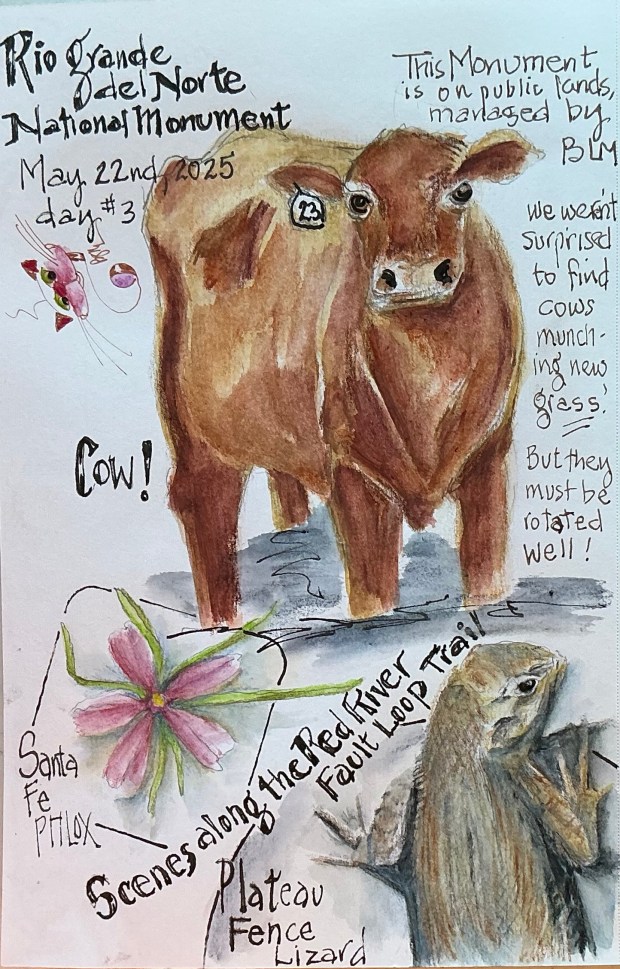
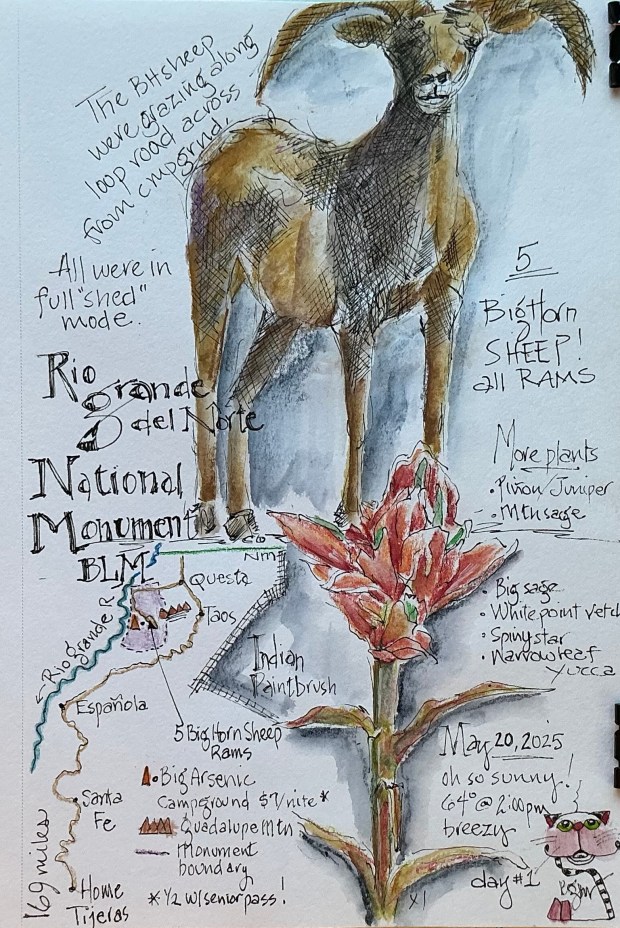
Rio Grande del Norte National Monument ….. 

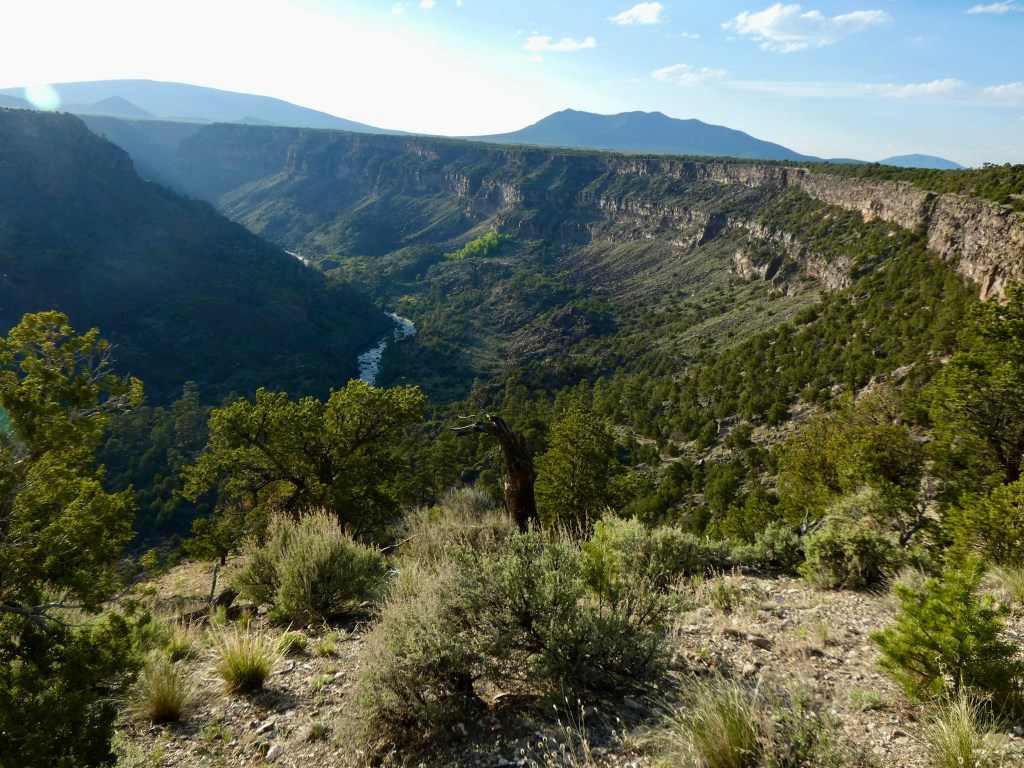
comprises a breathtaking 245,000 acre area of the northern Rio Grande rift valley in north central New Mexico.  Established as a Bureau of Land Management (BLM) national monument in 2013, the rugged wide-open plains average 7,000 feet in elevation before dropping into steep narrow canyons carved into the landscape by rivers that have been flowing for millennia.  
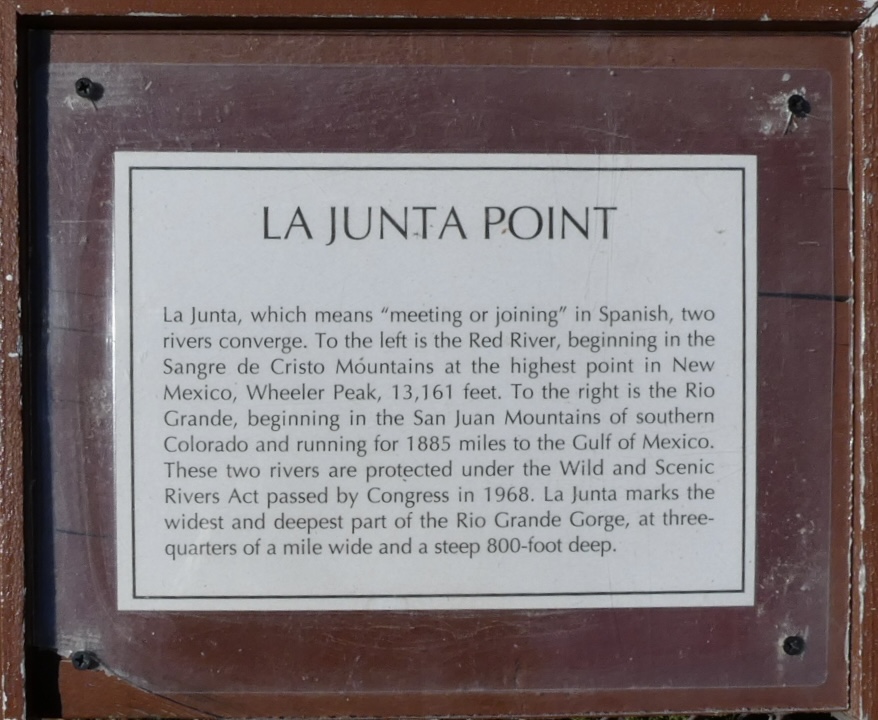
The confluence of two of these rivers, the Rio Grande and the Red River, occurs in the northern Wild Rivers area of the Monument. It’s at this confluence where the gorge is its deepest at 800 feet, and its widest from rim to rim measuring 3/4 mile. It’s an impressive view from the la Junta (“the Meeting”) Overlook. All of the views from anywhere along the rim are impressive.
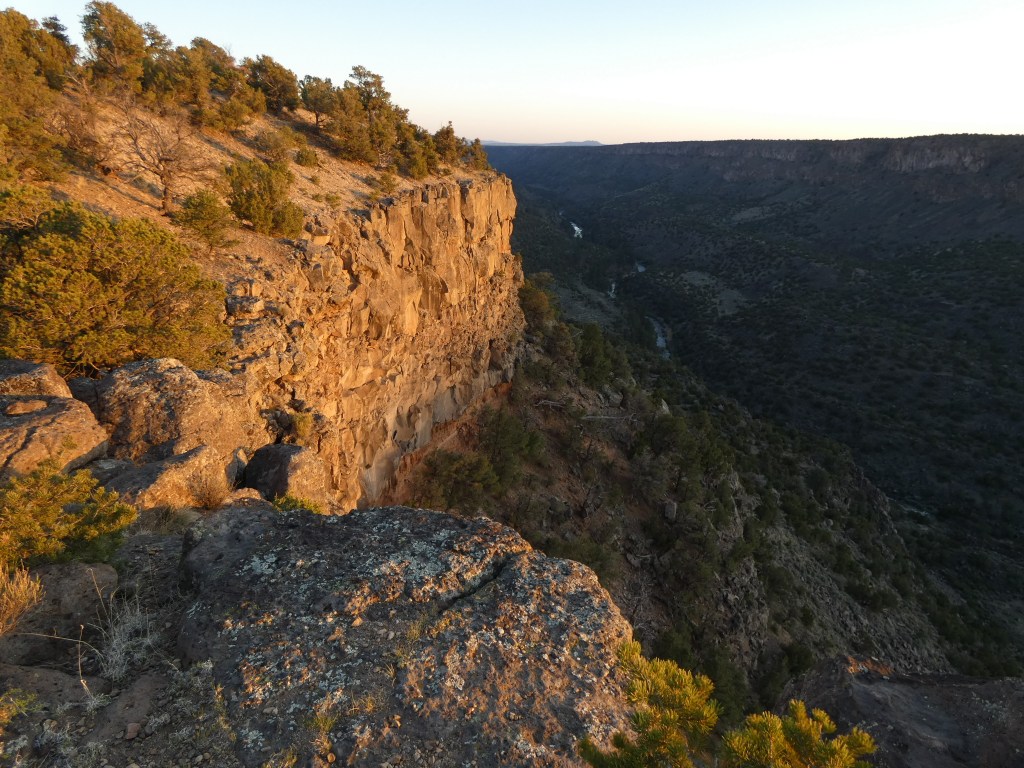
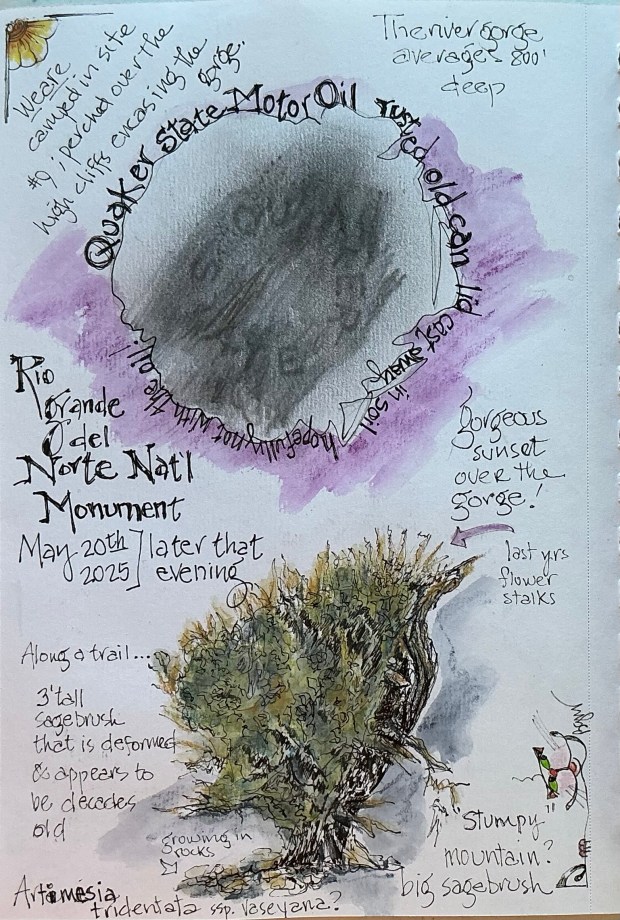
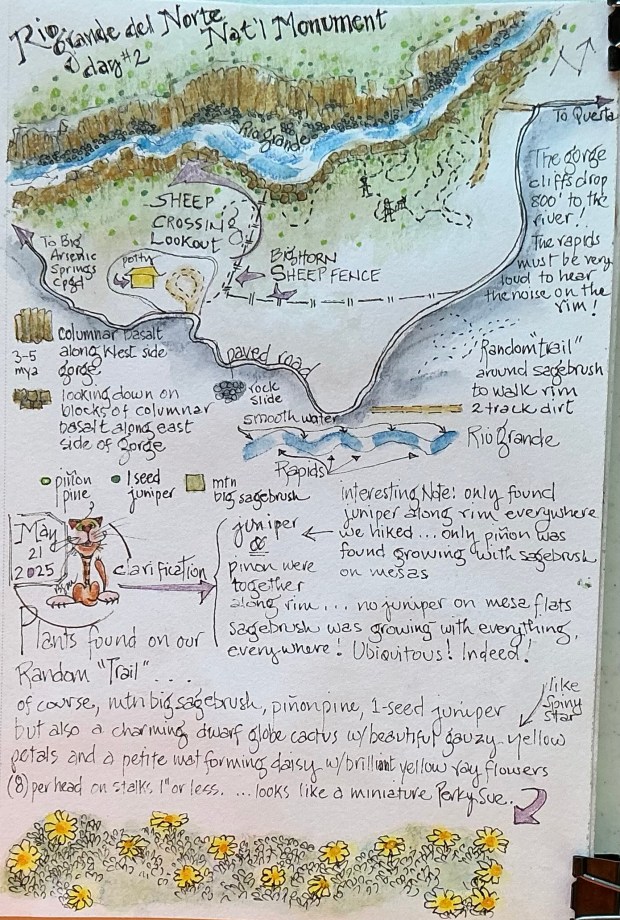
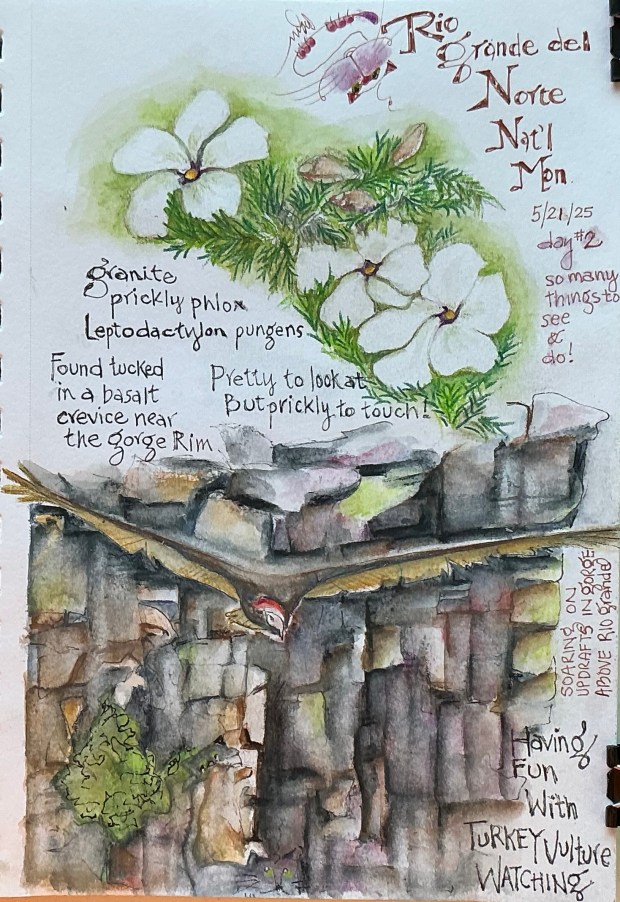
We backed our RV (‘Felix’) into what must’ve been the best designated camping site ever ….. #9 on the southern loop in Big Arsenic Springs Campground. After setting up, we discovered that Felix rested only a few steps west was the rim and the long plunge down to the Rio Grande!  But immediately south of us, the rim formed a small peninsula where nearly every afternoon I could be found sketching the plants growing from the basalt cliffs, or the swifts and turkey vultures soaring along the cliffs and over the river aided by the canyon’s updrafts. This skinny little peninsula quickly became my favorite sit spot; then late one morning it became priceless …….
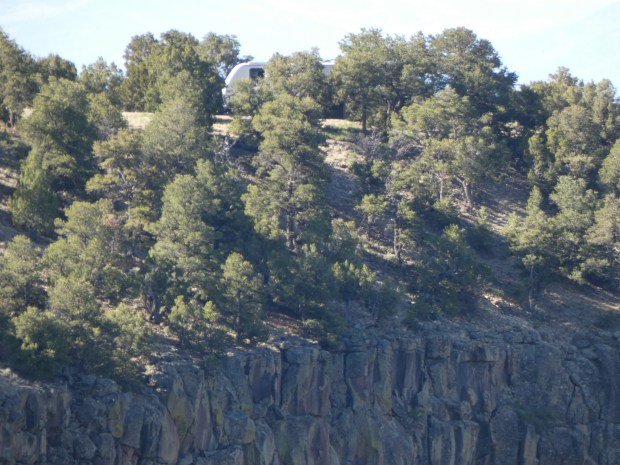
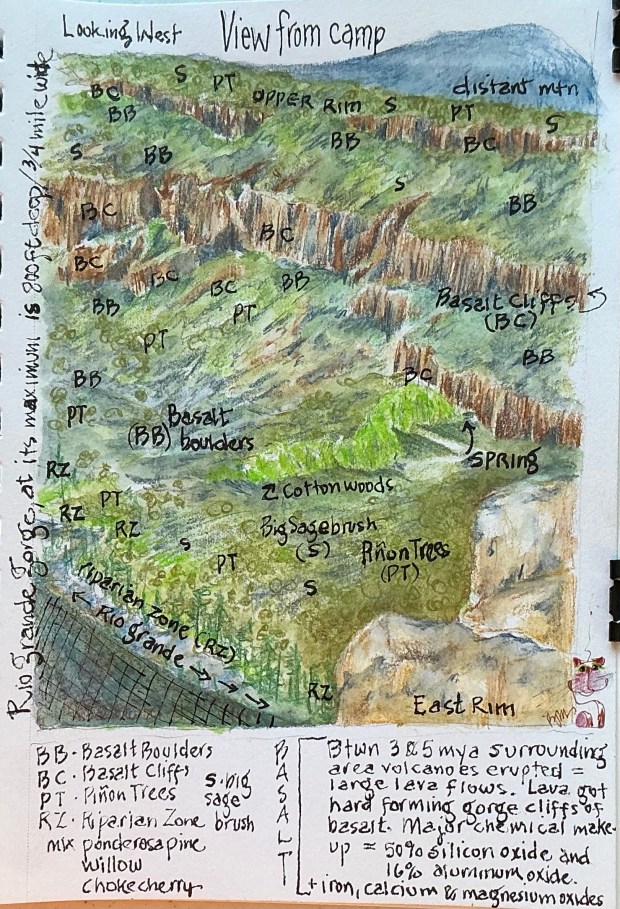
Can you spot our RV? We were precariously perched above the Rio Grande, right on the rim of the gorge!

I could hear them approaching, like a swarm of bees. In a matter of seconds I was  witnessing a cacophonous chorus of 100’s of pinyon jays. These noisy birds quickly moved in and onward while descending, like they were famished, on this year’s piñon pine cone-laden trees in large erratic groups, all the while screaming, “Hurry, Hurry, Hurry, Hurry!” Where exactly they came from or where they went remains a mystery. All I know was the spectacle must’ve lasted a good 10 minutes or more, as I watched wave after wave of these birds pass by. I still get goosebumps (jaybumps?) recalling those exciting moments.
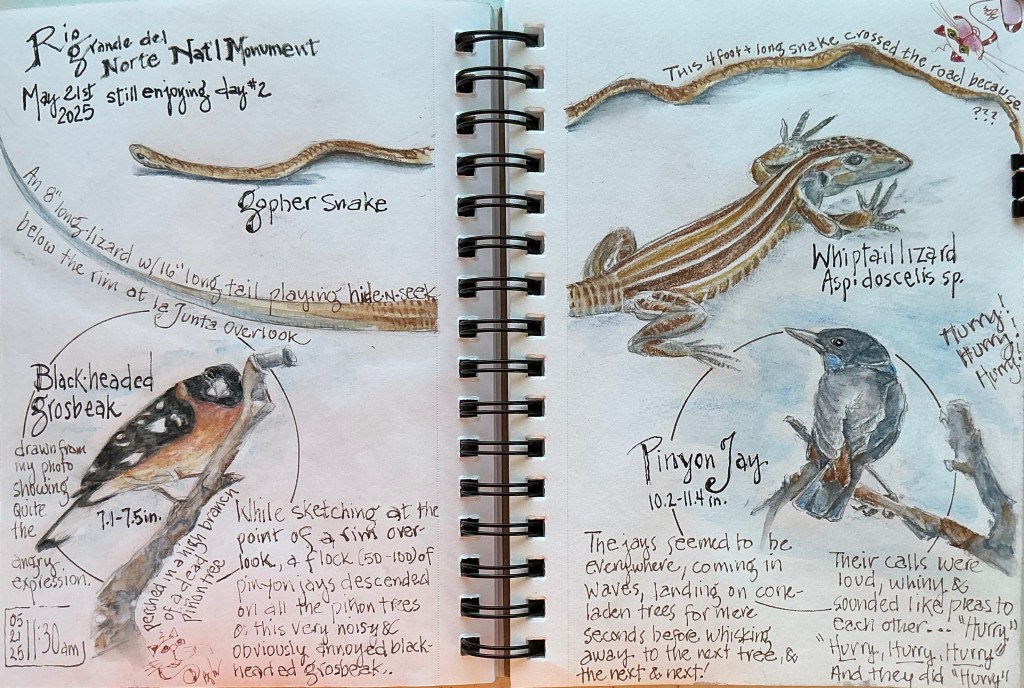
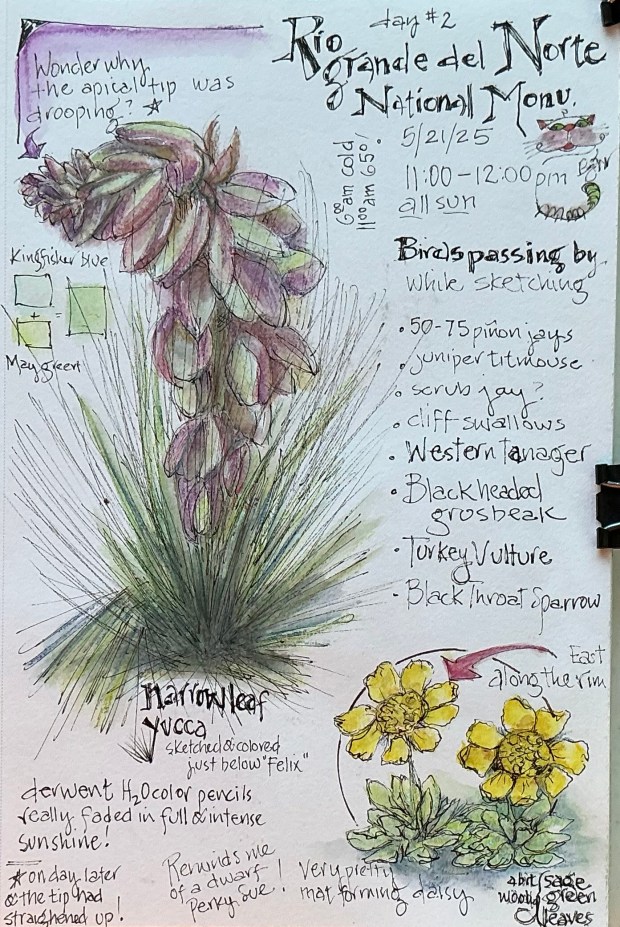
We had planned to spend only one day camping in the Monument, but every morning we decided to stay at least another and then another day. We hiked every rim and interior trail (sometimes more than once), spent hours at all of the Overlooks getting ‘High on the Views,” were thrilled with our chance encounters of five (5) Rocky Mountain Big Horn Sheep rams (twice in one day), and marveled at how the forces of nature* collaborated to carve the narrow and steep 800 foot deep gorge within the Monument.

But alas, it became time to pack up our home away from home. Even tho a string of completely clear days allowed sun to shine on our solar panels from sunup to sundown, keeping Felix’s battery purring happily our entire stay, it did nothing to recharge our potable water tank. So the morning we found the water indicator light teetering on ‘Empty,’ was the day we headed for home (after enjoying a farewell hike, of course) with my nature journal full of sketches and memories for a lifetime!

Do you have an especially special place where you can spend time in nature? Please share your discovery and what makes it so awesome!

As always, thanks for stopping by!

*Geology 101

From the overlooks throughout the Monument, we could see stacks and stacks of basalt and ash lining the narrow canyon walls of the Rio Grande Gorge. It’s hard to imagine the volume of material deposited during two very active periods of volcanic activity that occurred 5 and 3 million years ago. Soon after these events, water moving through the major drainage in the area (today’s Red River) began eroding pathways into these deposits as it flowed downstream into the 10-16 million year old rift valley. Geologists refer to the ancient Red River drainage as the ‘original Rio Grande’ because the still-closed San Luis Basin to the north (in south central Colorado) would not overflow for a few million years. Then 400,000 years ago, coinciding with a change in climate resulting in an overabundance of snow and rain, the San Luis Basin filled and spilled. As water does so well, this new and powerful river, today’s Rio Grande, moved ‘downhill’ towards the ‘original Rio Grande’, cutting through everything in its path (including the ancient volcanic deposits). When it converged with the ‘original Rio Grande,’ the erosive force of both rivers became enough to eventually carve out an 800-foot deep gorge in the Rift.  
Jack

July 16, 2024

While my mind is on the subject of local wildlife residents (see my long-tailed weasel post just a few days ago), I’ve been wondering a bit about the black-tailed jackrabbit (Lepus californicus). Fairly common in our area (and throughout most of New Mexico and the West), it’s always exciting to see one of these swift, long-legged desert “Jacks” bolt and run when spooked. To escape a predator, at the very last moment before discovery, the jackrabbit uses the element of surprise by leaping from his hiding place in the tall grass. The predator, now in hot pursuit, is usually left in the dust as the jackrabbit continues to leap, then leaps/runs until the “Jack” reaches top running speed all the while zig-zagging in an unpredictable manner. And poof! Gone! The predator, now completely baffled, gives up the chase, while the clever jackrabbit lives another day. 

So back to my wonderings.  Just how fast can a “Jack” actually run? How far can he leap? Doesn’t the jackrabbit get its genus name, Lepus, because they “leap?”

What I learned is the top running speed for a jackrabbit is 35-40 mph (Zoom!) and they can leap 15-20 feet in a single bound (super Jack!). Their top speed + their leaping nature allows them to easily escape most predators. But the name Lepus has nothing to do with leaping. Lepus, as translated from the Latin, means rabbit/hare. And one other thing that was news to me …… a jackrabbit is actually a hare, not a rabbit as the common name would imply!   Of course this sparked another wondering.  What’s the difference between a hare and a rabbit?

Various sources cleared up the hare vs rabbit conundrum ….. 

Hares are usually larger than rabbits, have longer ears and black markings on their fur. Hares have 48 chromosomes; rabbits have 44. Hares haven’t been domesticated; rabbits have. Hares live and give birth in shallow depressions in the grass; the young are born fully furred with eyes wide open, able to fend for themselves soon after birth (precocial).  Rabbits usually live and give birth in burrows; the young are born blind and hairless and totally dependent on mom (altricial). Hares usually live alone; rabbits live in large communities called warrens.

There’s so much more to learn, but this will have to do to satisfy my curiosity for now. If you have hares living near you, or perhaps you have a pet rabbit, share your experiences and observations of one or both species.  

P.S. I had fun drawing this jackrabbit (jackhare???), and did so as a gift for a dear friend who happens to love hares/rabbits. Wonder which one is her favorite? I’ll have to ask!

As always, thanks for stopping by!

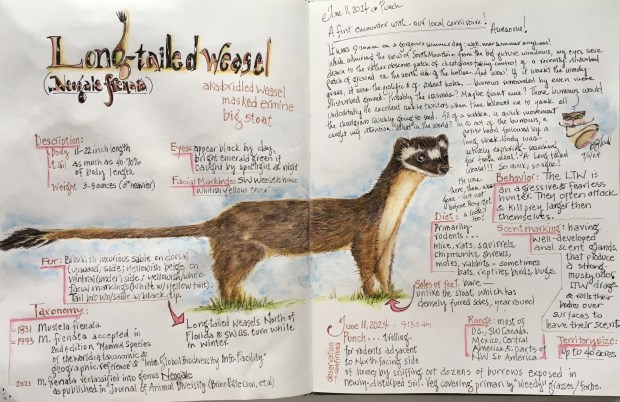
Never Underestimate this Pint-Sized Carnivore…. The Long-Tailed Weasel!

July 13, 2024

Such a surprise and total delight to find a long-tailed weasel hunting on our property! Busy probing numerous rodent burrows for an easy meal, he was too occupied to notice us staring in awe. What a beautiful little guy ……. from the white mask markings on his head, to his luxurious sable-colored fur draped over creamy buff-colored underparts; from his ground hugging, long, thin and sleek body, to his equally long or longer tail with a dashing black tip ……. the long-tailed weasel is a sight to behold!

long-tailed weasel tracks

Although their range includes southwest Canada, all of the lower “48,”Mexico, Central America and parts of northwest and southwest South America, seeing a long-tailed weasel is rare. Only one animal occupies a territory roughly 40 acres in size, which boundaries are aggressively maintained by frequent scent marking.

Even though the neighborhood pack rat, mole, squirrel and mice populations might suffer within a long-tailed weasel’s territory, we would enjoy and appreciate seeing more of this ferocious, pint-sized carnivore around our home!

Have you ever seen this or any weasel species? If you’ve seen this weasel (aka ermine) during winter, fully cloaked in brilliant white except for a black-tipped tail, ooooooooo! How lucky! Share your weasel observations please.

As always, Thanks for stopping by!

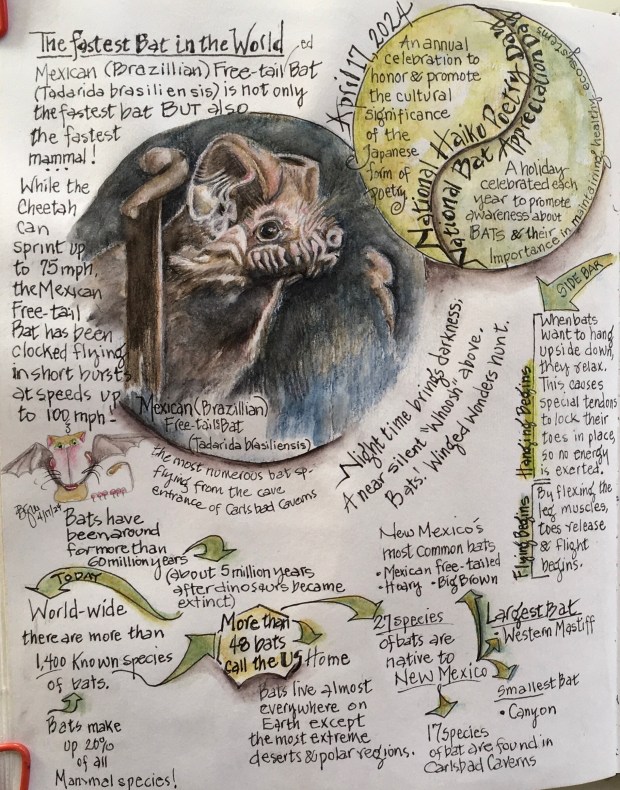
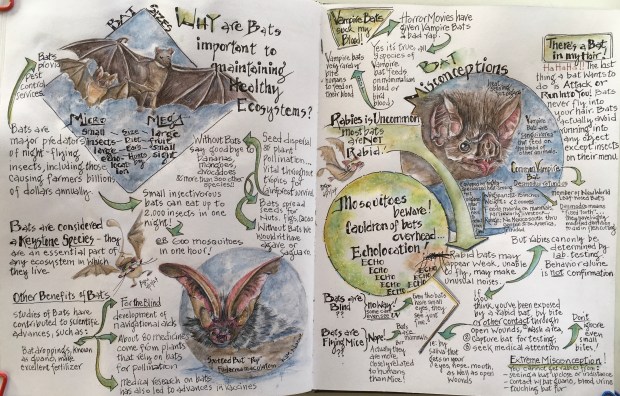
National Bat Appreciation Day & National Haiku Poetry Day -April 17th


April 19, 2024

Of the dozen or so celebrations taking place annually on April 17th, you might think that combing both National Bat Appreciation Day and National Haiku Poetry Day in one blog post makes no sense at all. But if you’ve ever spent even a bit of time witnessing a bat ‘out flight’ at dusk, you’d agree with me that their near-silent hunting maneuvers are sheer poetry! 

National Bat Appreciation Day

A holiday celebrated each year to promote awareness about bats and their importance in maintaining healthy ecosystems.

National Haiku Poetry Day

An annual celebration to honor and promote the cultural significance of Haiku, a Japanese form of poetry.


Dedication

This post is dedicated to my good friend, Holly Silva, who finds bats fascinating. She suggested for my first celebratory day in April, I tackle bats. (Not literally of course!) Like Holly, I’ve always been in awe of bats, having seen many ‘out-flights’ of the tiny insectivorous myotis bat and little brow bat. And then there’s fruit bats!  Oh my …… so hard to resist sharing my story of an amazing fruit bat ‘out flight’ Roy & I witnessed in the Australian Outback, Bats in OZ! 


Bats in OZ

Talk about right place/right time scenario!  We had finally arrived at a well known hot springs south of Katherine after a long, hot, dry day through central Australia. Mataranka, a beautiful series of natural pools surrounded by hundreds of eucalyptus (gum) trees. It was late in the day and we were luxuriating in the hot water, when we noticed everyone there before us was leaving. It was a mass exodus; suddenly we had the springs to ourselves. Five minutes later that we noticed the water rippling around us. We figured a freak storm had appeared out of nowhere to offload huge raindrops in just this spot. Then the “rain” became more intense, the noise became cacophonous, and day turned into night. 

When we first arrived at Mataranka, our focus was on the inviting pools of water nicely shaded by the gum trees. We never looked up into any of those tall, branchy trees … we were happy to have the shade. Now, soaking in the hot water while getting pelted by “rain,” we wondered if we should haul ourselves out, recalling that the locals must’ve known this storm was about to happen (as it did every night); maybe it wasn’t safe for some reason? So wondering how big the storm cloud was we glanced up at the sky through the tree branches. That’s when shock and awe grabbed us! Hundreds and hundreds of tree branches which must’ve been straining under a great weight minutes ago were sighing relief as thousands of fruit bats (aka flying foxes) dropped from their roosts to take flight. Wing membranes spread wide, their sheer numbers blocked out the fading sun. We were speechless! Gaping in awe at the spectacle, our mouths quickly snapped shut …… you see, that “downpour” wasn’t rain at all! All of those big, beautiful bats were pooping out guano as fast as they could! Another ah-ha moment struck us (along with copious quantities of guano) as we made a hasty retreat out of the water, grabbing our clothes and sun hats, and laughing uproariously while beating feat back to the safety and cover of the rental car!

As fast as the “storm” of bats appeared, they were gone, flying off to feed for the night on a Downunder spring bounty of fruits only they knew about. Stuffed by sunrise they would return to the Mataranka community roost to rest and digest before once again taking flight while pooping on the heads of foolish tourists tomorrow at dusk! 


The Post

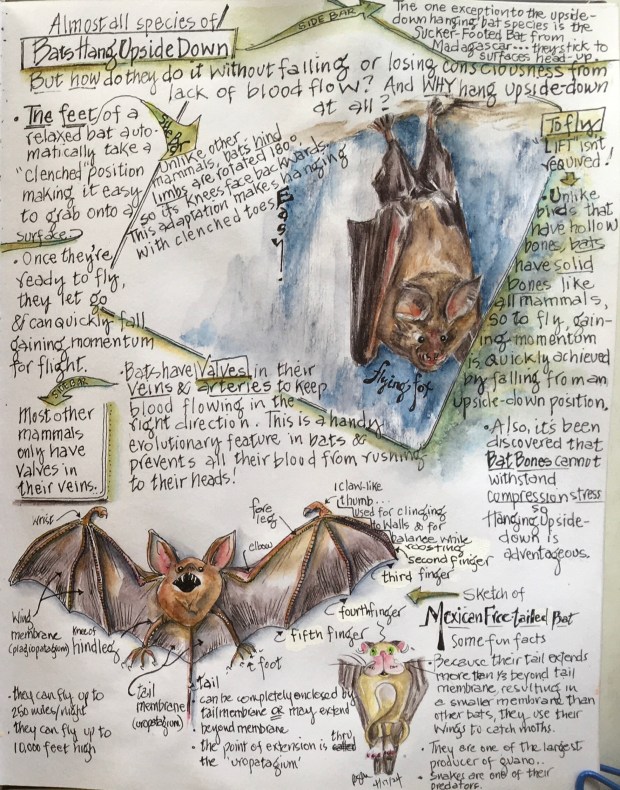
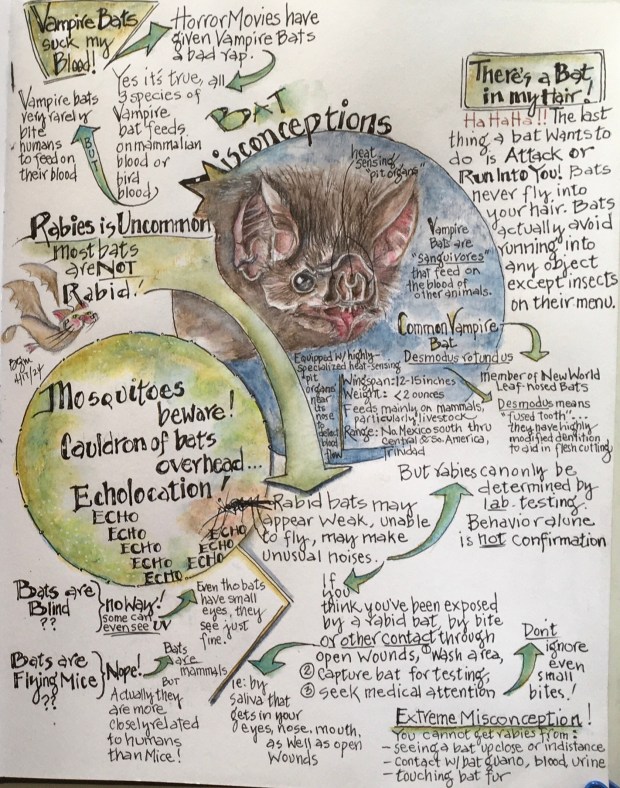
For this post, while exploring bats’ importance in the ecosystem, to science, and while recalling all of those Australian flying foxes I was curious about why and how bats hang upside down, the types of bats and their diets, and what adaptations Vampire bats have causing them to crave a diet of blood. Much of this rabbit-trailing led to myths and misconceptions about bats, then back to New Mexico’s most famous ‘out flight’ of the American Free-tailed Bat every spring, summer and fall evening from Carlsbad Caverns. While learning, several Haiku poems materialized reflecting bat behavior.  

Nighttime brings darkness
A near silent “whoosh” above
Bats! Winged wonders hunt

It would’ve been easy and fun to fill up the rest of my journal with bat facts and more Haiku, but because the celebratory date of both National Bat Appreciation Day and National Haiku Poetry Day has now come and gone, I had to stop. Maybe you’ll want to answer a bunch of your own questions about bats? Maybe you’ll want to write your own Haiku about bats in honor of this style of poetry?  

Mosquitoes beware!
Cauldron of bats overhead ….
Echolocation!

Share your bat stories and Haiku, and let me know if this inspires you to dig deeper into the fascinating world of bats! 


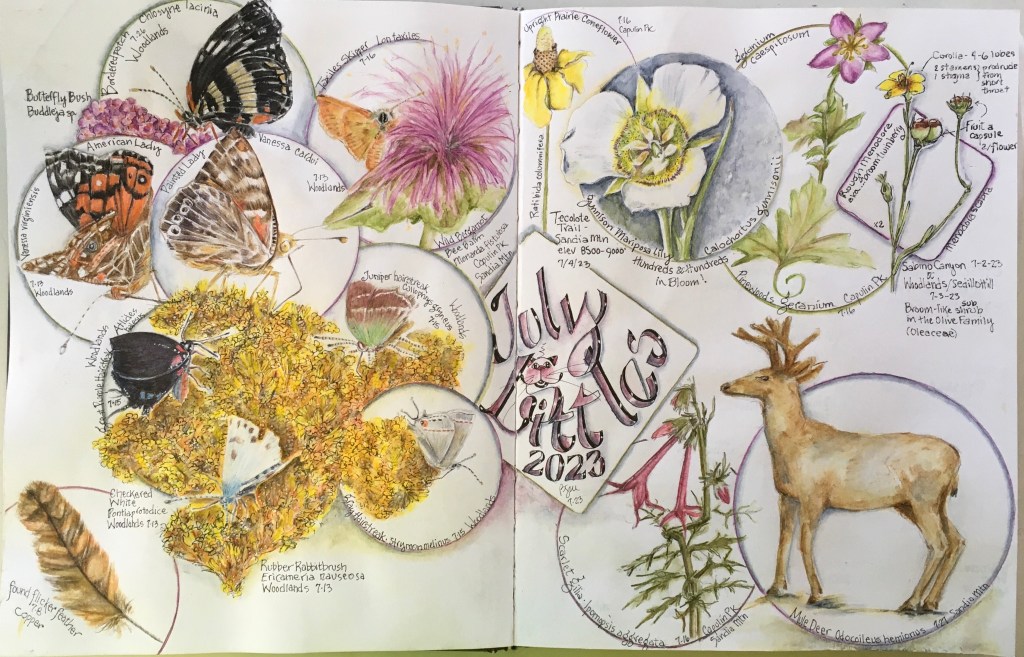
July “Littles” ….. Blooming flowers attract famished butterflies

Two-page spread for July Littles

June’s hot, dry weather slipped stealthily into July as we became mired in one of those infamous heat domes for weeks. Our rabbitbrush shrubs, usually late summer bloomers, burst into piles of brilliant yellow flowers a full month before normal, and for the first week of their premature bloom, not a single pollinator was in sight. I was so concerned the over abundance of nectar would dry up, pollen would blow haphazardly away, and seeds wouldn’t form. Then one morning I woke to find hundreds of butterflies, weevils, flies and bees flitting, crawling and buzzing about, nearly covering the shrubs completely in a pollination frenzy! How did they know? Where did they come from? What a relief for me, but it must’ve been an unimaginable relief for all of those pollinators that happened upon our oasis in the desert.

And so it went, all month…. bursts of early blooms rapidly completing their floral life cycles, thanks to urgently feeding pollinators.

This is how I remember July, with everything in bloom at once, the air full of pollen and pollinators. It was quite a sight!

Once again, a big shout-out to “Made by Fay” for the inspiring “Littles” idea!  Stay tuned for the next installment of “Littles.” 

September 4, 2023

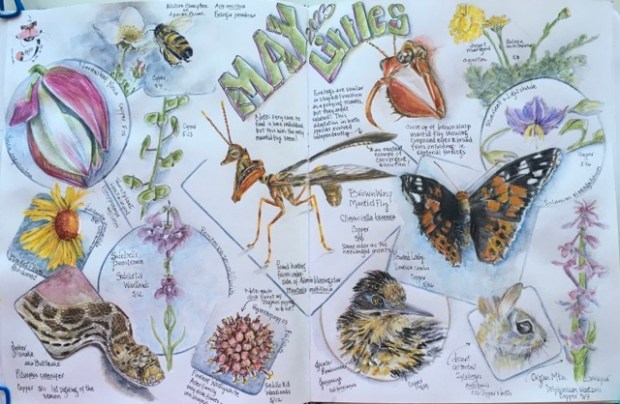
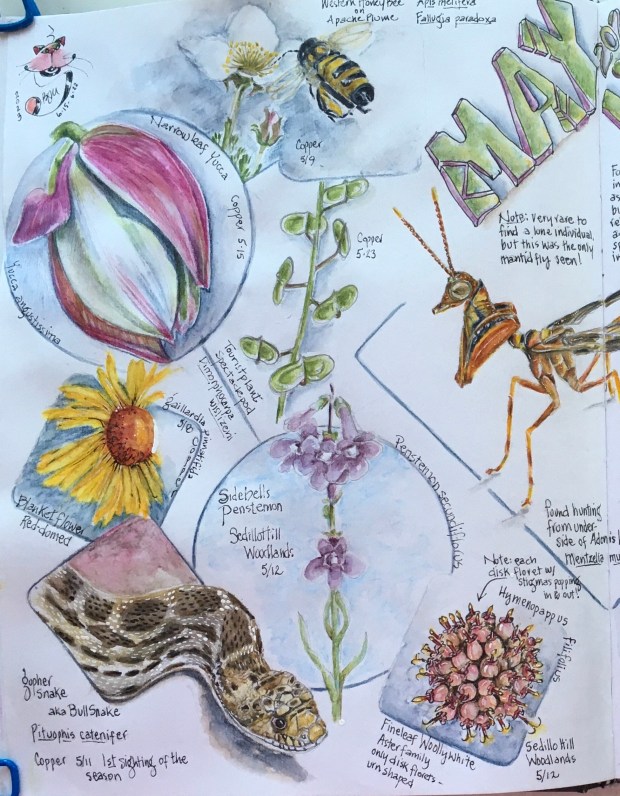
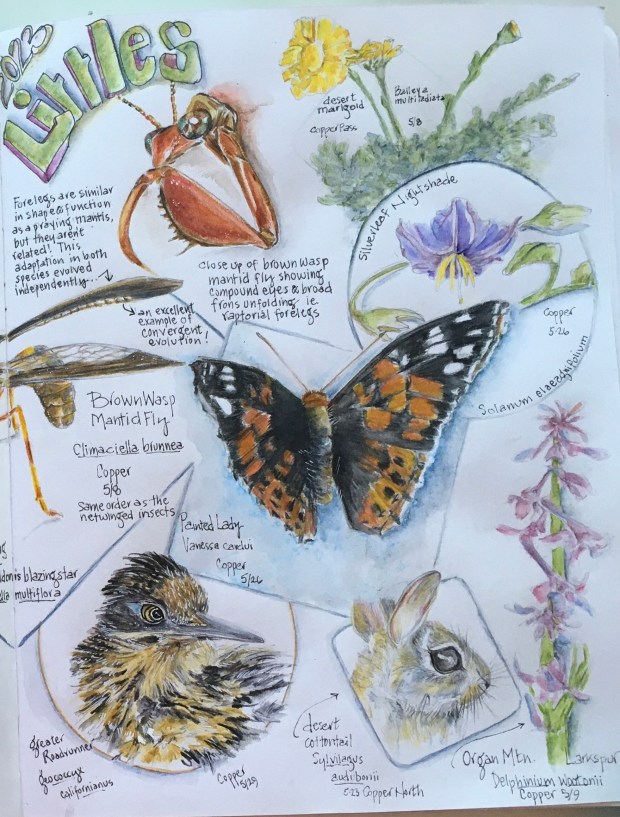
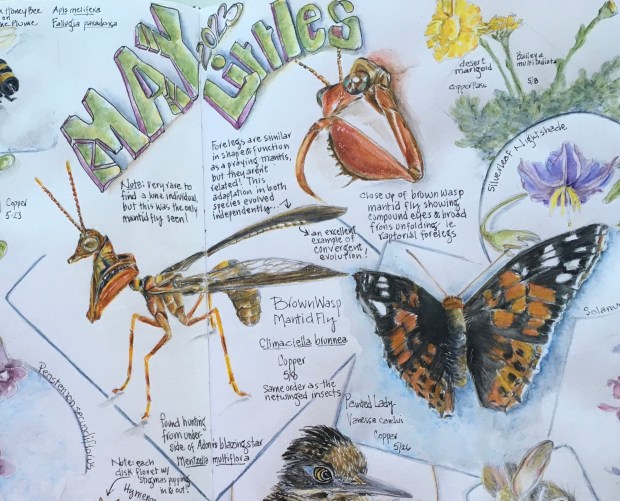
May “Littles” ….. blooming, buzzing, flying, fleeing, stalking, slithering surprises!

April may have been amazing, but it was nothing compared to the explosion of life during May. My 2-page spread doesn’t even come close to representing all that we encountered throughout the month. And the 15 species I chose as “picks” aren’t even a third of those making an appearance …… enter stage left and right! 

Noticeably missing was the black chinned hummingbird. They arrived mid-May, and began defending breeding territories. One of these years, I hope to find one of their miniature nests to see what building materials the hummers use. Until then, their aerial performance is always breathtaking! 

Close-up

Then there was the morning Luna nearly stepped right in the middle of a really upset, hissing and striking prairie rattlesnake, practically right out our front door! It was a scary few moments until we determined Luna did not get bit! Whew.  Roy expertly wrangled up the guy, herding him into a 5-gallon bucket, and relocated him a safe distance away.  (I may cheat and add him to my June “Littles,” if you don’t mind, along with the first rattlesnake encounter of the season! Gotta love the desert.)

Another close-up

Included in the long list of flowering plants, was prickly pear cactus. Several species began opening their buds to reveal 20-30 delicate waxy yellow to apricot colored petals per bloom. It didn’t take long for the pollinators to find these delicacies! 

And Another close up

Blooming in the foothills (5,000’ up to 7300’ elevation), there was milkwort, fleabane, scarlet globemallow, banana yucca, sundrops, milkweed, paintbrush, golden weed, common hoptree, puccoon, several species of pink-flowered hedgehog cactus, blazingstars, bee blossom, tahoka daisy, NM thistle, ……. etc.  I could go on and on! And even at nearly 9,000’ elevation, rock jasmine, valerian, creeping mahonia, prairie bluebells, pasque flower and dwarf lousewort were all in bloom. 

All in all, a bountiful full-on Spring bloom! 

A big shout-out to “Made by Fay” for the inspiring “Littles” idea!   Stay tuned for the next installment of “Littles.” 

June 22, 2023

Meet a Teeth Clacking, Jaw Grinding, Squealing and Woofing Peccary of the Desert Southwest….. the Javelina  

March 21, 2023

Another species we searched for while visiting the Sonoran Desert surrounding Tucson last December, was the javelina. Certainly this elusive little pig-like critter was nearly everywhere we went, as attested to by the thousands of hoof prints echoing their presence. And many of those hoof prints were fresh! Certainly there must’ve been squadrons of javelina hiding behind every mesquite tree around the next countless bend in the trail? 

But alas …. we never saw, heard or even sniffed out a single javelina. All we could do was record (and sketch) the herd of hoof prints, and then research this animal in the following months. Oh boy, did we really miss such a fascinating encounter.

Back at home, several months later, our friend Jim Silva was happy to share one of his javelina skull mounts for study and sketching. I’m thinking we may have been lucky not to have met up with a herd of their clacking canines during our travels! 

Maybe another time?  

Meanwhile …. If you’ve got a thirst for javelina knowledge, or just want to see my journal sketches, read on!

Continue reading “Meet a Teeth Clacking, Jaw Grinding, Squealing and Woofing Peccary of the Desert Southwest….. the Javelina  “

Coues …..Elfin Deer of the Desert Southwest

March 17, 2023

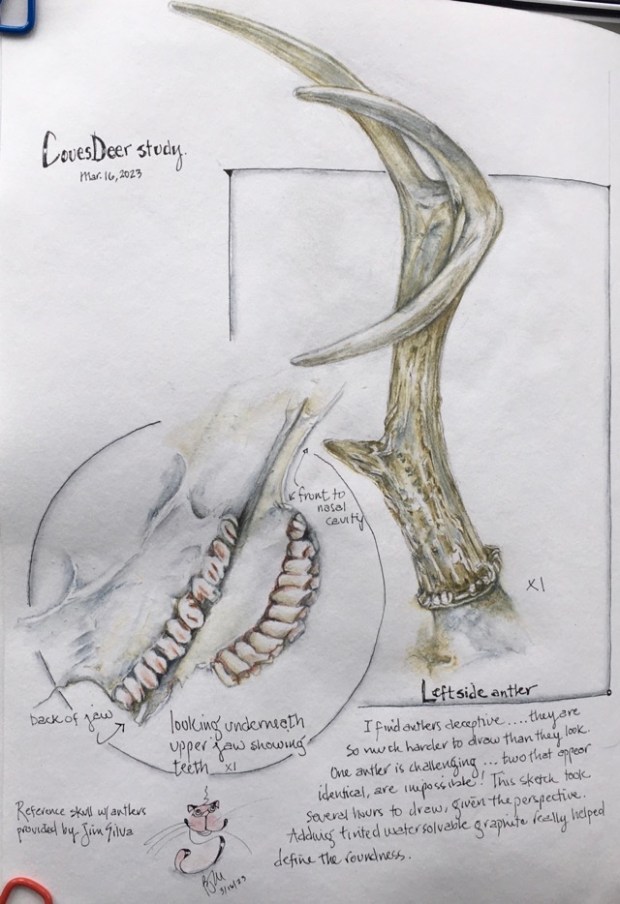
Even though we didn’t see any mammals while visiting the Tucson region last December, we knew they must’ve seen us! But little (pun intended) did we know, a diminutive elfin deer, the Coues Whitetail, was probably among the mix of critters observing us as we explored the area.

This tiny deer, with its oversized ears and flashing tail, is a native species found in the mountainous desert regions of the extreme Southwest and south into Mexico. 

A good friend, Jim Silva, who has hunted this species in southwest New Mexico, shared one of his skull mounts with me. Since sketching the skull and an antler, I’ve learned a bit about the Coues deer, including the highlights included on my journal pages.

“Coues” is most properly pronounced “cows” (but more commonly pronounced “cooz”), is also known as the Arizona Whitetail or Fantail.  Having lived in eastern North Carolina for a number of years, we are well familiar with the Eastern Whitetail, a small enough deer when compared to our local Mule Deer.  But it’s hard to imagine a deer smaller than the Eastern Whitetail.  Now we’re ready to return to the mountains of the Southwest and search for the Coues deer! Maybe late spring when there’s a chance of seeing a few fawns too!

What’s on your nature agenda for this spring? Ours is filling up fast!

Until next time!