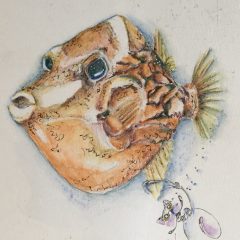
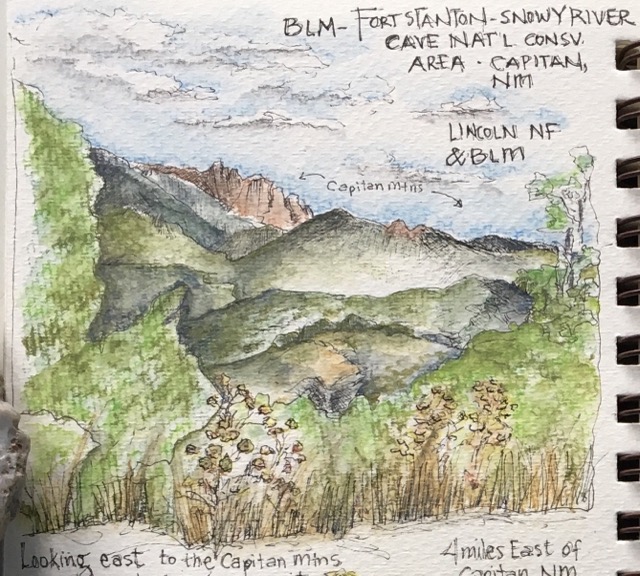
Come on along with us for 5 days of camping fun in the Land of Enchantment, where we had some weird and close encounters with botanical beauties, a bare-butted gopher, a swarm of bees, and voracious leaf-footed beetles! All this, and more while exploring a National Conservation Area, a Desert National Monument, and a New Mexico State Park, all within the Chihuahuan desert ecosystem.
Category Archives: Nature journal
A Sandia Mountain High
Sunday, May 7, 2023
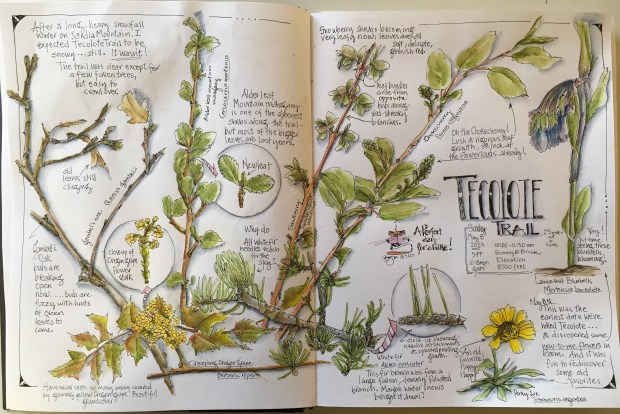
After having just returned from a fabulous week in southern New Mexico (blog posts to come) where we hiked and hiked, and got reacquainted with the Spring-time desert flora and fauna, we seemed to be craving pine and fir trees and some mountain air. How high do we dare hike? Would there still be snow? These and more questions rattled about in my mind as we headed the truck up the 13 mile long and winding Sandia Mountain Crest Road (central New Mexico). Ahhhhh …… so invigorating!
Satisfying our craving (at 8500 feet in elevation) and answering the question about leftover winter snow (not a single snowflake to be found), we pulled up to the Tecolote Trail trailhead and began our ascent, in shorts and T-shirts. The first half mile up was brisk, both in temperature and pace, but after I was well warmed up it was time to open my eyes to investigate anything and everything growing, sprouting and blooming.
This was the earliest date (May 7th) in the Spring we’ve hiked Tecolote, so I was hoping to see a variety of wildflowers that were new-to-me species. I wasn’t disappointed! Blooming beautifully were the minuscule Pygmy-flower rock jasmine (in the primrose family), Arizona valerian (a species of honeysuckle), along with lance-leaf bluebells (borage family), and White Mountain bladderpod (a brilliant yellow 4-petaled member of the mustard family). Covering the slopes everywhere we’re the bright yellow flowers of Oregon creeping grape (aka creeping mahonia), and common along the trail were flats and flats of the dwarf purple and white lousewort (in the broomrape family), it’s flowers growing close to the ground amongst its deep green dense and curly margined fern-like leaves. Perky Sue (a happy yellow daisy) and the soft-like-a-teddy-bear prairie pasque flower (a type of buttercup) rounded out the bloomers that I could find.
These pages in my journal focused on the shrubs and trees showing growth alongside the trail, drawn from snippets collected during the hike.
It was a perfect morning for a hike! Wished you’d been there with us.
Until next time …… How’s your Spring is shaping up! Do you have a favorite plant that’s blooming, or a singing bird tending chicks? I’d love to hear your story.
P.S. This journal page layout was inspired by an amazing nature journaler, artist and teacher, Jean Mackay who loves all of nature and sharing her discoveries through illustration. Thanks Jean!
A “Snow White” Spring Super Bloom … Albuquerque Foothills
April 2023
Oh my goodness! What a brilliant Spring Super Bloom is on display mere steps east of Albuquerque.
Alas, I found myself lamenting for months over the long and snowy wet winter we just climbed out of here in the East Mountains of central New Mexico. It seemed the back-to-back snowstorms since last November were never ending; snow shoveling every morning became the norm. But I know better than to whine. An abundance of winter moisture always results in a spectacular abundance of spring flowers. And this Spring has proven that true.

The last two months we’ve seen a mad splash of sunshine yellow from the blooming of a native winter annual called Golden Corydalis, aka Scrambled Eggs (Corydalis aurea). This member of the poppy family quickly converted the dusty hillsides from brown to a glowing yellow as the many-flowered stalks of this plant seemed to shoot up over last season’s dried grasses. Scrambled Eggs was the plant I thought would be our Spring super bloomer.
But, oh no!
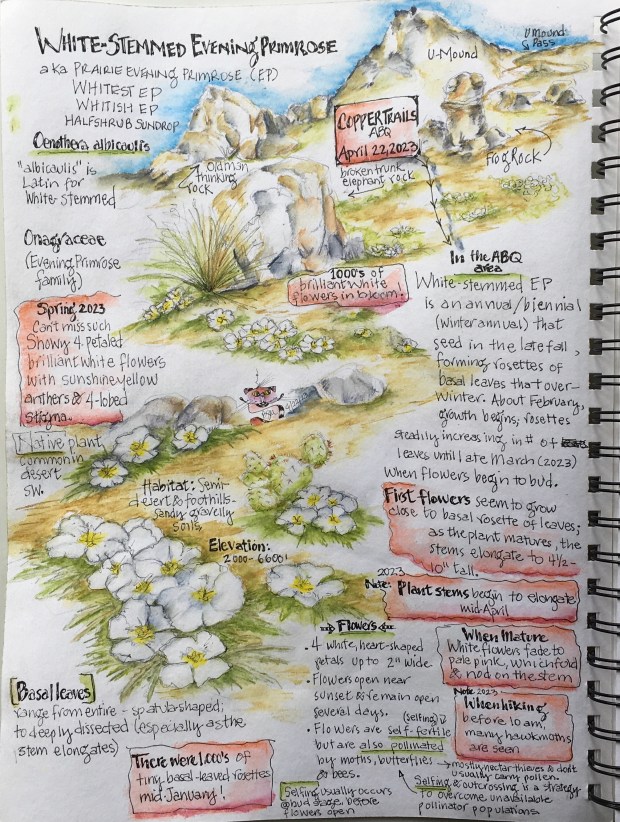
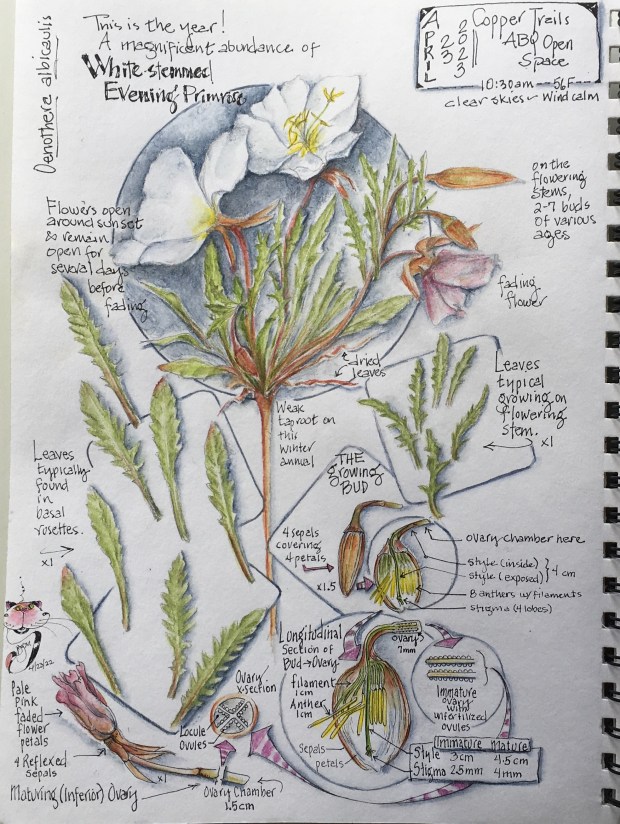
During a full two weeks of being distracted by the glow of all that yellow, all around our feet, 1,000s and 1,000s of blue-gray-green rosettes began to grow. I noticed these rosettes (the very same mystery rosettes I described in my January journal), were rapidly expanding outward to make room for flower stalks heavily laden with little rosy orange buds. And then one day one of those buds unfurled into a brilliantly white 4-petaled flower. In the center of that flower were 8 lemon-yellow pollen-heavy anthers surrounding a 4-fingered lemon-yellow stigma, ripe for pollination. Of course …… now I knew with certainty ….. the flower blooming atop the pretty winter rosettes is the White-stemmed Evening Primrose (Oenothera albicaulis)!
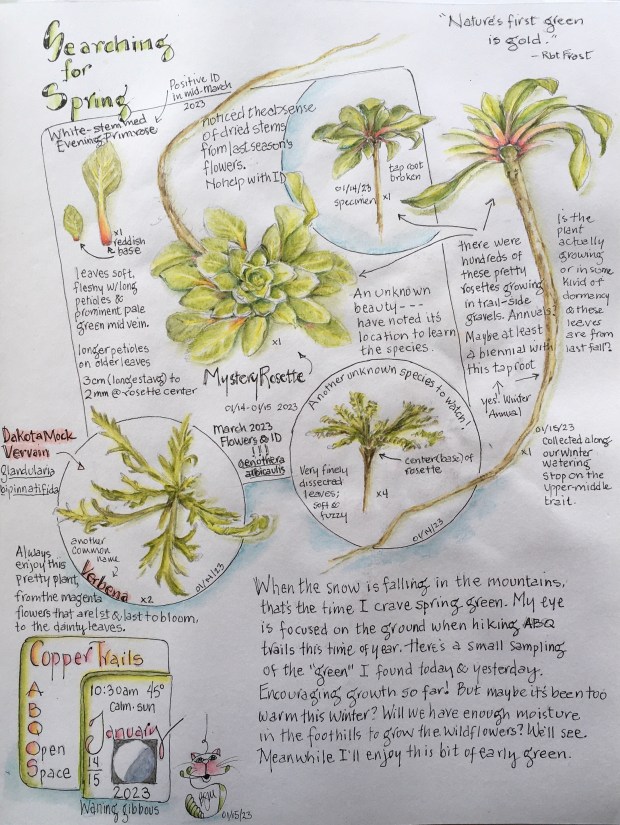
Also known as Whitest Evening Primrose, it wasn’t long until more flowers began to appear. “But, wow, was it possible that all those 1,000s and 1,000s of rosettes would each produce a bouquet of flowers?” Hiking these foothills every day paid of. As the excitement of possibility steadily unfolded, hundreds of thousands of large 2-4” white flowers unfurled each evening about sunset to greet potential overnight pollinators, and to welcome hikers the following morning.
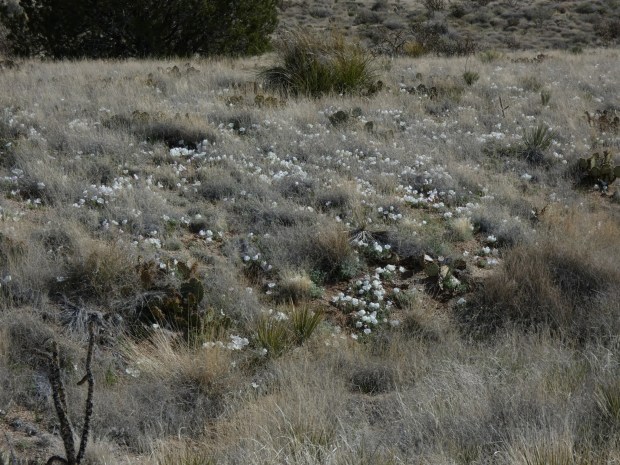
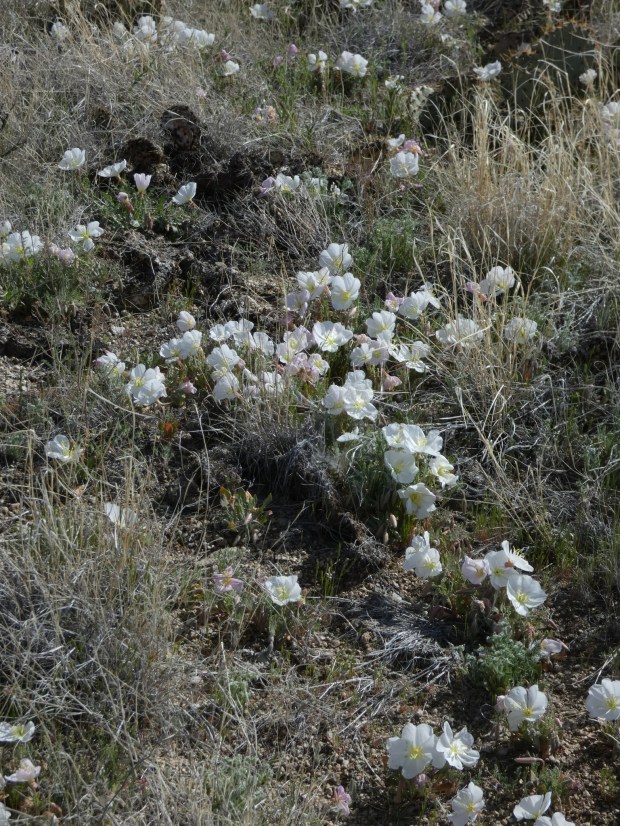
In about a week since I noticed that first open flower, this native Evening Primrose was carpeting the hillsides in white as brilliant and sparkly as newly fallen snow. The ground became “Snow White” with flowers, out-performing the still profusely-blooming Scrambled Eggs.
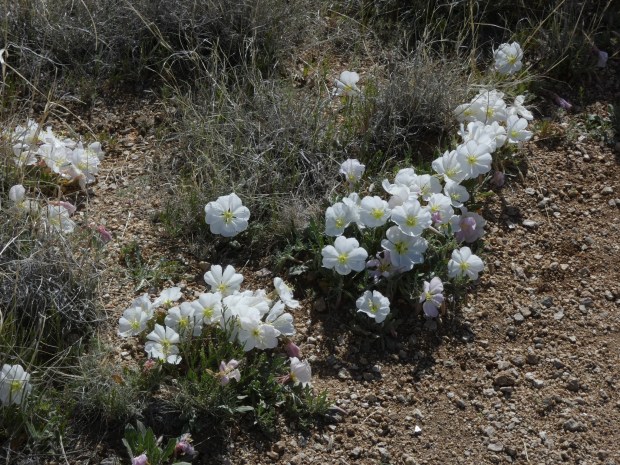

And the show won’t end any time soon …. there are still an unbelievable number of White-stemmed Evening Primrose buds awaiting their turn to enter the play from stage right! Now that’s what I call a true Spring Super Bloomer.
What marvelous transformations have or are happening outside your world this Spring?
March “Littles” ….. Looking for Spring Amidst March Madness
April 3, 2023
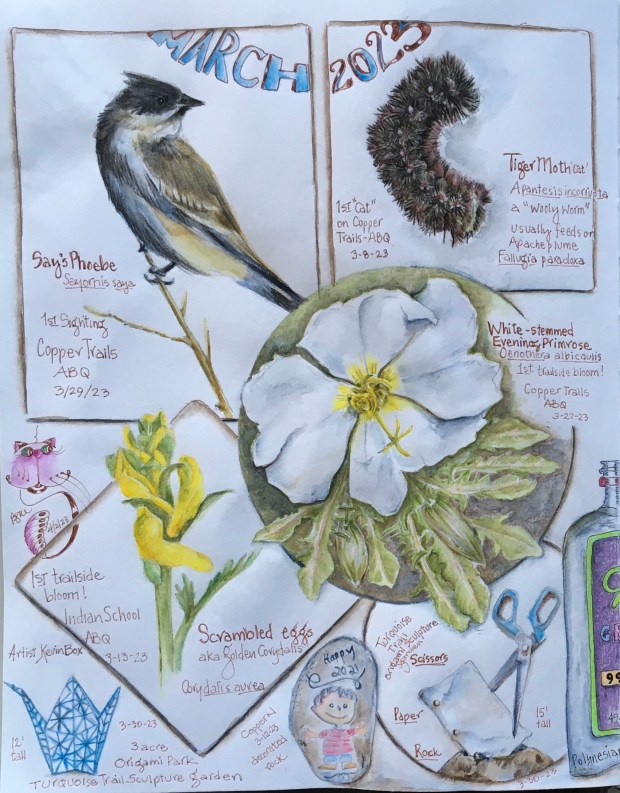
March came in like a passive lion, allowing a few signs of Spring to peek through. My collection of nature snippets and decorative trail rocks was going well, until ……. Before long we were once again shoveling drifts and piles of snow, dumped on New Mexico thanks to California’s 13 atmospheric rivers that flowed from coast to coast. This was looking like the winter that would never end.
It was truly and literally “March Madness” out there. So, in the spirit of the crazy seasonal weather, an emergency road trip became necessary to search for some “Littles” filler. And I knew the perfect route to take …..
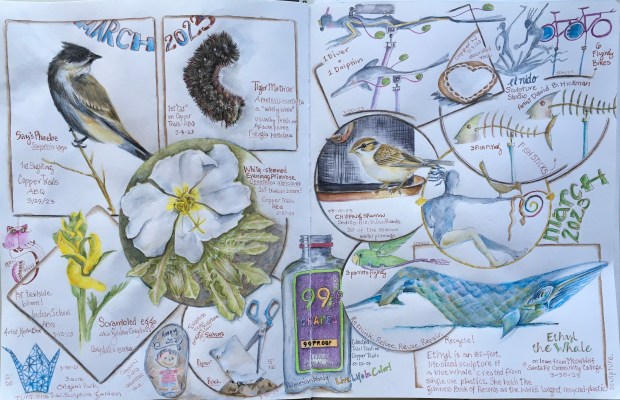
The Turquoise Trail Scenic Byway winds around the Ortiz Mountains and Cerrillos Hills, while passing through the historic mining towns of Golden, Madrid (MAH-drid) and Cerrillos (sir-REE-yoose). Today, there’s minimal mining taking place in them there hills. Today it’s all about art, and there’s some really weird stuff on display out there.
From Golden to just north of Cerrillos, the hillsides are adorned with metal sculptures like a Trojan horse, three boned fish on sticks, a scuba diver fleeing a curious dolphin, two-story tall origami made of folded metal, butterflies as big as pterodactyls, a squadron of green parrots, and a fleet of racing bicycles. You have to look around every bend in the road ….. they’re all there, and more!
It was fun “collecting” these images for my March “Littles” collection, but I needed one more. We had heard the story of Ethyl the Whale somehow living out of water, somewhere in Santa Fe. Sounded like the perfect weird addition to that blank spot on my page.
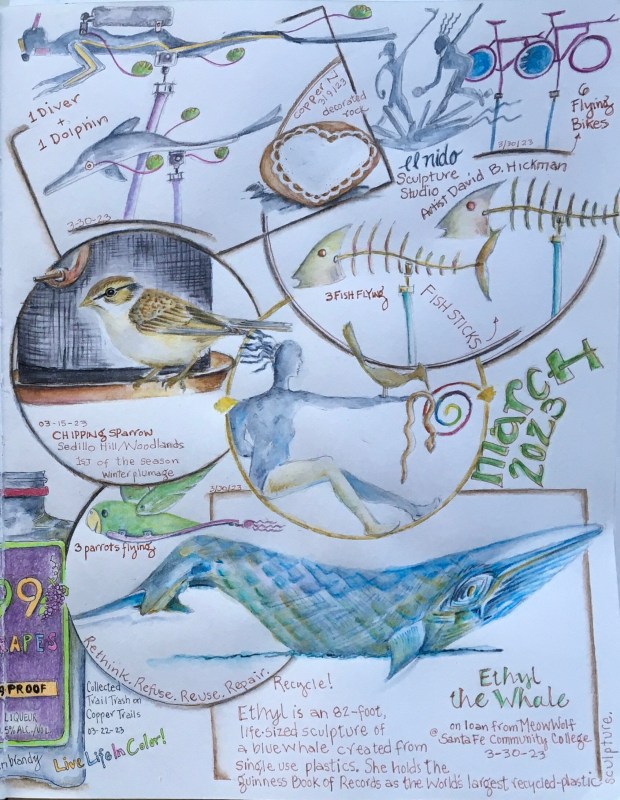
And there she was! Around the back side of the Santa Fe Community College, in a large, flat field was Ethyl, the 82-foot long blue whale sculpted out of single use plastics. Ethyl is HUGE! She not only holds the Guinness Book of Records for the World’s largest recycled plastic sculpture, she also delivers an important message about the health of our oceans.
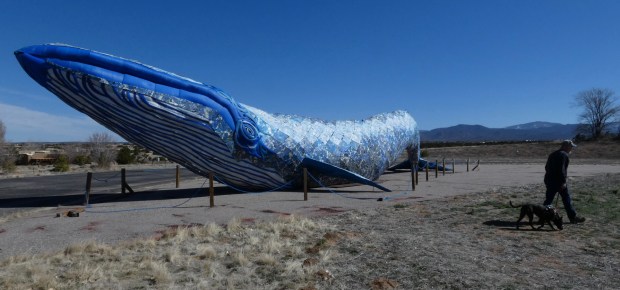
Well, there you have it; my eclectic assortment of “Littles” to remember this March of 2023. Let me know what you think! I’m already looking forward to true Spring in April. Wildflowers should be popping up everywhere and maybe a few more bugs will make an appearance for my April “Littles.”
Thanks again to “Made by Fay” for the “Littles” inspiration!
Meet a Teeth Clacking, Jaw Grinding, Squealing and Woofing Peccary of the Desert Southwest….. the Javelina
March 21, 2023
Another species we searched for while visiting the Sonoran Desert surrounding Tucson last December, was the javelina. Certainly this elusive little pig-like critter was nearly everywhere we went, as attested to by the thousands of hoof prints echoing their presence. And many of those hoof prints were fresh! Certainly there must’ve been squadrons of javelina hiding behind every mesquite tree around the next countless bend in the trail?
But alas …. we never saw, heard or even sniffed out a single javelina. All we could do was record (and sketch) the herd of hoof prints, and then research this animal in the following months. Oh boy, did we really miss such a fascinating encounter.
Back at home, several months later, our friend Jim Silva was happy to share one of his javelina skull mounts for study and sketching. I’m thinking we may have been lucky not to have met up with a herd of their clacking canines during our travels!
Maybe another time?
Meanwhile …. If you’ve got a thirst for javelina knowledge, or just want to see my journal sketches, read on!
Continue reading “Meet a Teeth Clacking, Jaw Grinding, Squealing and Woofing Peccary of the Desert Southwest….. the Javelina “Coues …..Elfin Deer of the Desert Southwest
March 17, 2023
Even though we didn’t see any mammals while visiting the Tucson region last December, we knew they must’ve seen us! But little (pun intended) did we know, a diminutive elfin deer, the Coues Whitetail, was probably among the mix of critters observing us as we explored the area.
This tiny deer, with its oversized ears and flashing tail, is a native species found in the mountainous desert regions of the extreme Southwest and south into Mexico.

A good friend, Jim Silva, who has hunted this species in southwest New Mexico, shared one of his skull mounts with me. Since sketching the skull and an antler, I’ve learned a bit about the Coues deer, including the highlights included on my journal pages.
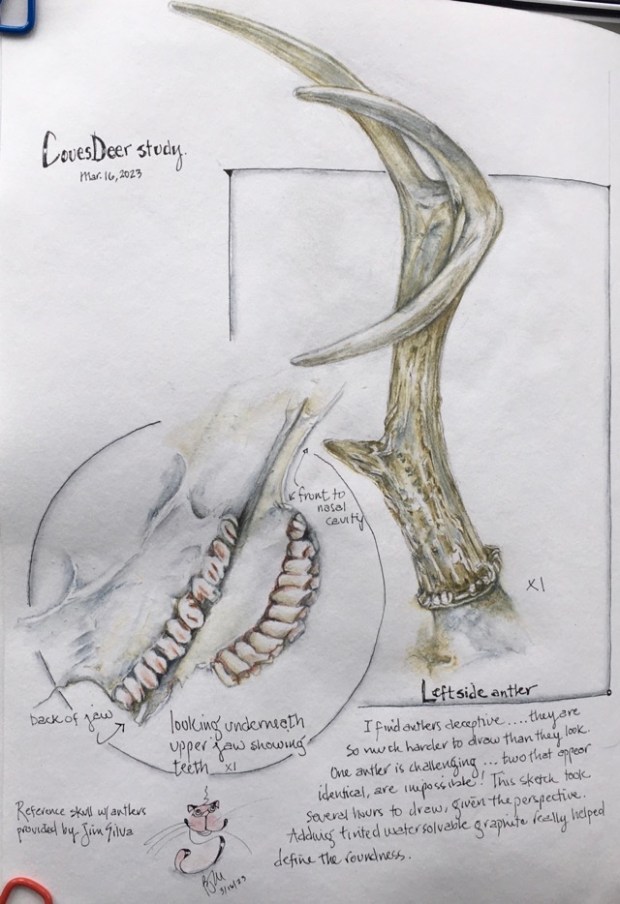
“Coues” is most properly pronounced “cows” (but more commonly pronounced “cooz”), is also known as the Arizona Whitetail or Fantail. Having lived in eastern North Carolina for a number of years, we are well familiar with the Eastern Whitetail, a small enough deer when compared to our local Mule Deer. But it’s hard to imagine a deer smaller than the Eastern Whitetail. Now we’re ready to return to the mountains of the Southwest and search for the Coues deer! Maybe late spring when there’s a chance of seeing a few fawns too!
What’s on your nature agenda for this spring? Ours is filling up fast!
Until next time!
February “Littles” Seeds, Pods, and Other Curiosities

March 13, 2023
Like my January “Littles” page of the bird species that visit our feeders in winter, here’s another “Littles” to commemorate the not-quite-winter-or-spring month of February ….. Seeds and Seed Pods. As a way to pass the time while waiting for Roy to finish up with a doctor visit, Luna and I conducted a focused scavenger hunt along a 2 mile circuit surrounding a large Albuquerque shopping mall. In no time at all, my collection bag was full. But knowing my pages would need some local flavor and color too, I scavenged a bit longer and turned up a few more curiosities.
Like with January’s page of birds, sketches of the species of seed pod and seeds (if collected) took less than 5 minutes each; my watercolor pencil paintings took about 10 minutes each. The restaurant logo and the frog design took a bit longer, and were done using my photos as reference.
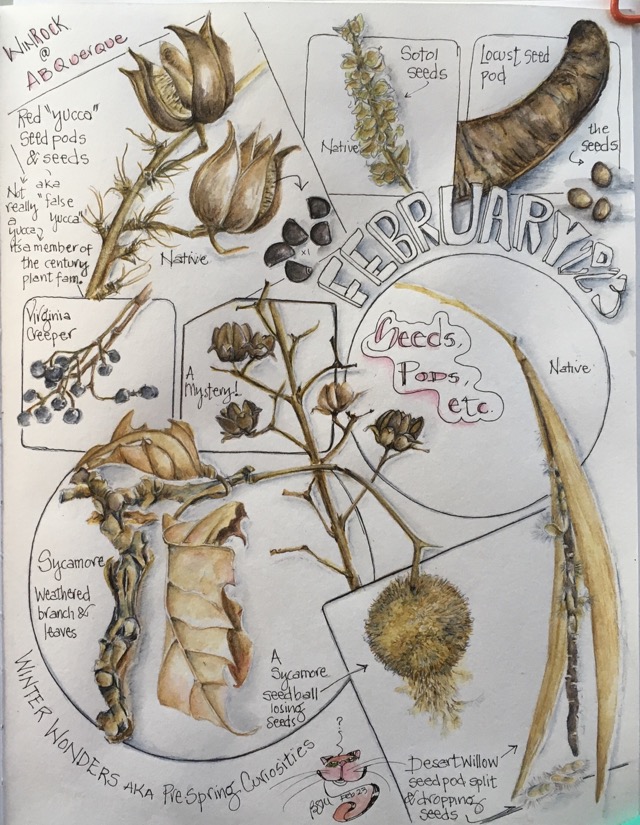
I’m not sure why it took nearly the entire month to decide what to do for my February “Littles.” In hindsight, the decision should have been obvious, because I love seeds and the seemingly unlimited variety of pods. Now I have a record of a few city seeds that will soon germinate, helping change the landscape from brown to spring green!
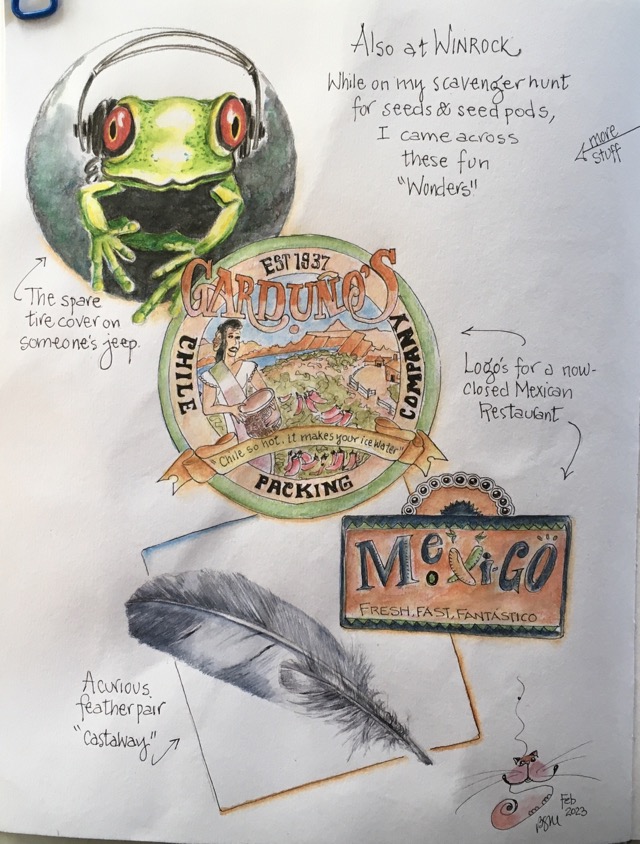
Let me know what you think! I’m looking forward to March, when wildflower seedlings will be popping up which may appear in a few “Littles” boxes as well!
Thanks to “Made by Fay” for the “Littles” inspiration!
A Festive Anniversary Week in the Sonoran Desert. Part 7: Snowbirds
December 11-17, 2022
The much anticipated finale, Snowbirds, and wrap-up to a grand anniversary week celebration in and around Tucson, AZ, follows!
Despite an unexpected snow the evening of our arrival, we never seemed to slow down, taking in as many sights and good eats as humanly possible. …… Open the full post for a recap of our week, and a bit about some of the birds we found while traveling around.
Continue reading “A Festive Anniversary Week in the Sonoran Desert. Part 7: Snowbirds”Chasing a Dream … a poet, a few goats, and a circular pantoum : March 3, 2023

March 3, 2023
A dear friend of mine, and poet, is constantly inspiring me with her skill in creating original and verbally illustrative prose. I love the visual images she can conjure with perfectly chosen and placed words. Happily, my collection includes many of her award-winning pieces, including poems she has penned to interpret beautiful works of art. Amazing!
Wanting to send her a unique birthday gift, complete with an original poem and illustrations, became my challenge. And what a challenge!
Continue reading “Chasing a Dream … a poet, a few goats, and a circular pantoum : March 3, 2023”Winter Birding on Sedillo Hill: January 2023
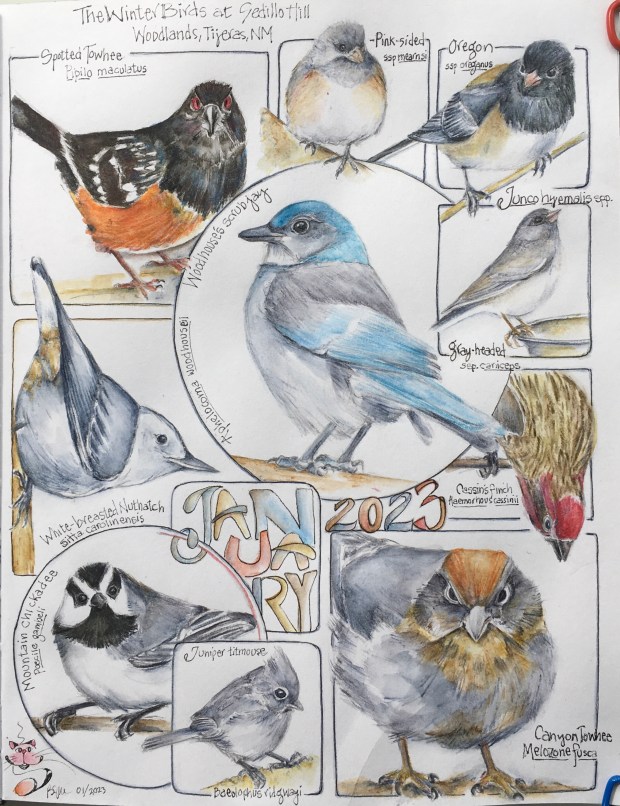
East Mountains, Tijeras, New Mexico elevation 7,300 ft
February 15, 2023
The design for today’s post was inspired by sketchbook artist Fay. I came across her blog (see link below) while searching for nature journalers who are active in creating art and who also share some unique approaches to page layout and composition. “Littles” is the name Fay has given to one of her unique approaches. This is where she lays out several pages full of empty boxes with the goal to fill up a box a day for an entire month. Not only does this encourage a daily drawing and painting practice, but it’s her way of creating a record of what she’s observed for an entire month. “Littles” reminds me of a hyper-compressed perpetual journal.
After seeing Fay’s blog post with all her miniature drawings and paintings, I knew this would be fun to try, and I had to learn more. So we chatted and Fay encouraged me to give “Littles” a go. And I did …… with a “little” twist! I’ve been thinking of ways to keep a visual record of the birds visiting our feeders during the winter. And I needed an approach with minimal fuss, without feeling each bird needed a detailed description. Ta da!
So here’s my “Littles” page of the bird species that visit our feeders in January. I kept my sketches to less than 5 minutes each; my watercolor pencil paintings took about 10 minutes each. My sketches were done using my own reference photos, and relied heavily on my many hours of observing these species’ poses and behaviors.
Let me know what you think! I just may create a “Littles” page for our February birds. Maybe by March, when all of our snow has melted, hints of new spring growth may appear in a few “Littles” boxes as well!
Oh and …… Follow Fay! Her blog “Made By Fay” can be found at the link below. If you enjoy my posts, I will guarantee you’ll love what Fay does. She is an extraordinary visual storyteller, and enjoys drawing what she sees from her home state of Washington and on her travels about.
https://madebyfay.wordpress.com
 a curious nature