Happy National Love a Tree Day!

May 16, 2025

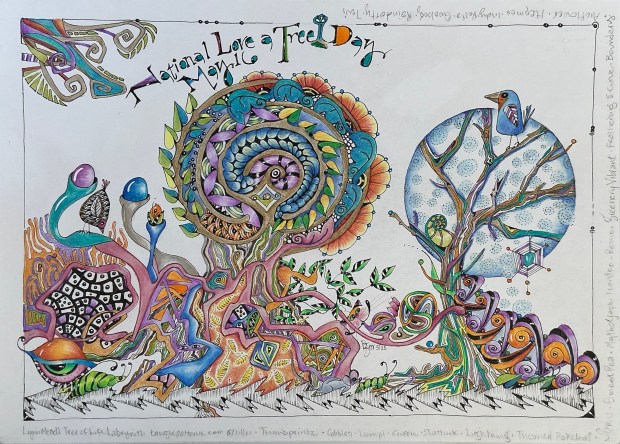
Zentangle Patterns: thumbprints, cobbles, Lumpi, Cruffle, Shattuck, lightning, thorned Pokeleaf, sweet pea, mythograph, Icantoo, remo, greenery vibrant, feathering s-curve, boundary, Arcflower, hepmee, Quabog, raindotty, tsui 


And many thanks to Lynn Mead for sharing her Tree of Life Labyrinth pattern. Super fun to give a whirl! The easy to follow directions can be found on tanglepatterns.com posted 08/14/2021 

Today, May 16th, just so happens to be National Love a Tree Day! It’s the official day to celebrate all of life’s joys brought to us by the trees we share this planet with. Whether you love reading in the shade or taking a bite out of a fresh fruit pie, National Love a Tree Day encourages y’all to get outside and enjoy a tree.

A Changing Landscape

We all know many tree species live many many years; some live to be several thousand years old. According to the U.S. Forest Service, about 766 million acres of forest land exists in the United States today, a number that’s held steady since 2012. But the nature of our forests has changed over the last 400 years, due to changes in management practices and demand. Population growth, rural and urban development, along with a variety of land uses (like conversion of forests to agriculture use) resulted in a steady decline of forested acres between 1630 and 1910;  a decline from 1,023 million acres to 753 million acres or 46% to 34% of the total land area in the U.S. Since that time until the present, where people choose to live and how the land is used has been constantly changing.  While some urban forests increase, other areas see a decline. Tree planting programs improve landscapes but human activities and population growth continue to impact these ecosystems.

We All Benefit from Trees

Trees provide more than just beautiful landscapes and a shady canopy on a sunny day. They play a significant role in reducing erosion and moderating the climate as well as give us oxygen. Large quantities of carbon are stored in their tissues as trees remove carbon dioxide from the atmosphere. They provide habitat and structure for strong ecosystems.

How to Observe National Love a Tree Day

This is a good day to plant a new tree native to your area, or spend some time enjoying the beauty of the trees, Take time to learn how to care for the trees you have, too, whether you live in the mountains or the desert. Write down all the reasons trees are important to you. If you have a favorite tree, or a tree you’re not familiar with, begin a little research project about that (or those) species, and journal about your findings. 

What will you do today to celebrate trees?

Happy National Love a Tree Day!

As always, thanks for stopping by!

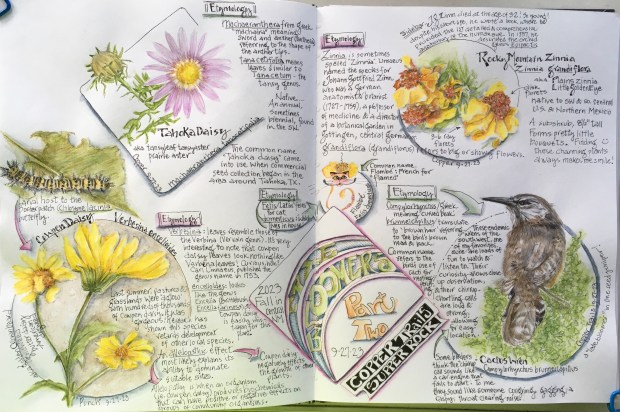
Late Bloomers …. Fall’s Flowery Foothills

September 26 & 27, 2023


It’s hard now to imagine how extremely hot and dry the summer was this year. Without even a spittle of rain, the 100+ degree temps for weeks effectively suppressed the usual mid-season bloomers in and around the Albuquerque foothills/East Mountains. Even invasive plants, like goathead and tumbleweed, remained dormant or failed to germinate all together. It looked like winter browns had arrived early.

Then in less than a week, a small rain followed by several long downpours flooded the parched landscape, transforming browns to greens. You’ve heard this from me in a few earlier posts, but it was magical, and a reminder about the resiliency of desert vegetation.

Here’s a few pages highlighting a handful of the Late Bloomers I recorded in only 2 days. More than 2 dozen species had sprung back to life, setting flowers at all stages of accelerated vegetative growth. The landscape seemed wide awake. If plants could talk, I imagined them laughing while excitedly chanting, “hurry, hurry, hurry!” Only their roots prevented them from dancing! 

In addition to the species on these journal pages, there are many (more) composites, native grasses, shrubs and sub shrubs, small forbs from Spring and early Summer actively growing and blooming right now, and (of course) the weedy invasives are growing and blooming with wild abandon.

Random thoughts and wonderings ….. are pollinators still hanging around …… or ….. how many of today’s bloomers are self fertile …… are local birds, insects, reptiles and mammals that depend on earlier summer pollen and/or fruit and seed production stressed with this timing change/availability of food sources … will there be noticeable shifts in species composition, including plants, insects, reptiles and animals (including birds) ….. what species can and will adapt to changes, and how quickly ….. etc. The answers to these and many more questions are probably best answered in coming years, if it’s even possible to answer them at all.

Have you observed vegetation anomalies that may be influenced by changes in climate? If so, please share your observations and where these changes are taking place.  Meanwhile, keep your eyes wide open.

“Closing your eyes isn’t going to change anything. Nothing’s going to disappear just because you can’t see what’s going on. ……….. Closing your eyes and plugging up your ears won’t make time stand still.”  – Haruki Murakami.

published October 2, 2023

The Forecast: Scattered Green Mixed With Dry Brown Dust

August 6, 2023

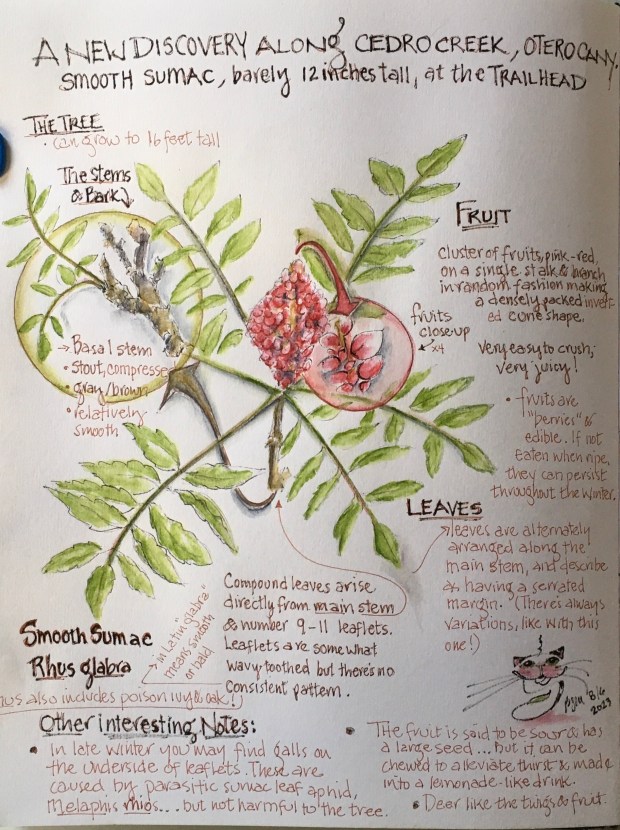
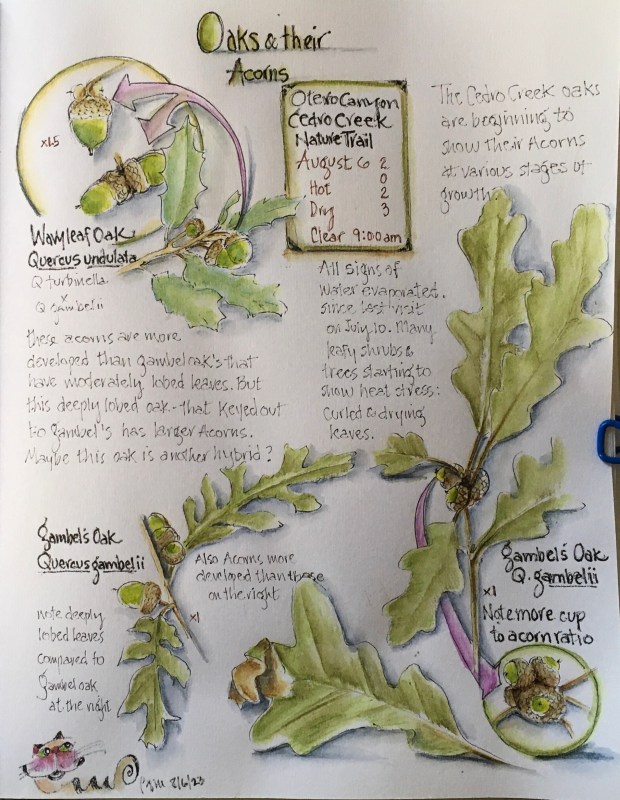
Sharing my pages from today’s short hike up Cedro Creek, on the fringes of the Manzano Mountains. The water shortage here and all around us has become dire; soils are cracked and dry and beginning to take flight with the barest puff of wind. 

Since we last hiked this area (a few days shy of a month ago), the scattered shallow pools of water have either evaporated completely or made a retreat underground, where there may be just enough water to wet the riparian area. All the tender flowering plants have disappeared; many have been able to set seed in hopes of a wetter year to come. With this premature wrap up to the summer season, the birds, bees and butterflies have moved on; hopefully up in elevation where food may still be found.

Our summer monsoon season just didn’t materialize (yet?). But despite the hot and dry conditions, we did manage to find a few leafy green shrubs. The massive cottonwoods appear to be doing well (must still be sufficient groundwater). In the cooler parts of the canyon, there are berries hanging on the 2 species of juniper trees. Acorns have begun to mature on several oak species, even though there are many that have withered; is all of this earlier than usual? 

At the trailhead, tucked in a swale where water (when it comes) can collect, I was surprised to see some very stunted smooth sumac. Already showing off their clusters of juicy red berries, the plants are barely a foot tall. This species can rapidly grow to heights of 16 feet. Maybe flowering and fruiting on such short plants is a type of survival mechanism this sumac exhibits when conditions are not favorable? I will be able to watch this little grove over the coming years and maybe answer that question.

Then further up the canyon, about 20-30 feet above the riparian area, Gambel’s and Wavyleaf oaks are growing their acorns. That’s encouraging news for the squirrels who collect and cache them in overwintering nests.

It’s been a challenging year. 

What differences in nature have you been noticing where you live? Do you think our changing climate has played a role in driving the changes? Have you observed not only negative but positive affects? I’d be very interested in knowing!

As always, thanks for following!