November 24, 2026
Steller’s Jay (Cyanocitta stelleri)
—aka—
That hefty, crested bird with attitude!
A few mornings past I happened to glance out our bedroom window overlooking the bird feeder. The sun had just popped over the horizon and a gorgeous sunrise highlighted the activity on and below the feeder. Expecting to see the usual assortment of winter birds — dark-eyed juncos, house finches, canyon towhees and their cousins the spotted towhee, I did a ‘double take’!
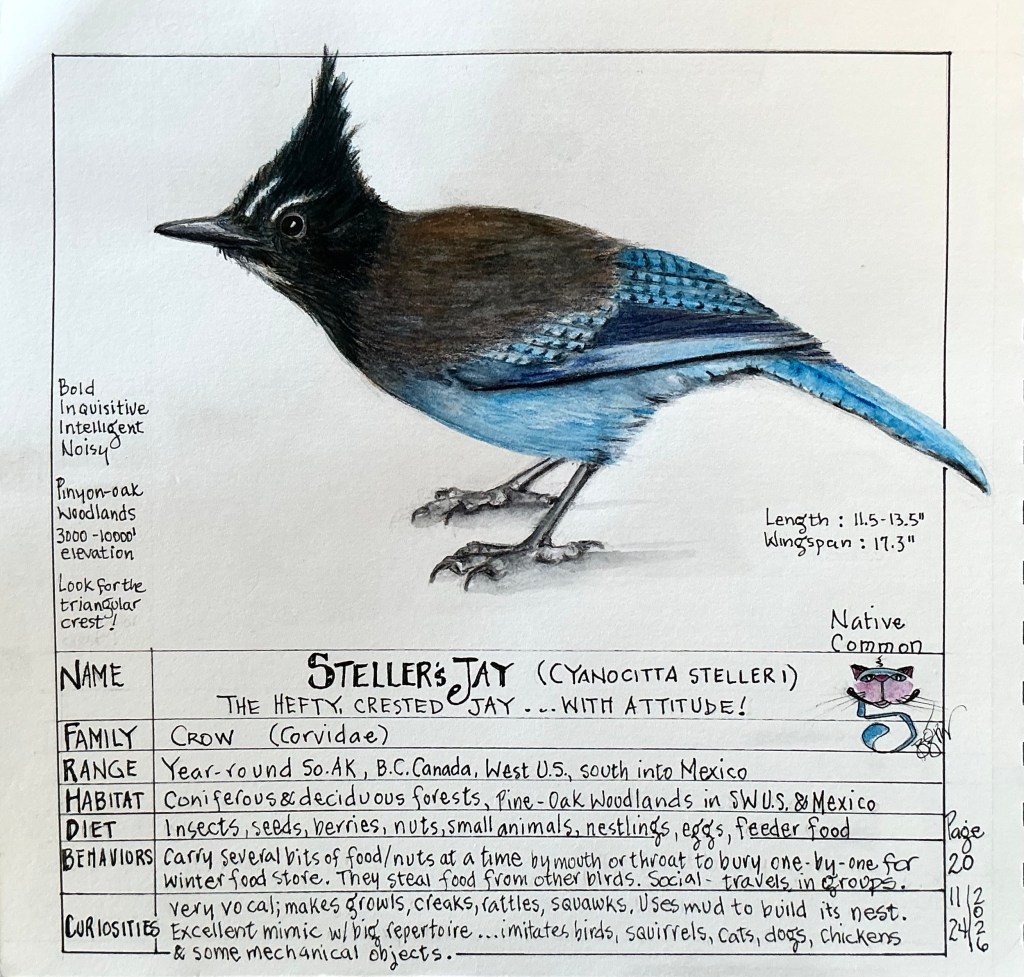
On the ground wasn’t one of the big Woodhouse’s scrub jays that frequently visits, but a larger, somewhat heftier bird. Unmistakably, it was a Steller’s Jay! Oh such brilliant blue, yet blue-greenish “Cyan” colored flight and tail feathers accented with bars of peacock blues harmonize perfectly with his shiny black head, a brownish green grey back, and powder blue belly. Slightly agitated, the large crest on his head was standing upright and spread wide, giving him a larger-than-usual appearance. This form of intimidation effectively chased away all of the smaller birds under the feeder allowing him to stuffed as many sunflower seeds in his mouth as possible, before flying off to hide his booty.
We’d been seeing a number of Steller’s Jays in the neighborhood — flying from one pinyon tree to another, but this was the first time one has visited our bird feeder!
How do you know a bird is a Steller’s Jay?
As a member of the Crow family, these large birds (which happens to be the only western jay with a crest) are very social. Often seen flying in groups with others of their own species, they may even travel with mixed-species flocks. As one of the most vocal species of mountainous forests, Steller’s Jays keep up a running commentary on events, while playing with or chasing each other, and when they instigate mobbing of predators and other possibly dangerous intruders.
In dense and towering evergreen forests you want to look up! Steller’s Jays stick to the high forest canopy, moving about with graceful, almost lazy long-swooping wingbeats. Listen for their harsh, scolding calls if they’re nearby. In significantly less dense and much shorter pinyon pine and oak forests typical of interior Southwest U.S., you’ll likely encounter Steller’s Jays moving from tree to tree at or above eye level!
There are 16 subspecies of the Steller’s Jay in North and Central America, each with different combinations of black and blue on the crest, head, and body. Some populations have black crests and backs, and others blue. One black-crested form in southern Mexico is surrounded by eight other blue-crested forms. The Queen Charlotte Islands off British Columbia are home to the largest and darkest race. In mainland North America, you can notice differences between darker Pacific forms, with blue streaks over the eye, and lighter Rocky Mountain forms with white streaks pointing to the crest and a partial white eye ring.
Where in the World do Steller’s Jays live?
Found wherever evergreen forests grow in the intermountain West, their range extends north into British Columbia and southeast Alaska, and south into Mexico and northern Central America. Steller’s Jays are common in forest wildernesses at elevations ranging from 3,000 to 10,000 feet. But within these areas, they are also common in campgrounds, recreational parks, picnic areas, and backyards, where they are quick to spy bird feeders as well as unattended picnic items.
The “Anything Goes” Diet of a Steller’s Jay
Described as a generalist forager, their diet consists of insects, seeds, berries, nuts, small animals, eggs, and nestlings. In forested areas frequented by people, you’ll find them eating garbage, unguarded picnic items, and feeder fare such as peanuts, sunflower seeds, and suet. Steller’s Jays also never pass up an opportunity to steal food from other birds or look for handouts from people. When the menu includes large nuts like acorns and pinyon pine seeds, they will collect as many as they can carry at a time in their mouth and throat, then bury them one by one as a winter food store.
Like many other jay species, Steller’s Jays are habitual nest-robbers. And they’ve occasionally been seen attacking and killing small adult birds including a Pygmy Nuthatch and a Dark-eyed Junco.
Fun Facts About Steller’s Jays
- They were discovered on an Alaskan island in 1741 by Georg Steller, a naturalist on a Russian explorer’s ship. When a scientist officially described the species, in 1788, they named it after him, along with other discoveries including the Steller’s sea lion and Steller’s Sea-Eagle.
- Steller’s (the western species) and Blue jays (the eastern species) are the only North American jays with crests. The Blue Jay is expanding its range westward. Where they meet, the two species occasionally interbreed and produce hybrids.
- The Steller’s Jay and the Blue Jay are the only New World jays that use mud to build their nests.
- They are excellent mimics with a large repertoire, able imitate birds, squirrels, cats, dogs, chickens, and some mechanical objects like water sprinklers. It’s thought they make these noises so they don’t have to share food sources with others. Any thoughts?
- A group of jays may be called a “band, ” “cast, ” “party,” or “scold” of jays.
Have you heard a Steller’s Jay squawking, creaking or gurgling calls? Have you heard them mimicking the neighborhood dog or your sprinkler? If so, I’d love to know!
And that’s all for now, folks!
…………………………………………………………………………………………………
Hope you found this interesting!
As always, thanks for stopping by!
References: allaboutbirds.org; dirtyclassroom.com; estesparknews.com; iNaturalist.org; wikipedia.org

