NATIONAL DIATOMACEOUS EARTH DAY

Part 1 – Diatomaceous Earth

August 31, 2025
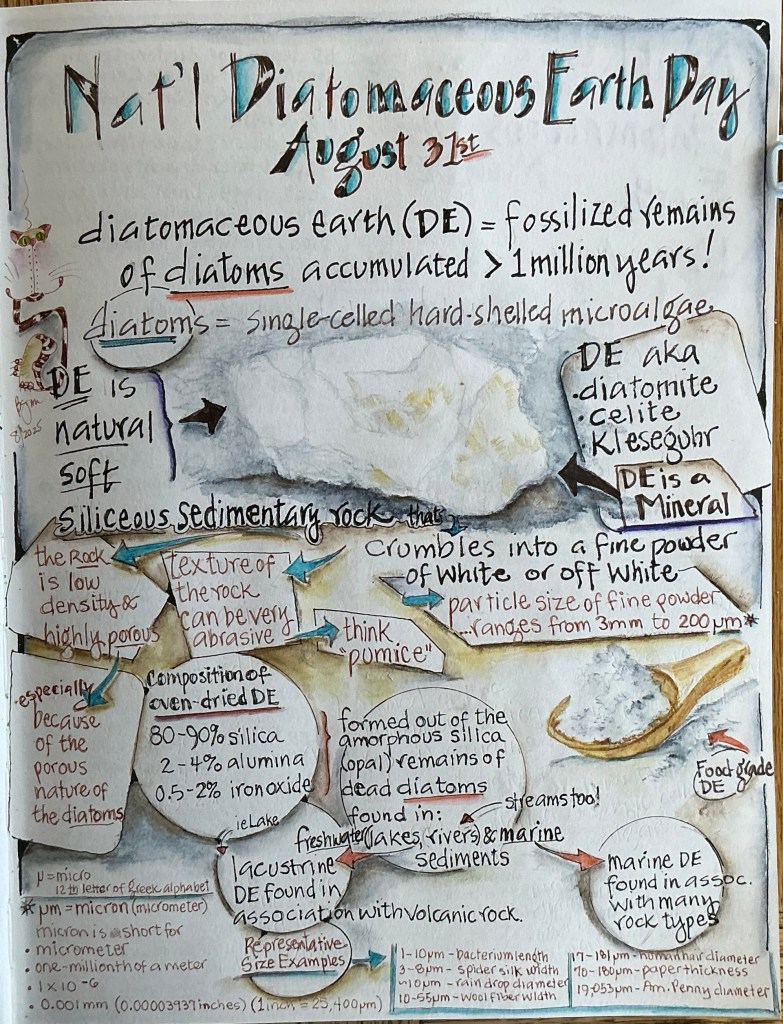
On August 31, National Diatomaceous Earth Day recognizes the diatom and the remarkable mineral it creates! 

Have you ever heard of Diatomaceous Earth (DE)? If you answer “yes” then perhaps you brew your own beer, have a swimming pool in need of water filtration, or a vegetable garden that’s been invaded by a herd of hungry slugs. But did you know DE is a mineral1 composed of the fossilized remains of single-celled, microscopic algae called Diatoms? (More about diatoms in an upcoming post.) DE is truly a remarkable mineral, found around the world in ancient marine and lacustrine (freshwater lakes, streams, and rivers) sedimentary deposits.

Early Discoveries and Uses of DE

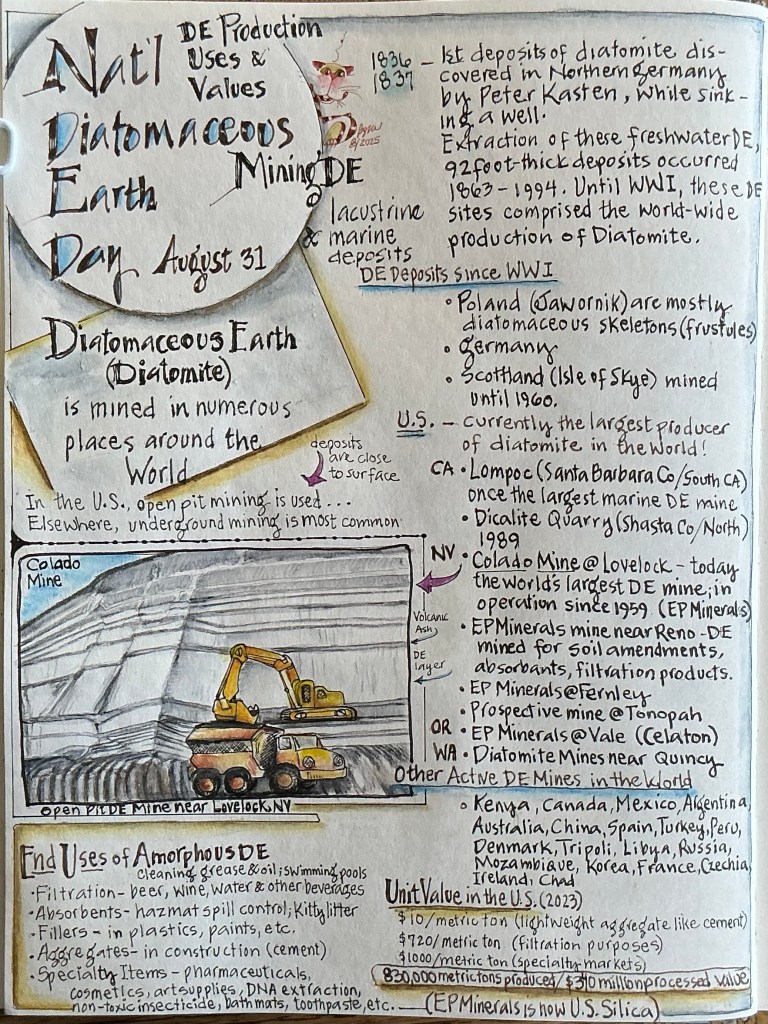
The year was 1836; the place, Northern Germany …… One day, a peasant named Peter Kasten was sinking a well when he encountered a mysterious-to-him layer of rock. Curious what this soft powdery rock might be, Pete took a sample to a friend who was a friend of a friend learned in the science of geology. This geologist carefully examined the rock then exclaimed (in German, of course), “Why this is the much prized and never-before-seen-in-Northern-Germany mineral known as Diatomaceous Earth! It has remarkably unique abilities to absorb, filtrate, polish, and stabilize!  These qualities make Diatomaceous Earth (aka Diatomite) valuable and much sought after by numerous industries!” 

Well, word spread and immediate exploration of the area commenced. It wasn’t long before numerous substantial deposits of lacustrine DE were discovered; some up to 92 feet thick!   Extraction began in 1863. Until WWI, these sites comprised the world-wide production of Diatomite. Mining these deposits ended in 1994, when all of the DE deposits had been extracted.  

But long before Pete’s discovery, Ancient Greeks used DE as an abrasive as well as a building material in lightweight bricks. Even in pre-historic times, DE was used in the ice-age cave paintings in France.
DE Deposits and Extraction – Worldwide

When diatoms die and fall to the bottom of marine and lacustrine waterbodies, they form large deposits. Over time, the organic portions of the diatoms weather away, leaving behind their hard silica shells. These remaining shells, called Frustules, with their opaline-like quality are what forms DE. Some of the largest deposits in the U.S. formed in ancient lakes that existed in California, Nevada, Oregon, and Washington. They also formed in oceans and occur along the coasts of North and South America.

Since WWI, exploration for and discovery of numerous DE deposits have occurred worldwide-wide, and are still on-going. Large mining companies have unearthed and continue to extract this mineral in substantial quantities, which is processed for use by industries that manufacture products for home and business (more on that below). DE deposits are (or have been) mined in many countries around the world, including the U.S., Mexico, Chile, Peru, France, Spain, Denmark, China, Canada, Argentina, Australia, Spain, Turkey, Libya, Russia, Mozambique, Ireland, and France. Today, the world’s largest DE mine, Colado Mine, is located just outside of Lovelock, NV, and has been in operation since 1959.

DE’s Modern Uses and Values

Today, DE is one of the most useful and durable substances known. The white to off-white powdery rock that makes up the more than 1 million year old DE deposits, is used in many common products likely encountered every day. One nearly universal use is in the filtration of liquids like the beer, wine and water. DE is also used to filter water in swimming pools, and to clean grease and oil. DE is used as an absorbent for hazmat spill control and in some kitty litters. As a filler in paint, it removes the sheen making flat paint flat; in plastics, it prevents blocking in plastic film. DE is used as an aggregate in construction, particularly in Portland Cement. And the list of specialty items that use DE for a variety of purposes is very long ….. including pharmaceuticals, cosmetics, art supplies, in the medical industry for DNA extraction, as a non-toxic insecticide, soil amendments, in bath mats for quick drying, in toothpaste as an abrasive, and as food additives to control moisture and extend shelf life. There are hundreds of other applications for DE with many more yet to be discovered!

But the biggest use of DE is in filtration. In 2023, the beverage industry paid $720/metric ton for processed food-grade DE (amount used to filter a keg of beer??). Compare that cost to $10/metric ton charged in 2023 for lightweight aggregates used in construction (wonder if or how tariffs impacted the 2025 cost?), or the $1000/metric ton charged for some specialty items. 

Ideas on How to Observe Diatomaceous Earth Day 

Discover more about DE, and learn about its common uses around your home or work. 

Read product labels to learn what you use on a daily basis that contains DE.

Consult the fda.gov website to learn more about labeling.

Visit a Diatomite mining operation.

Learn about unmined deposits near where you live.

Use a magnifying glass or microscope to inspect the contents of bag of insecticidal DE.

Stay tuned for NATIONAL DIATOMACEOUS EARTH DAY – Part 2 – Diatoms! They are ultra-fascinating! 

As always, thanks for stopping by!

1 Minerals are naturally occurring, inorganic solids with a definite chemical composition and internal structure, and are the main components of rocks.  DE (Diatomite) is a naturally occurring inorganic mineral that forms from the fossilized siliceous (silica-based) skeletons of diatoms, which are single-celled aquatic organisms. While the organisms themselves are organic, the hard, porous mineralized skeletons they produce are considered inorganic. 

Being an inorganic mineral, DE falls into the same category as minerals we’re all familiar with, such as Quartz, Feldspar, Mica, Pyrite, Hematite, Galena, Sulfur, Gold, and Copper. The chemical formula of DE is primarily SiO2 (silicon dioxide), with traces of other minerals.
High on the Views: Camping Above the Rio Grande

June 6, 2025

Such an awesome-inspiring place to spend a Spring week in New Mexico!

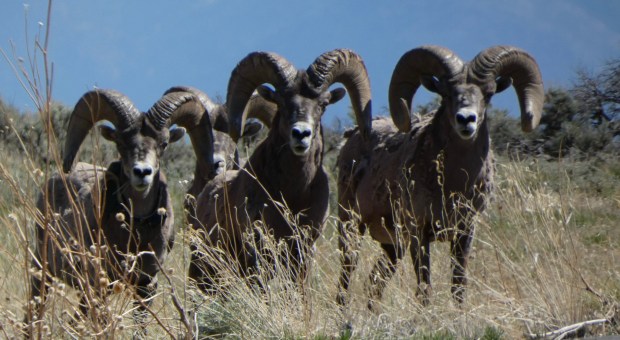
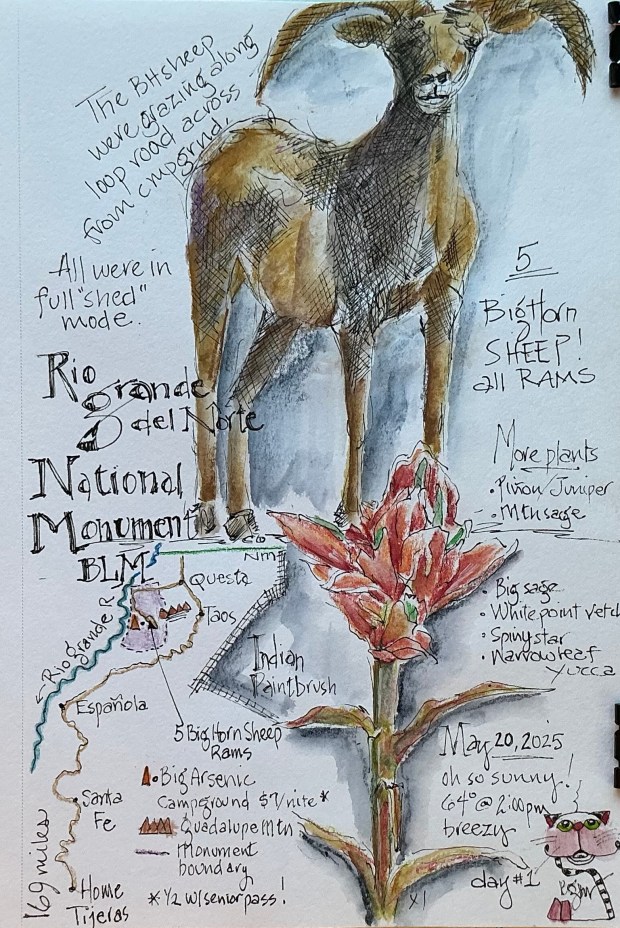
Three of the five big boys! Rocky Mountain Big Horn Sheep.

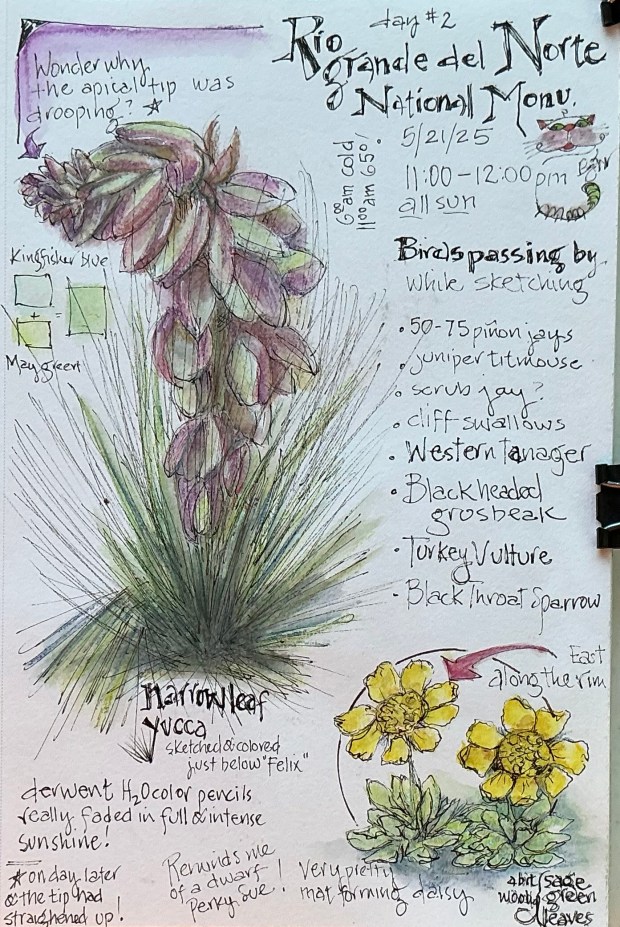
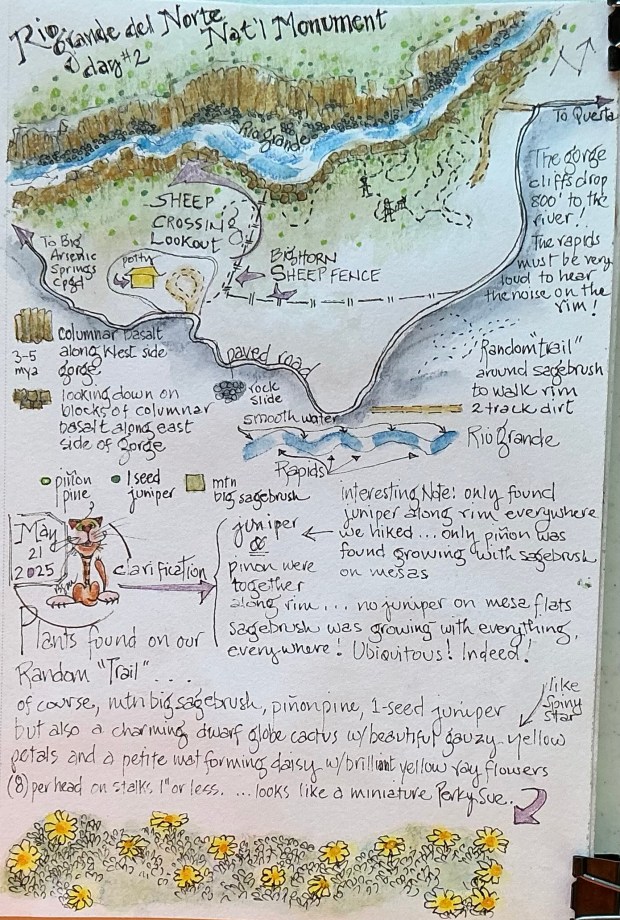
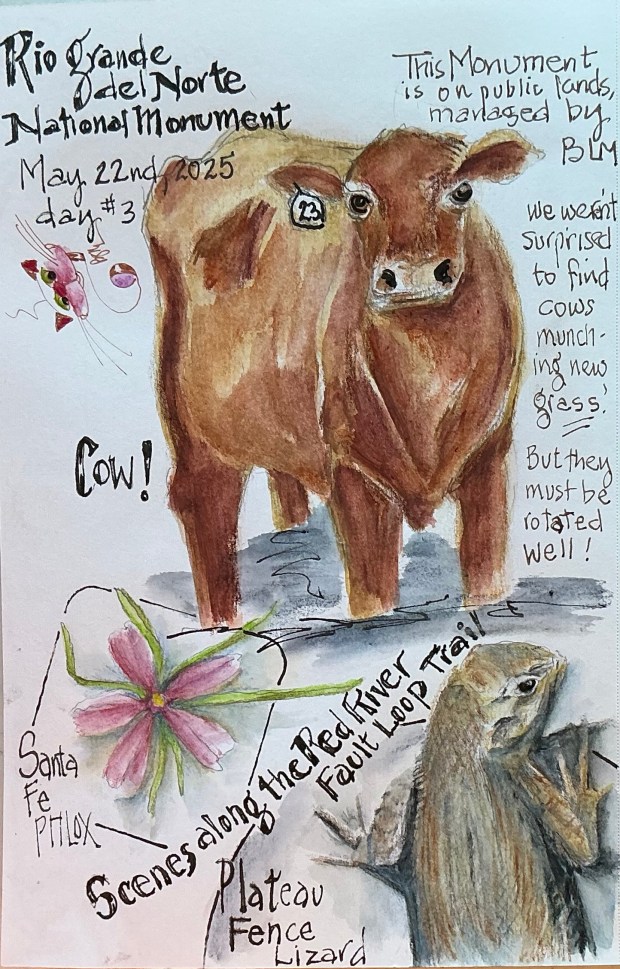
Rio Grande del Norte National Monument ….. 

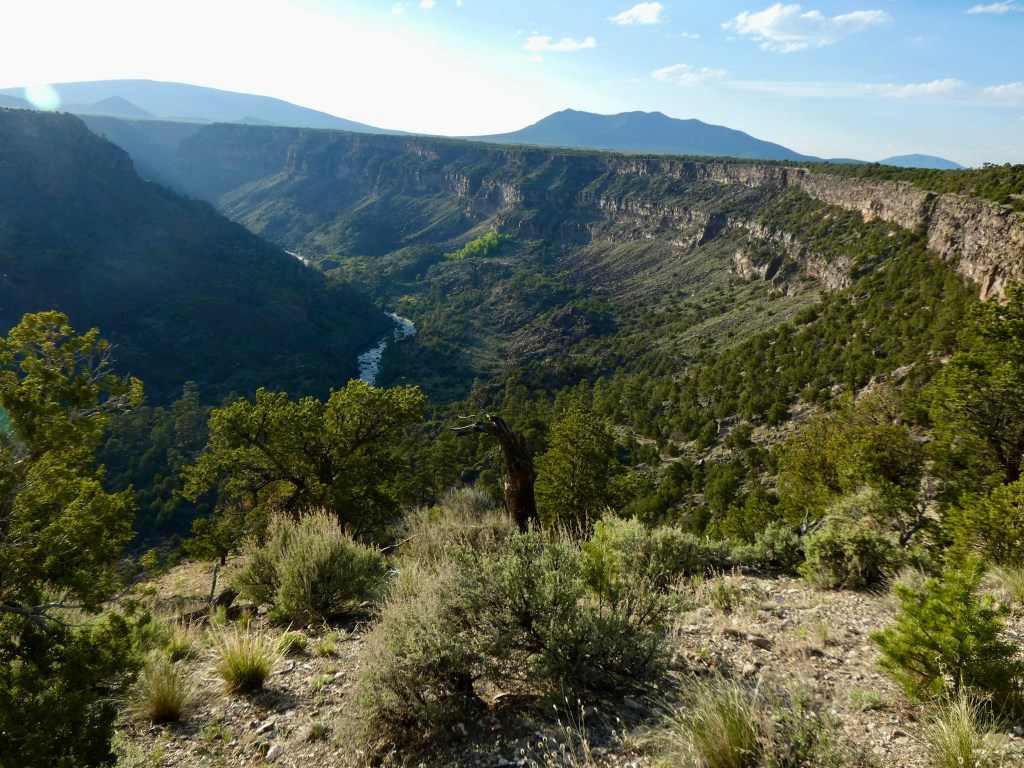
comprises a breathtaking 245,000 acre area of the northern Rio Grande rift valley in north central New Mexico.  Established as a Bureau of Land Management (BLM) national monument in 2013, the rugged wide-open plains average 7,000 feet in elevation before dropping into steep narrow canyons carved into the landscape by rivers that have been flowing for millennia.  

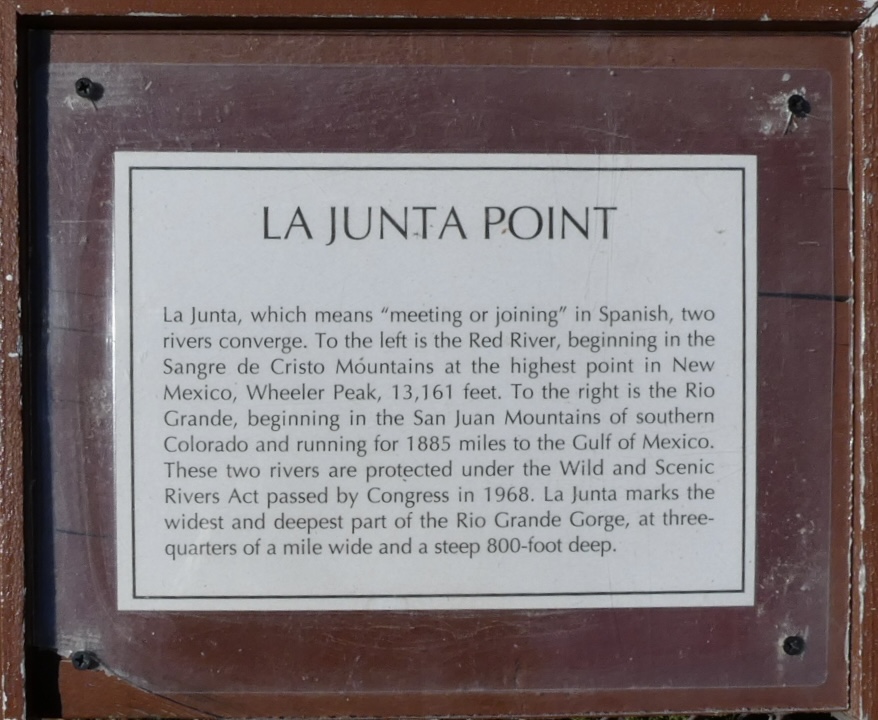
The confluence of two of these rivers, the Rio Grande and the Red River, occurs in the northern Wild Rivers area of the Monument. It’s at this confluence where the gorge is its deepest at 800 feet, and its widest from rim to rim measuring 3/4 mile. It’s an impressive view from the la Junta (“the Meeting”) Overlook. All of the views from anywhere along the rim are impressive.

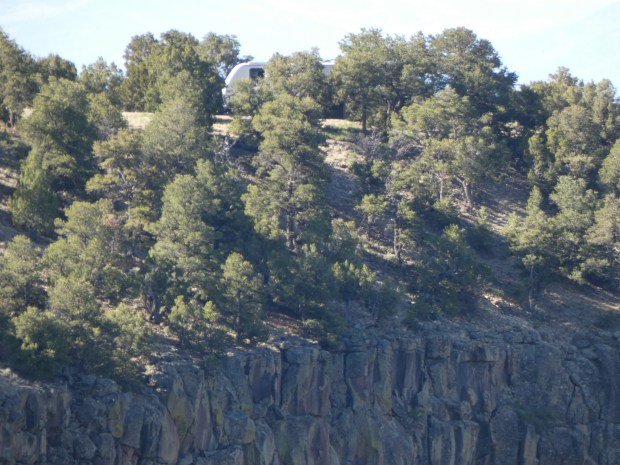
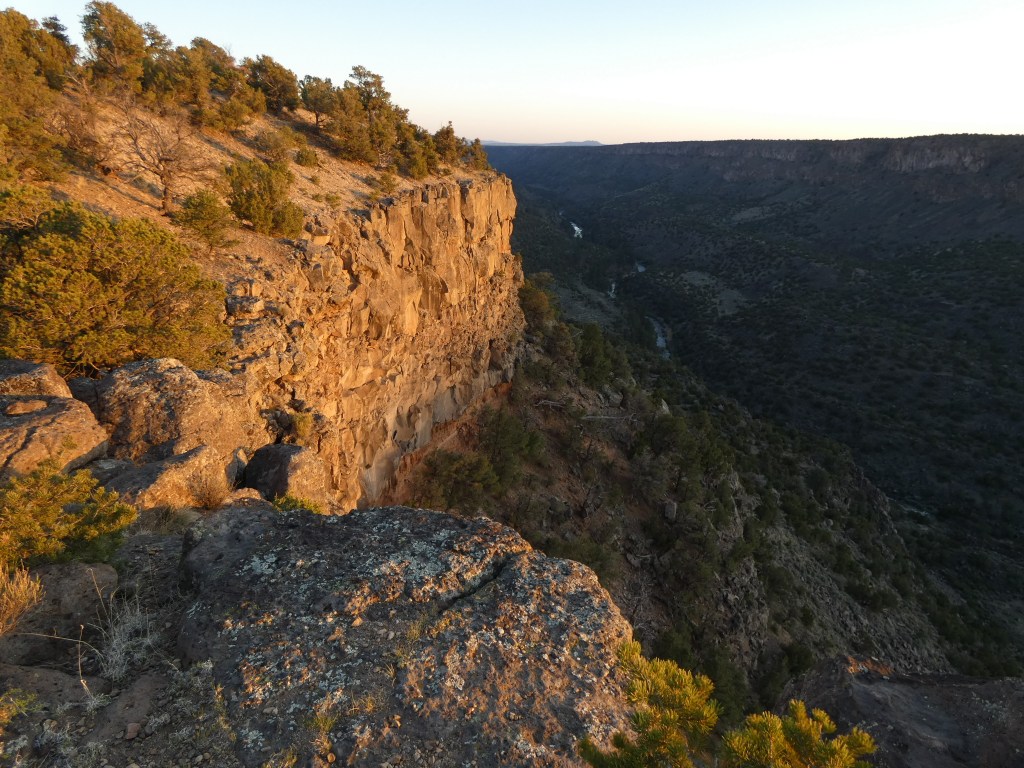
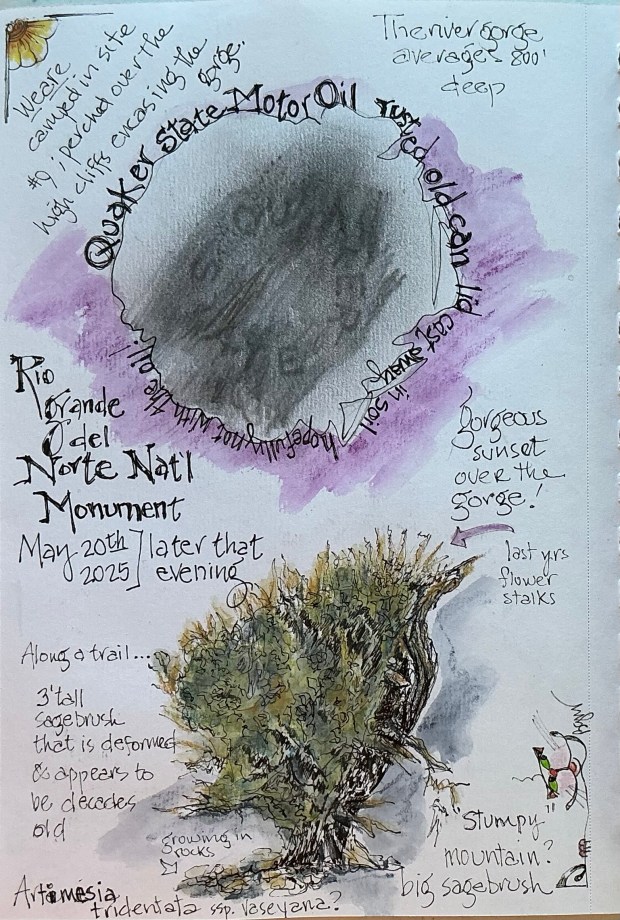
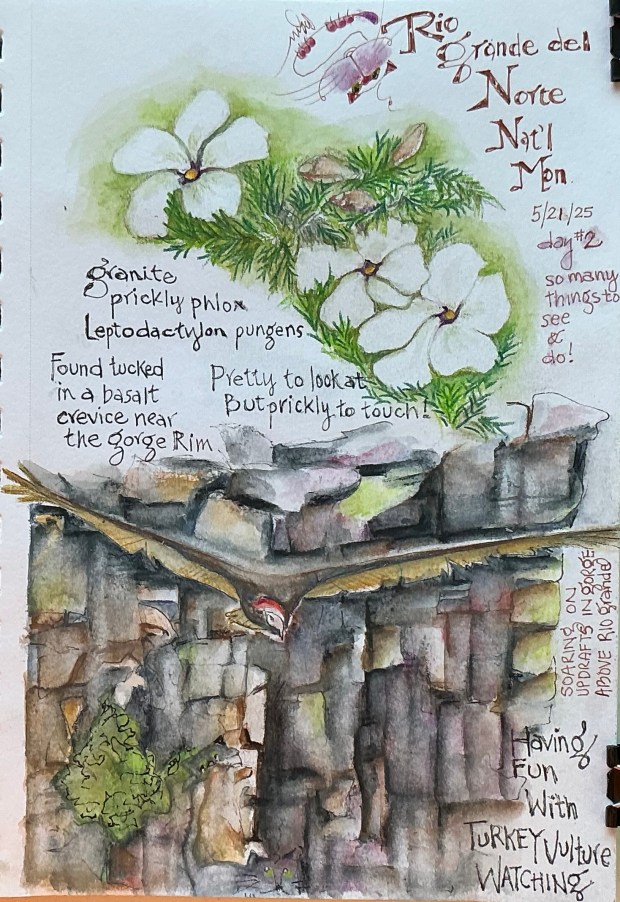
We backed our RV (‘Felix’) into what must’ve been the best designated camping site ever ….. #9 on the southern loop in Big Arsenic Springs Campground. After setting up, we discovered that Felix rested only a few steps west was the rim and the long plunge down to the Rio Grande!  But immediately south of us, the rim formed a small peninsula where nearly every afternoon I could be found sketching the plants growing from the basalt cliffs, or the swifts and turkey vultures soaring along the cliffs and over the river aided by the canyon’s updrafts. This skinny little peninsula quickly became my favorite sit spot; then late one morning it became priceless …….

Can you spot our RV? We were precariously perched above the Rio Grande, right on the rim of the gorge!

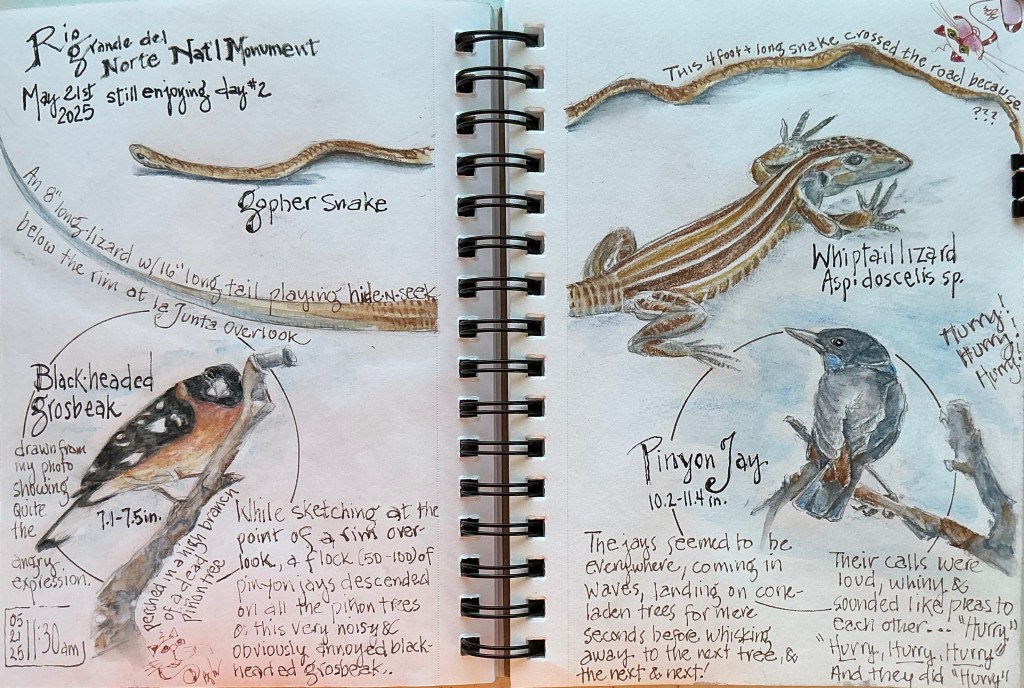
I could hear them approaching, like a swarm of bees. In a matter of seconds I was  witnessing a cacophonous chorus of 100’s of pinyon jays. These noisy birds quickly moved in and onward while descending, like they were famished, on this year’s piñon pine cone-laden trees in large erratic groups, all the while screaming, “Hurry, Hurry, Hurry, Hurry!” Where exactly they came from or where they went remains a mystery. All I know was the spectacle must’ve lasted a good 10 minutes or more, as I watched wave after wave of these birds pass by. I still get goosebumps (jaybumps?) recalling those exciting moments.

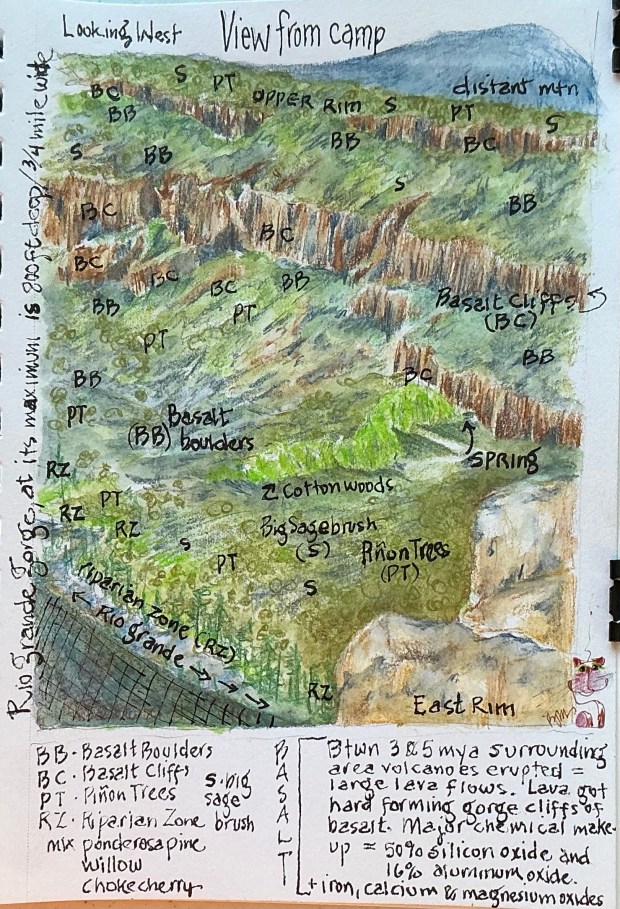
We had planned to spend only one day camping in the Monument, but every morning we decided to stay at least another and then another day. We hiked every rim and interior trail (sometimes more than once), spent hours at all of the Overlooks getting ‘High on the Views,” were thrilled with our chance encounters of five (5) Rocky Mountain Big Horn Sheep rams (twice in one day), and marveled at how the forces of nature* collaborated to carve the narrow and steep 800 foot deep gorge within the Monument.

But alas, it became time to pack up our home away from home. Even tho a string of completely clear days allowed sun to shine on our solar panels from sunup to sundown, keeping Felix’s battery purring happily our entire stay, it did nothing to recharge our potable water tank. So the morning we found the water indicator light teetering on ‘Empty,’ was the day we headed for home (after enjoying a farewell hike, of course) with my nature journal full of sketches and memories for a lifetime!

Do you have an especially special place where you can spend time in nature? Please share your discovery and what makes it so awesome!

As always, thanks for stopping by!

*Geology 101

From the overlooks throughout the Monument, we could see stacks and stacks of basalt and ash lining the narrow canyon walls of the Rio Grande Gorge. It’s hard to imagine the volume of material deposited during two very active periods of volcanic activity that occurred 5 and 3 million years ago. Soon after these events, water moving through the major drainage in the area (today’s Red River) began eroding pathways into these deposits as it flowed downstream into the 10-16 million year old rift valley. Geologists refer to the ancient Red River drainage as the ‘original Rio Grande’ because the still-closed San Luis Basin to the north (in south central Colorado) would not overflow for a few million years. Then 400,000 years ago, coinciding with a change in climate resulting in an overabundance of snow and rain, the San Luis Basin filled and spilled. As water does so well, this new and powerful river, today’s Rio Grande, moved ‘downhill’ towards the ‘original Rio Grande’, cutting through everything in its path (including the ancient volcanic deposits). When it converged with the ‘original Rio Grande,’ the erosive force of both rivers became enough to eventually carve out an 800-foot deep gorge in the Rift.  

Escapito #5: Public Lands Boondocking through central New Mexico

“The Felix” was loaded and ready for a fun boondocking adventure through forest and desert, ghost towns and lava flows, rainbow colored ridges and badlands.
Central New Mexico is a splendid place to explore and discover wildlife, geology and spectacular scenery.

Come on along with us for 4 days of camping fun in the Land of Enchantment.

Continue reading “Escapito #5: Public Lands Boondocking through central New Mexico”

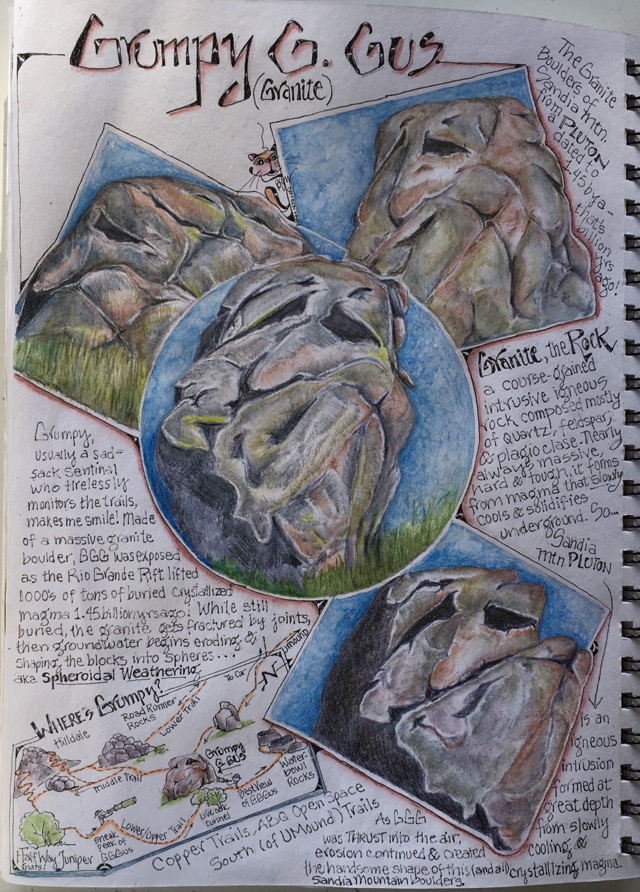
Grumpy G. Gus …. A Sandia Mountain Sentinel

Sandia Mountain granite! Such distinctively gnarly gargoyles, whimisically odd and judgmental, critter and caricature mimics ……. There’s nothing like these boulders! This is a short story about one of a cast of thousands; Grumpy G. Gus.

But there’s a longer story too. Underneath the often comical-looking and recognizable characters that can be envisioned in these boulders, there’s an even more fascinating tale that tells volumes about the geologic history of central New Mexico. Come along and meet Gus and learn a bit about Sandia Mountain granite.

Continue reading “Grumpy G. Gus …. A Sandia Mountain Sentinel”

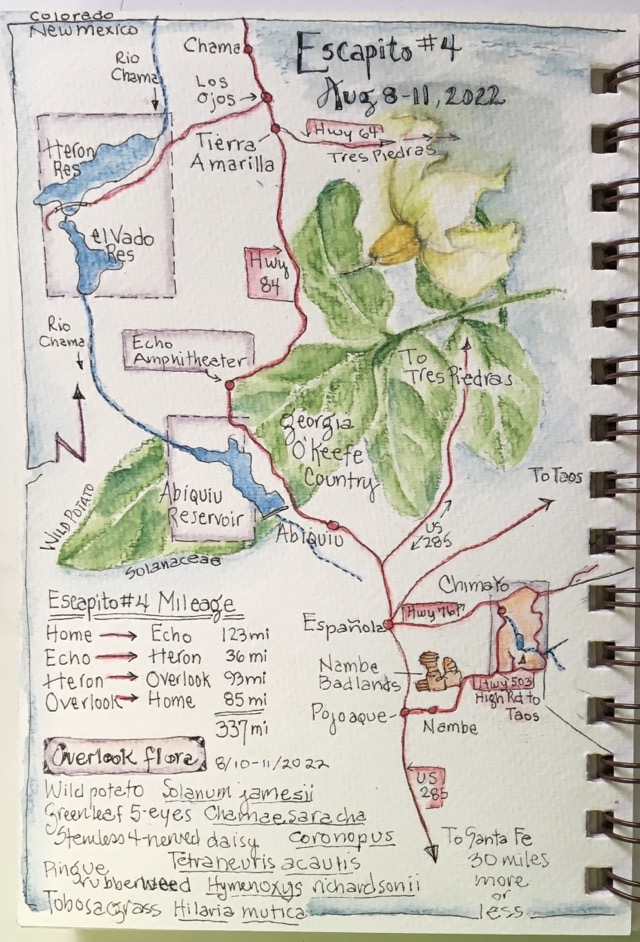
Escapito #4: Reservoir Hopping thru Georgia O’Keefe Country

On the road again with “The Felix” reservoir hopping through spectacular Georgia O’Keefe country in north-central New Mexico.

Come along and see what we discovered!

Continue reading “Escapito #4: Reservoir Hopping thru Georgia O’Keefe Country”

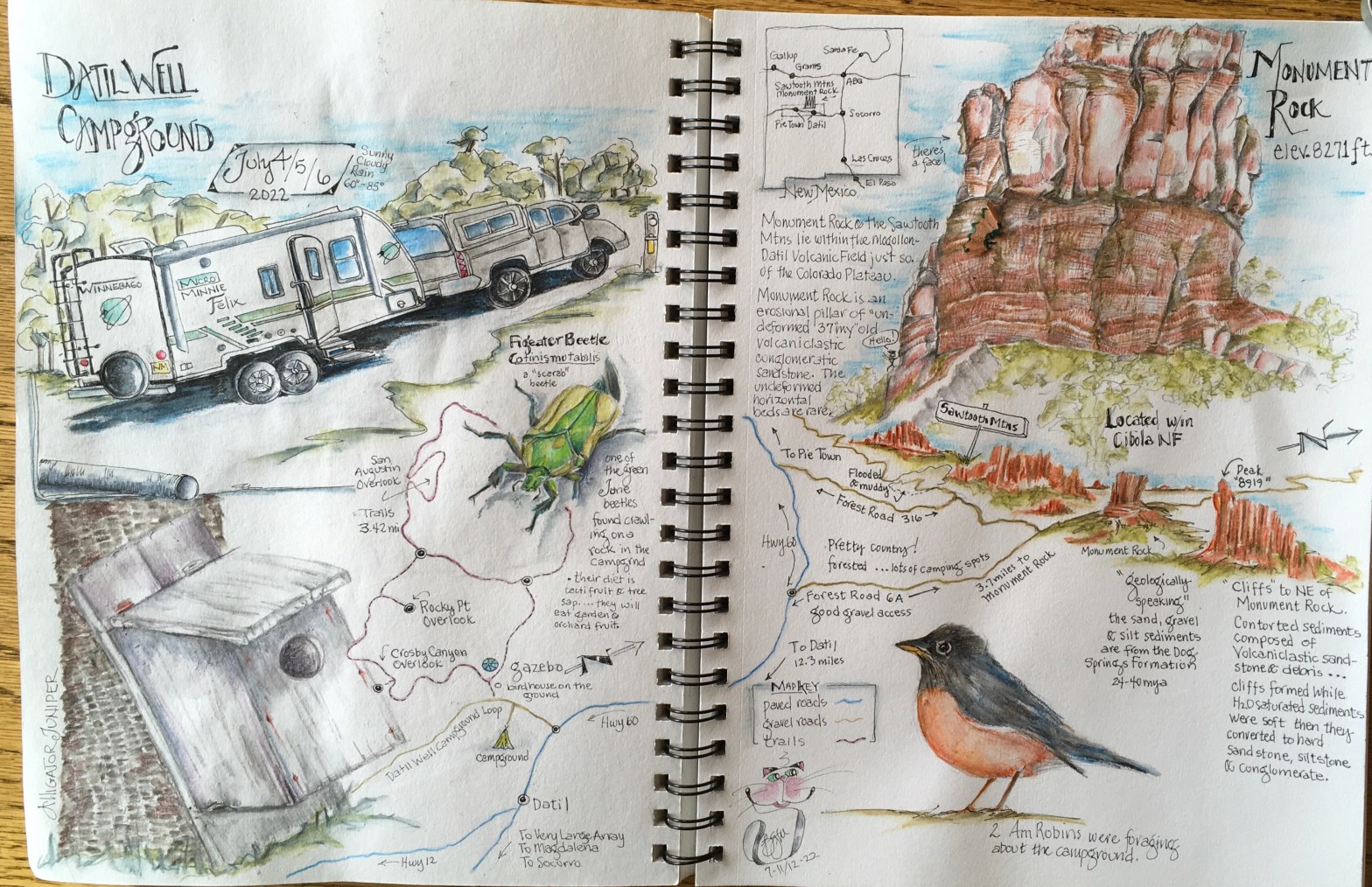
Escapito #3: Wildlife and Geology of Catron County

“The Felix” was back in action for another camping adventure into the wilds of New Mexico.  For a few days we enjoyed spending time at one of our favorite dry campgrounds, Datil Well. Then on one day we unhooked truck from trailer and headed further afield to explore a seldom visited area of the Cibola National Forest ….. the Sawtooth Mountains.

Come along and see what we discovered!

Continue reading “Escapito #3: Wildlife and Geology of Catron County”

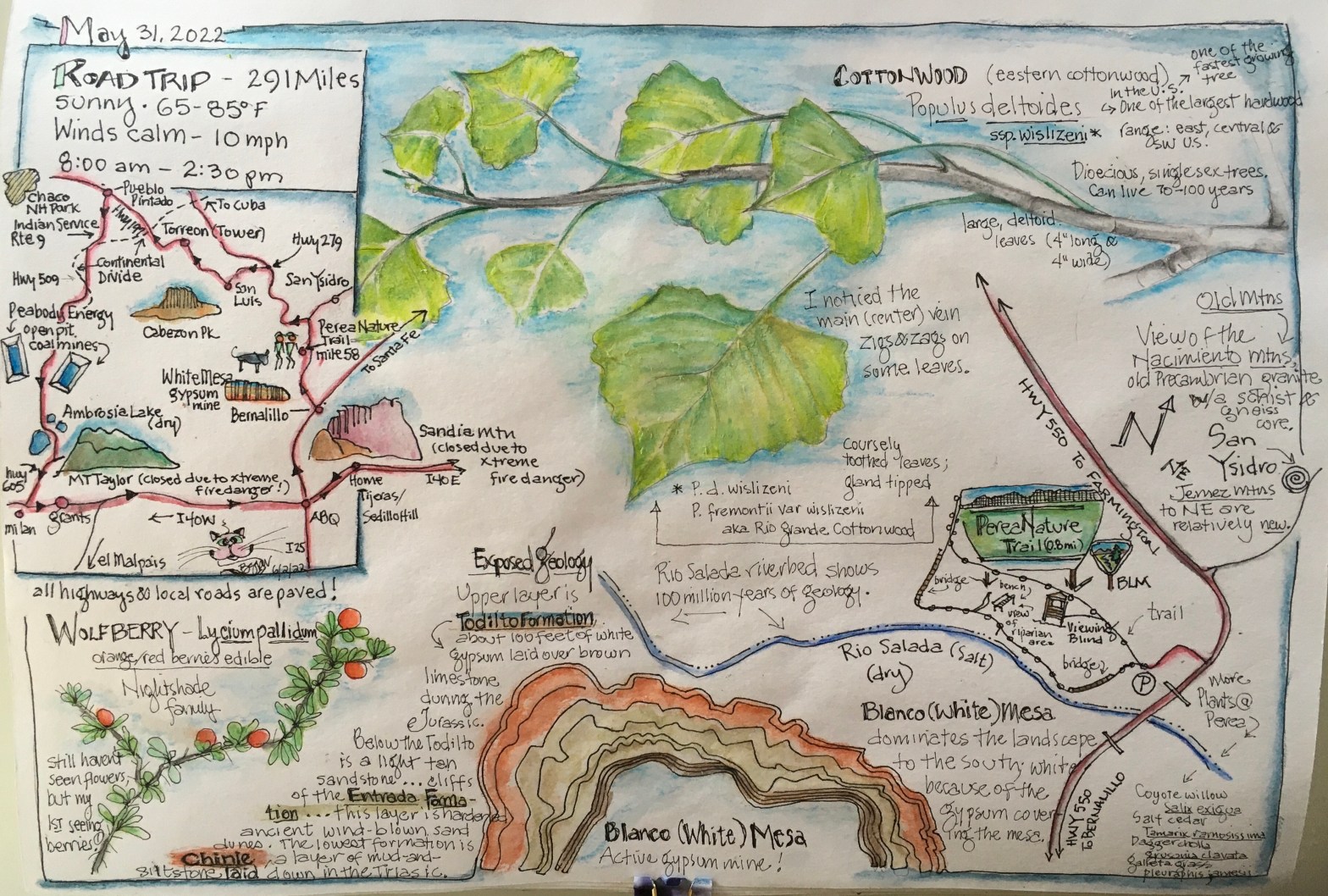
Escapito Mini: Perea Nature Trail, Pueblo Pintado Solar Fields and Open Pit Coal Mines

Do you ever wake up with an urge to head out for the day on an adventure? To go somewhere new ….. excited about the chance of seeing something different? It was the last day of May, and we decided to play tourist in our home state. But where? With so many areas closed to public access because of extreme fire danger, our choices were limited.

So we pulled out our book of New Mexico maps and found an entire portion of the NW badlands area we’ve never seen. And look …. the 291 mile round trip would take us over the Continental Divide too! Cool.

Continue reading “Escapito Mini: Perea Nature Trail, Pueblo Pintado Solar Fields and Open Pit Coal Mines”

Travel Journal, Escapito #1, 2022: Exploring Southern NM

March 14-18, 2022

New Mexico, our home state, is a wonderful state to explore, and this little 5 day Escapito lived up to expectations.  Over 650 miles round-trip, from central NM south and then east, we visited  3 new-to-us state parks, and revisited one of our favorite Bureau of Land Management campgrounds. Our main objective was to find migrating birds; those coming north from south of the border to breed in the US, and those that overwintered along the Rio Grande River corridor and are heading way north to Canada and Alaska.  We found some beautiful birds while exploring some very rugged country to within 12 miles of the Mexican border. 

With my travel journal in hand, I was able to capture a few pages of images and notes from the week. 

Continue reading “Travel Journal, Escapito #1, 2022: Exploring Southern NM”