Meet a Teeth Clacking, Jaw Grinding, Squealing and Woofing Peccary of the Desert Southwest….. the Javelina  

March 21, 2023

Another species we searched for while visiting the Sonoran Desert surrounding Tucson last December, was the javelina. Certainly this elusive little pig-like critter was nearly everywhere we went, as attested to by the thousands of hoof prints echoing their presence. And many of those hoof prints were fresh! Certainly there must’ve been squadrons of javelina hiding behind every mesquite tree around the next countless bend in the trail? 

But alas …. we never saw, heard or even sniffed out a single javelina. All we could do was record (and sketch) the herd of hoof prints, and then research this animal in the following months. Oh boy, did we really miss such a fascinating encounter.

Back at home, several months later, our friend Jim Silva was happy to share one of his javelina skull mounts for study and sketching. I’m thinking we may have been lucky not to have met up with a herd of their clacking canines during our travels! 

Maybe another time?  

Meanwhile …. If you’ve got a thirst for javelina knowledge, or just want to see my journal sketches, read on!

Continue reading “Meet a Teeth Clacking, Jaw Grinding, Squealing and Woofing Peccary of the Desert Southwest….. the Javelina  “

Coues …..Elfin Deer of the Desert Southwest

March 17, 2023

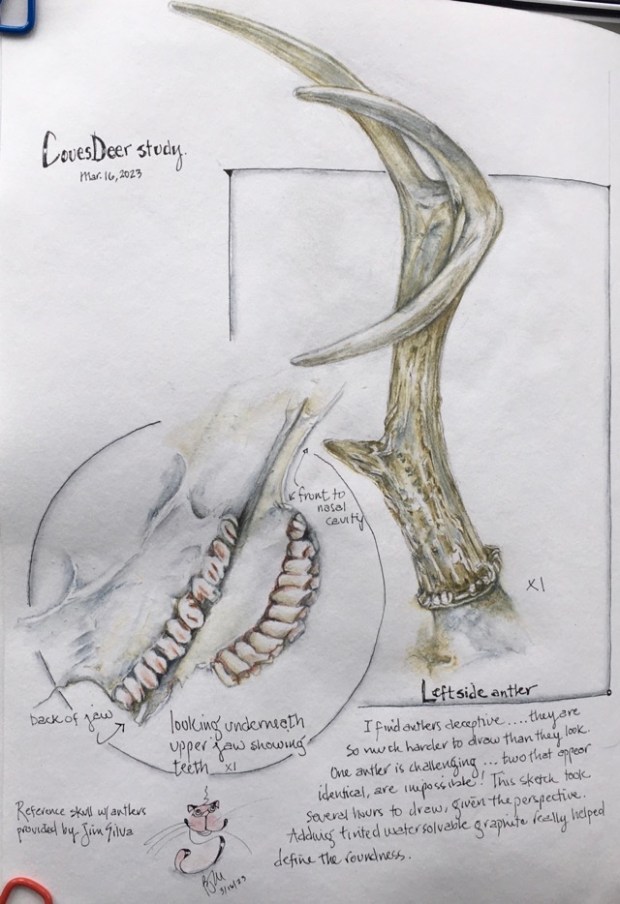
Even though we didn’t see any mammals while visiting the Tucson region last December, we knew they must’ve seen us! But little (pun intended) did we know, a diminutive elfin deer, the Coues Whitetail, was probably among the mix of critters observing us as we explored the area.

This tiny deer, with its oversized ears and flashing tail, is a native species found in the mountainous desert regions of the extreme Southwest and south into Mexico. 

A good friend, Jim Silva, who has hunted this species in southwest New Mexico, shared one of his skull mounts with me. Since sketching the skull and an antler, I’ve learned a bit about the Coues deer, including the highlights included on my journal pages.

“Coues” is most properly pronounced “cows” (but more commonly pronounced “cooz”), is also known as the Arizona Whitetail or Fantail.  Having lived in eastern North Carolina for a number of years, we are well familiar with the Eastern Whitetail, a small enough deer when compared to our local Mule Deer.  But it’s hard to imagine a deer smaller than the Eastern Whitetail.  Now we’re ready to return to the mountains of the Southwest and search for the Coues deer! Maybe late spring when there’s a chance of seeing a few fawns too!

What’s on your nature agenda for this spring? Ours is filling up fast!

Until next time! 


February “Littles” Seeds, Pods, and Other Curiosities

March 13, 2023

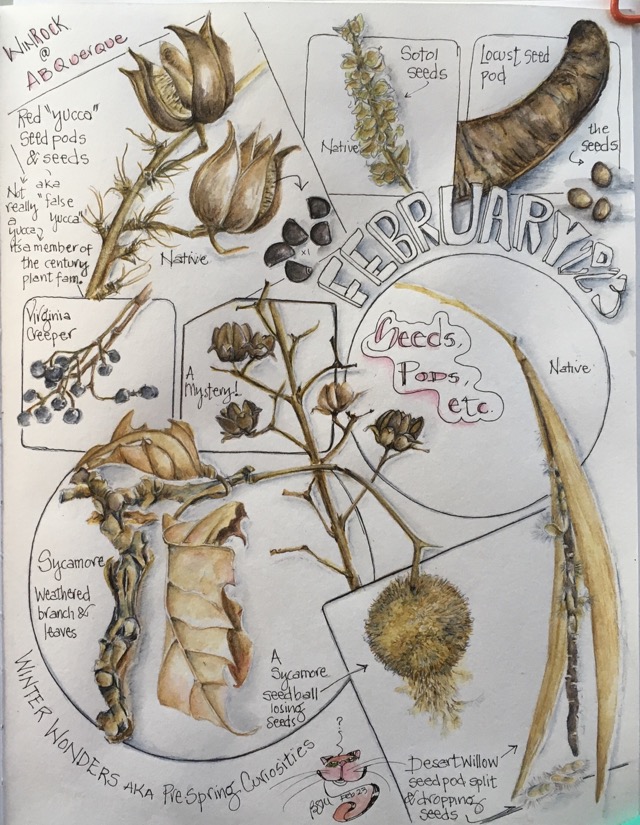
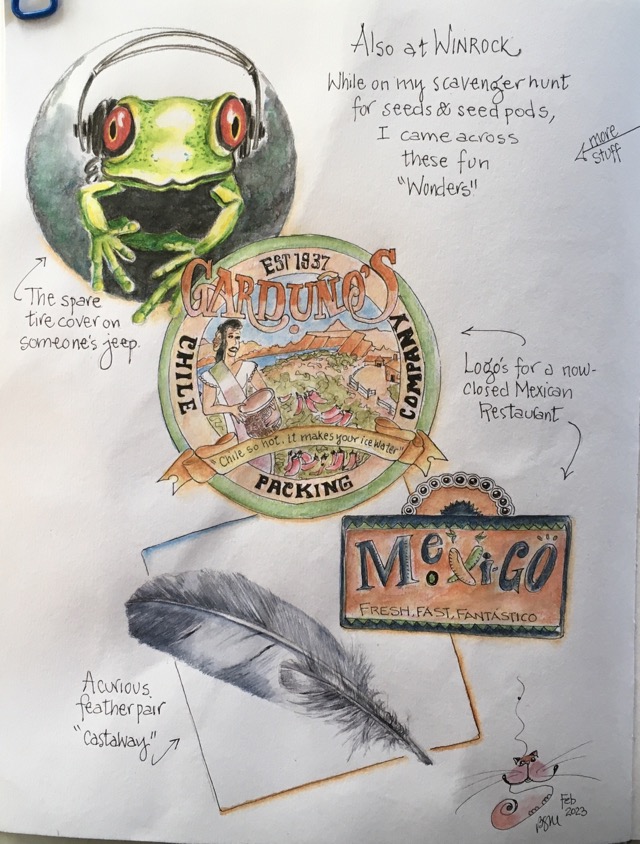
Like my January “Littles” page of the bird species that visit our feeders in winter, here’s another “Littles” to commemorate the not-quite-winter-or-spring month of February ….. Seeds and Seed Pods.  As a way to pass the time while waiting for Roy to finish up with a doctor visit, Luna and I conducted a focused scavenger hunt along a 2 mile circuit surrounding a large Albuquerque shopping mall. In no time at all, my collection bag was full.   But knowing my pages would need some local flavor and color too, I scavenged a bit longer and turned up a few more curiosities.    

Like with January’s page of birds, sketches of the species of seed pod and seeds (if collected) took less than 5 minutes each; my watercolor pencil paintings took about 10 minutes each. The restaurant logo and the frog design took a bit longer, and were done using my photos as reference. 

I’m not sure why it took nearly the entire month to decide what to do for my February “Littles.”  In hindsight, the decision should have been obvious, because I love seeds and the seemingly unlimited variety of pods.  Now I have a record of a few city seeds that will soon germinate, helping change the landscape from brown to spring green! 

Let me know what you think! I’m looking forward to March, when wildflower seedlings will be popping up which may appear in a few “Littles” boxes as well!

Thanks to “Made by Fay” for the “Littles” inspiration!


Winter Birding on Sedillo Hill: January 2023


East Mountains, Tijeras, New Mexico elevation 7,300 ft

February 15, 2023

The design for today’s post was inspired by sketchbook artist Fay. I came across her blog (see link below) while searching for nature journalers who are active in creating art and who also share some unique approaches to page layout and composition.  “Littles” is the name Fay has given to one of her unique approaches.  This is where she lays out several pages full of empty boxes with the goal to fill up a box a day for an entire month.  Not only does this encourage a daily drawing and painting practice, but it’s her way of creating a record of what she’s observed for an entire month.  “Littles” reminds me of a hyper-compressed perpetual journal.

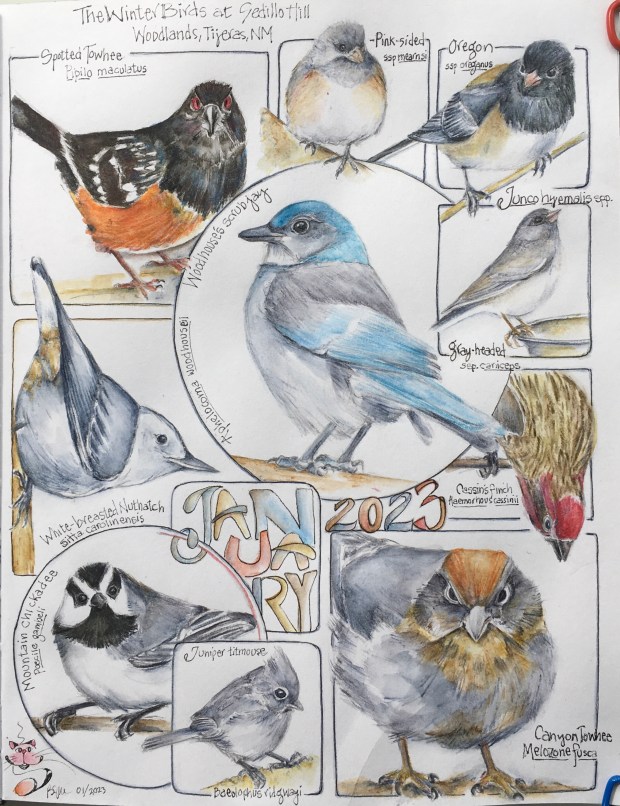
After seeing Fay’s blog post with all her miniature drawings and paintings, I knew this would be fun to try, and I had to learn more.  So we chatted and Fay encouraged me to give “Littles” a go.  And I did …… with a “little” twist!  I’ve been thinking of ways to keep a visual record of the birds visiting our feeders during the winter.  And I needed an approach with minimal fuss, without feeling each bird needed a detailed description. Ta da! 

So here’s my “Littles” page of the bird species that visit our feeders in January.  I kept my sketches to less than 5 minutes each; my watercolor pencil paintings took about 10 minutes each. My sketches were done using my own reference photos, and relied heavily on my many hours of observing these species’ poses and behaviors.

Let me know what you think! I just may create a “Littles” page for our February birds. Maybe by March, when all of our snow has melted, hints of new spring growth may appear in a few “Littles” boxes as well!

Oh and …… Follow Fay!  Her blog “Made By Fay” can be found at the link below.  If you enjoy my posts, I will guarantee you’ll love what Fay does.  She is an extraordinary visual storyteller, and enjoys drawing what she sees from her home state of Washington and on her travels about. 

https://madebyfay.wordpress.com


Keeping it Hot-n-Spicy! Happy Holiday Season

December 25, 2022

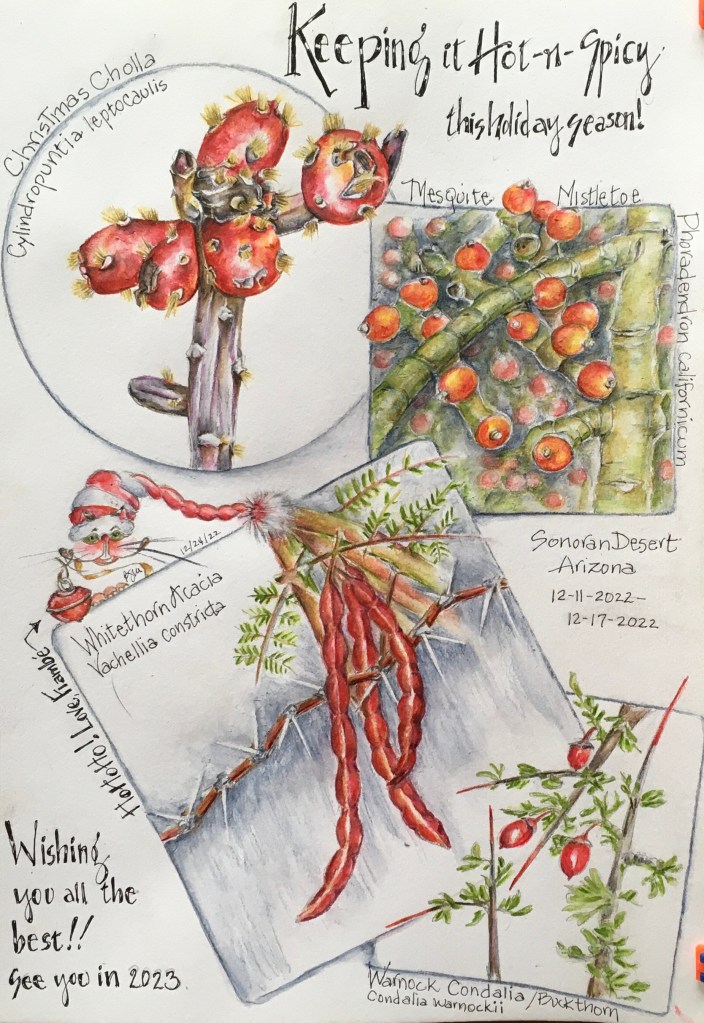
A little holiday red and green from the desert southwest.
Flambé and I send you warm season’s greetings from our home base in beautiful New Mexico to wherever you may live on planet Earth.
May all your 2023 New Year’s Resolutions come true.

A little sampling from the Sonoran Desert, SE Arizona

Thanks to all for following my first full year of posts. Flambé Kat and I are excited to share our (mis)adventures with you during 2023!

A Prickly Situation ….. A Renovating Wren

For years we’ve hiked (carefully) past hundreds of stately cane chollas, many with what looks like wads of dried grasses caught tightly in and around the numerous spindly and haphazard arms that grow all over this desert cactus. On closer examination, we’ve discovered the cholla does not actually capture grasses blowing in the wind.  Instead, an industrious and very chatty little bird collects great quantities of dried grass to build a football-sized cavity nest woven protectively and securely on and between    the many arms of a cholla. 

Meet the Cactus Wren.  

Full journal page

Once you’ve heard this gregarious wren chatter and sputter hilariously, you’ll never forget it’s call! As we were walking along the trail one day, I instantly recognized a wildly vocalizing cactus wren. Scanning the skyline (because I know they also love rattling from a perch), he readily showed himself, and did not shy away as I approached. He was calling from the highest (10 feet) arm of a pretty stout cholla, and then quickly jumped down into the center of the branches to inspect an old nest.

This nest may have been old, but apparently this little guy felt a facelift was in order and began tidying up the tunnel-like entrance. He then collected a wad of grasses he’d plucked from the entrance and plunged himself down the tunnel, grasses included! What? What was this crazy bird doing …… nest building?

Turns out cactus wrens build several nests in the spring within their territory, and maintain them year-round. I have to believe they use their nests throughout the cold winter months to keep warm, and it looked like this guy was fixing up the interior of this particular nest with super soft bushmuhly grass stems. I would’ve loved an invitation to peek inside, but hiked on, leaving the cactus wren to his chores.

I’ve been by this nest several times in the past few weeks, hoping to catch the wren at home, but to no avail. Maybe he’s tending another nest somewhere else, as this one is in disarray. 

The Sketch
My sketch, mostly from memory, was done all in graphite using the “subtractive” technique. I don’t usually sketch in his manner, because it can get quite messy ….. laying graphite down then using my mono zero eraser to create the image …. but it was an effective way to illustrate the complexity of the nest and so many cholla spines.  Let me know what you think!

November 27, 2022

Have you rescued a leaf today?

It’s always a grand idea to save leaves raked up in the Fall into big piles scattered about your yard. These cast leaves provide important habitat for overwintering birds, small mammals and insects. In the Spring they break down forming compost which helps recharge the soil with nutrients and microbes that fertilize new seedlings and build soil structure.

But what about that lone leaf, now brown and crunchy, alone on the ground? That leaf, once part of a network of thousands that once beautifully graced a massive shade tree growing bravely alongside a busy city street? That leaf, now fallen to a surface covered in concrete or pavement, is skittering about in the late morning breeze searching fruitlessly for an organic resting place.

Full journal page

After leaving our favorite Albuquerque Mexican restaurant the other day, I stepped into the parking lot and noticed a giant sycamore leaf scratching and skidding across the pavement. Seconds later, an incoming car full of hungry customers about to park, was on a collision course with this abandoned leaf! Yikes! Quickly playing out the scene out in my mind, I dashed across the pavement and scooped up this big brown leaf, rescuing it from being smashed into bits and pieces.

Close up sketch of the upper leaf surface, showing the “skirt” over the petiole.

Whew! That was a close call. Naturally this leaf deserved better treatment and a chance to contribute to Earth’s complex web of resources. And that’s what would happen ……. after a few sketches in my journal, of course.

The rescued sycamore leaf before being placed in a compost pile

This big, brown, crunchy sycamore leaf is now a part of one of the various compost piles we keep scattered about our yard. If leaves could feel, I’d like to think she’s so much happier being rescued than the alternative. Would you agree?

The compost pile topped with the rescued sycamore leaf. Home at last!

Have you rescued a leaf today?

Almost fallen leaves

Our Smoke Tree is always one of the last to drop its leaves. While this tree tenaciously clings to its thousands of food makers, the leaves go through many stages of decay. Some remain purple-green but are polka-dotted with rusty red spots. Some more quickly change to brilliant yellow-orange with rusty splatters. Some display hints of green-brown and it’s these leaves that show the most insect spotting and damage.

One day, probably soon, the tree will get tired of the display, and just before a heavy frost or wet snow, it will stand bare with piles of multi-colored leaves lying on the ground, having dropped in one big fall.

Here’s a page from my perpetual journal that I created yesterday from a few leaves plucked from this pretty Smoke Tree.

Enjoy your seasonal changes wherever you may live!

Escapito #6: Summer Sequel …. A Desert SW Escape       Part 4: Indian Bread Rocks, AZ to City of Rocks, NM

October 22/23, 2022

We usually know where we’re headed in the morning, but how we get there is another story. As we left Indian Bread Rocks we talked about optional routes to reach our destination …. City of Rocks State Park. There were several choices, and since we’re not interstate highway fans (unless absolutely necessary) we opted for the road less traveled; through New Mexico’s “Bootheel” in the extreme southwestern part of the state.  Going this way we might just catch a glimpse of that infamous Border Wall too.

Although this route was the long way to City of Rocks (200 miles versus 110 miles), it was definitely eye-opening. As we traveled lonely roads, dodging no less than 3 huge rattlesnakes sunning themselves on the pavement, the only vehicles we saw were border patrol. It was windy and hot as we approached the Mexican border, and we strained our eyes to see something resembling a Wall off in the distance.  Between Hachita and Columbus, NM, we could make out what looked to be a RR bed in the valley bottom. Binoculars weren’t much use, as this very straight line wasn’t resolving into a Wall, until ….. all at once we saw the RR track climb straight up a pretty substantial hill. That answered the question …. that faux track was indeed the Border Wall, and we had already seen miles and miles of it.

Border Wall

A short distance out of Columbus, driving very close to the border, we found a side road that appeared to lead down to the Wall, so we went to investigate. Coming within about a quarter mile of the Border Wall we saw how very tall it was, and how it was built with metal slats too close for a person to squeeze through, but spaced and angled just so to see Mexico beyond. 

Border Wall

We’re both glad to have seen this Wall for ourselves. Rest assured I’ve no intention of turning my blog posts into political commentary, but I have to say this obscene border wall is absolutely embarrassing and offensive. 

Border Wall

On to Columbus, North to Deming and to City of Rocks State Park.

Our assigned campsite was a pull through and it was a snap to get The Felix all set up. Then it was off for a nice romp through the assortment of boulders that were created from volcanic tuff and eroded over years to form what appears like, from a distance, a city of high rises. There’s a marked trail through the rock formations that lead you to some of the best rocks and views. But it’s more than okay to wander wherever your legs take you … and sometimes it’s like a maze with many dead ends.  The Park also has a nice botanical garden, many “outside the city” trails, and a super visitor center with helpful volunteer staff offering info like lists of plants, birds, insects, reptiles and mammals you might encounter in the park.

Discovering City of Rocks
Roy and Luna rock hopping

Before a big cold front blew in bringing rain and winds, I was able to do some sketching, we spotted lots of new-to-us plants (still in bloom) and a gorgeous rainbow grasshopper. Several birds (cactus wren, curve-billed thrasher and canyon towhee) paid us a call at The Felix.  About to go searching for the covey of scaled quail making quite a racket somewhere in the rocks, we changed that plan ….. a good decision as we would’ve gotten drenched with rain!

Rainbow grasshopper calling City of Rocks home
The approaching storm made for nice photos
Cat-claw Mimosa

This was our third trip to City of Rocks, and not likely to be our last. It’s a fun place to visit for a short time or an extended stay.

Before the storm

We were going to enjoy one more day in SW NM east of Las Cruces before returning home, but the weather forecast for the next many days called for high winds, rain and snow ….. so, not at all disappointed in all the ground we covered we came home a day early, driving all 283 miles in good time thanks to a tail-wind assist.

(Turns out the next day, had we stayed one day longer, would’ve greeted us with rain, freezing rain and snow by the time we got home. I could feel it in my bones!)

All in all it was a great Escapito #6, all 4 stops and the 922 miles in between, and a fun way to close out the 2022 camping season (or is it?!).  Stay tuned!

Thanks for coming along!

Escapito #6: Summer Sequel …. A Desert SW Escape       Part 3: Clifton, AZ to Indian Bread Rocks, AZ

October 21/22, 2022

Another short (96 miles) drive took us from Clifton, through Safford (to find ice cream ….. it’s getting warm!), and then south of the nearly deserted town of Bowie to visit a sprawling garden of giant granite boulders called Indian Bread Rocks.  We seem to find the most amazing collections of boulders and rocks around, and this area didn’t disappoint. Unable to find out the origin of the name “Indian Bread Rocks,” this new-to-us recreation area sits in the foothills on the northeast fringes of Dos Cabezas Mountains Wilderness Area …. both areas managed by Bureau of Land Management (BLM). Public lands “Rock!”

Scene just before entering Indian Bread Rocks Recreation Area …. Previews! Dos Cabezas Mountains in the background

To access Indian Bread Rocks (maybe the name came from the big loaf-shaped boulders?), you must first pass by a few miles of pistachio orchards looking ready to harvest. Wonder where the irrigation water for these big trees comes from way out in this desert? We then made a southwest turn onto a gravel road (Happy Camp Canyon Road) and in 3 miles we arrived at the designated Indian Bread Rocks picnic area, “sandwiched” between extremely large boulders.  No camping here tho … so we continued on up the deteriorating two track road, pushing bawling cows out of our way. These free-range Brahman bulls, cows and calves turned into camp visitors after we set up about 3/4 mile beyond the picnic area.

Entering Indian Bread Rocks Recreation Area ….. a loaf with a face?

With the rocks calling louder than the bellowing livestock, we brought The Felix to rest and took off on foot, walking further up the dusty road to scope out the area for a longer hike after temps cooled down a bit (85 sunny degrees and loving it!). 

Free range Brahaman cattle

The surrounding granite boulders really were very excellent, and seemed to be animated as well. Many looked like bakery goods; loaves of bread, pancakes, popovers and muffins. Some reminded me of dinosaurs like T-Rex and triceratops. There were precariously balanced hoodoo-like boulders, and many with dark hiding places that make perfect roosting places for bats (which we enjoyed at sunset). 

Discovering Indian Bread Rocks

Indian Bread Rocks plants consist of Chihuahuan desert species with impossible-to-navigate and tire penetrating thorned mesquite, and 6 foot tall spiny prickly pear choking the valley floors. But up small riparian areas (mostly dry washes where water may flow during the monsoon season) we found large oak trees, ocotillo, intermittent water dependent mesquite and cat claw mimosa, sotol and many other shrubs, wildflowers, ferns and grasses. We didn’t hear many birds, but they were around, and we found an assortment of insects (grasshoppers, true bugs, beetles and wasps) flying, hopping and snacking on desert plants. 

A mesquite branch sporting those tire penetrating thorns!

One of the most common insect was the Comanche paper wasp; seen flying everywhere, with exaggeratedly long yellow hind legs hanging down as they flew.  I learned this species of wasp is common here, and colonies of 25-30 build paper nests between the rocks and in the dense vegetation. They didn’t seem aggressive but we were careful to keep The Felix well buttoned up while we explored, as we camped in a small opening surrounded by large velvet mesquite.

Comanche paper wasp warming up in the morning sun
Indian Bread Rocks scenery
Roy and Luna … a bit of a rest from hiking
Indian Bread Rocks scenery

I dare say Indian Bread Rocks was the highlight of our Escapito. It’s always fun to explore new areas. But revisiting familiar areas is also lots of fun. Our next stop, City of Rocks State Park, north of Deming, NM is one of our favorite places ……. for rocks! Can’t get enough.

Stay tuned for Part 4 of this Summer Sequel: Indian Bread Rocks, AZ to City of Rocks, NM