World Ampersand Day

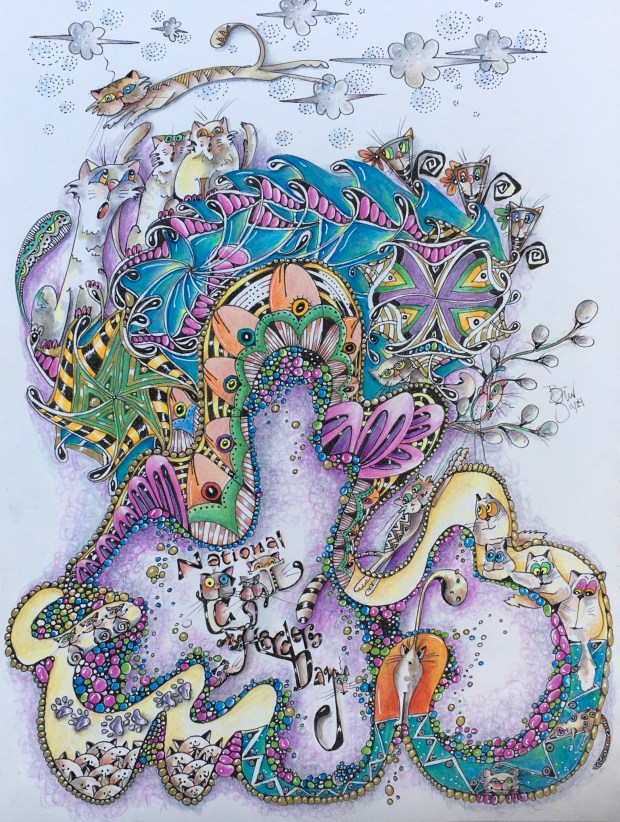
Ampersand & and & and & and ………

September 8, 2025; posted September 16, 2025
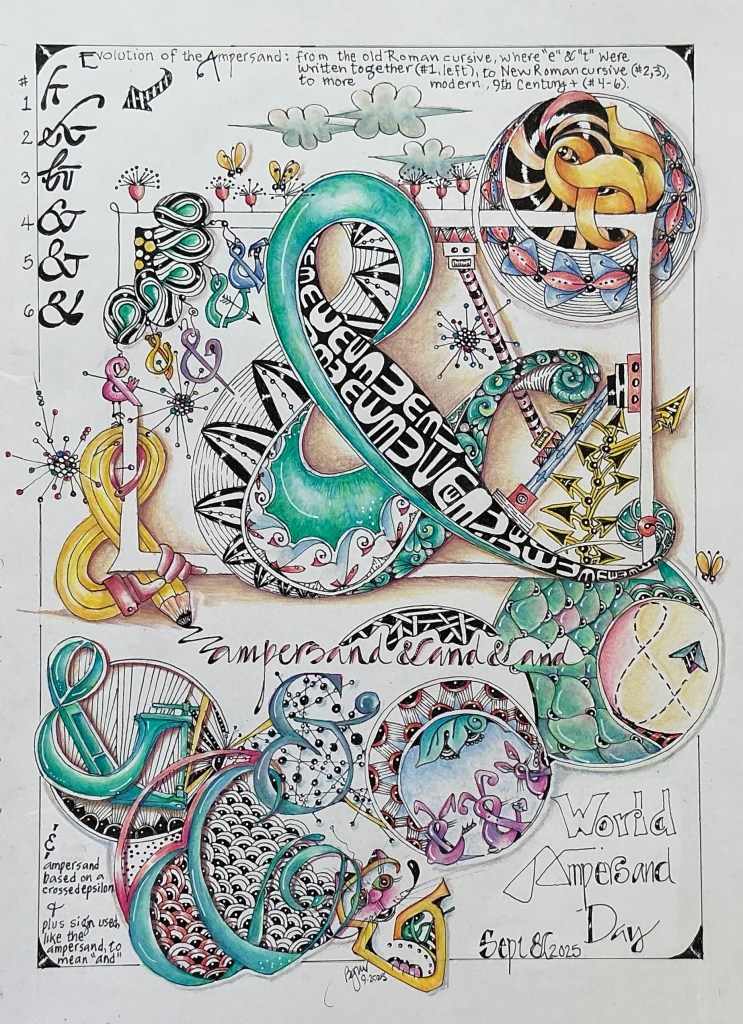
Zentangle patterns: Spanders, Footlites, Diver, Lewe, Fifolia, Sprave, Qurtuba, Cloudy Day, Fission, Icantoo, Marbles, Soutache, Strutz, RowRow, Ping, FITA (Flies in the Air), Ease, Antique, Barberpole, ArcFlower, & Arrow Tree
Did you notice World Ampersand Day was more than a week ago? No worries! Although September 8th is the official day for this World celebration, such a fun & functional, curly & quirky little character, know as the “Ampersand,” deserves a party every day of the year! Don’t you agree? 

The Symbol we use today for the ampersand is more than 2,000 years old! Designed by an Ancient Roman scribe around 63 CE, it served as the shorthand version of the Latin word “et,” meaning “and.” This ingenious calligrapher created the Symbol by combining the letters “e” & “t” into a single ligature or  glyph, for the purpose of saving valuable time, space, & parchment while writing the voluminous & tediously-penned documents of the day.

Observation #1: if you refer to my drawing, top left, you’ll see how the evolution of the ampersand symbol changed over the course of a few thousand years, beginning with Figure #1, the 2,000 year old design.

Observation #2: unless the old Roman cursive “et” included exaggerated negative space before, after, and/or within,  I’m uncertain how the symbol in Fig. #1 saved space? What are your thoughts?

The Word “Ampersand” didn’t emerge until the early 19th century (1837) as the shortcut to the commonly used phrase “and per se and.” Now that phrase-to-pronunciation of “Ampersand” may seem intuitive, the eventual slurring of the four words follows a more complex explanation that’s pretty interesting.  Based upon a traditional English custom that involved spelling out loud, “any letter that could also be used as a word in itself (“A”, “I”, & “O) was referred to by the Latin expression per se (‘by itself’), as in “per se A” or “A per se A” or “A by itself = A.”  Following that tradition of verbal spelling, the single Ampersand glyph was verbally spelled aloud like this: “and per se and,” “& per se &,” or (much more helpful) “& by itself = and.” This clarification of “& by itself” was necessary so as not to confuse the more extended forms of the “&” in use, such as “&c.” which is one of the abbreviations for the Latin phrase “et cetera,” which, of course, means “the rest.”

Today’s Stylistic Ampersand Symbols

Today, it seems there are hundreds and hundreds of unique ways of symbolizing the Ampersand. A quick internet search of font styles reveals a different twist on the symbol for each font. Can you imagine what an extensive search of fonts would uncover?! But there’s one criteria that must be met, somehow, in designing each “&” …… it must be a ligature (a combination) of the letters “e” & “t” into a single glyph (character), & if not readily recognizable, the artist must be able to demonstrate the presence of both letters, no matter how abstract. 

Used to be ……

Did you know the Ampersand used to be the last letter of the English alphabet? It’s true! The “&” was added as the 27th letter in the alphabet in the 19th century &, as such, was taught to children learning their ABCs. Primers written for ‘little folks,’ some novels, & even nursery rhymes recognized the “&” as an official character. One especially popular nursery rhyme, Apple Pie ABC1, finishes with the lines “X, Y, Z, and ampersand, All wished for a piece in hand.”  But sometimes good things come to an end. By the late 19th century, the “&” was accepted as a ligature it truly is, rather than a letter, & lost its place in the alphabet.

.

Celebrate every day by having fun with the Ampersand:

  • Use lots & lots of ampersands!
  • Substitute “&” for “and” in everything you write
  • Think of syllable replacements in words such as:  &roid, c&elabra, b&
  • Send friends whose names contain “and” a special note — &y, &rea, Alex&er, Br&don, Gr&ma
  • Design new styles of ampersands being sure they represent the letters “et”
  • Count the number of ampersands in my drawing2

Well, Flambé doesn’t know about you, but she certainly had lots of fun learning about the Ampersand, & is kicking-off a campaign to have it restored as the 27th letter of the alphabet. After all, we lost Pluto as the 9th planet in the solar system, the Ampersand has almost been around as long as Pluto, & most importantly the “&” has the shape of her long lost best cat friend & lover, Cognac, who’s been on a planetary exploration for years, and has probably reached Pluto by now.  Kat says, “Let’s bring back the Ampersand! All in favor, say, “and & and & and & and …..!’”     

As always thanks for stopping by, & for voting because Flambé believes all voices must be heard on the issue of the deported Ampersand.

1“ApplePie ABC” is a simple rhyme written to teach children the order of the alphabet by relating the various ways children react to an apple pie. After the first line, A was an apple pie, the rest of the letters refer to verbs.

“A was an Apple pie; B bit it; C cut it; D dealt it; E eat it; F fought for it; G got it; H had it; J joined it; K kept it; L longed for it; M mourned for it; N nodded at it; O opened it; P peeped in it; Q quartered it; R ran for it; S stole it; T took it; V viewed it; W wanted it; X, Y, Z, and &, All wished for a piece in hand”. 

Note the absence of two letters; the vowels I & U. When the rhyme was originally written (sometime in the 18th century), there was no differentiation between the capital letters I & J, & between U & V. But in 19th century versions, when the I & U were accepted as distinct letters, the rhyme was updated to include these two lines: 

“I inspected it” & “U upset it.”

2 Spoiler Alert: Flambé & I each counted twice & agree …. you should come up with a total of 29 Ampersands in my drawing. If you also agree, Bravo! If you found fewer than 29, try again! If you found more than 29, send a message PDQ, letting us know how many there actually are & that we must’ve been sniffing too much catnip to count higher than 29! Then I’ll have Kat begin the scavenger hunt anew!

Zentangle patterns: Spanders, Footlites, Diver, Lewe, Fifolia, Sprave, Qurtuba, Cloudy Day, Fission, Icantoo, Marbles, Soutache, Strutz, RowRow, Ping, FITA (Flies in the Air), Ease, Antique, Barberpole, ArcFlower, & Arrow Tree

Sketchbook Revival 2025 ….. Binge Fest Extravaganza!

June 16, 2025

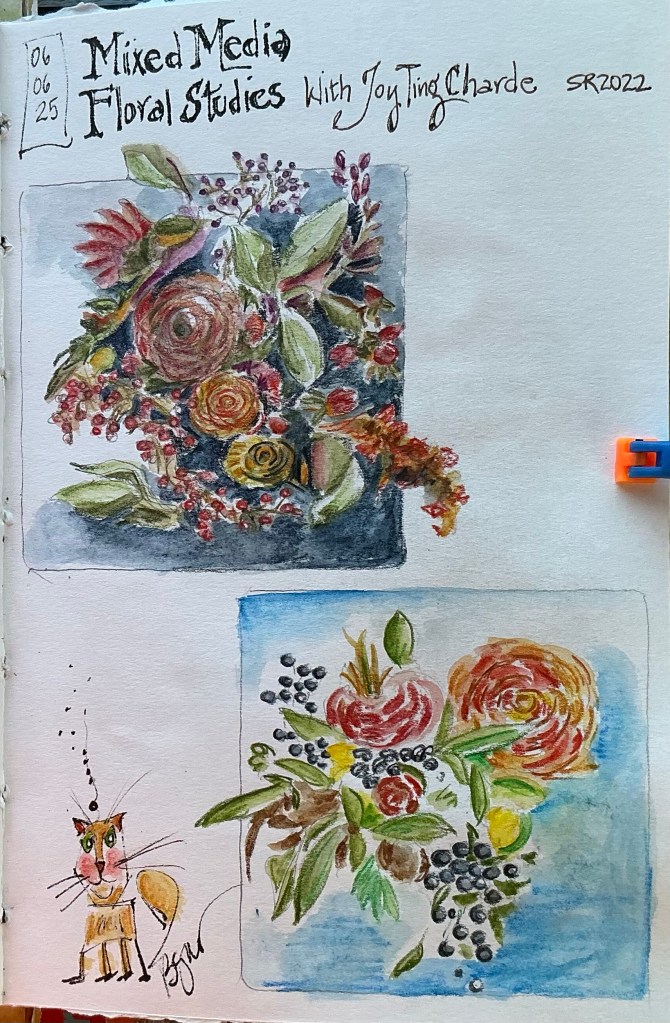
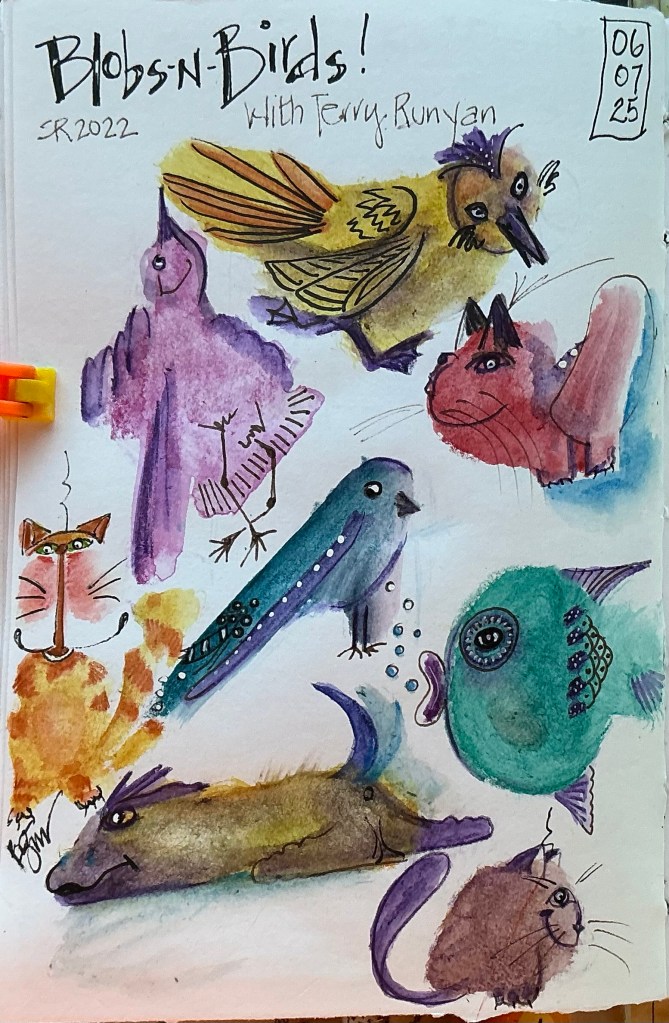
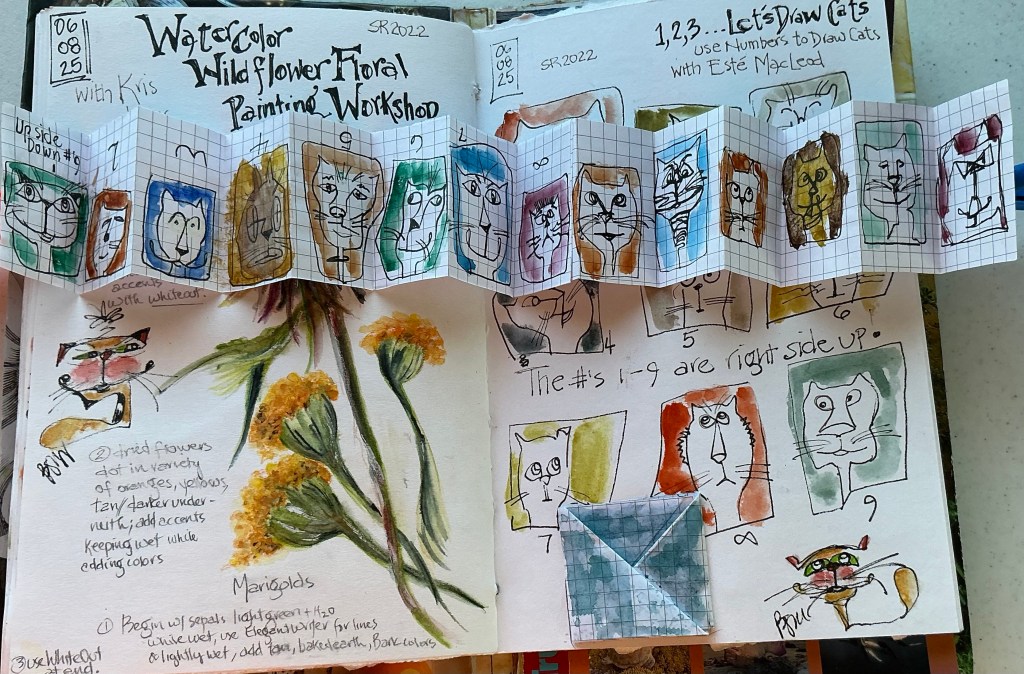
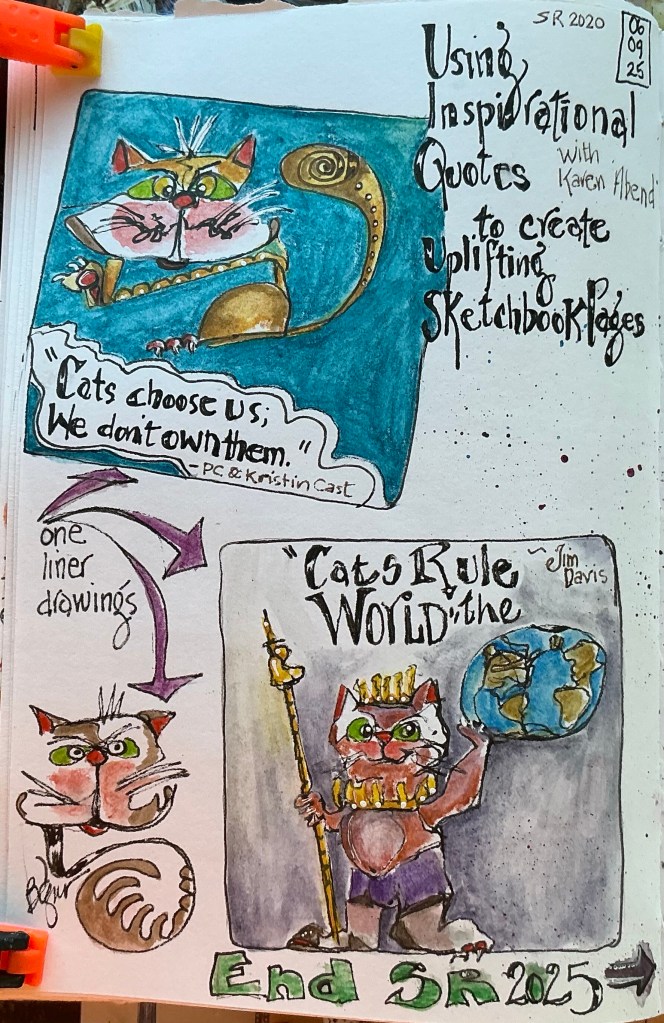
What a whirlwind celebration! Sketchbook Revival (SR) 2025 Binge Fest was so much fun. And Wow! Two jam packed weeks of creativity was over in the blink of an eye! 

Karen Abend, SR creator, host extraordinaire, and wonderful artist, came up with a brilliant idea for the SR 2025 session. I would swear the creative gears inside her head were spinning with delight as she declared, “Yureka! I’ve got it!”

Beginning on May 27th thru June 9th, Karen generously opened up the SR historic vault and set free all of the workshops conducted the first 5 years of SR (2018-2022)! That unbelievable offering came to more than 130 one-hour-long workshops of inspiring, hands-on, and creative  play time all instructed by well-known experts in artistic fields associated with Sketchbook Journaling.  

Challenge presented ……. Challenge accepted.

Since I’ve been participating in SR each year since 2018, and attended most of these workshops in the past, my goals and strategies to tackle the challenge were these: 

  1. Complete a minimum of 4 workshops daily;
  2. Two workshops should involve a project outside of my comfort zone, such as portrait drawing, fantasy, word play, collage, and properly stitching my own SR sketchbook so it wouldn’t fall apart during the 2-week challenge, etc.;
  3. Two workshops should involve projects within my comfort zone, such nature subjects, urban sketching, whimsey, and lettering, and those using watercolor pencils, graphite, and ink;
  4. Develop fresh, interesting, and imaginative sketches during the workshops;
  5. Allow Flambé to play along;
  6. Slow down, breathe, and enjoy the 2-week marathon without becoming overwhelmed;
  7. Recognize and gather take-away tips and techniques to bring into my Nature Journaling practice and Zentangle storytelling. 
  8. Keep sketching and sharing.

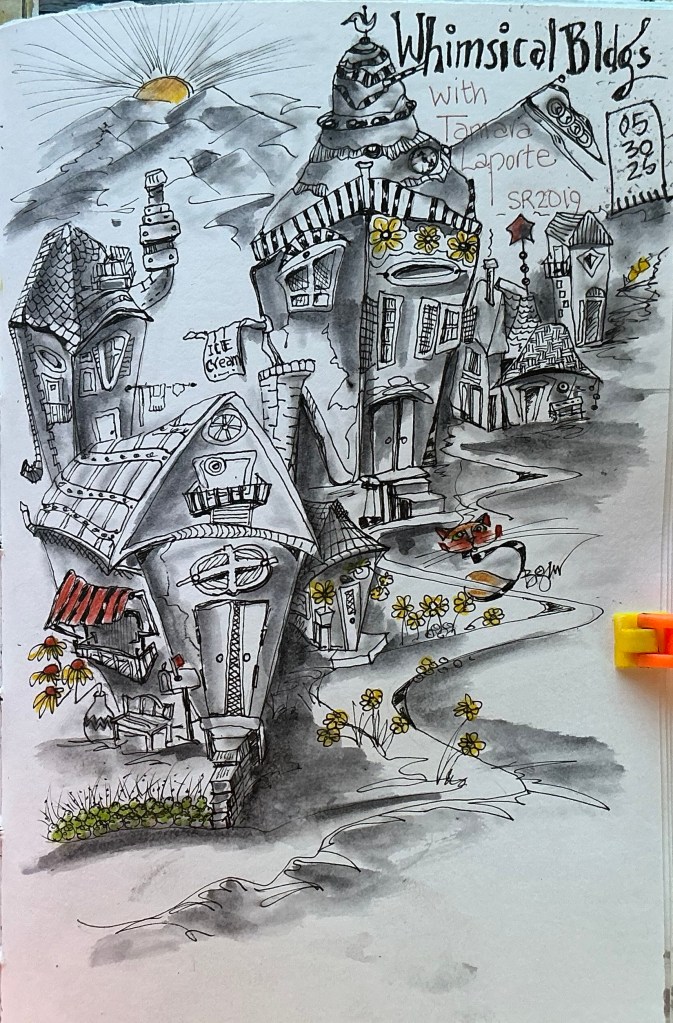
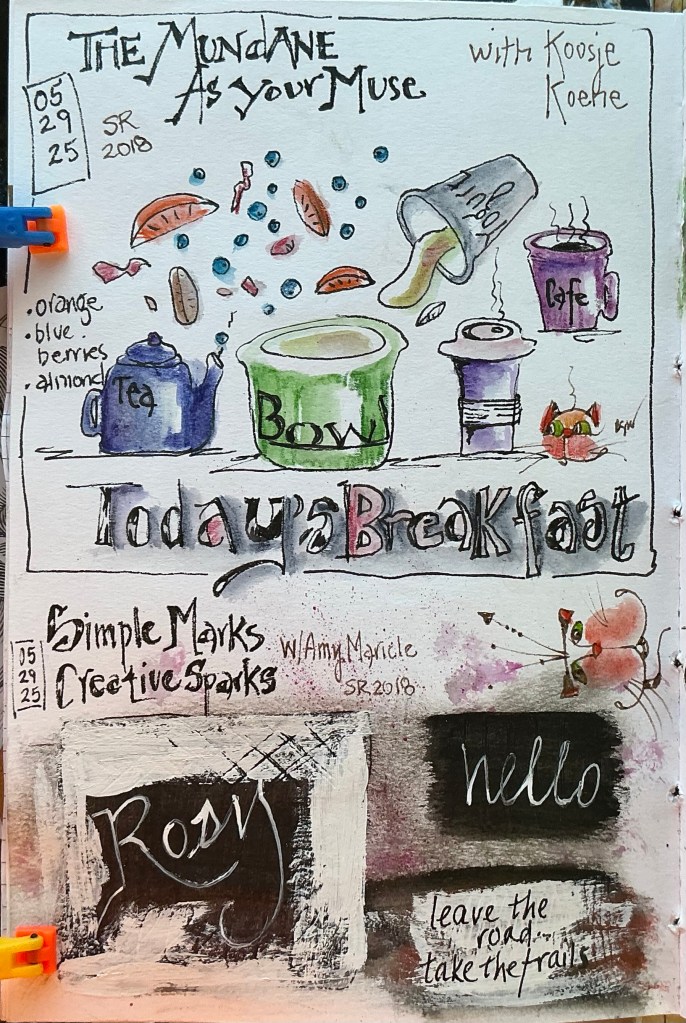
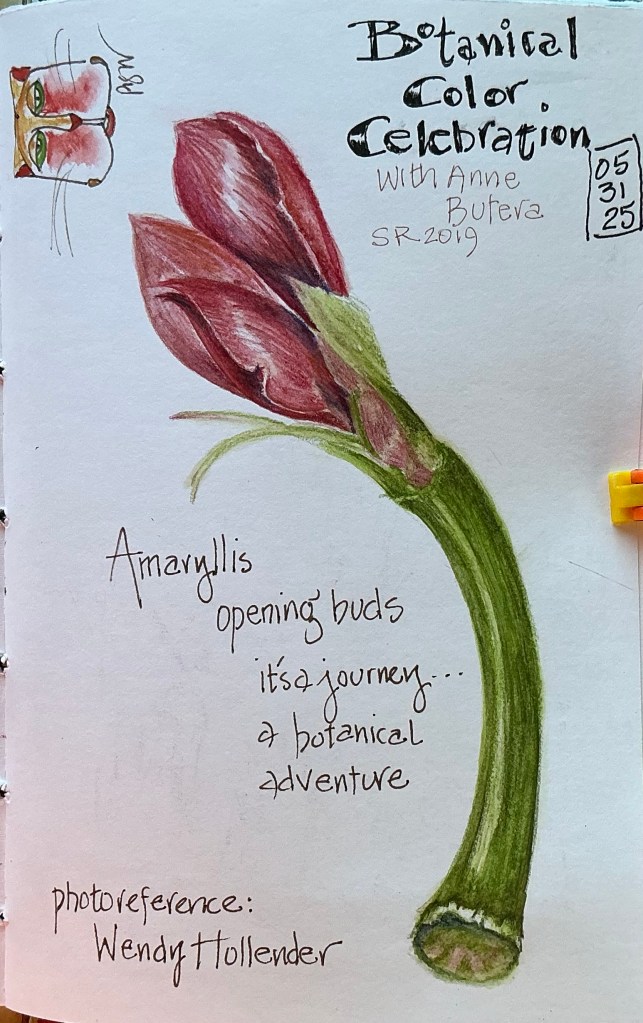
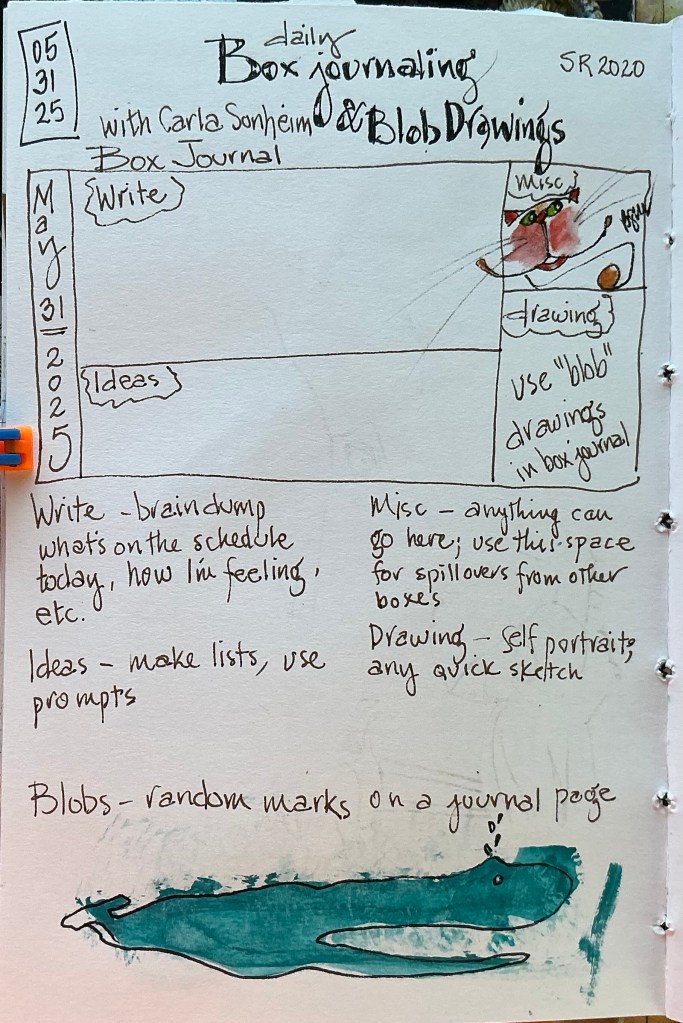
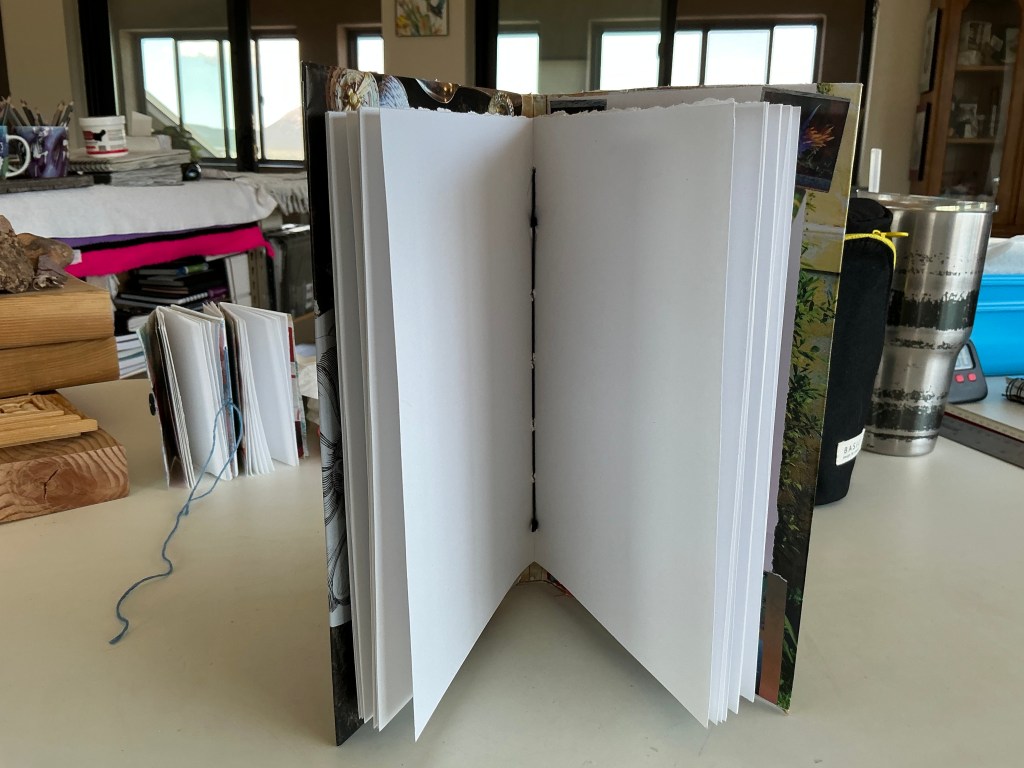
After two weeks of play, I was able to fill up my handmade and successfully stitched SR 2025 sketchbook! With a total of 46 pages completed (doubling up workshop projects on a handful of pages), including several pockets with inserts, I was pretty happy (and a bit exhausted). 

If you’ve participated in SR in the past, or maybe took on the 2025 challenge as your first time, you know how intense (in an exhilarating way) it can become.   If not, and would like to learn more, check out this link 

This link will take you to Karen Abend’s website where you can ask for more information about Sketchbook Revival. https://karenabend.com

Hope my collection made you smile and laugh! I certainly got a kick out of the experience.

Well, until Sketchbook Revival next year, thanks for coming along! 

Happy National Love a Tree Day!

May 16, 2025

Zentangle Patterns: thumbprints, cobbles, Lumpi, Cruffle, Shattuck, lightning, thorned Pokeleaf, sweet pea, mythograph, Icantoo, remo, greenery vibrant, feathering s-curve, boundary, Arcflower, hepmee, Quabog, raindotty, tsui 


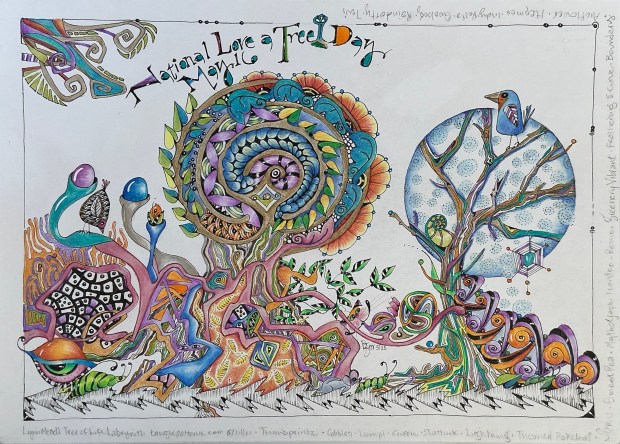
And many thanks to Lynn Mead for sharing her Tree of Life Labyrinth pattern. Super fun to give a whirl! The easy to follow directions can be found on tanglepatterns.com posted 08/14/2021 
Today, May 16th, just so happens to be National Love a Tree Day! It’s the official day to celebrate all of life’s joys brought to us by the trees we share this planet with. Whether you love reading in the shade or taking a bite out of a fresh fruit pie, National Love a Tree Day encourages y’all to get outside and enjoy a tree.
A Changing Landscape

We all know many tree species live many many years; some live to be several thousand years old. According to the U.S. Forest Service, about 766 million acres of forest land exists in the United States today, a number that’s held steady since 2012. But the nature of our forests has changed over the last 400 years, due to changes in management practices and demand. Population growth, rural and urban development, along with a variety of land uses (like conversion of forests to agriculture use) resulted in a steady decline of forested acres between 1630 and 1910;  a decline from 1,023 million acres to 753 million acres or 46% to 34% of the total land area in the U.S. Since that time until the present, where people choose to live and how the land is used has been constantly changing.  While some urban forests increase, other areas see a decline. Tree planting programs improve landscapes but human activities and population growth continue to impact these ecosystems.

We All Benefit from Trees

Trees provide more than just beautiful landscapes and a shady canopy on a sunny day. They play a significant role in reducing erosion and moderating the climate as well as give us oxygen. Large quantities of carbon are stored in their tissues as trees remove carbon dioxide from the atmosphere. They provide habitat and structure for strong ecosystems.

How to Observe National Love a Tree Day

This is a good day to plant a new tree native to your area, or spend some time enjoying the beauty of the trees, Take time to learn how to care for the trees you have, too, whether you live in the mountains or the desert. Write down all the reasons trees are important to you. If you have a favorite tree, or a tree you’re not familiar with, begin a little research project about that (or those) species, and journal about your findings. 

What will you do today to celebrate trees?

Happy National Love a Tree Day!

As always, thanks for stopping by!

Welcome New and Returning Subscribers

Many Hearty Thanks, Sharing Creative Ideas, Answering the ‘Kat’ Kwestion

April 1, 2025

Completing my 15th sketchbook, and beginning the next one is always cause for celebration!  To do so, Kat and I thought it would be especially fitting to shout-from-the-treetops enthusiastically, THANK YOU! Thank you all, my loyal subscribers, for coming along on my interesting, hopefully educational, sometimes crazy, always curious nature journaling adventure. 

Zentangle patterns used: LoveBuzz, Membranart, Frostz, Chatoo, Sea Urchin, Toku, Rosie, Calibree

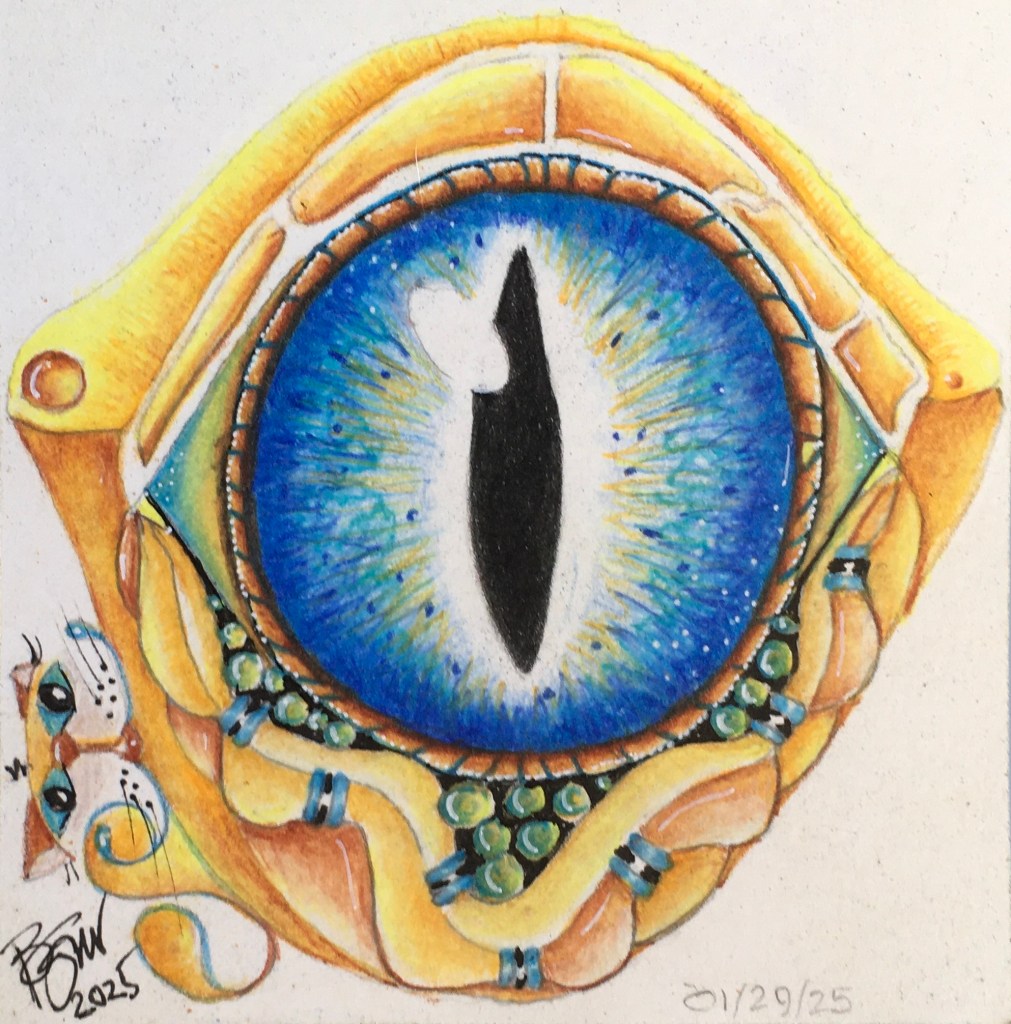
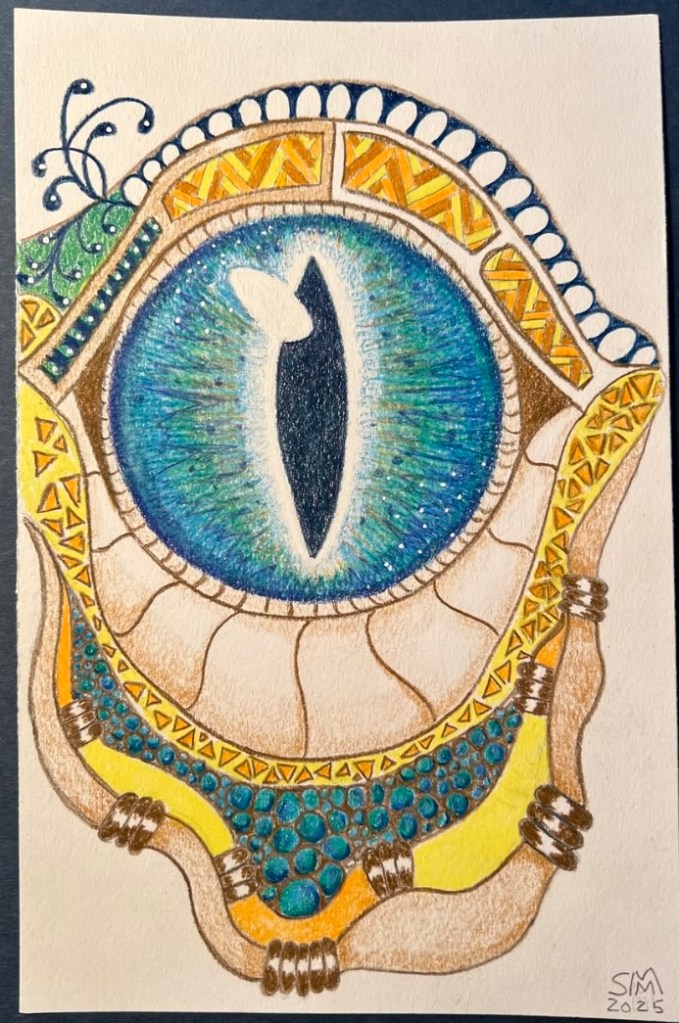
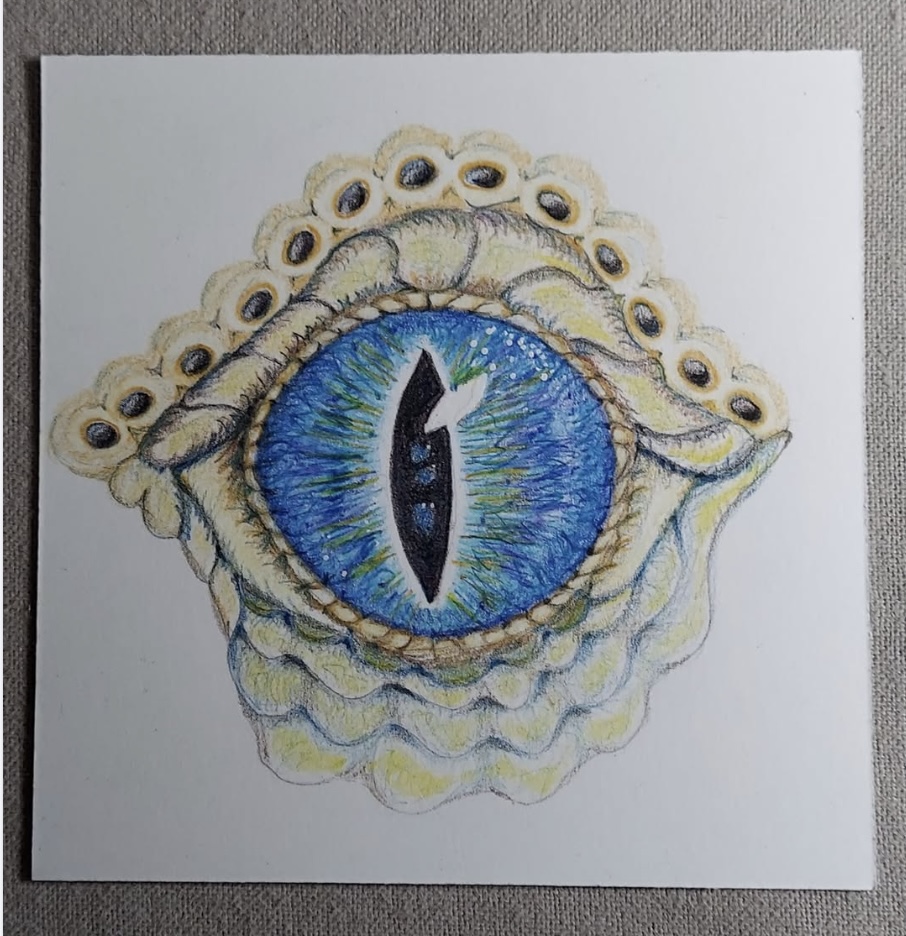
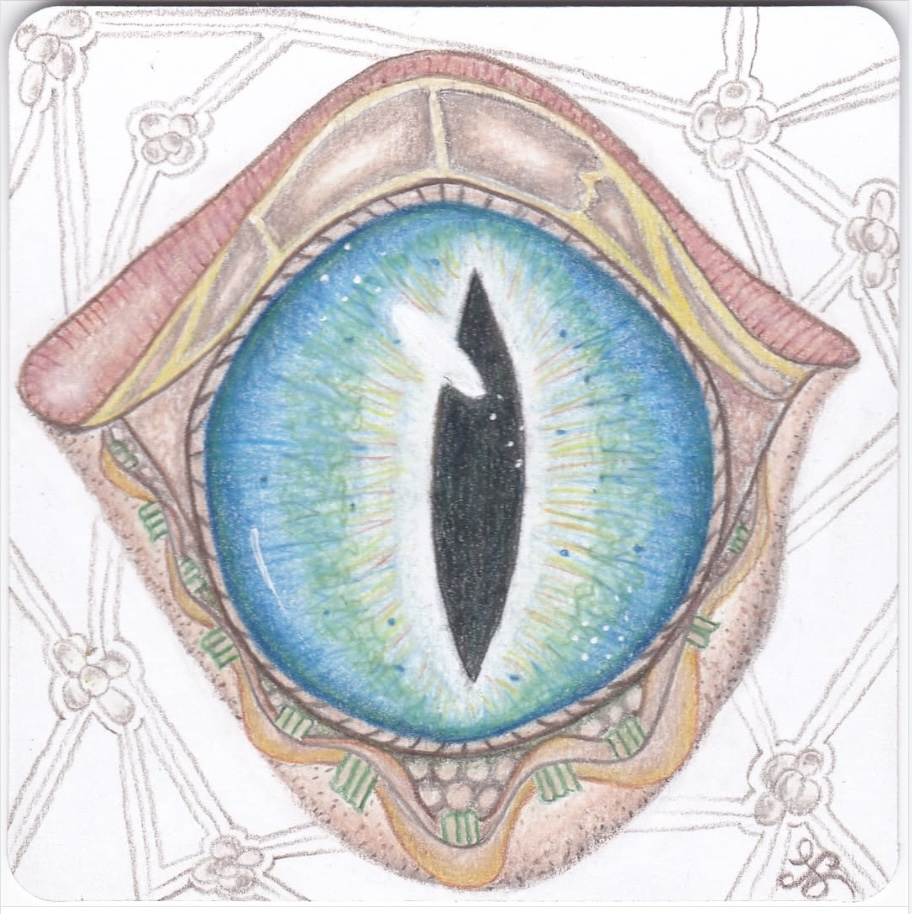
My recent webinar class, “Create a Colorful Reptile Eye1,” sponsored by Host Karen Abend (of Sketchbook Revival fame), generated many new subscribers to my web page and blog, “A Curious Nature.” Wow! And Thanks so much. A special thanks to those who attended the live and/or recorded class. I loved seeing so many colorful lizard eyes (a sampling below). They were incredible! 

Sharing the Wonder of Nature

With all the past and current activity on my blog, I feel so fortunate and very encouraged to carry on. Even though new postings have been random lately, there’s lots of works-in-progress soon to be shared. Meanwhile, comments including what you like about my posts and what you’d like to see more of, are always appreciated.  What inspired you to subscribe to this blog? If it’s just enjoy, that’s perfect! Or maybe you’d like tips to develop a regular or even a daily creative practice, how can I be more encouraging? I’d love to know if you are an active nature journaler or tangler, or express yourself by creating art in other ways, such as through music, poetry, or storytelling. Send me your ideas by commenting on this or any future posts. I’ve created my webpage and blog because of my insatiable curiosity about the natural world. It’s extraordinarily fun to go beyond learning what the names of flowers, animals, rocks, and clouds are. The excitement of wondering and discovering answers for all the why’s, who’s, when’s, and how’s is so rewarding. Sharing is my joy!

Explaining Kat

Thinking new subscribers may be puzzled by my constantly mentioning Flambé or Kat or both, now might be a good time for explanation and background (and perhaps provide a refresher for those who’ve been following along from day 1 of my blog):

In 2014, a young stray calico cat showed up one day on our doorstep when we (Roy and I) lived in Oriental, North Carolina (U.S.A.). This little wild miss seemed to magically appear from our backyard woods, perhaps in search of a meal or a friend. She sat and meowed for a few minutes, but when we opened the door, she ran away.  Efforts to get close to her when she returned several times during the week were futile. Then one day she vanished and never returned. Not knowing what may have happened to this pretty kitty, Roy thought a nice remembrance of her visit would be to add a small cat sketch to my next drawing. A dandy idea!“But only one drawing,” I thought? It was at that moment that Flambé appeared on my creative doorstep, and has never left!

Flambé, aka Kat, is always smiling, popping in and out of all my art, regardless if the piece is imaginatively & whimsically tangled or a serious nature study. Along with forming the best part of my signature “chop,” she’s the heroine of some pretty wild and crazy tangled misadventures, sometimes pushing Kat’s 9-lives threshold to satisfy her insatiably curious nature (and appetite). Flambé adores being noticed, whether she hides inside the story, or shows up front and center. She makes everything creative more fun.  Flambé may be just “Kat,” but she’s my inspiration for and reminder about the value of komic relief, and makes the perfect konstant kompanion!  

Whew! That’s all for now. Hopefully your questions about this blog, inspiration and Kat have been answered. If you’re craving to learn answers to other related topics, let me know.  Meanwhile, Flambé and I wish you an exciting and creative remainder of the year ….. have times full of happiness, creativity, and memorable adventures, but most of all laughter and fun!

Hope to hear from you soon, and as always, thanks for stopping by!   

Meow!

1Unfortunately, the class or recording are no longer available for viewing. But I may have another live demo class some day in the future.  If so, you can be sure the announcement will show up on my blog.

National Cat Herders Day!

December 15, 2024

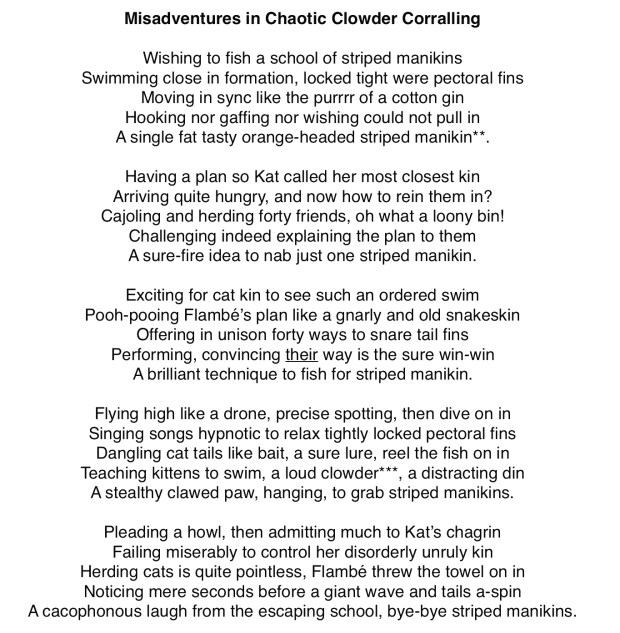
You don’t have to be a cat lover to celebrate National Cat Herders Day. The only requirement is to know someone or even be that someone who’s attempted to accomplish a complex task by controlling the uncontrollable, organizing the disorganized, or bringing to order a disorderly cast of characters, akin to like trying to herd cats*.  From parents and teachers to project managers and team leaders, this humorous observance pays tribute to those willingly and persistently taking on the challenge of controlling difficult or chaotic situations. Show the love and appreciation for people in your life, and quite possibly yourself, who take on any impossible or frustrating task with patience and humility.

Zentangle patterns used: Choir, Ease, Windflower, KittyKitty, Fragment oA6, Apichu, Budlite, Cat-kin, CD Joy, Cloudy Day, Raindotty

___________________________________________________________________

*The origin of the phrase “like herding cats” likely came from the opening scene of Monty Python’s Life of Brian (1979). In this scene, shepherds are discussing sheep and the topic strays to cats: “Can you imagine a herd of cats waiting to be sheared?”  

___________________________________

**A fish manikin is a form carved from wood or foam by taxidermists used to mount a trophy fish. Flambé’s school of striped manikins all looked like trophies to her! If only she could’ve herded her cat kin into an attentive and cohesive group long enough to teach them her sure-fire plan for breaking up that school of fish …….. maybe, just maybe she would’ve had a striped manikin to Mount on the wall of her den!

___________________________________

***A clowder is a real thing! It’s what “they” call a group of cats. Honest.  But then being naturally curious like my sidekick, Flambé, I wanted to know how many cats are needed to make a clowder. Here’s what I learned: 

“Three or more cats make up a clowder, which makes sense. After all, three is a clowd—er, crowd. Jokes aside, this is mainly because the word “pair” covers pretty much any group of two, and if a cat is by themselves, then they’re just … a cat.”

But that doesn’t explain how these feline groups are ever formed ……. after all, wouldn’t that be a frustrating endeavor and quite nearly impossible …… exactly like Herding Cats?

I’ll let you be the judge, but please let me know!

___________________________________

As always, thanks for stopping by!

On the Edge of Chaos …. Annual Chaos Never Dies Day

November 9, 2024

Chaos Never Dies Day is an annual holiday observed on November 9th that reminds us that chaos and disorder are natural and inevitable parts of life. The day encourages us to embrace the chaos and find humor, creativity, and resilience in the face of uncertainty and unpredictability. It’s a time to let go of perfectionism, embrace imperfection, and enjoy the ride.

Flowing from Flambé’s depiction of the chaotic world that lives between her pointy ears, emerges 16 simple continuous line shapes. Can you find them all? 

Drawings and Zentangle patterns: Zip, Stacked Stones, Bekkwheat, Boxworth, Ellis Chuang Rabbit, Tomada Rooster

(If you’d like a little help finding these shapes, the answers can be found at the end of this post. But only peek after you’ve given the illustration a thorough looking over.)

Of course, Kat has embedded herself within the chaos; her discovery makes for 17 total shapes.

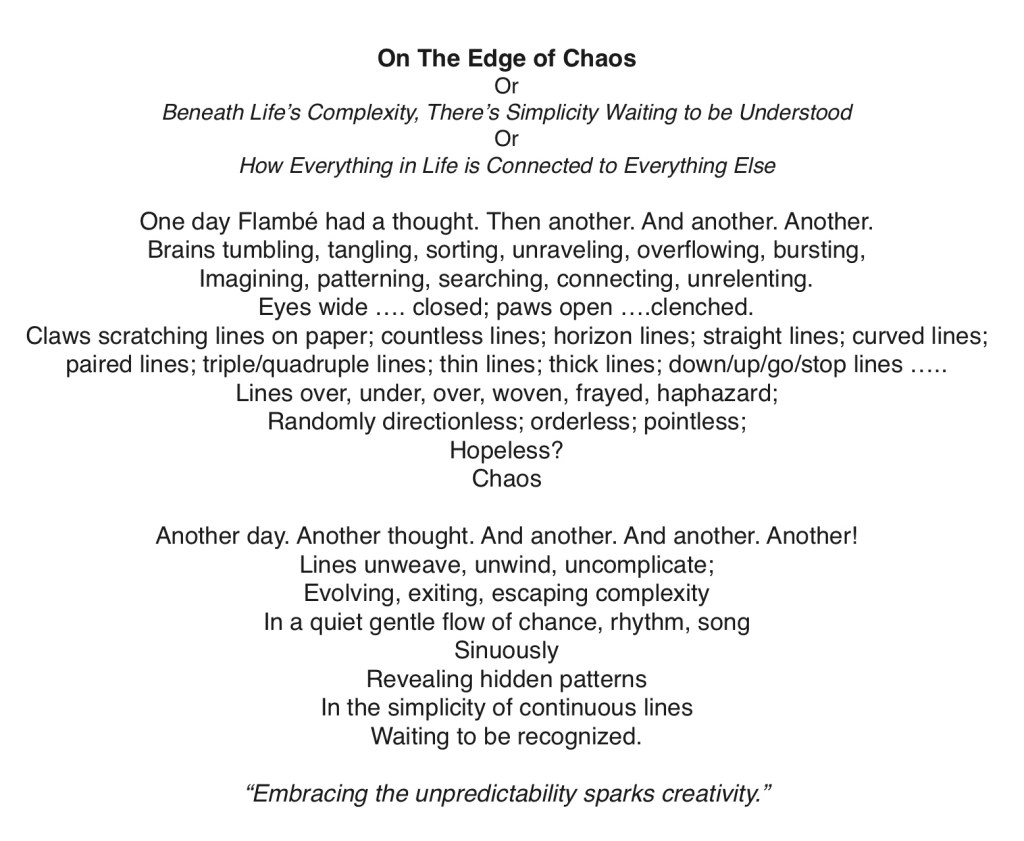
Flambé’s thoughts on Chaos to Creativity OR an attempt to interpret her scratched lines on paper, in the above illustration.

A few of my elementary thoughts about Chaos and Chaos Theory

Now that Flambé has delighted and (most likely) confused you on the Nature of Chaos, allow me to reflect on my first exploration into the fascinatingly mind bending subject of Chaos Theory. Having never given much thought to the Theory, per se, I’ve always pictured “chaos” as something hectic and uncontrollable. A state of unruliness, mayhem, or disarray liken to natural disasters, mob pandemonium, mass shootings. Sound familiar? We’ve all likely been witness to an unfathomable situation and declared our world to be in “complete and utter chaos!” But there’s more, a lot more to Chaos Theory, where it is encountered and how it affects us. 

When my reference list of lesser known Annual Days revealed November 9th is celebrated every year as “Chaos Never Dies” day, I was appalled.  I mean, really; who wants to live in a world of ever-present and everlasting chaos? 

But from the description of this Day, it appeared there was a positive side to chaos, piquing my curiosity.  Anything that can make us laugh and inspire creativity has to be awesome! So began my last few weeks of intense study and pouring over countless YouTube videos to learn about Chaos Theory. 

The more I read and viewed educational videos proclaiming to explain Chaos Theory in easy-to-understand language, the more confusing it seemed. The language was English, but the concepts seemed abstract to me …….. well, they were just plain chaotic! (This caused me to laugh!). It would be easy to spend a lifetime trying to “get it.” I’ll just have to keep learning!

So far, I learned about many familiar and new terms associated with Chaos Theory.  These include the Butterfly Effect (highly central to Chaos Theory) which shows the connection between disorderly and highly organized things, like how the flap of a butterfly’s wings can lead to a string of events that can form a hurricane! It’s complex, but emphasizes (among many things) that we can’t know the consequences of seemingly simple systems due to unpredictable variables. That leads to Heisenberg’s Uncertainty Principle, Feedback Loops, Fractals, Probabilistic and Deterministic modes, etc. 

Are you still with me?

In a nutshell, Chaos Theory “provides a scientifically quantifiable but simultaneously poetically suggestive way of looking at how almost everything in life is connected to everything else.”

We live in a “chaotic” world, and how we react and/or adapt to its unpredictability and complexities matters.  But as someone (?) once said, “Embracing unpredictability sparks creativity.” 
What does Chaos spark in you?

The images of all Continuous Line drawings and their order of emergence.

As always, thanks for stopping by!

Happy World Smile Day!

October 4, 2024

World Smile Day is an annual celebration of the simple yet powerful act of smiling and spreading joy to others. It was created by commercial artist Harvey Ball in 1999 to honor the iconic smiley face he created in 1963. On this day, people are encouraged to perform acts of kindness and make others smile, both in person and through social media. World Smile Day is celebrated on the first Friday in October.

Poem Created by Barb

As always, thanks for stopping by!

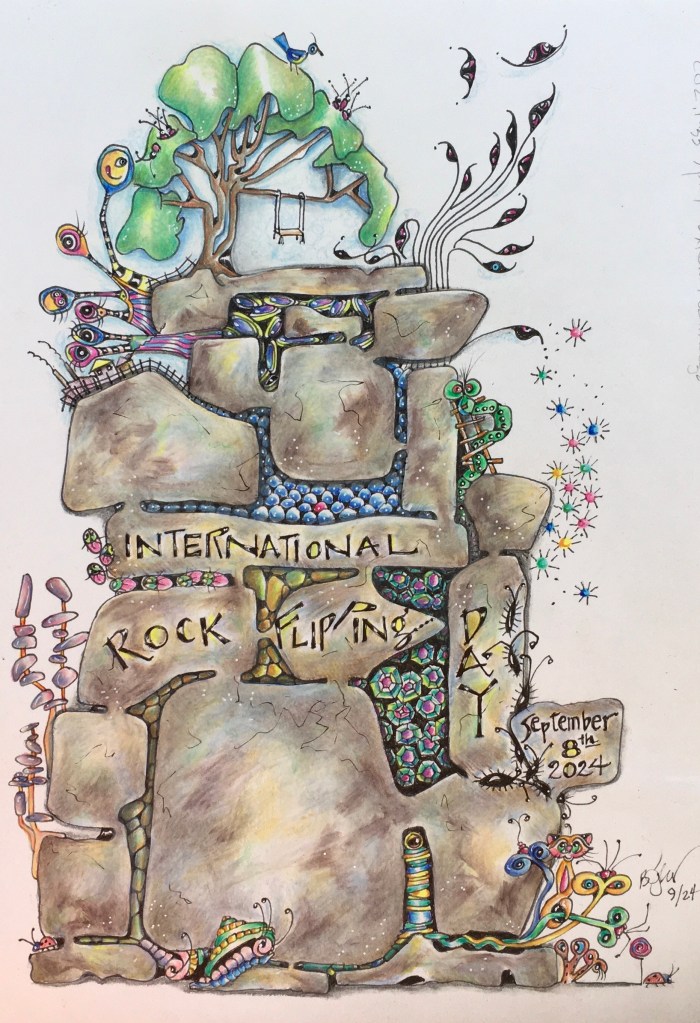
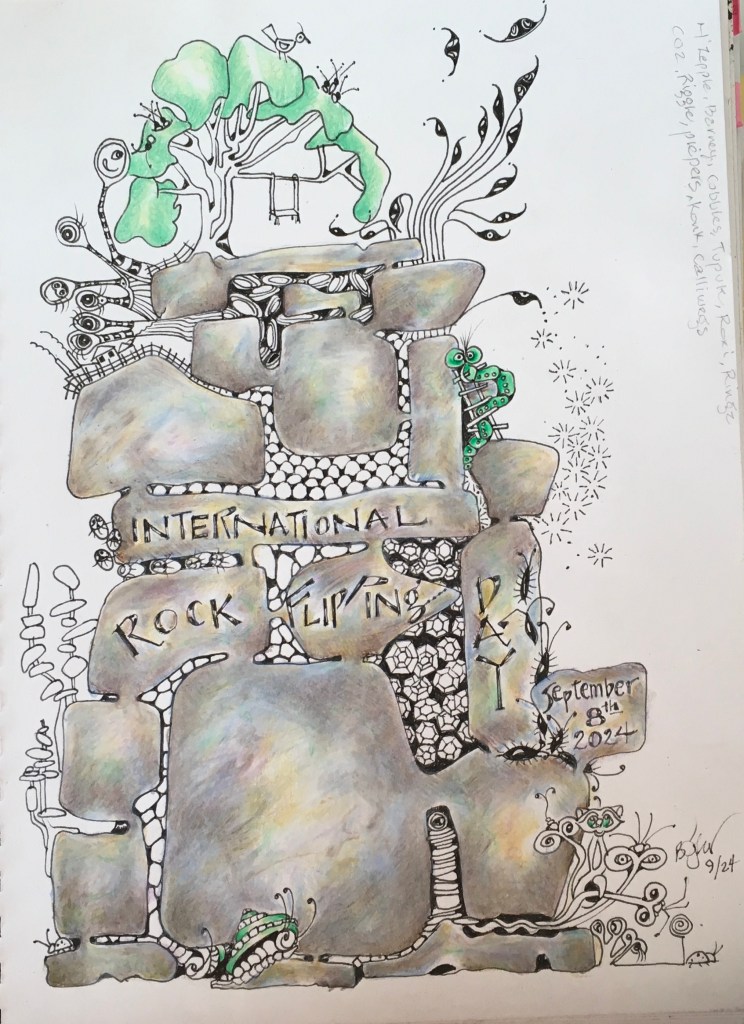
Nature Journaling Meets Zentangle …… It’s International Rock Flipping Day

September 8, 2024

Unbeknownst to me …… until right now! Hitting me like a ton of rocks, I just learned that every second Sunday in September each year marks a worldwide celebration known as

 International Rock Flipping Day

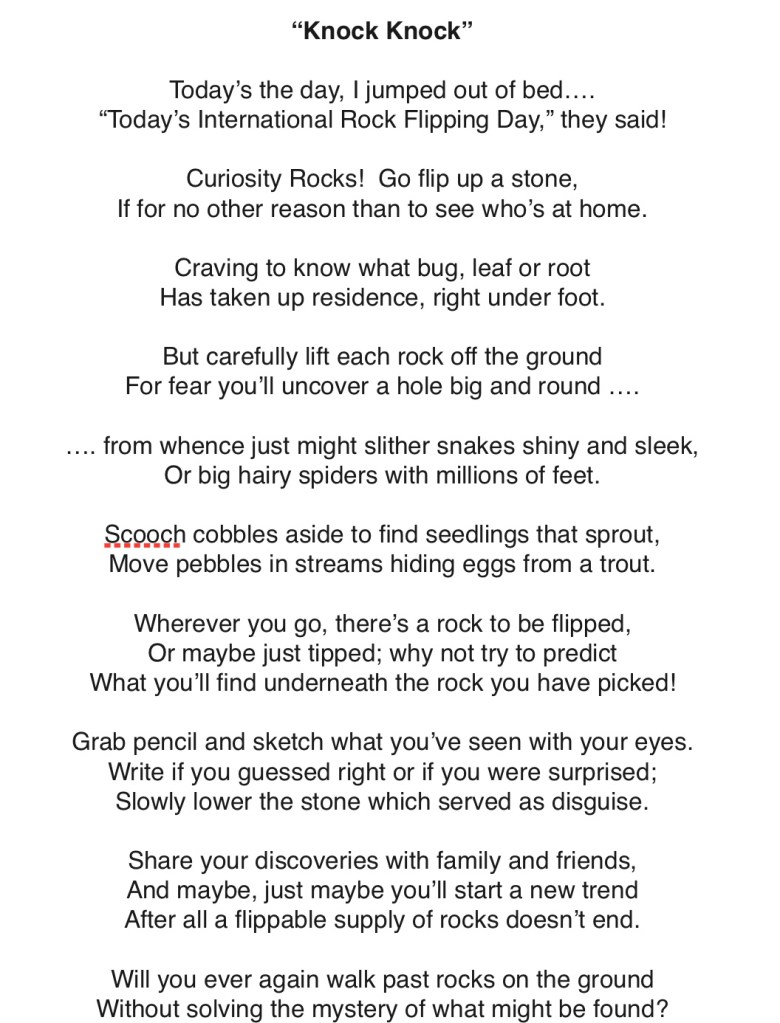
Today is a day to encourage people to explore and learn about the natural world by flipping over rocks to see what creatures and other organisms live underneath them. Participants share their findings and observations with others to promote curiosity and appreciation for the environment.

Zentangle patterns: Barney, Cobbles, Tupuk, Roxi, Ringz, CO2, Rigel, Piepers, Konk, Calliwags, N’Zeppel
Whimsical poetry by Barb

So tell me …..

How many rocks have you flipped over today?

What did you discover?

If no one was at home, tell me about your flipped rock(s)!

Bring out your Inner Child!

I don’t care what town you’re born in, what city, what country. If you’re a child, you are curious about your environment. You’re overturning rocks. You’re plucking leaves off of trees and petals off of flowers, looking inside, and you’re doing things that create disorder in the lives of the adults around you. – Neil deGrasse Tyson

A few more …..

As with other phases of nature, I have probably loved the rocks more than I have studied them. – John Burroughs

If it weren’t for the rocks in its bed, the stream would have no song. – Carl Perkins

The problem is not scientifically illiterate kids; it is scientifically illiterate adults. Kids are born curious about the natural world. They are always turning over rocks, jumping with two feet into mud puddles and playing with the tablecloth and fine china. – Neil deGrasse Tyson

an earlier version

As always, thanks for stopping by!

By Kraken! It’s National Sea Serpent Day, August 7, 2024

August 7, 2024

Today is National Sea Serpent Day, and while these magical, mystical, and mythological creatures may not ring true for you, Flambé now believes otherwise. Read why a Mama Kat’s lessons should be heeded at all costs, and how a litter of 8 kittens would’ve been better off if they’d had a wise Mama like Flambé. Learn how a Sea Serpent finds his lunch in murky water, and what they like to binge eat. But most of all, be sure to celebrate this auspicious day …… perhaps by visiting an aquarium to see what a “real” Sea Serpent looks like, and to learn about their life cycle, color(s), size and the habitats where they live.

National Sea Serpent Day is a day dedicated to the legendary creature known as the sea serpent. It is a time to celebrate and learn about these mythical sea creatures, which are often described as large, snake-like creatures that live in the depths of the Oceans.

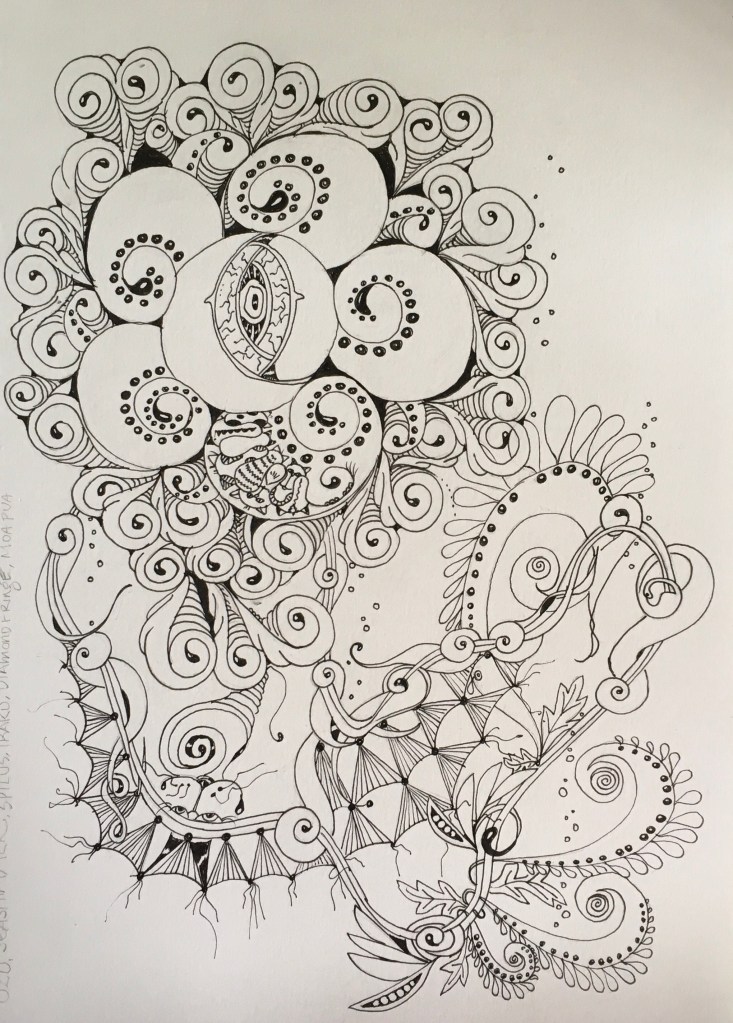
Zentangle patterns used: Uzu, Seashimmer, Spilus, Iraku, Diamond Fringe, Mona Pua, Cat-a-line

Baby, it’s hot outside! 

Poor Flambé has been searing her paw pads while conducting daily curiosity quests. To cool the burn, she’s been wading into a sizable neighborhood pond, becoming engulfed in a cloud of steam as all four paws are instantly chilled.  “Aaaahhhhhhh! Now that’s relief!”

However, one day Kat decided to indulge in a full body pond plunge, completely drenching her lush fur coat. Because the pond was unfathomably deep, and since she was soaked to the tip of her tail, Flambé decided to practice a bit of free diving. Gulping a huge breath of air then turning tail, down …. down ….. down she plunged into the murky cold water.  After zipping up to the surface to fill her lungs, Kat exclaimed, “Cool!  I’ll return every hot afternoon to chill out!”

But during her second deep … deep … deep dive, Flambé saw she was not alone. Emerging out of the dim depths of the pond was a gynormously scary creature with a huge head, foot-long eyes, sharp teeth, and long wavy arms! Could it be her nemesis? 

As a wee kitten, mama Kat warned her about swimming or diving in deep water.  Mama Kat warned Flambé about the presence of the always ravenous, underwater creatures known as Hydra, Kraken, or Sea Serpent.  Mama said these monstrous Sea Serpents had such a keen sense of smell, they could instantly sniff a potential meal of “fat furry feline” frolicking frivolously in their watery realm. In the blink of a foot-long eye, an unsuspecting Kat might be greedily gobbled and gulped!

Now back to dire matters at “paw” ….. Daring to take a closer look at the menacing Kraken, Flambé gazed in horror at one of its five crops; it was plum full with a litter of eight kittens! Mama Kat was right.

Sea Serpents may have an excellent sense of smell, but Flambé’s hearing was superb. Before the Hydra could sniff out Kat, simultaneously those eight kaptured kitties let out a yowl loud enough to raise an undersea garden! “They’re alive!” Flambé to the rescue!!! 

What is Flambé’s plan to rescue all eight kitties? How does she avoid being sniffed out by the Sea Serpent? Will hiding in plain sight right next to that row of razor sharp teeth, fool the Kraken? What can Kat use to quickly pry open the Hydra’s crop cage, rapidly expelling the kitties? Are Sea Serpents ticklish, and if so, where? If you were in Flambe’s predicament, what would you do?

Please share your ideas quickly …. just in case Kat’s efforts are foiled and all is lost!

Line work before color.

Until the next chapter of Flambé’s exciting Misadventures!