Surprise! A vine-y, twine-y desert milkweed discovery ……

July 9, 2024

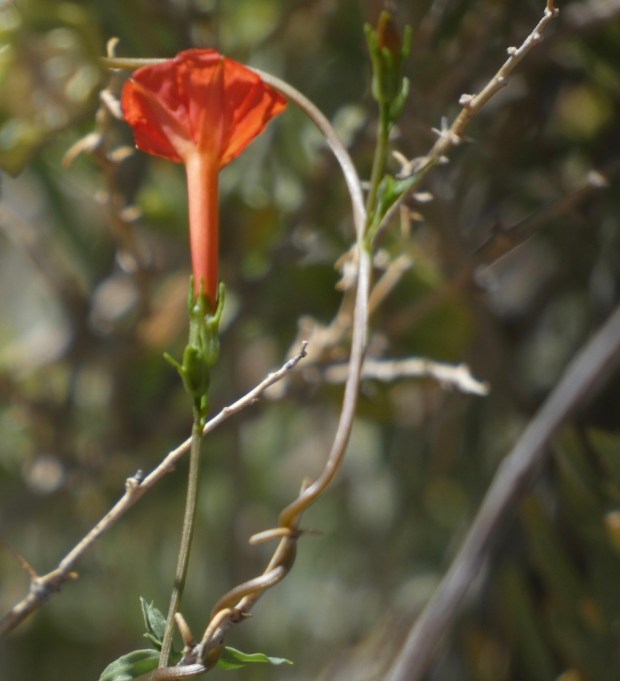
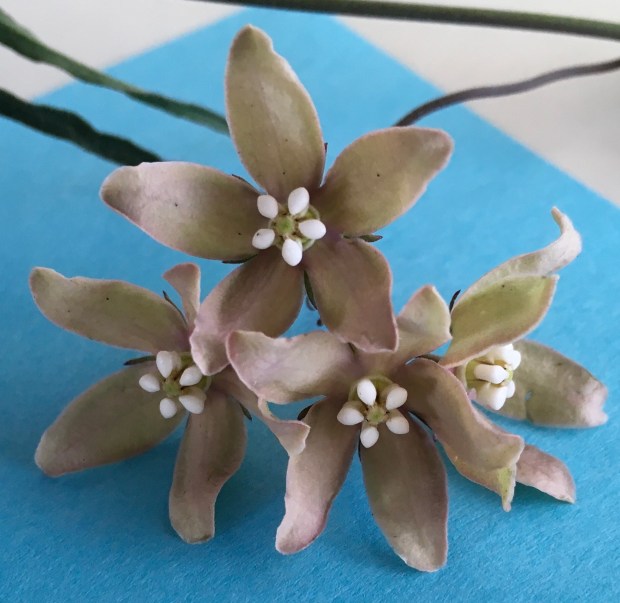
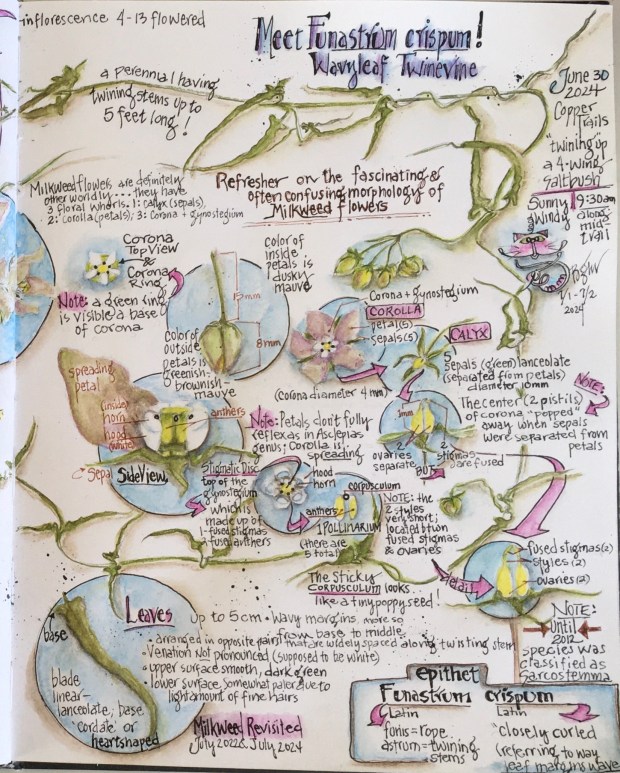
Just when I was feeling confident about the morphology of the milkweed family of plants, a new twist on the familiar leaps out shoutin’ “ Hey, lookie here!”      Expecting to see a common vine gracefully twirling its way up a desert shrub, I paused ……. searching for the crimson red trumpet-shaped flowers of Ipomoea cristulata (Trans-Pecos morning glory). But instead there was an umbrella of 5 flowers, each with 5 widely spreading greenish-brownish-mauve colored petals crowned in the center of an unmistakable floral corona, a sure fire characteristic of a milkweed! Could it be?

Trans-Pecos Morning glory

Oh Yes! 

This unexpected, undeniable discovery had me puzzled though. It’s been two years since I created a detailed post about the Asclepias genus of milkweed (see Summer Botany: Meet the Milkweeds). At that time and throughout the decades prior, my knowledge of milkweeds was limited to Asclepias, and the specific characteristics of that genus. 

Spreading petals of Wavyleaf Twinevine

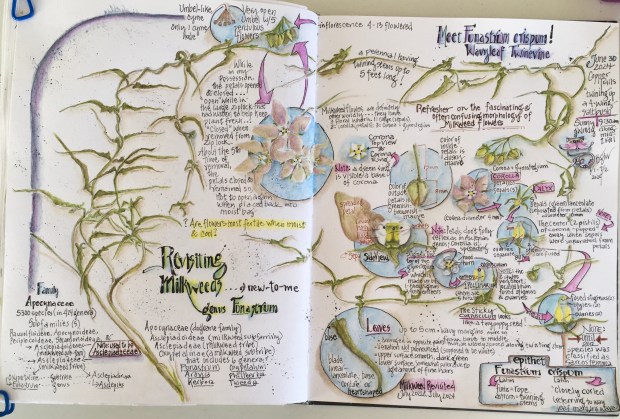
But here was something new-to-me; so worthy of whatever time it might take to learn all about this find in the dogbane family (Apocynaceae), aka the Milkweeds.  I quickly confirmed this vine does not belong with the Asclepias species of milkweeds, but is of the genus Funastrum, which is Latin for rope (funis) with twining stems (astrum), commonly referred to as the “twinevines.” And the full name of this plant is Funastrum crispum, commonly called Wavyleaf Twinevine.

Most of what I uncovered about Wavyleaf Twinevine is included on my 2 journal pages, along with some confusing taxonomy involving family and subfamily names, tribe and subtribe names, and how until 2012, this plant was known as Sarcostemma crispum. Curiosity about the taxonomic history will undoubtedly tempt me to sort through the confusion ……. maybe someday soon!

Have you discovered anything new-to-you in nature lately? What was it, and did it lease to more discoveries?

Thanks for stopping by!

Mysterious Parking Lot Encounters

May 25, 2024

Accidentally Seeking Landscaping Curiosities

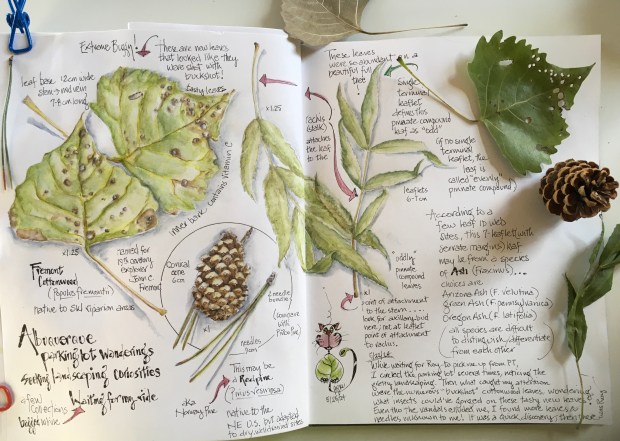
Oops! I was caught without my sketchbook ….. but that didn’t prevent me from making a few interesting collections while waiting for a ride.

My curiosity unleashed, I began by wondering what voracious insect(s) tried to eat 1000x their weight in fresh cottonwood leaves. Then I noticed a very lovely leafy tree growing next to a stately pine, both of which were mysteries to me.

So I spent this afternoon sketching, painting, and looking over ID and reference materials, as much fun as collecting my three parking lot treasures!

If you find yourself “waiting,” how do you pass the time?

Thanks for stopping by!

Crazy for Locoweeds! Meet the White Point-Vetch

May 24, 2024

After a longer than planned for blog break, I’m glad to be back and sharing a few pages from my nature journal.  Beginning in April, the riot of wildflowers popping up everywhere has, and still keeps me scurrying about my backyard, the “back 40,” and local hiking trails just to refresh my memory about familiar plant species while searching for new discoveries. I’ve been sketching daily, learning about new-to-me plants, and growing my knowledge about favorites.  

Recording first seasonal sightings, it’s interesting to compare previous years’ emergence and abundance, and wonder why timings vary. For example, last year the white-stemmed evening primrose (Oenothera albicaulis) blanketed the hillsides with white; this year those beautiful white blooms have been scarce. Last year the tall crowded flower stems of White Point-Vetch (Oxytropis sericea) were few and far between. This year an explosion of these graceful plants that belong in the pea family (Fabaceae) began blooming in April and are still going strong! 

White Point-Vetch, also called white locoweed, whitepoint crazyweed, and silky crazyweed, makes a striking bouquet that glows like a bright light as it blooms along tall flower stalks 15+ inches above bare brown ground. New stems push up through multiple dried stems packed with last year’s empty seedpods. But it’s obvious this species is an aggressive re-seeder; there are so many new plants this year where last year there were none! 

It’s been a spectacular show!

Enjoying researching this species, dissecting a few fresh flowers, and searching for remnant seeds in the dried pods, kept me delving deep into the bits and pieces of what defines this group of plants. This large family, which houses well over 10,000 species world-wide, includes peas, acacias, mimosas, and licorice (see the list below for more residents). 

The dried stem was drawn and shaded in graphite.

But one species at a time, please! Actually the locoweeds, which fall into the genera Oxytropis (like the White Point-Vetch) and Astragalus, contain over 600 species world-wide, 21 of which grow in the U.S. Many plants in these two genera are toxic, particularly to domestic ungulates. More about the toxin and what happens when these animals ingest even small quantities, along with other interesting facts are described on my two journal pages. ……

There is so much more to learn about this important family of plants, but I’ll save that for another post. 

Thanks for stopping by and have a safe and happy Memorial Day weekend! 

Thanks for stopping by …… have a safe and happy Happy Memorial Day!

Perky Sue!

May 11, 2024

It’s Spring in my neighborhood, and not a day too soon!!
Along with gusty winds carrying clouds of yellow pollen come drifts of an outrageously bright yellow ‘sunflower’ named Perky Sue.

How Perky Sue got its common name is a mystery. My best guess is this herbaceous forb, native to New Mexico, has to be the Perky-est, Happiest Spring Flower, Ever!

What is your favorite native flower signaling the arrival of Spring in your world? Does its bloom cause you to smile; perhaps you break out in your happy dance?

Thanks for stopping by …… and Happy Mother’s Day to all!

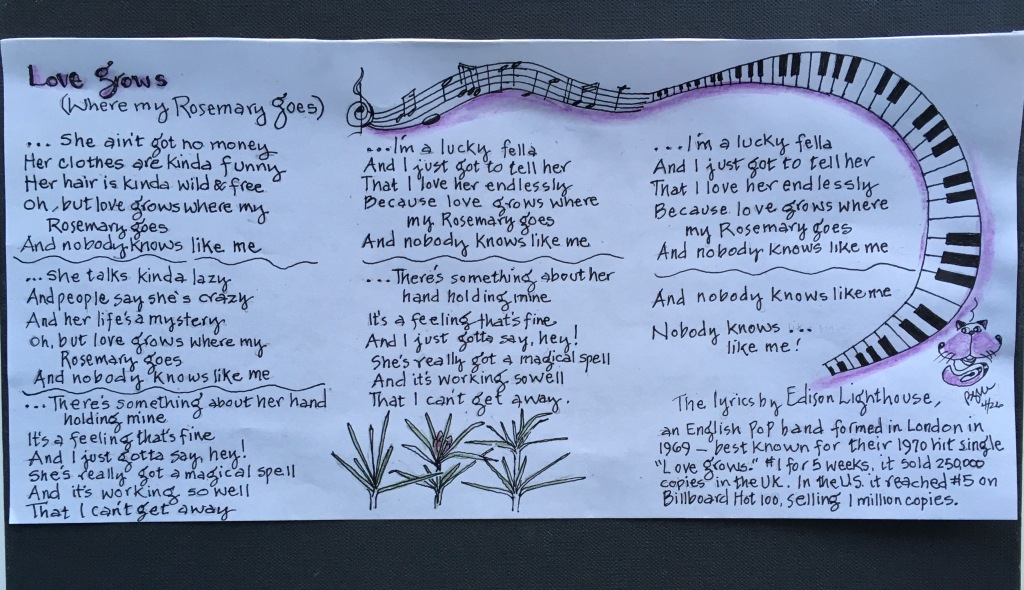
Rosemary …. Next Up in my Herb Series


April 27, 2024


When trying to pin down exactly what’s so special about Herbs, a deliciously aromatic group of plants, I was stumped.  Well, maybe not stumped, exactly. There are so many reasons to fall in love with Herbs, and picking one feature or even one Herb that’s especially special is nearly impossible. Best known for their culinary flavor enhancements, can you imagine pickles without Dill, pesto without Basil, salsa without Cilantro? What’s a dark chocolate circular pattie without Peppermint, or a cookie cutter man without Ginger?  


Herbs excite memories, calm the mind, reduce inflammation. Does the aroma of sage conjur thoughts of Thanksgiving? Does a sprig of lavender make you sleepy? Does bold yellow turmeric soothe arthritic joints?


And many Herbs are decorative and lovely to look at, form beautiful shrubs, have gorgeous flowers

But I keep coming back to the aroma. It’s hard to resist crushing the leaves of herbs like thyme or mint between my fingers. The essential oils released into the air and lingering on my fingers causes me to take a deep breath, inhaling the fragrance, embedding the aroma in my brain, resulting in a memory I can recall over and over again. 

Herbs are Special!

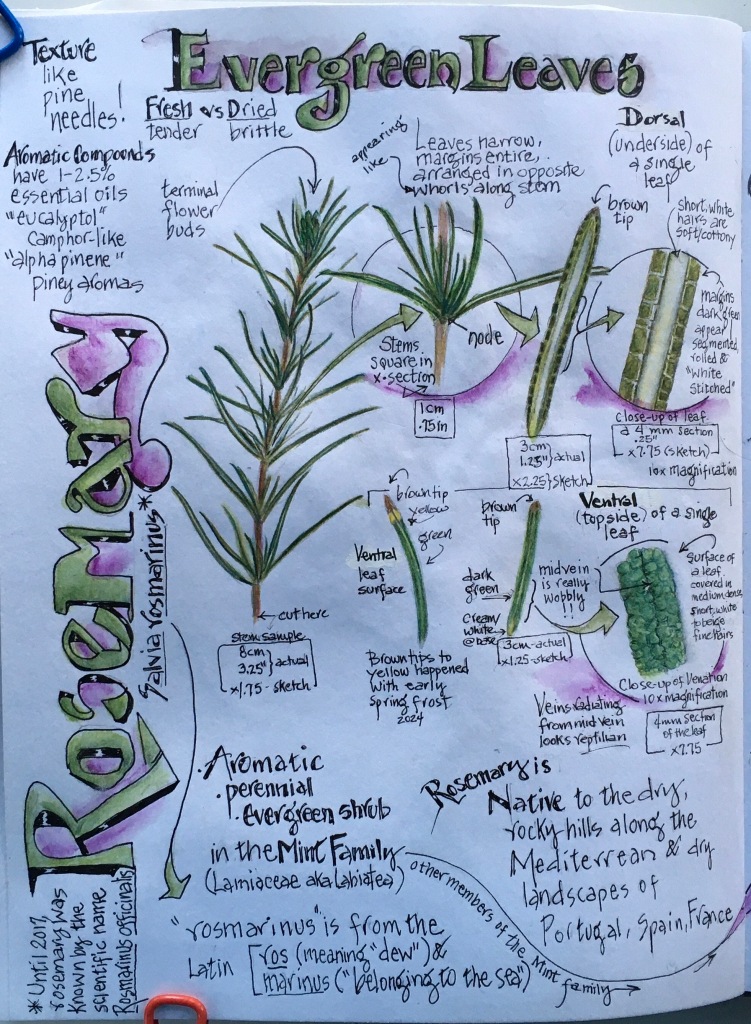
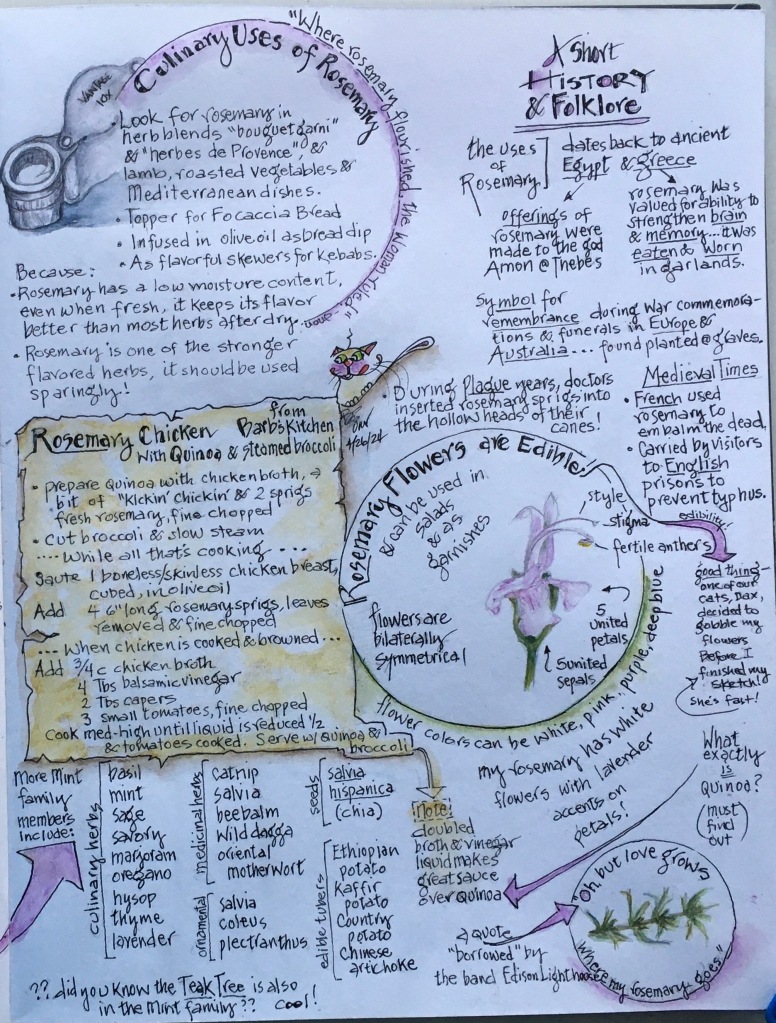
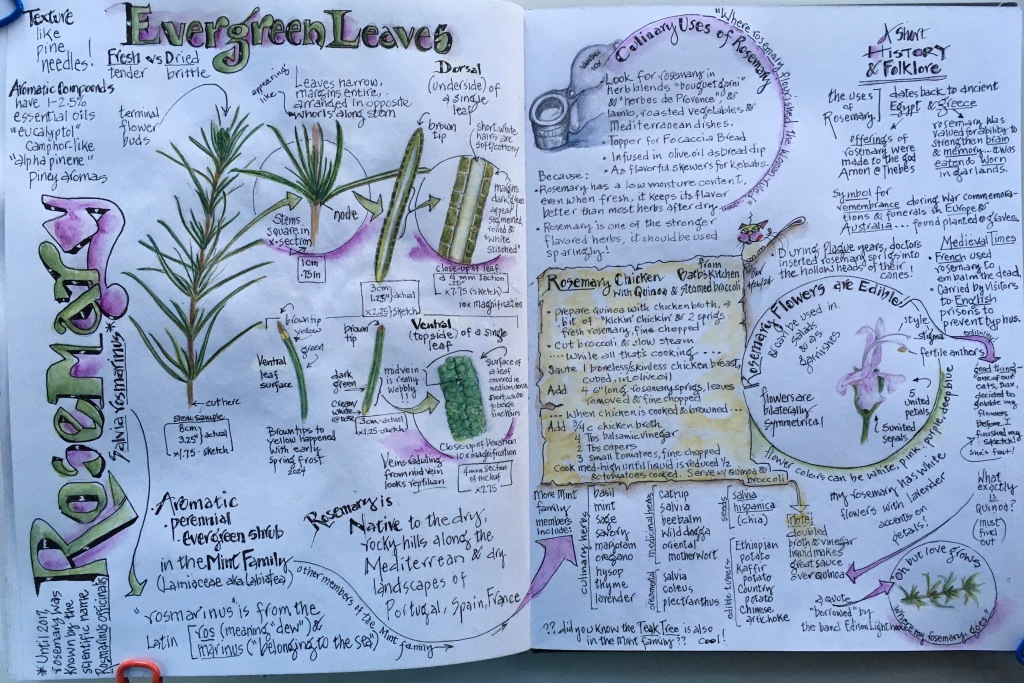
The Rosemary plant (actually a mini shrub) in my yard always invites my attention, and just this week it welcomed spring by coming into full bloom!

Who remembers this?! Now I can’t get it out of my head!

Do you have a favorite Herb? Why is it special? How do you use it?
Please share! And thanks for stopping by!


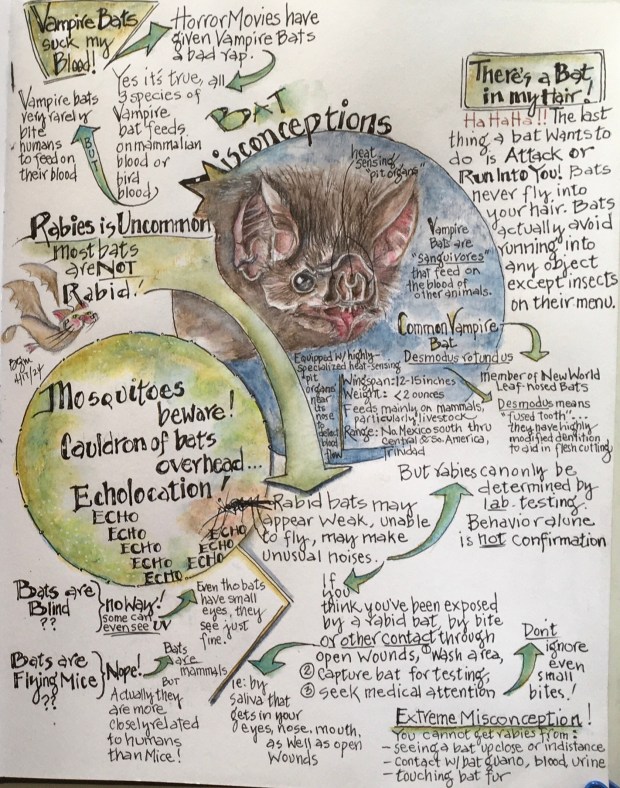
National Bat Appreciation Day & National Haiku Poetry Day -April 17th


April 19, 2024

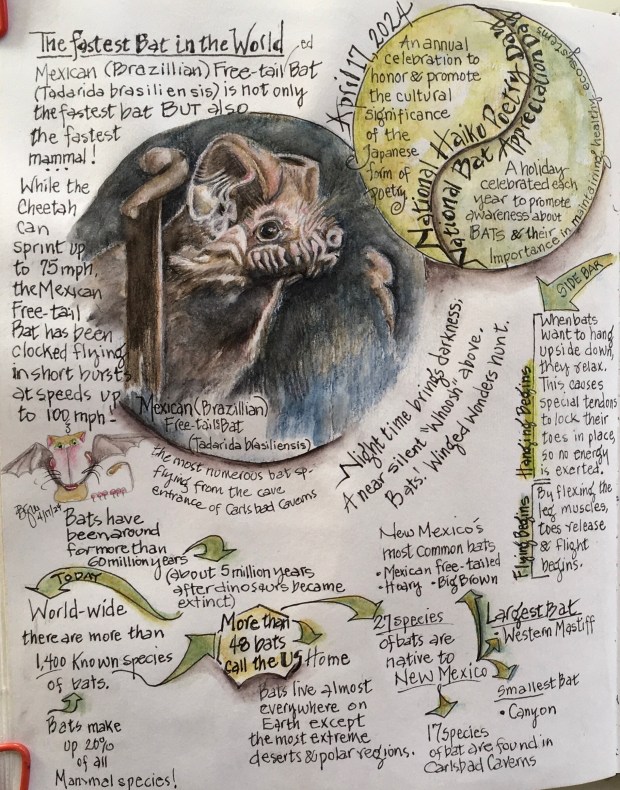
Of the dozen or so celebrations taking place annually on April 17th, you might think that combing both National Bat Appreciation Day and National Haiku Poetry Day in one blog post makes no sense at all. But if you’ve ever spent even a bit of time witnessing a bat ‘out flight’ at dusk, you’d agree with me that their near-silent hunting maneuvers are sheer poetry! 

National Bat Appreciation Day

A holiday celebrated each year to promote awareness about bats and their importance in maintaining healthy ecosystems.

National Haiku Poetry Day

An annual celebration to honor and promote the cultural significance of Haiku, a Japanese form of poetry.


Dedication

This post is dedicated to my good friend, Holly Silva, who finds bats fascinating. She suggested for my first celebratory day in April, I tackle bats. (Not literally of course!) Like Holly, I’ve always been in awe of bats, having seen many ‘out-flights’ of the tiny insectivorous myotis bat and little brow bat. And then there’s fruit bats!  Oh my …… so hard to resist sharing my story of an amazing fruit bat ‘out flight’ Roy & I witnessed in the Australian Outback, Bats in OZ! 


Bats in OZ

Talk about right place/right time scenario!  We had finally arrived at a well known hot springs south of Katherine after a long, hot, dry day through central Australia. Mataranka, a beautiful series of natural pools surrounded by hundreds of eucalyptus (gum) trees. It was late in the day and we were luxuriating in the hot water, when we noticed everyone there before us was leaving. It was a mass exodus; suddenly we had the springs to ourselves. Five minutes later that we noticed the water rippling around us. We figured a freak storm had appeared out of nowhere to offload huge raindrops in just this spot. Then the “rain” became more intense, the noise became cacophonous, and day turned into night. 

When we first arrived at Mataranka, our focus was on the inviting pools of water nicely shaded by the gum trees. We never looked up into any of those tall, branchy trees … we were happy to have the shade. Now, soaking in the hot water while getting pelted by “rain,” we wondered if we should haul ourselves out, recalling that the locals must’ve known this storm was about to happen (as it did every night); maybe it wasn’t safe for some reason? So wondering how big the storm cloud was we glanced up at the sky through the tree branches. That’s when shock and awe grabbed us! Hundreds and hundreds of tree branches which must’ve been straining under a great weight minutes ago were sighing relief as thousands of fruit bats (aka flying foxes) dropped from their roosts to take flight. Wing membranes spread wide, their sheer numbers blocked out the fading sun. We were speechless! Gaping in awe at the spectacle, our mouths quickly snapped shut …… you see, that “downpour” wasn’t rain at all! All of those big, beautiful bats were pooping out guano as fast as they could! Another ah-ha moment struck us (along with copious quantities of guano) as we made a hasty retreat out of the water, grabbing our clothes and sun hats, and laughing uproariously while beating feat back to the safety and cover of the rental car!

As fast as the “storm” of bats appeared, they were gone, flying off to feed for the night on a Downunder spring bounty of fruits only they knew about. Stuffed by sunrise they would return to the Mataranka community roost to rest and digest before once again taking flight while pooping on the heads of foolish tourists tomorrow at dusk! 


The Post

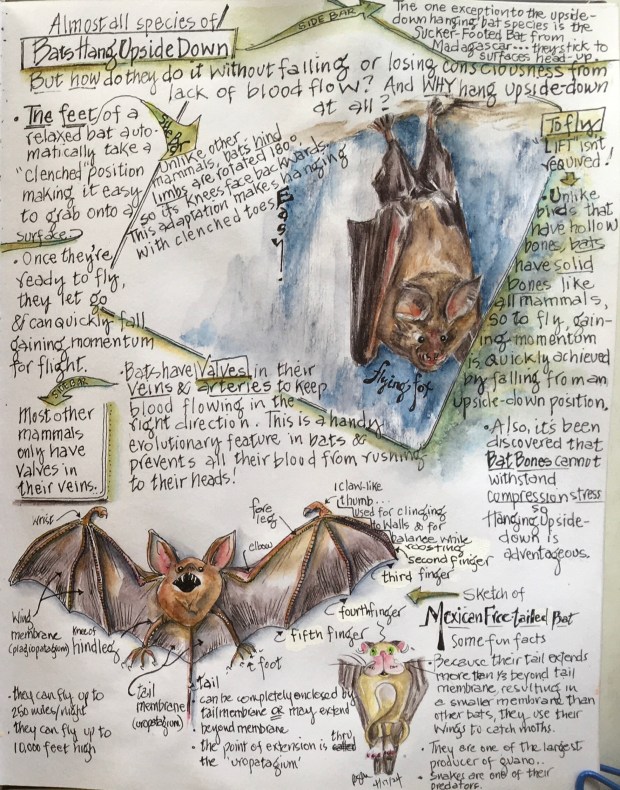
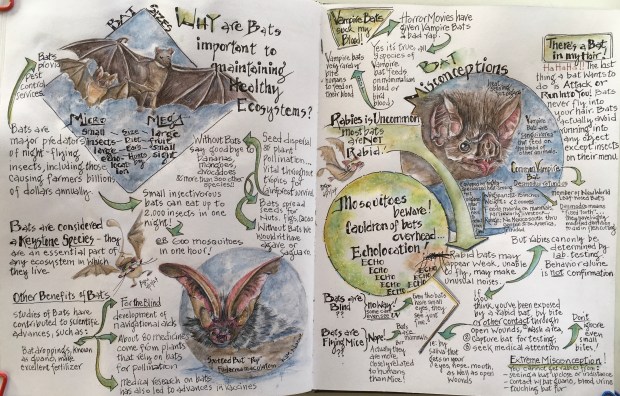
For this post, while exploring bats’ importance in the ecosystem, to science, and while recalling all of those Australian flying foxes I was curious about why and how bats hang upside down, the types of bats and their diets, and what adaptations Vampire bats have causing them to crave a diet of blood. Much of this rabbit-trailing led to myths and misconceptions about bats, then back to New Mexico’s most famous ‘out flight’ of the American Free-tailed Bat every spring, summer and fall evening from Carlsbad Caverns. While learning, several Haiku poems materialized reflecting bat behavior.  

Nighttime brings darkness
A near silent “whoosh” above
Bats! Winged wonders hunt

It would’ve been easy and fun to fill up the rest of my journal with bat facts and more Haiku, but because the celebratory date of both National Bat Appreciation Day and National Haiku Poetry Day has now come and gone, I had to stop. Maybe you’ll want to answer a bunch of your own questions about bats? Maybe you’ll want to write your own Haiku about bats in honor of this style of poetry?  

Mosquitoes beware!
Cauldron of bats overhead ….
Echolocation!

Share your bat stories and Haiku, and let me know if this inspires you to dig deeper into the fascinating world of bats! 


Meet an “Extreme” Creative!

April 8, 2024

After years of on-line and email chats, I was delighted when my friend Robin Atkins decided it was finally time we met in person! Bravo!

Robin and her travel buddy Lunnette, drove over 1,800 miles to Tucson to teach a Spirit Doll class to a local beading group. Then after spending 5+ days exploring Tucson and before driving home to Friday Harbor on San Juan Island, WA, they took a “short” scenic 450 mile detour …… to Tijeras, NM. This out-of-the way drive would bring them to our doorstep, and our first face-to-face meeting! While in Tijeras, we were able to spend an evening and full day getting to know each other and spent time hiking, nature sketching, and sharing each other’s art.

Robin snapped this photo of me sketching out at Golden Open Space. The beautiful wind sculpted juniper trees growing along the precipices of the windy observation areas are absolutely captivating (and tough). Luna thinks they’re tasty!

Meet Robin

Robin, whom I’ve always thought of as an “extreme creative,” is a fascinating, energetic, curious, passionate and bright-eyed adventurer in her early 80s. Her many interests and skills, in addition to creating uniquely designed, hand sewn and beaded Spirit Dolls, include: quilting (many with bead embellishments), thread embroidery, book making, watercolor painting, Zentangle art, nature journaling, making decorative papers, poetry, weaving, collage, crochet, felting and book author. And she shares her skills and techniques by teaching. 

This isn’t an exhaustive list by any means! As someone who seems to thrive on learning and developing new skills, Robin never stops seeking artistic challenges to take on. 

Check out Robin’s beautiful webpage and blog (http://robinatkins.com) where you can find photos and posts highlighting her current and past creative projects. 

A Short-but-Sweet Visit

We had a wonderful time getting to know each other, and what a delight to have also met Robin’s long-time friend and travel buddy, Lunnette. A retired firefighter in her mid 70s, Lunnette is also a nature journaler, calligrapher, quilter, and according to Robin, “she’s a terrific navigator, who always uses her keen sense of direction and map reading skills to keep us on the “right road,” (in both the literal and figurative sense).”

This is my finished graphite drawing of the twisted juniper I spent 5 minutes sketching.

Parting company was hard, but Robin and Lunnette needed to return home. Along their route they visited both Mesa Verde National Park and Arches National Park, soaking in more of the desert southwest sun and culture before taking on the 1,200 mile journey for Friday Harbor.

Memories!

Painting Bird Eggs with Jean Mackay

My notes taken and sketches/watercolor paintings created during the workshop

April 6, 2024

Each Spring, Winslow Art Center of Seattle organizes and hosts their Spring Fling! For four days, back-to-back live Zoom workshops are offered, featuring artists skilled in a wide range of media. Each workshop is free, a full hour long, and may include talks, demos, or a work-along. And all of the workshops are recorded for unlimited playback in case you miss one or all of the live sessions or want to watch one or more over and over again!

Each workshop is fascinating; there’s always something new to learn from all of the professional artists. But one work-along session presented by artist, educator and naturalist, Jean Mackay, I look forward to with exuberant excitement! Jean has been actively observing, illustrating and sharing, through her blog, stunning watercolor paintings of her daily encounters with nature for the past 20 years. Jean’s knowledge of wildlife and the many wonders found in nature are reflected in her illustrations. But there’s more! She always provides helpful tips and techniques pertinent to the development of her pages.
For Spring Fling! 2024, Jean’s workshop was all about creating realistic looking bird eggs. I’m not sure how she managed to cover so much material in a very short hour, but she did. Beginning with a bit of bird egg natural history (just enough to whet the appetite for more), Jean jumped right in by describing 3 basic techniques for sketching egg shapes. Defining edges, shadowing, coloring and marking eggs came next, and before I knew it, time was up!

Somehow during the excellent, well organized presentation, I felt compelled to try a sketch of my favorite nature journaler, Jean Mackay. Perhaps not as good as my eggs turned out, but a pretty recognizable likeness, even if I do say so myself!

Thank you so much Jean! Every minute was a joy!

You too can follow Jean’s artistic journey! Check out her webpage and subscribe to her blog at: http://www.jeanmackayart.com

And if you’d like to give egg painting a try, for free, the Winslow Art Center’s webpage at: http://www.winslowartcenter.com


Quite possibly the best tool of the trade …… Happy National Crayon Day, March 31st

National Crayon Day is a day dedicated to celebrating the beloved colorful drawing tool. Observed annually on March 31st, it encourages people of all ages to embrace their creativity and express themselves through art using crayons.

So much history ….. So much enjoyment!

But where to begin? Because I’ve posted about crayons in the past and didn’t wish to repeat myself (too much) …  I dug deeper this time and learned something new … there’s a “place” called The Crayola® Hall of Fame


Since 1904, when cousins Edwin Binney and C. Harold Smith sold their first box of 8 “Gold Medal” Crayola® crayons, colors have come and gone. There’s been an assortment of reasons for changing out colors such as unpopularity, social, racial or politically incorrect names, or discovery of a new pigment. The fate of colors also varies: 

  • they may be renamed to better represent current trends or social acceptability (e.g. the color Chestnut replaced Indian Red and Peach is now the new name for Flesh), 
  • they may be temporarily discontinued to make way for a new promotion or contest (e.g. plain colors have made way for a naming contest for sparkly or neon colors),
  • they may be permanently retired (e.g. Dandelion lost out to Bluetiful, to introduce the latest pigment discovery of blue)

And once a color is discontinued or retired (even temporarily) gaps are left in the box where each color lived, whether that be the small box of 8 Crayola crayons, all the way up to the box of 120! 

One of my many rainbow-colored rabbit trails led me down the path to The Crayola Hall of Fame. I had no idea! Apparently there is such a place, established in 1990, populated with crayon colors that have been retired as far back as 1910. Most of these colors are now permanent residents in Easton, PA, where The Crayola Hall of Fame is located. There they are (re)learning the joys of coloring outside the lines, golf cart decorating, and marathon rolling. But some of the retired colors, having a taste of the easy life, have decided to rejoin the active ranks of worker-writers, painters, and scribblers, as re-employed annuitants.

The Short but Brilliant Story of Dandelion 

Doesn’t look like annuitant status will happen any time soon for the self-retired, extremely happy-cheerful and brilliantly radiant Dandelion yellow Crayola.  From 1990 through 2017, a short 27-year blip on the Crayola history timeline, Dandelion was the color lighting up the boxes of 24+. But when he heard a gorgeous new blue hue had been discovered, Dandelion graciously checked into The Crayola Hall of Fame allowing the exciting new Bluetiful to take center stage! What a guy!

Being honored with permanent residency in The Crayola Hall of Fame also means the retired color has gone out of production permanently. How lucky to have found two brand new, never before used Dandelions in my stash of crayons! And a single Dandelion is worth as much as $20! 

$20 is also the value of each of the four recently retired (2003) Crayola crayons: Magic Mint, Mulberry, Teal Blue, and Blizzard Blue. I also own these four colors! You can do the math, but instead of cashing in on any of the 5 colors in my possession, I’ve decided to keep them, then created this floral page using only these colors for my post, showing off their beauty in celebration of this year’s ………………………………..

National Crayon Day!

Would you have done the same? 


The Winds of Imagination

March 22, 2024

Reading this poem not only gave me the “lift” I was seeking on a dreary winter day…….. it was clear I wanted to design an illustration to further heighten the “lift” in anticipation of Spring and the new season of imaginative creation that was fast approaching!

Thanks to Michele Lee for allowing me permission to reprint her wonderful poem, Paper Airplane Pilot (March 6, 2024). Michele is a talented and prolific writer of poetry and prose, and a published author who lives in the heart of the Sonoran Desert. I look forward to her almost daily posts featuring something new and inspired on her widely-followed blog.

If you enjoyed Paper Airplane Pilot, your sure to enjoy her regular posts by becoming a subscriber to her blog, myinspiredlife.org

Enjoy! And a hearty “Thanks” to all my followers!