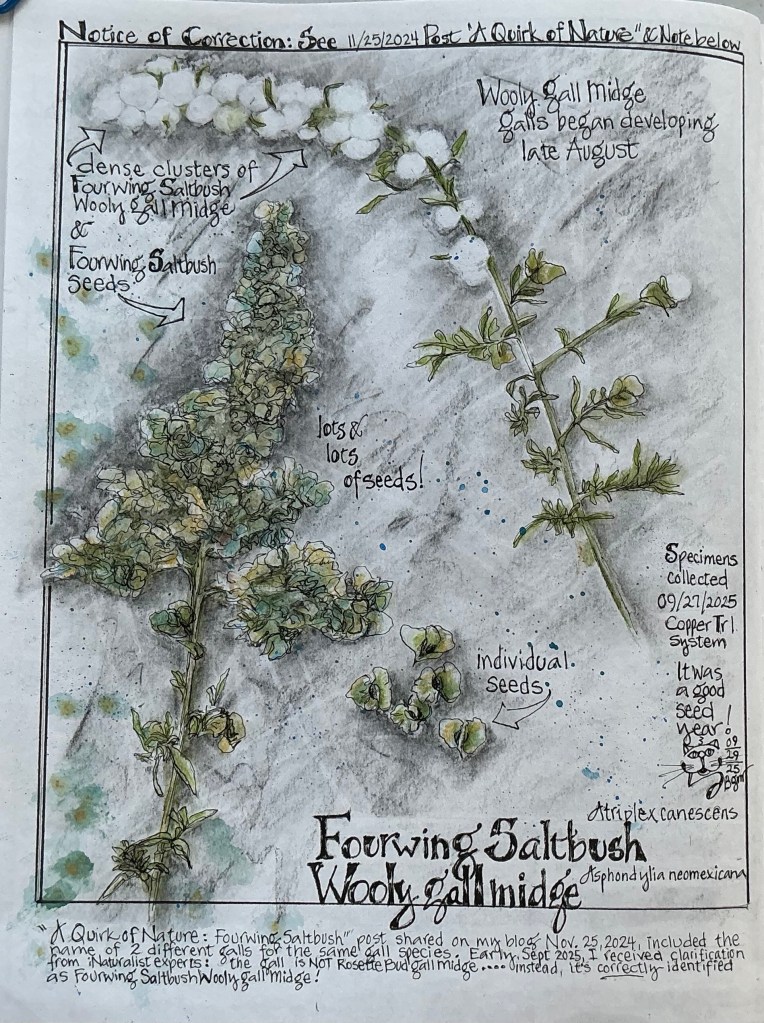
If you’re a fan of weird twists in nature (like me), and enjoyed my November 25, 2024 post, “A Quirk of Nature: Fourwing Saltbush,” you may have lost many hours of sleep wondering how I could’ve missed such an obvious mistake! You know the one. The labeling error made when naming those cottonball-like insect galls hugging the Fourwing stems.
In my confusion (or wishing to cover all options?), I seemed to believe two different midge species were somehow responsible for the same gall.
Are they Rosette Bud Gall Midge galls or Fourwing Saltbush Wooly Gall Midge galls?
Decisions, decisions.
My Quandry quite clear, it was time to consult the experts.
A short 10 months later, confirmation arrived from the iNaturalist experts in all things “Fourwing.” All the puffy galls are none other than those made by Fourwing Saltbush Wooly Gall Midges!
And the answer to my question is well timed, as the stems of the female Fourwing shrubs are once again ‘heavy’ with Wooly Gall Midge galls. Now I know! Now you also know!
Enjoy this official correction, at long last, and wishing you sweet dreams.
As always, thanks for stopping by!
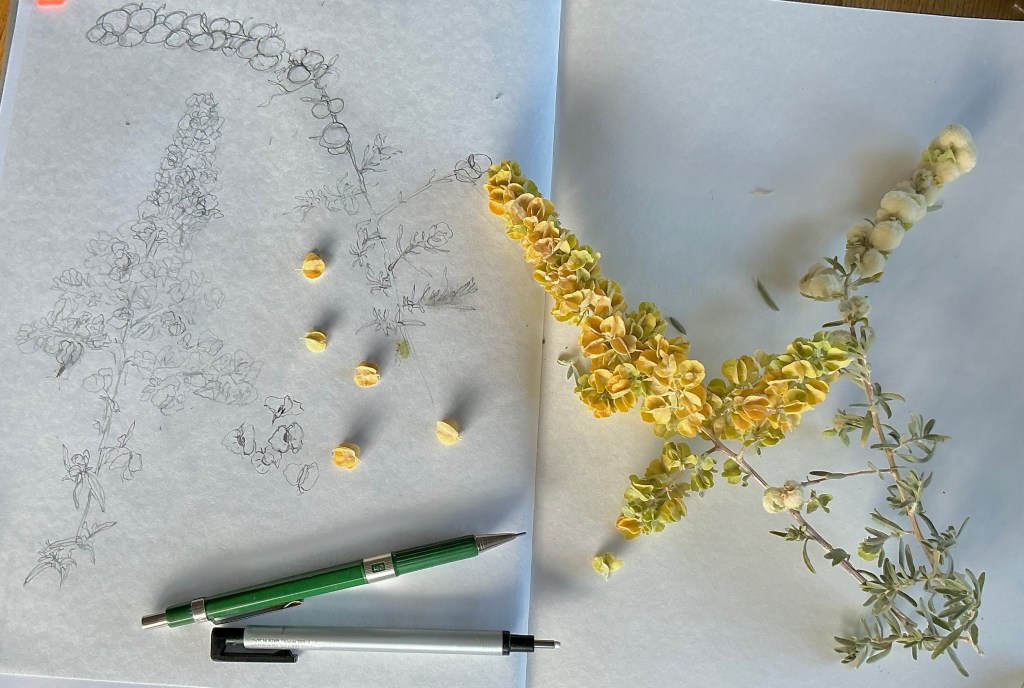
PS: My journal page was created by first sketching in graphite the two Fourwing stems, followed by outlining with loose ink lines from a Micron 005, adding a background of both soft and medium charcoal – blending with a stump, then using a Tombow Mono Zero eraser to clean up the ‘cottonballs,’ before adding watercolor pencil, color splatters, and eraser lines randomly placed through the charcoal background. A bit experimental, and lots of fun.
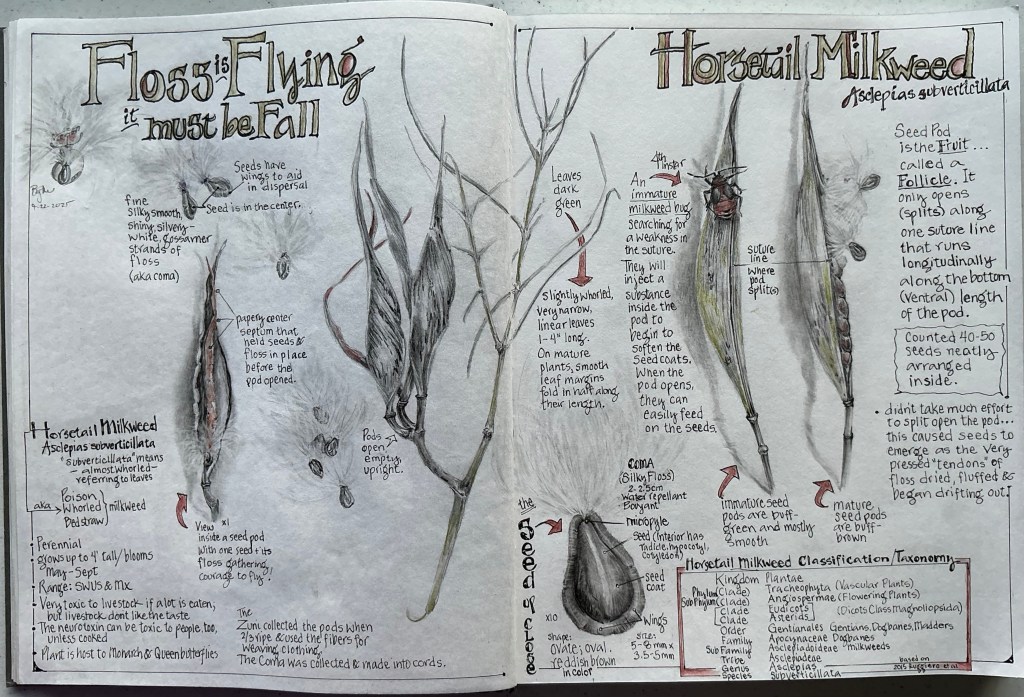
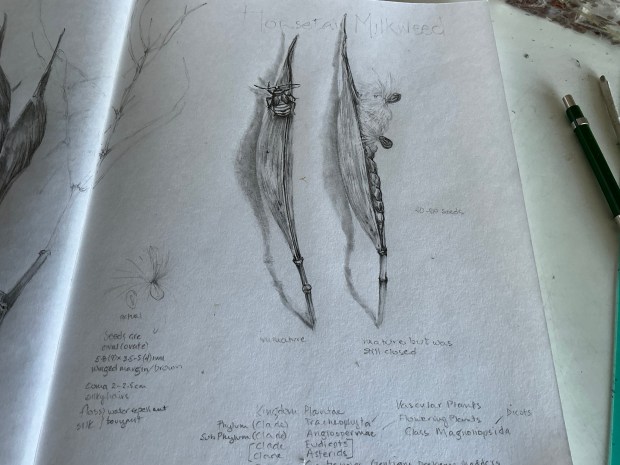
Like soft, fluffy snow! Glistening orbs of silky gossamer are floating about the neighborhood, drifting hither and yon in the gentle breeze. Suspended beneath each orb is a single reddish-brown winged seed that appears to coax its wind-propelled puff in a safe descent to the ground. But the white floss (the Coma) wants to fly, and it becomes a tug of war. As the weight of the seed overwhelms the ability (and the desire) of the floss to carry it, their brief relationship is severed. But both get their wish …. the floss flies free as the seed drops to the ground, hopefully landing in an ideal spot to overwinter and sprout next spring.
Welcome Fall!
When the air is full of Horsetail Milkweed parachutes and their ‘riders,’ I walk along the neighborhood roadways and collect a bounty of their new-crop seeds + floss to set free around our property. If they find the right soil, moisture, and light conditions for spring germination, the seeds will not only form the beginnings of a stand of these beautifully blooming, creamy-white milkweed flowers, but the plants might just play host to Monarch and Queen butterflies!
Now wouldn’t that be dandy!
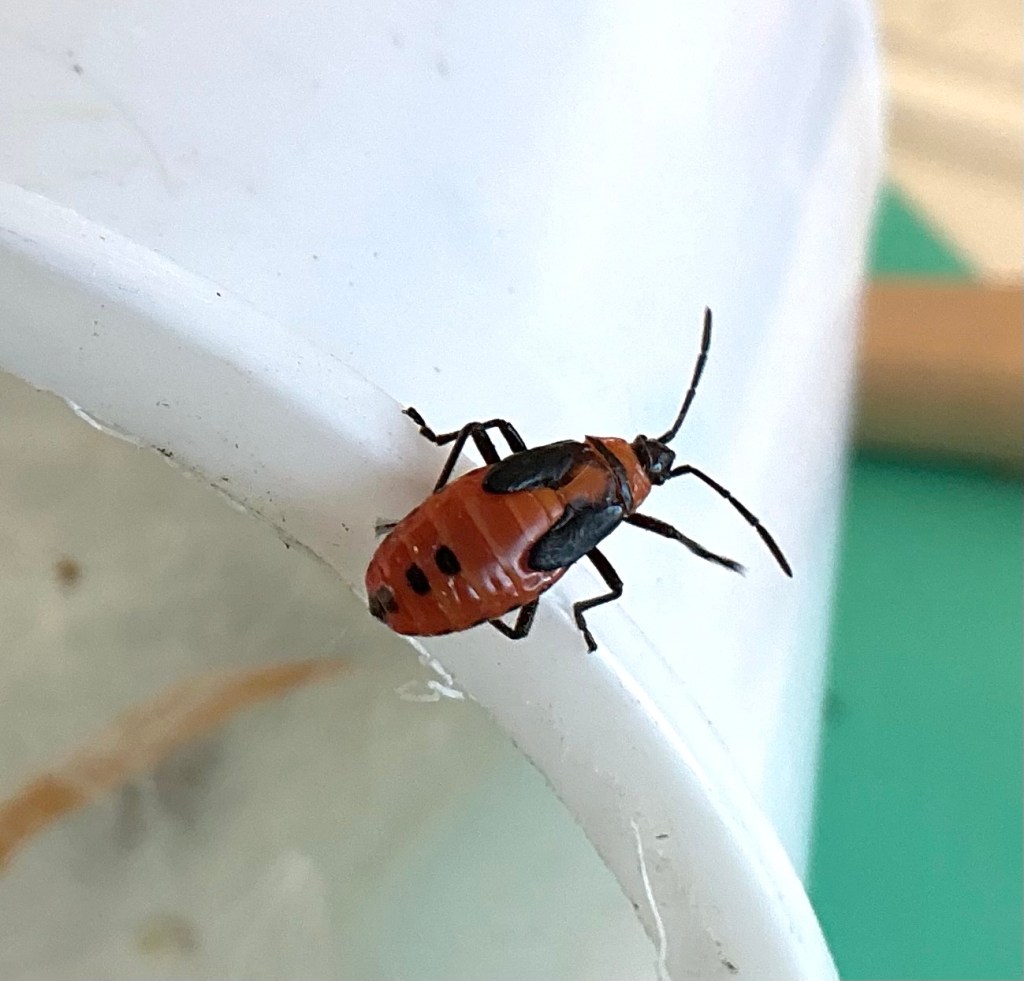
(Of course, mature seeds from new plants will undoubtedly entice a hungry crop of well-dressed Milkweed Bugs next Fall. That’s OK! They have to eat too!)
Before hint of color
My Journal Pages ……
For something different, instead of using ink and watercolor, all sketches on these pages were created in graphite. The pods, seeds and the milkweed bug were sketched from my collected samples using a mechanical pencil loaded with a fine point HB lead. The touches of color were added with water soluble graphite.
Work in Progress #1Work in Progress #2
Thanks for stopping by ….. And Have a Fabulous Fall!
Zentangle patterns: Spanders, Footlites, Diver, Lewe, Fifolia, Sprave, Qurtuba, Cloudy Day, Fission, Icantoo, Marbles, Soutache, Strutz, RowRow, Ping, FITA (Flies in the Air), Ease, Antique, Barberpole, ArcFlower, & Arrow Tree
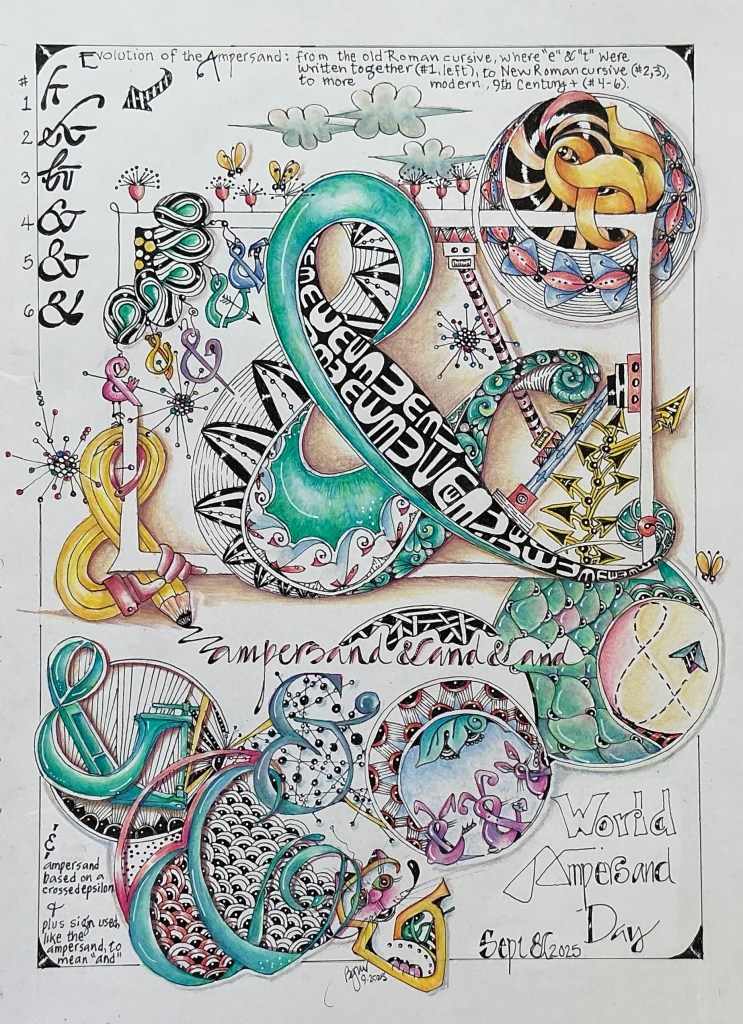
Did you notice World Ampersand Day was more than a week ago? No worries! Although September 8th is the official day for this World celebration, such a fun & functional, curly & quirky little character, know as the “Ampersand,” deserves a party every day of the year! Don’t you agree?
The Symbol we use today for the ampersand is more than 2,000 years old! Designed by an Ancient Roman scribe around 63 CE, it served as the shorthand version of the Latin word “et,” meaning “and.” This ingenious calligrapher created the Symbol by combining the letters “e” & “t” into a single ligature or glyph, for the purpose of saving valuable time, space, & parchment while writing the voluminous & tediously-penned documents of the day.
Observation #1: if you refer to my drawing, top left, you’ll see how the evolution of the ampersand symbol changed over the course of a few thousand years, beginning with Figure #1, the 2,000 year old design.
Observation #2: unless the old Roman cursive “et” included exaggerated negative space before, after, and/or within, I’m uncertain how the symbol in Fig. #1 saved space? What are your thoughts?
The Word “Ampersand” didn’t emerge until the early 19th century (1837) as the shortcut to the commonly used phrase “and per se and.” Now that phrase-to-pronunciation of “Ampersand” may seem intuitive, the eventual slurring of the four words follows a more complex explanation that’s pretty interesting. Based upon a traditional English custom that involved spelling out loud, “any letter that could also be used as a word in itself (“A”, “I”, & “O“) was referred to by the Latin expression per se(‘by itself’), as in “per se A” or “A per se A” or “A by itself = A.” Following that tradition of verbal spelling, the single Ampersand glyph was verbally spelled aloud like this: “and per se and,” “& per se &,” or (much more helpful) “& by itself = and.” This clarification of “& by itself” was necessary so as not to confuse the more extended forms of the “&” in use, such as “&c.” which is one of the abbreviations for the Latin phrase “et cetera,” which, of course, means “the rest.”
Today’s Stylistic Ampersand Symbols
Today, it seems there are hundreds and hundreds of unique ways of symbolizing the Ampersand. A quick internet search of font styles reveals a different twist on the symbol for each font. Can you imagine what an extensive search of fonts would uncover?! But there’s one criteria that must be met, somehow, in designing each “&” …… it must be a ligature (a combination) of the letters “e” & “t” into a single glyph (character), & if not readily recognizable, the artist must be able to demonstrate the presence of both letters, no matter how abstract.
Used to be ……
Did you know the Ampersand used to be the last letter of the English alphabet? It’s true! The “&” was added as the 27th letter in the alphabet in the 19th century &, as such, was taught to children learning their ABCs. Primers written for ‘little folks,’ some novels, & even nursery rhymes recognized the “&” as an official character. One especially popular nursery rhyme, Apple Pie ABC1, finishes with the lines “X, Y, Z, and ampersand, All wished for a piece in hand.” But sometimes good things come to an end. By the late 19th century, the “&” was accepted as a ligature it truly is, rather than a letter, & lost its place in the alphabet.
.
Celebrate every day by having fun with the Ampersand:
Use lots & lots of ampersands!
Substitute “&” for “and” in everything you write
Think of syllable replacements in words such as: &roid, c&elabra, b&
Send friends whose names contain “and” a special note — &y, &rea, Alex&er, Br&don, Gr&ma
Design new styles of ampersands being sure they represent the letters “et”
Count the number of ampersands in my drawing2
Well, Flambé doesn’t know about you, but she certainly had lots of fun learning about the Ampersand, & is kicking-off a campaign to have it restored as the 27th letter of the alphabet. After all, we lost Pluto as the 9th planet in the solar system, the Ampersand has almost been around as long as Pluto, & most importantly the “&” has the shape of her long lost best cat friend & lover, Cognac, who’s been on a planetary exploration for years, and has probably reached Pluto by now. Kat says, “Let’s bring back the Ampersand! All in favor, say, “and & and & and & and …..!’”
As always thanks for stopping by, & for voting because Flambé believes all voices must be heard on the issue of the deported Ampersand.
1“ApplePie ABC” is a simple rhyme written to teach children the order of the alphabet by relating the various ways children react to an apple pie. After the first line, A was an apple pie, the rest of the letters refer to verbs.
“A was an Apple pie; B bit it; C cut it; D dealt it; E eat it; F fought for it; G got it; H had it; J joined it; K kept it; L longed for it; M mourned for it; N nodded at it; O opened it; P peeped in it; Q quartered it; R ran for it; S stole it; T took it; V viewed it; W wanted it; X, Y, Z, and &, All wished for a piece in hand”.
Note the absence of two letters; the vowels I & U. When the rhyme was originally written (sometime in the 18th century), there was no differentiation between the capital letters I & J, & between U & V. But in 19th century versions, when the I & U were accepted as distinct letters, the rhyme was updated to include these two lines:
“I inspected it” & “U upset it.”
2 Spoiler Alert: Flambé & I each counted twice & agree …. you should come up with a total of 29 Ampersands in my drawing. If you also agree, Bravo! If you found fewer than 29, try again! If you found more than 29, send a message PDQ, letting us know how many there actually are & that we must’ve been sniffing too much catnip to count higher than 29! Then I’ll have Kat begin the scavenger hunt anew!
Zentangle patterns: Spanders, Footlites, Diver, Lewe, Fifolia, Sprave, Qurtuba, Cloudy Day, Fission, Icantoo, Marbles, Soutache, Strutz, RowRow, Ping, FITA (Flies in the Air), Ease, Antique, Barberpole, ArcFlower, & Arrow Tree
Ohhhhhh, what a sweet month …… August. It almost got away from me without sharing a small collection of Littles1 that reflect the inevitable shifts in nature that occur during the month. It’s always hard to imagine summer winding down; where did the time go? But as surely as butter melts on freshly baked bread, undeniably, August forms a reliable bridge between summer and autumn. It’s a time of change and transition; abundance and harvest; transformation and a period of letting go.
So before I “let go” and before the snow flies (and it will), here’s a handful of little discoveries during the month of August:
-A female Wheel Bug gone slightly astray while searching for a protected place to overwinter the eggs she’s about to lay.
-A female Soldier Beetle doing her best to attract a mate by sending out pheromones while munching late season pollen from the disk flowers of a brilliant yellow Showy Goldeneye.
-An acorn that made it to maturity, ready to drop beneath a still green-leaved Gambel Oak soon to be decked out in radiant fall colors.
-Some hot red trumpet-shaped Scarlet Gilia flowers, still irresistible to hummingbirds until migration, will all be pollinated in time for seed set and mature.
-The snowy white fruit dangling from the draping branches of Roundleaf Snowberry shrubs are ripe and ready for plucking by hungry birds flying south for the winter.
-And plump purple-black Chokecherry berries that will become a juicy dietary supplement for black bears needing to bulk up for hibernation.
Enjoy!
And as always, thanks for dropping by!
1“Littles” is part of a blog series I began posting several years ago, beginning in January 2023. The concept was inspired by Fay (thanks again Fay!) who came up with the idea for her blog madebyfay.wordpress.com





 a curious nature