Star Dust Skies — ABQ
October 11, 2026
“Time spent amongst trees is never wasted time” — Katrina Mayer
With nearly 300 public parks in Albuquerque (ABQ), it’s easy to find one beautifully landscaped with mature trees providing cool shade on a hot summer or fall day. The City’s Urban Forestry division manages roughly 25,000 trees within its parks, and when ‘in town,’ these parks feel like irresistible magnets reeling Luna and I in for an hour of discovery.
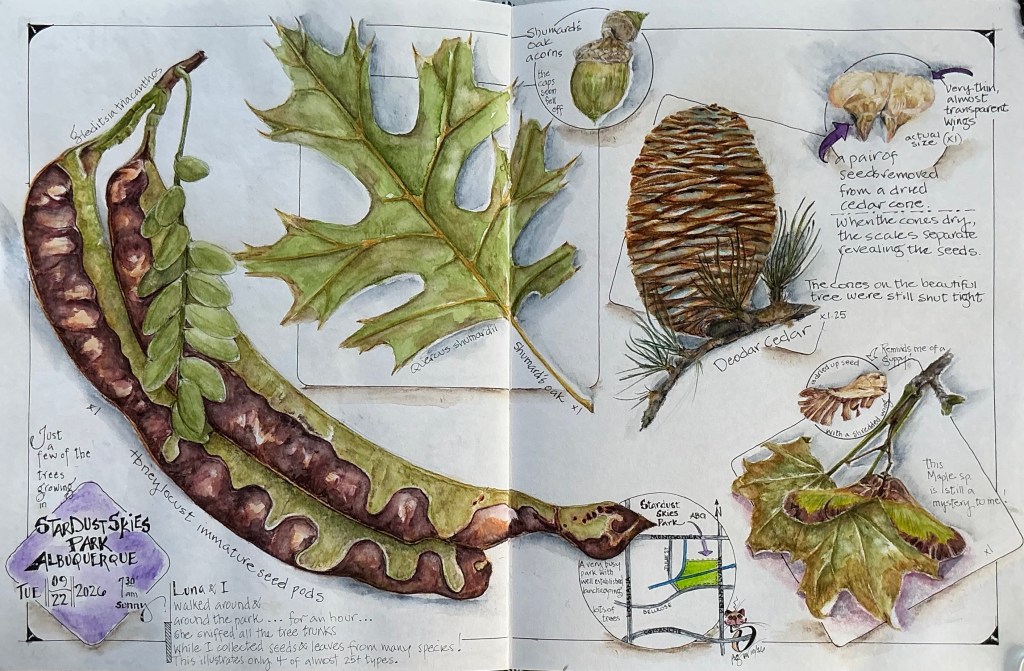
Star Dust Skies Park is one we’ve visited many times ….. as it’s just behind our dentist’s office. So on the morning of September 22nd, while Roy was “lounging” in a reclining chair discussing a tooth extraction with the Doc, Luna informed me the neighboring Park was calling.
Like many other City parks, the canopies of the abundance of mature trees seemed to touch, almost entirely eliminating the direct sunshine from penetrating the underlying lawn. Our walk-about was cool and refreshing as Luna sniffed every single tree trunk while I searched for seeds, seed pods and cones to draw.
As we moved from tree (trunk) to tree (trunk), I found myself wondering about the many non-native trees growing in the City. After all, ABQ is in the middle of a desert, in the middle of a drought (coincidentally, the 13 mile reach of the Rio Grande through town turned to sand from late May through mid-September 20261). Turns out the city has a water-wise urban forestry program; a permit must be obtained to plant a tree in a park, ensuring it is a drought-tolerant species. And growing trees in such an arid environment provides measurable annual benefits, like carbon sequestration, pollution reduction, and stormwater capture.
All of that (along with the other benefits of having established green spaces in the City) made me feel somewhat better about so many non-native trees in so many parks.
After an hour or so, it was time to head home. Both Luna and I were happy with our collections as we walked back to the dentist’s office ….. mine, a bag full of interesting and new-to-me seeds, seed pods and a few cones; Luna, a nose full of exquisite aromas describing the life and times of at least three dozen dogs who roamed Star Dust Skies Park this fine morning.
Where have you discovered Nature lately?
As always, thanks for stopping by!
1 During 2026, major stretches of the Rio Grande through the Middle Rio Grande Valley (including 13 miles through central ABQ and southward) reached historic dryness levels, running dry for approximately three months; sections drying as early as late March and June. By late August, total dry river miles across the Middle Rio Grande Valley reached 112.4 miles (from Cochiti to Elephant Butte Reservoir), surpassing previous records.
On September 3rd, water temporarily returned to the Rio Grande in ABQ, after a 650-million-gallon release was ordered from the Abiquiú Reservoir for a brief three-day research and environmental rewetting period. But it wasn’t until September 18th, that consistent late-summer rains finally brought natural flows back to the river around ABQ.


Barb,Those pages are exquisite! And I
LikeLiked by 1 person
Thank you so very much, Chris! The pages were lots of fun to create!
Looks like part of your comment was eliminated?
LikeLike
Fantastic! loved the idea of seeing the benefits of some non-invasive non-native plants.
Nothing better than spending time among the trees.
LikeLiked by 1 person
Elaine! Love your comments. It’s difficult to find nearly anywhere, world-wide, where non-native species haven’t been introduced or have moved into natural ecosystems. Of course, cities are man-made ecosystems. I’m glad ABQ’s parks have been created for people to enjoy while also establishing some green space with some drought-tolerant species —— even if the species are non-native.
LikeLike
Wonderful discovery, Barb! Wow, the Rio Grande has been dry in ABQ for the summer. Glad you have a place to visit a variety of trees that are drought-tolerant! Last weekend we walked the entire length (1 mile) and back of the UW Arboretum, starting at the Japanese Garden and winding through the trails of sequoia, camelia, rowan, New Zealand garden and more! It was such a special and beautiful walk visiting with all those trees! Thanks for sharing!
LikeLiked by 1 person
Karen! Your comments always warm my heart! Thanks so much. And thanks for sharing your very long walking visit to the UW Arboretum. Sounds so gorgeous. (Seriously, they have sequoia?!?). It was a very, very hot and dry spring and summer in the Rio Grande Valley ….. with water (or lack thereof) on everyone’s mind. Nobody watered yards, landscaping or gardens. Farmers couldn’t grow crips, pecan orchards suffered, and water flowing through wildlife refuges went subterranean. ABQ was drawing drinking water from already-low aquifers. And boy do we ever have a lot of dead piñon trees in the East Mountains. Even though the ABQ park trees are mostly drought tolerant, I’m wondering if the Urban Forestry folks are contemplating future water shutoffs to the parks. Sigh.
LikeLiked by 1 person
Barb — thanks for the updates on things in your neck of the woods. I sure hope there will be some relief in the near future!
LikeLiked by 1 person
You’re so welcome, Karen! I also hope the relief keeps coming. I listened to a podcast yesterday describing the water situation in NM’s Central Valley remains dire, as is,also true for many SW desert areas.
LikeLiked by 1 person