A Rosette by any other name …….

April 23, 2025

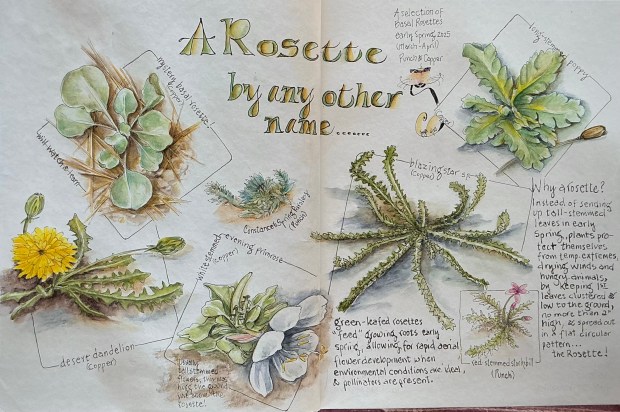
A selection of basal rosettes that popped out of the ground this Spring.

Have you ever noticed a dandelion? Oh sure …… you’ve seen hundreds, probably thousands of those ubiquitous sunburst yellow flowers blanketing a lawn or brightening an abandoned field. But before all that brilliance magically appears, have you ever looked below all those flower stalks? Have you ever noticed a dandelion before it blooms?

It’s early Spring in the mountainous areas of central New Mexico, and it seems like the high desert is slow to bloom this year. Anxious to spot even a hint of green during this transition time is always challenging, but if you look closely …….. Tucked beneath dry grasses and piled-high tumbleweed skeletons wedged next to swelling cholla you’ll find the green. Clusters of new leaves hugging the ground no more than an inch high, are beautifully arranged in a circular pattern like the unfolding petals of a rose.  

Rosettes!

Rosette arrangements are found throughout nature,1 but in the flowering plants they are particularly common in the following families: Asteraceae (like dandelions), Brassicaceae (like cabbage), and Bromeliaceae (like pineapple). Many other families display the rosette morphology too. The needle sharp leaves of yucca and the bayonet-shaped leaves of century plant (in the Agave family) form tall rosettes. The intricate leaves of wild spring parsley (a tiny member of the Parsley family) and the petite red-stemmed stork’s bill (Geranium family) both form ground-hugging rosettes. 
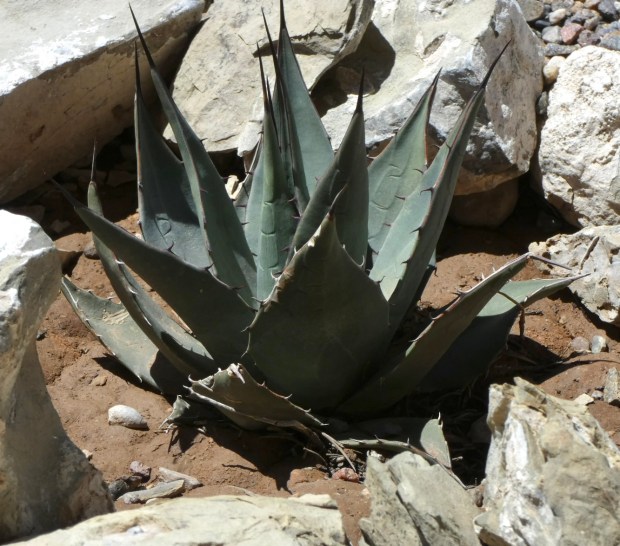
A century plant displaying a beautiful basal rosette.

Where Rosettes Form

Basal Rosettes grow close to the soil at or near the plant’s crown (the thick part of the stem where the roots attach). Their structure is an example of a modified stem in which the internode gaps between the leaves do not expand, ensuring all the leaves stay tightly bunched together and at a similar height.  A protective function of a basal rosette makes it hard to pull from the ground; the leaves come away easily while the taproot is left intact (have you ever tried to pull a dandelion without snapping off the root?). Generally speaking, basal rosettes improve a plant’s odds at survival. For example, overwintering rosettes, like the basal leafy growth produced in year #1 of the 2-year life span of giant mullein, protect the plant and its roots from extreme cold temperatures. Emerging Spring rosettes, like those found in long-stemmed poppy, also protect the plant from late winter frosts. Basal rosettes are also more protected from changes in microclimate, gravity, wind, browsing, and mechanical damage if they are closer to the ground than tall leafy stems would be. help in water balance and conservation, especially important during periods of drought. 
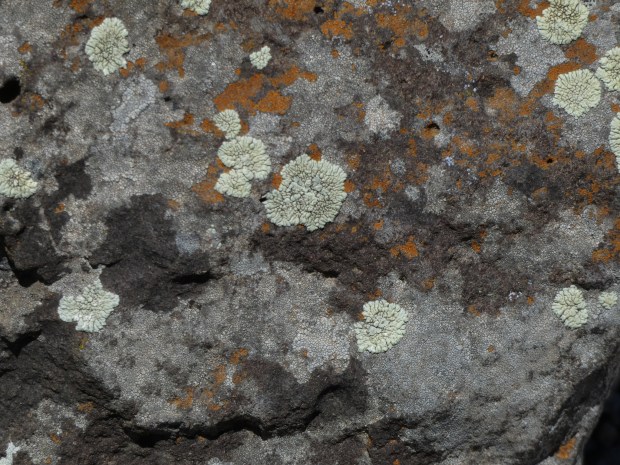
Lichen that has form small rosettes on rock.

But don’t only look down. Another form of rosette occurs when the internodes (those areas between leaves) along a stem are shortened, bringing leaves closer together as in lettuce and some succulents.2. And although not as common as basal rosettes, some plants form rosettes at the terminal or top end of their often naked stems, branches, or even trunks. One plant that does this is the native sedum called wild stonecrop. The top of the plant stems usually terminate in whorls or three fleshy leaves. Another example is the Hawaiian screwpine, which has a terminal rosette of sword-shaped leaves which sits atop an erect trunk, often supported by prop roots.

Know Your Local Rosettes

A number of desirable and undesirable (weedy) plant species produce rosettes, particularly basal rosettes.  Being able to identify a species that pops up in the Spring by its rosette is so helpful in preventing a removal mistake by inadvertently digging them up. Many weedy, non-native plants gaze first at their world through rosette “eyes.” But not all plants with rosettes are undesirable. Do you know your local rosettes by their other names?

………………………………………………………………

1  Rosettes are found throughout nature, not just in the flowering plants.  Here’s some examples you may have seen or heard of:  

In bryophytes and algae, a rosette results from the repeated branching of the thallusas grown by plant, resulting in a circular outline. Lichens also grow rosettes.

Tiny wasps and midges can induce the development of galls that become leafy rosettes.

Jaguars, leopards and other feline species display rose-like markings on their fur, referred to as rosettes.

Malaria parasites are known to form spontaneous rosettes in uninfected red blood cells.

Neural rosettes in the human brain are being studied to learn how new cells are born.

It is unknown why the Rosette-Nosed Pygmy chameleon, at home in the mountains of Tanzania, has evolved a distinctive, rosette-shaped, fleshy protrusion on the end of its nose.

The Rosette nebula, named for its rosette-like appearance, is a beautiful collection of gas and dust 5,200 light-years from Earth in the constellation Monoceros the Unicorn, and stretches about 130 light-years across.
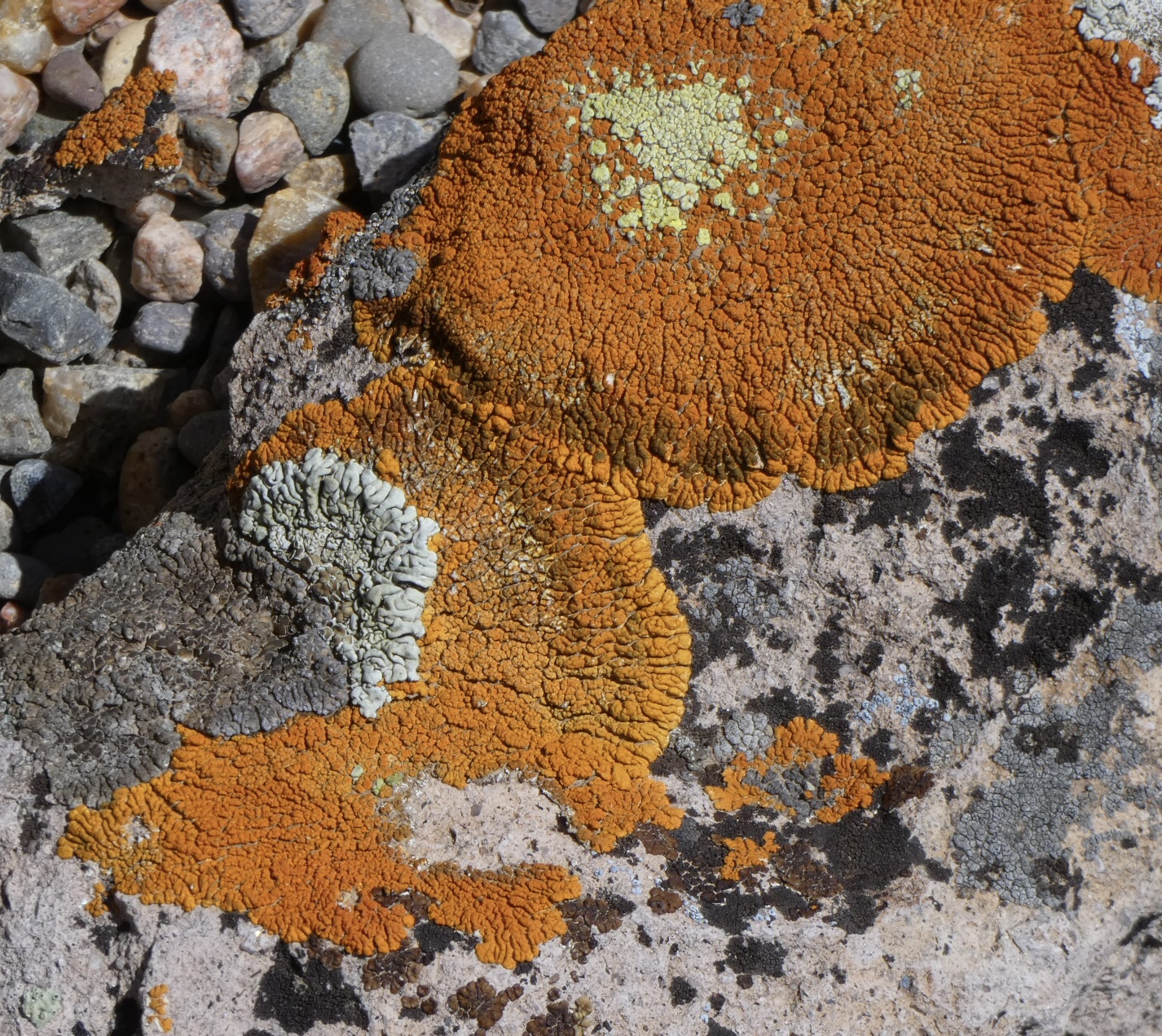
A gorgeous lichen decorated rock from Colorado. Note the rosette patterns of growth (the thallus)

  The horticultural definition of a succulent describes a drought-resistant plant where the leaves, stems, or roots have become fleshy and their tissues are able to store water. Succulents include aloe, euphorbia, sedum, the garden favorite hen-and-chicks, and bromeliads. But horticulturalists do not include cacti in the succulent group. huh? Even though cacti are frequently found in books describing succulents based the definition of a succulent, succulents are not cacti. In agreement with that last statement are many botanical and other scientific experts. (Can this get any more confusing?). So basically some experts are lumpers, while other are splitters.  Which are you? 

Basal rosette of a yucca in the NM foothills.

P.S. Cacti have stems that are thickened fleshy water-storing structures, and are considered to be a stem-succulent group of plants. Are there any cacti species that develop leafy rosettes? Because the spines are the leaves, greatly modified, in all my rabbit-trailing thru the internet and perusal of my collection of botanical references I’ve yet to see any spines forming whorled/rosette-like patterns. If you have, please contact me immediately!

……………………..……………..😂…………………………………………

Are you ready to explore the wide diversity of rosette forming plants in your neighborhood? Get on out there before those circularly-arranged leaves become disguised by an overabundance of gorgeous wildflowers! 

As always, thanks for stopping by!  And Happy Earth Day (week)!

The Gall! A Curiosity of Oak Galls, Revisited …… Part III

August 27, 2024

Webster’s had it “right on” when describing the Ubiquitous Plant Gall!

gall /ga:l/  1. something irritating; rude. 2. not able to understand a behavior is unacceptable.

—-the boldness of these guys; the sheer gall and effrontery; the chutzpah; the unmitigated gall; What gall!

“Yeah ….. What Gall is This?!”  

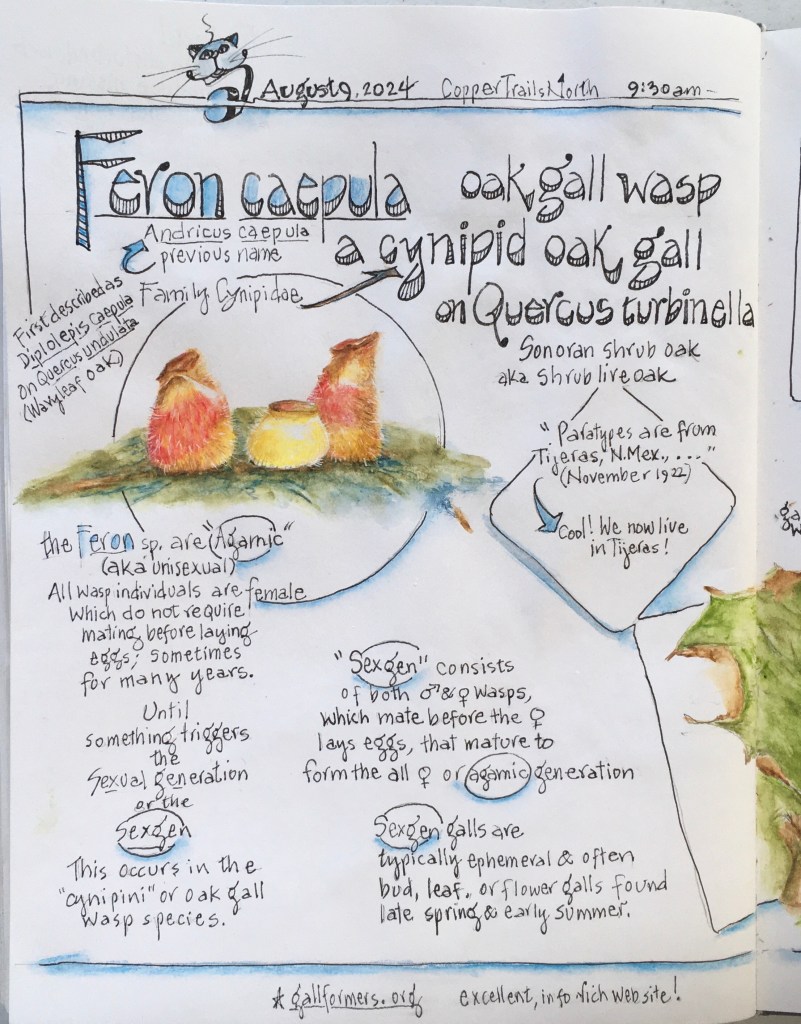
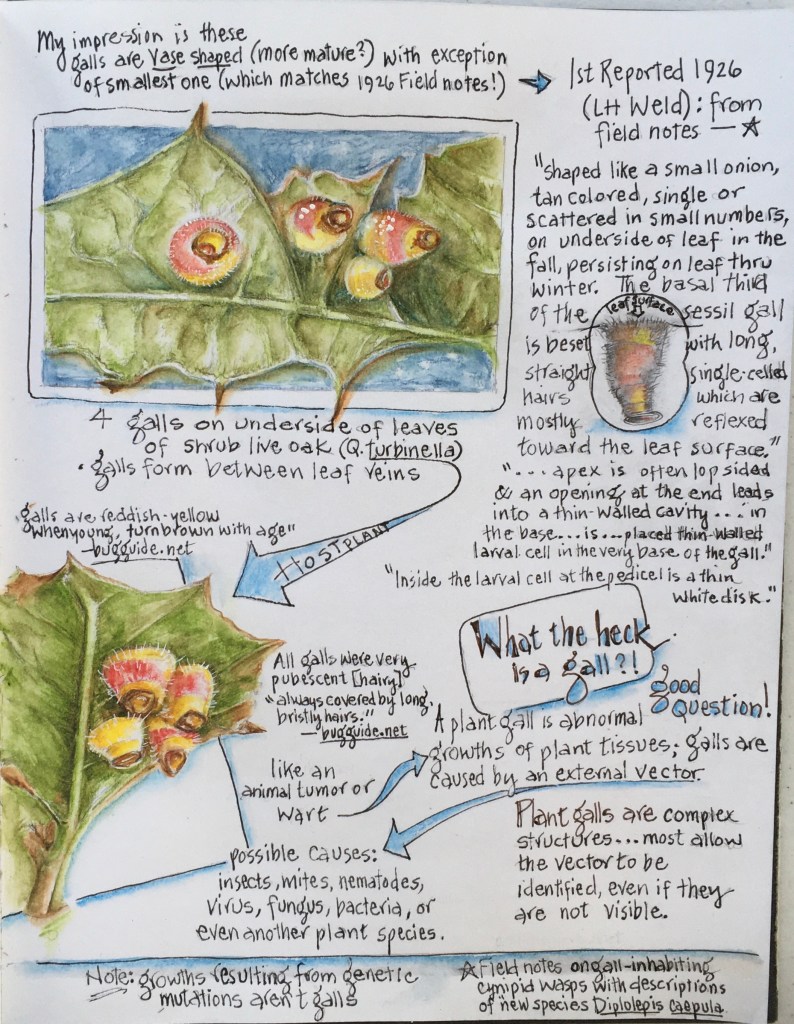
That was the question uppermost on my mind when a slight breeze wafting down the trail lifted a fresh oak leaf revealing four slightly wonky vase-shaped growths. One was squatty and pale;  three were colored with alternating bands of cadmium yellow and deep vermillion. All four galls were attached to the underside of the leaf, hanging upside down, so whatever might’ve been inside is out.

After 5 minutes of inspection ….. poking and prodding, and peering inside the tiny vases ….. I took some photos to post on iNaturalist to figure out this little mystery. It didn’t take long before my discovery was identified! These are galls of the parasitic cynipid wasp called Feron caepula, formed this Spring on a new leaf of Shrub Live Oak (Quercus turbinella).

Originally identified in a 1926 field report as a new species, Diplolepis undulata, this species’ name was reestablished as Feron caepula in a report published in 2023. Ordinarily I choose to only cite a field report, but decided to make an exception in this case for several reasons…… the description of this new species was helpful in better understanding my specimens, and……. one of the paratypes used to describe the new species came from Tijeras, NM (which happens to be my home!). So the entire 1926 field report* (surprisingly short) by LH Weld is added below.


Supplement to the Nature Journal Pages

A Curiosity of Oak Galls, Revisited …… Part III

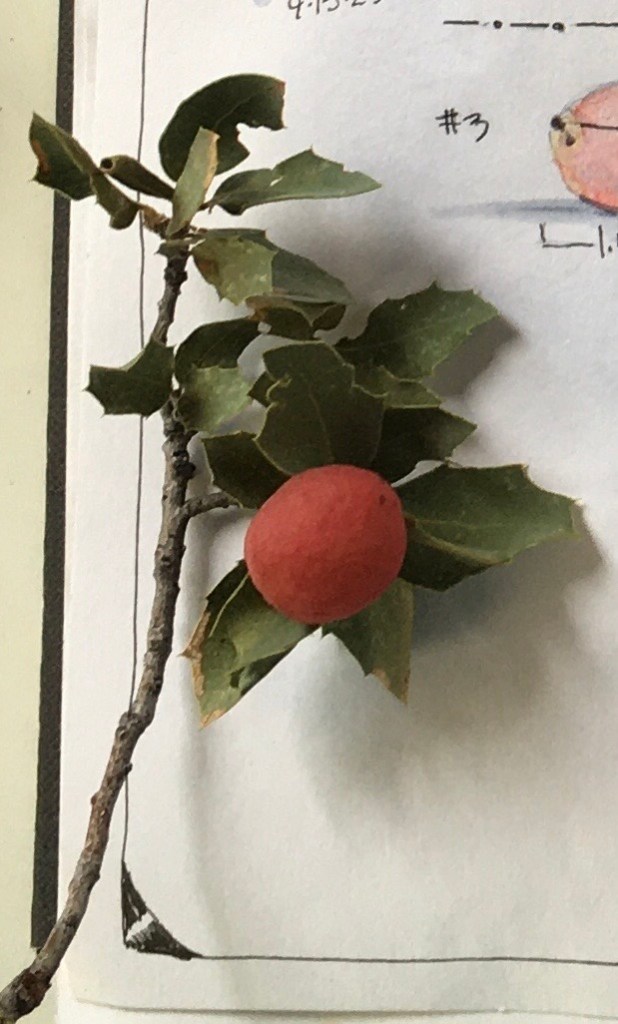
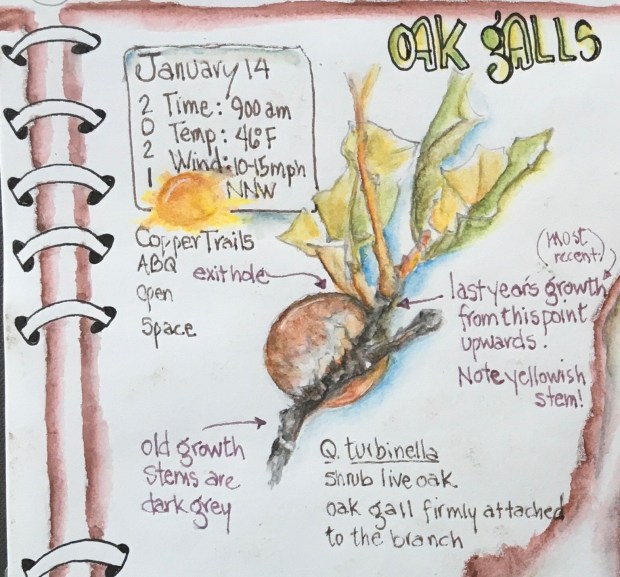
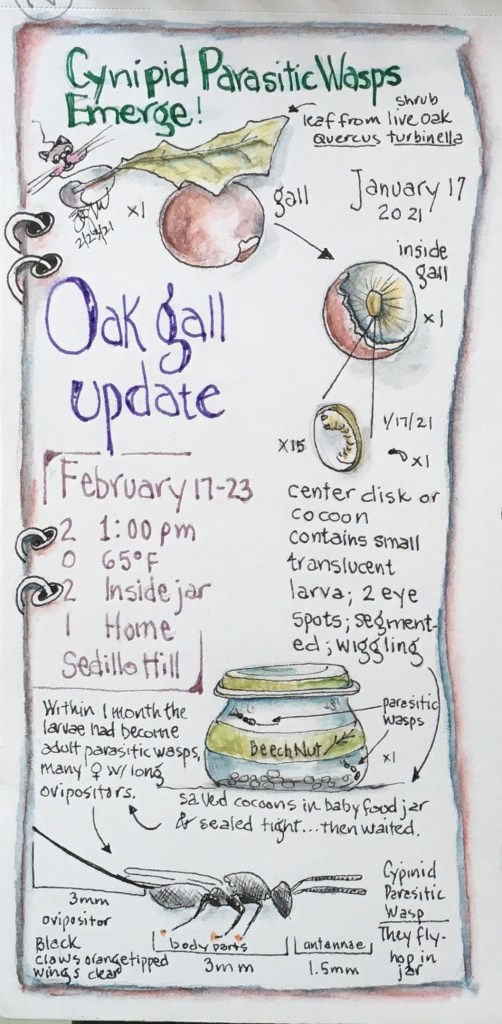
Curious about plant galls for decades, I finally began reading and experimenting to learn a bit about the inner world of oak galls. Throughout the winter of 2020-2021, I enlisted Roy’s help to collect about 100 nickel diameter, reddish-brown galls hanging on oak leaves like holiday decorations.  Not knowing what to expect, I cut into a bunch of these galls and found tiny squirming grubs (larvae) – one/gall.  The grubs seemed to be suspended by a complex network of stringy plant tissue radiating from each larva at the center to the inner gall shell. It reminded me of a snow globe frozen in time!  Of course I had to know what these guys would become. So I placed about half of the galls into glass jars, and the other half went into jars without their protective gall home. In a few weeks the jars were full of the smallest wasps ever! Wasps! Little parasitic cynipid gall wasps active and ready to be released back into the wild to do what these wasps do! (Rest assured, they were releases in the same area where the galls were collected.)

A few years later, I was once again smitten by these tiny wasps and their galls, and learned more about their life cycle and other facts about galls in general.  You can read all about my earlier experiences (and my efforts with experiments) in 2021 and 2023 at this post “No Small Galls this Fall! Oak galls, then and now, the sequel”.

Back to the Present

Here it is 2024, and while hiking the Albuquerque foothills, a new (to me) and colorful gall form appeared hanging beneath an oak leaf. My curiosity piqued. It was high time I gained some insight about the life cycle of cynipid gall wasps. Paraphrasing numerous expert sources, my attempt to interpret and understand what has been described the one of the most complicated life cycles known in the animal kingdom, still seems confusing. Maybe it’s been hard to wrap my mind around Parthenogenesis (asexual reproduction)***….. a key component of a cynipid gall wasp’s life cycle. By taking my time (over a month), and after many written and diagrammatic iterations, I stitched together a description that works.  If you’re curious, read on!

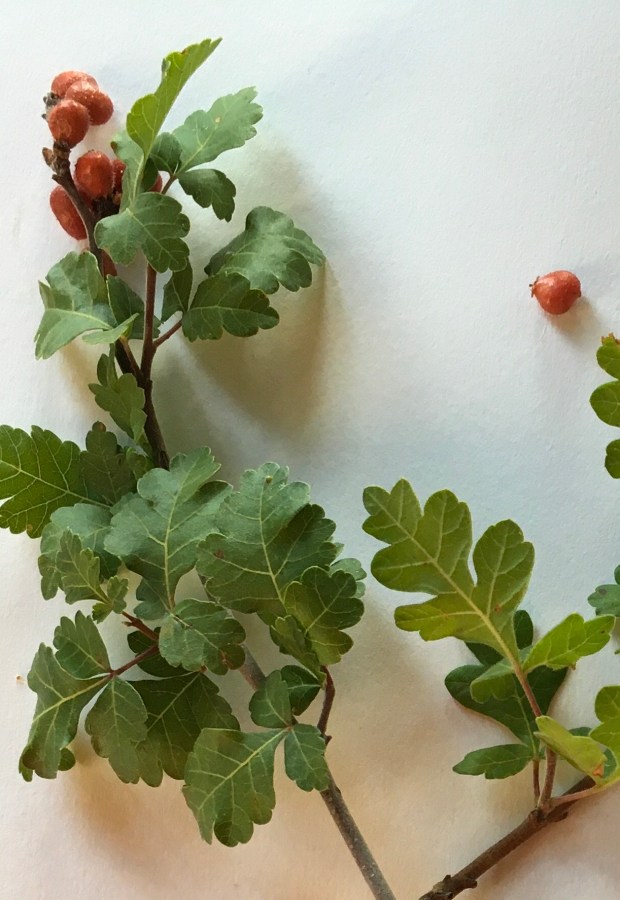
One of the oak galls collected late 2020 …. On Shrub Live Oak (aka Sonoran Live Oak)

Where do Oak Galls Come From, and Why?

Every year in late-Spring and through early Summer our shrub live oaks (Quercus turbinella) are a-buzz with a cloud of nearly microscopic cynipid gall wasps that have emerged from a hundreds and hundreds of leaf galls. These often weird looking abnormalities begin forming during an oaks’ accelerated growth period in the Spring. “But where do galls come from and why?”

It’s Complicated!

In the case of cynipid gall wasps, the majority of more than 1400 known species* parasitize oaks, while a much smaller number favor rose and chestnut as host plants. Where and how a gall forms on a host plant, along with the gall’s size, shape and coloring is vector-specific. This gall uniqueness makes it possible to identify what species of insect, such as a cynipid gall wasp (or other external vector like a mite or virus or nematode or fungus or virus or bacteria) was responsible for each gall.

The life cycle of cynipid gall wasps alternate between asexual and sexual generations. This process, called Cyclical Parthenogenesis, is both fascinating and baffling. Typically, the gall formed by the females of the sexual generation (sexgen) shows itself in late winter/early spring, and is on a different part of the oak (such as a twig or stem) than the later asexual (or agamic) generation (agamic galls usually appear on actively growing plant tissues).  The following is what appears to happen during the  ………………

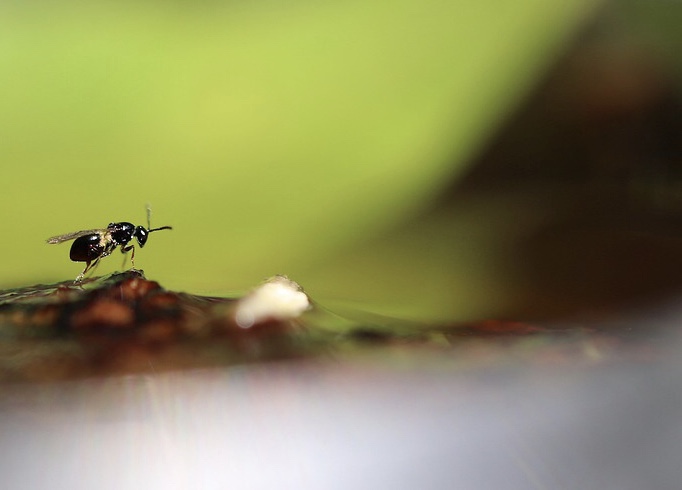
Photo of Cynipid gall wasp (courtesy Pixabay)

Lifecycle of a Cynipid Gall Wasp

The Asexual (Agamic) Generation

When the weather warms in late winter, an all-female generation of cynipid gall wasps emerge from galls which developed and became dormant the previous year, well before the cold and snow set in. This asexual generation of wasps initiates late Spring/early Summer gall development by inserting (with its ovipositor) an egg along with a maternal secretion from the venom gland, into a swollen leaf bud of the host oak. Egg laying takes place as the growing (meristematic) tissues inside the bud rapidly develop. The egg quickly hatches, and the larva begins feeding, all the while exuding specialized growth hormones that stimulate exaggerated tissue growth resulting in structures (the galls) that are visibly different from normal plant tissues. It’s during the Spring/Summer that developing galls are readily seen, often on the undersides of new leaves.

Portion of journal page from 2021

The safely hidden larva continues to eat the nutrient-rich plant tissues forming inside the gall and grows quickly until it develops into a pupa. After a few weeks in this pupal stage, an adult cynipid gall wasp has formed. Still tucked away, the adult (which is either a male or female) chews a small hole in the gall and emerges to mate. 

Another journal page from 2021

The Sexual Generation (aka “Sexgen”)

With the business of mating taken care of, and with no mouth parts to eat, the males quickly die, followed soon by the females. However, before the females die, they deposit one or more eggs on a leaf or within a twig or stem of the host plant. Before the plant’s growing season concludes, the eggs have hatched, larvae have eaten and grown within their individual galls, and have pupated in preparation for over-wintering. Depending on the length and/or severity of winter where these cynipid gall wasps live (and they can live nearly anywhere worldwide), the dormancy period may last from three-five months. 

And now …. back to the emergence of the Asexual or agamic generation (the females), in an on-going cyclic loop that is the life cycle of the cynipid gall wasp. 

A Supplement to the Supplement!

Types of Galls

Leaf galls

  • Form on leaf blades or petioles (leaf stems)
  • Most common galls appear on the upper or lower leaf surface, on or between leaf veins.
  • Galls may look like leaf curls, blisters, nipples or hairy, felt-like growths.
Oak galls on Gambel Oak

Stem and Twig Galls

  • Deformed growth on stems and twigs. 
  • Range from slight swelling to large knot-like growth. 
  • When seen, may be peppered with many tiny holes where the adult gall wasps have emerged.

Bud or Flower Galls

  • Deformed size and shape of buds or flowers. 

Fun Facts

  • Galls are growing plant parts and require nutrients just like other plant parts.
  • A gall keeps growing as the gall former feeds and grows inside the gall. 
  • Once galls start to form, they continue to grow even if larvae die.
  • Most galls remain on plants for more than one season.
  • Galls are usually not numerous enough to harm the plant and control is not warranted.
  • Gall numbers vary from season to season. 
  • Typically, plant galls become noticeable only after they are fully formed.
  • The asexual generation (agamic) galls are reported more often because they are larger and persist longer than the sexual generation (sexgen) galls.
  • Mature plant tissues are usually not affected by gall-inducing organisms.
  • Iron gall ink, which was the most common ink used from the Middle Ages to the 19th century, was used in line drawings by DaVinci, Van Gogh, and Rembrandt, and in the writing of many historical documents like the US Declaration of Independence.

It’s been so helpful to study the life cycle of these tiny parasitic cynipid wasps, if for no other reason than to admit my understanding remains basically rudimentary, and I must keep my Curiosity alive!

As always, thanks for stopping by!

………………………………………………………………………………………………………………

*Field report from 1926 by LH Weld

Diplolepis caepula, new species

Host. — Quercus undulata [Wavyleaf oak, Quercus x undulata]

Gall. — Shaped like a small onion, tan-colored, single or scattered in small numbers on under side of leaf in the fall, persisting on the leaf through the winter. The basal third of the sessile gall is beset with long straight single-celled hairs which are mostly reflexed toward the leaf surface. The conical apex is often lop sided and an opening at the end leads into a thin-walled cavity in which are a few scattered hairs and in the base of which is the transversely placed thin-walled larval cell in the very base of the gall. Inside the larval cell at the pedicel is a thin white disk.

Habitat. — The type is selected from a series from galls collected November 14, 1921, near Hillsboro, N. Mex., the flies emerging April 5-25, 1922. Paratypes are from Tijeras, N. Mex., and of the adults cut out of the galls on November 1 some lived in a pill box until December 28. Other paratypes are from Blue Canyon west of Socorro, adults being cut out of the galls on January 2.  ….. Similar galls were seen on Q. grisea at Magdalena, N. Mex.

  • LH Weld: (1926) Field notes on gall-inhabiting cynipid wasps with descriptions of new species”

Reference: https://gallformers.org

**The 1400 known species of cynipid gall wasps have been identified worldwide, with an estimated total of more than 6,000 species.  In the U.S. there are over 2,000 known species of gall-inducing insects, including 750+ cynipid wasps (500 of which are found in just the West). Worldwide, entomologists have estimated that there are over 210,000 gall-inducing insects yet to be identified!

*** Parthenogenesis is a form of asexual reproduction where an egg develops into a complete individual without being fertilized. The resulting offspring can be either haploid or diploid, depending on the process and the species. Parthenogenesis occurs in invertebrates such as water fleas, rotifers, aphids, stick insects, some ants, wasps, and bees. Bees use parthenogenesis to produce haploid males (drones) and diploid females (workers). 

Some vertebrate animals, such as certain reptiles, amphibians, and fish, also reproduce through parthenogenesis. Although more common in plants, parthenogenesis has been observed in animal species that were segregated by sex in terrestrial or marine zoos. Two Komodo dragons, a bonnethead shark, and a blacktip shark have produced parthenogenic young when the females have been isolated from males.


Exploring the Familiar

July 23, 2024

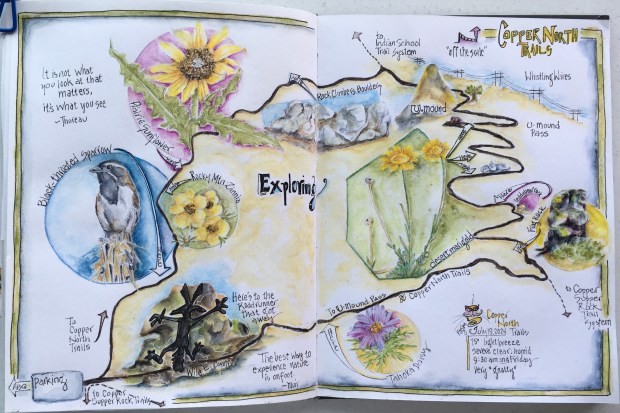
Hiking and rehiking familiar areas always turns up new discoveries. This may be because my eyes skim over the most commonly seen phenomena, allowing me to actively search for anything new or anything out of place. Rarely am I disappointed.

A few days ago, we explored one of our favorite hiking areas. Because birds tend to be more secretive this time of year, the best surprise was to hear a black-throated sparrow sweetly singing from his perch atop a cholla skeleton.

Because it’s monsoon season, many plants that bloomed late spring are making a comeback, and are happily spreading throughout the area. So to keep track of how ranges are expanding, I made note of their locations and transferred this information to a simple trail map. I also noted that the most commonly seen flowers were from the composite family …. the sunflowers.

Oh! Couldn’t resist capturing the silhouette of Wile E. Coyote glued to the back end of a dented vehicle in the parking area. That’s was a perfect discovery for the resident roadrunners!

Do you enjoy exploring familiar areas? What surprises have you discovered?

As always, thanks for stopping by!

Nature Sleuthing Resumes ….. Sunflowers and Fibonacci; Natural Spirals

November 26, 2023

After a well deserved rest from Inktober and from my self-imposed pressure to create something every day from a list of random prompts, I’m happy to be out again nature sleuthing. Curiosities in nature sometimes stare us in the face. But more often than not making discoveries require keen observational skills, noticing something new to you, and an ability to look for clues to a mystery with wide open eyes.  

Double page post with an extra add on; all art work done with Graphgear 1000 loaded with 0.3mm 2B lead and all inked lettering done with Faber-Castell Pitt Artist Pen Fineliner, 0.3mm.

It was during a hike on an unseasonably warm day that I paused to admire the dried flower heads from one of the late blooming sunflowers. Have you ever noticed how they look like another kind of sunflower? Papery textured “petals” circle a central disk where a few weeks ago it was crammed full of puffy parachute-topped seeds. After the seeds become airborne, all that’s usually left is a slicked off surface punctuated with dots arranged in spirals radiating out from the center.

Click the link below to read more ………

Continue reading “Nature Sleuthing Resumes ….. Sunflowers and Fibonacci; Natural Spirals”

Late Bloomers …. Fall’s Flowery Foothills

September 26 & 27, 2023


It’s hard now to imagine how extremely hot and dry the summer was this year. Without even a spittle of rain, the 100+ degree temps for weeks effectively suppressed the usual mid-season bloomers in and around the Albuquerque foothills/East Mountains. Even invasive plants, like goathead and tumbleweed, remained dormant or failed to germinate all together. It looked like winter browns had arrived early.

Then in less than a week, a small rain followed by several long downpours flooded the parched landscape, transforming browns to greens. You’ve heard this from me in a few earlier posts, but it was magical, and a reminder about the resiliency of desert vegetation.

Here’s a few pages highlighting a handful of the Late Bloomers I recorded in only 2 days. More than 2 dozen species had sprung back to life, setting flowers at all stages of accelerated vegetative growth. The landscape seemed wide awake. If plants could talk, I imagined them laughing while excitedly chanting, “hurry, hurry, hurry!” Only their roots prevented them from dancing! 

In addition to the species on these journal pages, there are many (more) composites, native grasses, shrubs and sub shrubs, small forbs from Spring and early Summer actively growing and blooming right now, and (of course) the weedy invasives are growing and blooming with wild abandon.

Random thoughts and wonderings ….. are pollinators still hanging around …… or ….. how many of today’s bloomers are self fertile …… are local birds, insects, reptiles and mammals that depend on earlier summer pollen and/or fruit and seed production stressed with this timing change/availability of food sources … will there be noticeable shifts in species composition, including plants, insects, reptiles and animals (including birds) ….. what species can and will adapt to changes, and how quickly ….. etc. The answers to these and many more questions are probably best answered in coming years, if it’s even possible to answer them at all.

Have you observed vegetation anomalies that may be influenced by changes in climate? If so, please share your observations and where these changes are taking place.  Meanwhile, keep your eyes wide open.

“Closing your eyes isn’t going to change anything. Nothing’s going to disappear just because you can’t see what’s going on. ……….. Closing your eyes and plugging up your ears won’t make time stand still.”  – Haruki Murakami.

published October 2, 2023

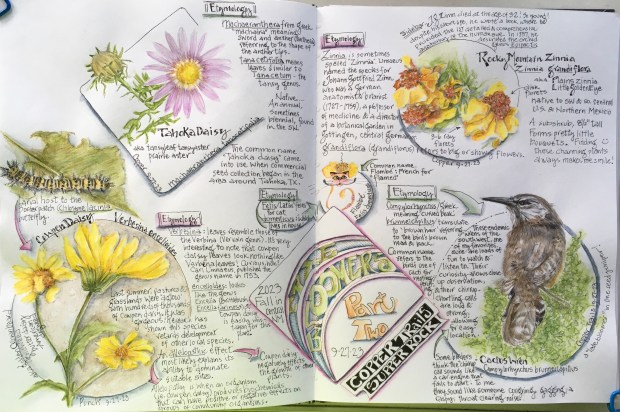
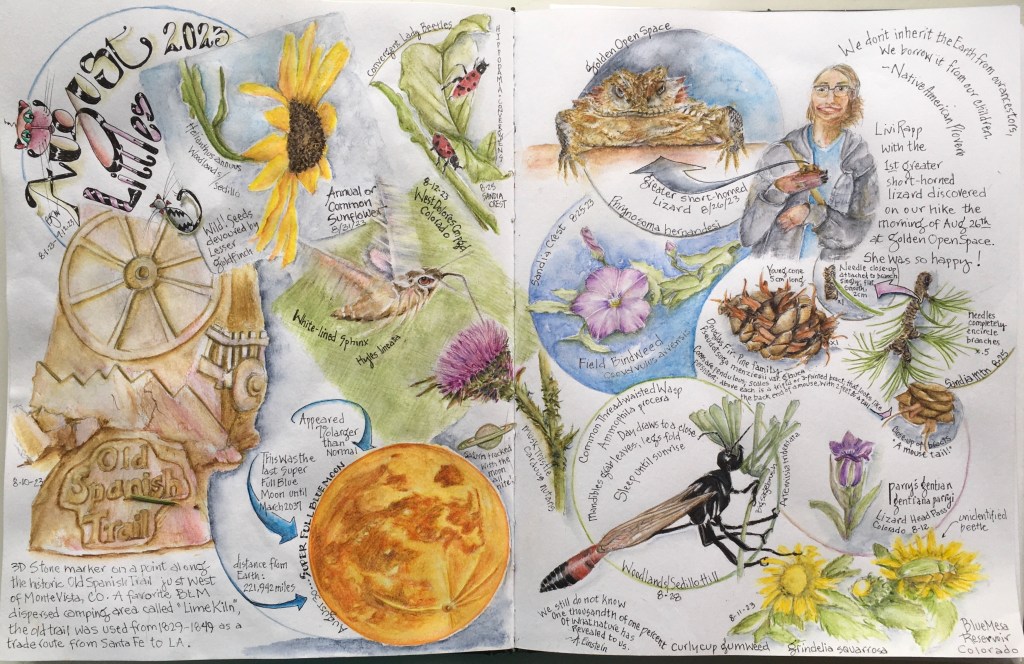
August “Littles” …. Horned lizards and Sphinx moths, a sleepy wasp under the Super Full Blue Moon, and nature through the eyes of a 15 year old!

Two-page spread for August Littles

August was a busy month, filled with high elevation camping in Colorado, and a lot of cool mountain hiking back home. Even though the lower elevations took on a hot and parched look, at 9,000 feet and higher the wildflower season was far from over as evidenced along roadways and trails, where fresh, colorful blooms could still be found.

The highlight of the month was a 3-1/2 day visit from my brother Bob and grandniece Livi. At 15 years of age, Livi is already a fine artist, and took to nature journaling like a pro! It was great fun discovering and sketching nature on our daily hikes. She even got a chance to hold one of the adult ornate short-horned lizards we see frequently along various trails, and then found a baby lizard on her own, hiding nearly motionless under a small plant. Her smiles were priceless!

Despite the high temps, it was a month of good days and nights, ending perfectly with the rising of a rare Super Full Blue Moon! If you missed it, there’s plenty of time to prepare for the next …… which occurs in March 2037.

Once again, a big shout-out to “Made by Fay” for the inspiring “Littles” idea! These pages are fun to create, and remind me of monthly highlights as I revisit my previous “Littles” posts. Hope you’re enjoying them too, along with the ending days of the season.
Stay tuned for the next installment of “Littles.” 

September 14, 2023

Fading Flowers Reveal Leafy Greens ….. Cedro Creek

July 14, 2023

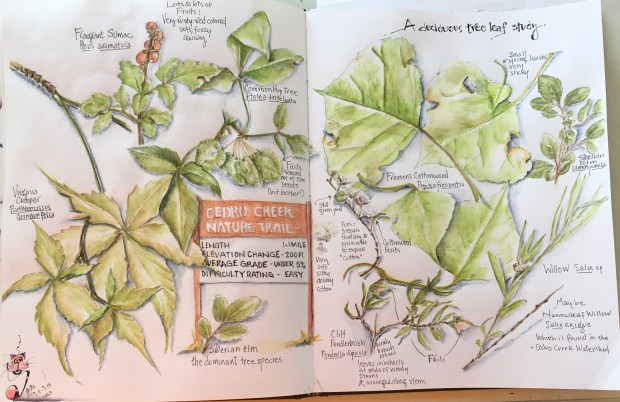
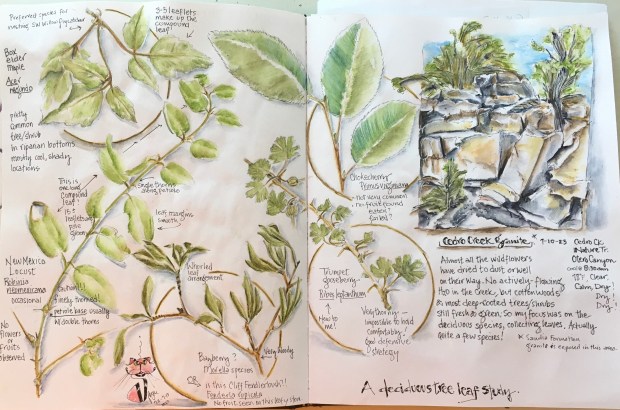
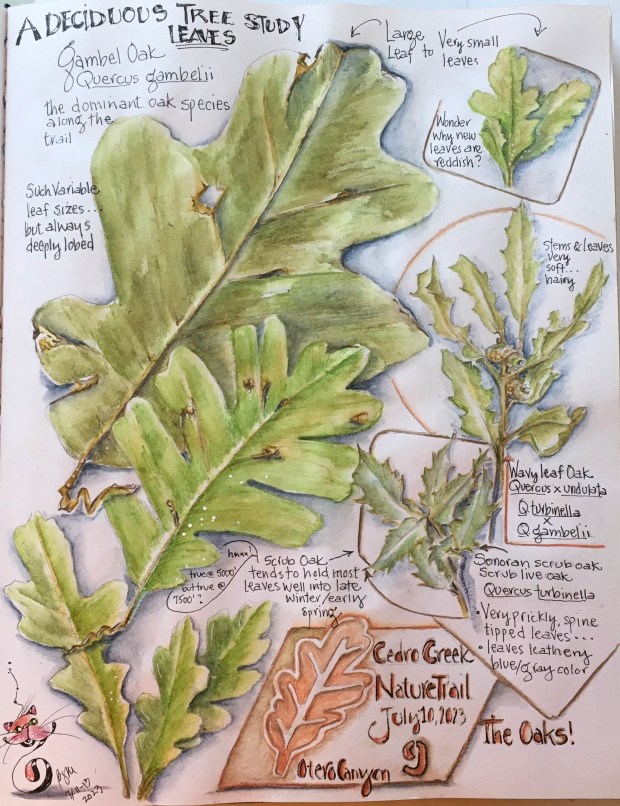
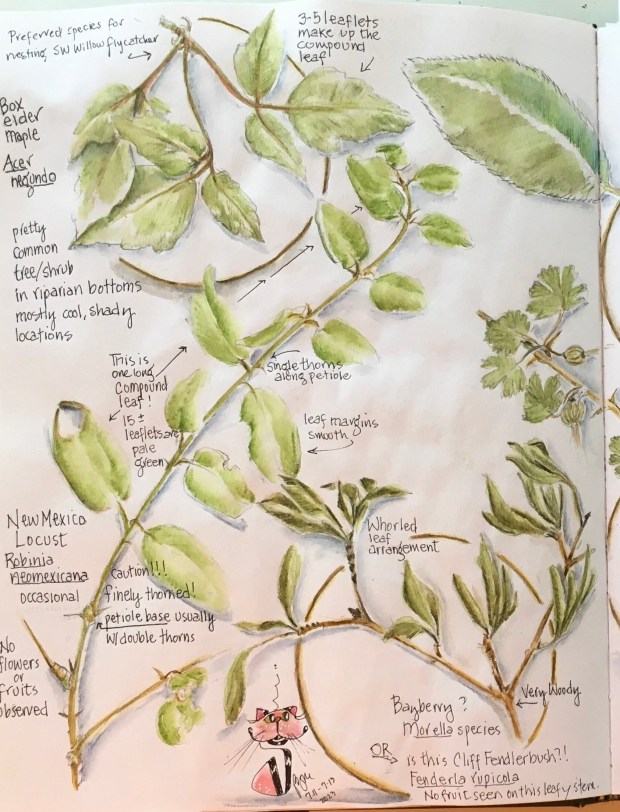
Learning the deciduous Trees and Shrubs shading Cedro Creek Nature Trail ….. Grab n Go Nature Journaling

The timing and location of our daily hikes are being influenced by the extreme summer temperatures we’re experiencing throughout central New Mexico, and throughout the desert southwest. Whew! Even at 7300-8300’ elevation, 95-100F has become the norm, with no relief (or moisture) in sight.  I don’t even want to think about Albuquerque temperatures; over 100F before noon, and soaring. 

Because hiking in the Albuquerque foothills, at any time of the day, is out of the question, we’ve begun revisiting some our favorite mountain trails. But even tho these areas are higher in elevation, and shadier, it’s still plenty hot. That means if we set out between 7-8am, we can still manage a few miles before our water, like all the creeks, runs dry. 

A few mornings ago, we decided to hike Cedro Creek Nature Trail, a rocky but easy dirt path under the shade of big cottonwoods. Expecting to find some water in the creek (there was none), I was hoping to find some interesting wildflowers (which had all withered and dried). The further along the trail we hiked, my focus quickly changed from wildflowers to other natural elements. 

Geology is always interesting in these mountain drainages, and Cedro Creek is no exception. The overlying shales and limestones have long ago eroded to reveal large granite boulders that showed signs of erosion from long ago flowing water. That’s a nice thought!

And then there were so many varieties of deciduous trees and shrubs; their leafy greens not only provided relief from the heat, but became a visual treat as we explored the riparian areas alongside the dry creek bed. 

As my curiosity about the diversity of tree and shrub species began to grow, so did the air temperature. Not wanting to become reduced to a sweaty puddle in the middle of the trail, and sensing a swarm of drooling, biting gnats and flies giving me a hungry eye, I resorted to collecting leaf and branch samples using a Grab n Go technique. By the time we got back to the car, I had 3 large ziplocks stuffed with over a dozen species of tree and shrub leaves and some fruits.  

Back at home, in the comfort of my cool studio, I began my detailed study of these leaves (and the few bugs that managed to hitch a ride). Three days and several gallons of iced tea later, I had completed the 5 journal pages in this post.  

That iced tea was deliciously cool, but not as cool as learning what’s growing overhead along Cedro Creek!

Until next time ……. be curious

A “Snow White” Spring Super Bloom … Albuquerque Foothills

April 2023

Oh my goodness! What a brilliant Spring Super Bloom is on display mere steps east of Albuquerque. 

Alas, I found myself lamenting for months over the long and snowy wet winter we just climbed out of here in the East Mountains of central New Mexico. It seemed the back-to-back snowstorms since last November were never ending; snow shoveling every morning became the norm. But I know better than to whine. An abundance of winter moisture always results in a spectacular abundance of spring flowers.  And this Spring has proven that true.

Scrambled Eggs

The last two months we’ve seen a mad splash of sunshine yellow from the blooming of a native winter annual called Golden Corydalis, aka Scrambled Eggs (Corydalis aurea). This member of the poppy family quickly converted the dusty hillsides from brown to a glowing yellow as the many-flowered stalks of this plant seemed to shoot up over last season’s dried grasses. Scrambled Eggs was the plant I thought would be our Spring super bloomer.  

But, oh no!

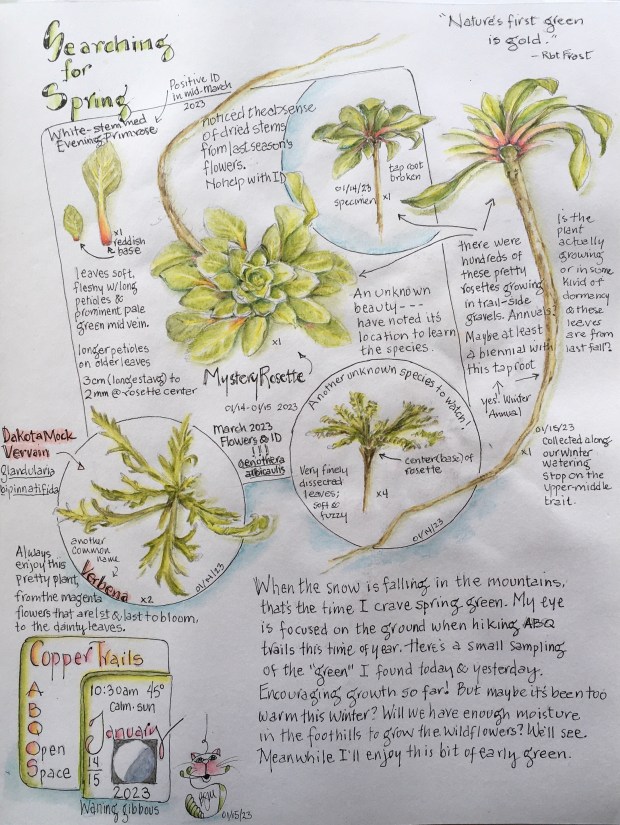
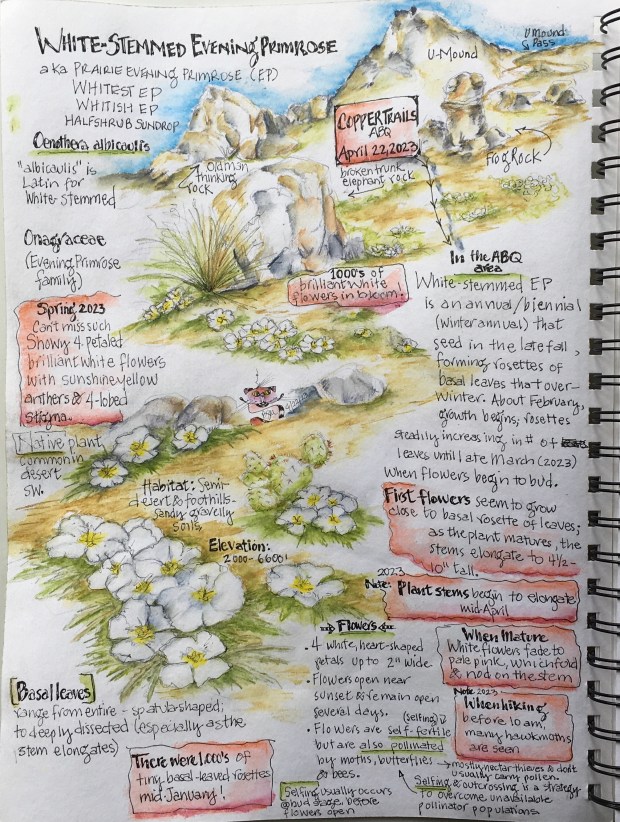
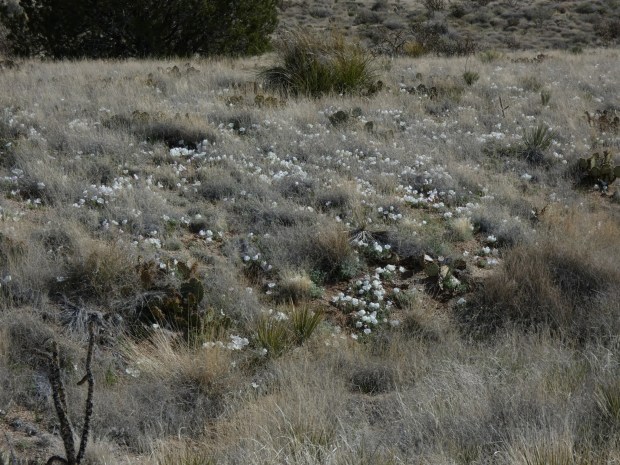
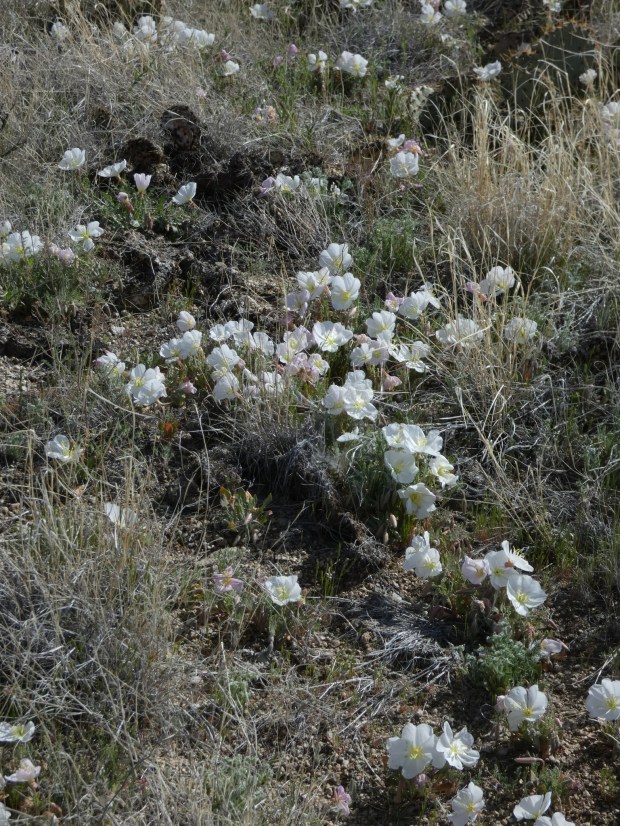
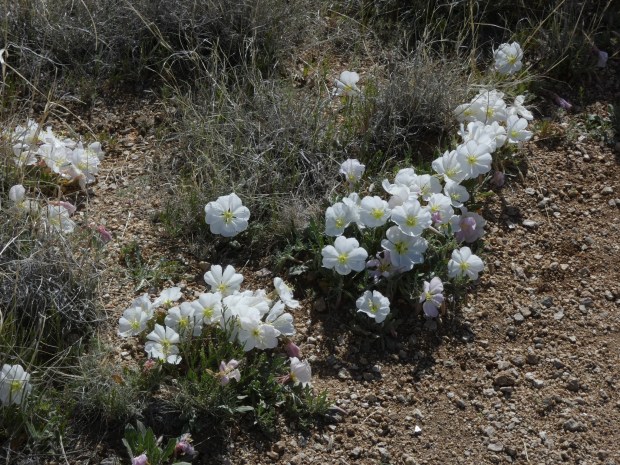
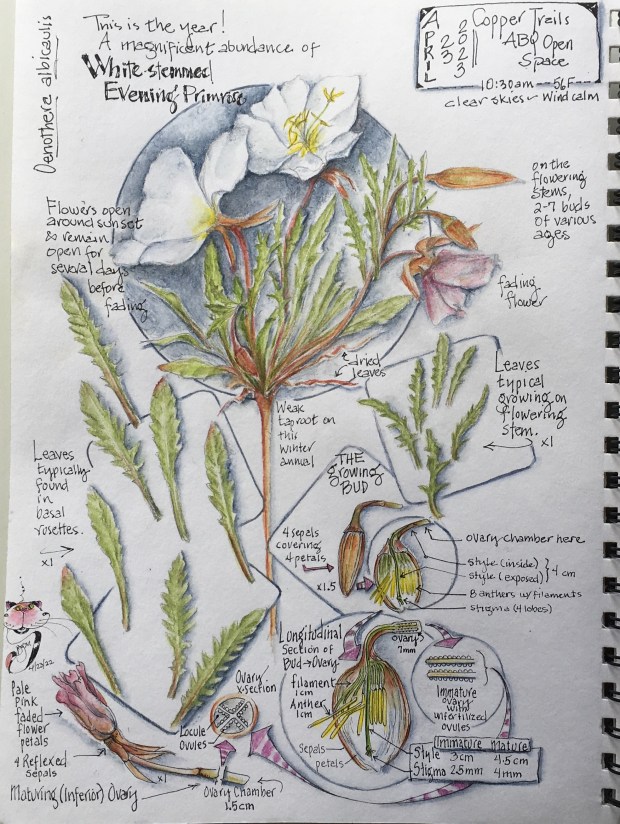
During a full two weeks of being distracted by the glow of all that yellow, all around our feet, 1,000s and 1,000s of blue-gray-green rosettes began to grow. I noticed these rosettes (the very same mystery rosettes I described in my January journal), were rapidly expanding outward to make room for flower stalks heavily laden with little rosy orange buds. And then one day one of those buds unfurled into a brilliantly white 4-petaled flower.  In the center of that flower were 8 lemon-yellow pollen-heavy anthers surrounding a 4-fingered lemon-yellow stigma, ripe for pollination. Of course …… now I knew with certainty ….. the flower blooming atop the pretty winter rosettes is the White-stemmed Evening Primrose (Oenothera albicaulis)!

One of my January posts included this page where I illustrated a mystery rosette (top center) that seemed to be everywhere.

Also known as Whitest Evening Primrose, it wasn’t long until more flowers began to appear. “But, wow, was it possible that all those 1,000s and 1,000s of rosettes would each produce a bouquet of flowers?” Hiking these foothills every day paid of.  As the excitement of possibility steadily unfolded, hundreds of thousands of large 2-4” white flowers unfurled each evening about sunset to greet potential overnight pollinators, and to welcome hikers the following morning. 

My journal page illustrating the abundance of white-stemmed evening primrose
A vista of white
white-stemmed evening primrose

In about a week since I noticed that first open flower, this native Evening Primrose was carpeting the hillsides in white as brilliant and sparkly as newly fallen snow. The ground became “Snow White” with flowers, out-performing the still profusely-blooming Scrambled Eggs. 

white-stemmed evening primrose

And the show won’t end any time soon …. there are still an unbelievable number of White-stemmed Evening Primrose buds awaiting their turn to enter the play from stage right! Now that’s what I call a true Spring Super Bloomer.

A detailed page of my dissection of white-stemmed evening primrose

What marvelous transformations have or are happening outside your world this Spring? 

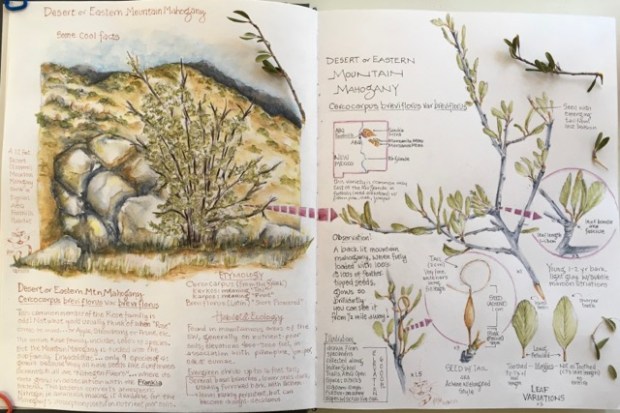
Intermission: Meet an Odd Member of the Rose Family …. The Desert (Eastern) Mountain Mahogany

2 page journal spread

February 8, 2023

The Desert (Eastern) Mountain Mahogany is a very branchy shrub commonly found in the mid-elevation foothills of the Sandia, Manzanita, and Manzano Mountains east of the Rio Grande River in central New Mexico. This species’ formal and very appropriate name, Cercocarpus breviflorus variety breviflorus, comes from both Greek (kerkos: tail; karpos: fruit) and Latin (brevi: short; florus: flowered). As a matter of fact, the 9 species of the genus Cercocarpus all have long feathery tails that twist and turn from the tip of a single fruit, called an achene (like a sunflower seed). 

So why is this species odd? 

Well, the fruit, for one reason. Most of the thousands of rose family members have fruits called a hip (rose), pome (apple), drupe (prune), or aggregate (strawberry). And even though the strawberry is composed of numerous miniature achenes, it’s the single achene found in the mountain mahoganies that’s unusual to the family. 

To further emphasize the oddness of the Cercocarpus genera, all of its 9 species has a symbiotic relationship with a bacteria called Frankia.  And that’s an unusual characteristic of the rose family, which moved Cercocarpus and 4 other genera into the subfamily Dryadoideae. That’s all a bit technical when it comes to plant classification, and kind of skips the real reason why the Frankia bacteria is important to the survival of Desert Mountain Mahogany. Nitrogen Fixation!

Read on to learn more …..

Continue reading “Intermission: Meet an Odd Member of the Rose Family …. The Desert (Eastern) Mountain Mahogany”

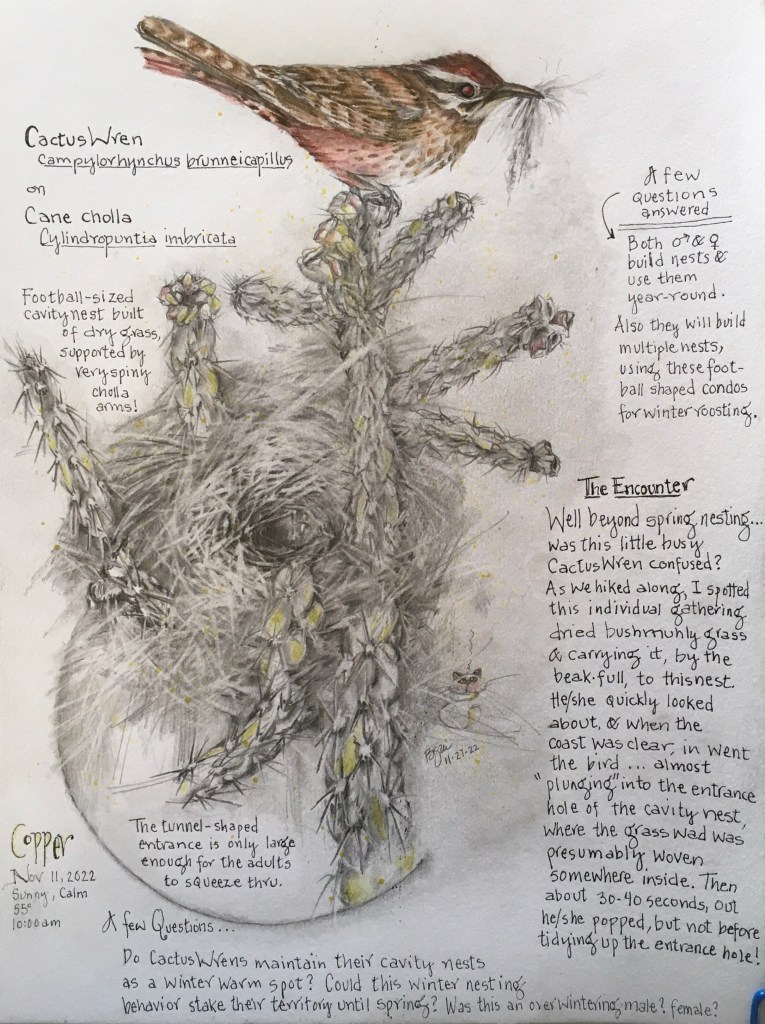
A Prickly Situation ….. A Renovating Wren

For years we’ve hiked (carefully) past hundreds of stately cane chollas, many with what looks like wads of dried grasses caught tightly in and around the numerous spindly and haphazard arms that grow all over this desert cactus. On closer examination, we’ve discovered the cholla does not actually capture grasses blowing in the wind.  Instead, an industrious and very chatty little bird collects great quantities of dried grass to build a football-sized cavity nest woven protectively and securely on and between    the many arms of a cholla. 

Meet the Cactus Wren.  

Full journal page

Once you’ve heard this gregarious wren chatter and sputter hilariously, you’ll never forget it’s call! As we were walking along the trail one day, I instantly recognized a wildly vocalizing cactus wren. Scanning the skyline (because I know they also love rattling from a perch), he readily showed himself, and did not shy away as I approached. He was calling from the highest (10 feet) arm of a pretty stout cholla, and then quickly jumped down into the center of the branches to inspect an old nest.

This nest may have been old, but apparently this little guy felt a facelift was in order and began tidying up the tunnel-like entrance. He then collected a wad of grasses he’d plucked from the entrance and plunged himself down the tunnel, grasses included! What? What was this crazy bird doing …… nest building?

Turns out cactus wrens build several nests in the spring within their territory, and maintain them year-round. I have to believe they use their nests throughout the cold winter months to keep warm, and it looked like this guy was fixing up the interior of this particular nest with super soft bushmuhly grass stems. I would’ve loved an invitation to peek inside, but hiked on, leaving the cactus wren to his chores.

I’ve been by this nest several times in the past few weeks, hoping to catch the wren at home, but to no avail. Maybe he’s tending another nest somewhere else, as this one is in disarray. 

The Sketch
My sketch, mostly from memory, was done all in graphite using the “subtractive” technique. I don’t usually sketch in his manner, because it can get quite messy ….. laying graphite down then using my mono zero eraser to create the image …. but it was an effective way to illustrate the complexity of the nest and so many cholla spines.  Let me know what you think!

November 27, 2022