Up Close and Conversational .. ‘Glorieta’ Southwestern Orangetip Butterfly

April 2, 2025

New Mexico Orangetip butterflies

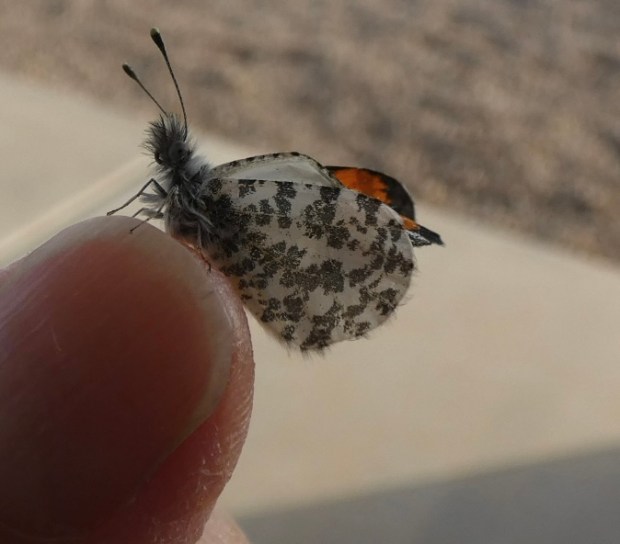
The ‘Glorieta’ Southwestern Orangetip (Anthocharis thoosa ssp coriande), are only known to occur in the central and north central counties of New Mexico. This recently recognized form of A. thoosa was described by M. Fisher and Scott in 2008, from specimens collected near Glorieta Pass southeast of Santa Fe1 (which just northeast of our home).

The Orangetips are classified in the Family Pieridae/Subfamily Pierinae ….. commonly called the Whites. In NM there are 16 known species of Whites, including the non-native European Cabbage White.  After a wet winter, plentiful males compete for hilltop display locations while females search surrounding areas for the choicest of native plants in the mustard family (Brassicaceae) on which to lay their eggs. When the eggs hatch, the larvae (caterpillars) voraciously devour the leaves of their host mustard plants, until they’ve grown to over 1,000 times in size!  Because this family of butterflies is common in desert habitats, to withstand drought conditions some species have the ability to suspend development during their pupal stage (when they are in their chrysalis), a mechanism called pupal diapause. And if winter rains do not cause favorable conditions for their larval hosts (the mustard plants), they can remain in pupal diapause for several years.   

The White’s preference for mustard plants may not be about taste. It’s thought that chemicals contained in these host plants make butterflies in this group unpalatable. Entomologist, “Mike Toliver has witnessed only one attack by a bird on members of this group in more than 60 years of observation.”1

1https://peecnature.org/butterflies-of-new-mexico/whites-pieridae-pierinae/

A Very Close Encounter

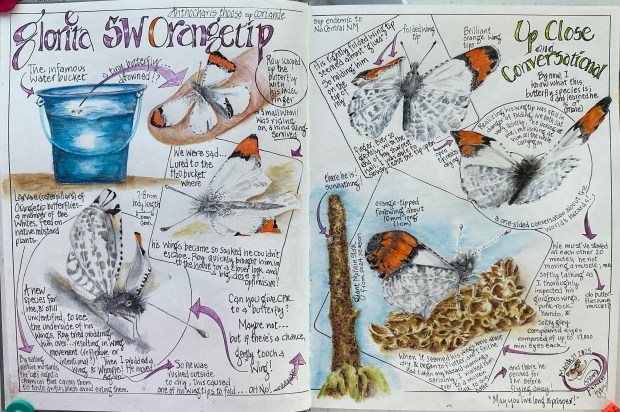
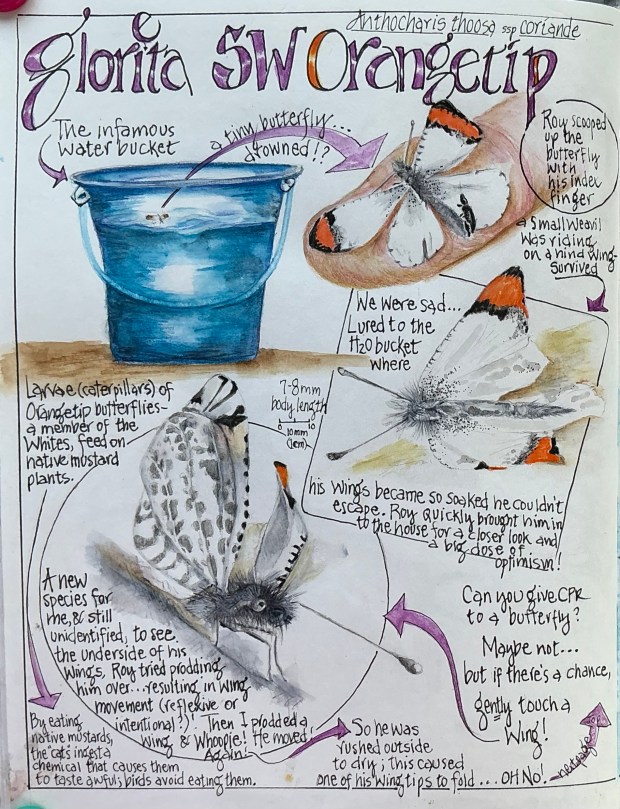
Early one morning (a few days ago), Roy discovered a miniature butterfly afloat, upside down, in a water bucket left outside overnight. Looking very drowned, Roy scooped him up with the tip of his index finger and brought him inside the house for my inspection. Excited and sad all at once, I snapped a few photos, having never seen this species before.  Because this little guy had such striking marks and color, finding him in the online New Mexico butterfly field guide was easy.  This beauty was a ‘Glorieta’ Southwestern Orangetip (Anthocharis thoosa ssp coriande)!

Roy was about to turn him over to take a look at the flip side when one of the wings fluttered a bit. Not believing our eyes, I gently prodded him, and sure enough! He seemed alive! But just how much alive we didn’t know.

Rushing this tiny guy outside where his wings might dry, he slowly became more active. Unfortunately the tip of a still damp forewing folded over and stuck like glue making it impossible to synchronize those wings  …. he didn’t seem remotely interested in taking flight. Not to be defeated, he then crawled up to the tip of my pinky finger, looked me in the eyes, raised one of his six legs politely asking for help. Gathering my courage and willing any clumsiness ‘be gone’ from my fingers, I held my breath while using the edge of my longest fingernail to slowly and carefully separate the fold. Taking my time to tease up the delicate tip millimeter by millimeter, this butterfly never moved a muscle (do butterflies have muscles?). After what seemed like hours the wing unfolded, popping back into alignment without any apparent damage! 

“The Talk”

He didn’t fly tho, so I sat with him for about 20 minutes as he perched on my finger. During my ultra close inspection of his eyes (you know I love eyes, and his were sultry grey and gorgeous), punk-rock style hairdo, and brilliant orange tipped wings, he seemed content while I carried on a lengthy one-sided conversation warning him of the world’s dangers. 

Somewhat convinced he believed and would abide by my every word, I walked him over to a large mullein stalk, where he walked off my finger to enjoy a sunbath (hopefully to prepare to take wing). He wasn’t in much of a hurry tho. About an hour later and checking to see if the coast was clear, off he flew.  That beautiful Glorieta Southwestern Orangetip butterfly was free!

All-in-all, it was an exciting encounter! 

What exciting encounters are you experiencing during this change of seasons? 

As always, thanks for stopping by!

Welcome New and Returning Subscribers

Many Hearty Thanks, Sharing Creative Ideas, Answering the ‘Kat’ Kwestion

April 1, 2025

Completing my 15th sketchbook, and beginning the next one is always cause for celebration!  To do so, Kat and I thought it would be especially fitting to shout-from-the-treetops enthusiastically, THANK YOU! Thank you all, my loyal subscribers, for coming along on my interesting, hopefully educational, sometimes crazy, always curious nature journaling adventure. 

Zentangle patterns used: LoveBuzz, Membranart, Frostz, Chatoo, Sea Urchin, Toku, Rosie, Calibree

My recent webinar class, “Create a Colorful Reptile Eye1,” sponsored by Host Karen Abend (of Sketchbook Revival fame), generated many new subscribers to my web page and blog, “A Curious Nature.” Wow! And Thanks so much. A special thanks to those who attended the live and/or recorded class. I loved seeing so many colorful lizard eyes (a sampling below). They were incredible! 

Sharing the Wonder of Nature

With all the past and current activity on my blog, I feel so fortunate and very encouraged to carry on. Even though new postings have been random lately, there’s lots of works-in-progress soon to be shared. Meanwhile, comments including what you like about my posts and what you’d like to see more of, are always appreciated.  What inspired you to subscribe to this blog? If it’s just enjoy, that’s perfect! Or maybe you’d like tips to develop a regular or even a daily creative practice, how can I be more encouraging? I’d love to know if you are an active nature journaler or tangler, or express yourself by creating art in other ways, such as through music, poetry, or storytelling. Send me your ideas by commenting on this or any future posts. I’ve created my webpage and blog because of my insatiable curiosity about the natural world. It’s extraordinarily fun to go beyond learning what the names of flowers, animals, rocks, and clouds are. The excitement of wondering and discovering answers for all the why’s, who’s, when’s, and how’s is so rewarding. Sharing is my joy!

Explaining Kat

Thinking new subscribers may be puzzled by my constantly mentioning Flambé or Kat or both, now might be a good time for explanation and background (and perhaps provide a refresher for those who’ve been following along from day 1 of my blog):

In 2014, a young stray calico cat showed up one day on our doorstep when we (Roy and I) lived in Oriental, North Carolina (U.S.A.). This little wild miss seemed to magically appear from our backyard woods, perhaps in search of a meal or a friend. She sat and meowed for a few minutes, but when we opened the door, she ran away.  Efforts to get close to her when she returned several times during the week were futile. Then one day she vanished and never returned. Not knowing what may have happened to this pretty kitty, Roy thought a nice remembrance of her visit would be to add a small cat sketch to my next drawing. A dandy idea!“But only one drawing,” I thought? It was at that moment that Flambé appeared on my creative doorstep, and has never left!

Flambé, aka Kat, is always smiling, popping in and out of all my art, regardless if the piece is imaginatively & whimsically tangled or a serious nature study. Along with forming the best part of my signature “chop,” she’s the heroine of some pretty wild and crazy tangled misadventures, sometimes pushing Kat’s 9-lives threshold to satisfy her insatiably curious nature (and appetite). Flambé adores being noticed, whether she hides inside the story, or shows up front and center. She makes everything creative more fun.  Flambé may be just “Kat,” but she’s my inspiration for and reminder about the value of komic relief, and makes the perfect konstant kompanion!  

Whew! That’s all for now. Hopefully your questions about this blog, inspiration and Kat have been answered. If you’re craving to learn answers to other related topics, let me know.  Meanwhile, Flambé and I wish you an exciting and creative remainder of the year ….. have times full of happiness, creativity, and memorable adventures, but most of all laughter and fun!

Hope to hear from you soon, and as always, thanks for stopping by!   

Meow!

1Unfortunately, the class or recording are no longer available for viewing. But I may have another live demo class some day in the future.  If so, you can be sure the announcement will show up on my blog.

Happy International Day of Happiness

March 20, 2025

Every year on March 20th, the International Day of Happiness is celebrated by promoting the idea that part of humanity’s progress should include how to increase happiness and wellbeing. Wow! What a great idea. 

Just where did this great idea come from?

The year was 2011.  The members of the UN General Assembly collectively brainstormed ideas on how to recognize happiness as a fundamental human goal. From these exciting talks a resolution was born, calling for a more inclusive and balanced approach to economic growth promoting happiness as an essential part of progress.

The following year (2012) the General Assembly held the very first UN Conference on Happiness. From this event another resolution was adopted declaring International Happiness Day be celebrated annually on March 20th.

Inspired to find ways of enhancing human progress through happiness, in 2013 the world celebrated the first ever International Day of Happiness! 😃

Zentangle patterns used: Ailux, Bzings, Adobe, FloralySs, Bunnyline, N’Zeppel 

What is this thing called Happiness? 

The “pursuit of happiness,” a phrase found in the Declaration of Independence, is an ideal upon which America is based. Merriam-Webster defines happiness as having “a sense of well-being, joy, or contentment. When people are successful, or safe, or lucky, they feel happiness.” But reasons for feeling happy vary from person to person.  Are you happy when delighted or glad?   Do you experience happiness when sipping a cup of good coffee or tea? What about when your dog greets you at the door after a long day, or when your cat purrs in your face …. do these signs of affection make you happy? 

Research has shown people feel happy if they have good quality relationships, are passionate about their job and/or hobbies, and by helping others through volunteer work or random acts of kindness. Other factors influencing happiness might include your overall satisfaction with life, your mood at the moment, and your ability to meet basic needs related to health, work, and finances  (although having extra money does not necessarily make people happier).

Have you ever considered what things in life make you happy? Do these things just seem to happen randomly or do you intentionally seek out ways to experience happiness? Have you taken the pulse of your happiness meter lately? 

When there are large numbers of happy people, it can make communities and even entire countries happier places to live. Some of the happiest countries in the world include Finland, Denmark, Norway, and Iceland. Switzerland, New Zealand, Canada, and Australia also rank in the top 10 for the happiest countries. The United States ranked 19th.

Prismacolor pencil colors used: white, cream, yellowed-orange, goldenrod, crimson lake, dahlia purple, mulberry, violet, violet blue, non-photo blue, true blue, peacock blue, apple green, peacock green. Inking created with Sakura Pigma Micron archival ink pen, size 01.

Looking for ways to observe this year’s International Day of Happiness? 

If the daily grind, never ending politics, or hearing about or even experiencing one natural disaster after another have got you down, I know the feeling. It’s high time to regain control of our inner selves and set free the happiness within. It may not be easy, but what better day to take on this challenge than March 20th, the official International Day of Happiness!

How to start? There’s probably as many ways to promote, create and achieve happiness as there are people in this world. If you already know what to do, great! But if you’re seeking ways to become a happier person and share your happiness with others, here’s some ideas I thought make good sense: 

To become a happier you:  Be kind to yourself, not overly self-critical or perfectionistic. Really savor your life experiences because this will intensify and prolong their enjoyment. Set meaningful goals for yourself that provide structure and purpose, give a sense of identity and increase self-esteem. Seek healthy challenges, stretching your abilities just a bit beyond your comfort zone to realize your potential. Build intrinsic motivation, rather than just relying upon doing things to please others. (‘Intrinsic motivation’ refers to the drive to engage in activities that are inherently interesting or enjoyable without external incentives or rewards.) Practice gratitude. Appreciate and make note of all the ‘ups’ (the good things) in your life rather than focusing only on the ‘downs’ or what you still desire. Be a problem-solver; avoid the temptation to vent, complain and reinforce negativity; instead, cultivate optimism and practice positivity regardless of circumstances. And last but not least, engage in random acts of kindness.

To promote happiness in others:  Take time to build and improve the quality of relationships with supportive people. Respond actively and constructively, celebrating when others share good news. Listen to others with 100% of your attention. Practice mindfulness, compassion and empathy. Maybe you can volunteer or help someone in need. And this is worth repeating ….. Take time to engage in random acts of kindness.

*************************************

For far too long, progress in the world has been all about the economy. But more people are realizing that happiness is also an essential part of progress. And come to find out, Flambé agrees! Especially when she can improve her relationships with the birds, bunnies, fish and frogs. Now if I can only teach her to sing instead of all that katter-walling she seems so fond of! Guess I’d better brush up on my constructive criticism? Hahahaha-Lalalalalalala-Hahahahaha!

Whatever you do on this day (and into the future), be sure to spread the happiness!

And as always, thanks for stopping by!

From Seed to Tree: The Irresistible Urge to Grow

A Pinyon Pine/Piñon Seed Update

February 7, 2025

Give a seed the right conditions ……. enough water, sunlight, the perfect temperature ….. and this small package cannot resist emerging from its protective coat to grow into a full grown plant.

Seeds are tiny marvels of nature. 

Looking inside the seed reveals a miniature pine tree!

Think about it ……. a seed is really a living baby plant (the embryo) surrounded by a cozy blanket (the endosperm) that cradles and nourishes the embryo while tucked inside the seed coat. When the coat unzips, freeing the “baby” as it begins to grow, it continues to be nourished by the endosperm until the first true leaves appear. Witnessing the process is so cool!

After collecting piñon seeds from last November’s foraging expedition, (Piñon or Pinyon, Piñon Seed or Pine Nut), we decided to treat a dozen or so to conditions just right to stimulate germination. But first the seeds required a short period of stratification (moisture) to help soften and crack the seed coats. Introducing moisture was done by lining a clear glass jar with damp paper towels and placing the seeds between the towels and glass to watch the action.

Post from November 2024 Seed Foraging Expedition

Soon embryonic roots (the radicles) successfully cracked the seed coats of nine seeds and began growing downward, as roots tend to do. In a week or so, before the embryonic leaves (cotyledons) appeared, all of the germinating embryos were planted. Six of the nine then sprouted their whorled cotyledons, followed by a growth spurt of the first true leaves, initiating the process of food manufacturing (photosynthesis). 

Steps to Germination

All of the germination and seedling development details of these piñon seeds, to date, can be found in my update illustrations. 

Seed germination is a fascinating process, and like the seed itself, is also a marvel of nature. Have you ever tried to germinate a seed? If not, give it a go.  It’s fun, educational, and imagination provoking ….. from such a small seed comes a full-grown flowering plant!

The evidence!

As always, thanks for stopping by!

Winter Botany: Horsetail Milkweed

February 1, 2025

Wandering about the neighborhood one warm summer morning in 2018, I noticed a dense stand of plants lining a 20 foot section of road. What caught my eye were the umbrella-like clusters of pearly white flowers topping each slender stem. From a distance these plants resembled our native white-flowering yarrow. But I soon realized the narrow dark green leaves were not fuzzy; the tiny exotic-looking flowers were not daisy shaped. Unmistakably, this plant was a species of milkweed! And the flowers of more than 50 individual plants in this population were a-flutter and a-buzz and a-crawling with hungry insects!
What was this milkweed species?

This is the Winter Botany portion of this post. All that remains of last summer’s Horsetail Milkweed are stems and mostly empty seed pods clinging to short branches. But some of the seed pods still hold silky tailed seeds clinging to their open pods. Hundreds of seed pods line the roadways in our neighborhood.

It didn’t take long to confirm this plant as Horsetail Milkweed (Asclepias subverticillata), a species commonly found along roadsides in pinyon-juniper woodlands. Knowing what to look for on future walks, over the next several years I was excited to find 30+ more populations of various sizes along neighborhood roadways! From 2018 until early summer 2024, I continued to monitor these seemingly abundant populations. The small numbers of seeds I collected in the Fall were planted in our yard, and every year I checked for the presence, variety and numbers of insects busy feeding on nectar as they pollinated the flowers.  

During June 2024, when we moved only a few miles to the northeast, I was happy to see Horsetail Milkweed grew abundantly in our new subdivision. This prompted me to dig deeper into researching this species. Its been exciting to discover how important this milkweed is to native insects, including monarch and queen butterflies.

Photo (mine) taken in July 2022 of a blooming Horsetail Milkweed being enjoyed by a feeding wasp.

According to pollination ecologists, Horsetail Milkweed is especially valuable to large numbers of native bees. This plant species also supports conservation biological control by attracting predatory or parasitoid insects that prey upon pest insects. 

And Horsetail Milkweed is one of the favorite host plants for monarch and queen butterflies, all because it’s toxic!  Producing an especially nasty tasting and potent neurotoxin strong enough to kill livestock, the caterpillars of these two butterflies have evolved to benefit from such a poisonous substance. Voraciously ingesting a diet of only milkweed leaves, obviously tasty to the larvae, makes them unpalatable to would-be predators, such as birds. The toxin from milkweed leaves has become their primary means of defense; definitely a benefit for such chubby, slow little caterpillars.

Monarch caterpillar (source: open commons)

Although central New Mexico isn’t in any of the major migratory routes of these butterflies, I have observed both species in our previous neighborhood. Since learning more about Horsetail Milkweed and it’s favored roadside habitat close to home, my hope is to provide actively growing plants throughout the summer (a safe distance away from roadside easements) for both the monarch and queen adult butterflies and their caterpillars ……. especially important when governing covenants of our previous and new subdivisions require the roadways be groomed (mowed down like a butch haircut!) on a monthly basis by subdivision landscape crews. 

Because milkweeds are among my favorite of all plant species, mainly due to their complex flowers and the clever trickery they’ve developed to ensure pollination, I wrote about and illustrated two in-depth blog posts on this subject. Believe me when I say,  “It’s overboard fascinating!”

Check out the following posts …..

Surprise! A vine-y, twine-y desert milkweed discovery from July 2024, where I revisit milkweed flower structure and pollination and learn about a new-to-me genus, Funastrum.

Summer Botany: Meet the Milkweeds from July 2022. This is my first comprehensive look at milkweed flower structure, how pollination takes place, and the genus Asclepias.

Read on to learn more botanical information about Horsetail Milkweed AND how to find out if you live in Spring and/or the Fall Migration routes of the monarch butterfly AND where queen butterflies migrate to and from. 

Characteristics and habitat requirements of Horsetail Milkweed

Horsetail Milkweed is a perennial species with a stout, woody rootstock. Plants readily spread by rhizomes (underground stems) producing dense communities. Cold-hardy to at least 0℉, this milkweed bounces right back in the Spring. Plants are also drought-tolerant once established, thriving in well-drained, sandy soil under full to partial sun.

Able to thrive in a variety of habitats and plant communities from 2500 – 8000 feet in elevation, Horsetail Milkweed grows among grasses, on sandy or rocky flats, on slopes, roadsides, and along trails in Chaparral, Semidesert Grasslands, Pinyon-Juniper Woodlands, Montane Conifer Forests, and in disturbed areas.

All of these characteristics and its adaptability to a wide range of habitats make Horsetail Milkweed one of the easiest milkweed species to grow.

Monarch butterfly (source: open commons)

Monarch Butterfly

To learn if you live within the path of or close to spring and/or fall monarch butterfly migration routes, you can view a map or these route here:

https://www.monarchwatch.org/

Queen butterfly (source: open commons)

Queen Butterfly

The queen is chiefly a tropical species. In the US, it is usually confined to the southern portion of the country. It can be found regularly in peninsular Florida and southern Georgia, as well as in the southern portions of Texas, New Mexico, Arizona, and California. Occasionally, the subspecies of the queen can be found somewhat north, in Kansas, Colorado and Utah. 

Queen butterflies do not migrate as dramatically as monarch butterflies, but they do move short distances in tropical regions with dry seasons to higher elevations.

Queen caterpillar (source: open commons)

As always, thanks for stopping by!

Pick Me! Pick Me!

January 20, 2025

Winter can be challenging for nature journalers. Getting outside when it’s cold and windy, cloudy and dreary, snowy, icy or wet, are not ideal weather under any circumstances.  And when everything looks brown and crispy and pretty much the same, the challenge to nature journal in the great outdoors grows exponentially. While these conditions make it difficult for spontaneous observing, I try to remember there’s always something remarkable to be discovered in nature, even in winter.

 Who knew a little whack on the head would be just the thing to reawaken my curiosity?

Bundled in layers, leash in hand, Luna led me on her early morning walk around suburban Albuquerque. Having been along this route before, we’ve both made some interesting discoveries in the past.  And as usual, this time was no exception for Luna. For me though, everything appeared brown, crispy and familiar. But I was inspired by  and enjoying Luna’s sense of curiosity, and her encouraging tug on the leash. 

Nearing the end of our 2-1/2 mile walk, and mightily concerned I’d go home empty handed, we turned our last corner. It wasn’t 100 feet down the cement block-lined sidewalk that I abruptly stopped in my tracks. Something had lightly whacked me in the head! While the sound of rhythmic clacking rang out, I looked up, and to my surprise spotted the accidental assailant. Draped over the 6 foot wall, suspended from a hearty Trumpet Vine (Campsis radicans) growing in the hidden yard beyond was a string of pods resembling brown green beans. Long and plump and full of seeds, one of these pods had reached down low enough to make contact with to my head. (I say “reached” because that’s what my imagination said had happened.) Quickly awaking my sleepwalking brain, the effort made by the seed pod to get my attention paid off too. Silently whispering, “Pick me! Pick me!” it was as if the seed pod and its adjacent buddies either wanted to be harvested, or wanted to be featured in my nature journal (or both). 
So I did ………… both!

I loved learning about and sketching these fascinating Trumpet Vine seed pods, while my mind was filled with the muffled notes of a trumpet. Tooo-too-too-toooooom!

Hope you enjoyed reading this story and browsing around my journal pages.

As always, thanks for stopping by!

The Whimsy of Redefining Heartwood

January 10, 2025

After an unseasonably warm, almost spring-like December in the mountains of central New Mexico, January clearly has something else in mind. Winter! Windy days have resulted in bitter cold as they brought us cloud-cover and a few mini-snowstorms. 

The change in weather and absence of wildlife, combined with an abundance of dried vegetation is making it challenging to find nature journaling subjects. So a few days ago, I followed Luna around to see what was capturing her attention. Turns out burrowing rodents expanding their underground tunnels are leaving behind fresh mounds of soil with fascinating odors (to Luna, at least; I couldn’t smell a thing). 

When one of her explorations led me under a good sized pinyon tree, I noticed a very interesting piece of bark lying on the ground. Turning the piece over and over, examining all the beautiful patterns in the wood, the colors, old bug holes, and woodpecker drillings, I was surprised and delighted to see a good-sized hole in the shape of a perfect Heart! Eureka! 

The 7” piece of pinyon bark …. Can you find the Heart?

Many things crossed my mind in that moment …… but the one word that stuck was “Heartwood!!” Could this small piece of bark redefine the meaning of heartwood? Could this tree have been wearing it’s true emotions on its bark in the form of a heart-shaped window?  

After a refresher on basic tree anatomy, and reconfirming that heartwood surrounds the core of the trunk, my imagination went wild.  Could that heart-shaped hole in the bark been the opening of a mysterious pathway through the inner workings of the tree?!!! If I could’ve returned the piece of bark to the exact place from where it fell, could the heartbeat of the tree be heard? 

My finished pages mostly about Redefining Heartwood, but also featuring the view of South Mountain (to the NE) as seen from our new home (including my studio) and the trail where the “Heartwood” bark was found.

While sketching the piece of bark with its perfectly-shaped heart, I wondered if peering at the inner workings of a tree through this window would make a fun children’s picture book? ….. Where the layers of a trunk and how they work would be experienced first hand by a child walking down the pathway?

After you stop laughing from all this nonsense, let me know what you think?

As always, thanks for stopping by (on my magic carpet ride!)

A Quirk of Nature: Fourwing Saltbush

November 25, 2024

In November 2023, I created a journal page of seeds and seed pods, which posted on 12/14/2023, under the title November Littles: Seeds, Pods, Silk, and Wings. On that page was a small drawing of two Fourwing Saltbush seeds, absent any information about this plant species, Atriplex canescens. At that time I remember finding a wealth of articles and research documents about this widespread shrub, but what really stuck in my mind was a very unusual quirk exhibited by this plant. Finally, a year later and WOW! I discovered Fourwing Saltbush has a reproductive superpower …… this species has the ability to change sex!

An Unusual Quirk

My first dive into the literature revealed that within a 7-year period of time, 40% of a Fourwing population switches sexes with 20% of a population changing sex every year. Botanically, this is known as Trioecious, or the 3rd Sexual State.  

But clearly a bit of back peddling is needed ……. if Trioecious is the 3rd Sexual State in plants, what about the 1st and 2nd sexual states, huh? Yes, they exist …….. but before explaining them, which requires comparison with the more common sexual state in plants, I must describe this sexual norm. 

And now for a little Botany 101 ……..

The Sexual Norm …… Plants with Perfect or Complete Flowers

You are likely familiar with plants like roses, tulips, lilies, garden strawberries, beans, peas and cabbage. If you’ve closely examined their flowers while inhaling their fragrant aromas, you may have noticed their centers have both female and male parts. These are known as plants with Perfect or Complete flowers (aka hermaphroditic or bisexual) defined by each individual flower having a fully functional pistil (the female part) and stamens (the male parts). Worldwide, about 90% of flowering plants have Perfect or Complete flowers.

Monoecious ….. the 1st Sexual State

Here again you are likely familiar with many plant species described as Monoecious (moh-NEE-shuhs). These include corn, all of the plants in the gourd family (i.e. cucumber, squash, watermelon), oak, birch, pine, spruce and dogwood. Monoecious, which means “one house” in Greek, describes plants having separate female and male flowers in different places on the same plant, often blooming at different times. Visualize corn growing in a field; the tassels are the male (staminate) flowers, and the corn kernels you eat are the female (pistillate) flowers.  Around 10% of all flowering plant species worldwide are Monoecious.

Not to confuse the matter, but sometimes botanical experts refer to Monoecious species as Perfect or Complete because they have both male and female flowers on the same plant, even though these flowers are separate and considered sexually Incomplete (aka unisexual) by themselves. 

Dioecious ….. the 2nd Sexual State

A plant species with individual plants in a population having only female flowers, and individual plants of the same species in the same population with only male flowers is called Dioecious (dahy-EE-shuhs). This Greek word meaning “two houses,” describes plants such as spinach, asparagus, sumac, currant, box elder, willow, holly, ginkgo, juniper and aspen. Only 5% of all flowering plant species worldwide are Dioecious.

Another confusing matter once again. There are botanical experts that refer to plant species with Perfect or Complete flowers as Dioecious because they require cross-pollination to produce seeds (fruit). Tree fruit species such as apples, pears, cherries and plums are common examples.

Trioecious ….. the 3rd Sexual State

An extremely rare reproductive strategy among flowering plants, Trioecious (aka trimonoecious or “three houses”), is characterized by a species that can have Incomplete (unisexual) male, Incomplete (unisexual) female, and Perfect or Complete (bisexual or hermaphroditic) male/female flowers on separate plants in a population or even all on the same plant! Just over 3% flowering plant species worldwide are Trioecious (trahy-EE-shuhs).

This is where Fourwing Saltbush (Atriplex canescens) enters the story

Primarily a Dioecious species, some Fourwing Saltbush populations have a Monoecious component ranging from entirely male (staminate) or female (pistillate) individuals to those that are Perfect or Complete (hermaphroditic or bisexual). And in this DioeciousMonoeciousHermaphroditic gender system, referred to as Trioecy, switching sexes occurs. To reiterate from an earlier paragraph, on average, in a 7-year period, about 40% of a Fourwing Saltbush population switches sexes with 20% changing from male to female or from female to male every year.

Reasons Behind and Benefits of Fourwing’s Sex Change Phenomenon

Fourwing Saltbush has evolved to be one of the most adaptable plant species found throughout central and the western US. It grows from sea level to 8500 feet elevation, and in a multitude habitats within a wide range of plant communities, no matter the successional stage. Fourwing can adapt to all soil textures, soil depths and all but the wettest of soil conditions. The species is able to tolerate hot (+100F) and dry (6” precipitation annually) summers, and bitter cold (-50F) and dry winters.  

The ability of the species to adapt to such a wide range of physical and climatic conditions is, in part, due to this sex change phenomenon. Environmental stressors seem to be the major triggers resulting in Fourwing plants switching sexes. Female plants are more likely to change sex than male plants, especially following a drought, an extremely cold winter, or after a heavy fruiting season. Because fourwing is so tasty as range forage, overgrazing can also trigger a sex change, with male plants tending to dominate regularly grazed sites. Male plants that change to female typically flower earlier than plants that remain female season after season. And female plants dominate richer sites than do male plants, becoming larger and producing more seed.

Undoubtably there’s more environmental stressors, such as wildfire and other climate change-induced factors, that may result in Fourwing Saltbush to switch sex. I’ll be curious to learn what they are and how these triggers influence the adaptability and survivability of this robust species.  And I’m excited get busy marking this season’s female and male plants that we see nearly every day, and will begin more closely observing these populations for gender changes and possible stressors that may have triggered these switches. 

A Retrospective and Thoughts on Prospective Studies

There’s so much to learn about Fourwing Saltbush that it seemed logical to tackle one characteristic at a time. Originally I had planned to discuss both the plant’s reproductive quirk and several of its common galls, but found there would be too much information for one post. While deciphering the complexities of the Fourwing’s sex change abilities, I found it necessary to describe certain key botanical terms in my buildup to the crucial piece of the puzzle ….. the Trioecious reproductive strategy.  So this post focused on the first of my two journal pages; my beginning exploration into this plant.  The galls illustrated on my second journal page, that could not be easily chopped away from the first page, serve as a preview of a future post about the fascinating Fourwing Saltbush. 

And Finally ……….

For a shrub I used to describe as a messy tangle of branches haphazardly cloaked with unremarkable features like dusty little grey-green leaves, nearly invisible flowers, shreddy dull grey trunks and a chaotic canopy, Fourwing Saltbush has captured my imagination, respect, and love as an almost invincible survivor of our changing world!

Hopefully you found this interesting and informative. Bet you never look at flowering plants in casual ways again.  Let me know if you are familiar with Fourwing Saltbush. Where does it grow? Have you ever marveled at the thousands of winged seeds densely crowded at the tops of these shrubs?  And then satisfied an irresistible urge to strip dozens of skinny branches of those ripe seeds, tossing them in the air like confetti? If so, please share.

As always, thanks for stopping by!

Nature’s Colorful Fall Patchwork ….. The Beauty of Gambel Oak Leaves

November 12, 2024

It’s late October, mid-Fall in the Manzano Mountains, perhaps a week before the first snow of the season. The Gambel Oak covering hillsides and mountains somehow sense a change in the air.  Seemingly overnight every leaf on every oak shrub and tree magically transformed from their summer greens to royal rusty reds, gleaming golden yellows, and shocking sunset oranges. As I look across the landscape and marvel at the sight, I can’t help wondering, “How do they know?”

The spectacle is short lived. Over the next few weeks, these gorgeously painted leaves slowly change to crispy beige brown, fooling the observer into believing they can’t face another winter; that every single oak shrub and tree just gave up and died! Thinking that was the case my first winter in central New Mexico, I was fooled. But since then I’ve learned a lot about the life cycle of Gambel Oak, and have come to appreciate the persistence of all those crispy browns covering up the otherwise barren nakedness of chaotically jumbled branches. 

There’s a lot that can be said about Gambel Oak (Quercus gambelii), but this post focuses on

The Leaves of Quercus gambelii 

The most interesting thing about this oak species’ leaves is no two are alike. Even though each leaf looks different from its neighbor, they do all have common characteristics that distinguish its leaves from other oak species. For example, All Gambel Oak Leaves …….

  • are lobed (but the number of lobes varies from side-to-side of a leaf’s mid-vein; depth of lobes varies on a single leaf and between leaves; lobes can be gently concave to acutely angled).
  • are flat and leaf margins are smooth (if leaves appear somewhat wavy and/or exhibit some serrated margins and/or points on the lobe tips, this is not a true Q. gambelii, but likely a hybrid of Gambel Oak and Shrub Live Oak (Q. turbinella) resulting in Wavyleaf Oak (Q. undulata), very common where ranges converge). 
  • are different lengths and widths, and leaf sizes are random along each branch, with large leaves adjacent to small ones adjacent to tiny ones adjacent to gigantic ones, etc.
  • change color in the Fall, eventually becoming beige brown and crispy (but color patterns on individual leaves and throughout a shrub/tree are wildly various; some leaves turn one color, while others become a mixture of greens, reds, yellows and/or oranges).
  • that are brown/crispy persist on the shrubs/trees throughout late Fall and Winter, then drop all at the same time in Spring when buds begin to open.
  • that are fresh have little 5-star hairs on the undersides, while the upper surface is smooth and leathery.
  • are relatively free of insect damage, with the exception of the occasional oak gall or insect nibbles (perhaps due to their leathery texture on the upper surface and hairy texture on the undersides?).

Every Fall I observe and collect Gambel Oak leaves. They make great subjects for my nature journal! Because every leaf looks different, the easiest way to depict the various shapes is to trace their outlines directly onto my journal pages. Then with leaves in hand, I can use my Inktense watercolor pencils to paint within the outlines, spending most of my effort on their beautiful colors.

I hope you’ve enjoyed my page of Gambel Oak leaves. Do you share nature with oaks? If so, which species, and are their leaves all the same or different somehow? Do you record your observations in a nature journal too? I’d love to know!

As always, thanks for stopping by!