The ‘Glorieta’ Southwestern Orangetip (Anthocharis thoosa ssp coriande), are only known to occur in the central and north central counties of New Mexico. This recently recognized form of A. thoosa was described by M. Fisher and Scott in 2008, from specimens collected near Glorieta Pass southeast of Santa Fe1 (which just northeast of our home).
The Orangetips are classified in the Family Pieridae/Subfamily Pierinae ….. commonly called the Whites. In NM there are 16 known species of Whites, including the non-native European Cabbage White. After a wet winter, plentiful males compete for hilltop display locations while females search surrounding areas for the choicest of native plants in the mustard family (Brassicaceae) on which to lay their eggs. When the eggs hatch, the larvae (caterpillars) voraciously devour the leaves of their host mustard plants, until they’ve grown to over 1,000 times in size! Because this family of butterflies is common in desert habitats, to withstand drought conditions some species have the ability to suspend development during their pupal stage (when they are in their chrysalis), a mechanism called pupal diapause. And if winter rains do not cause favorable conditions for their larval hosts (the mustard plants), they can remain in pupal diapause for several years.
The White’s preference for mustard plants may not be about taste. It’s thought that chemicals contained in these host plants make butterflies in this group unpalatable. Entomologist, “Mike Toliver has witnessed only one attack by a bird on members of this group in more than 60 years of observation.”1
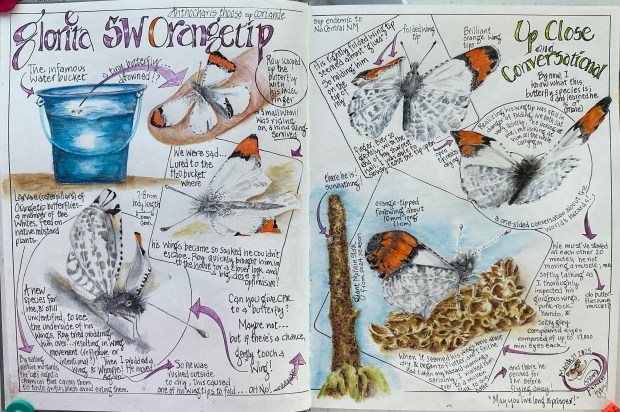
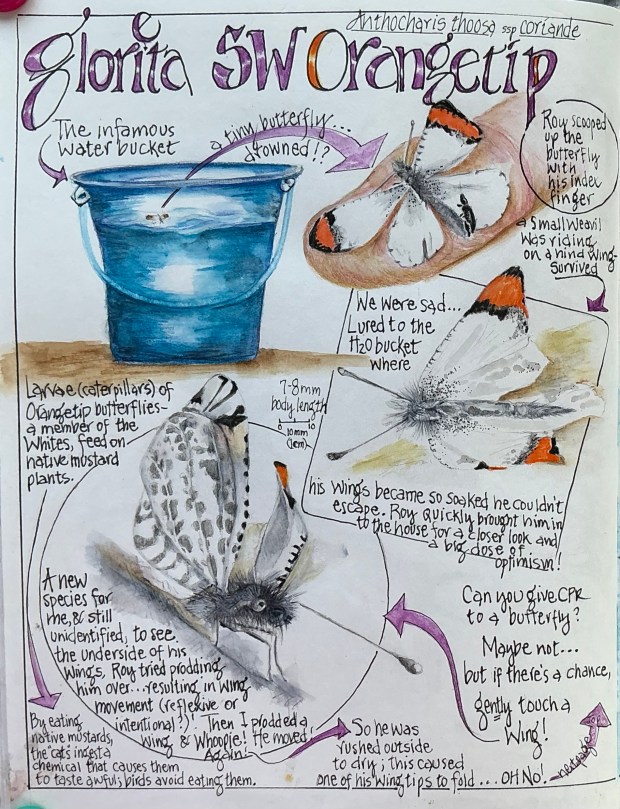
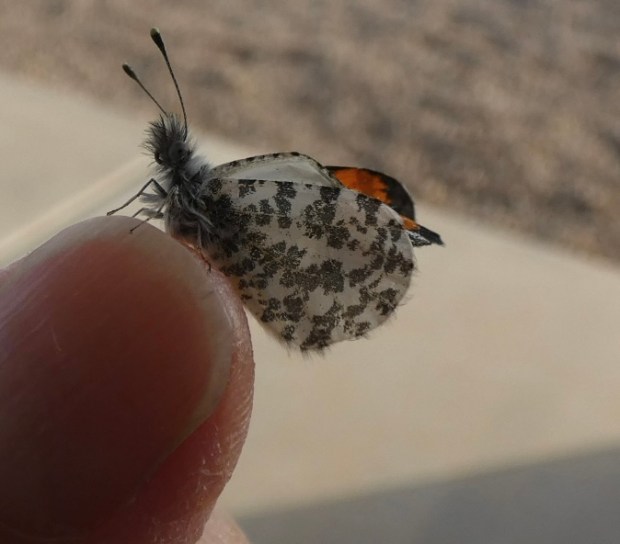
Early one morning (a few days ago), Roy discovered a miniature butterfly afloat, upside down, in a water bucket left outside overnight. Looking very drowned, Roy scooped him up with the tip of his index finger and brought him inside the house for my inspection. Excited and sad all at once, I snapped a few photos, having never seen this species before. Because this little guy had such striking marks and color, finding him in the online New Mexico butterfly field guide was easy. This beauty was a ‘Glorieta’ Southwestern Orangetip (Anthocharis thoosa ssp coriande)!
Roy was about to turn him over to take a look at the flip side when one of the wings fluttered a bit. Not believing our eyes, I gently prodded him, and sure enough! He seemed alive! But just how much alive we didn’t know.
Rushing this tiny guy outside where his wings might dry, he slowly became more active. Unfortunately the tip of a still damp forewing folded over and stuck like glue making it impossible to synchronize those wings …. he didn’t seem remotely interested in taking flight. Not to be defeated, he then crawled up to the tip of my pinky finger, looked me in the eyes, raised one of his six legs politely asking for help. Gathering my courage and willing any clumsiness ‘be gone’ from my fingers, I held my breath while using the edge of my longest fingernail to slowly and carefully separate the fold. Taking my time to tease up the delicate tip millimeter by millimeter, this butterfly never moved a muscle (do butterflies have muscles?). After what seemed like hours the wing unfolded, popping back into alignment without any apparent damage!
“The Talk”
He didn’t fly tho, so I sat with him for about 20 minutes as he perched on my finger. During my ultra close inspection of his eyes (you know I love eyes, and his were sultry grey and gorgeous), punk-rock style hairdo, and brilliant orange tipped wings, he seemed content while I carried on a lengthy one-sided conversation warning him of the world’s dangers.
Somewhat convinced he believed and would abide by my every word, I walked him over to a large mullein stalk, where he walked off my finger to enjoy a sunbath (hopefully to prepare to take wing). He wasn’t in much of a hurry tho. About an hour later and checking to see if the coast was clear, off he flew. That beautiful Glorieta Southwestern Orangetip butterfly was free!
All-in-all, it was an exciting encounter!
What exciting encounters are you experiencing during this change of seasons?
Give a seed the right conditions ……. enough water, sunlight, the perfect temperature ….. and this small package cannot resist emerging from its protective coat to grow into a full grown plant.
Seeds are tiny marvels of nature.
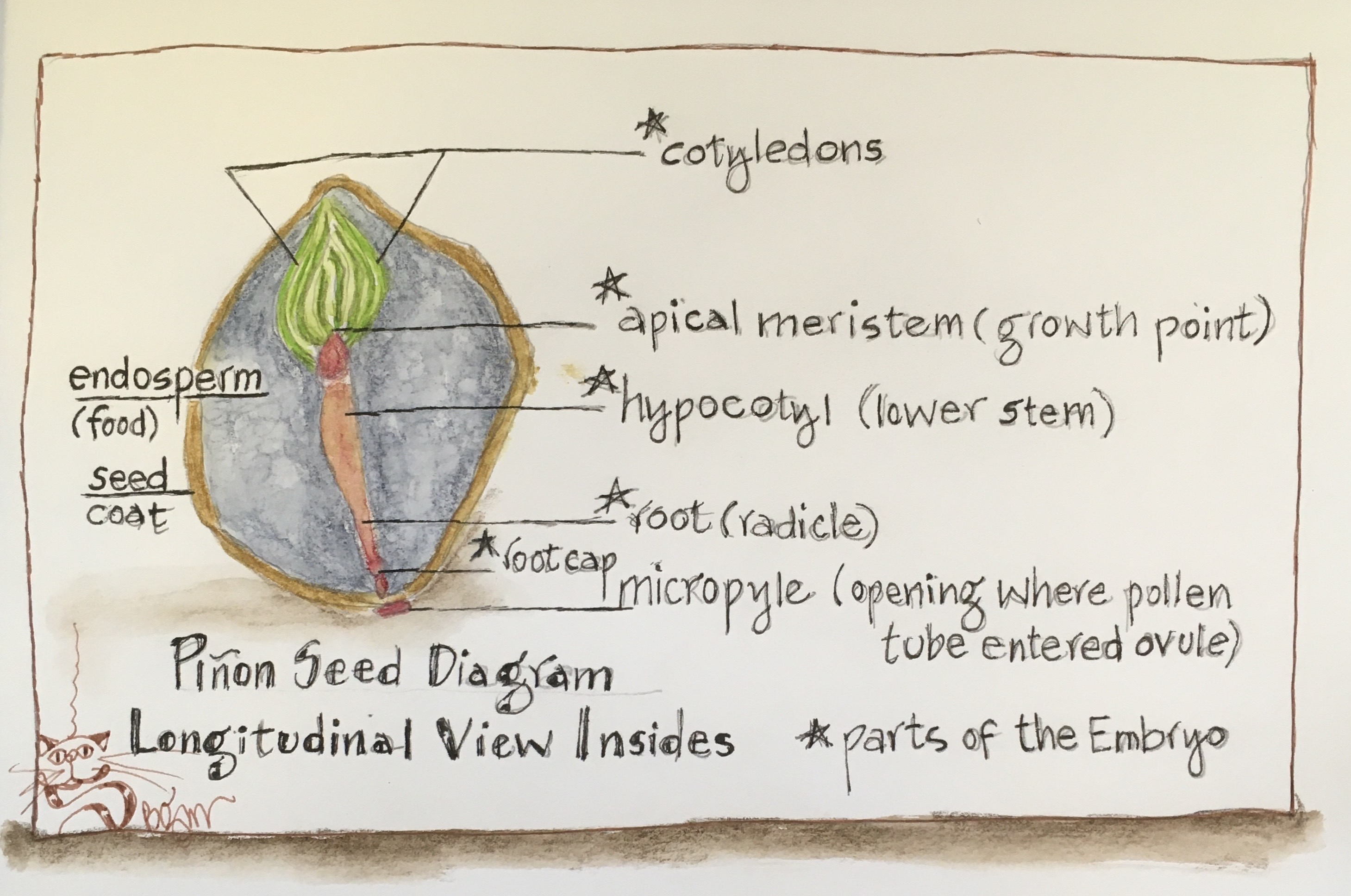
Looking inside the seed reveals a miniature pine tree!
Think about it ……. a seed is really a living baby plant (the embryo) surrounded by a cozy blanket (the endosperm) that cradles and nourishes the embryo while tucked inside the seed coat. When the coat unzips, freeing the “baby” as it begins to grow, it continues to be nourished by the endosperm until the first true leaves appear. Witnessing the process is so cool!
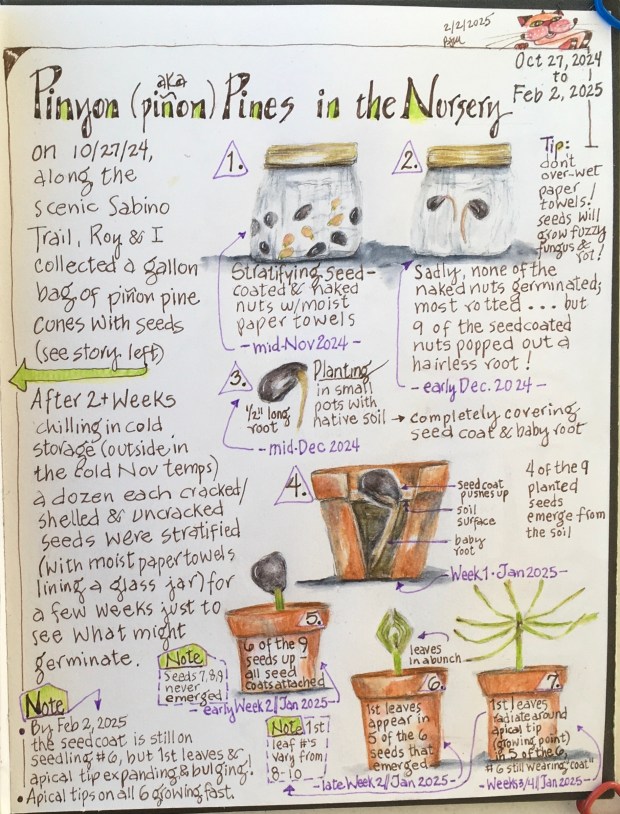
After collecting piñon seeds from last November’s foraging expedition, (Piñon or Pinyon, Piñon Seed or Pine Nut), we decided to treat a dozen or so to conditions just right to stimulate germination. But first the seeds required a short period of stratification (moisture) to help soften and crack the seed coats. Introducing moisture was done by lining a clear glass jar with damp paper towels and placing the seeds between the towels and glass to watch the action.
Post from November 2024 Seed Foraging Expedition
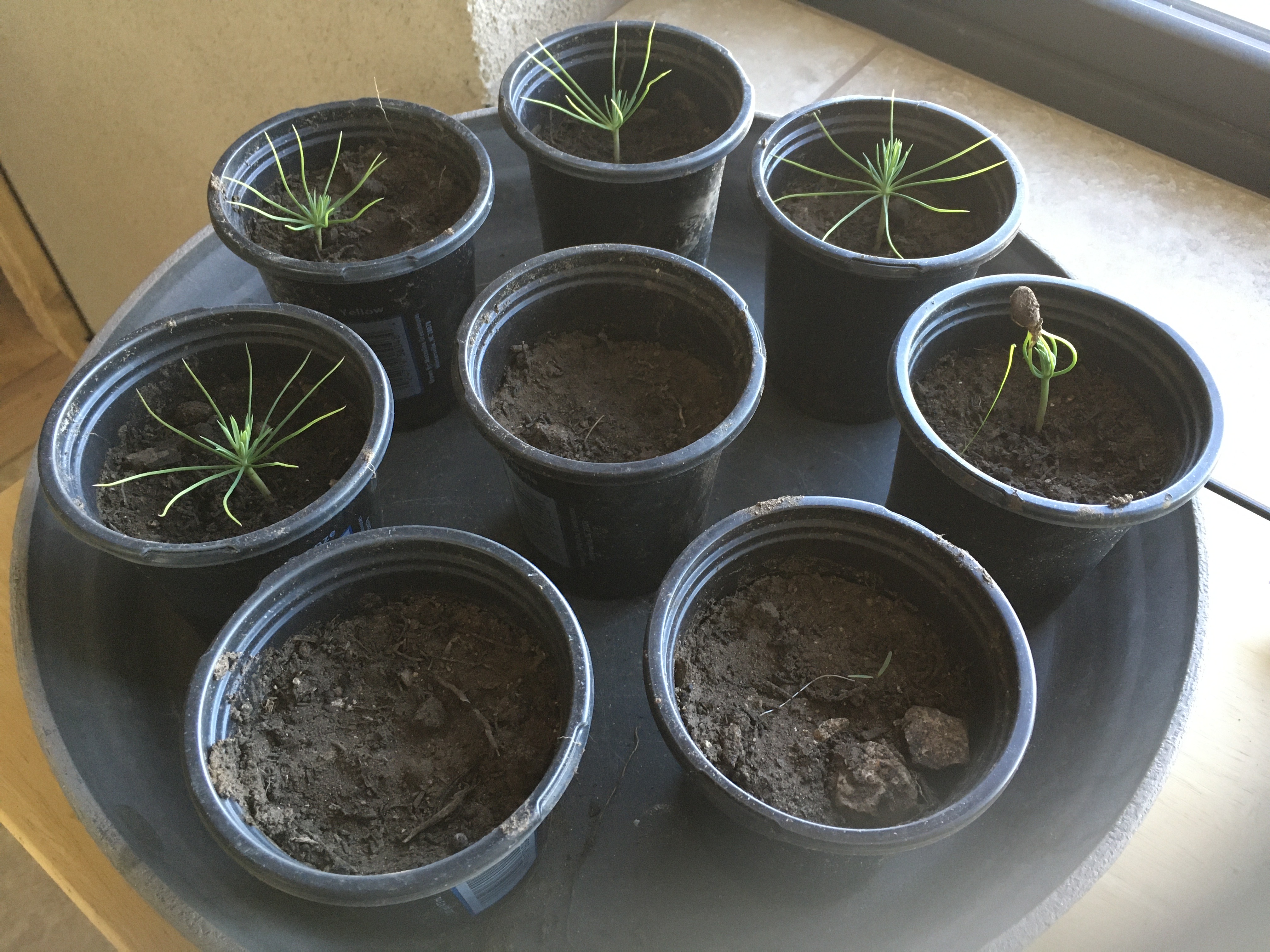
Soon embryonic roots (the radicles) successfully cracked the seed coats of nine seeds and began growing downward, as roots tend to do. In a week or so, before the embryonic leaves (cotyledons) appeared, all of the germinating embryos were planted. Six of the nine then sprouted their whorled cotyledons, followed by a growth spurt of the first true leaves, initiating the process of food manufacturing (photosynthesis).
Steps to Germination
All of the germination and seedling development details of these piñon seeds, to date, can be found in my update illustrations.
Seed germination is a fascinating process, and like the seed itself, is also a marvel of nature. Have you ever tried to germinate a seed? If not, give it a go. It’s fun, educational, and imagination provoking ….. from such a small seed comes a full-grown flowering plant!
Wandering about the neighborhood one warm summer morning in 2018, I noticed a dense stand of plants lining a 20 foot section of road. What caught my eye were the umbrella-like clusters of pearly white flowers topping each slender stem. From a distance these plants resembled our native white-flowering yarrow. But I soon realized the narrow dark green leaves were not fuzzy; the tiny exotic-looking flowers were not daisy shaped. Unmistakably, this plant was a species of milkweed! And the flowers of more than 50 individual plants in this population were a-flutter and a-buzz and a-crawling with hungry insects!
What was this milkweed species?
This is the Winter Botany portion of this post. All that remains of last summer’s Horsetail Milkweed are stems and mostly empty seed pods clinging to short branches. But some of the seed pods still hold silky tailed seeds clinging to their open pods. Hundreds of seed pods line the roadways in our neighborhood.
It didn’t take long to confirm this plant as Horsetail Milkweed (Asclepiassubverticillata), a species commonly found along roadsides in pinyon-juniper woodlands. Knowing what to look for on future walks, over the next several years I was excited to find 30+ more populations of various sizes along neighborhood roadways! From 2018 until early summer 2024, I continued to monitor these seemingly abundant populations. The small numbers of seeds I collected in the Fall were planted in our yard, and every year I checked for the presence, variety and numbers of insects busy feeding on nectar as they pollinated the flowers.
During June 2024, when we moved only a few miles to the northeast, I was happy to see Horsetail Milkweed grew abundantly in our new subdivision. This prompted me to dig deeper into researching this species. Its been exciting to discover how important this milkweed is to native insects, including monarch and queen butterflies.
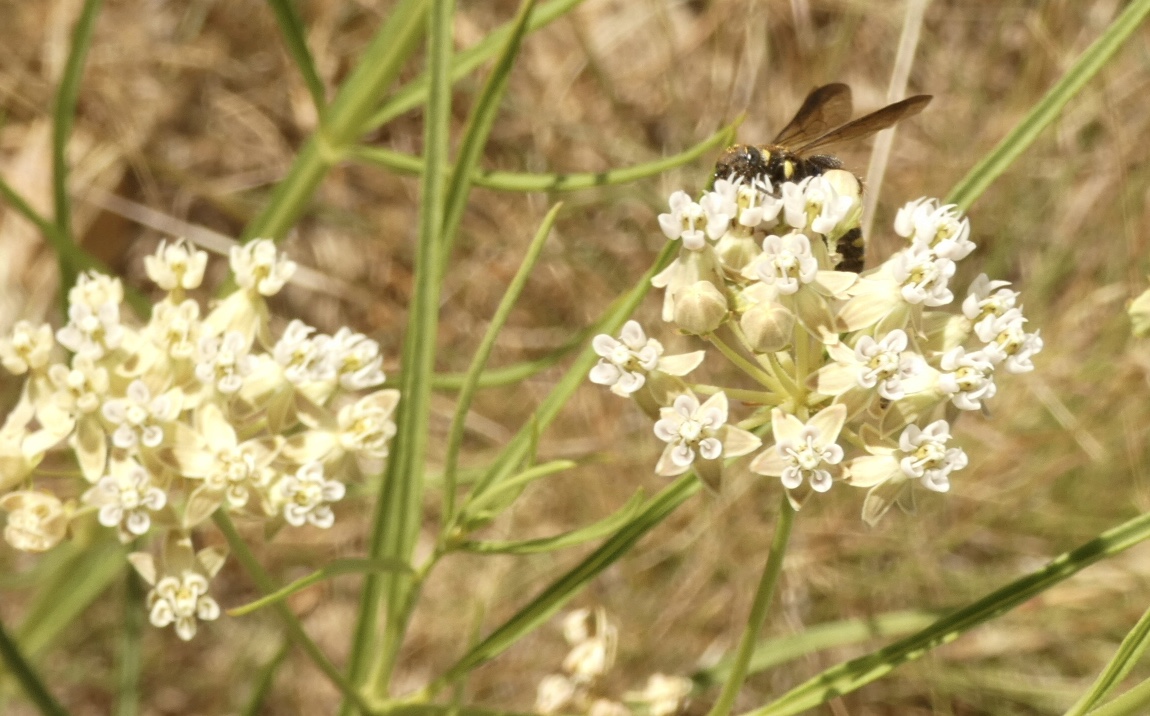
Photo (mine) taken in July 2022 of a blooming Horsetail Milkweed being enjoyed by a feeding wasp.
According to pollination ecologists, Horsetail Milkweed is especially valuable to large numbers of native bees. This plant species also supports conservation biological control by attracting predatory or parasitoid insects that prey upon pest insects.
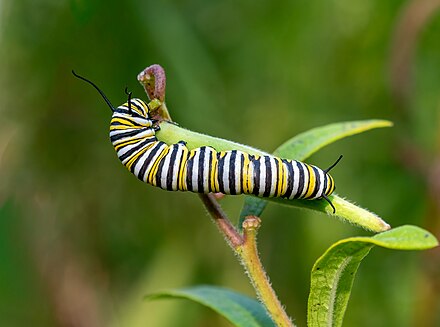
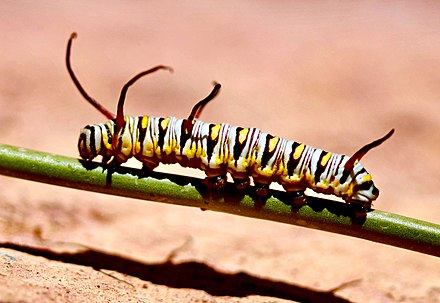
And Horsetail Milkweed is one of the favorite host plants for monarch and queen butterflies, all because it’s toxic! Producing an especially nasty tasting and potent neurotoxin strong enough to kill livestock, the caterpillars of these two butterflies have evolved to benefit from such a poisonous substance. Voraciously ingesting a diet of only milkweed leaves, obviously tasty to the larvae, makes them unpalatable to would-be predators, such as birds. The toxin from milkweed leaves has become their primary means of defense; definitely a benefit for such chubby, slow little caterpillars.
Monarch caterpillar (source: open commons)
Although central New Mexico isn’t in any of the major migratory routes of these butterflies, I have observed both species in our previous neighborhood. Since learning more about Horsetail Milkweed and it’s favored roadside habitat close to home, my hope is to provide actively growing plants throughout the summer (a safe distance away from roadside easements) for both the monarch and queen adult butterflies and their caterpillars ……. especially important when governing covenants of our previous and new subdivisions require the roadways be groomed (mowed down like a butch haircut!) on a monthly basis by subdivision landscape crews.
Because milkweeds are among my favorite of all plant species, mainly due to their complex flowers and the clever trickery they’ve developed to ensure pollination, I wrote about and illustrated two in-depth blog posts on this subject. Believe me when I say, “It’s overboard fascinating!”
Summer Botany: Meet the Milkweeds from July 2022. This is my first comprehensive look at milkweed flower structure, how pollination takes place, and the genus Asclepias.
Read on to learn more botanical information about Horsetail Milkweed AND how to find out if you live in Spring and/or the Fall Migration routes of the monarch butterfly AND where queen butterflies migrate to and from.
Characteristics and habitat requirements of Horsetail Milkweed
Horsetail Milkweed is a perennial species with a stout, woody rootstock. Plants readily spread by rhizomes (underground stems) producing dense communities. Cold-hardy to at least 0℉, this milkweed bounces right back in the Spring. Plants are also drought-tolerant once established, thriving in well-drained, sandy soil under full to partial sun.
Able to thrive in a variety of habitats and plant communities from 2500 – 8000 feet in elevation, Horsetail Milkweed grows among grasses, on sandy or rocky flats, on slopes, roadsides, and along trails in Chaparral, Semidesert Grasslands, Pinyon-Juniper Woodlands, Montane Conifer Forests, and in disturbed areas.
All of these characteristics and its adaptability to a wide range of habitats make Horsetail Milkweed one of the easiest milkweed species to grow.
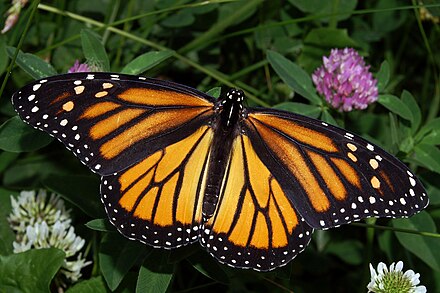
Monarch butterfly (source: open commons)
Monarch Butterfly
To learn if you live within the path of or close to spring and/or fall monarch butterfly migration routes, you can view a map or these route here:
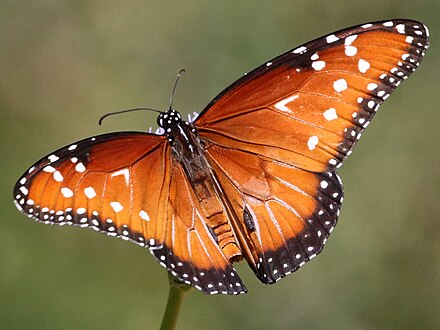
The queen is chiefly a tropical species. In the US, it is usually confined to the southern portion of the country. It can be found regularly in peninsular Florida and southern Georgia, as well as in the southern portions of Texas, New Mexico, Arizona, and California. Occasionally, the subspecies of the queen can be found somewhat north, in Kansas, Colorado and Utah.
Queen butterflies do not migrate as dramatically as monarch butterflies, but they do move short distances in tropical regions with dry seasons to higher elevations.
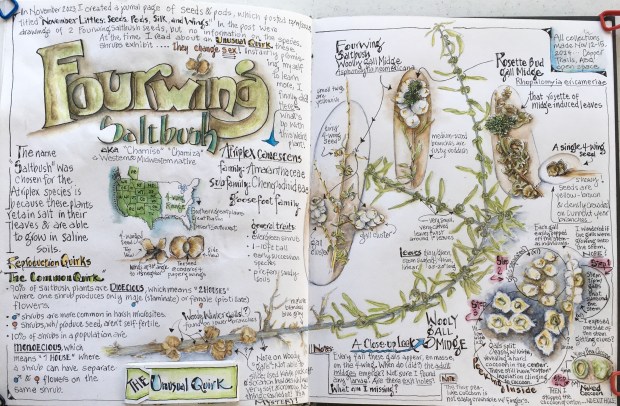
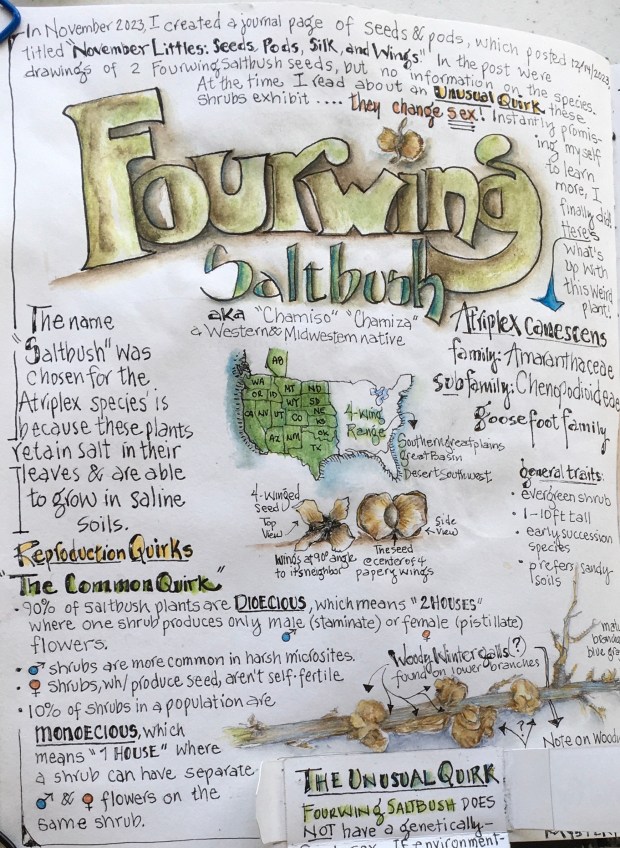
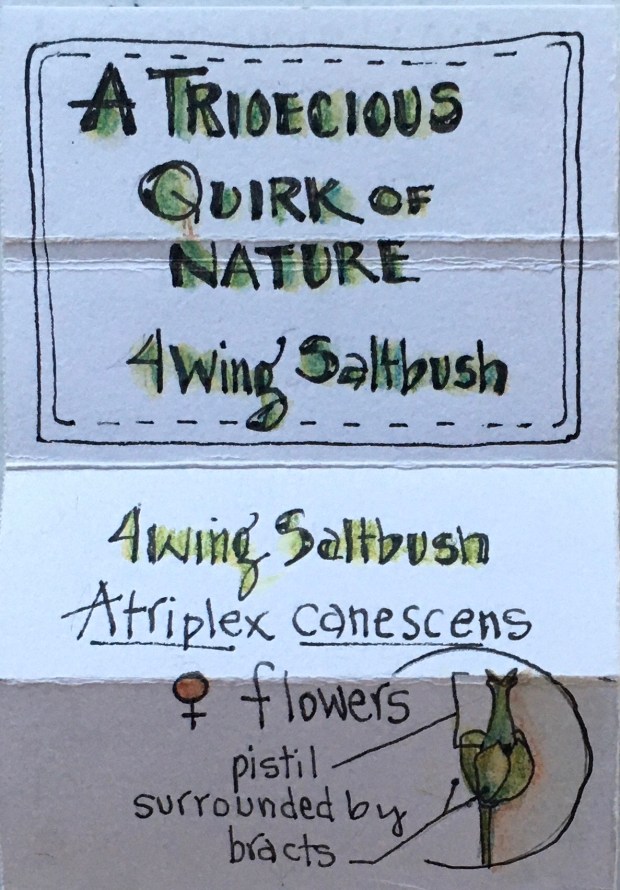
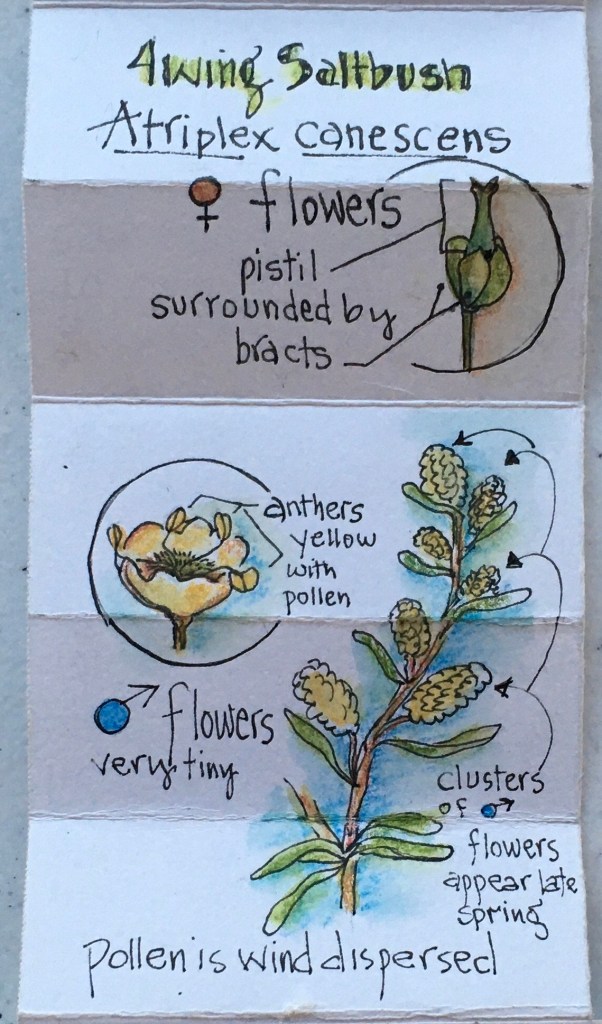
In November 2023, I created a journal page of seeds and seed pods, which posted on 12/14/2023, under the title November Littles: Seeds, Pods, Silk, and Wings. On that page was a small drawing of two Fourwing Saltbush seeds, absent any information about this plant species, Atriplexcanescens. At that time I remember finding a wealth of articles and research documents about this widespread shrub, but what really stuck in my mind was a very unusual quirk exhibited by this plant. Finally, a year later and WOW! I discovered Fourwing Saltbush has a reproductive superpower …… this species has the ability to change sex!
An Unusual Quirk
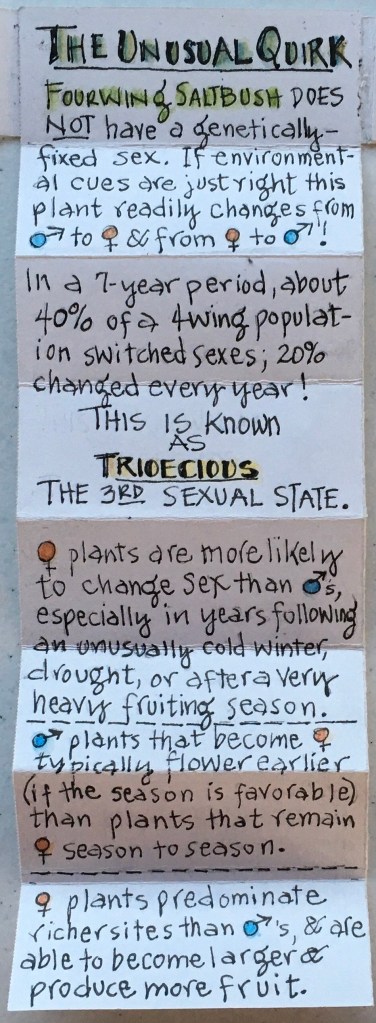
My first dive into the literature revealed that within a 7-year period of time, 40% of a Fourwing population switches sexes with 20% of a population changing sex every year. Botanically, this is known as Trioecious, or the 3rd Sexual State.
But clearly a bit of back peddling is needed ……. if Trioecious is the 3rd Sexual State in plants, what about the 1st and 2nd sexual states, huh? Yes, they exist …….. but before explaining them, which requires comparison with the more common sexual state in plants, I must describe this sexual norm.
And now for a little Botany 101 ……..
The Sexual Norm …… Plants with Perfect or Complete Flowers
You are likely familiar with plants like roses, tulips, lilies, garden strawberries, beans, peas and cabbage. If you’ve closely examined their flowers while inhaling their fragrant aromas, you may have noticed their centers have both female and male parts. These are known as plants with Perfect or Complete flowers (aka hermaphroditic or bisexual) defined by each individual flower having a fully functional pistil (the female part) and stamens (the male parts). Worldwide, about 90% of flowering plants have Perfect or Complete flowers.
Monoecious ….. the 1st Sexual State
Here again you are likely familiar with many plant species described as Monoecious (moh-NEE-shuhs). These include corn, all of the plants in the gourd family (i.e. cucumber, squash, watermelon), oak, birch, pine, spruce and dogwood. Monoecious, which means “one house” in Greek, describes plants having separate female and male flowers in different places on the same plant, often blooming at different times. Visualize corn growing in a field; the tassels are the male (staminate) flowers, and the corn kernels you eat are the female (pistillate) flowers. Around 10% of all flowering plant species worldwide are Monoecious.
Not to confuse the matter, but sometimes botanical experts refer to Monoecious species as Perfect or Complete because they have both male and female flowers on the same plant, even though these flowers are separate and considered sexually Incomplete (aka unisexual) by themselves.
Dioecious ….. the 2nd Sexual State
A plant species with individual plants in a population having only female flowers, and individual plants of the same species in the same population with only male flowers is called Dioecious (dahy-EE-shuhs). This Greek word meaning “two houses,” describes plants such as spinach, asparagus, sumac, currant, box elder, willow, holly, ginkgo, juniper and aspen. Only 5% of all flowering plant species worldwide are Dioecious.
Another confusing matter once again. There are botanical experts that refer to plant species with Perfect or Complete flowers as Dioecious because they require cross-pollination to produce seeds (fruit). Tree fruit species such as apples, pears, cherries and plums are common examples.
Trioecious ….. the 3rd Sexual State
An extremely rare reproductive strategy among flowering plants, Trioecious (aka trimonoecious or “three houses”), is characterized by a species that can have Incomplete (unisexual) male, Incomplete (unisexual) female, and Perfect or Complete (bisexual or hermaphroditic) male/female flowers on separate plants in a population or even all on the same plant! Just over 3% flowering plant species worldwide are Trioecious (trahy-EE-shuhs).
This is where Fourwing Saltbush (Atriplexcanescens) enters the story
Primarily a Dioecious species, some Fourwing Saltbush populations have a Monoecious component ranging from entirely male (staminate) or female (pistillate) individuals to those that are Perfect or Complete (hermaphroditic or bisexual). And in this Dioecious–Monoecious–Hermaphroditic gender system, referred to as Trioecy, switching sexes occurs. To reiterate from an earlier paragraph, on average, in a 7-year period, about 40% of a Fourwing Saltbush population switches sexes with 20% changing from male to female or from female to male every year.
Reasons Behind and Benefits of Fourwing’s Sex Change Phenomenon
Fourwing Saltbush has evolved to be one of the most adaptable plant species found throughout central and the western US. It grows from sea level to 8500 feet elevation, and in a multitude habitats within a wide range of plant communities, no matter the successional stage. Fourwing can adapt to all soil textures, soil depths and all but the wettest of soil conditions. The species is able to tolerate hot (+100F) and dry (6” precipitation annually) summers, and bitter cold (-50F) and dry winters.
The ability of the species to adapt to such a wide range of physical and climatic conditions is, in part, due to this sex change phenomenon. Environmental stressors seem to be the major triggers resulting in Fourwing plants switching sexes. Female plants are more likely to change sex than male plants, especially following a drought, an extremely cold winter, or after a heavy fruiting season. Because fourwing is so tasty as range forage, overgrazing can also trigger a sex change, with male plants tending to dominate regularly grazed sites. Male plants that change to female typically flower earlier than plants that remain female season after season. And female plants dominate richer sites than do male plants, becoming larger and producing more seed.
Undoubtably there’s more environmental stressors, such as wildfire and other climate change-induced factors, that may result in Fourwing Saltbush to switch sex. I’ll be curious to learn what they are and how these triggers influence the adaptability and survivability of this robust species. And I’m excited get busy marking this season’s female and male plants that we see nearly every day, and will begin more closely observing these populations for gender changes and possible stressors that may have triggered these switches.
A Retrospective and Thoughts on Prospective Studies
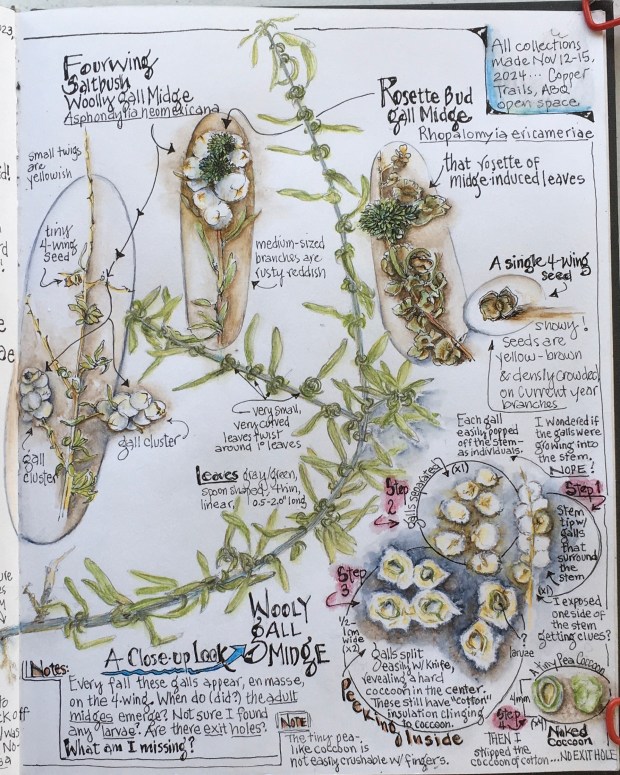
There’s so much to learn about Fourwing Saltbush that it seemed logical to tackle one characteristic at a time. Originally I had planned to discuss both the plant’s reproductive quirk and several of its common galls, but found there would be too much information for one post. While deciphering the complexities of the Fourwing’s sex change abilities, I found it necessary to describe certain key botanical terms in my buildup to the crucial piece of the puzzle ….. the Trioecious reproductive strategy. So this post focused on the first of my two journal pages; my beginning exploration into this plant. The galls illustrated on my second journal page, that could not be easily chopped away from the first page, serve as a preview of a future post about the fascinating Fourwing Saltbush.
And Finally ……….
For a shrub I used to describe as a messy tangle of branches haphazardly cloaked with unremarkable features like dusty little grey-green leaves, nearly invisible flowers, shreddy dull grey trunks and a chaotic canopy, Fourwing Saltbush has captured my imagination, respect, and love as an almost invincible survivor of our changing world!
Hopefully you found this interesting and informative. Bet you never look at flowering plants in casual ways again. Let me know if you are familiar with Fourwing Saltbush. Where does it grow? Have you ever marveled at the thousands of winged seeds densely crowded at the tops of these shrubs? And then satisfied an irresistible urge to strip dozens of skinny branches of those ripe seeds, tossing them in the air like confetti? If so, please share.
A fallen cone from Pinus edulis. Still a few seeds remain, tucked in the lowest scales. Typically there are 2 seeds per scale; 10-30 seeds are common per cone. Seed viability is uncertain until the inside kernel is exposed.
Pine Nuts Come From Where?
Many years ago, maybe about 45 of them, Roy and I, his sister and her husband, set off on a pine nut safari in the mountains of south central Colorado. They knew of a large stand of a specific pine tree, called Pinyon (Piñon**) heavy with cones and ready to harvest. This was my first encounter with the Colorado Pinyon Pine (Pinus edulis), and my first taste of the buttery rich tear-drop shaped seeds produced by these trees. I was hooked! After 4-5 hours collecting wide open seed stuffed cones from low hanging branches and off the ground, we had to stop. Our fingers were impossibly stuck together from the cones’ copious coating of resin, definitely stickier than Super Glue! Without a solvent to dissolve this adhesive pine tar, we were in danger of losing our fingerprints.
Having made a less-than-minor dent in the harvestable nuts, ample quantities of this energy rich bounty remained for foraging wildlife, such as migrating birds like pinyon jays, deer and squirrels.
For the past 45 years I truly believed pine nuts (which are, botanically speaking, not true nuts but the edible seeds of pinyon pines) only came from stands of Colorado Pinyon Pine. When the popularity of pesto skyrocketed, I thought “wow, you couldn’t pay me enough to harvest the amount of pine nuts necessary to make even one batch!” I honestly thought that was the reason the seeds were so expensive ….. harvesting is such a tedious and labor intensive job. Alas, we never returned to harvest pine nuts, and I never made pesto until years later.
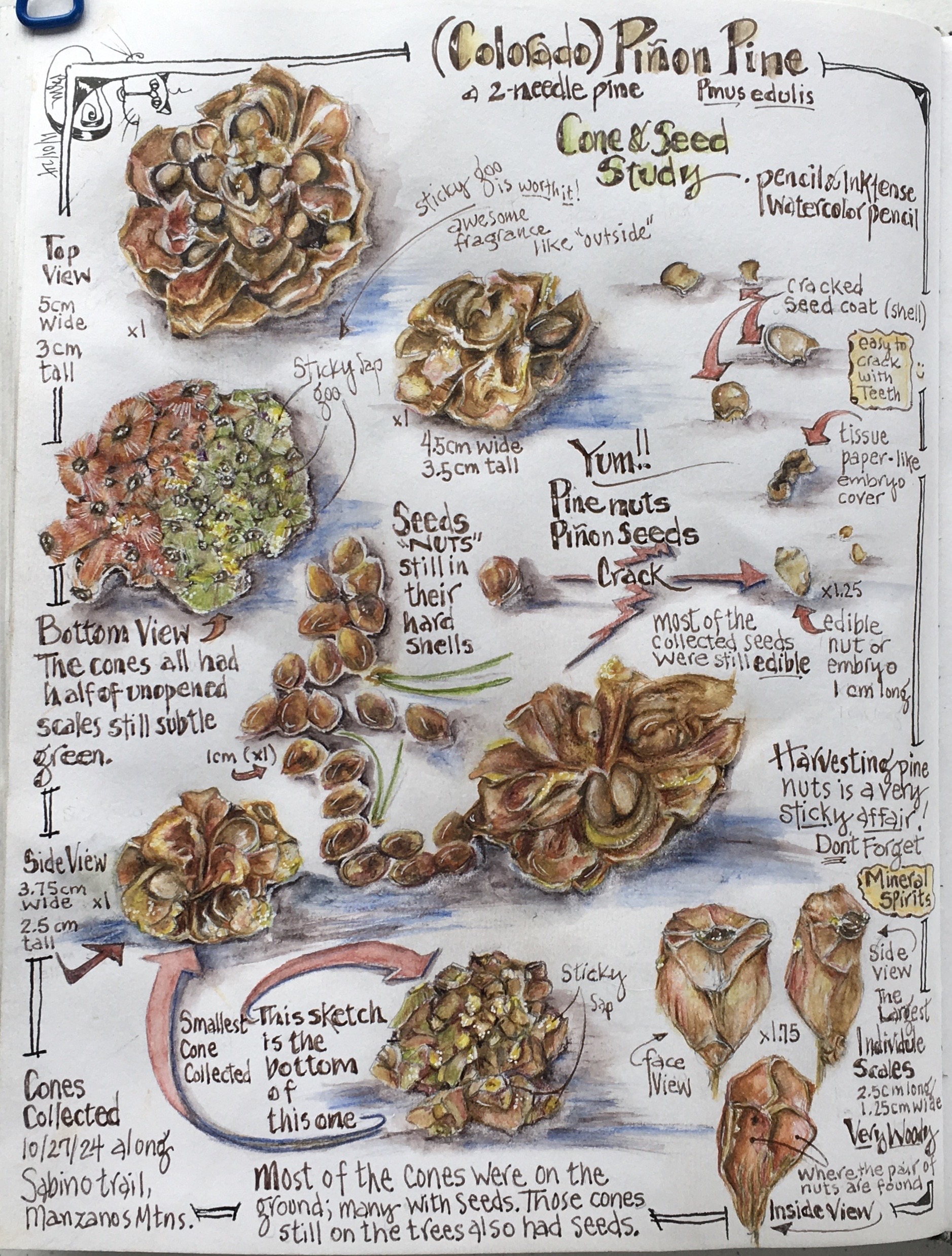
The result of my Pinus edulis cone and seed sketching exercise.
While studying a few dozen pine cones for my sketches, the seeds kept falling out and bouncing across my drawing table. This got me thinking about pine nuts and wondering how the Colorado Pinyon Pine could possibly fill the insatiable global demand! Of course by now I was well aware that this tree species is endemic in the southwest, but still ?…….
News to Me ….
Of the 126 different species of pine in the world, 29 are considered edible; 20 of which have seeds large enough to be marketed. The biggest producers and exporters are China, Russia, Mongolia, Turkey, and Pakistan, in that order. I found it interesting that China is also the largest importer of pine nuts, who’s marketing goal is to export 60% of the world’s demand.
What about the US? The pine nuts harvested from Colorado Pinyon Pine (Pinus edulis) is rated the best tasting in the world, with those produced by the One Leaf Pine (Pinus monophylla), harvested primarily from these California trees, comes in a close second. Yet, the US is a major importer of shelled pine nuts, primarily from China. But if China is the largest importer and the largest exporter of shelled pine nuts, then the pine nuts on the shelves of Trader Joe’s and Costco, labeled as imported from China, probably came from a variety of pinyon species from a combination of suppliers importing seeds to China?!
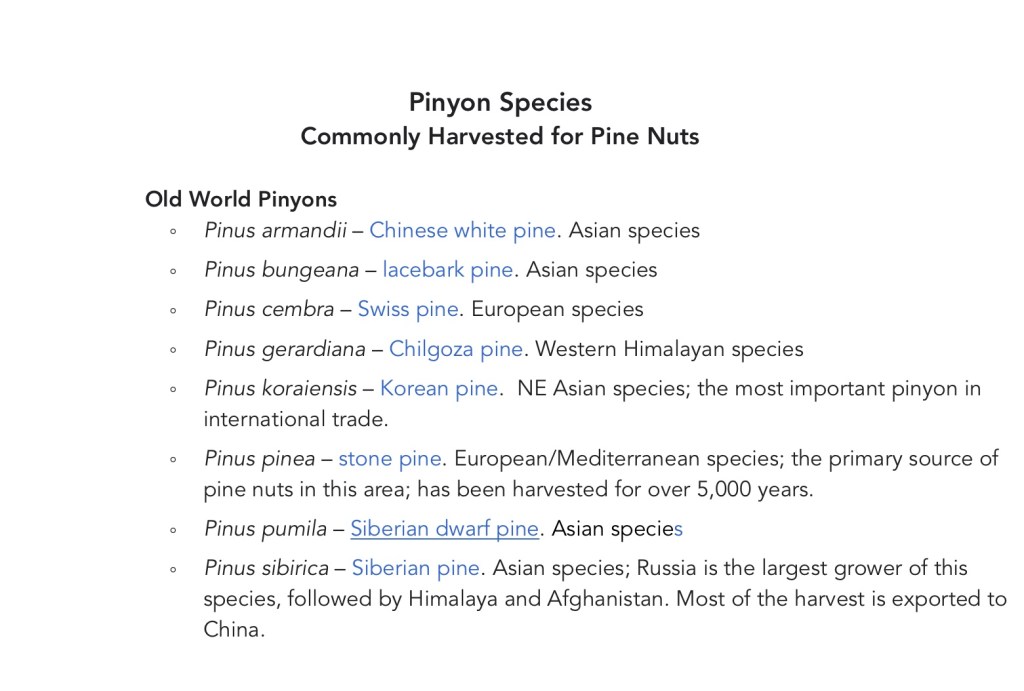
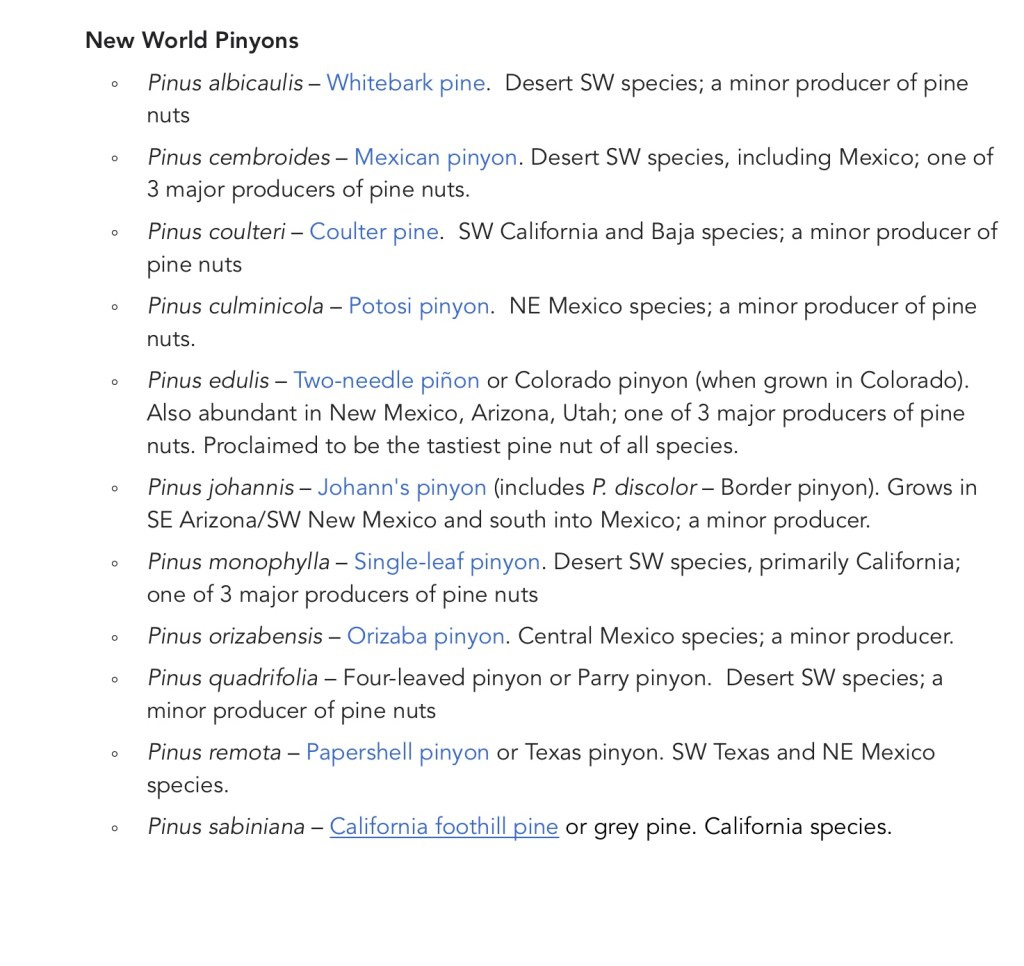
Being naturally curious about the Pinyon species that grow in various countries around the world, I included a list of 16 of the most commonly harvested trees the end of this post.
What’s the Real Reason Pine Nuts are so Expensive?
It’s said that “pine nuts are the most expensive seeds we would never buy!” (**** Check out this footnote for the 2024 costs/pound and my random calculations per serving and for a batch of pesto). Pine nuts are the second most expensive “nut” in the world, second only to the macadamia nut. Butwhy? While it’s true the seemingly exorbitant price of shelled pine nuts is directly influenced by labor costs, compounded by the annoying sticky factor, other challenges exist.
Harvesting Pine Cones
Cones are harvested by hand, directly gathering those that have fallen on the ground, and from tree branches (where the densest number congregate in the upper 1/4th of 30 foot tall trees). Another common harvesting technique is to whack the branches (which reportedly does not injure the trees [hmmmmm?]). But a faster method used in many countries is to cut off branches with cones, resulting in a number of detrimental effects to the trees (open entry points for insects and pathogens; stunted growth; stalled production; tree death).
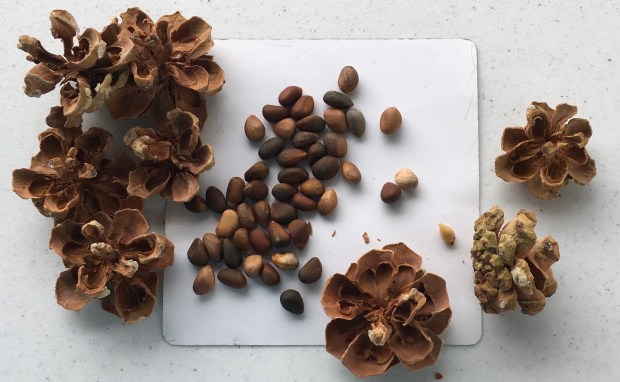
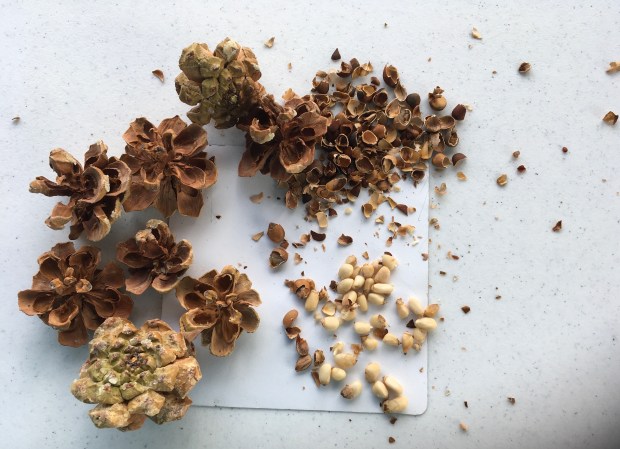
A sampling of Pinus edulis cones with hard coated seeds removed, ready for cracking. There’s a single kernel between the two lower right cones.
Pine Nuts
Once the seeds are taken out of the cones, their hard shells (seed coats) must be removed without damaging the soft edible kernels inside, the “pine nuts.” (And not every seed is viable ….. more about that below.) The shelled pine nuts must now be handled quickly and properly due to their short shelf life. It only takes a few weeks or even days in warm and humid conditions for shelled pine nuts to lose flavor, turn rancid, and completely deteriorate. Until they can be marketed for export, pine nuts must be kept frozen. Ideally, shelled pine nuts should remain frozen during export/import and until consumer purchase and consumption.
There were the remains of the Pinus edulis seeds extracted from these cones; 30 tasty kernels were viable; 20 were either missing or dried up.
Tree Characteristics
Slow growing trees and inconsistent production are several more reasons pine nuts are so expensive. Pinyon pines are notoriously slow to grow, mature (10 years) and produce a harvestable crop of cones with viable seeds (75-100 years). But pinyon pines typically live an average 350 years, and have the potential to produce tons of harvestable seeds. However, all pinyons exhibit a common characteristic called “masting,” where they may produce a bumper (harvestable) crop only once in as many as every eleven years. Good years are not predictable either, as many factors influence growth and production, with local droughts and a changing climate having the biggest impact.
Gifford Pinchot (1909), U.S. Forest Service Chief said: “Seasons of especially abundant production occur, as a rule, at intervals of from five to seven years, although heavy crops are sometimes produced for two or three consecutive years, and heavy seed years are not the same throughout the range of the tree.”
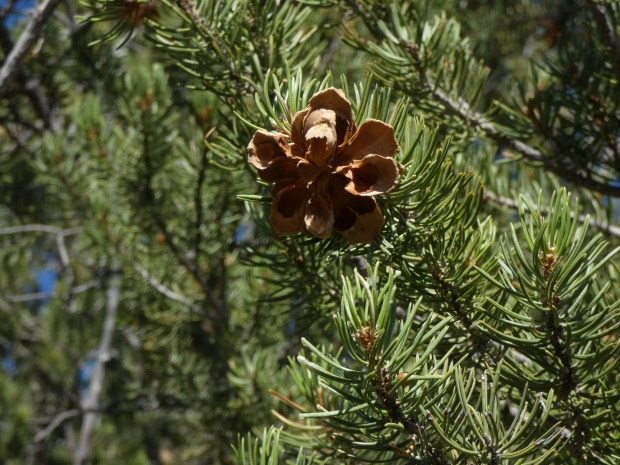
A Pinus edulis tree showing the 2 needles/fascicle densely covering the branches, and a remaining cone ready to fall..
______________________________________________________________ A Few Footnotes
**Piñon or Pinyon?
The most common common name for Pinus edulis is “Colorado” Pinyon Pine, even though the species is widespread in New Mexico, Utah and Arizona as well as Colorado. The words pinyon and piñon are usually considered interchangeable. Use of the word “piñon” (Spanish for pine nut) is tied to the seed (i.e. piñon seed or pine nut seed) and the tree (i.e. piñon pine or pine nut pine) particularly used by Native Americans in the southwest US. Because references consulted during my research were not consistent in their use of common names for Pinus edulis, to avoid (my) confusion I’ve opted to call the piñon seed (pine nut seed) a “pine nut” and the pine trees with edible seeds “pinyons.”
**** The 2024 retail market cost (shelled raw or roasted seeds) averages $40/pound
1 pound of seeds = about 4 cups (depending on seed size)
1 cup of seeds weighs about 4 ounces (price $10§)
1 ounce or 1/4 cup of seeds = 1 serving (price $2.50)
1 serving = about 167 seeds (price 1.5 cents/seed)
167 seeds = 191 calories (pine nuts are extremely high in unsaturated, heart-healthy fats and carbohydrates)
1 cup of seeds = about 668 seeds = 764 calories
4 cups of seeds = about 2,672 seeds = 3,056 calories
Number Play
Of the 50 seeds I harvested, only 30 were viable (price 45 cents)
It took me about 45 minutes to crack open the 50 seeds (this doesn’t include the time it took to collect the resin-coated cones and remove the seeds)
It would take me 67 hours to fill a 1 pound bag with 2,672 viable shelled seeds!
At $40/pound, a pine nut cracker would be paid only $0.59/hour for their labor, a wage earned back in the 1950’s and 1960’s which didn’t even come close to supporting a family then, let alone today.
Assuming a pine nut cracker makes a minimum wage of $7/hour, it would cost $468 to fill a 1 pound bag. That’s 1,170% more than the 2024 retail cost of a pound of pine nuts!
Obviously, a professional pine nut cracker is far more efficient than I was, using some form of mechanization to crack the seed coats (requiring more research on my part).
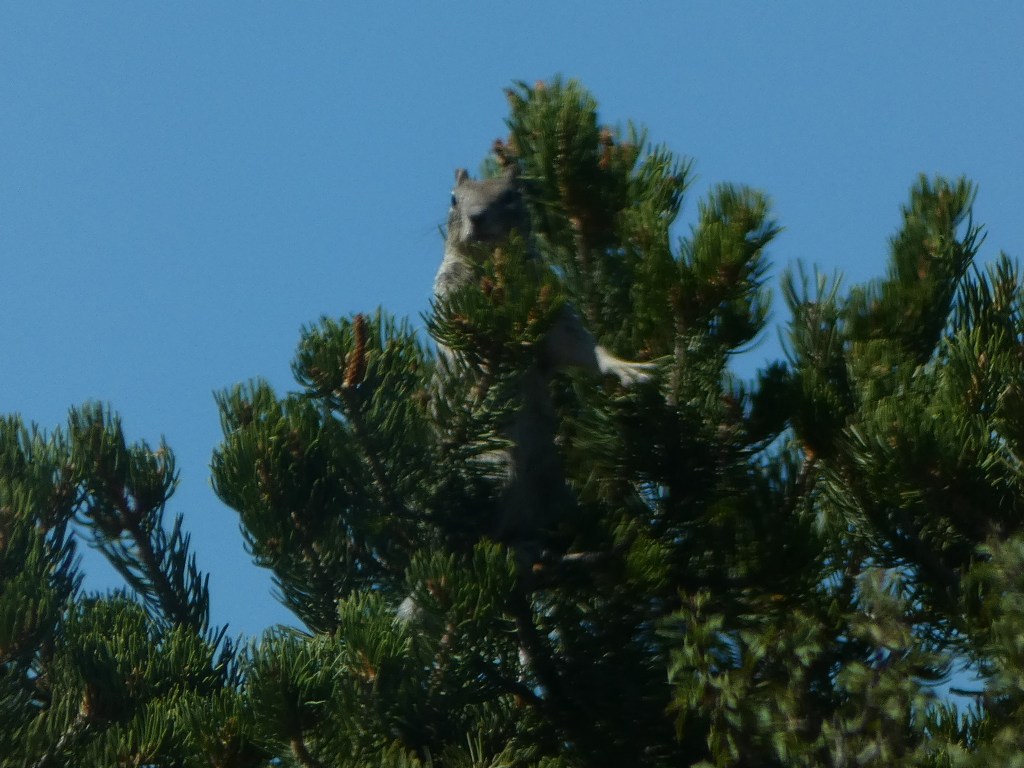
A rock squirrel high in a Pinus edulis tree, keeping watch for red tailed hawks while searching for pine nuts.
§Pesto ……. most pesto recipes I found call for the addition of 1 cup of shelled pine nuts, or 668 seeds. At 1.5 cents/seed, you’d be adding $10 of pine nuts to make one batch of pesto. Enjoy slowly!
Living in the East Mountains of central New Mexico ensures daily appreciation of hundreds and hundreds of Piñon Pines (Pinusedulis). This iconic pine, the state tree of New Mexico, has been a source of nutrient rich seeds for wildlife and indigenous peoples for millennia. It was fun learning more about this tree and the many Pinyon species that grow around the world.
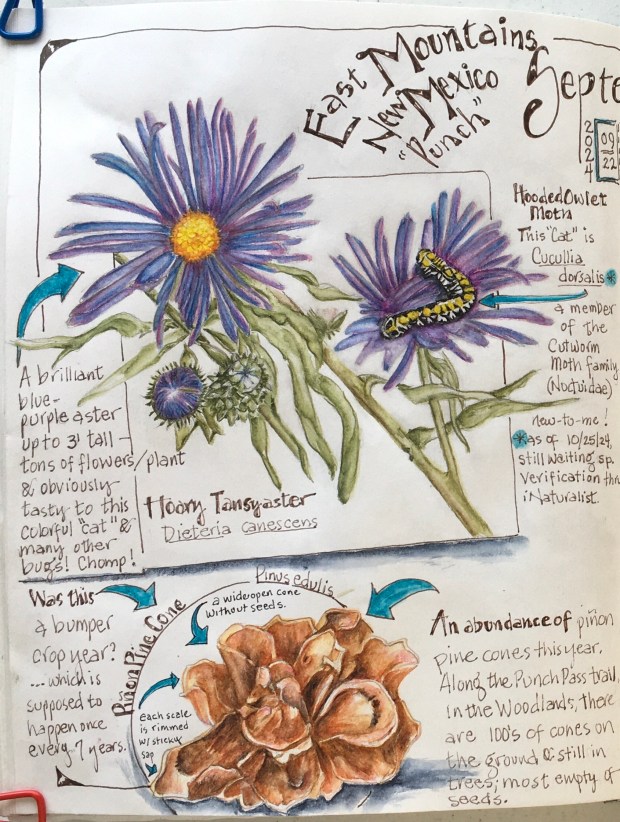
September 22nd was a morning full of new-to-me discoveries in nature. That was more than a month ago; a time when temperatures were still in the upper 80’s and flowers in full bloom.
But plenty of hints of what was to come ….. the inevitable change in seasons ….. existed. There were seeds of spring and summer bloomers blowing in the wind; squirrels stockpiling pine nuts from recently shed cones; darkling beetles mating and laying eggs in the ground to hatch next year’s population; caterpillars feasting on energy-packed flower petals needed to spin their cocoons; the chortling chatter of sandhill cranes high overhead migrating to Bosque del Apache for the winter.
Still it is hard to believe that today, a little more than a month later, everything has turned brown, and our first hard frost is forecasted for tomorrow morning!
In an effort to cling to a not-so-long ago summer, this small selection of the botanical and entomological happenings on the cusp of Fall, is now a part of my nature journal. Enjoy!
Webster’s had it “right on” when describing the Ubiquitous Plant Gall!
gall /ga:l/ 1. something irritating; rude. 2. not able to understand a behavior is unacceptable.
—-the boldness of these guys; the sheer gall and effrontery; the chutzpah; the unmitigated gall; What gall!
“Yeah ….. What Gall is This?!”
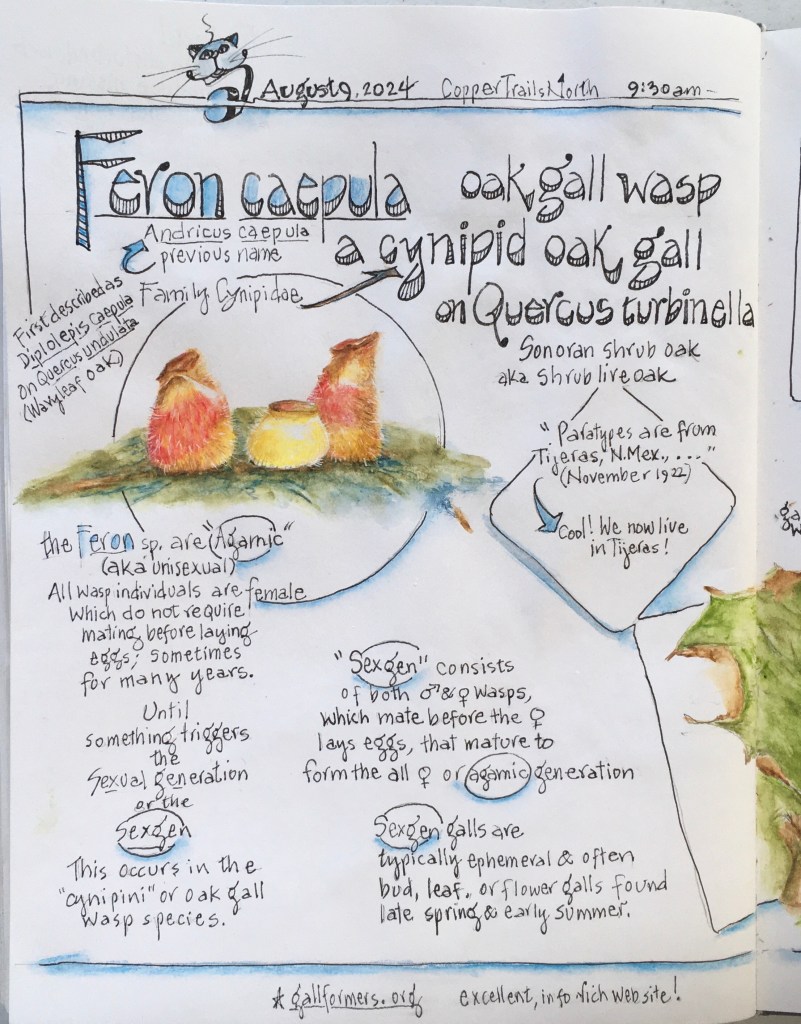
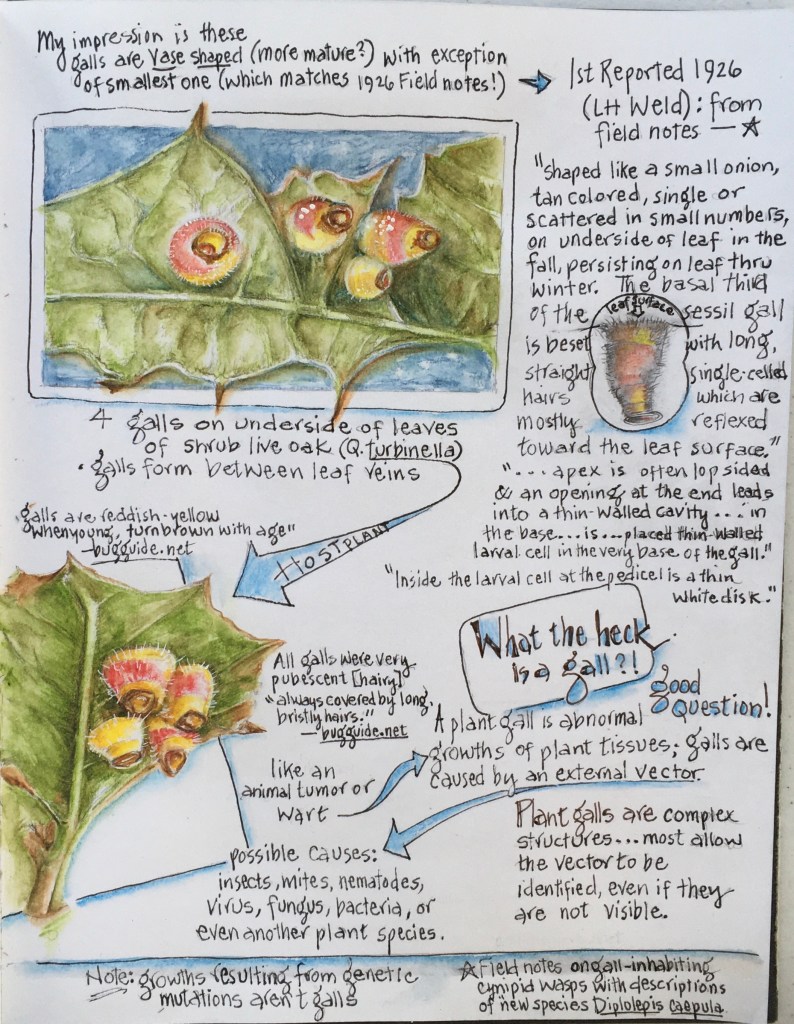
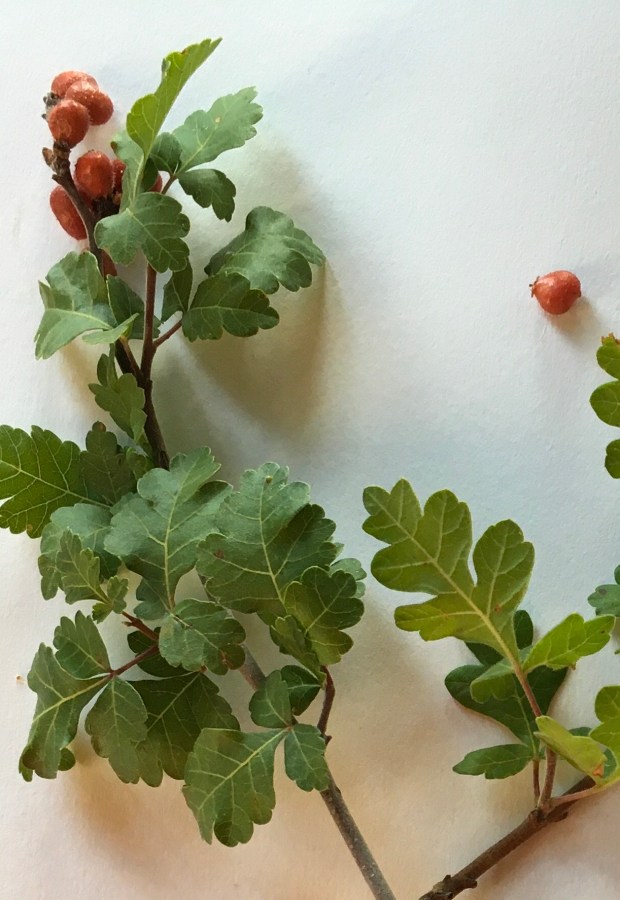
That was the question uppermost on my mind when a slight breeze wafting down the trail lifted a fresh oak leaf revealing four slightly wonky vase-shaped growths. One was squatty and pale; three were colored with alternating bands of cadmium yellow and deep vermillion. All four galls were attached to the underside of the leaf, hanging upside down, so whatever might’ve been inside is out.
After 5 minutes of inspection ….. poking and prodding, and peering inside the tiny vases ….. I took some photos to post on iNaturalist to figure out this little mystery. It didn’t take long before my discovery was identified! These are galls of the parasitic cynipid wasp called Feroncaepula, formedthis Spring on a new leaf of Shrub Live Oak (Quercusturbinella).
Originally identified in a 1926 field report as a new species, Diplolepisundulata, this species’ name was reestablished as Feron caepula in a report published in 2023. Ordinarily I choose to only cite a field report, but decided to make an exception in this case for several reasons…… the description of this new species was helpful in better understanding my specimens, and……. one of the paratypes used to describe the new species came from Tijeras, NM (which happens to be my home!). So the entire 1926 field report* (surprisingly short) by LH Weld is added below.
Supplement to the Nature Journal Pages
A Curiosity of Oak Galls, Revisited …… Part III
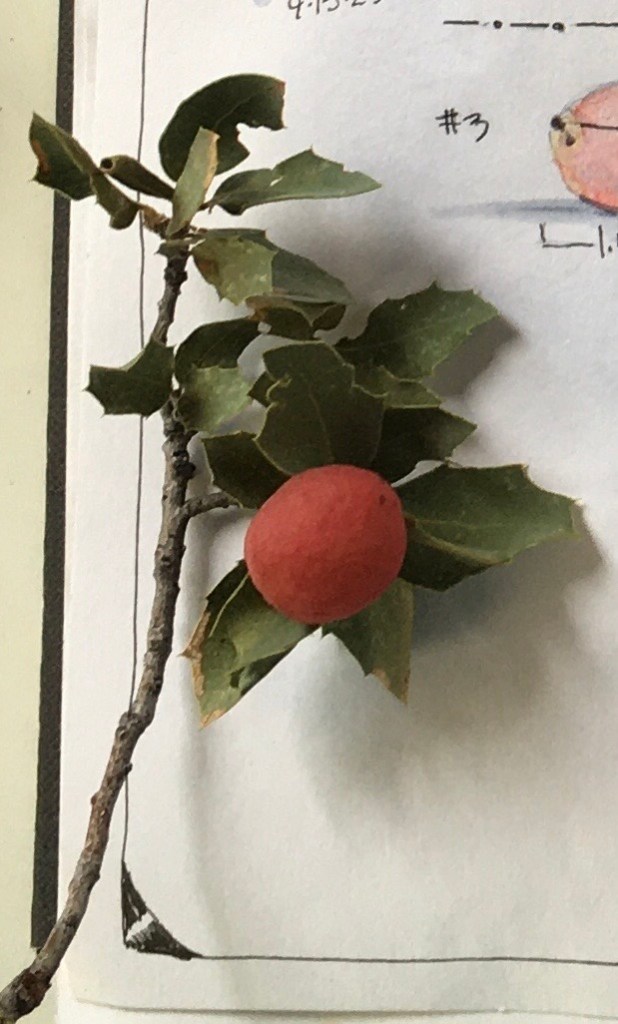
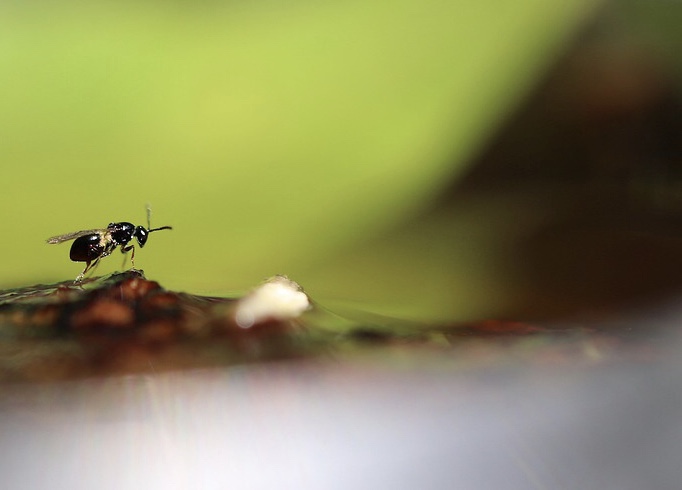
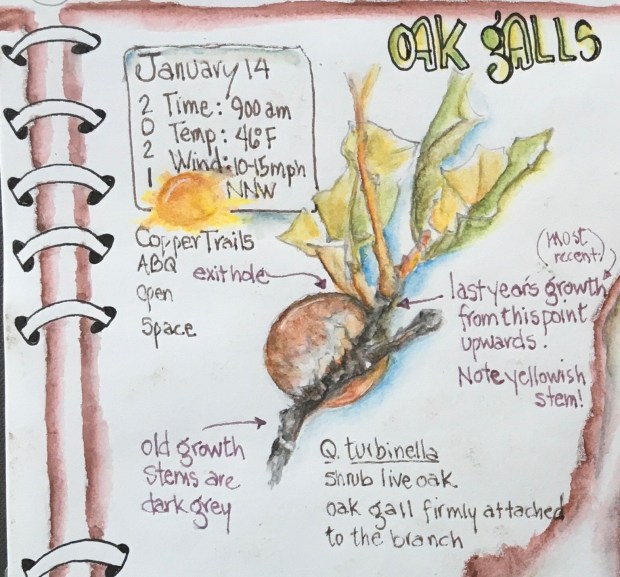
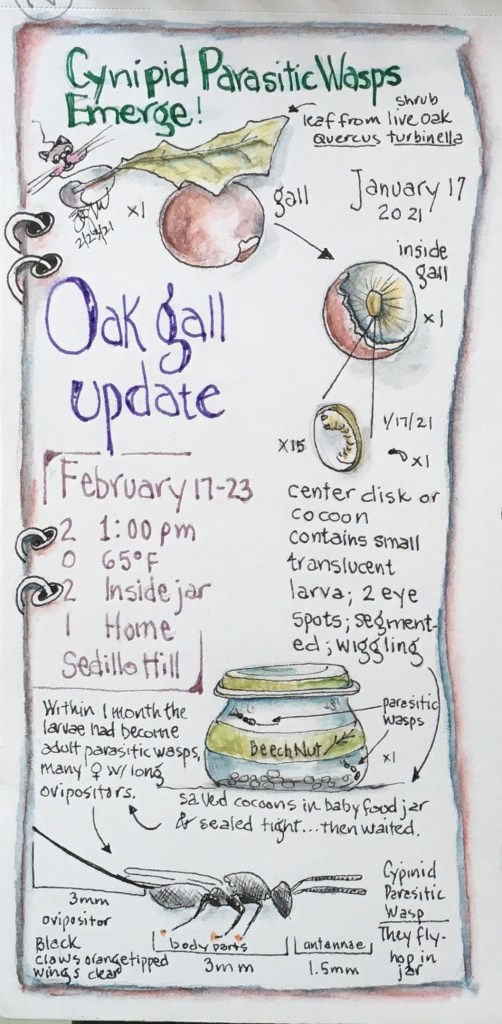
Curious about plant galls for decades, I finally began reading and experimenting to learn a bit about the inner world of oak galls. Throughout the winter of 2020-2021, I enlisted Roy’s help to collect about 100 nickel diameter, reddish-brown galls hanging on oak leaves like holiday decorations. Not knowing what to expect, I cut into a bunch of these galls and found tiny squirming grubs (larvae) – one/gall. The grubs seemed to be suspended by a complex network of stringy plant tissue radiating from each larva at the center to the inner gall shell. It reminded me of a snow globe frozen in time! Of course I had to know what these guys would become. So I placed about half of the galls into glass jars, and the other half went into jars without their protective gall home. In a few weeks the jars were full of the smallest wasps ever! Wasps! Little parasitic cynipid gall wasps active and ready to be released back into the wild to do what these wasps do! (Rest assured, they were releases in the same area where the galls were collected.)
A few years later, I was once again smitten by these tiny wasps and their galls, and learned more about their life cycle and other facts about galls in general. You can read all about my earlier experiences (and my efforts with experiments) in 2021 and 2023 at this post “No Small Galls this Fall! Oak galls, then and now, the sequel”.
Back to the Present
Here it is 2024, and while hiking the Albuquerque foothills, a new (to me) and colorful gall form appeared hanging beneath an oak leaf. My curiosity piqued. It was high time I gained some insight about the life cycle of cynipid gall wasps. Paraphrasing numerous expert sources, my attempt to interpret and understand what has been described the one of the most complicated life cycles known in the animal kingdom, still seems confusing. Maybe it’s been hard to wrap my mind around Parthenogenesis (asexual reproduction)***….. a key component of a cynipid gall wasp’s life cycle. By taking my time (over a month), and after many written and diagrammatic iterations, I stitched together a description that works. If you’re curious, read on!
One of the oak galls collected late 2020 …. On Shrub Live Oak (aka Sonoran Live Oak)
Where do Oak Galls Come From, and Why?
Every year in late-Spring and through early Summer our shrub live oaks (Quercusturbinella) are a-buzz with a cloud of nearly microscopic cynipid gall wasps that have emerged from a hundreds and hundreds of leaf galls. These often weird looking abnormalities begin forming during an oaks’ accelerated growth period in the Spring. “But where do galls come from and why?”
It’s Complicated!
In the case of cynipid gall wasps, the majority of more than 1400 known species* parasitize oaks, while a much smaller number favor rose and chestnut as host plants. Where and how a gall forms on a host plant, along with the gall’s size, shape and coloring is vector-specific. This gall uniqueness makes it possible to identify what species of insect, such as a cynipid gall wasp (or other external vector like a mite or virus or nematode or fungus or virus or bacteria) was responsible for each gall.
The life cycle of cynipid gall wasps alternate between asexual and sexual generations. This process, called Cyclical Parthenogenesis, is both fascinating and baffling. Typically, the gall formed by the females of the sexual generation (sexgen) shows itself in late winter/early spring, and is on a different part of the oak (such as a twig or stem) than the later asexual (or agamic) generation (agamic galls usually appear on actively growing plant tissues). The following is what appears to happen during the ………………
Photo of Cynipid gall wasp (courtesy Pixabay)
Lifecycle of a Cynipid Gall Wasp
The Asexual (Agamic) Generation
When the weather warms in late winter, an all-female generation of cynipid gall wasps emerge from galls which developed and became dormant the previous year, well before the cold and snow set in. This asexual generation of wasps initiates late Spring/early Summer gall development by inserting (with its ovipositor) an egg along with a maternal secretion from the venom gland, into a swollen leaf bud of the host oak. Egg laying takes place as the growing (meristematic) tissues inside the bud rapidly develop. The egg quickly hatches, and the larva begins feeding, all the while exuding specialized growth hormones that stimulate exaggerated tissue growth resulting in structures (the galls) that are visibly different from normal plant tissues. It’s during the Spring/Summer that developing galls are readily seen, often on the undersides of new leaves.
Portion of journal page from 2021
The safely hidden larva continues to eat the nutrient-rich plant tissues forming inside the gall and grows quickly until it develops into a pupa. After a few weeks in this pupal stage, an adult cynipid gall wasp has formed. Still tucked away, the adult (which is either a male or female) chews a small hole in the gall and emerges to mate.
Another journal page from 2021
The Sexual Generation (aka “Sexgen”)
With the business of mating taken care of, and with no mouth parts to eat, the males quickly die, followed soon by the females. However, before the females die, they deposit one or more eggs on a leaf or within a twig or stem of the host plant. Before the plant’s growing season concludes, the eggs have hatched, larvae have eaten and grown within their individual galls, and have pupated in preparation for over-wintering. Depending on the length and/or severity of winter where these cynipid gall wasps live (and they can live nearly anywhere worldwide), the dormancy period may last from three-five months.
And now …. back to the emergence of the Asexual or agamic generation (the females), in an on-going cyclic loop that is the life cycle of the cynipid gall wasp.
A Supplement to the Supplement!
Types of Galls
Leaf galls
Form on leaf blades or petioles (leaf stems)
Most common galls appear on the upper or lower leaf surface, on or between leaf veins.
Galls may look like leaf curls, blisters, nipples or hairy, felt-like growths.
Oak galls on Gambel Oak
Stem and Twig Galls
Deformed growth on stems and twigs.
Range from slight swelling to large knot-like growth.
When seen, may be peppered with many tiny holes where the adult gall wasps have emerged.
Bud or Flower Galls
Deformed size and shape of buds or flowers.
Fun Facts
Galls are growing plant parts and require nutrients just like other plant parts.
A gall keeps growing as the gall former feeds and grows inside the gall.
Once galls start to form, they continue to grow even if larvae die.
Most galls remain on plants for more than one season.
Galls are usually not numerous enough to harm the plant and control is not warranted.
Gall numbers vary from season to season.
Typically, plant galls become noticeable only after they are fully formed.
The asexual generation (agamic) galls are reported more often because they are larger and persist longer than the sexual generation (sexgen) galls.
Mature plant tissues are usually not affected by gall-inducing organisms.
Iron gall ink, which was the most common ink used from the Middle Ages to the 19th century, was used in line drawings by DaVinci, Van Gogh, and Rembrandt, and in the writing of many historical documents like the US Declaration of Independence.
It’s been so helpful to study the life cycle of these tiny parasitic cynipid wasps, if for no other reason than to admit my understanding remains basically rudimentary, and I must keep my Curiosity alive!
As always, thanks for stopping by!
………………………………………………………………………………………………………………
*Field report from 1926 by LH Weld
Diplolepis caepula, new species
Host. — Quercus undulata [Wavyleaf oak, Quercus x undulata]
Gall. — Shaped like a small onion, tan-colored, single or scattered in small numbers on under side of leaf in the fall, persisting on the leaf through the winter. The basal third of the sessile gall is beset with long straight single-celled hairs which are mostly reflexed toward the leaf surface. The conical apex is often lop sided and an opening at the end leads into a thin-walled cavity in which are a few scattered hairs and in the base of which is the transversely placed thin-walled larval cell in the very base of the gall. Inside the larval cell at the pedicel is a thin white disk.
Habitat. — The type is selected from a series from galls collected November 14, 1921, near Hillsboro, N. Mex., the flies emerging April 5-25, 1922. Paratypes are from Tijeras, N. Mex., and of the adults cut out of the galls on November 1 some lived in a pill box until December 28. Other paratypes are from Blue Canyon west of Socorro, adults being cut out of the galls on January 2. ….. Similar galls were seen on Q. grisea at Magdalena, N. Mex.
LH Weld: (1926) Field notes on gall-inhabiting cynipid wasps with descriptions of new species”
**The 1400 known species of cynipid gall wasps have been identified worldwide, with an estimated total of more than 6,000 species. In the U.S. there are over 2,000 known species of gall-inducing insects, including 750+ cynipid wasps (500 of which are found in just the West). Worldwide, entomologists have estimated that there are over 210,000 gall-inducing insects yet to be identified!
*** Parthenogenesis is a form of asexual reproduction where an egg develops into a complete individual without being fertilized. The resulting offspring can be either haploid or diploid, depending on the process and the species. Parthenogenesis occurs in invertebrates such as water fleas, rotifers, aphids, stick insects, some ants, wasps, and bees. Bees use parthenogenesis to produce haploid males (drones) and diploid females (workers).
Some vertebrate animals, such as certain reptiles, amphibians, and fish, also reproduce through parthenogenesis. Although more common in plants, parthenogenesis has been observed in animal species that were segregated by sex in terrestrial or marine zoos. Two Komodo dragons, a bonnethead shark, and a blacktip shark have produced parthenogenic young when the females have been isolated from males.
One of our early morning landscaping projects has been keeping us busy shoveling our way through 14 tons of pea gravel, one wheelbarrow load at a time. As each backbreaking load is hauled into our back yard and dumped on miles of weed barrier fabric, we keep reminding ourselves how nice it will be when Luna no longer returns home with muddy paws.
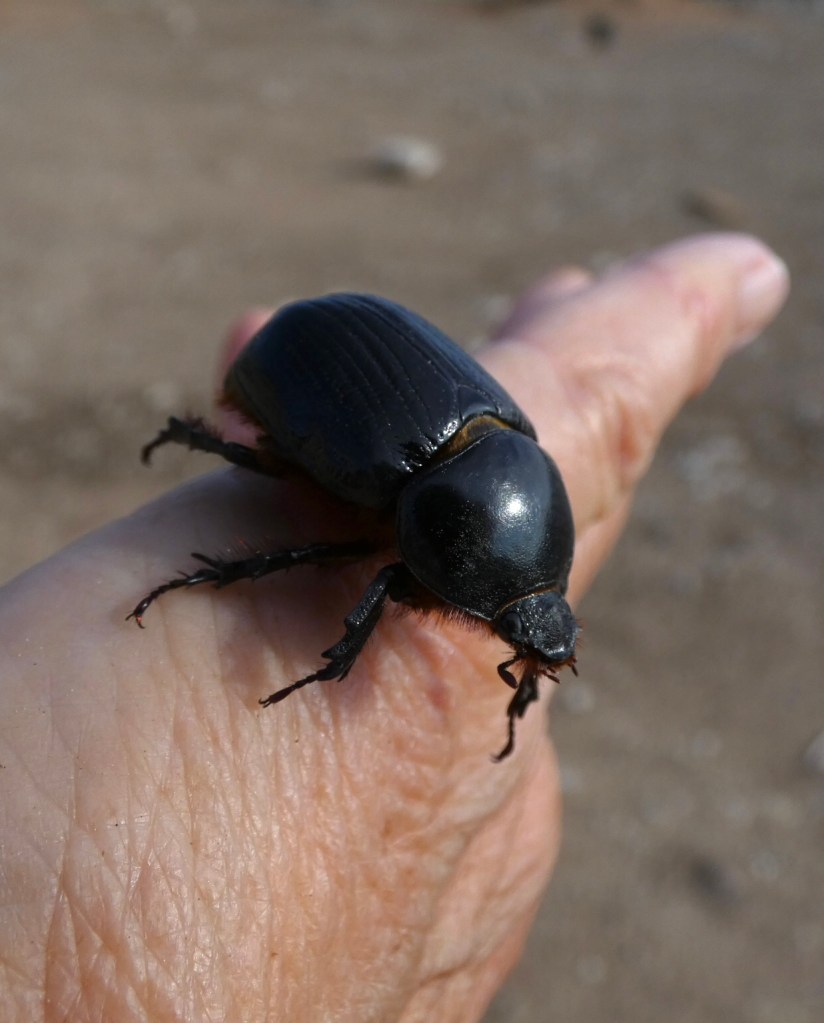
What began as a daunting pile of millions and millions of tiny little stones, by morning #3 the pile still looked impossibly huge, while the only thing diminishing was our enthusiasm. So it wasn’t a big surprise when, after only 15 minutes of scooping, a very large and shiny black beetle was welcome excuse for a break! After all, she was charging across our travel path, and without rescuing would’ve surely been squished flat under a careless wheelbarrow tire!
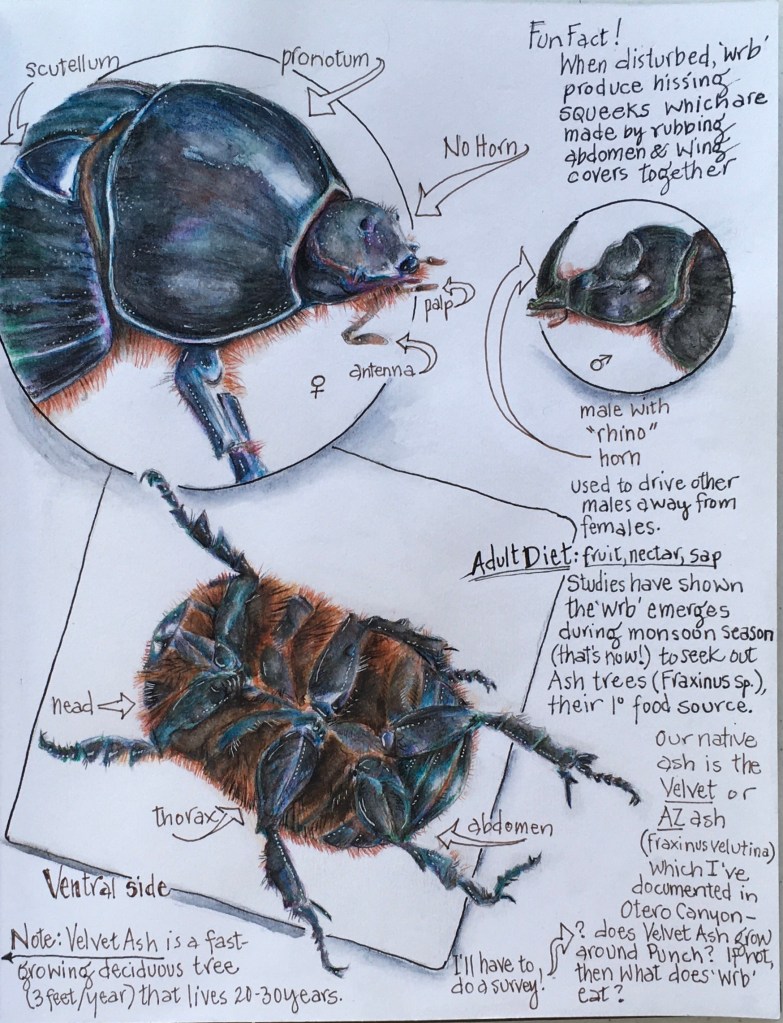
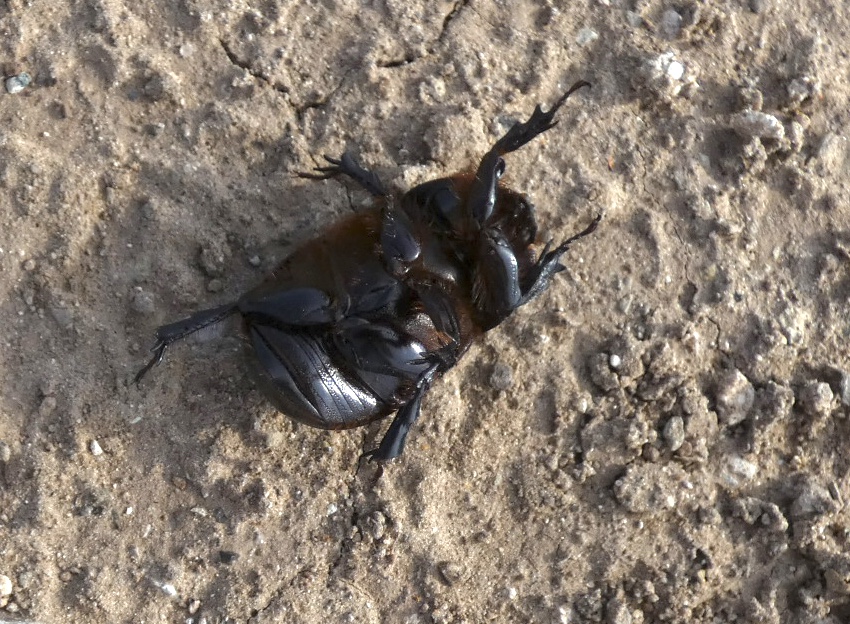
And we paused …… for nearly 45 minutes ….. as we ooohed and aaaahed over such a magnificent beetle, wondering what she could be. Well over an inch long, we noticed her blue-black head, thorax (pronotum) and hard wing covers (elytra) as shiny as freshly polished paten leather shoes, were ringed by a dense fringe of rusty orange hairs. When she went belly-up, we could see those hairs all over the ventral (lower) side of her head and thorax.
Not enjoying exposing her undersides to the world, those six flailing, long and powerful, many-segmented claw-tipped legs flipped her body over and she quickly resumed charging across the ground. Roy kept her in sight while I ran for the camera, determined to take lots of photos to get an ID. About a dozen poses later, and with the help of iNaturalist, I learned that our visitor appeared to be a female Western Rhinoceros Beetle (WRB)!
Yes, apparently there are Rhinos in New Mexico! How cool it would be to find a male or two, and watch how they use their horns (which are as tall or taller than their steeply pitched and somewhat concave pronotums) in battle to win a hornless female.
Wonderings! Why was our female WRB in such a hurry? Was she running from a male? Two battling males? Had she mated already and was in search of a Velvet Ash Tree (a NM native species and likely her preferred food source) where she could lay her more than 100 eggs in the soil beneath the tree? How does she find these ash trees, because I’ve never seen one on our 2 acres or along any of our neighborhood hiking trails?
So many unanswered questions! But you can bet I’ll be on the lookout for the next WRB to trek on by. Maybe I’ll drop everything I’m doing (like scooping pea gravel) and follow her or him just to answer a few questions! Do you think Roy will mind being left behind holding the shovel?
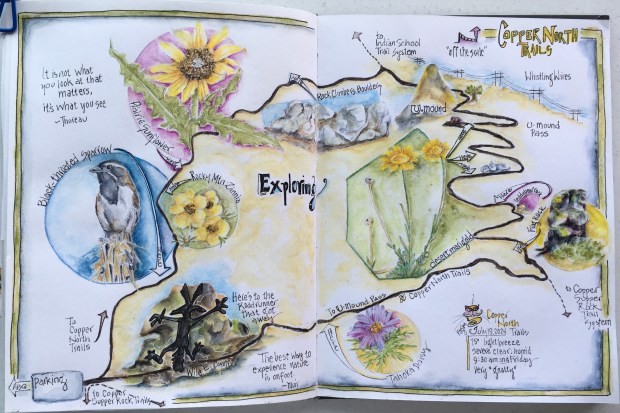
Hiking and rehiking familiar areas always turns up new discoveries. This may be because my eyes skim over the most commonly seen phenomena, allowing me to actively search for anything new or anything out of place. Rarely am I disappointed.
A few days ago, we explored one of our favorite hiking areas. Because birds tend to be more secretive this time of year, the best surprise was to hear a black-throated sparrow sweetly singing from his perch atop a cholla skeleton.
Because it’s monsoon season, many plants that bloomed late spring are making a comeback, and are happily spreading throughout the area. So to keep track of how ranges are expanding, I made note of their locations and transferred this information to a simple trail map. I also noted that the most commonly seen flowers were from the composite family …. the sunflowers.
Oh! Couldn’t resist capturing the silhouette of Wile E. Coyote glued to the back end of a dented vehicle in the parking area. That’s was a perfect discovery for the resident roadrunners!
Do you enjoy exploring familiar areas? What surprises have you discovered?
While my mind is on the subject of local wildlife residents (see my long-tailed weasel post just a few days ago), I’ve been wondering a bit about the black-tailed jackrabbit (Lepus californicus). Fairly common in our area (and throughout most of New Mexico and the West), it’s always exciting to see one of these swift, long-legged desert “Jacks” bolt and run when spooked. To escape a predator, at the very last moment before discovery, the jackrabbit uses the element of surprise by leaping from his hiding place in the tall grass. The predator, now in hot pursuit, is usually left in the dust as the jackrabbit continues to leap, then leaps/runs until the “Jack” reaches top running speed all the while zig-zagging in an unpredictable manner. And poof! Gone! The predator, now completely baffled, gives up the chase, while the clever jackrabbit lives another day.
So back to my wonderings. Just how fast can a “Jack” actually run? How far can he leap? Doesn’t the jackrabbit get its genus name, Lepus, because they “leap?”
What I learned is the top running speed for a jackrabbit is 35-40 mph (Zoom!) and they can leap 15-20 feet in a single bound (super Jack!). Their top speed + their leaping nature allows them to easily escape most predators. But the name Lepus has nothing to do with leaping. Lepus, as translated from the Latin, means rabbit/hare. And one other thing that was news to me …… a jackrabbit is actually a hare, not a rabbit as the common name would imply! Of course this sparked another wondering. What’s the difference between a hare and a rabbit?
Various sources cleared up the hare vs rabbit conundrum …..
Hares are usually larger than rabbits, have longer ears and black markings on their fur. Hares have 48 chromosomes; rabbits have 44. Hares haven’t been domesticated; rabbits have. Hares live and give birth in shallow depressions in the grass; the young are born fully furred with eyes wide open, able to fend for themselves soon after birth (precocial). Rabbits usually live and give birth in burrows; the young are born blind and hairless and totally dependent on mom (altricial). Hares usually live alone; rabbits live in large communities called warrens.
There’s so much more to learn, but this will have to do to satisfy my curiosity for now. If you have hares living near you, or perhaps you have a pet rabbit, share your experiences and observations of one or both species.
P.S. I had fun drawing this jackrabbit (jackhare???), and did so as a gift for a dear friend who happens to love hares/rabbits. Wonder which one is her favorite? I’ll have to ask!










 a curious nature