Ahhhh, September! The month of slowing down, hints of crisp morning air, tree leaves turning ever so slightly from green to golden, a bit of wanderlust satisfied.
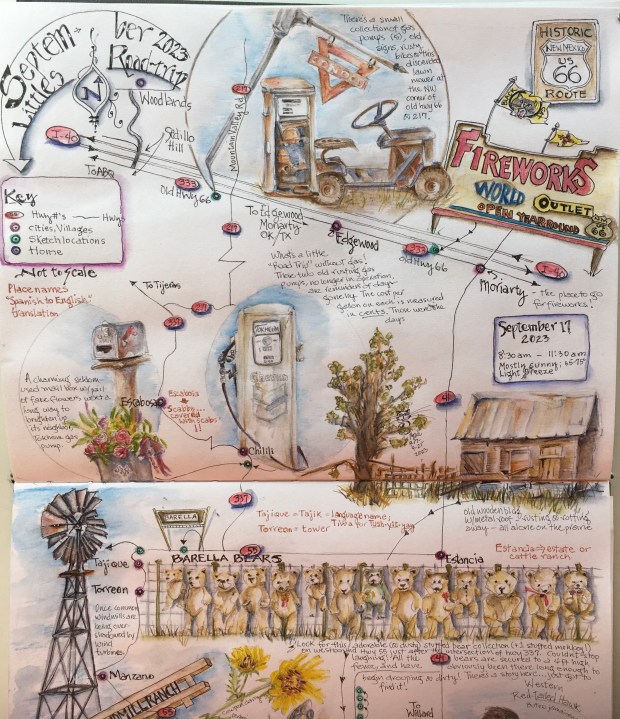
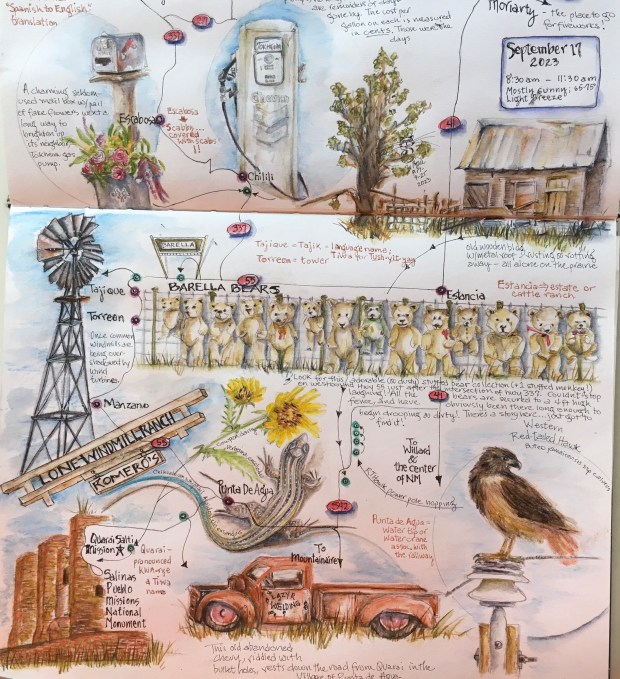
Instead of creating “Little” paintings of a month of highlights, and there have been many, I decided to focus on a single “Little” road-trip down the east side of the Manzano Mountains. My goal was to take a fresh look at, well, everything …….. and watch as the story of rural life unfolded.
As we wound our way along scenic backroads, I mentally sketched out our route map to depict some of the historic and present day highlights across the landscape. My imagination envisioned the full, prosperous and peaceful village life of the Tiwa Indians, and their conquest and struggle to survive Spanish occupation. There was evidence of the optimistic outlook of early settlers who came west to build a life centered around dryland farming and ranching. And today, modern day ranchers live on the land adjacent to land grants where indigenous peoples live a rural lifestyle on their native lands. I hope you enjoy my route map with some of these highlights, ranging from serious to funny, natural to commercial.
I’d love to know what story unfolds for you as you travel along on this September “Littles” Road-trip. Be sure to pack a lunch!
Once again, a big shout-out to “Made by Fay” for the inspiring “Littles” idea! These pages are fun to create, and remind me of monthly highlights and the random road-trip as I revisit my previous “Littles” posts. Hope you’re enjoying them too, along with the ending days of the season. Stay tuned for the next installment of “Littles.”
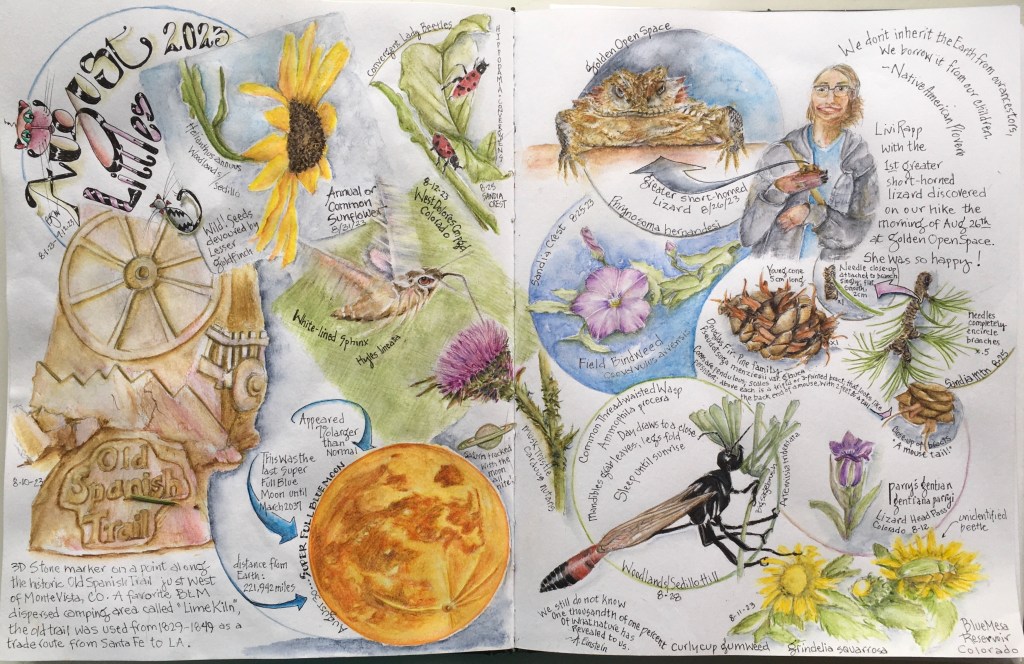
August was a busy month, filled with high elevation camping in Colorado, and a lot of cool mountain hiking back home. Even though the lower elevations took on a hot and parched look, at 9,000 feet and higher the wildflower season was far from over as evidenced along roadways and trails, where fresh, colorful blooms could still be found.
The highlight of the month was a 3-1/2 day visit from my brother Bob and grandniece Livi. At 15 years of age, Livi is already a fine artist, and took to nature journaling like a pro! It was great fun discovering and sketching nature on our daily hikes. She even got a chance to hold one of the adult ornate short-horned lizards we see frequently along various trails, and then found a baby lizard on her own, hiding nearly motionless under a small plant. Her smiles were priceless!
Despite the high temps, it was a month of good days and nights, ending perfectly with the rising of a rare Super Full Blue Moon! If you missed it, there’s plenty of time to prepare for the next …… which occurs in March 2037.
Once again, a big shout-out to “Made by Fay” for the inspiring “Littles” idea! These pages are fun to create, and remind me of monthly highlights as I revisit my previous “Littles” posts. Hope you’re enjoying them too, along with the ending days of the season. Stay tuned for the next installment of “Littles.”
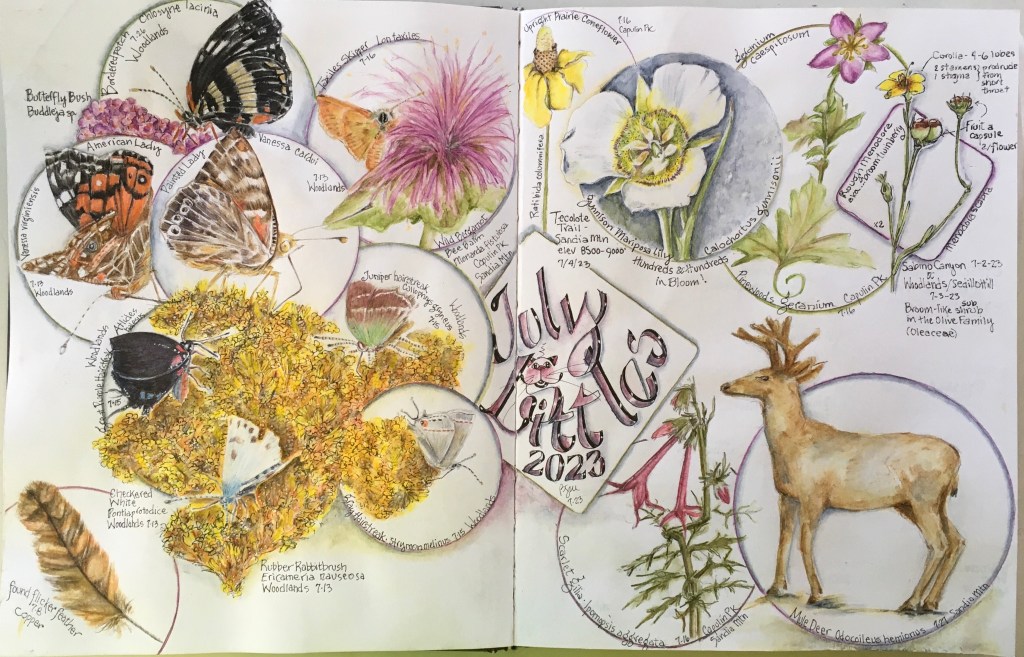
June’s hot, dry weather slipped stealthily into July as we became mired in one of those infamous heat domes for weeks. Our rabbitbrush shrubs, usually late summer bloomers, burst into piles of brilliant yellow flowers a full month before normal, and for the first week of their premature bloom, not a single pollinator was in sight. I was so concerned the over abundance of nectar would dry up, pollen would blow haphazardly away, and seeds wouldn’t form. Then one morning I woke to find hundreds of butterflies, weevils, flies and bees flitting, crawling and buzzing about, nearly covering the shrubs completely in a pollination frenzy! How did they know? Where did they come from? What a relief for me, but it must’ve been an unimaginable relief for all of those pollinators that happened upon our oasis in the desert.
And so it went, all month…. bursts of early blooms rapidly completing their floral life cycles, thanks to urgently feeding pollinators.
This is how I remember July, with everything in bloom at once, the air full of pollen and pollinators. It was quite a sight!
Once again, a big shout-out to “Made by Fay” for the inspiring “Littles” idea! Stay tuned for the next installment of “Littles.”
Welcome back to my nature journaling blog! Today I’m excited to introduce my grandniece, Alivia Rapp. Livi, who is a very creative 15 year old, and the daughter of one of my brother’s daughters, came to visit for 3-1/2 days with “Grandpa Bob” (that’s my brother).
Livi with her new love …. A Greater Short-horned Lizard
During the past year, Livi and I have been chatting online about her art, her storytelling skills and her keen imagination in character development which she has honed through many years of daily practice. Then last year, enrolled in a beginning art class where she quickly demonstrated her artistic skills, her teacher bumped her into the advanced class. It was obvious Livi was in her element! She excelled in all of her art assignments which included still life and nature studies, portraits and perspective drawing, using a wide variety of tools such as pencil, pen, watercolor, acrylic, and colored pencil. Her first love of Anime and fantasy storytelling showed in her work too, and one of her creations was awarded a ribbon at her local spring fair. Congratulations Livi!
Now back to nature journaling. Every morning, Livi and I (equipped with sketchbooks and pens), Bob and Roy (carrying daypacks with water), set out for a bit of hiking and sketching nature discoveries along 3 different trails. Roy and I picked trails at different elevations with different habitat zones and views, knowing we’d have a variety of sketchable subjects. We weren’t disappointed!
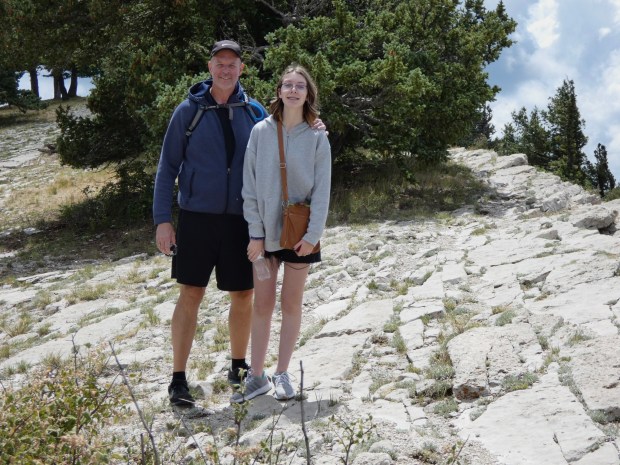
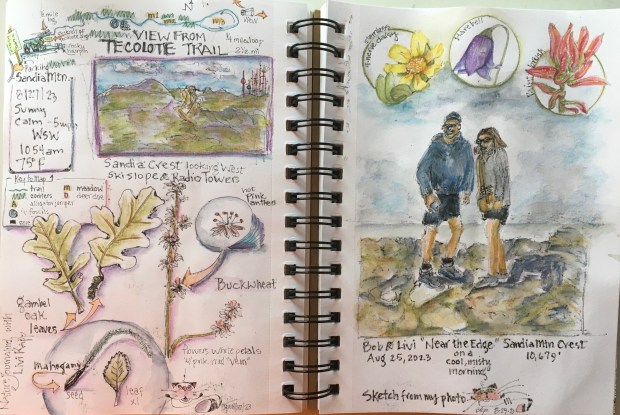
My brother, Bob and granddaughter Livi on the Sandia Mountain Crest Trail
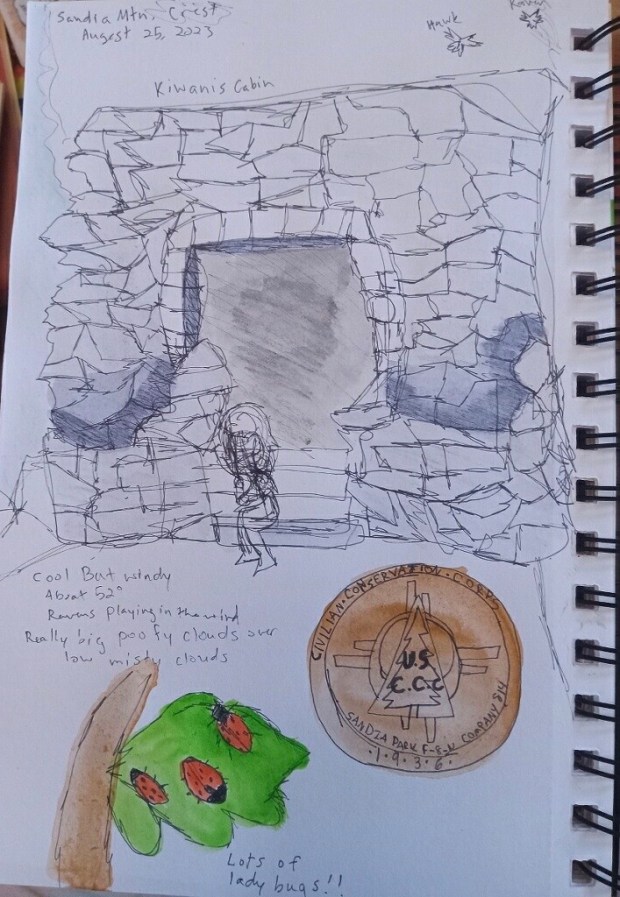
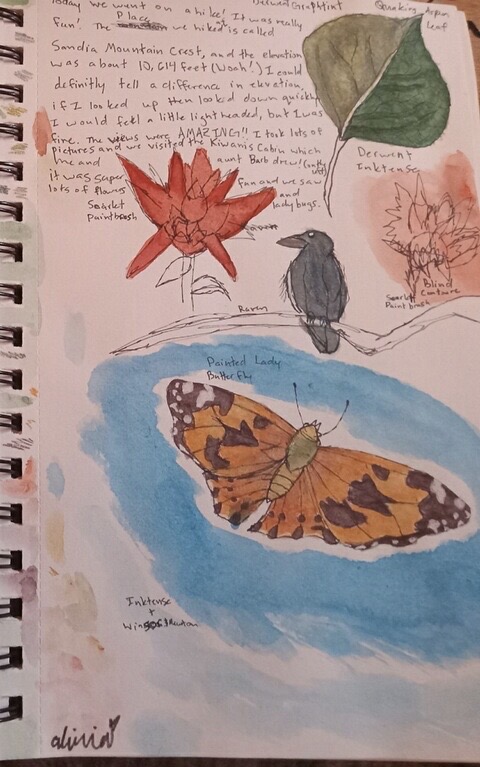
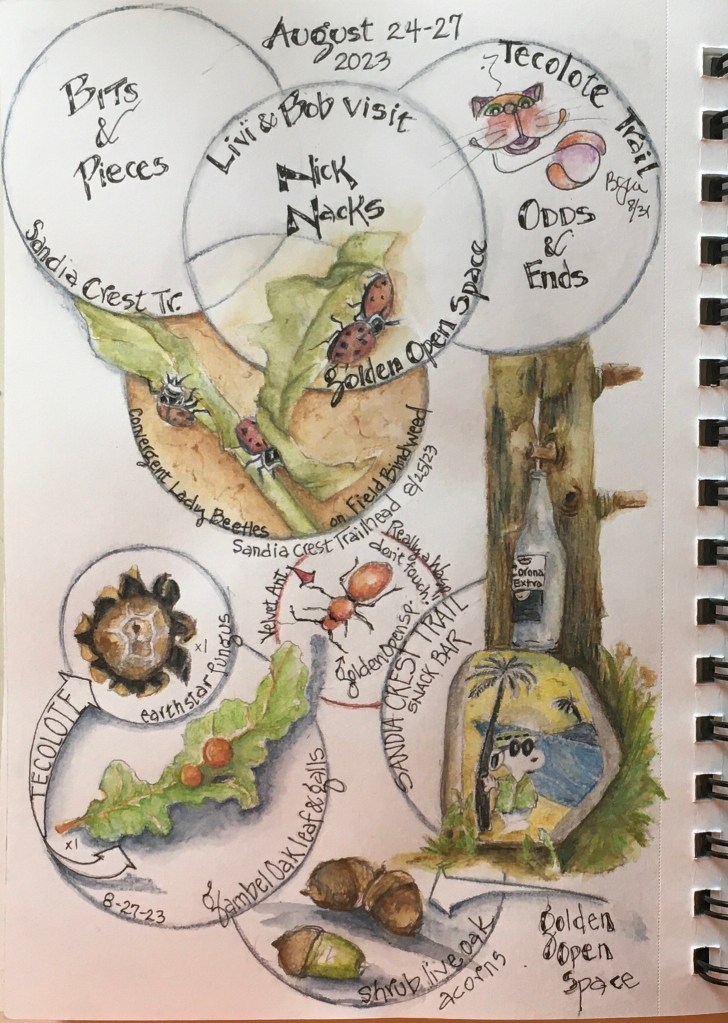
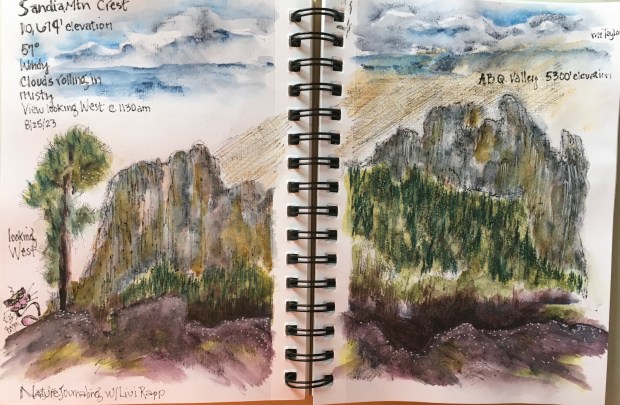
Hike #1 took us to the top of Sandia Mountain (10,679’) where we enjoyed many spectacular views of Albuquerque and the Rio Grande Valley a mile below, as we passed through a high elevation conifer forest on our way to the Kiwanis cabin. So many sketching opportunities ….. we each tackled the cabin, and Livi added a few of the 50+ lady beetles she discovered, then created a page with a raven, painted lady butterfly, a red paintbrush flower and aspen leaf. I chose a view, some wildflowers and the charming “Snack bar” marker (haha). Back at home we completed our sketches, adding watercolor pencil, with Livi being careful to note the names of my supplies she tried out.
The Kiwanis Cabin and CCC construction plaque; a few of the lady beetles Livi discovered near the trailhead
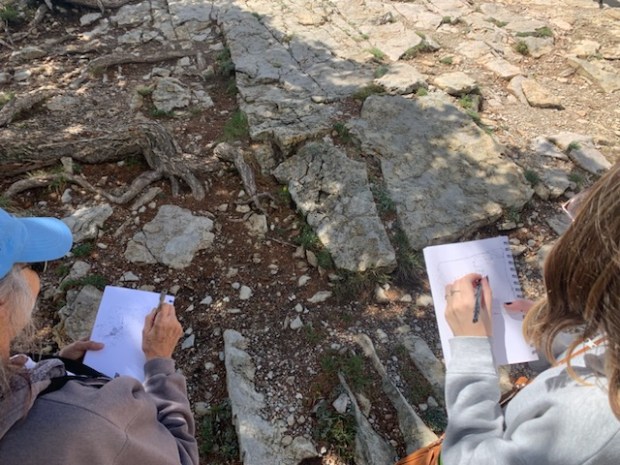
Livi and Barb hard at work sketching the Kiwanis Cabin
Livi’s wildlife composition along the Sandia Mountain Creat Trail
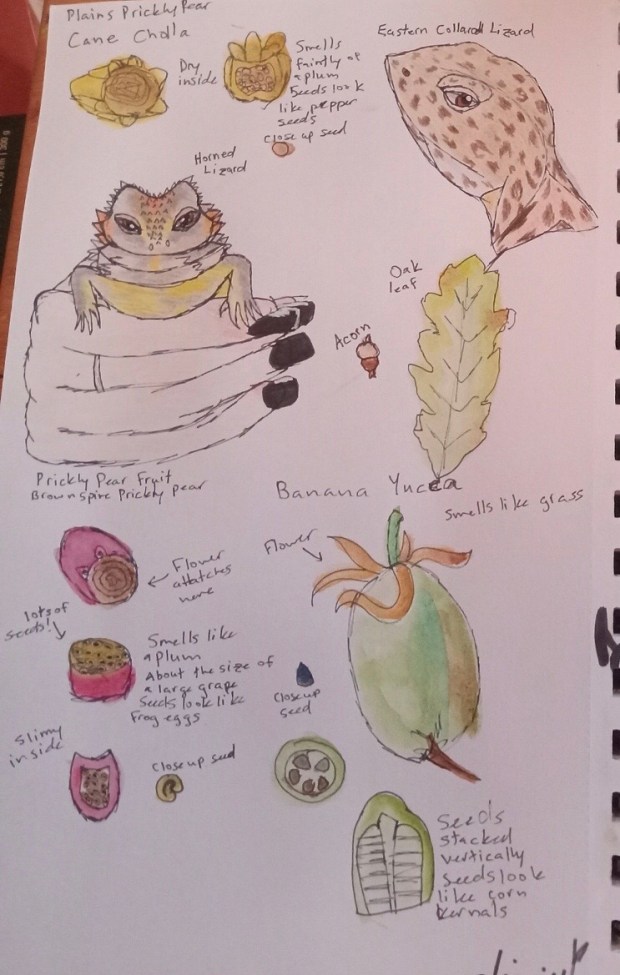
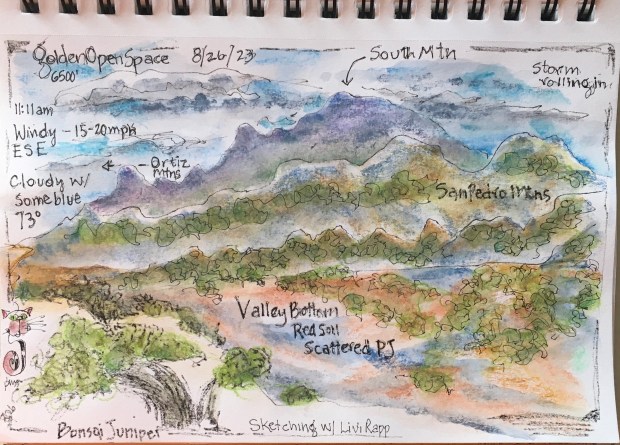
Hike #2 and we all hiked the upper loop trail at Golden Open Space which sits at about 6300’. The scenery and views were some of Bob’s favorites, so Livi and I spent about 5 minutes sketching one of the prettiest looking East towards the Ortiz and San Pedro Mountains and South Mountain. Then a great surprise discovery along the trail ….. an Eastern Collared Lizard! That was the first collared lizard Roy and I had ever seen at Golden, and after a few photos he decided to rise up on his tippy-toes and run like the wind! Then our second surprise …. we nearly stumbled over a beautifully ornate Greater short-horned lizard ….the lizard referred to by many as a “horny toad.” Before he could get away, Roy was able to snatch him up, roll him over on his back so he could get a belly rub that put the lizard to sleep. Sort of. Then after being entertained by a few erratically running fire engine red velvet ants, we had our 3rd great surprise, thanks to Livi’s eagle eye! A baby greater short-horned lizard that was trying to escape our view was also snatched up by Roy, and also became very sleepy. So cute. Livi was so glad we didn’t encounter any tarantulas, but declared that she loves the horned lizards! Back at home we finished our landscape sketches, and created pages illustrating the lizards. As an exercise in comparison, Livi dissected then sketched a few prickly pear “tunas” (the fruit) and a dried fruit from one of the chollas. She also cut into a large banana yucca fruit ….. which reminded her of a cucumber. Very interesting and fun!
Livi’s sketch of the San Pedro Mountains, colored with pan pastels
Golden Open Space was full of surprises! Livi’s journal page illustrating just a few!
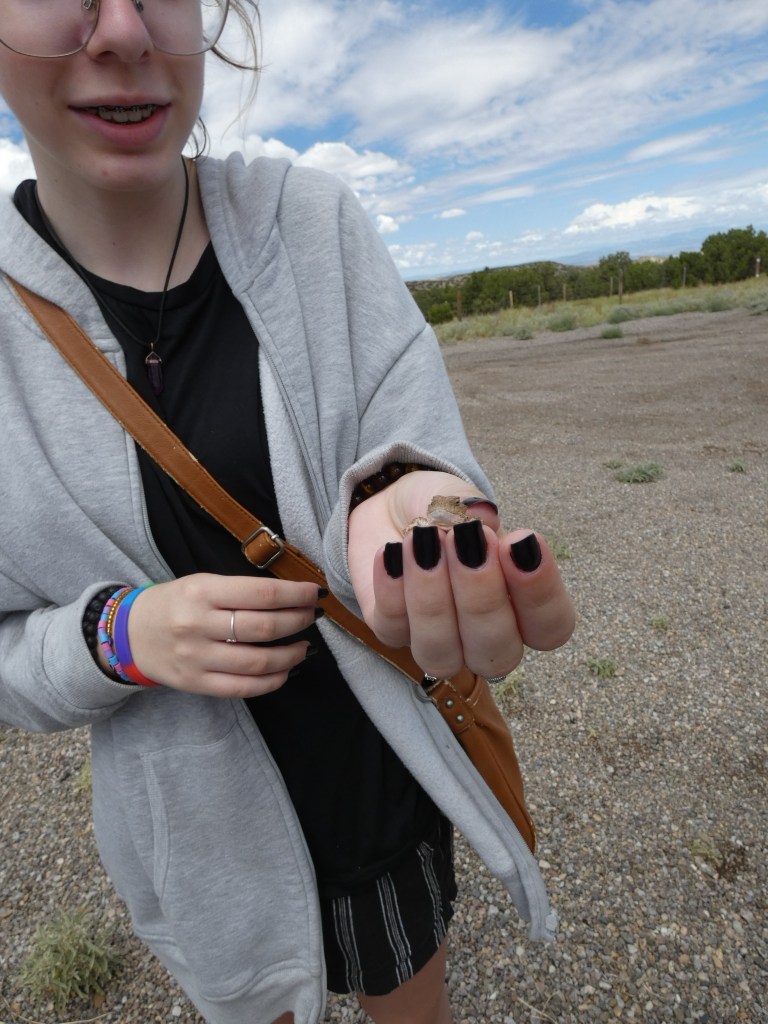
Livi holding the baby greater short-horned lizard she found.
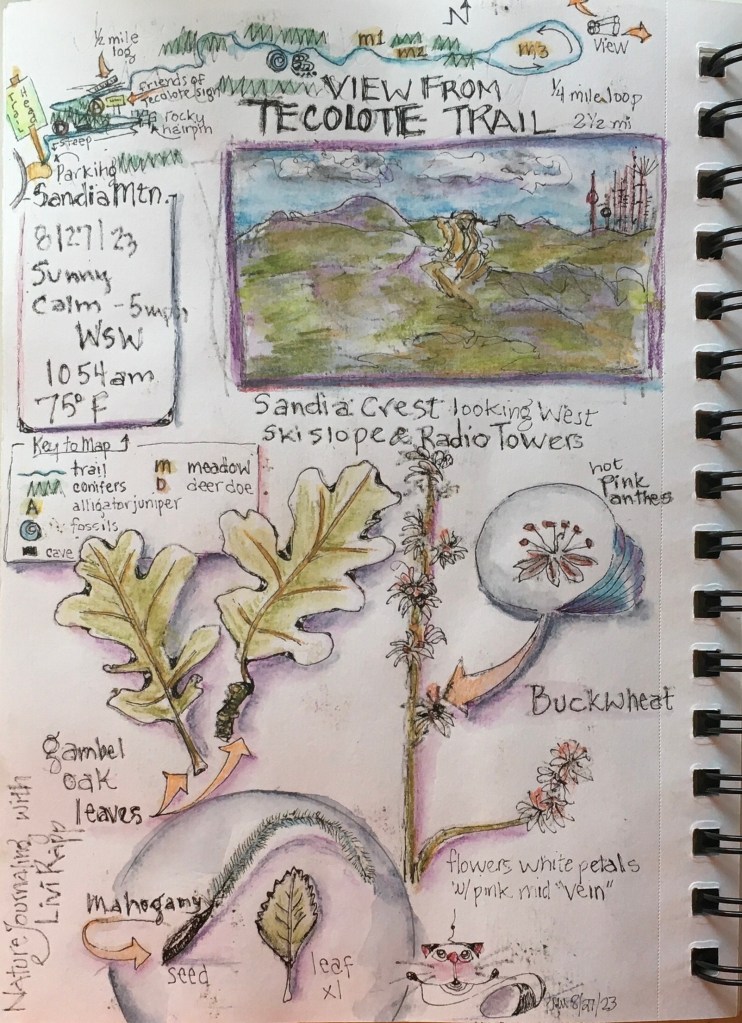
Hike #3 and we were back up Sandia Mountain and hiked the out-and-back 2.5 mile Tecolote Trail which sits at about 8500’ elevation. We had more beautiful views of the valleys below and the Sandia Mountain ski slope (which we sketched), and identified quite a few wildflowers, trees and shrubs. On the way down the trail we were surprised by a lovely mule deer doe as she quietly and carefully picked her way through the forest. Back at home we completed our sketches which included a wildflower drawing of a buckwheat plant, the seed and a leaf of an alder leaf mahogany shrub, and several sketches of oak leaves which we each tried as a blind contour drawing and a contiguous line drawing. Hey, they looked pretty good too! Back at home we rested, exhausted by our artistic efforts. But after Livi returned to her home near Seattle, she completed all of her pages and shared them with me.
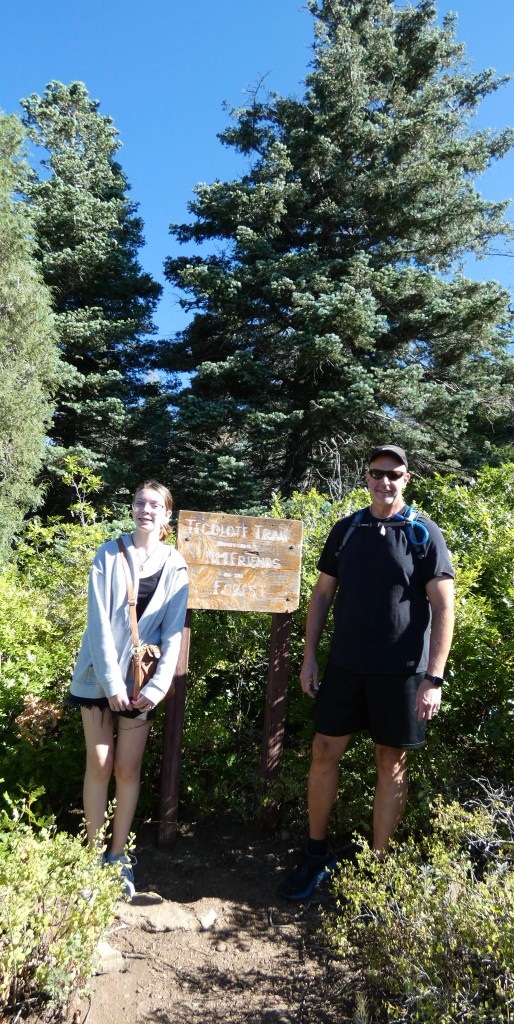
Livi and Bob about to embark on the Tecolote Trail
Livi’s journal page with on location sketching exercises
Roy and I had fun sharing our love of New Mexico with Bob and Livi. And I especially loved getting to know Livi and sharing my love of nature journaling with her! Livi and I will definitely be staying in touch throughout the school year as she begins grade 10 and a new session of the advanced art class. I can’t wait to see shat she learns and creates!
Thanks for wanting to come visit and sketch, Livi …. and thanks to Grandpa Bob for bringing you along. It was awesome!
Here’s my sketches from the 3-1/2 days. I loved every minute!
Until next time ……. Take a friend nature journaling!
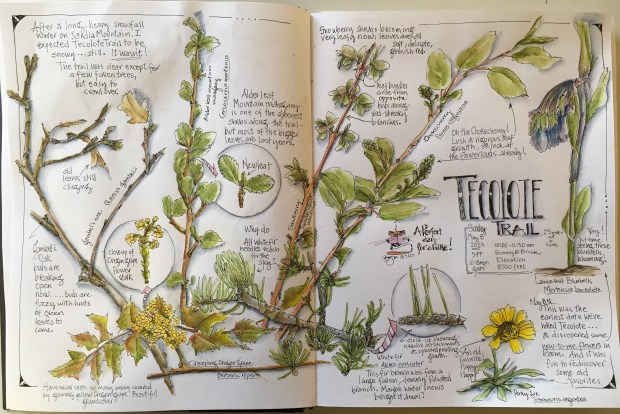
After having just returned from a fabulous week in southern New Mexico (blog posts to come) where we hiked and hiked, and got reacquainted with the Spring-time desert flora and fauna, we seemed to be craving pine and fir trees and some mountain air. How high do we dare hike? Would there still be snow? These and more questions rattled about in my mind as we headed the truck up the 13 mile long and winding Sandia Mountain Crest Road (central New Mexico). Ahhhhh …… so invigorating!
Satisfying our craving (at 8500 feet in elevation) and answering the question about leftover winter snow (not a single snowflake to be found), we pulled up to the Tecolote Trail trailhead and began our ascent, in shorts and T-shirts. The first half mile up was brisk, both in temperature and pace, but after I was well warmed up it was time to open my eyes to investigate anything and everything growing, sprouting and blooming.
This was the earliest date (May 7th) in the Spring we’ve hiked Tecolote, so I was hoping to see a variety of wildflowers that were new-to-me species. I wasn’t disappointed! Blooming beautifully were the minuscule Pygmy-flower rock jasmine (in the primrose family), Arizona valerian (a species of honeysuckle), along with lance-leaf bluebells (borage family), and White Mountain bladderpod (a brilliant yellow 4-petaled member of the mustard family). Covering the slopes everywhere we’re the bright yellow flowers of Oregon creeping grape (aka creeping mahonia), and common along the trail were flats and flats of the dwarf purple and white lousewort (in the broomrape family), it’s flowers growing close to the ground amongst its deep green dense and curly margined fern-like leaves. Perky Sue (a happy yellow daisy) and the soft-like-a-teddy-bear prairie pasque flower (a type of buttercup) rounded out the bloomers that I could find.
These pages in my journal focused on the shrubs and trees showing growth alongside the trail, drawn from snippets collected during the hike.
It was a perfect morning for a hike! Wished you’d been there with us.
Until next time …… How’s your Spring is shaping up! Do you have a favorite plant that’s blooming, or a singing bird tending chicks? I’d love to hear your story.
P.S. This journal page layout was inspired by an amazing nature journaler, artist and teacher, Jean Mackay who loves all of nature and sharing her discoveries through illustration. Thanks Jean!
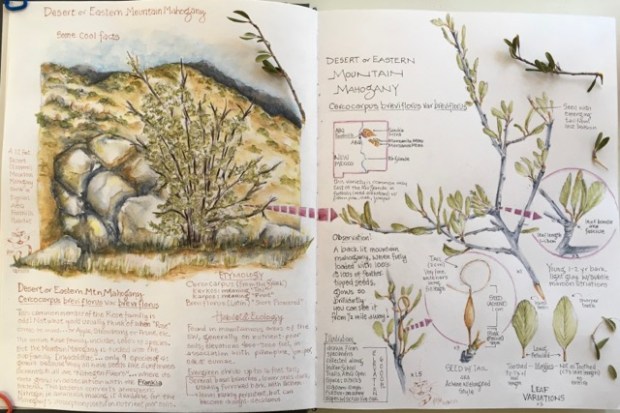
The Desert (Eastern) Mountain Mahogany is a very branchy shrub commonly found in the mid-elevation foothills of the Sandia, Manzanita, and Manzano Mountains east of the Rio Grande River in central New Mexico. This species’ formal and very appropriate name, Cercocarpusbreviflorus variety breviflorus, comes from both Greek (kerkos: tail; karpos: fruit) and Latin (brevi: short; florus: flowered). As a matter of fact, the 9 species of the genus Cercocarpus all have long feathery tails that twist and turn from the tip of a single fruit, called an achene (like a sunflower seed).
So why is this species odd?
Well, the fruit, for one reason. Most of the thousands of rose family members have fruits called a hip (rose), pome (apple), drupe (prune), or aggregate (strawberry). And even though the strawberry is composed of numerous miniature achenes, it’s the single achene found in the mountain mahoganies that’s unusual to the family.
To further emphasize the oddness of the Cercocarpus genera, all of its 9 species has a symbiotic relationship with a bacteria called Frankia. And that’s an unusual characteristic of the rose family, which moved Cercocarpus and 4 other genera into the subfamily Dryadoideae. That’s all a bit technical when it comes to plant classification, and kind of skips the real reason why the Frankia bacteria is important to the survival of Desert Mountain Mahogany. Nitrogen Fixation!
So much rain! Not complaining ….. we need the moisture. But with days of drenching rain falling in the East Mountains and the Sandias this entire week, summer seemed to flip into Autumn in a matter of days.
Trying to capture the last remnants of fading flowers, I was inspired by a remarkable naturalist and artist, Jean Mackay, to get out there and rescue blooming bits before everything turned brown and crunchy.
Thanks Jean, for the encouragement, and always helpful tips and techniques in creating interesting journal pages. My hike this morning revealed some surprise bloomers that I wanted to remember in my nature journal.
And thanks to my many followers for your continued interest in my discoveries!
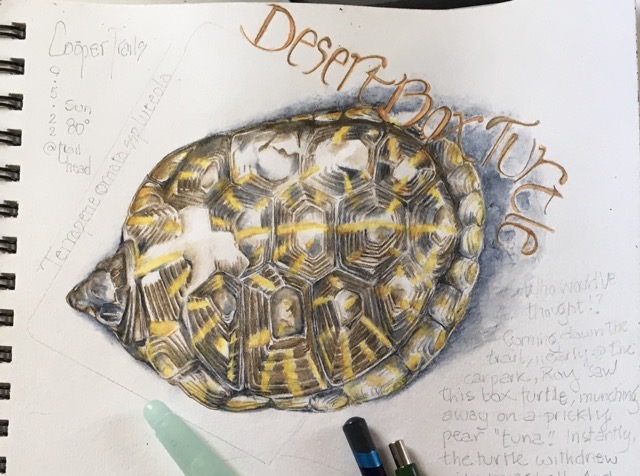
Observing nature, especially in a desert environment, requires cautious peering under scrub oak and cholla. It’s always wise to gently part the razor sharp leaves of plants like beargrass and banana yucca with a long stick. Everything seems well armed with spines, thorns or prickles. But look you must, because you never know what you might find cooling off in the shade of a big leafed buffalo gourd or making a noon meal of a prickly pear fruit in the shadows of fan-shaped pads.
But when exploring it’s wise to always, always remember you might be surprised by a snake. So imagine our relief and delight when on a stretch of dusty trail we encountered our very first desert box turtle!
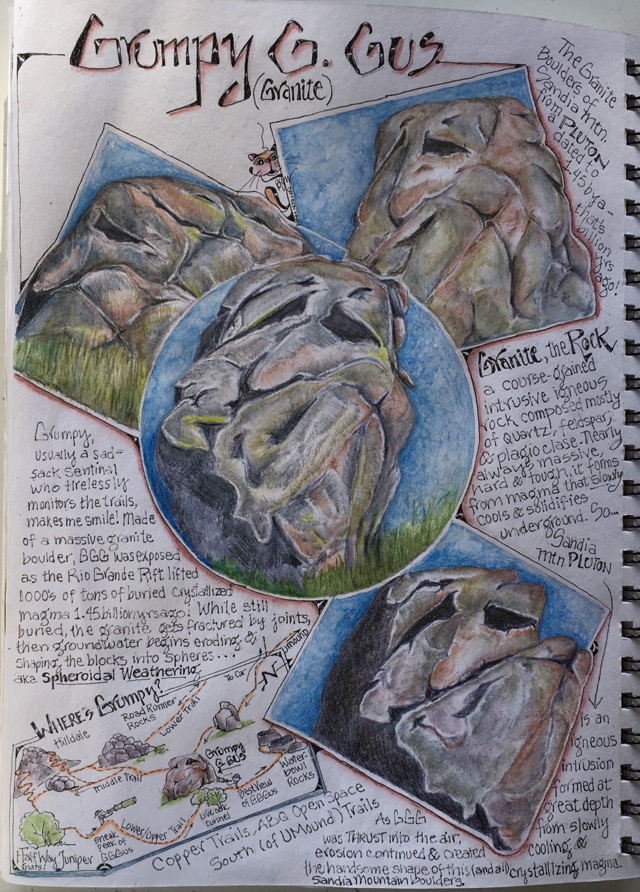
Sandia Mountain granite! Such distinctively gnarly gargoyles, whimisically odd and judgmental, critter and caricature mimics ……. There’s nothing like these boulders! This is a short story about one of a cast of thousands; Grumpy G. Gus.
But there’s a longer story too. Underneath the often comical-looking and recognizable characters that can be envisioned in these boulders, there’s an even more fascinating tale that tells volumes about the geologic history of central New Mexico. Come along and meet Gus and learn a bit about Sandia Mountain granite.
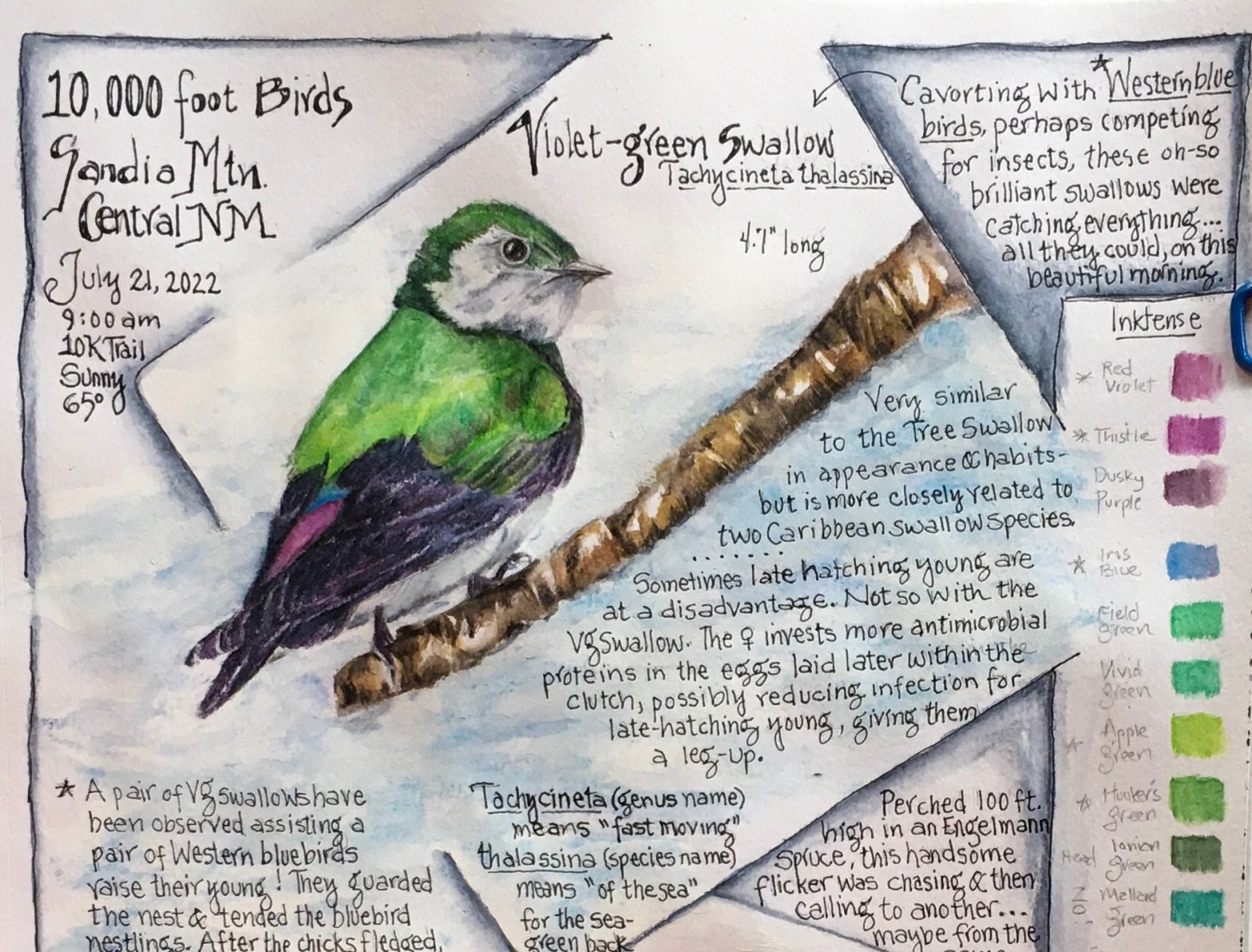
In an effort to escape the blistering temperatures brought on by a mid-July heat dome, we decided to take a cooling hike high above Albuquerque. At 10,000+ feet, the trails along the top of Sandia Mountain are a refreshing contrast to the dry desert habitats we usually enjoy.
Up high there are spruce, fir and aspen trees surrounding lush meadows full of blooming wildflowers. On the margins we found flying, flitting, perching and singing some of the prettiest birds we’ve seen all season. Let me share some of the fun facts I learned about two of these birds; the Violet-green Swallow and the Northern Flicker.







 a curious nature