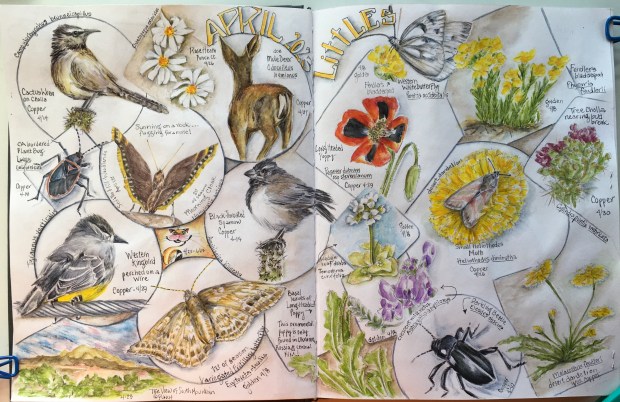
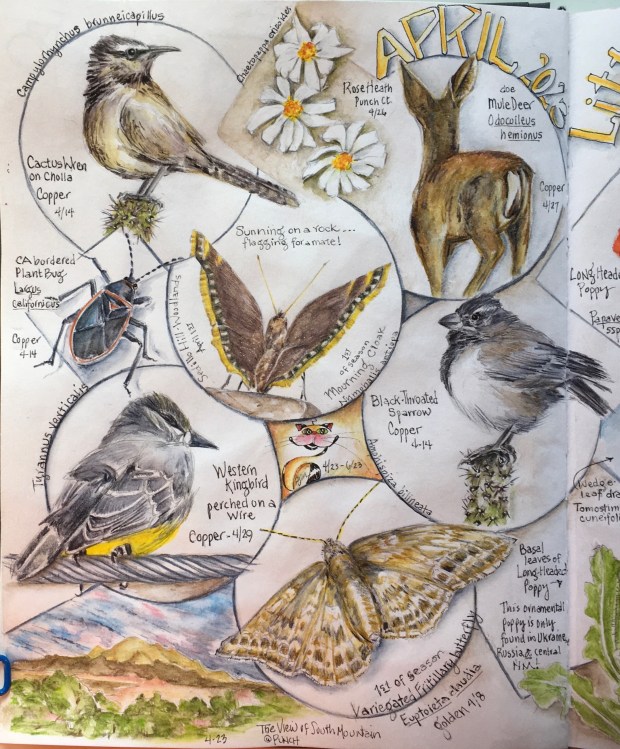
In the blink of an eye …… April! The dusty browns of late winter gave way to landscapes full of color! Movement was everywhere ….. Flower buds began opening as emerging insects smacked their lips in anticipation. Birds, flocking to their breeding grounds, had hungry eyes on the growing bug population. Hibernating reptiles began to stir as the earth warmed; lizards stretching sleepy legs in their underground burrows, that will help them flee slithering snakes; snakes wriggling and coiling and hissing, perhaps thinking about a breakfast of juicy lizard or a baby bird. Mule deer moved down from the surrounding hills to nibble fresh plant growth. Coyotes hunted desert cottontails as they snacked on prickly pear pads.
April was amazing! There was so much happening, that it was all I could do to take in so many changes. It was such a challenge just to slow hike the hills every day, observing and taking photos, that keeping up with my “Littles” pages seemed impossible!
Close up
So here it is mid-June, and I’ve finally put the finishing touches on my April “Littles.” While creating my tiny framed discoveries, I questioned my desire and/or the need to continue with this project. But then I quickly dismissed those thoughts. After seeing these pages finished, I realized it was not only great fun, but an important reminder of what happens in nature during April.
Another close up
Again, many thanks to “Made by Fay” for the inspiring “Littles” idea!
It’s that time of year again …… International Nature Journaling Week (INJW), and I’m excited to be taking part in the fun. Beginning June 1st, a full week of nature-inspired workshops, interviews, prompts and other activities will be presented by an amazing line-up of nature journalers, artists and environmental educators from around the world. The host, founder and organizer of INJW, is nature journaler, teacher and environmental educator, Bethan Burton. This year the theme of INJW is a “Sensory Safari,” and Bethan, who also hosts her own podcast, Drawing with Nature, will take us through each day as we explore how nature engages at least seven of our senses: Color, Texture, Aroma, Song, Flavor, Movement, and Heart.
It’s not too late to get involved and there’s no cost for participants, so check it out! All workshops and resources, the schedule and links to videos are available at https://www.naturejournalingweek.com/
Day 1: Color Across Continents
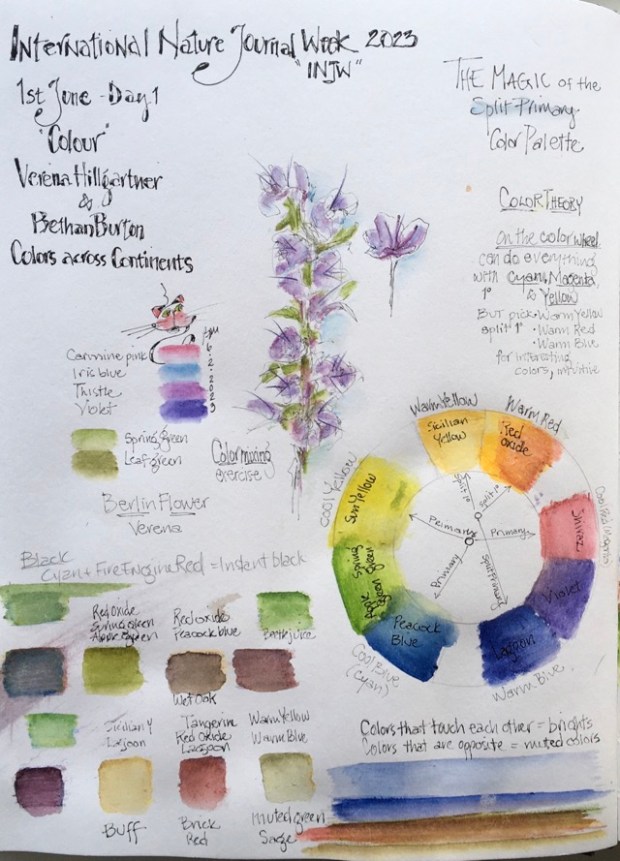
Imagine your world in black and white. Color brings life to our visual party and defines our sense of place. When I think about or see the colors of New Mexico …. the rusty reds and buff-colored rock and sand, the greens and blues of piñon pine and sagebrush, the lemon yellows and violet reds of spring wildflowers, all framed by vivid intensely blue skies ….. I know I’m home. After Verena (a naturalist from Berlin) and Bethan (who is from Queensland, Australia) talked about the use and how-to’s of color in a nature journal, Bethan presented a mind-blowing workshop on color mixing, color theory, and the Magic of the Split Primary. Admittedly, I’ve been a hit-or-miss approach artist when it comes to color mixing; struggling to achieve a color match with my surroundings. But there was something in the way Bethan explained color theory and the use and mixing of warm rather than vivid primaries; and all at once I was mixing those elusive sage greens and brick reds! It was a real “duh” moment for me; color theory definitely is something worth understanding!
Below is the practice page I created during the workshop guided by both Bethan and Verena. For fun, they even encouraged us to make up names for our color mixes ….. names that conjure up an image of the color based on a familiar object, such as Rusty Bike, Brick, Cotton Candy, Moldy Cheese (you instantly know those colors, right?!).
Then we were invited to create a journal page with colors of home. I quickly swatched out colors I’ve seen all Spring. Then borrowed on some of my photos captured while traveling about central New Mexico, adding in a few wildflowers and one of the most decorated bird to visit our feeders. When I look at this page, the colors truly warm my heart. This for me is a bit of what nature journaling is all about. But just a bit. I know this week will go a long way to reveal more of the “bits” that have made nature journaling such an important part of my world!
Thanks for taking a look! I hope my pages spark in you a sense of curiosity and wonder, and that you would like to learn more. A good place to start is by visiting the INJW home page at https://www.naturejournalingweek.com/.
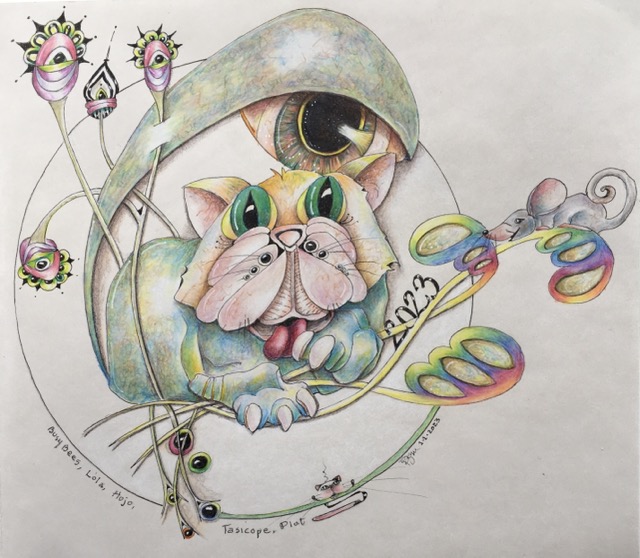
I tried to resist, but why? And that’s exactly what Flambé thought when on this night of the Full June Moon, a delectable “forever” buffet of royal red strawberries glistened with sweet goodness before her. Read on to discover how Kat finally decided which one of the countless strawberry confectioneries sprawling before her, she indulgently picked. Spoon optional!
Seems we’re now beyond the first exciting blush of Spring ….. the first new leaf, the first flower bud, the first darkling beetle; the first feather duster seed head of the Apache plume, the first hummingbird territorial battle, the first frantic squirrel noisily defending her nest.
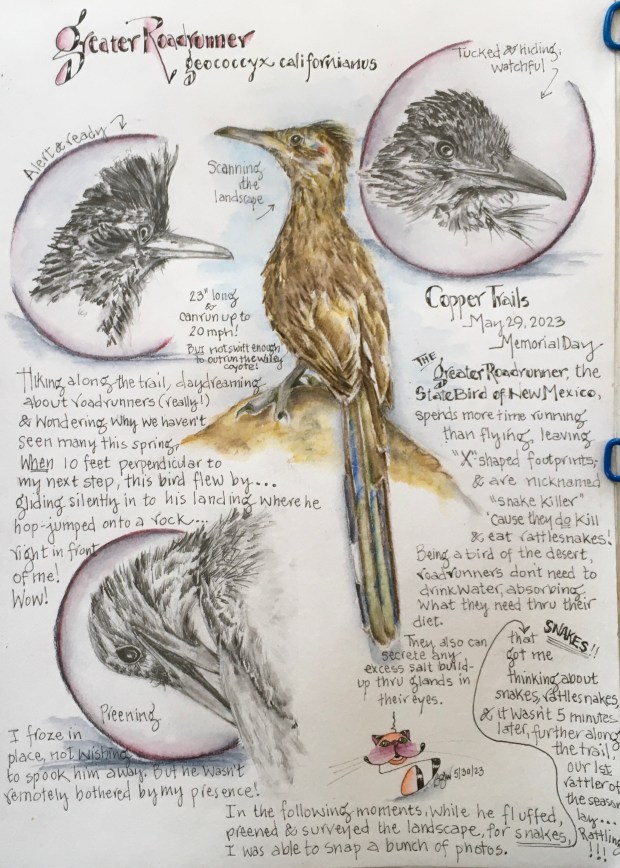
Having logged all the new flower species, insects, birds and mammals encountered on our favorite local trails, it’s now easy to daydream while hiking; easy to let your guard down and wonder about things like “where are all of the snakes hiding?” and “why haven’t we seen any roadrunners?”
It was while pondering these interesting questions along a stretch of trail bordered by oak scrub, that out of the blue, a short 10 feet in front of my next step, a roadrunner glided by and hop-jumped aboard a granite boulder! Shocked at how close and calm he was, I froze in place, not wishing to spook him. Having such a magnificent bird so close is a rare (for me) and crazy cool encounter. After a moment of stillness and observation on both our parts, I dared to take a photo. That bird didn’t care one bit, and was so incredibly unconcerned about my presence that he began preening his feathers, ruffled and shook, and started scanning the landscape for lunch.
Well, about a dozen or more photos later, it was time for me to resume my hike and catch up with Roy and Luna. I excitedly shared my encounter and photos with them (Luna wasn’t impressed) and wondered again, out loud, why we haven’t seen any rattlesnakes yet. Surely that roadrunner was hungry.
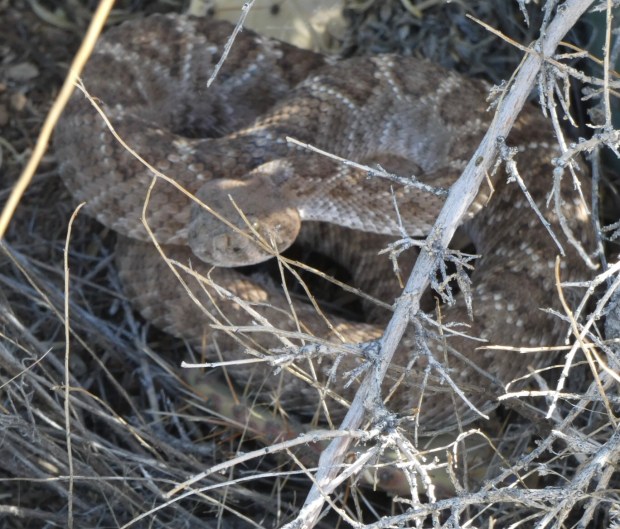
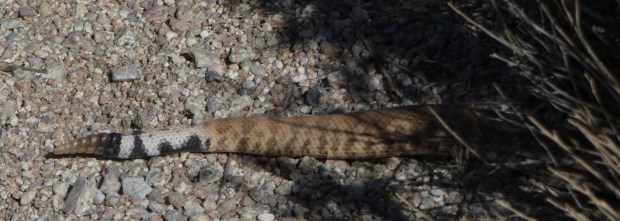
…… and then, out of the blue was the snake! About 5 minutes further along the trail was a 3 foot western diamondback rattler with 7 furiously rattling buttons on the tip of his tail! Luna jumped sky high, Roy came to a skidding stop, and I quickly (but oh so cautiously) approached to take photos! A very cranky snake he was too!
After having just returned from a fabulous week in southern New Mexico (blog posts to come) where we hiked and hiked, and got reacquainted with the Spring-time desert flora and fauna, we seemed to be craving pine and fir trees and some mountain air. How high do we dare hike? Would there still be snow? These and more questions rattled about in my mind as we headed the truck up the 13 mile long and winding Sandia Mountain Crest Road (central New Mexico). Ahhhhh …… so invigorating!
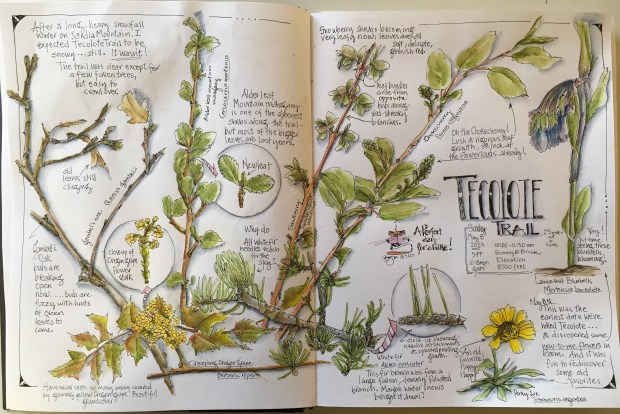
Satisfying our craving (at 8500 feet in elevation) and answering the question about leftover winter snow (not a single snowflake to be found), we pulled up to the Tecolote Trail trailhead and began our ascent, in shorts and T-shirts. The first half mile up was brisk, both in temperature and pace, but after I was well warmed up it was time to open my eyes to investigate anything and everything growing, sprouting and blooming.
This was the earliest date (May 7th) in the Spring we’ve hiked Tecolote, so I was hoping to see a variety of wildflowers that were new-to-me species. I wasn’t disappointed! Blooming beautifully were the minuscule Pygmy-flower rock jasmine (in the primrose family), Arizona valerian (a species of honeysuckle), along with lance-leaf bluebells (borage family), and White Mountain bladderpod (a brilliant yellow 4-petaled member of the mustard family). Covering the slopes everywhere we’re the bright yellow flowers of Oregon creeping grape (aka creeping mahonia), and common along the trail were flats and flats of the dwarf purple and white lousewort (in the broomrape family), it’s flowers growing close to the ground amongst its deep green dense and curly margined fern-like leaves. Perky Sue (a happy yellow daisy) and the soft-like-a-teddy-bear prairie pasque flower (a type of buttercup) rounded out the bloomers that I could find.
These pages in my journal focused on the shrubs and trees showing growth alongside the trail, drawn from snippets collected during the hike.
It was a perfect morning for a hike! Wished you’d been there with us.
Until next time …… How’s your Spring is shaping up! Do you have a favorite plant that’s blooming, or a singing bird tending chicks? I’d love to hear your story.
P.S. This journal page layout was inspired by an amazing nature journaler, artist and teacher, Jean Mackay who loves all of nature and sharing her discoveries through illustration. Thanks Jean!
“The Full Moon of May brings bright brushes to paint the Earth canvas with infinite flowers. In the Full Moon light of this month, the flowers are said to grow at night, and even dance in honor of the moon.”
Oh my goodness! What a brilliant Spring Super Bloom is on display mere steps east of Albuquerque.
Alas, I found myself lamenting for months over the long and snowy wet winter we just climbed out of here in the East Mountains of central New Mexico. It seemed the back-to-back snowstorms since last November were never ending; snow shoveling every morning became the norm. But I know better than to whine. An abundance of winter moisture always results in a spectacular abundance of spring flowers. And this Spring has proven that true.
Scrambled Eggs
The last two months we’ve seen a mad splash of sunshine yellow from the blooming of a native winter annual called Golden Corydalis, aka Scrambled Eggs (Corydalisaurea). This member of the poppy family quickly converted the dusty hillsides from brown to a glowing yellow as the many-flowered stalks of this plant seemed to shoot up over last season’s dried grasses. Scrambled Eggs was the plant I thought would be our Spring super bloomer.
But, oh no!
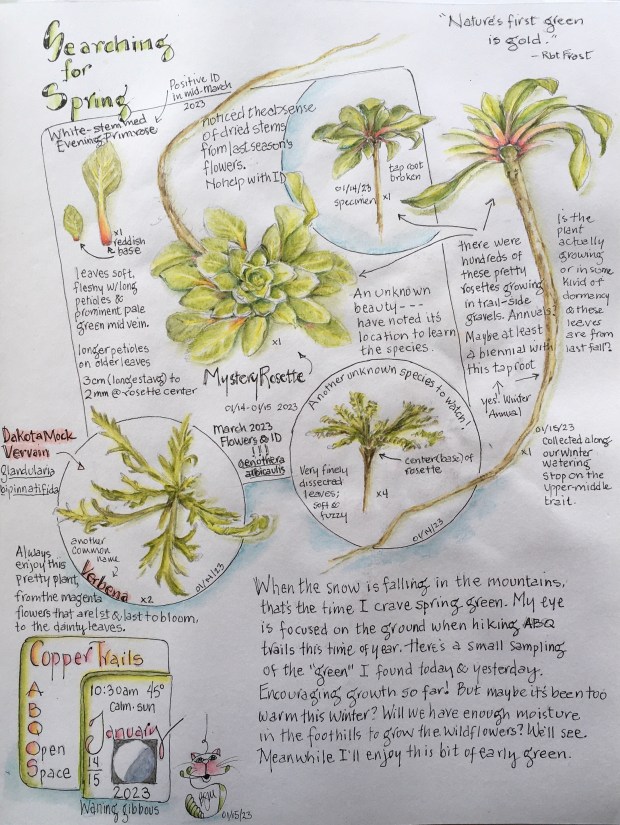
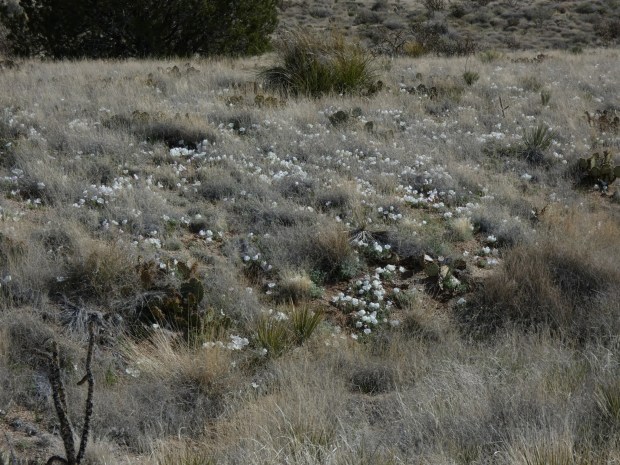
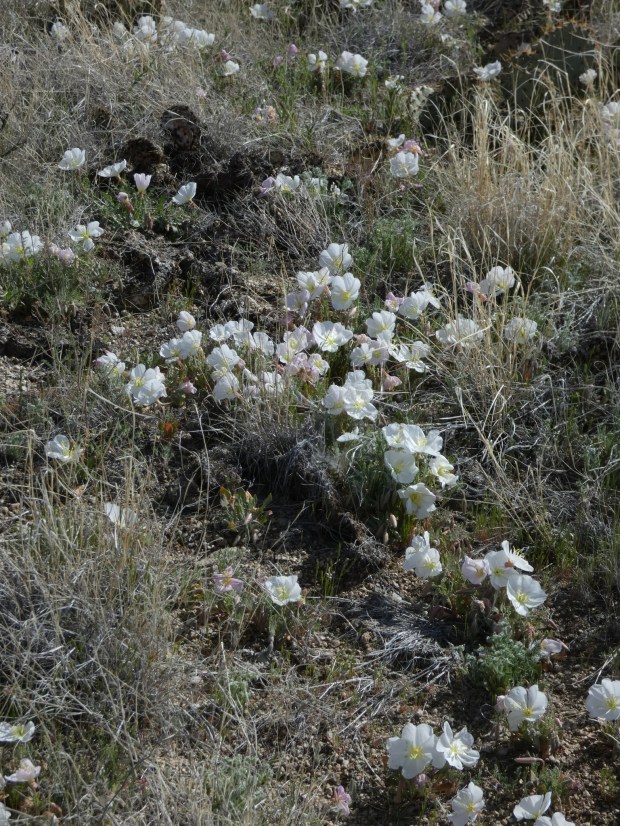
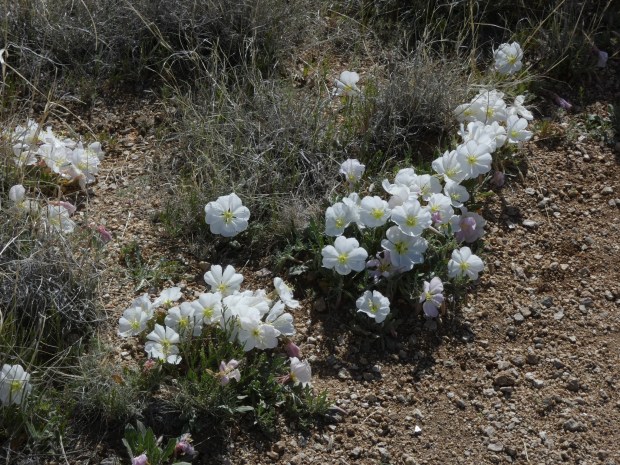
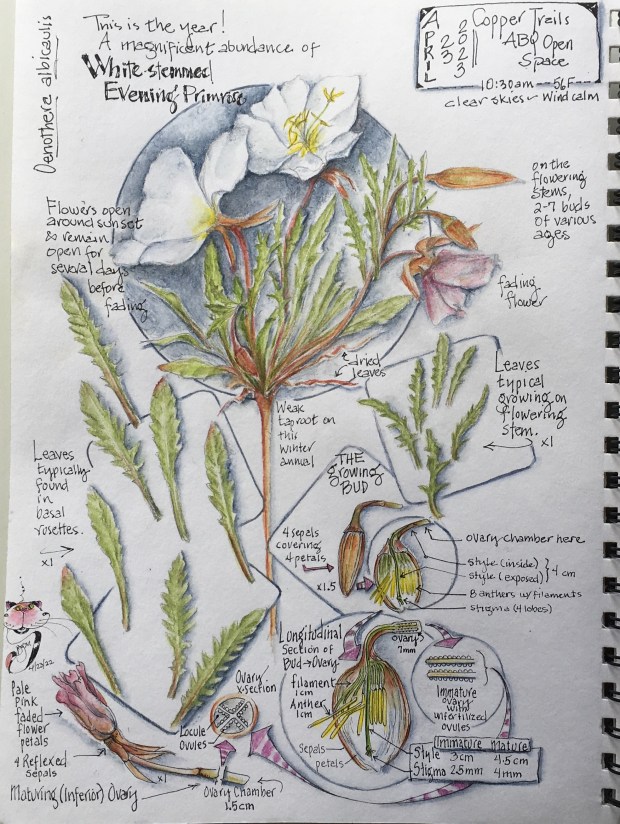
During a full two weeks of being distracted by the glow of all that yellow, all around our feet, 1,000s and 1,000s of blue-gray-green rosettes began to grow. I noticed these rosettes (the very same mystery rosettes I described in my January journal), were rapidly expanding outward to make room for flower stalks heavily laden with little rosy orange buds. And then one day one of those buds unfurled into a brilliantly white 4-petaled flower. In the center of that flower were 8 lemon-yellow pollen-heavy anthers surrounding a 4-fingered lemon-yellow stigma, ripe for pollination. Of course …… now I knew with certainty ….. the flower blooming atop the pretty winter rosettes is the White-stemmed Evening Primrose (Oenotheraalbicaulis)!
One of my January posts included this page where I illustrated a mystery rosette (top center) that seemed to be everywhere.
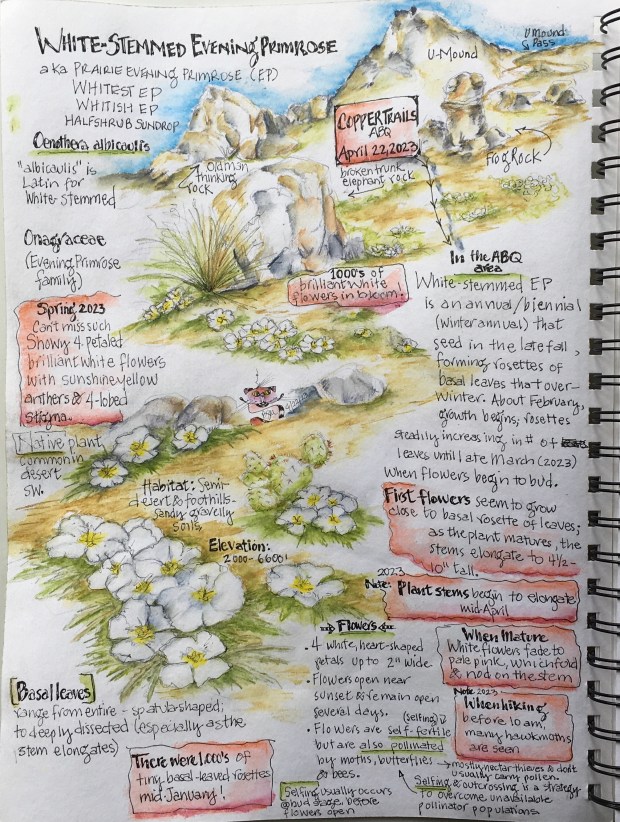
Also known as Whitest Evening Primrose, it wasn’t long until more flowers began to appear. “But, wow, was it possible that all those 1,000s and 1,000s of rosettes would each produce a bouquet of flowers?” Hiking these foothills every day paid of. As the excitement of possibility steadily unfolded, hundreds of thousands of large 2-4” white flowers unfurled each evening about sunset to greet potential overnight pollinators, and to welcome hikers the following morning.
My journal page illustrating the abundance of white-stemmed evening primroseA vista of whitewhite-stemmed evening primrose
In about a week since I noticed that first open flower, this native Evening Primrose was carpeting the hillsides in white as brilliant and sparkly as newly fallen snow. The ground became “Snow White” with flowers, out-performing the still profusely-blooming Scrambled Eggs.
And the show won’t end any time soon …. there are still an unbelievable number of White-stemmed Evening Primrose buds awaiting their turn to enter the play from stage right! Now that’s what I call a true Spring Super Bloomer.
A detailed page of my dissection of white-stemmed evening primrose
What marvelous transformations have or are happening outside your world this Spring?
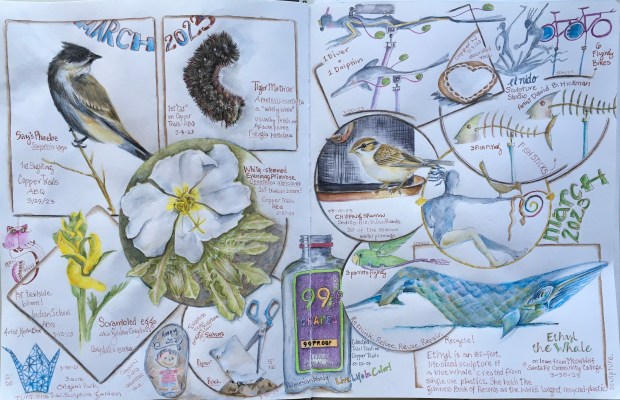
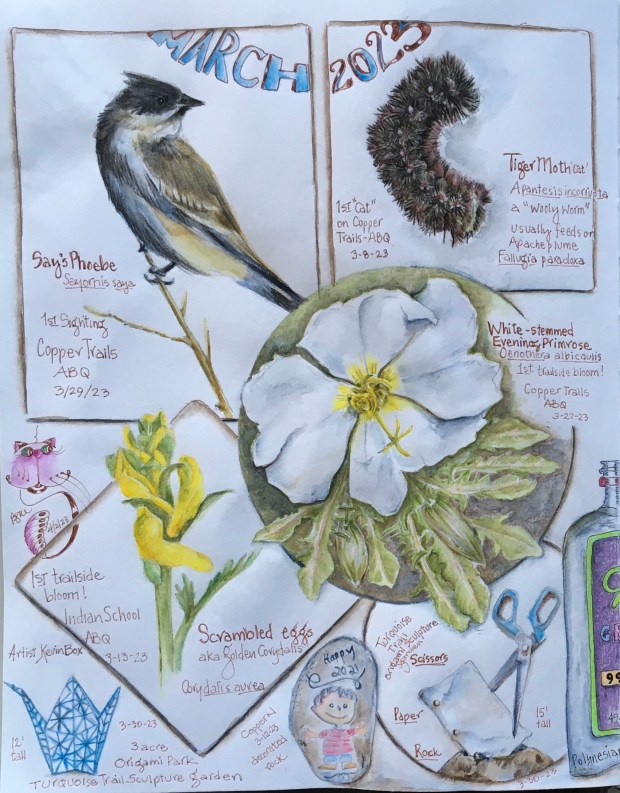
March came in like a passive lion, allowing a few signs of Spring to peek through. My collection of nature snippets and decorative trail rocks was going well, until ……. Before long we were once again shoveling drifts and piles of snow, dumped on New Mexico thanks to California’s 13 atmospheric rivers that flowed from coast to coast. This was looking like the winter that would never end.
It was truly and literally “March Madness” out there. So, in the spirit of the crazy seasonal weather, an emergency road trip became necessary to search for some “Littles” filler. And I knew the perfect route to take …..
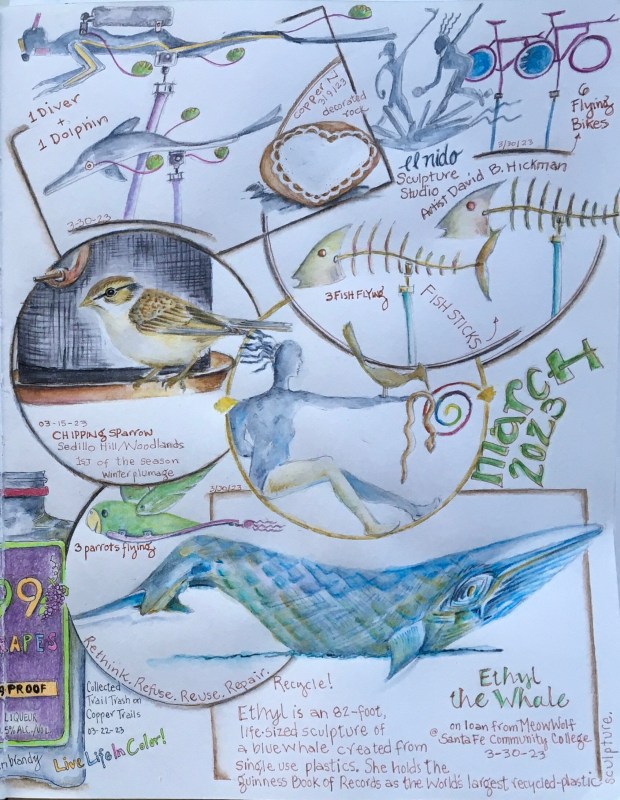
The Turquoise Trail Scenic Byway winds around the Ortiz Mountains and Cerrillos Hills, while passing through the historic mining towns of Golden, Madrid (MAH-drid) and Cerrillos (sir-REE-yoose). Today, there’s minimal mining taking place in them there hills. Today it’s all about art, and there’s some really weird stuff on display out there.
From Golden to just north of Cerrillos, the hillsides are adorned with metal sculptures like a Trojan horse, three boned fish on sticks, a scuba diver fleeing a curious dolphin, two-story tall origami made of folded metal, butterflies as big as pterodactyls, a squadron of green parrots, and a fleet of racing bicycles. You have to look around every bend in the road ….. they’re all there, and more!
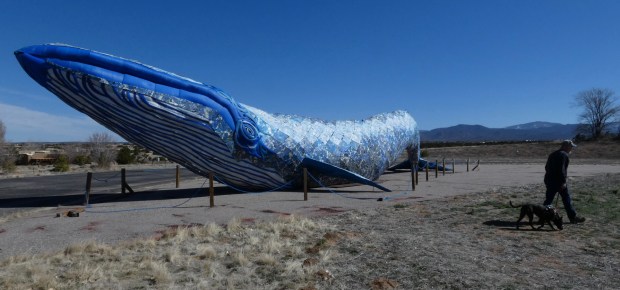
It was fun “collecting” these images for my March “Littles” collection, but I needed one more. We had heard the story of Ethyl the Whale somehow living out of water, somewhere in Santa Fe. Sounded like the perfect weird addition to that blank spot on my page.
And there she was! Around the back side of the Santa Fe Community College, in a large, flat field was Ethyl, the 82-foot long blue whale sculpted out of single use plastics. Ethyl is HUGE! She not only holds the Guinness Book of Records for the World’s largest recycled plastic sculpture, she also delivers an important message about the health of our oceans.
Well, there you have it; my eclectic assortment of “Littles” to remember this March of 2023. Let me know what you think! I’m already looking forward to true Spring in April. Wildflowers should be popping up everywhere and maybe a few more bugs will make an appearance for my April “Littles.”
Thanks again to “Made by Fay” for the “Littles” inspiration!
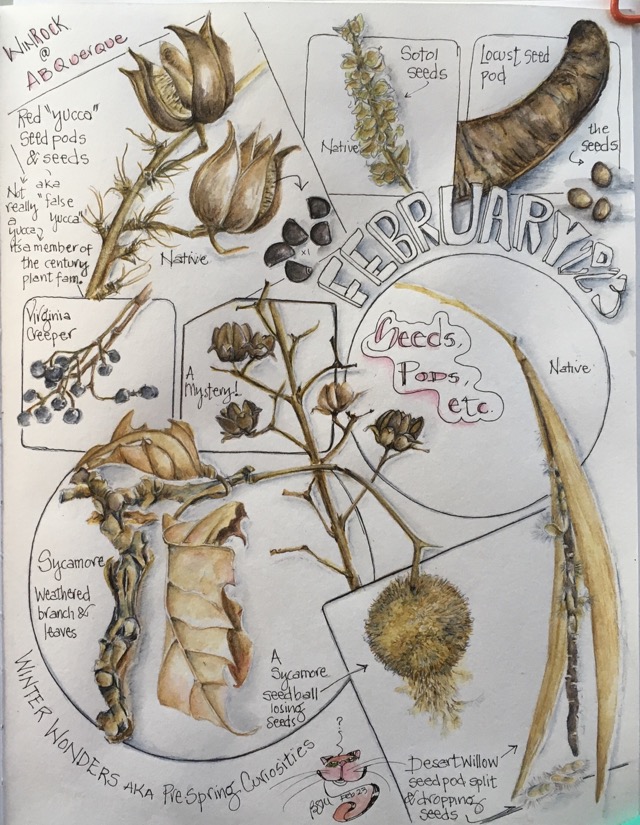
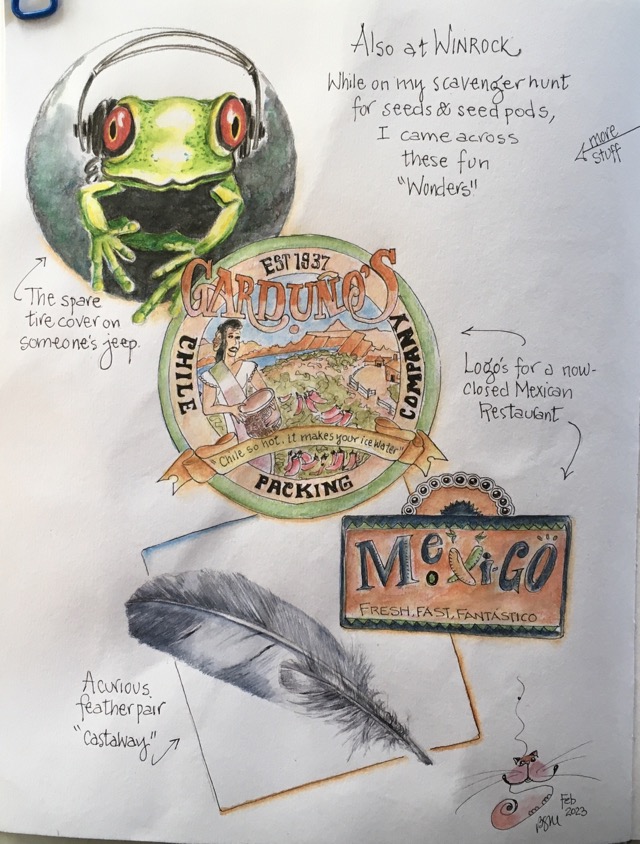
Like my January “Littles” page of the bird species that visit our feeders in winter, here’s another “Littles” to commemorate the not-quite-winter-or-spring month of February ….. Seeds and Seed Pods. As a way to pass the time while waiting for Roy to finish up with a doctor visit, Luna and I conducted a focused scavenger hunt along a 2 mile circuit surrounding a large Albuquerque shopping mall. In no time at all, my collection bag was full. But knowing my pages would need some local flavor and color too, I scavenged a bit longer and turned up a few more curiosities.
Like with January’s page of birds, sketches of the species of seed pod and seeds (if collected) took less than 5 minutes each; my watercolor pencil paintings took about 10 minutes each. The restaurant logo and the frog design took a bit longer, and were done using my photos as reference.
I’m not sure why it took nearly the entire month to decide what to do for my February “Littles.” In hindsight, the decision should have been obvious, because I love seeds and the seemingly unlimited variety of pods. Now I have a record of a few city seeds that will soon germinate, helping change the landscape from brown to spring green!
Let me know what you think! I’m looking forward to March, when wildflower seedlings will be popping up which may appear in a few “Littles” boxes as well!
Thanks to “Made by Fay” for the “Littles” inspiration!