A Rosette by any other name …….

April 23, 2025

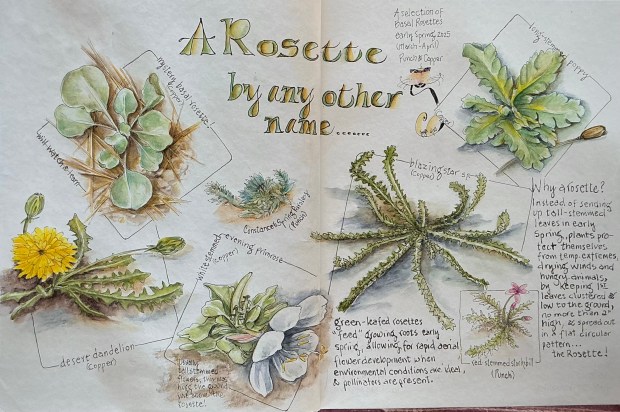
A selection of basal rosettes that popped out of the ground this Spring.

Have you ever noticed a dandelion? Oh sure …… you’ve seen hundreds, probably thousands of those ubiquitous sunburst yellow flowers blanketing a lawn or brightening an abandoned field. But before all that brilliance magically appears, have you ever looked below all those flower stalks? Have you ever noticed a dandelion before it blooms?

It’s early Spring in the mountainous areas of central New Mexico, and it seems like the high desert is slow to bloom this year. Anxious to spot even a hint of green during this transition time is always challenging, but if you look closely …….. Tucked beneath dry grasses and piled-high tumbleweed skeletons wedged next to swelling cholla you’ll find the green. Clusters of new leaves hugging the ground no more than an inch high, are beautifully arranged in a circular pattern like the unfolding petals of a rose.  

Rosettes!

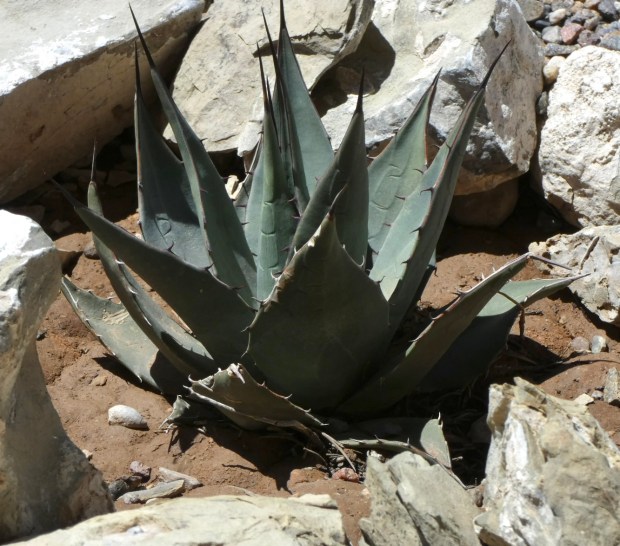
Rosette arrangements are found throughout nature,1 but in the flowering plants they are particularly common in the following families: Asteraceae (like dandelions), Brassicaceae (like cabbage), and Bromeliaceae (like pineapple). Many other families display the rosette morphology too. The needle sharp leaves of yucca and the bayonet-shaped leaves of century plant (in the Agave family) form tall rosettes. The intricate leaves of wild spring parsley (a tiny member of the Parsley family) and the petite red-stemmed stork’s bill (Geranium family) both form ground-hugging rosettes. 

A century plant displaying a beautiful basal rosette.

Where Rosettes Form

Basal Rosettes grow close to the soil at or near the plant’s crown (the thick part of the stem where the roots attach). Their structure is an example of a modified stem in which the internode gaps between the leaves do not expand, ensuring all the leaves stay tightly bunched together and at a similar height.  A protective function of a basal rosette makes it hard to pull from the ground; the leaves come away easily while the taproot is left intact (have you ever tried to pull a dandelion without snapping off the root?). Generally speaking, basal rosettes improve a plant’s odds at survival. For example, overwintering rosettes, like the basal leafy growth produced in year #1 of the 2-year life span of giant mullein, protect the plant and its roots from extreme cold temperatures. Emerging Spring rosettes, like those found in long-stemmed poppy, also protect the plant from late winter frosts. Basal rosettes are also more protected from changes in microclimate, gravity, wind, browsing, and mechanical damage if they are closer to the ground than tall leafy stems would be. help in water balance and conservation, especially important during periods of drought. 

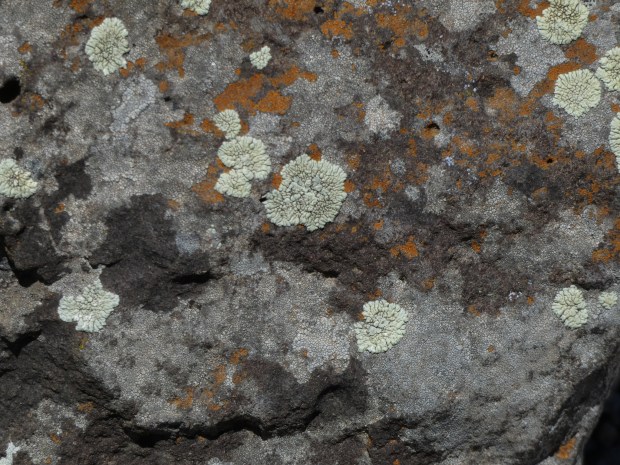
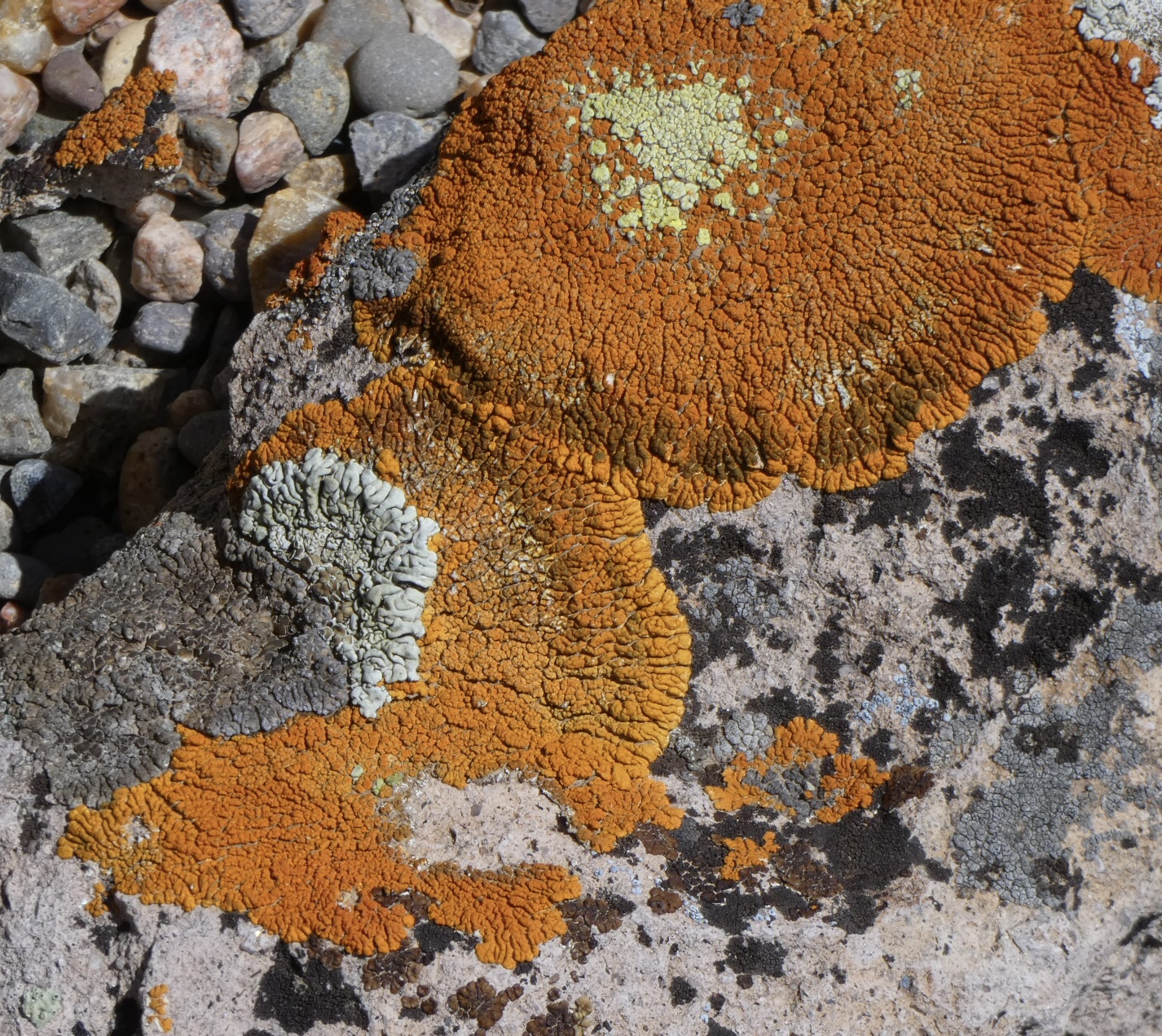
Lichen that has form small rosettes on rock.

But don’t only look down. Another form of rosette occurs when the internodes (those areas between leaves) along a stem are shortened, bringing leaves closer together as in lettuce and some succulents.2. And although not as common as basal rosettes, some plants form rosettes at the terminal or top end of their often naked stems, branches, or even trunks. One plant that does this is the native sedum called wild stonecrop. The top of the plant stems usually terminate in whorls or three fleshy leaves. Another example is the Hawaiian screwpine, which has a terminal rosette of sword-shaped leaves which sits atop an erect trunk, often supported by prop roots.

Know Your Local Rosettes

A number of desirable and undesirable (weedy) plant species produce rosettes, particularly basal rosettes.  Being able to identify a species that pops up in the Spring by its rosette is so helpful in preventing a removal mistake by inadvertently digging them up. Many weedy, non-native plants gaze first at their world through rosette “eyes.” But not all plants with rosettes are undesirable. Do you know your local rosettes by their other names?

………………………………………………………………

1  Rosettes are found throughout nature, not just in the flowering plants.  Here’s some examples you may have seen or heard of:  

In bryophytes and algae, a rosette results from the repeated branching of the thallusas grown by plant, resulting in a circular outline. Lichens also grow rosettes.

Tiny wasps and midges can induce the development of galls that become leafy rosettes.

Jaguars, leopards and other feline species display rose-like markings on their fur, referred to as rosettes.

Malaria parasites are known to form spontaneous rosettes in uninfected red blood cells.

Neural rosettes in the human brain are being studied to learn how new cells are born.

It is unknown why the Rosette-Nosed Pygmy chameleon, at home in the mountains of Tanzania, has evolved a distinctive, rosette-shaped, fleshy protrusion on the end of its nose.

The Rosette nebula, named for its rosette-like appearance, is a beautiful collection of gas and dust 5,200 light-years from Earth in the constellation Monoceros the Unicorn, and stretches about 130 light-years across.

A gorgeous lichen decorated rock from Colorado. Note the rosette patterns of growth (the thallus)

  The horticultural definition of a succulent describes a drought-resistant plant where the leaves, stems, or roots have become fleshy and their tissues are able to store water. Succulents include aloe, euphorbia, sedum, the garden favorite hen-and-chicks, and bromeliads. But horticulturalists do not include cacti in the succulent group. huh? Even though cacti are frequently found in books describing succulents based the definition of a succulent, succulents are not cacti. In agreement with that last statement are many botanical and other scientific experts. (Can this get any more confusing?). So basically some experts are lumpers, while other are splitters.  Which are you? 

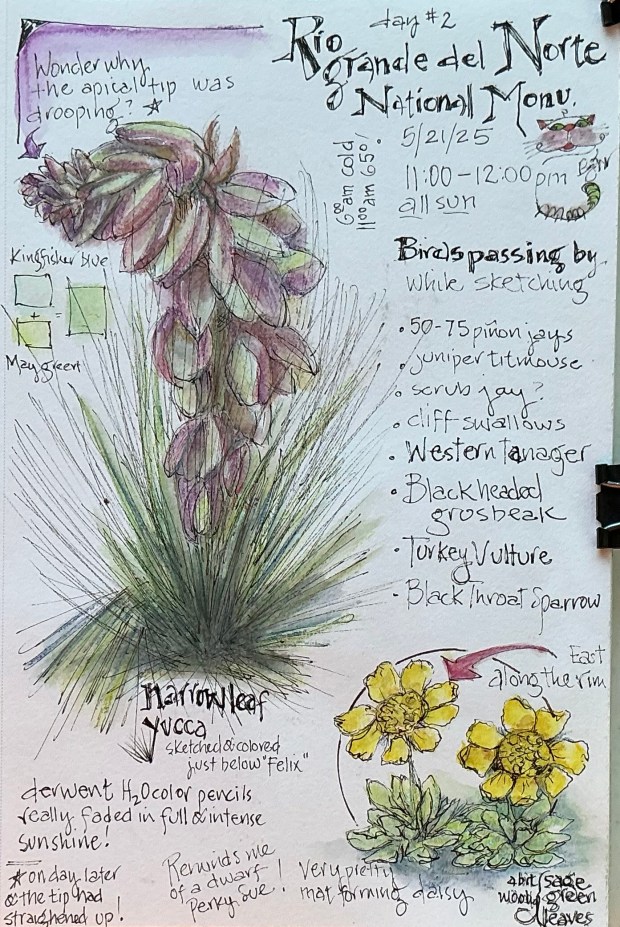
Basal rosette of a yucca in the NM foothills.

P.S. Cacti have stems that are thickened fleshy water-storing structures, and are considered to be a stem-succulent group of plants. Are there any cacti species that develop leafy rosettes? Because the spines are the leaves, greatly modified, in all my rabbit-trailing thru the internet and perusal of my collection of botanical references I’ve yet to see any spines forming whorled/rosette-like patterns. If you have, please contact me immediately!

……………………..……………..😂…………………………………………

Are you ready to explore the wide diversity of rosette forming plants in your neighborhood? Get on out there before those circularly-arranged leaves become disguised by an overabundance of gorgeous wildflowers! 

As always, thanks for stopping by!  And Happy Earth Day (week)!

A Honey of a Prize!

Meet the Honeydew Gall-Wasp Gall

April 4, 2025

It’s Spring

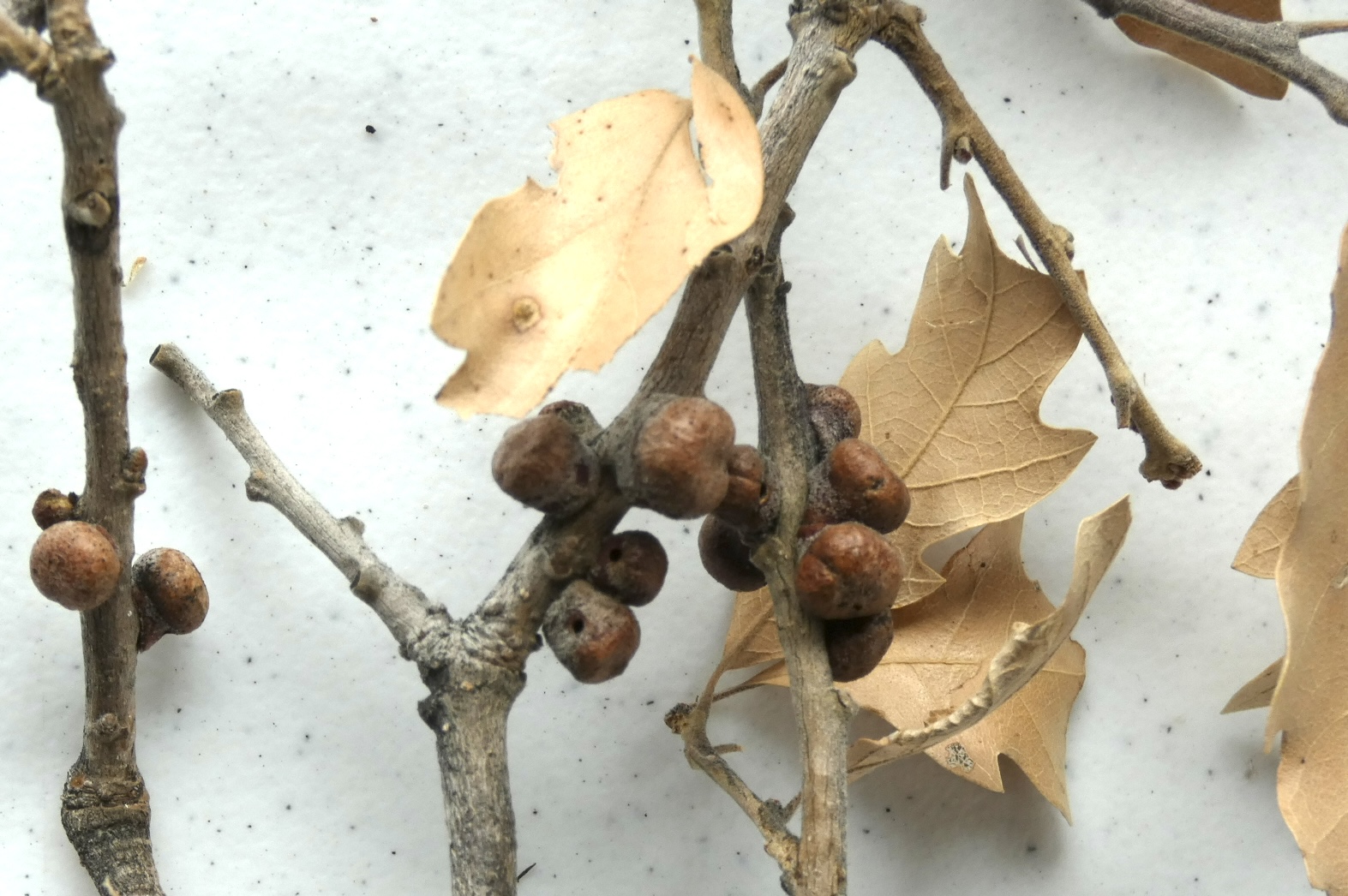
When the urge to nature journal is too hard to resist, but everything around you is still brown, crispy and covered in dust, I begin looking for any curious phenomena suitable for rabbit trailing (even rabbit tracks work!). The other day while hiking a steep hill, I was looking for sign the oaks were close to breaking bud. Spotting a string of little dark red beady objects lining many of the mostly leafless stems of am oak was certainly encouraging. From a distance they appeared to be swelling leaf buds; at least their color seemed right. But an up-close inspection revealed my hopeful find as last December’s vacated “homes” occupied by oak gall wasp larvae. Having never seen this species of stem gall before, naturally this would be a perfect most curious phenomenon to tackle. And that’s just what I did!

The Honeydew Gall-Wasp Gall

Arriving back home with a small collection of oak stems crowded with tightly packed galls (resembling miniature bread loaves), my work began. Assuming the host oak was a Gambel’s (Quercus gambelii), I began my search of stems galls on that species. Carefully scouring the literature the genus appeared to be Disholcaspis, but none of the species seemed a good match. So after many days in quandary, I consulted my favorite oak gall ID specialist, firing off a lot of questions, written descriptions and photos. Patiently awaiting his reply, I continued to find more resources to review. Gall wasps have a complex life cycle, and their galls are a challenge to identify. 

After 2 weeks a welcome reply arrived from the specialist.  Boy did I feel silly, knowing I should’ve known better! The oak host was not a Gambel’s but a cross between Gambel’s and Shrub Live Oak (Q. turbinella) which produces a hybrid called Wavyleaf oak (Quercus x undulata). Correcting my mistake was key to identifying the stem gall! Picky little wasps, huh? Happy the specialist agreed the genus is Disholcaspis, the obvious species responsible for the gall was turned out to be D. spissa; the Honeydew Gall-Wasp ….. making my discovery the Honeydew Gall-Wasp Gall!

Lesson Relearned  

When nature journaling, despite how excited you may be to find answers, it’s always, always best to slow down, breathe, carefully observe, ponder, question, make connections, and enjoy the journey ahead of the destination! 

Some Gall Descriptions and A Prize!

Outside appearance: Young galls of this wasp are yellowish and hairy. Mature galls have beige-brown to weathered grey sides, are black on top, and have a dull matte surface. They can have a round to ovoid to a rectangular ‘bread-loaf’ like shape. Texture appears mealy-granular. Galls sit snugly directly on the stems (sessile), and singly or in clusters of long compact chains that form all around the stems of host oak species. 

Inside the gall and back outside again: Each gall has one thin walled cell or chamber (known as monothalamous) that sits above the bottom of the gall. This is the larval chamber and is imbedded in dense cellular tissue that becomes a pulpy flesh with age. While the larvae are actively feeding and growing, they produce a copious amount of sticky-sweet honeydew that accumulates on the top of the gall. All of this honeydew attracts hordes of hungry ants and yellowjackets. The ecological importance of these secretions is unmistakeable; it provides a high energy food source for the insects. And while the ants and yellowjackets feed, they inadvertently protect the gall, like little bodyguards, from parasites and predators intent on infecting or eating the growing larvae inside. And another interesting ecological thing ….. the reason the tops of the galls are black and not the same color as their sides, has to do with a fungus called black sooty mold. The sugary secretions produced by the larvae accumulate in quantities too irresistible to the sooty mold. Colonies of the fungus develop rapidly on the honeydew giving the gall tops a dusty or powdery black color. So honeydew is the perfect medium for black sooty mold to complete its life cycle.

What about that Prize? Read on to learn more! Close-up inspection of the galls I collected, and there were about 25, revealed all but one had a single exit hole in a side just below its crusty red-black top. I learned the adult wasps emerge from these stem galls by late December; sometimes waiting for warmish temps until mid January. What happened to the adult wasps in the one gall without an exit hole? Because the gall had a sooty top, implying the larvae had been eating, growing and secreting honeydew, maybe the larvae died at some point or failed to develop into an adult? Had to know! Cutting the gall to find out wasn’t easy. The outer crust fell away first, then using steady knife pressure on the punky innards, the gall popped open, like a box of ‘Cracker Jacks!’ And there, near the bottom of the package, was a single sealed chamber. Carefully I was able to tease out the contents with fine pointed tweezers until out blurped the Prize! An intact cream colored gooey looking larvae, followed by a small puddle of viscous liquid. Even though the larvae filled up most of the chamber, there wasn’t any sign it was alive. And after an hour, when there still wasn’t any movement …. well, darn, I felt he must’ve died sometime before morphing into adult form. But peeking inside the gall did answer the question about the absence of an exterior exit hole.

And now an interesting note about these types of cynipid oak gall wasps: On my diagram, I used the term ‘agamic’ which is a formal label included with the genus/species name (i.e. Disholcaspis spissa ‘agamic’). This means these wasps have an asexual all female population that emerges from galls in late fall/early winter to lay fertilized eggs without needing to mate with males. Then a bisexual generation follows where adults emerge from galls in late winter/spring/early summer. This is the typical 2 generation annual life cycle of cynipid gall wasps, where the galls developed from each generation usually look very different and even occur on different parts of the host plant (on stems vs leaves). It’s interesting that nothing is known about the bisexual generation of D. spissa, but the asexual generation is common, well documented and abundant.

Known host oak species for D. spissa: Look for these galls on Shrub live oak (Quercus turbinella), Wavyleaf oak (Quercus x undulata), Mexican blue oak (Q. oblongifolia), Arizona white oak (Q. arizonica), and Shinnery oak (Q. havardi). 

******************************************************************************************

Hope you found my post interesting. Have you ever been curious enough about plant galls to look inside? Recalling the first time I saw a gall, I had no clue what it was and why it was precariously clinging to a plant leaf. It was round and hard, and reminded me of a tiny rusty red ping-pong ball. Was there something inside? Would it be squishy, alive, have teeth and bite, or perhaps whatever it was was dead and oh so smelly? Maybe it was some weird kind of flower bud, or a fruit lost under the leaf? Despite being a bit nervous, I needed to know what, if anything was inside. So I cut it in half, and in the center of the ball, suspended on hundreds of delicate threads, was a tiny, wormy creature twisting and turning and wriggling to music only it could hear! That was over 45 years ago, and to this day I still find galls irresistible!

As always, thanks for stopping by!

A Few References

Russo, Ronald A.: (2021) Plant Galls of the Western United States, section on tree galls; oak galls of the SW, page 173. 

Weld, LH: (1957) New American Cynipid Wasps From Oak Galls https://www.gallformers.org/gall/948

Mysterious Parking Lot Encounters

May 25, 2024

Accidentally Seeking Landscaping Curiosities

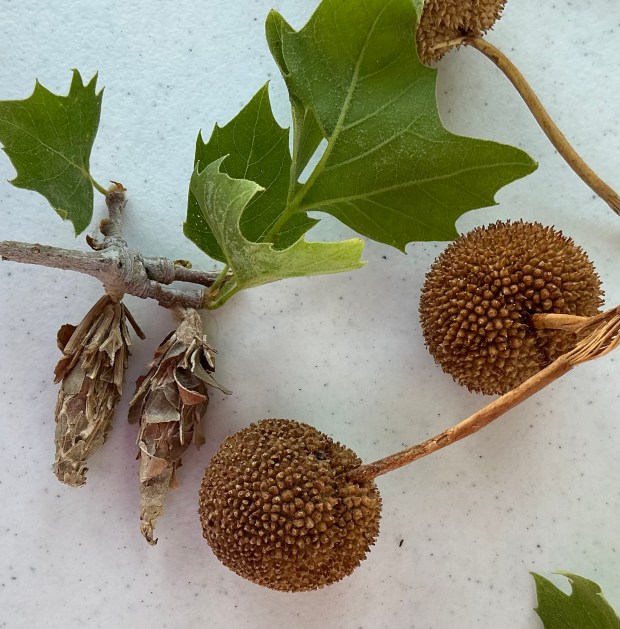
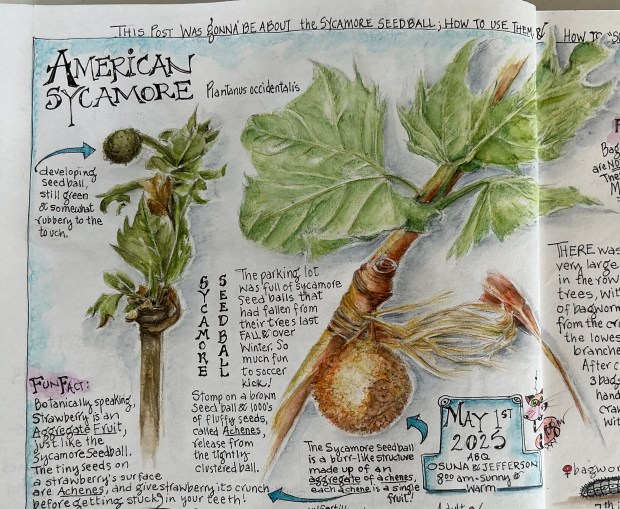
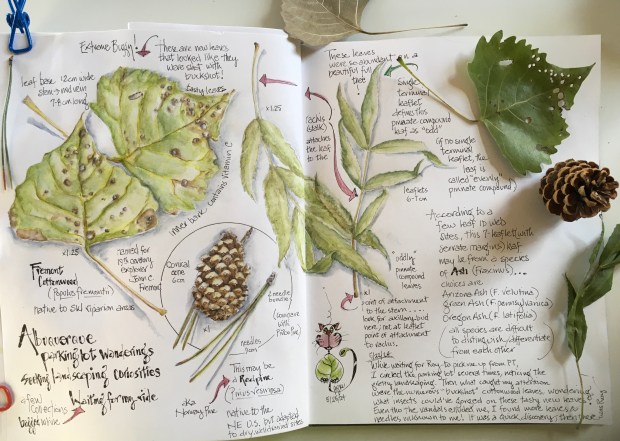
Oops! I was caught without my sketchbook ….. but that didn’t prevent me from making a few interesting collections while waiting for a ride.

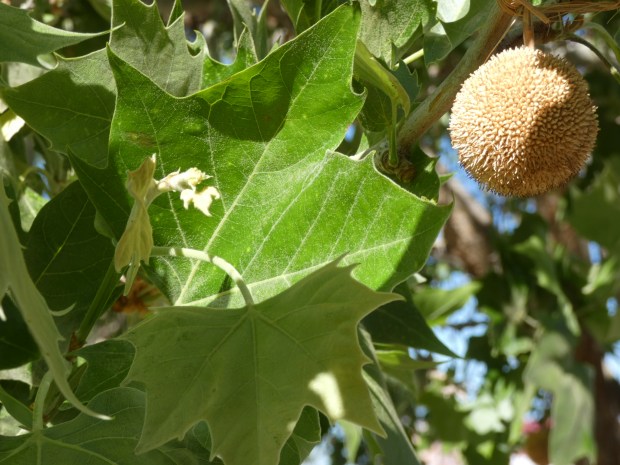
My curiosity unleashed, I began by wondering what voracious insect(s) tried to eat 1000x their weight in fresh cottonwood leaves. Then I noticed a very lovely leafy tree growing next to a stately pine, both of which were mysteries to me.

So I spent this afternoon sketching, painting, and looking over ID and reference materials, as much fun as collecting my three parking lot treasures!

If you find yourself “waiting,” how do you pass the time?

Thanks for stopping by!

Crazy for Locoweeds! Meet the White Point-Vetch

May 24, 2024

After a longer than planned for blog break, I’m glad to be back and sharing a few pages from my nature journal.  Beginning in April, the riot of wildflowers popping up everywhere has, and still keeps me scurrying about my backyard, the “back 40,” and local hiking trails just to refresh my memory about familiar plant species while searching for new discoveries. I’ve been sketching daily, learning about new-to-me plants, and growing my knowledge about favorites.  

Recording first seasonal sightings, it’s interesting to compare previous years’ emergence and abundance, and wonder why timings vary. For example, last year the white-stemmed evening primrose (Oenothera albicaulis) blanketed the hillsides with white; this year those beautiful white blooms have been scarce. Last year the tall crowded flower stems of White Point-Vetch (Oxytropis sericea) were few and far between. This year an explosion of these graceful plants that belong in the pea family (Fabaceae) began blooming in April and are still going strong! 

White Point-Vetch, also called white locoweed, whitepoint crazyweed, and silky crazyweed, makes a striking bouquet that glows like a bright light as it blooms along tall flower stalks 15+ inches above bare brown ground. New stems push up through multiple dried stems packed with last year’s empty seedpods. But it’s obvious this species is an aggressive re-seeder; there are so many new plants this year where last year there were none! 

It’s been a spectacular show!

Enjoying researching this species, dissecting a few fresh flowers, and searching for remnant seeds in the dried pods, kept me delving deep into the bits and pieces of what defines this group of plants. This large family, which houses well over 10,000 species world-wide, includes peas, acacias, mimosas, and licorice (see the list below for more residents). 

The dried stem was drawn and shaded in graphite.

But one species at a time, please! Actually the locoweeds, which fall into the genera Oxytropis (like the White Point-Vetch) and Astragalus, contain over 600 species world-wide, 21 of which grow in the U.S. Many plants in these two genera are toxic, particularly to domestic ungulates. More about the toxin and what happens when these animals ingest even small quantities, along with other interesting facts are described on my two journal pages. ……

There is so much more to learn about this important family of plants, but I’ll save that for another post. 

Thanks for stopping by and have a safe and happy Memorial Day weekend! 

Thanks for stopping by …… have a safe and happy Happy Memorial Day!

Perky Sue!

May 11, 2024

It’s Spring in my neighborhood, and not a day too soon!!
Along with gusty winds carrying clouds of yellow pollen come drifts of an outrageously bright yellow ‘sunflower’ named Perky Sue.

How Perky Sue got its common name is a mystery. My best guess is this herbaceous forb, native to New Mexico, has to be the Perky-est, Happiest Spring Flower, Ever!

What is your favorite native flower signaling the arrival of Spring in your world? Does its bloom cause you to smile; perhaps you break out in your happy dance?

Thanks for stopping by …… and Happy Mother’s Day to all!

The Winds of Imagination

March 22, 2024

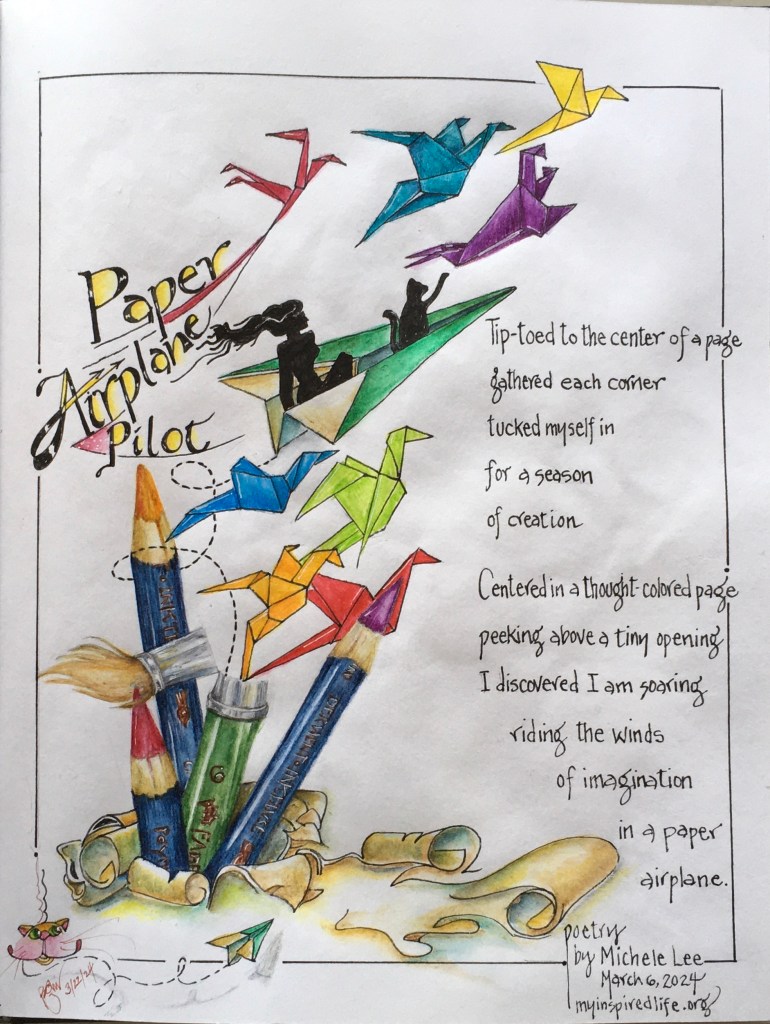
Reading this poem not only gave me the “lift” I was seeking on a dreary winter day…….. it was clear I wanted to design an illustration to further heighten the “lift” in anticipation of Spring and the new season of imaginative creation that was fast approaching!

Thanks to Michele Lee for allowing me permission to reprint her wonderful poem, Paper Airplane Pilot (March 6, 2024). Michele is a talented and prolific writer of poetry and prose, and a published author who lives in the heart of the Sonoran Desert. I look forward to her almost daily posts featuring something new and inspired on her widely-followed blog.

If you enjoyed Paper Airplane Pilot, your sure to enjoy her regular posts by becoming a subscriber to her blog, myinspiredlife.org

Enjoy! And a hearty “Thanks” to all my followers!

Once Upon a Tyme, there were Four Snowy Days Before Spring

March 19, 2024

Seems like we’ve had tons and tons of snow this winter. And the closer we got to the official date of Spring (the equinox falls on March 19th this year), the more intense the storms became.

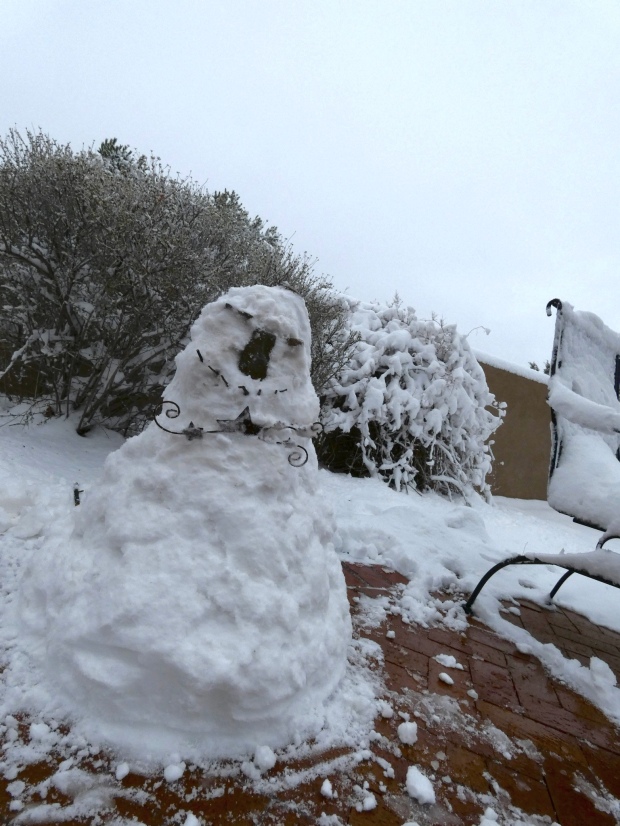
So when the forecast called for four straight days of snowstorms and piles of snow, I had an idea. ……. build a Jolly Snow Glob and journal his Life and Tymes.

Jolly Snow Glob, “Glob” for short!

Friday, March 15h was the birth day of the “Glob.” Constructed of freshly fallen snow that was the perfect combination of wet and fluffy, he seemed to hold together beautifully. If the weather forecast was accurate, he might even hold together long enough to witness the arrival of Spring.

Did he? See for yourself!

All four snow days and the 1st day of Spring …… from the beginning to the end of a Jolly Snow Glob

The (Untimely) End

Welcome Spring!

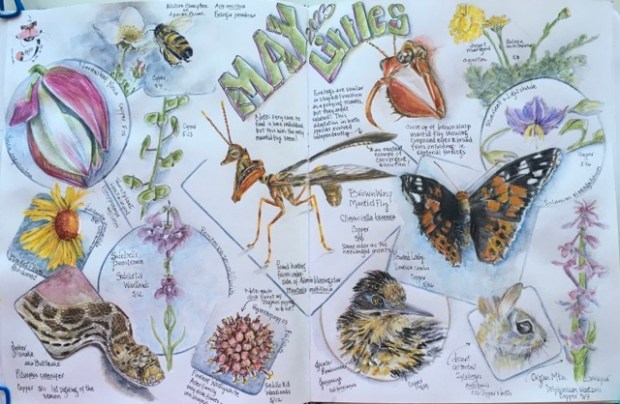
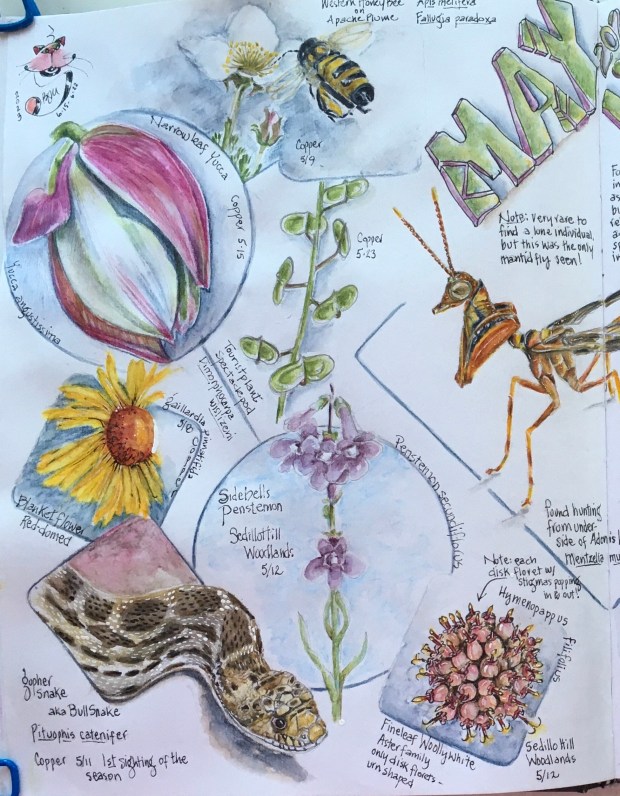
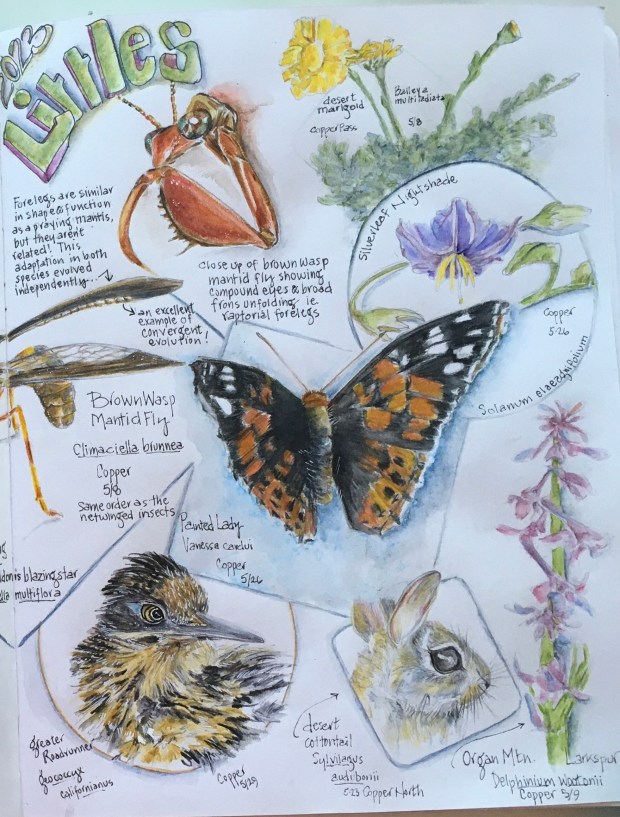
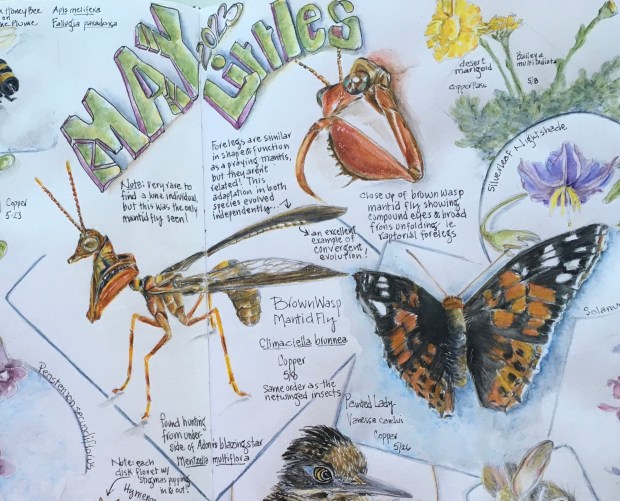
May “Littles” ….. blooming, buzzing, flying, fleeing, stalking, slithering surprises!

April may have been amazing, but it was nothing compared to the explosion of life during May. My 2-page spread doesn’t even come close to representing all that we encountered throughout the month. And the 15 species I chose as “picks” aren’t even a third of those making an appearance …… enter stage left and right! 

Noticeably missing was the black chinned hummingbird. They arrived mid-May, and began defending breeding territories. One of these years, I hope to find one of their miniature nests to see what building materials the hummers use. Until then, their aerial performance is always breathtaking! 

Close-up

Then there was the morning Luna nearly stepped right in the middle of a really upset, hissing and striking prairie rattlesnake, practically right out our front door! It was a scary few moments until we determined Luna did not get bit! Whew.  Roy expertly wrangled up the guy, herding him into a 5-gallon bucket, and relocated him a safe distance away.  (I may cheat and add him to my June “Littles,” if you don’t mind, along with the first rattlesnake encounter of the season! Gotta love the desert.)

Another close-up

Included in the long list of flowering plants, was prickly pear cactus. Several species began opening their buds to reveal 20-30 delicate waxy yellow to apricot colored petals per bloom. It didn’t take long for the pollinators to find these delicacies! 

And Another close up

Blooming in the foothills (5,000’ up to 7300’ elevation), there was milkwort, fleabane, scarlet globemallow, banana yucca, sundrops, milkweed, paintbrush, golden weed, common hoptree, puccoon, several species of pink-flowered hedgehog cactus, blazingstars, bee blossom, tahoka daisy, NM thistle, ……. etc.  I could go on and on! And even at nearly 9,000’ elevation, rock jasmine, valerian, creeping mahonia, prairie bluebells, pasque flower and dwarf lousewort were all in bloom. 

All in all, a bountiful full-on Spring bloom! 

A big shout-out to “Made by Fay” for the inspiring “Littles” idea!   Stay tuned for the next installment of “Littles.” 

June 22, 2023

April “Littles” ….. A Rush of Spring!

In the blink of an eye …… April! The dusty browns of late winter gave way to landscapes full of color! Movement was everywhere ….. Flower buds began opening as emerging insects smacked their lips in anticipation. Birds, flocking to their breeding grounds, had hungry eyes on the growing bug population. Hibernating reptiles began to stir as the earth warmed; lizards stretching sleepy legs in their underground burrows, that will help them flee slithering snakes; snakes wriggling and coiling and hissing, perhaps thinking about a breakfast of juicy lizard or a baby bird. Mule deer moved down from the surrounding hills to nibble fresh plant growth. Coyotes hunted desert cottontails as they snacked on prickly pear pads. 

April was amazing! There was so much happening, that it was all I could do to take in so many changes. It was such a challenge just to slow hike the hills every day, observing and taking  photos, that keeping up with my “Littles” pages seemed impossible! 

Close up

So here it is mid-June, and I’ve finally put the finishing touches on my April “Littles.” While creating my tiny framed discoveries, I questioned my desire and/or the need to continue with this project. But then I quickly dismissed those thoughts. After seeing these pages finished, I realized it was not only great fun, but an important reminder of what happens in nature during April.  

Another close up

Again, many thanks to “Made by Fay” for the inspiring “Littles” idea!

June 17, 2023

International Nature Journaling Week 2023 ……… A Sensory Safari ….. Day 1: Color

June 1 – 7, 2023

It’s that time of year again …… International Nature Journaling Week (INJW), and I’m excited to be taking part in the fun. Beginning June 1st, a full week of nature-inspired workshops, interviews, prompts and other activities will be presented by an amazing line-up of nature journalers, artists and environmental educators from around the world. The host, founder and organizer of INJW, is nature journaler, teacher and environmental educator, Bethan Burton. This year the theme of INJW is a “Sensory Safari,” and Bethan, who also hosts her own podcast, Drawing with Nature, will take us through each day as we explore how nature engages at least seven of our senses: Color, Texture, Aroma, Song, Flavor, Movement, and Heart.

It’s not too late to get involved and there’s no cost for participants, so check it out! All workshops and resources, the schedule and links to videos are available at  https://www.naturejournalingweek.com/

Day 1: Color Across Continents

Imagine your world in black and white. Color brings life to our visual party and defines our sense of place. When I think about or see the colors of New Mexico …. the rusty reds and buff-colored rock and sand, the greens and blues of piñon pine and sagebrush, the lemon yellows and violet reds of spring wildflowers, all framed by vivid intensely blue skies ….. I know I’m home.
After Verena (a naturalist from Berlin) and Bethan (who is from Queensland, Australia) talked about the use and how-to’s of color in a nature journal, Bethan presented a mind-blowing workshop on color mixing, color theory, and the Magic of the Split Primary. Admittedly, I’ve been a hit-or-miss approach artist when it comes to color mixing; struggling to achieve a color match with my surroundings. But there was something in the way Bethan explained color theory and the use and mixing of warm rather than vivid primaries; and all at once I was mixing those elusive sage greens and brick reds! It was a real “duh” moment for me; color theory definitely is something worth understanding!

Below is the practice page I created during the workshop guided by both Bethan and Verena. For fun, they even encouraged us to make up names for our color mixes ….. names that conjure up an image of the color based on a familiar object, such as Rusty Bike, Brick, Cotton Candy, Moldy Cheese (you instantly know those colors, right?!).


Then we were invited to create a journal page with colors of home. I quickly swatched out colors I’ve seen all Spring. Then borrowed on some of my photos captured while traveling about central New Mexico, adding in a few wildflowers and one of the most decorated bird to visit our feeders. When I look at this page, the colors truly warm my heart. This for me is a bit of what nature journaling is all about. But just a bit. I know this week will go a long way to reveal more of the “bits” that have made nature journaling such an important part of my world!

Thanks for taking a look! I hope my pages spark in you a sense of curiosity and wonder, and that you would like to learn more. A good place to start is by visiting the INJW home page at https://www.naturejournalingweek.com/.

#naturejournalingweek