Bird with a Bellyache?

July 29, 2023

Do birds get bellyaches? I wonder?
This is a puzzling yet happy little story about an American crow (Corvus brachyrhynchos) who paid us a visit and stayed for hours.

We’ve gotten in the habit of placing a dish of cracked corn just over our courtyard wall within view of a few windows. The corn was intended as a supplemental food source for the mule deer that occasionally wander by our house. The deer really haven’t been showing up much and we almost decided to remove the dish, but …………… Something was obviously eating the corn.

So we readjusted our thinking and began to look for critters smaller than deer, like squirrels. Yep, the rock squirrels were gobbling up huge quantities, stashing as much corn as possible into both cheeks, and merrily running off to their cache with their stash! It was quite funny and always drove Luna crazy when they were around (that was our clue).
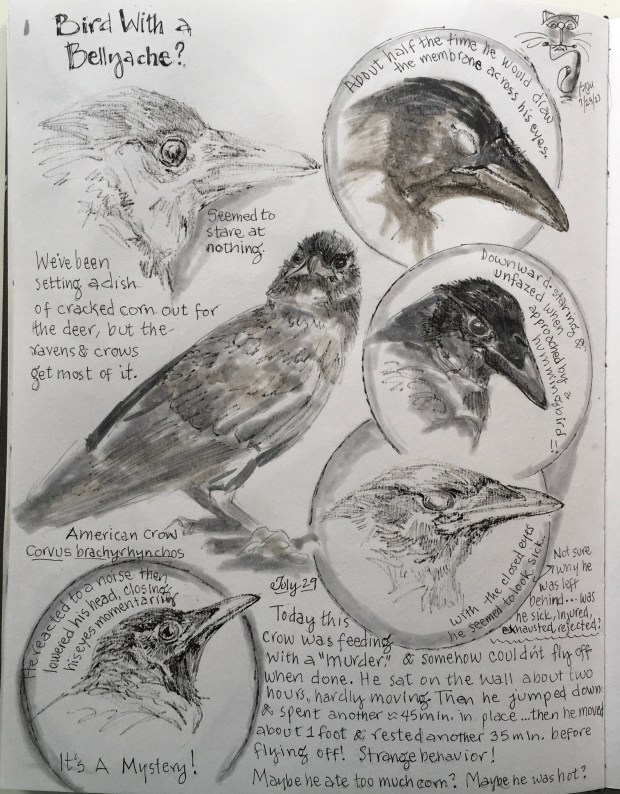
Some quick sketches of the crow as he “recovered” from some mysterious affliction.

But in addition to the hungry squirrels, there were regular visits from crows, lots of crows (aka “murders” of crows). As they feasted, there was much noisy squabbling amongst them, and definitely a pecking order would form where the older birds (?) would eat their fill, fly away, and then the younger birds would eat and leave. This had been going on for a few weeks, when yesterday Roy noticed a lone bird sitting on the wall long after all his friends had “eaten and run.”

The hummingbird perched over the crow, just watching with curiosity!

For a few hours he sat very still, hardly moving a feather, and didn’t appear well at all. Maybe he had eaten too much corn and couldn’t fly? Maybe he had come to blows with one of his friends and suffered some kind of injury? Maybe an opportunistic rattlesnake, lying in wait by the corn dish, struck and bit the unwary bird?

After a few hours, he jumped down to the ground about a foot away from the wall, and again remained stock still, except for slight reactions to an occasional jay or towhee flyby. He would open his eyes, cock his head, have a look, then resume his stoic stance. There was even a hummingbird that perched just over his head and watched the crow for a few minutes, curious perhaps about why this big black bird wasn’t with his clan?

Another 45 minutes went by where the crow spent most of this time with his head down and eyes closed; the rest of the time with head slightly raised while repeatedly “blinking” his nictitating eye membranes (the opaque eyelids). All of this behavior gave him an even more distressed, sorrowful look.

And then, with noticeable effort, he moved a foot across the ground, coming to rest for another 30+ minutes. We were discussing options to rescue this crow, when all of a sudden, he came to life and flew away! Poof! Just like that!

I think his friends must’ve given him a time out for hogging too much corn, and when he completed his banishment period, he was permitted to rejoin the murder? There haven’t been any crows around since.

I’d be interested in your thoughts!

Until next time ……. be curious

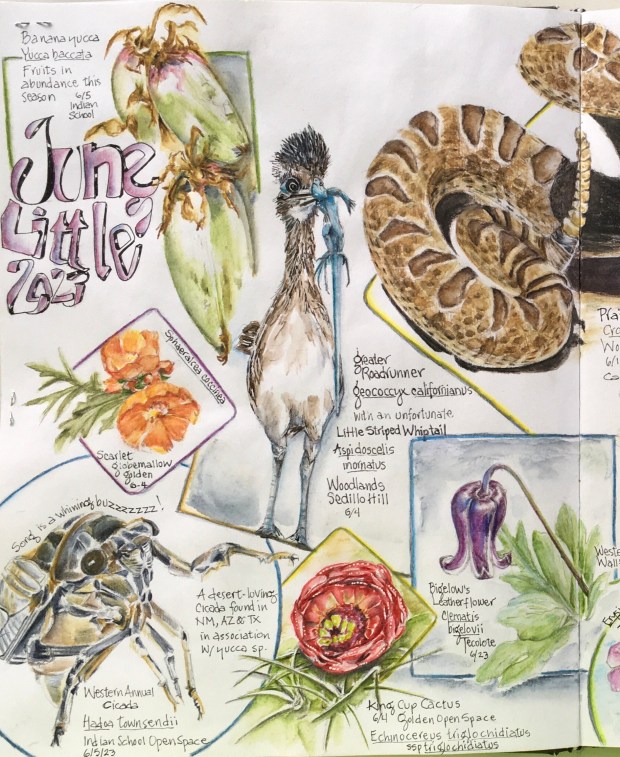
June “Littles” ….. a buzzy, buggy, snake-y month

June was hot, Hot, HOT

Two-page spread with 14 June Littles + Flambé

June was dry, Dry, DRY

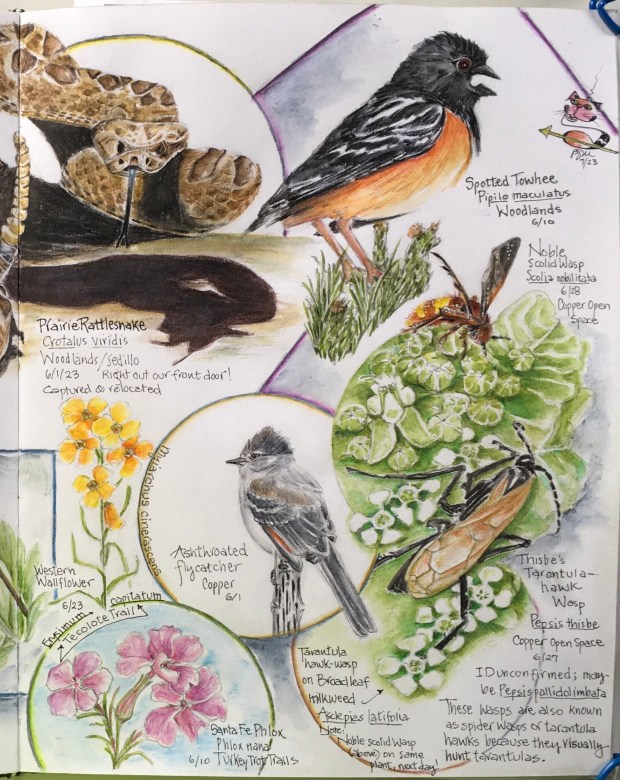
Close-up

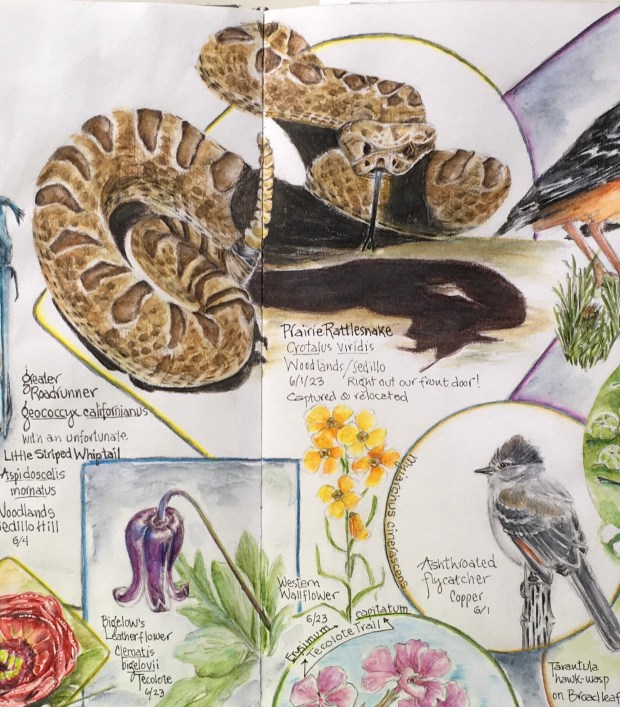
June was the month of bugs (from the big tarantula hawk wasps, to the microscopic gnats), withering flowers, disappearing birds, and snakes! We seemed to encounter an extraordinary number of snakes this month, including gopher (bull) snakes, diamondback rattlesnakes, patch nose snakes, garter snakes, and one very scary prairie rattlesnake. Read on for that story.

Another close-up

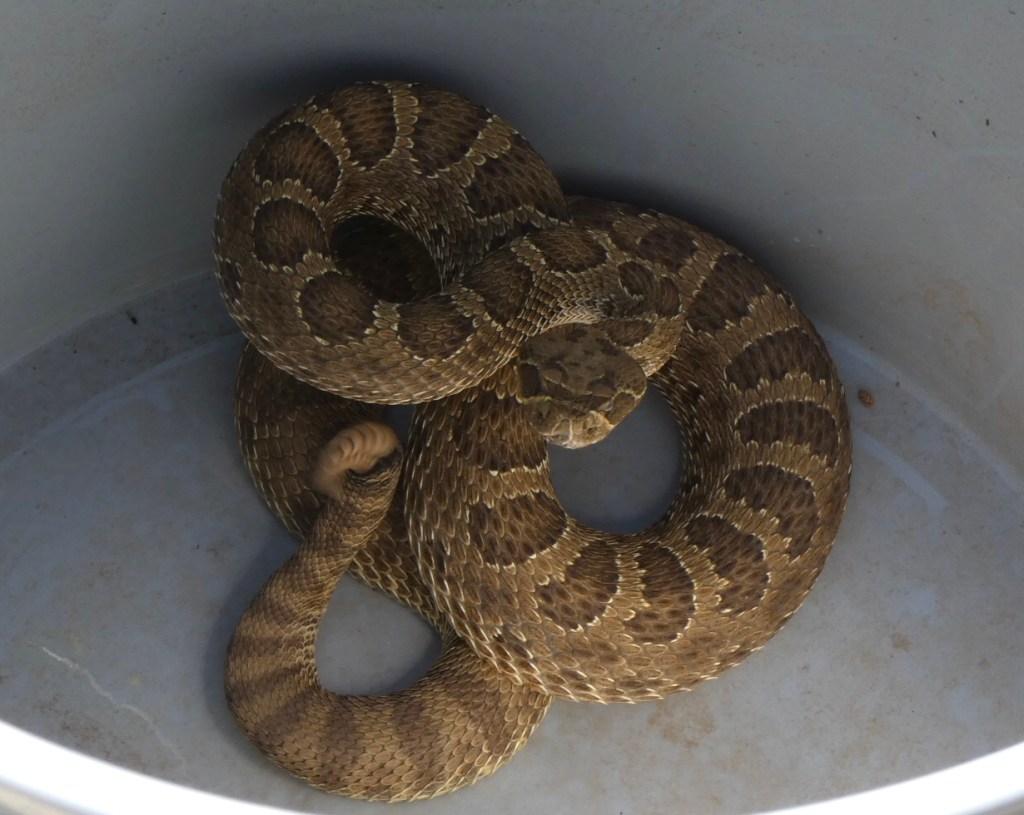
Luna and the Prairie Rattler! Our scariest encounter was with a 3-foot prairie rattlesnake right in our front courtyard. One day he had crawled out from the shade of a blue spruce to warm up in the morning sun. It was Luna that had changed his demeanor from placid to pissed off. Prairie rattlers don’t typically alert trespassers; that’s the secret to their hunting success, and Luna didn’t recognize the danger. She began sniffing around and unintentionally violated his personal space. The snake responded by instantly coiling and violently rattling his tail. The noise seemed deafening and was definitely alarming. As I came running to Luna’s rescue, Roy noticed the commotion and quickly arrived with snake stick and bucket in hand. By this time the snake had backed into a corner, furiously rattling, but was relatively easy to capture. Snake temporarily out of the way, we then carefully checked Luna for signs of snake bite (none detected! Lucky Luna).

Another close-up
Another close-up

Now back to the snake in bucket. It had taken less than 30 seconds for Roy to capture and slip him into the 5 gallon bucket. It was then that I was able to take my first photos, from a respectable distance just in case the snake decided to leap clear of the bucket!. If looks could kill, well ………….. About 15-20 photos later, the bucket lid was secured in place, and we took the snake for a little ride about a mile from home where he was carefully released in an uninhabited area, unharmed.

After release

Again, a big shout-out to “Made by Fay” for the inspiring “Littles” idea!   Stay tuned for the next installment of “Littles.” 

July 27, 2023

Sabino Canyon History not easily “Forgotten”

June 16, 2023

Sabino Canyon Open Space, a scenic area for a hike, is found just south of the town of Tijeras in the Manzano Mountains. with less than 120 acres of gently sloping meadows, surrounded by piñon pine and juniper trees, the area has been inhabited since 5500 B.C.

Needless to say, Sabino Canyon has “history,” some of which is on display by walking a short distance uphill from the parking area.

Between the 1600s and 1800s, the meadows of today were actively farmed for pinto beans and potatoes to support the small village of Sabino, of which little is known. However, the area became map worthy when in the 1920s, the Riedling family of musical fame, owned and operated the Riedmont Silver Fox Farm located within the west half of today’s Sabino Canyon Open Space property. Fur coats and capes were all the rage in the 1920s, and the farm raised between 300-500 silver fox, along with minx and rabbit to help supply the demand. When the fur market crashed in the late 1930s, the fox farm was abandoned. What remains are the fox, minx and rabbit enclosures, a water tower, and several outbuildings, all of which seem to be melting back into the landscape.

Visiting this historic area, it was hard to think about such beautiful animals living their lives out in small cages, only to be killed for their fur.

As we walked around the rapidly deteriorating farm buildings (it doesn’t appear any effort is being made to restore the structures), I unwittingly plowed through large patches of gnarly dried out cheatgrass hiding thickets of heavily seeded forget-me-nots. Ouch! When looking down at my socks, boots and boot laces, I wasn’t surprised to find hundreds of seeds had seemingly “jumped” and clamped snugly aboard! So for the next 30 minutes, I plucked and pulled enough of those pesky hitchhikers to allow me to hike on out of there!

A memorable hike back into history….. one I won’t soon “Forget!”

Fading Flowers Reveal Leafy Greens ….. Cedro Creek

July 14, 2023

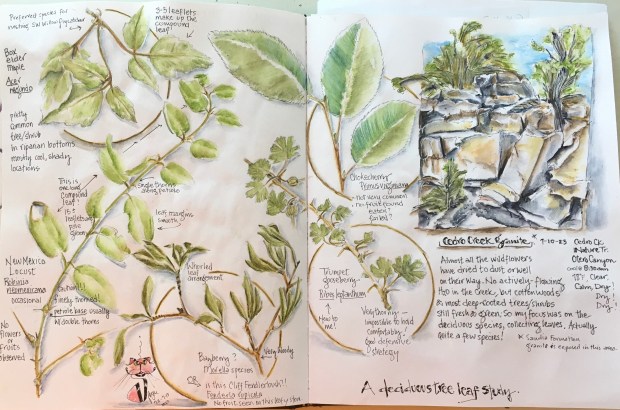
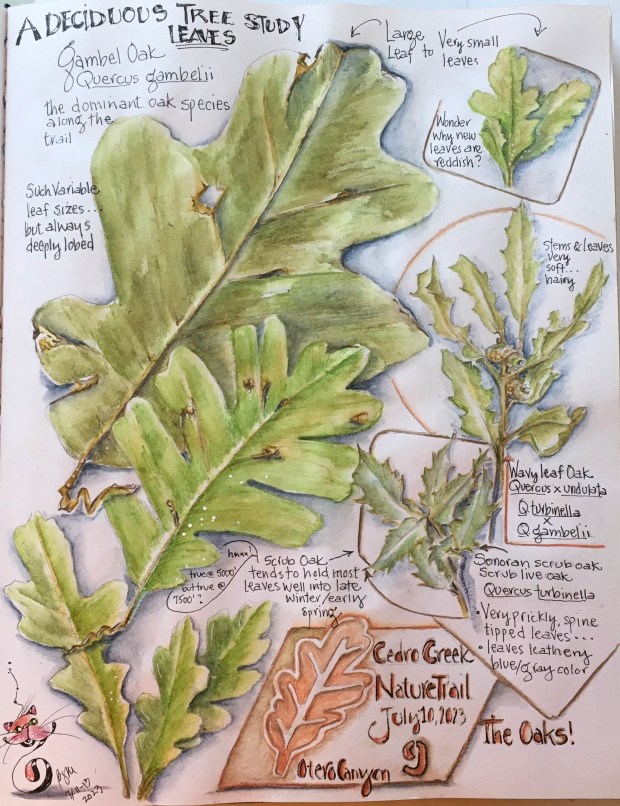
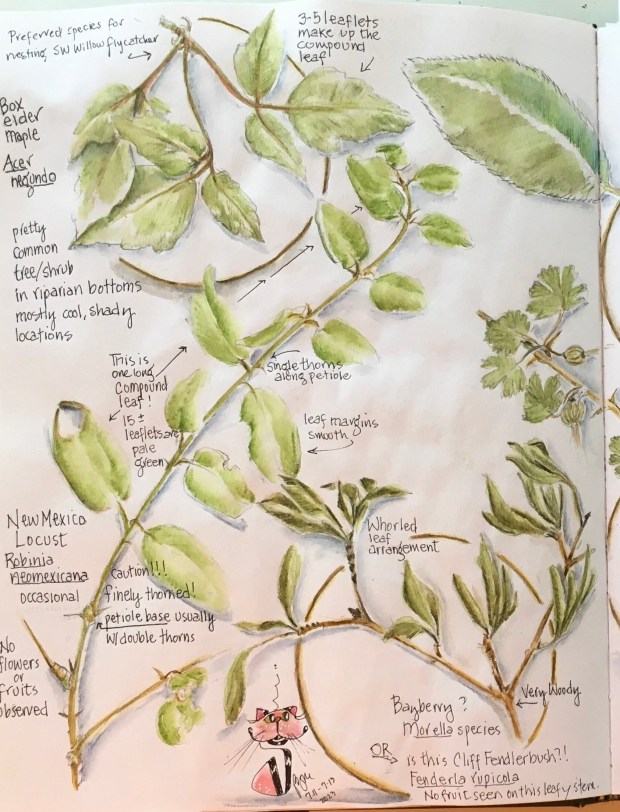
Learning the deciduous Trees and Shrubs shading Cedro Creek Nature Trail ….. Grab n Go Nature Journaling

The timing and location of our daily hikes are being influenced by the extreme summer temperatures we’re experiencing throughout central New Mexico, and throughout the desert southwest. Whew! Even at 7300-8300’ elevation, 95-100F has become the norm, with no relief (or moisture) in sight.  I don’t even want to think about Albuquerque temperatures; over 100F before noon, and soaring. 

Because hiking in the Albuquerque foothills, at any time of the day, is out of the question, we’ve begun revisiting some our favorite mountain trails. But even tho these areas are higher in elevation, and shadier, it’s still plenty hot. That means if we set out between 7-8am, we can still manage a few miles before our water, like all the creeks, runs dry. 

A few mornings ago, we decided to hike Cedro Creek Nature Trail, a rocky but easy dirt path under the shade of big cottonwoods. Expecting to find some water in the creek (there was none), I was hoping to find some interesting wildflowers (which had all withered and dried). The further along the trail we hiked, my focus quickly changed from wildflowers to other natural elements. 

Geology is always interesting in these mountain drainages, and Cedro Creek is no exception. The overlying shales and limestones have long ago eroded to reveal large granite boulders that showed signs of erosion from long ago flowing water. That’s a nice thought!

And then there were so many varieties of deciduous trees and shrubs; their leafy greens not only provided relief from the heat, but became a visual treat as we explored the riparian areas alongside the dry creek bed. 

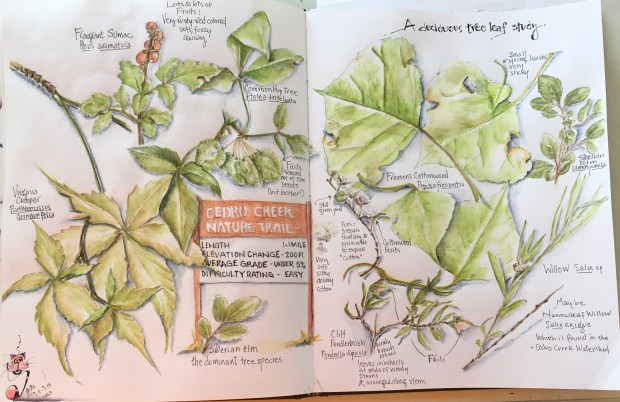
As my curiosity about the diversity of tree and shrub species began to grow, so did the air temperature. Not wanting to become reduced to a sweaty puddle in the middle of the trail, and sensing a swarm of drooling, biting gnats and flies giving me a hungry eye, I resorted to collecting leaf and branch samples using a Grab n Go technique. By the time we got back to the car, I had 3 large ziplocks stuffed with over a dozen species of tree and shrub leaves and some fruits.  

Back at home, in the comfort of my cool studio, I began my detailed study of these leaves (and the few bugs that managed to hitch a ride). Three days and several gallons of iced tea later, I had completed the 5 journal pages in this post.  

That iced tea was deliciously cool, but not as cool as learning what’s growing overhead along Cedro Creek!

Until next time ……. be curious
Cypsela! The Sunflower Seed

July 9, 2023

Buckle in …… 

In my last blog post, Fascinating Fasciations, I shared my discovery of an extremely malformed Rush Skeletonplant. While researching this much branched and dainty member of the plant family, Asteraceae (which includes asters, sunflowers and daisies), I became entangled in the winding and seemingly never-ending number of rabbit trails on my journey, until finding myself on a surprising detour. Totally absorbed in the subject of plant malformations, and learning a lot of cool stuff about Rush Skeletonplant along the way …….

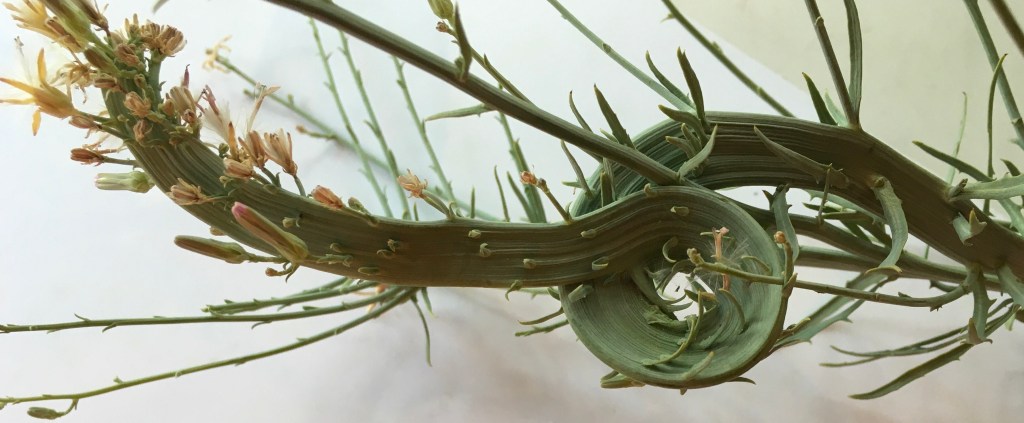
The weirdly wild fasciated Rush Skeletonplant

………. I tripped and fell flat on my face (only figuratively!). One of the published research papers appeared to be in error …… regarding the seed (aka fruit) name of this plant. Known to me for decades by the name “Achene,” the researchers had labeled the seed “Cypsela.” And not only did they call seed of Rush Skeletonplant a “Cypsela,” but they used this name when referring to all the seeds of the Aster family! 

What! No Way! Who was responsible for this name change? When did this happen? Why oh Why

Continue reading “Cypsela! The Sunflower Seed”

Chapter 230703: Flambé’s latest Misadventure ………………. July’s Full “Buck” Supermoon  

“Your growing antlers are proof of your intimate place in the forest—for of all the things that live and grow only the trees and the deer shed their foliage each year and replace it more strongly, more magnificently, in the spring.” – Felix Salten

A Fairy Tale in Silhouette – as told by Flambé 

Once upon a cloudless night, in a field of Warts ‘n Wobbles, roamed a fabled Vipson deer. The young buck, proudly dressed in softly felted antlers, quietly sniffed the air. He detected an artificial Hush afoot; a loud quiet in disguise, deeply hidden in newly-cropped Walu. His common-sense caution, an inherent trait which has served Vipson for as long as a day is honest, was suddenly overcome by his curious nature. Even tangles of braided Irevir wound tightly around his hooves were only momentarily effective in distracting the buck from investigating. The lush Oasis he called home has surely been invaded by a PdA …… a pesky darn anomaly, a peculiarity desiring admittance, a paradoxically divergent aberration ….. and the source must be rooted out, tout sweet!

don’t stop now! …………

Continue reading “Chapter 230703: Flambé’s latest Misadventure ………………. July’s Full “Buck” Supermoon  “

Fascinating Fasciations …… Malformations in the Plant World

July 2, 2023

It was early morning, but already a hot 85F as we hiked the dry, dusty trails of the Albuquerque foothills. With a few exceptions, late June’s wildflower display is all but gone, replaced by an abundance of seeds ready to drop, blow away, or feed hungry chicks. While the “stage” resets for the next Act, the Summer Monsoons, plants in the Sunflower-Daisy-Aster family (Asteraceae) still dot the quickly browning landscape with bright yellows, whites, and shades of purples.  One of the most curious plants now making a showing is Rush Skeletonplant (Lygodesmia juncea). 

Perfectly adapted to the desert environment with its chaotic tangle of blue-green mostly leafless stems, is Rush Skeletonplant. Spindly stems, standing up to 18” tall, are topped with 1-2 petite pale lavender-pink flowers. These tiny delicate beauties may not be as showy as your garden variety sunflower, but when closely examined you’ll find typical characteristics of the family, including 4-6 strap shaped ligulate florets each with a protruding hot pink anther tube surrounding a double lobed stigma. Short lived, the florets quickly transform into dandelion-like seed heads.

So there we were, hiking along, wishing for even the gentlest of breezes to keep the biting gnats from crawling into our ears and mouths, when out of the corner of my eye …… Weirdness Extreme! A wildly malformed Rush Skeletonplant.

Continue reading “Fascinating Fasciations …… Malformations in the Plant World”