The much anticipated finale, Snowbirds, and wrap-up to a grand anniversary week celebration in and around Tucson, AZ, follows!
Despite an unexpected snow the evening of our arrival, we never seemed to slow down, taking in as many sights and good eats as humanly possible. …… Open the full post for a recap of our week, and a bit about some of the birds we found while traveling around.
As Spring blows in across the Northern Hemisphere, liquifying the last bits of ice and snow, rainbow-colored water droplets begin to penetrate thawing ground. If you have hearing like Kat, you’d be able to detect a distinctive “unzipping” noise made by thirsty compacted soil as its pores open wide to receive the welcome runoff. All this soil soaking and swelling creates an underground uproar; hundreds of thousands of micro- and macroscopic critters wake from their winter slumber to get on with their important job of soil building.
The saying, “as the worm turns,” now assumes the literal meaning. Earthworms and their kin play a crucial role in soil development as they “worm” their way around under the earth’s surface.
A dear friend of mine, and poet, is constantly inspiring me with her skill in creating original and verbally illustrative prose. I love the visual images she can conjure with perfectly chosen and placed words. Happily, my collection includes many of her award-winning pieces, including poems she has penned to interpret beautiful works of art. Amazing!
Wanting to send her a unique birthday gift, complete with an original poem and illustrations, became my challenge. And what a challenge!
East Mountains, Tijeras, New Mexicoelevation 7,300 ft
February 15, 2023
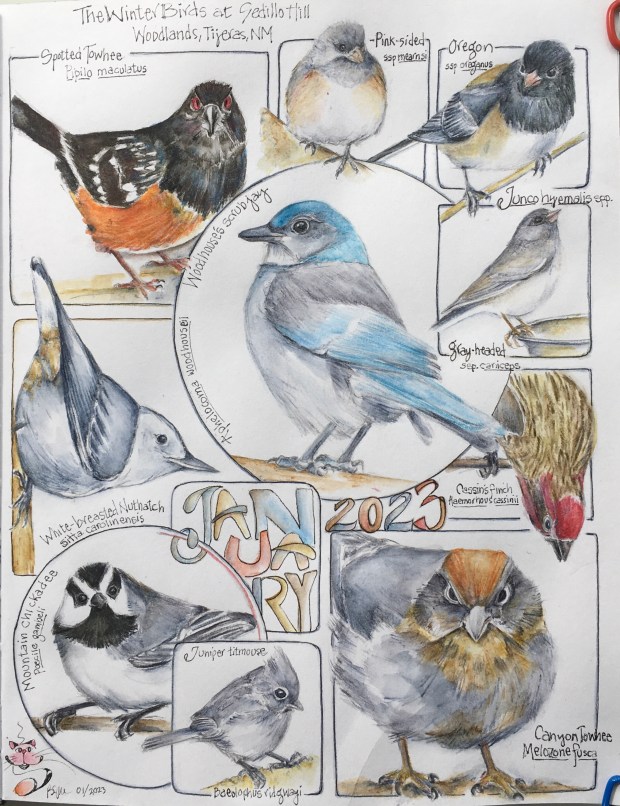
The design for today’s post was inspired by sketchbook artist Fay. I came across her blog (see link below) while searching for nature journalers who are active in creating art and who also share some unique approaches to page layout and composition. “Littles” is the name Fay has given to one of her unique approaches. This is where she lays out several pages full of empty boxes with the goal to fill up a box a day for an entire month. Not only does this encourage a daily drawing and painting practice, but it’s her way of creating a record of what she’s observed for an entire month. “Littles” reminds me of a hyper-compressed perpetual journal.
After seeing Fay’s blog post with all her miniature drawings and paintings, I knew this would be fun to try, and I had to learn more. So we chatted and Fay encouraged me to give “Littles” a go. And I did …… with a “little” twist! I’ve been thinking of ways to keep a visual record of the birds visiting our feeders during the winter. And I needed an approach with minimal fuss, without feeling each bird needed a detailed description. Ta da!
So here’s my “Littles” page of the bird species that visit our feeders in January. I kept my sketches to less than 5 minutes each; my watercolor pencil paintings took about 10 minutes each. My sketches were done using my own reference photos, and relied heavily on my many hours of observing these species’ poses and behaviors.
Let me know what you think! I just may create a “Littles” page for our February birds. Maybe by March, when all of our snow has melted, hints of new spring growth may appear in a few “Littles” boxes as well!
Oh and …… Follow Fay! Her blog “Made By Fay” can be found at the link below. If you enjoy my posts, I will guarantee you’ll love what Fay does. She is an extraordinary visual storyteller, and enjoys drawing what she sees from her home state of Washington and on her travels about.
Ahhhh! February …. long celebrated as the most romantic month of the year. If this rings true for you, why? Is this the month when hugs and kisses are most popular? Maybe it’s more about exchanging flowers, cards and a giant heart-shaped box of chocolates? No matter the reason, apparently what began as a pagan celebration way, way back in the year 270 AD, was officially designated as a “romantic holiday” in 1375 by the English poet, Geoffrey Chaucer, in his poem “Parliament of Foules.” If nothing else, his “designation” kicked off an annual tradition of card giving, at the very least.
And what about the cards? Remember those vintage Valentine’s cards shared with hopeful wannabe elementary school classmates? Then this card giving thing morphed into pastel colored candy hearts with sayings like “Be Mine” ….. “U R Cute” …. “Crazy 4U.” Do candy hearts still exist today? If so, would they say “Text Me” …. “Ur Tweet is Sweet” …… or maybe “Friend Me on FB.”
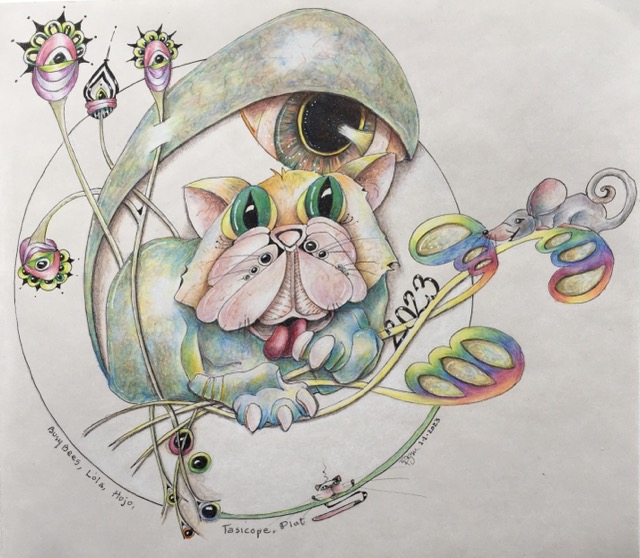
Flambé is not into flowers or candy (much), but she does have a few lovers and tons of friends. So in honor of all her followers, whether romantically inclined or otherwise, she’s just popping in to wish everyone a wonderfully romantic Valentine’s Day!
We totally get it! Why Mt. Lemmon is nicknamed “Tucson’s Great Escape.” Why the scenic highway is ”Cool!” From the Lower Sonoran Desert and the Tucson Valley (2,200 feet) to the upper reaches of a Spruce-Fir Forest (topping out at about 9,200 feet), the popular Scenic Highway up Mt. Lemmon offers breathtaking views, plants to discover, geology to learn, recreation opportunities, and temperatures often 30 degrees F lower than the desert below. That means a lot, especially when Tucson’s summer temps are in the triple digits!
But on the day of our driving adventure we found snow ….. on the highway, at scenic overlooks, and on walking trails. The storm hit 4 days earlier forcing closure of much of the highway. But on this day, most of the roads were clear and so was the sky.
So come along and learn what there’s to see along the Mt. Lemmon Scenic Highway.
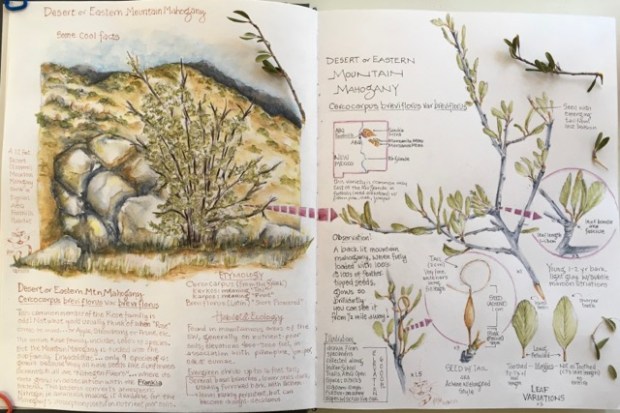
The Desert (Eastern) Mountain Mahogany is a very branchy shrub commonly found in the mid-elevation foothills of the Sandia, Manzanita, and Manzano Mountains east of the Rio Grande River in central New Mexico. This species’ formal and very appropriate name, Cercocarpusbreviflorus variety breviflorus, comes from both Greek (kerkos: tail; karpos: fruit) and Latin (brevi: short; florus: flowered). As a matter of fact, the 9 species of the genus Cercocarpus all have long feathery tails that twist and turn from the tip of a single fruit, called an achene (like a sunflower seed).
So why is this species odd?
Well, the fruit, for one reason. Most of the thousands of rose family members have fruits called a hip (rose), pome (apple), drupe (prune), or aggregate (strawberry). And even though the strawberry is composed of numerous miniature achenes, it’s the single achene found in the mountain mahoganies that’s unusual to the family.
To further emphasize the oddness of the Cercocarpus genera, all of its 9 species has a symbiotic relationship with a bacteria called Frankia. And that’s an unusual characteristic of the rose family, which moved Cercocarpus and 4 other genera into the subfamily Dryadoideae. That’s all a bit technical when it comes to plant classification, and kind of skips the real reason why the Frankia bacteria is important to the survival of Desert Mountain Mahogany. Nitrogen Fixation!
We certainly enjoyed visiting Saguaro NP – East. Most of the Rincon Mountains Unit is wilderness and only accessible on foot; no dogs allowed. But the cactus Forest Loop Drive was scenic, with views of the Rincon Mountains to the East, and saguaro everywhere!
Really couldn’t seem to get enough saguaro! The highlights of this day were finding another crested saguaro while hiking an area Luna could enjoy, standing next to some shoulder high fishhook barrel cactus, and enjoying the Phainopeplas with their shimmery black feathers.
If you’re up for more saguaro botany, read on. This post will be dedicated to this largest of all North American cactus, Carnegieagigantea. (Beware. This post is long, so settle in!)
This day we explored areas as far as 50 miles north of la Casita. Following the old highway between Tucson and Phoenix, we first came upon a roadside rest area and memorial to the legendary cowboy, Tom Mix, who died at this spot 83 years ago. Tom who? Of course we had to stop and learn more about this interesting bit of history.
Then on to Casa Grande Ruins National Monument where history dates back more than 1700 years, well before the first Spanish explorers showed up, exploring. Even Luna was permitted to wander around this cultural monument, but we may have appreciated the stories surrounding the Hohokam more than she did.
Then to complete our tour for the day, we came upon a lonely ranch road on the way back to la Casita, where the saguaro stood tall over countless cholla, barrel cactus, iron trees and palo verde. It was here, in the middle of “where-are-we-now?” that I peered under a creosote bush and found the weirdest puffball fungus ever.