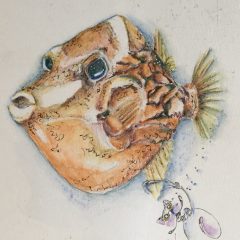
Dark Jerusalem Cricket – Page 5 .. The 100 Day Project (2026)

April 5, 2026

Dark Jerusalem Cricket (Ammopelmatus fuscus)
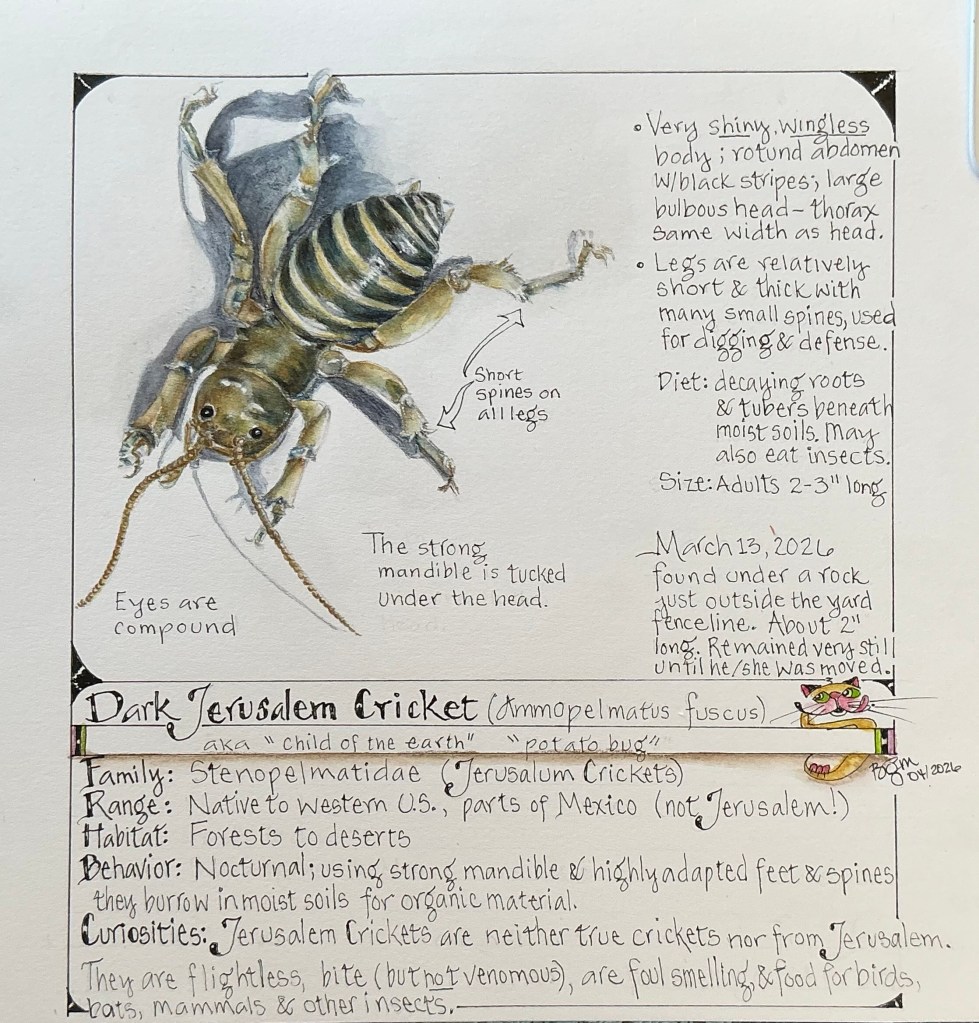
Last month (mid-March), while looking everywhere for signs of spring (something green and growing), I dared to peek under a flat rock and gasped with surprise! Instead of uncovering a tiny flower bud was a gigantic “creepy-crawly” bug! Yikes! After quickly dropping the rock back on his head I realized my run-away imagination had gotten the better of me. 

So gathering my courage, I took another look. There, hiding under that rock was a “cuddly” Jerusalem cricket trying his best to be invisible (while avoiding the bright sunlight). 

This wasn’t my first Jerusalem cricket, but seeing this guy prompted me to learn more about this curious insect……

Firstly, Jerusalem crickets are neither true crickets nor are they native to Jerusalem

  • Taxonomists agree, “Jerusalem crickets are in a very different family than true crickets. This includes a bunch of flightless varieties, and some with wings, found in Africa. The Jerusalem crickets are wingless and are found in the Americas.”
  • “The origins of the name, “Jerusalem” cricket isn’t certain, but it’s thought that it comes either as a reference to the skull-shaped head (they’re also known as skull crickets), which is associated with skull hill in Jerusalem; or, comes from a watered-down swear word from the ‘40s and ‘50s. Around this time, in the US, both “Jerusalem” and “Cricket” were expletives, associated with being startled.”

Next, some Jerusalem Cricket Mating Characteristics

  • Similar to true crickets, each species of “sings” a different song during mating. They actually sing by drumming and they drum by beating their butts on the ground.
  • Once a larger female has successfully mated with a smaller male, and before she lays eggs, females usually eat the males!
  • She lays her egg masses in holes in the soil. After hatching, over the next 1-2 years, nymphs undergo several molts (as many as 10) until they reach sexual maturity which lasts for only 2-6 months.
  • Adults can reach up to 2 to 3 inches in length. Females are often larger in size; males have longer hind legs.

Third, Jerusalem Cricket Habitats and Out-of-Sight Living Quarters

  • They are “well-adapted to living in sandy soils, but can be found in sand dunes, chaparrals, grasslands, woodlands, and forests.”
  • Being nocturnal, they spend a majority of their lives underground. 
  • They hide underneath organic matter and other debris like rocks, wood. With their powerful mandibles, spiny legs and specially adapted feet, they also dig underground burrows for comfortable living quarters.

And Almost Lastly …. the Cultural Significance of Jerusalem Crickets

  • Of great importance to Native Americans as food, many tribes in southwestern U.S. also considered Jerusalem crickets as a powerful cultural symbol. Its striking appearance leads some to think the cricket brings mortality, as depicted in the folklore of the Chumash people of southern California. 
  • The Hopi, who settled in Arizona, portrays this cricket as a spirit being (a Kachina) named Sösööpa who races. As a result, it’s often carved into their Katsina dolls as a yellow humanlike character with black beady eyes, a black-and-white plaid skirt, and antennae made from sand grass, depicting traits of the cricket.
  • The Navajo associated the Yucca plant with the insect; you had to eat the plant as a cure of the cricket’s painful bite. This myth possibly gave rise to the misconception that their bite is venomous. 

It’s Greek to Me!  (Entomologically Speaking) 

Learning the meaning of a scientific name assigned to a species not only helps me remember uncommon words and how they’re pronounced, but often describes aspects of a species’ characteristics that may help differentiate it from another similar-looking species. Learning about these complex names falls into a study called entomology.   

Ammopelmatus fuscus, the scientific name for the Dark Jerusalem Cricket, is quite a mouthful. Curious about the meanings (in plain English) of these two strange words, I learned the name originates from Greek and Latin roots meaning “dark sand-sole” or “dark sand-burrower,” obviously referring to their sandy habitats, dark color, and burrowing behavior. But to learn how the common name with the word “sole” ties to one of the cricket’s characteristics, my dive continued. Here’s the entomology breakdown:

  • Genus Ammopelmatus
    • Ammos (Greek) means “sand,” referring to the cricket’s specialized adaptation to arid, sandy environments.
    • pelma (Greek) means “sole of the foot,” highlighting the specialized leg structures the cricket uses for burrowing.
    • tus (Greek) is a common word meaning either “them” or “their.” In this case, “tus” ties the first two parts together into “their sand sole.”
  • Species fuscus (Latin) means “dark,” “dusky,” or “brown,” describing the cricket’s color.
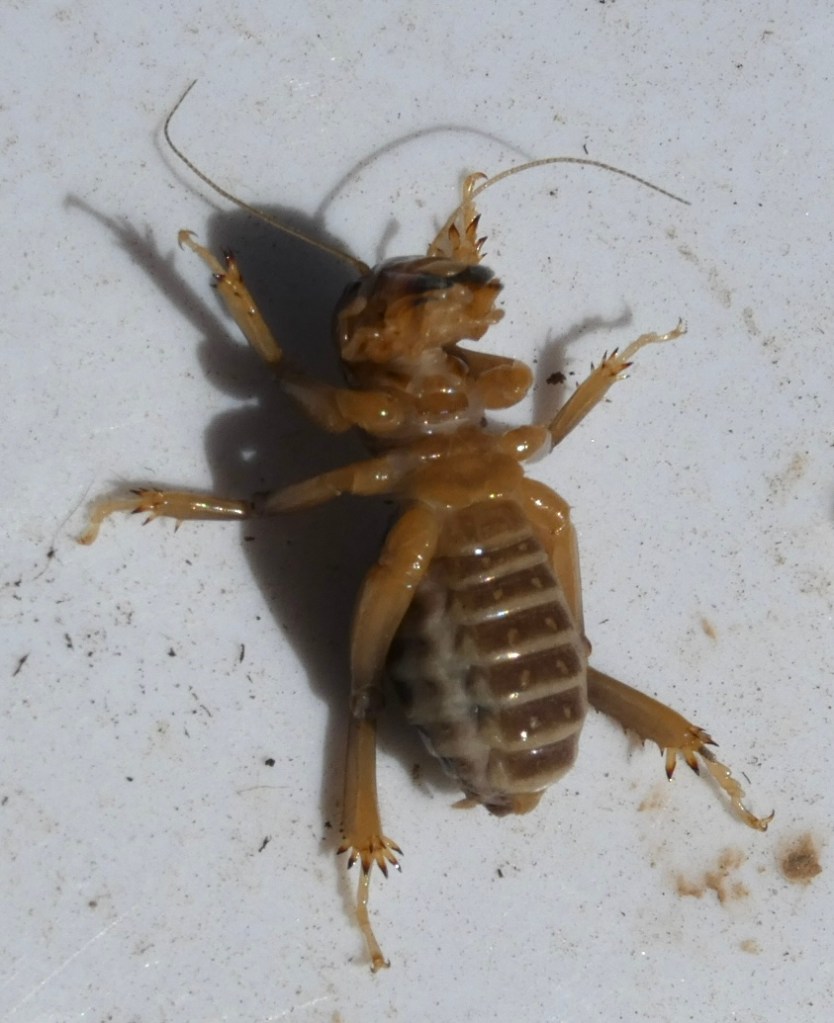
Here’s the underside of my Dark Jerusalem Cricket. The leg spines really show well as does the strong mandible. A scary fascinating view!

After learning more about the Dark Jerusalem Cricket, maybe next time I discover one, I won’t jump so high?! Do you think?

Have you seen a Jerusalem cricket hiding out in your yard? If so, what was your reaction?

Hope you enjoyed this post! Thanks for stopping by!

References

inaturalist.org/taxa

bugguide.net/node/view/154

factanimal.com/jerusalem-cricket/

  • Eaton, Eric R.; Kenn Kaufman (2007). Kaufman Field Guide to Insects of North America. New York: Houghton Mifflin. p. 84. 
  • Milne, Lorus Milne, Lorus and Milne, Margery (1980) The Audubon Society Field Guide to North American Insects & Spiders. Alfred A. Knopf, Inc, pp. 437. 
  • Stoffolano JG, Wright B (2005). “So so opa —Jerusalem Cricket: An Important Insect in the Hopi Katsina Pantheon.”American Entomologist. 51 (3): 174–179. doi:10.1093/ae/51.3.174
Spotted Towhee – Page 4 .. The 100 Day Project (2026)

April 1, 2026

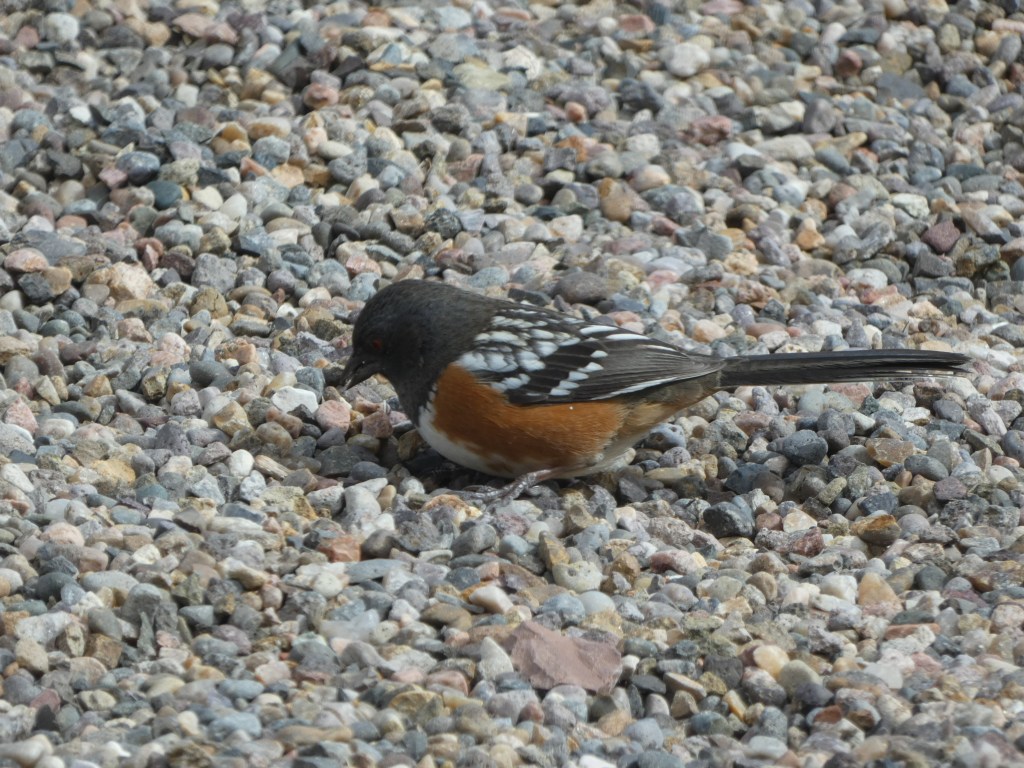
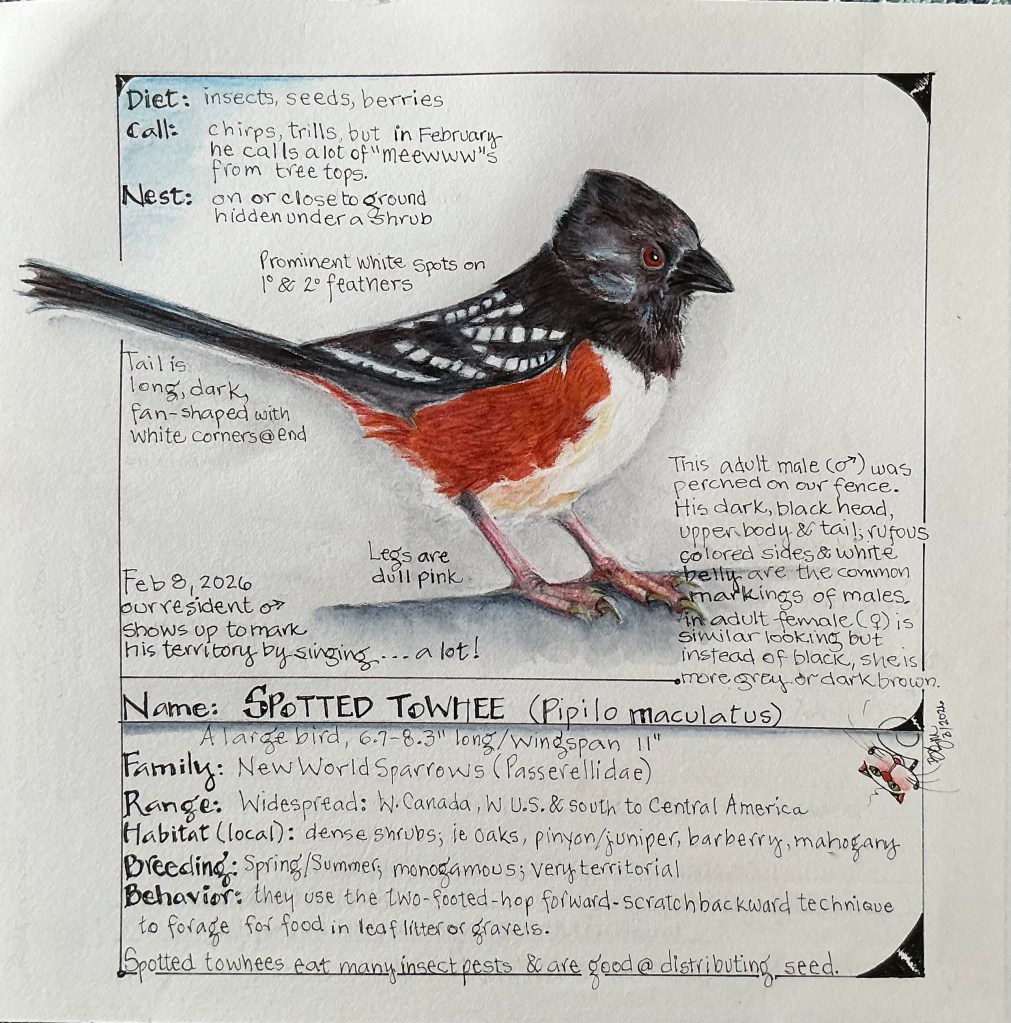
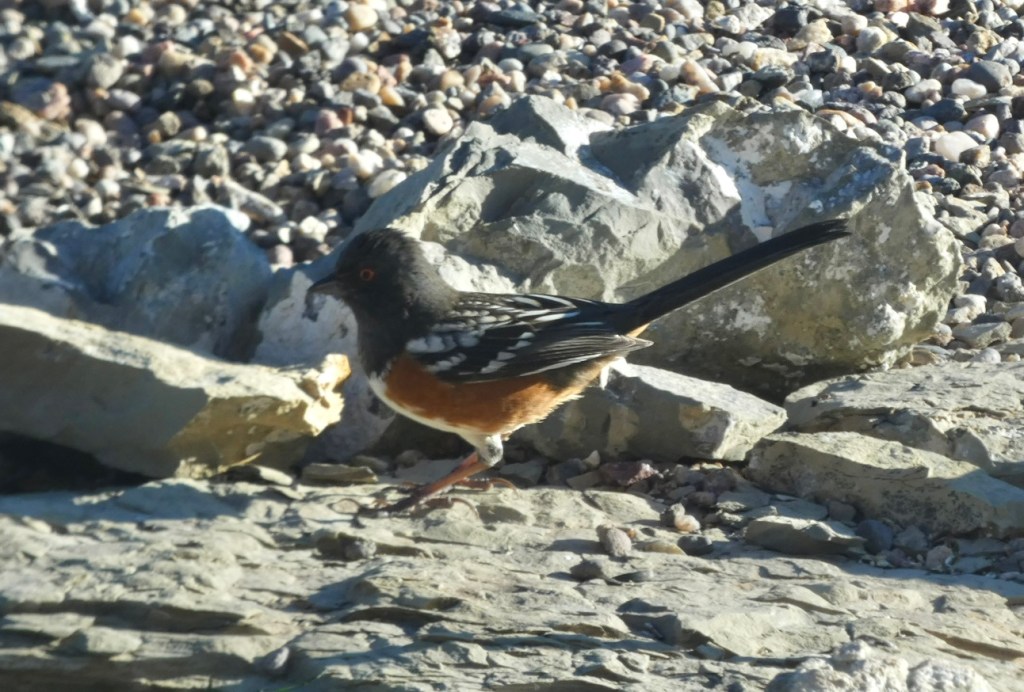
Spotted Towhee (Pipilo maculatus)

Here’s one of my favorite birds that’s a regular visitor to our yard. Spotted towhees, especially the males, are year-round residents throughout most of New Mexico, which means they breed in the shrubby vegetation surrounding our home. In our area, males sing at the crack of dawn until late afternoon beginning in early February. Instantly recognizable, their beautiful songs carry far and wide. Their songs not only signal to their mate it’s time to pair up again (spotted towhees are monogamous), they also let other male competitors know they’re horning in on his territory.

With favorable weather and abundant food, spotted towhees can produce two clutches of chicks during the breeding season. Their ground nests are hidden so well under a dense oak that I’ve never been able to find one. But it’s a lot of fun to watch clumsy fledglings trying to master the “two-footed-hop-forward-scratch-backward” forging technique all spotted towhees use to uncover hidden bugs and seeds.

Fun Facts

  • The spotted towhee and the eastern towhee were considered to be the same species called the rufous-sided towhee until 1995.
  • Male towhees have been recorded spending 70% to 90% of their mornings singing during breeding season.
  • Once a male mates, he only spends about 5% of his time singing.
  • It’s thought that the spotted towhee’s white spots are a form of camouflage.
  • Spotted towhees will sun themselves by lying on the ground feathers spread.
  • They will bathe in the dew or fog that has collected on vegetation.
  • Nesting females have been seen running away when disturbed rather than flying.
  • A group of towhees is called a “tangle” or a “teapot.”
  • When two towhees fight, one bird will pick up a piece of twig and carry it around as a sign of submission. 
  • Their bright red eyes act as a visual signal during the breeding season, standing out in their dark, shady, ground-level habitats.

Do spotted, canyon, green, eastern or any of the towhee species visit your yard? 

Hope you enjoyed this post! Thanks for stopping by!

References

audubon.org

inaturalist.org/taxa

allaboutbirds.org

explorer.natureserve.org

https://peecnature.org/learn/nature-guides/featured-critters/spotted-towhee/

Davis Mountain Mock Vervain – Page 3 .. The 100 Day Project (2026)

March 23, 2026

Davis Mountain Mock Vervain (Glandularia wrightii)

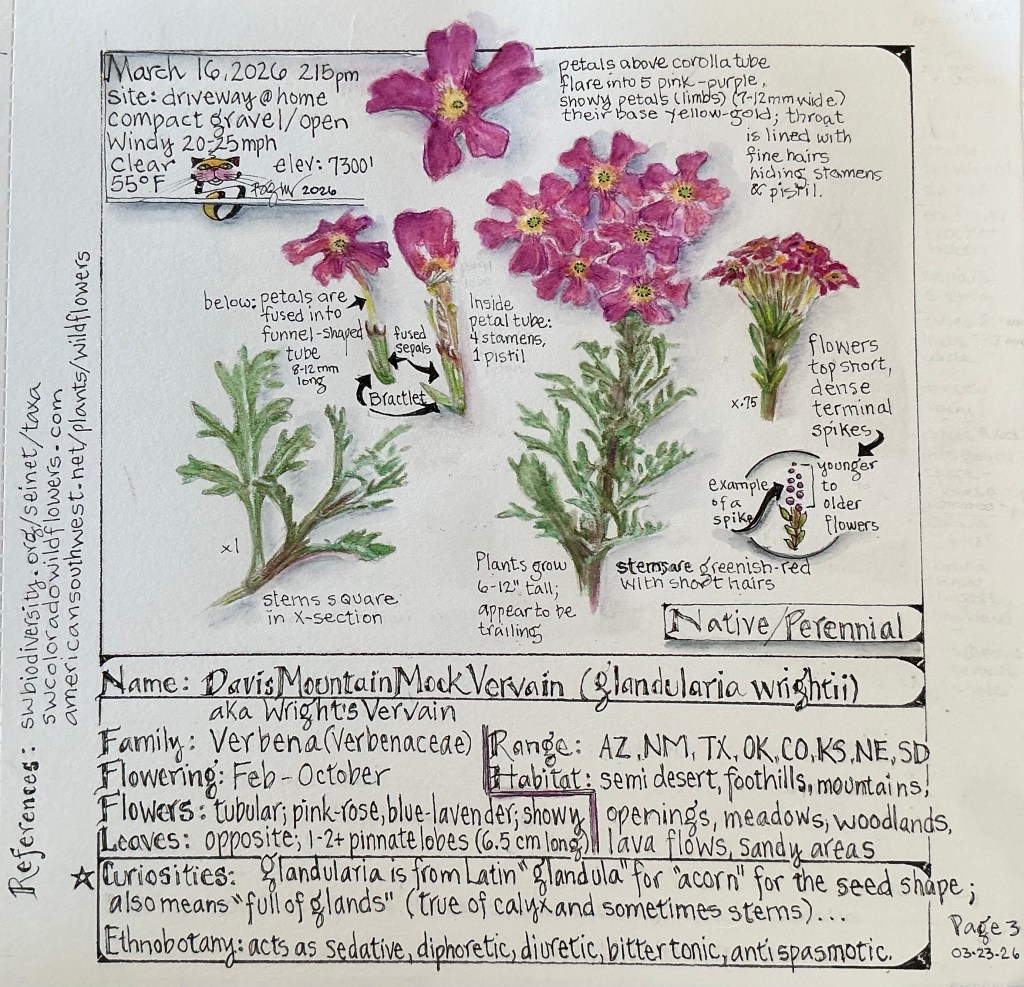
The final page
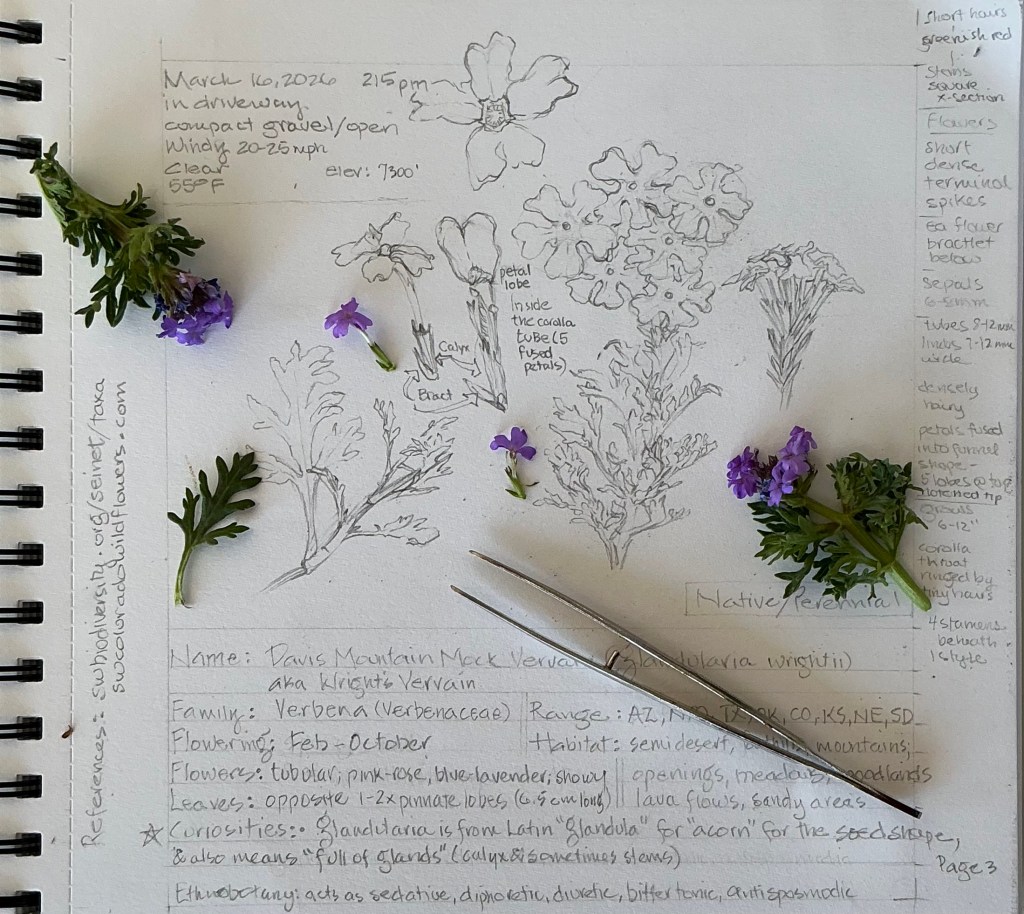
This page shows samples from my specimen.. Although the flowers of my specimens are a purple-blue color, I chose to create the flower petals as reddish-pink; this color is also common.

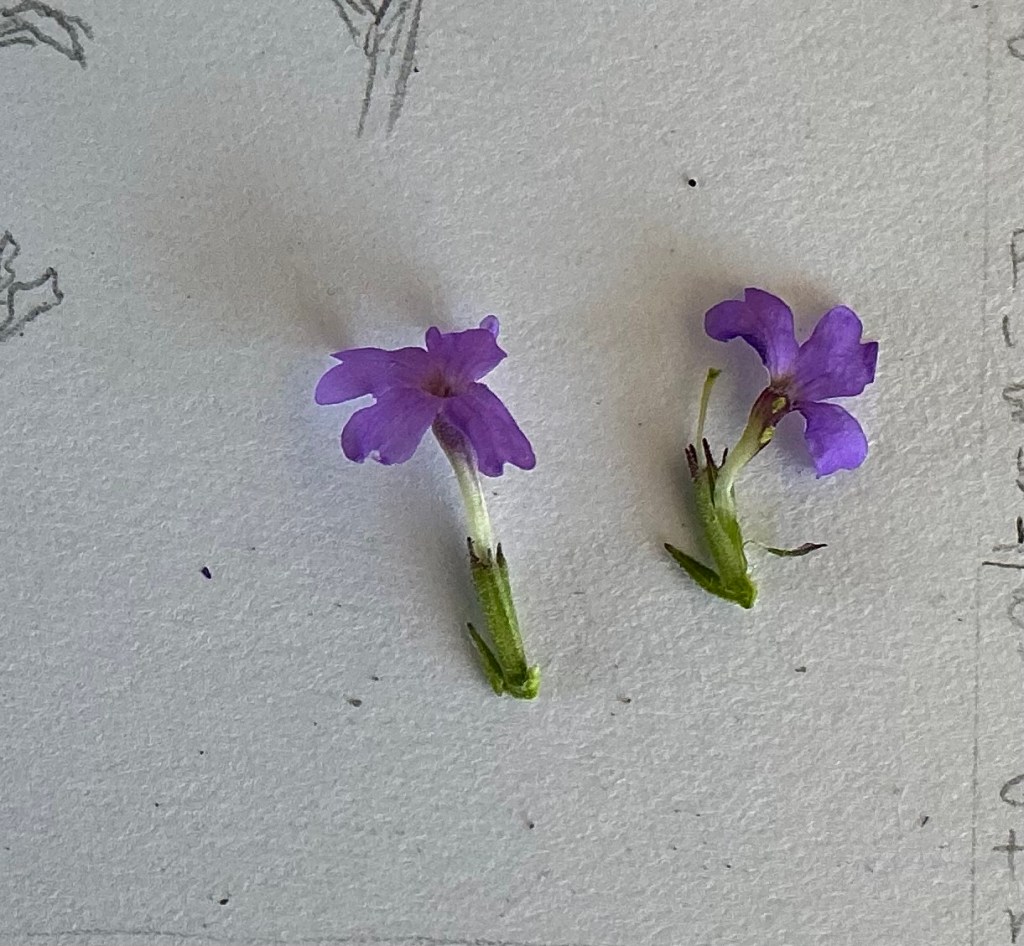
This is a photo of the two flowers I sketched for my final painting.
The specimen on the left shows the upper part of the flower, the “limb” where 5 petals flair out from the throat ringed by fine hairs. The throat leads to the lower part of the flower – the floral tube (5 fused pale green petals). . Both upper and lower petals make up the flower’s corolla. Below the floral tube are 5 red tipped green sepals (collectively called a calyx) all fused into a cup shape. The specimen on the right is a dissected flower; 2 upper petals are removed, and the floral tube has been opened to reveal the reproductive parts. On the left side are 2 of the female parts of the pistil (pale green style supporting the 2-lobed stigma of the pistil; the ovary was not exposed). Two of the four stamens (male) lie in the mid- to upper right side of the opened floral tube; look for the bright yellow anthers, each sitting atop their own filament

Here’s Another Curiosity to Ponder: I wondered why this plant has 5 petals and 5 sepals but doesn’t also have 5 stamens, which is usually the norm in so many other 5-merous plant species??? Here’s what I learned:

Davis Mountain Mock Vervain (Glandularia wrightii) exhibits a common evolutionary trait in the Vervain (Verbenaceae) family where the flower displays a 5-lobed calyx of fused sepals, and 5 5-lobed petals which fuse into a tube (the corolla). This trait, commonly described as 5-merous, curiously has a reduced the number of functional stamens to four. 

This reduction is due to an evolutionary transition from a 5-stamen ancestor. According to literature, the four fertile stamens I observed in my specimens are properly arranged in two pairs (didynamous), both neatly hidden in the floral tube beneath a ring of fine hairs. Also properly so, the filaments (the stalks that support the anthers) of the stamens are fused to the inside of the tube, and not easily teased free.

So apparently, many, many, many, many, Many hundreds of years ago, plants in the Vervain family “decided” having a 5th stamen was unnecessary. “We can do just fine without it, thank you.” Thru the process of evolution, that expendable #5 was ever so slowly reduced to a tiny non-functional structure (referred to as a staminode in modern botanical lingo), or was completely and totally lost, becoming only a memory.

Believe me, this species is an energetic producer of leaves, flowers and seeds. In my experience, Davis Mountain Mock Vervain seems to explode in masses of pink and purple flowers throughout spring, summer and fall, and can last thru winters that don’t freeze. It’s easy to understand why the species has no need of a 5th fertile stamen. Once the plant becomes established, it keeps growing and flowering and spreading, often to the detriment of other desirable plants. If it wasn’t so gorgeous at the height of bloom, it might be considered a weed!   

But I’m reminded of the definition of a “Weed ….. a plant out of place.” So yes, you’ll find me actively weeding actively growing Davis Mountain Mock Vervain so my other native plants have a chance at life too!! 

Thanks for stopping by!

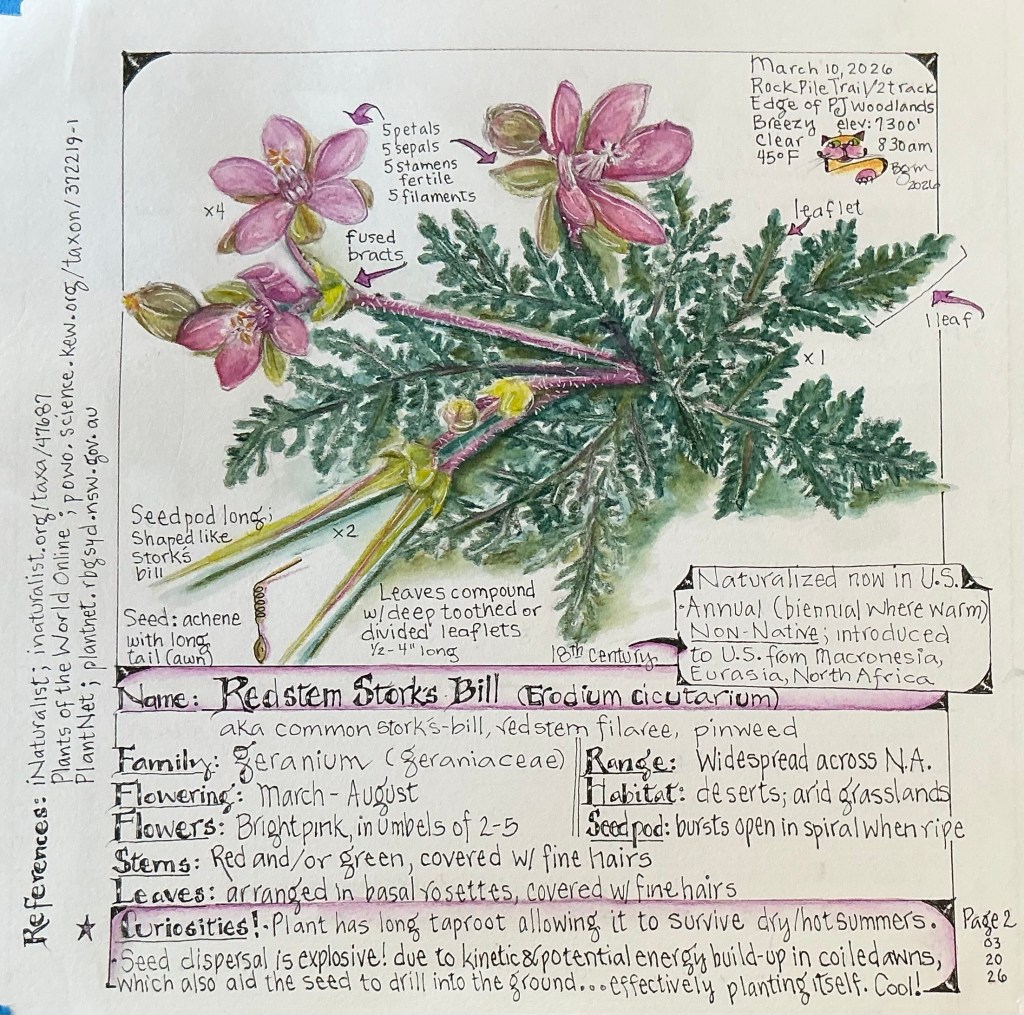
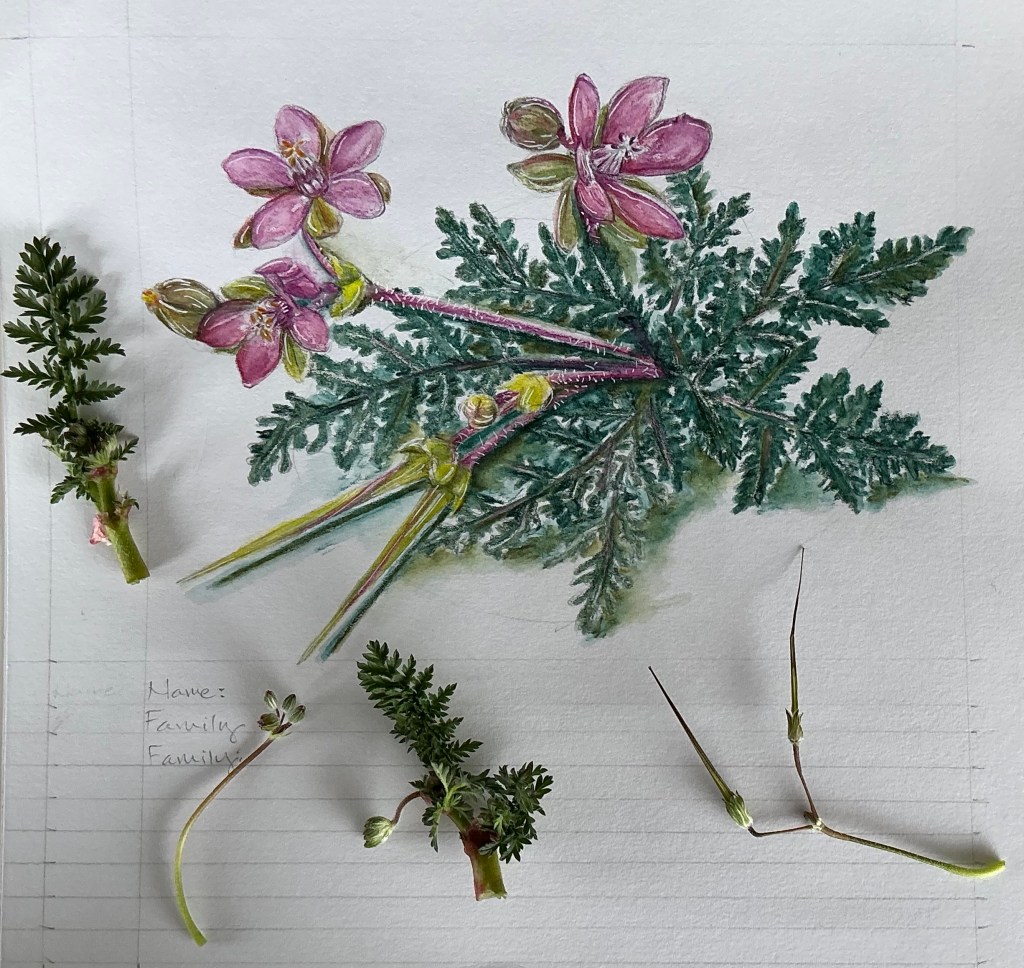
Redstem Stork’s-Bill – Page 2 .. The 100 Day Project (2026)

March 20, 2o26

Redstem Stork’s-Bill (Erodium cicutarium)

The final page
An early draft of the page with actual plant parts

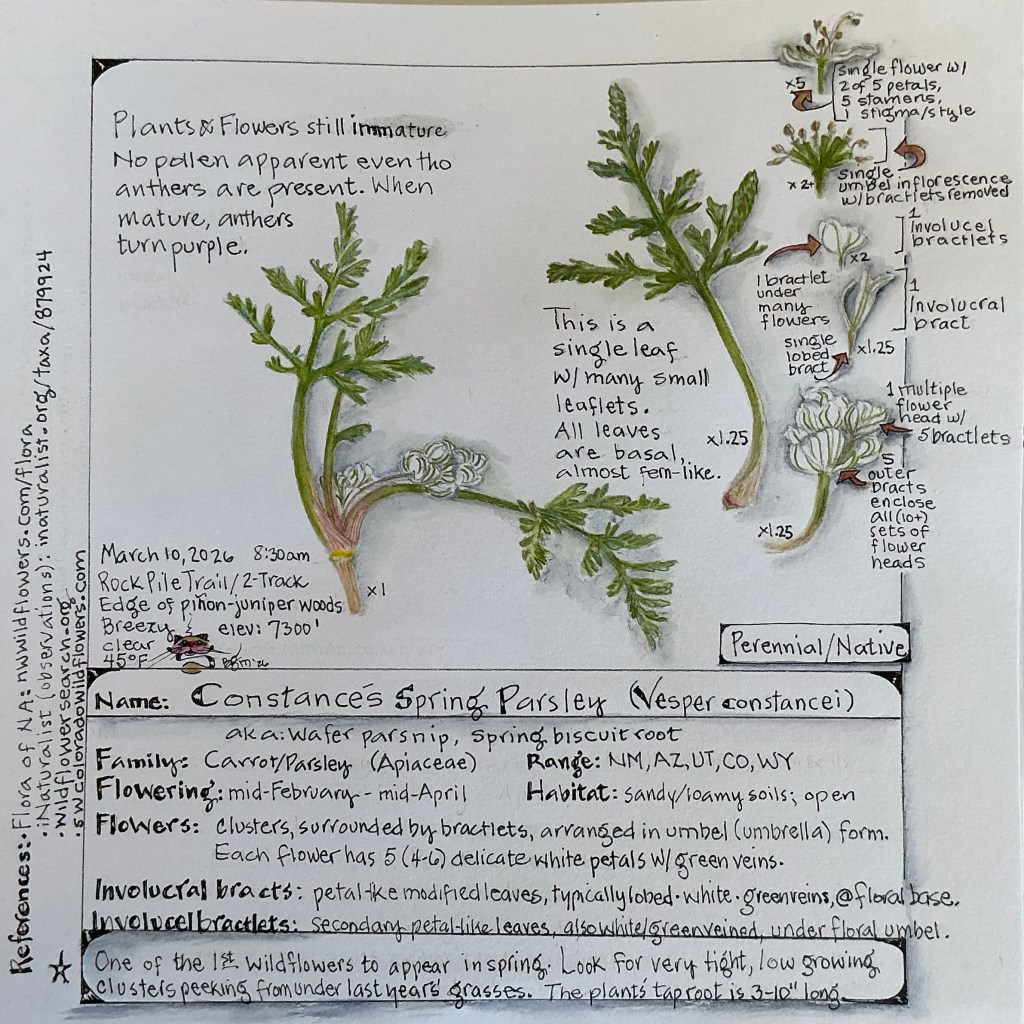
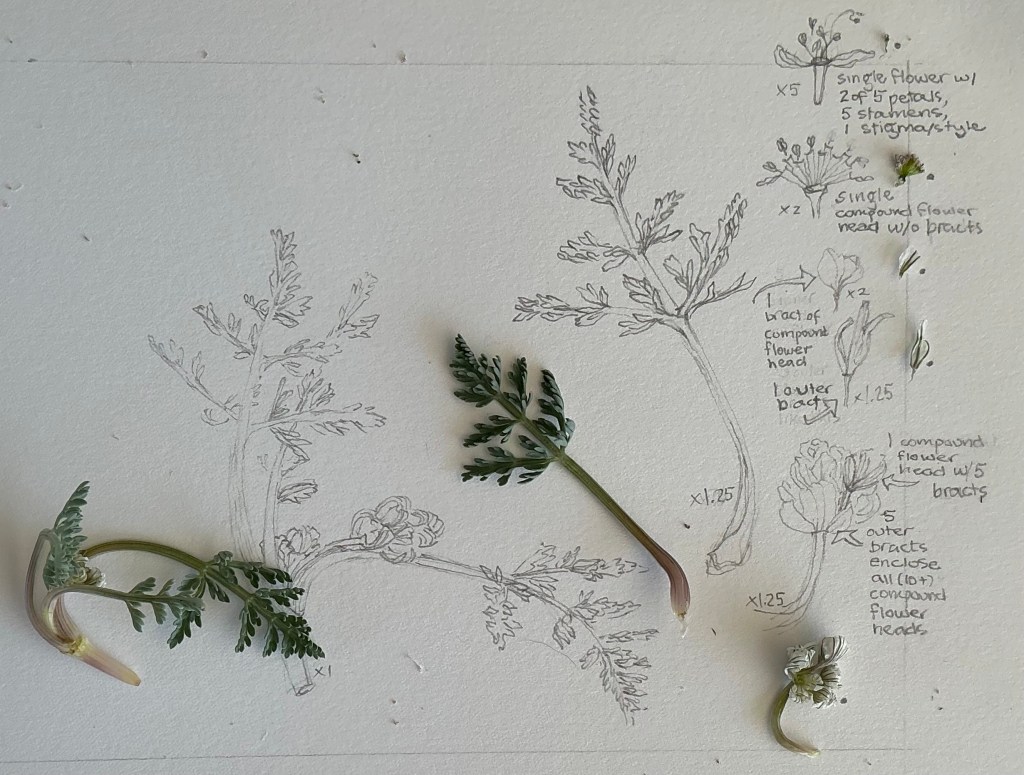
Constance’s Spring Parsley – Page 1 .. The 100 Day Project (2026)

March 18, 2026

Project Introduction

For the last few years my “someday” goal has been to create a nature field guide, of sorts, highlighting my many years of observations in the East Mountains of central New Mexico.   Well, my “Someday” is officially here! Coinciding with the February 22, 2026 kick-off of the 100 Day Project1 (Project), I began by committing an hour/day to developing that field guide as my project and immediately penciled out an outline and a few thumbnail sketches of a sample page. But, after retrieving my iNaturalist lists of East Mountains sightings I’ve made from home and during countless hikes, eliminating redundancies, and totaling up the individual species, my reported observations still numbered in the many hundreds. I would be working on this Project for the next five to six years!

Interlude

When we moved to the East Mountains in the summer of 2017, we quickly fell in love with the beauty of the wide open landscapes, the grasslands and woodlands habitats, the diverse populations of wildflowers and mammals, resident and migratory birds, and the insects and reptiles. So yes, nature is plentiful; species are many. 

Now Back to the Project

Not to be overwhelmed (or defeated) by the potential magnitude of my Project, I decided to:

  1. “Divide and Conquer” by focusing on a single location …. our current subdivision and surrounding area and trails; and
  2. Prioritize quality over quantity by creating one page over two days, keeping each work session to one hour; and 
  3. Keep the Project motivating and interesting, by adding fun facts or other research tidbit about each species.

“These guidelines seemed more realistic,” I thought, with a cautiously optimistic chance of achieving my goal of creating a nature field guide. 

So with that as an introduction to my Project, here’s Page 1 to “An Illustrated Guide to the Nature of Las Leyendas Subdivision & Environs, Tijeras, East Mountains, New Mexico” — with many more pages to follow. 🤞

Constance’s Spring Parsley (Vesper constancei)

The final page
An early draft of the page with live samples of this pretty wild parsley

1 “The 100 Day Project is a free global art project that takes place online (https://www.the100dayproject.org/).  Every year, thousands of people all around the world commit to 100 days of creating, and anyone can participate. The idea is simple: choose a creative project, do it every single day for 100 days, and document and share your process online. The most recent round of the Project began February 22, 2026, but any day is a great day to begin.”