August 10, 2026
Ladder-backed Woodpecker (Dryobates scalaris)
aka Cactus Woodpecker (Dryobates scalaris cactophilus)
Such dashing little birds, Ladder-backed Woodpeckers are fairly common along the trails of the Albuquerque foothills, easily spotted as they fly from one prickly cholla to another. They feed on insects living under the leather-like hide of the cactus’ trunks, somehow avoiding getting speared by thorns. Ladder-backed Woodpeckers are also at home among our neighborhood stands of pinyon pine and oak. For several years I’ve heard their high-pitched “Peek” call as they fly amongst the trees, but hadn’t caught a glimpse of one to confirm a sighting ….. until this summer!
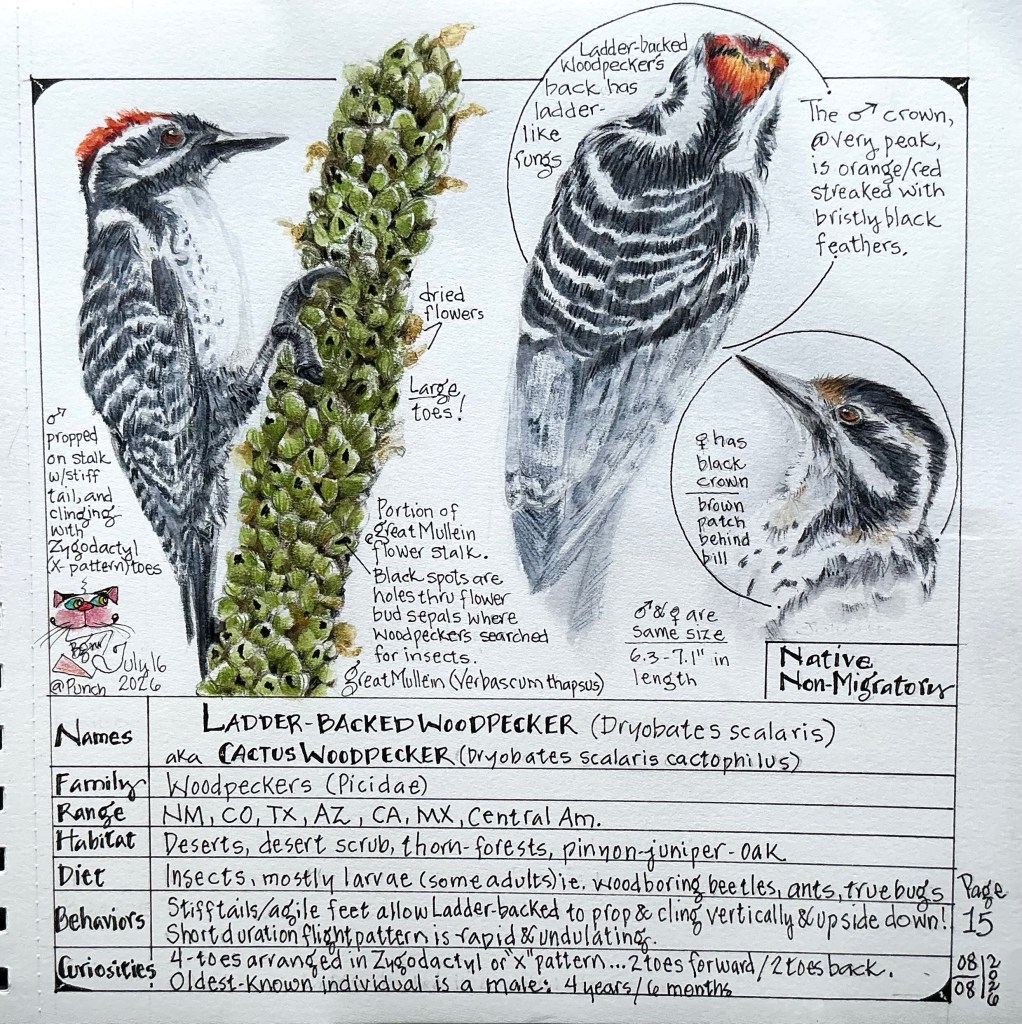
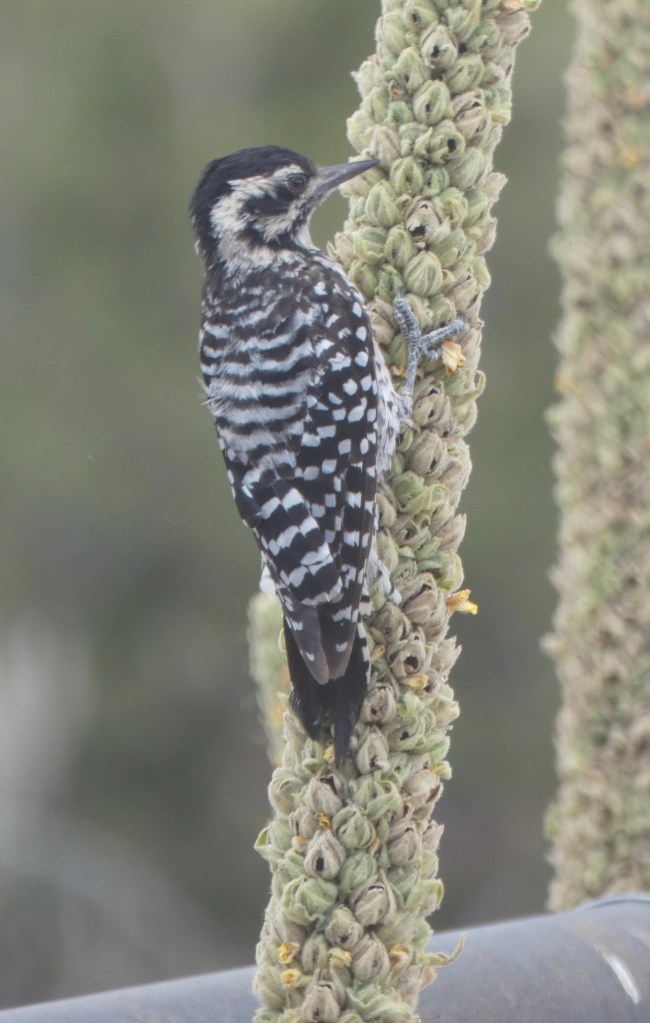
While walking into the back yard one day I came to an abrupt stop at the gate. A mere 20 feet to my right came a “Peek” call —- and then another “Peek.” Turning only my head, ever so slowly, in the direction of that familiar call, I saw a male Ladder-backed Woodpecker creeping up and around the 5 foot tall vertical flower stalk of a mullein plant (Verbascum thapsus) growing along the fence line. And not 1 foot away from him was his partner busy working her way up another mullein flower stalk. They were both so intent on drilling into bug-filled seed pods, they seemed not to notice me! Here was my Ladder-backed Woodpecker confirmation!
After watching their activity for 10 minutes or so, I tip-toed away to fetch Roy and my camera, confident the birds had enough seed pods to keep them busy. Upon our return, they were still excitedly feasting and calling to each other, and I was able to capture a few dozen photos.
Like clockwork, the pair returned every day for a week! It was such a joy to watch them both ….. mostly they got along — like a newlywed couple. But there were times ….. like when one or the other of them dared to feed from the same mullein flower stalk, at the same time! Quite a squabble took place; both birds shouting rapid-fire “PEEK – PEEK” with wings wildly flapping all while they hitched themselves up and around the stalk to the very tip! Peace returned by default when the first bird reaching the top ran out of flower stalk, and surrendered to their mate by flying away to another mullein. Because there were only a few mullein plants with a supply of delicious bugs, competition and arguments between the two birds was frequent. But I never knew who the winner would be until each round was won.
A Bit About Looks
Ladder-backed Woodpeckers have a square head, a small but straight chisel-like bill, short neck, and stiff tail that they lean against for support. Both sexes are 6.3 – 7.1 inches long and have a 13 inch wingspan. Color-wise, they are black-and-white above arranged in neat stripes like ladder rungs on their backs, and a more checkered pattern on their wings. Underparts are buffy white or grayish, stippled with black. Their buffy white face is broken by black lines that extend from the bill and eye and join at the neck. Males have mostly red crowns from their eyes to back of the head; females have blackish crowns with a buffy patch in front of the eyes.
A Bit About Behaviors
Usually staying hidden by foliage, Ladder-backed Woodpeckers are readily detected by their “Peek” calls or rapid drumming on trees while searching for food. As they move about from tree-to-tree, you’ll notice their short duration flight pattern is rapid and undulating. Breeding pairs of this woodpecker form or re-form in winter or early spring.
A Bit About Foraging, Diet and Related Behaviors
Like most woodpecker species, the Ladder-backed male typically forages on tree branches and trunks; females forage on smaller plants and bushes. They find insects by pecking, picking, probing, prying, gleaning, flicking, or tapping their bill at bark or other spots that might be hiding insects. Ladder-backed Woodpeckers can be quite acrobatic, twisting and turning, balancing with the wings open, and hanging upside down in pursuit of food as they hitch and hop upwards on a tree or other plant. Their ability to prop themselves in any position on just about any plant to feed is due to their stiff tails and agile feet.
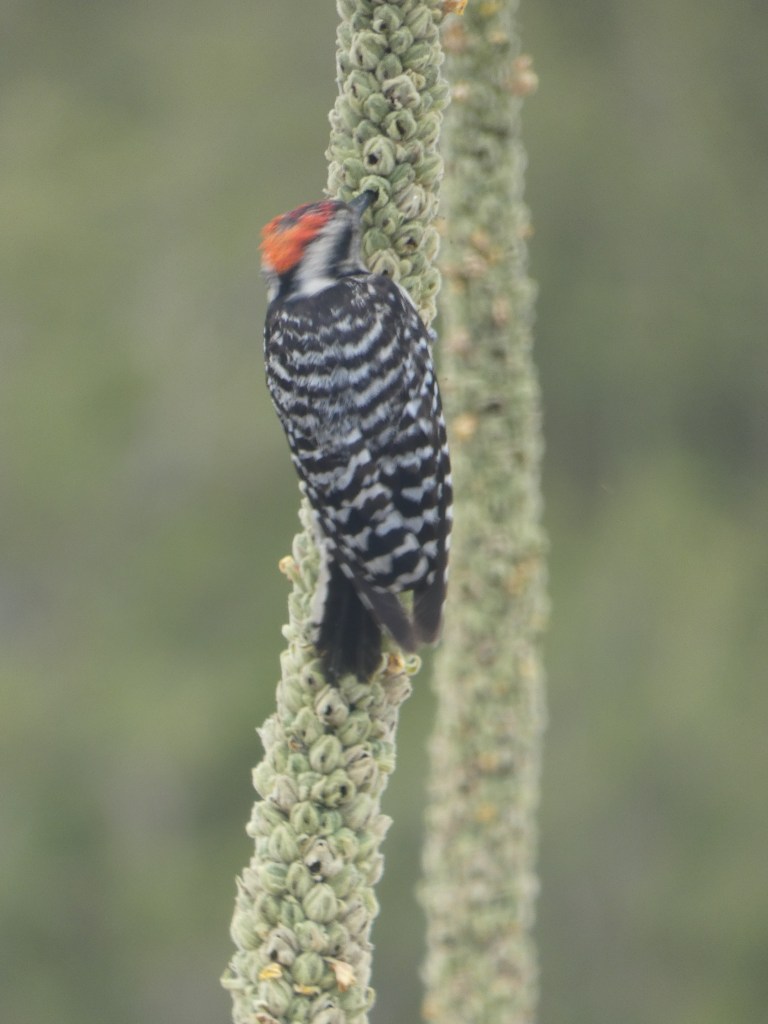
Although Ladder-backed Woodpeckers eat mostly insect larvae, they do eat some adult insects. Prey include wood-boring beetles, leaf worms, ants, caterpillars, and true bugs (hemipterans). Occasionally they will eat cactus fruit.
Unlike larger woodpecker species, the Ladder-backed rarely digs deep into the wood, they do not cache (store) food or capture flying insects in midair. They rarely feed on the ground.
A Bit About Range and Habitat
Ladder-backed Woodpeckers are permanent residents (not migratory) within their range which includes: central and eastern parts of NM through extreme southeast CO; southern, western and northwestern AZ; extreme eastern and northeastern tip of the TX panhandle; extreme southeast CA. Ladder-backed Woodpeckers are found throughout most of Mexico and in parts of Central America.
Typically, these woodpeckers live in very dry habitats such as deserts, desert scrub, thorn forest, and pinyon-juniper woodlands from the lowest elevations up to about 7,600 feet.
A Tiny Bit of Fun Facts
Like most woodpeckers, the Ladder-backed have their four toes arranged in an X-pattern, with two set forward and two backward (known as “zygodactyl”). This adaptation allows them to cling to vertical surfaces and even upside down on horizontal surfaces more easily and firmly than perching birds (which have three toes set forward and one backward).
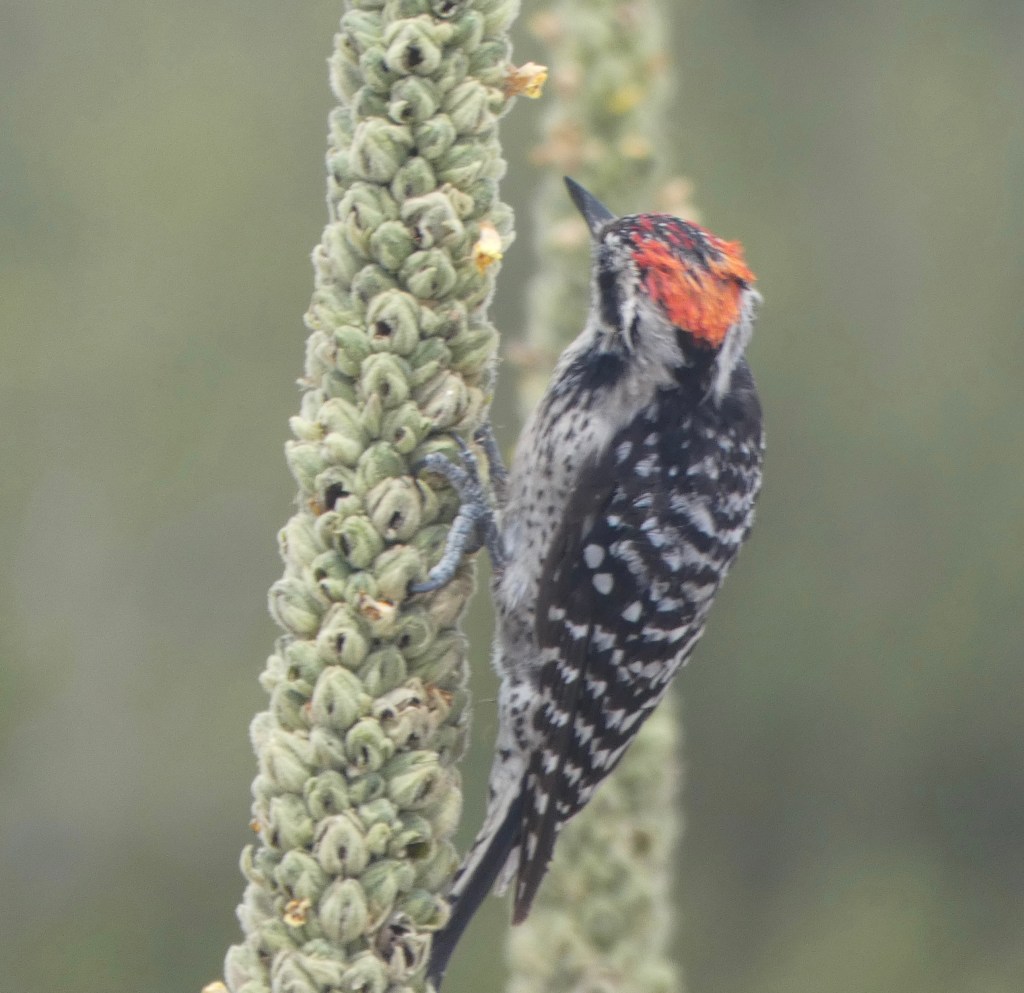
The oldest known Ladder-backed Woodpecker was a male who was at least 4 years, 6 months old when caught and released in Texas.
A Bit About Common Names
The “Ladder-backed” name comes from the pattern of black-and-white markings climbing the bird’s back in neat stripes like ladder rungs, all the way up to the base of their heads.
The “Cactus Woodpecker” (D. s. cactophilus) is an old name for a subspecies of the Ladder-backed Woodpecker that inhabits the southwestern United States and adjacent Mexico. Calling them “Cactus Woodpecker” was fitting as they frequently forage on and nest in various species of cacti.
A Bit About Scientific Names – Etymology
Dryobates scalaris and Dryobates scalaris cactophilus
The genus Dryobates, named by the German naturalist Friedrich Boise in 1826, is from the Greek compound word δρυο-βάτης : ‘woodland walker’; from δρυο (-drus) meaning “woodland,” and βάτης (-bátēs) meaning “walker.”
The species scalaris comes from Latin, meaning “of or pertaining to a ladder” or “a flight of steps.”
The subspecies cactophilus was likely a slight misspelling of cactophily (or cactophile/cactophilic). Breaking down cactophily (cacto– and –phily), you have something with an affinity for or specialization in cacti. More precisely, cacto- is from the Neo-Latin noun for cactus, which derived originally from the Ancient Greek kaktos, a term used by Theophrastus to describe a kind of thorny thistle. And -phily is derived from the Ancient Greek suffix -philia meaning love, fondness, affinity, or a tendency toward something.
…………………………………………………………………………………………………
Hope you found this interesting!
I’d love to know what woodpeckers visit your neighborhood.
As always, thanks for stopping by!
References