Winter can be challenging for nature journalers. Getting outside when it’s cold and windy, cloudy and dreary, snowy, icy or wet, are not ideal weather under any circumstances. And when everything looks brown and crispy and pretty much the same, the challenge to nature journal in the great outdoors grows exponentially. While these conditions make it difficult for spontaneous observing, I try to remember there’s always something remarkable to be discovered in nature, even in winter.
Who knew a little whack on the head would be just the thing to reawaken my curiosity?
Bundled in layers, leash in hand, Luna led me on her early morning walk around suburban Albuquerque. Having been along this route before, we’ve both made some interesting discoveries in the past. And as usual, this time was no exception for Luna. For me though, everything appeared brown, crispy and familiar. But I was inspired by and enjoying Luna’s sense of curiosity, and her encouraging tug on the leash.
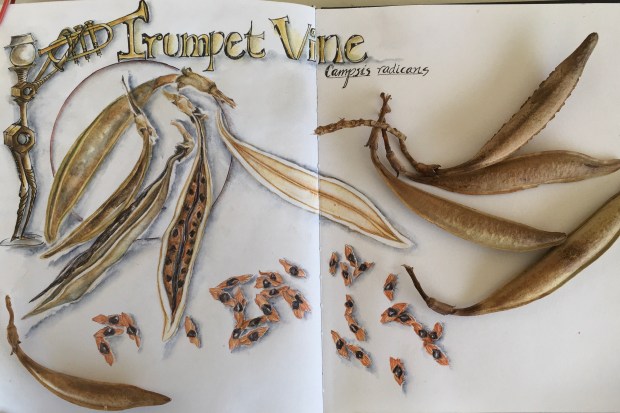
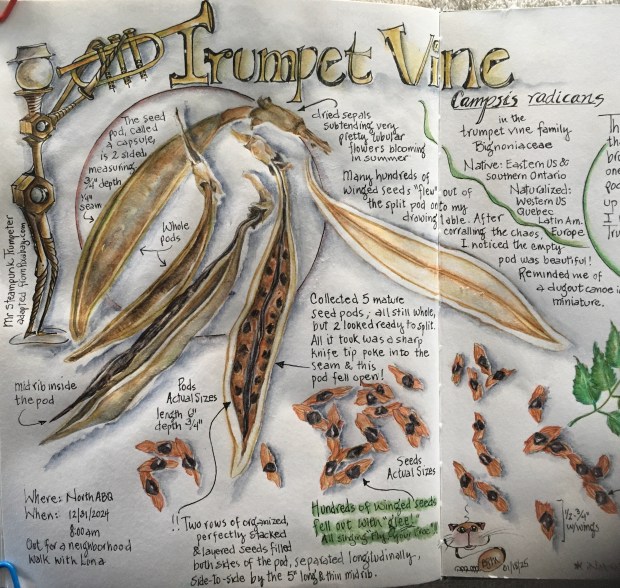
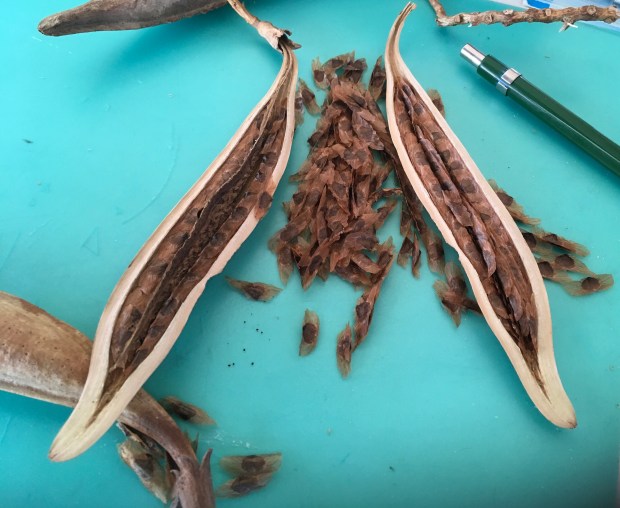
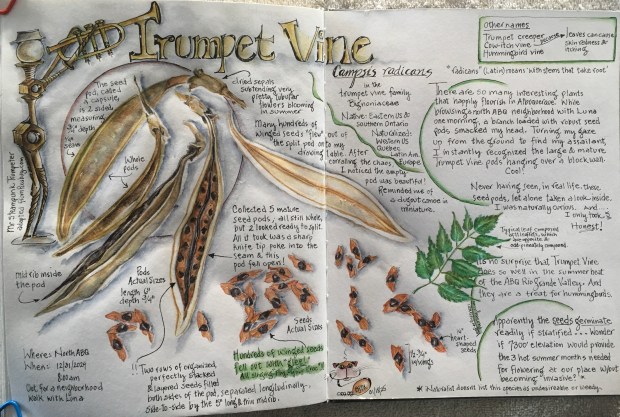
Nearing the end of our 2-1/2 mile walk, and mightily concerned I’d go home empty handed, we turned our last corner. It wasn’t 100 feet down the cement block-lined sidewalk that I abruptly stopped in my tracks. Something had lightly whacked me in the head! While the sound of rhythmic clacking rang out, I looked up, and to my surprise spotted the accidental assailant. Draped over the 6 foot wall, suspended from a hearty Trumpet Vine (Campsis radicans) growing in the hidden yard beyond was a string of pods resembling brown green beans. Long and plump and full of seeds, one of these pods had reached down low enough to make contact with to my head. (I say “reached” because that’s what my imagination said had happened.) Quickly awaking my sleepwalking brain, the effort made by the seed pod to get my attention paid off too. Silently whispering, “Pick me! Pick me!” it was as if the seed pod and its adjacent buddies either wanted to be harvested, or wanted to be featured in my nature journal (or both).
So I did ………… both!
I loved learning about and sketching these fascinating Trumpet Vine seed pods, while my mind was filled with the muffled notes of a trumpet. Tooo-too-too-toooooom!
Hope you enjoyed reading this story and browsing around my journal pages.
It’s late October, mid-Fall in the Manzano Mountains, perhaps a week before the first snow of the season. The Gambel Oak covering hillsides and mountains somehow sense a change in the air. Seemingly overnight every leaf on every oak shrub and tree magically transformed from their summer greens to royal rusty reds, gleaming golden yellows, and shocking sunset oranges. As I look across the landscape and marvel at the sight, I can’t help wondering, “How do they know?”
The spectacle is short lived. Over the next few weeks, these gorgeously painted leaves slowly change to crispy beige brown, fooling the observer into believing they can’t face another winter; that every single oak shrub and tree just gave up and died! Thinking that was the case my first winter in central New Mexico, I was fooled. But since then I’ve learned a lot about the life cycle of Gambel Oak, and have come to appreciate the persistence of all those crispy browns covering up the otherwise barren nakedness of chaotically jumbled branches.
There’s a lot that can be said about Gambel Oak (Quercusgambelii), but this post focuses on
The Leaves of Quercus gambelii
The most interesting thing about this oak species’ leaves is no two are alike. Even though each leaf looks different from its neighbor, they do all have common characteristics that distinguish its leaves from other oak species. For example, All Gambel Oak Leaves …….
are lobed (but the number of lobes varies from side-to-side of a leaf’s mid-vein; depth of lobes varies on a single leaf and between leaves; lobes can be gently concave to acutely angled).
are flat and leaf margins are smooth (if leaves appear somewhat wavy and/or exhibit some serrated margins and/or points on the lobe tips, this is not a true Q. gambelii, but likely a hybrid of Gambel Oak and Shrub Live Oak (Q. turbinella) resulting in Wavyleaf Oak (Q. undulata), very common where ranges converge).
are different lengths and widths, and leaf sizes are random along each branch, with large leaves adjacent to small ones adjacent to tiny ones adjacent to gigantic ones, etc.
change color in the Fall, eventually becoming beige brown and crispy (but color patterns on individual leaves and throughout a shrub/tree are wildly various; some leaves turn one color, while others become a mixture of greens, reds, yellows and/or oranges).
that are brown/crispy persist on the shrubs/trees throughout late Fall and Winter, then drop all at the same time in Spring when buds begin to open.
that are fresh have little 5-star hairs on the undersides, while the upper surface is smooth and leathery.
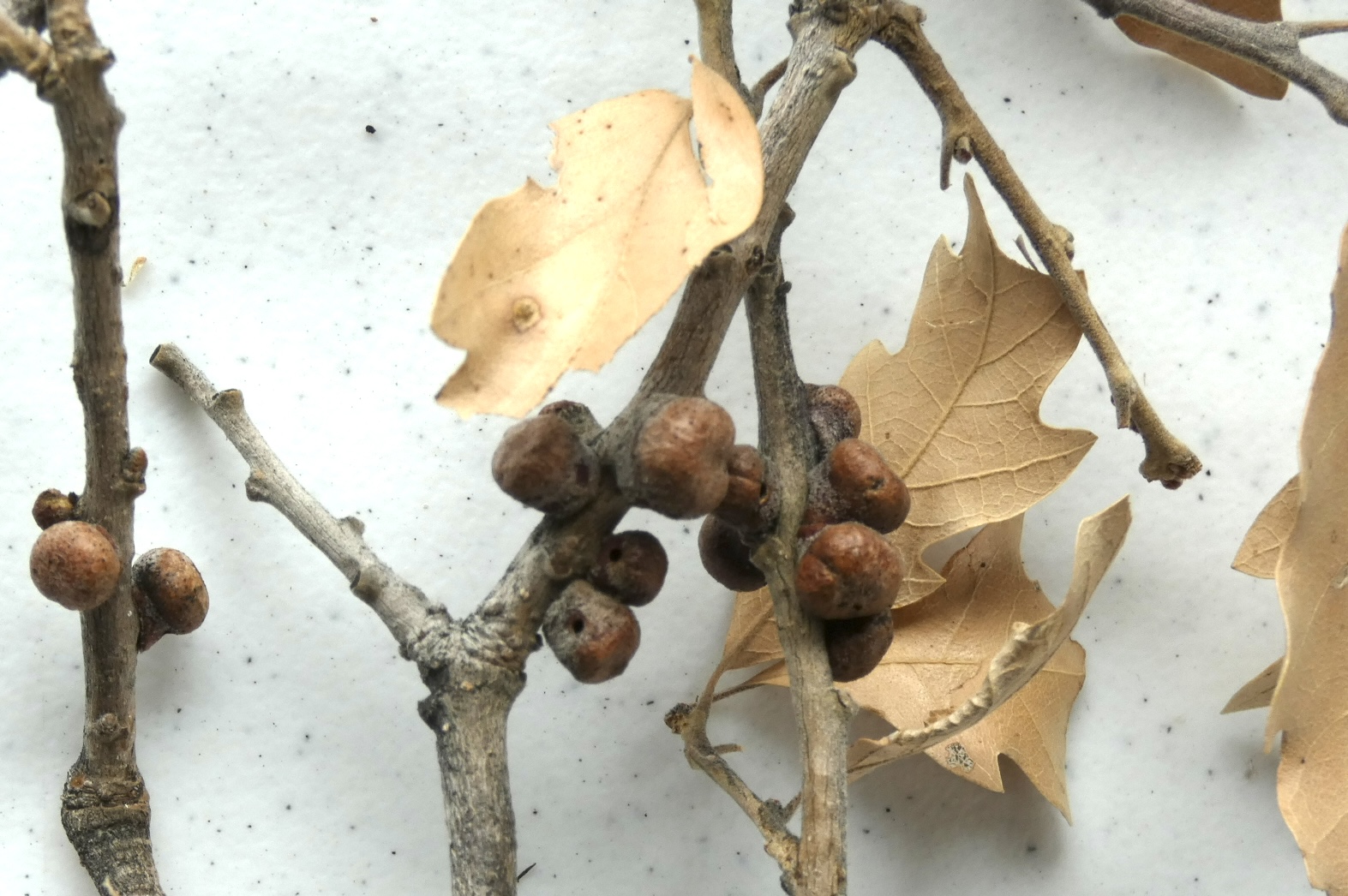
are relatively free of insect damage, with the exception of the occasional oak gall or insect nibbles (perhaps due to their leathery texture on the upper surface and hairy texture on the undersides?).
Every Fall I observe and collect Gambel Oak leaves. They make great subjects for my nature journal! Because every leaf looks different, the easiest way to depict the various shapes is to trace their outlines directly onto my journal pages. Then with leaves in hand, I can use my Inktense watercolor pencils to paint within the outlines, spending most of my effort on their beautiful colors.
I hope you’ve enjoyed my page of Gambel Oak leaves. Do you share nature with oaks? If so, which species, and are their leaves all the same or different somehow? Do you record your observations in a nature journal too? I’d love to know!
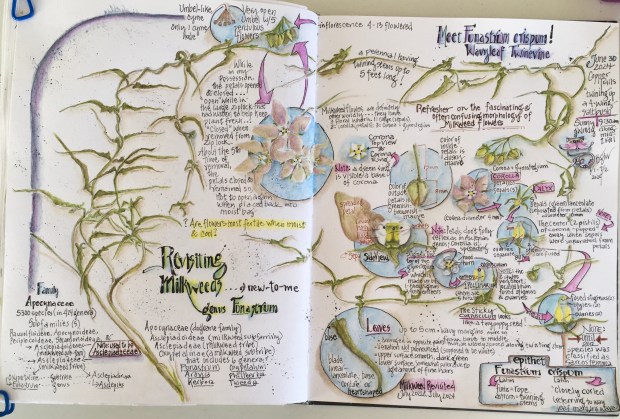
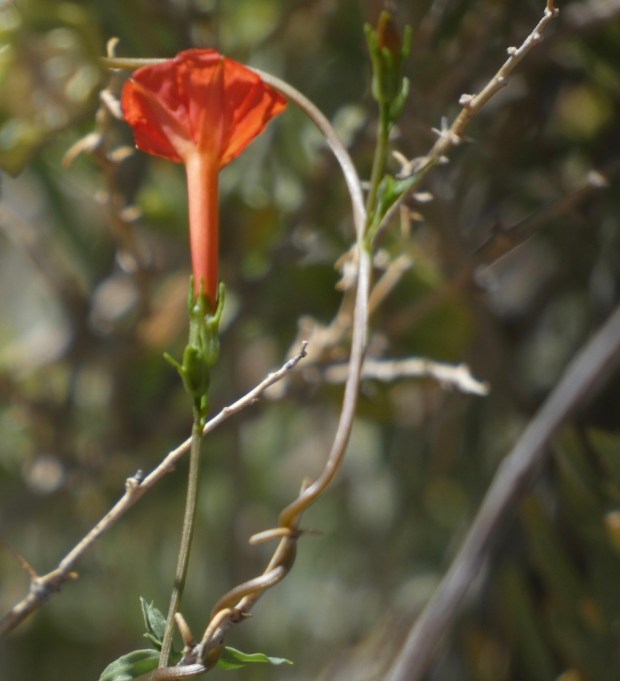
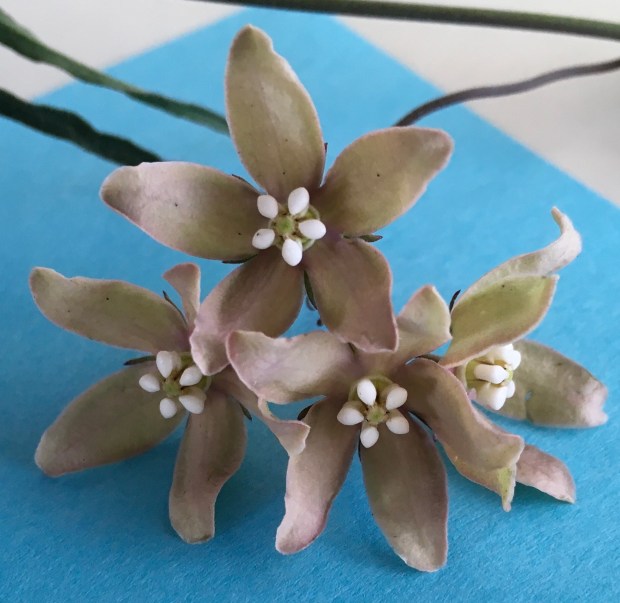
Just when I was feeling confident about the morphology of the milkweed family of plants, a new twist on the familiar leaps out shoutin’ “ Hey, lookie here!” Expecting to see a common vine gracefully twirling its way up a desert shrub, I paused ……. searching for the crimson red trumpet-shaped flowers of Ipomoeacristulata (Trans-Pecos morning glory). But instead there was an umbrella of 5 flowers, each with 5 widely spreading greenish-brownish-mauve colored petals crowned in the center of an unmistakable floral corona, a sure fire characteristic of a milkweed! Could it be?
Trans-Pecos Morning glory
Oh Yes!
This unexpected, undeniable discovery had me puzzled though. It’s been two years since I created a detailed post about the Asclepias genus of milkweed (see Summer Botany: Meet the Milkweeds). At that time and throughout the decades prior, my knowledge of milkweeds was limited to Asclepias, and the specific characteristics of that genus.
Spreading petals of Wavyleaf Twinevine
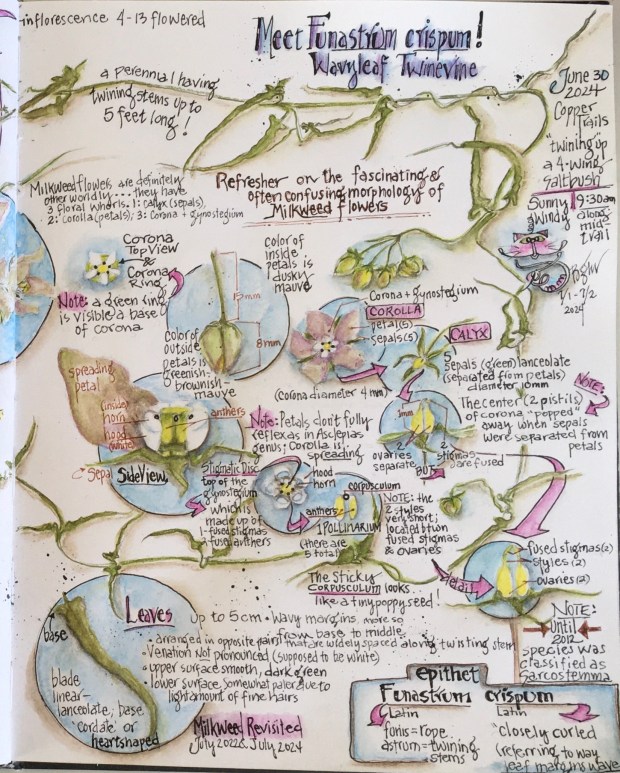
But here was something new-to-me; so worthy of whatever time it might take to learn all about this find in the dogbane family (Apocynaceae), aka the Milkweeds. I quickly confirmed this vine does not belong with the Asclepias species of milkweeds, but is of the genus Funastrum, which is Latin for rope (funis) with twining stems (astrum), commonly referred to as the “twinevines.” And the full name of this plant is Funastrum crispum, commonly called Wavyleaf Twinevine.
Most of what I uncovered about Wavyleaf Twinevine is included on my 2 journal pages, along with some confusing taxonomy involving family and subfamily names, tribe and subtribe names, and how until 2012, this plant was known as Sarcostemmacrispum. Curiosity about the taxonomic history will undoubtedly tempt me to sort through the confusion ……. maybe someday soon!
Have you discovered anything new-to-you in nature lately? What was it, and did it lease to more discoveries?
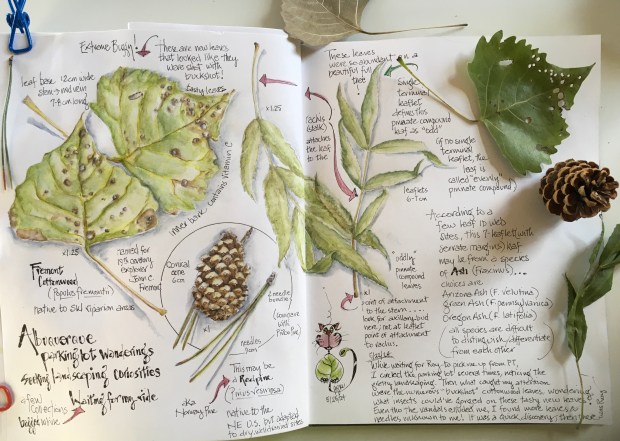
Oops! I was caught without my sketchbook ….. but that didn’t prevent me from making a few interesting collections while waiting for a ride.
My curiosity unleashed, I began by wondering what voracious insect(s) tried to eat 1000x their weight in fresh cottonwood leaves. Then I noticed a very lovely leafy tree growing next to a stately pine, both of which were mysteries to me.
So I spent this afternoon sketching, painting, and looking over ID and reference materials, as much fun as collecting my three parking lot treasures!
If you find yourself “waiting,” how do you pass the time?
When trying to pin down exactly what’s so special about Herbs, a deliciously aromatic group of plants, I was stumped. Well, maybe not stumped, exactly. There are so many reasons to fall in love with Herbs, and picking one feature or even one Herb that’s especially special is nearly impossible. Best known for their culinary flavor enhancements, can you imagine pickles without Dill, pesto without Basil, salsa without Cilantro? What’s a dark chocolate circular pattie without Peppermint, or a cookie cutter man without Ginger?
Herbs excite memories, calm the mind, reduce inflammation. Does the aroma of sage conjur thoughts of Thanksgiving? Does a sprig of lavender make you sleepy? Does bold yellow turmeric soothe arthritic joints?
And many Herbs are decorative and lovely to look at, form beautiful shrubs, have gorgeous flowers.
But I keep coming back to the aroma. It’s hard to resist crushing the leaves of herbs like thyme or mint between my fingers. The essential oils released into the air and lingering on my fingers causes me to take a deep breath, inhaling the fragrance, embedding the aroma in my brain, resulting in a memory I can recall over and over again.
Herbs are Special!
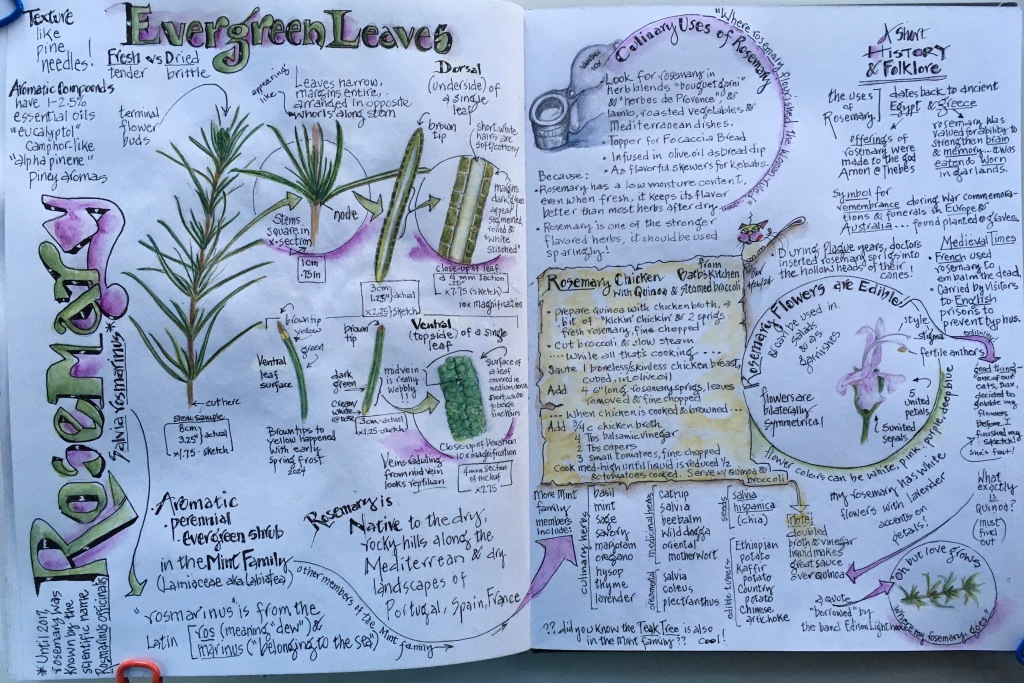
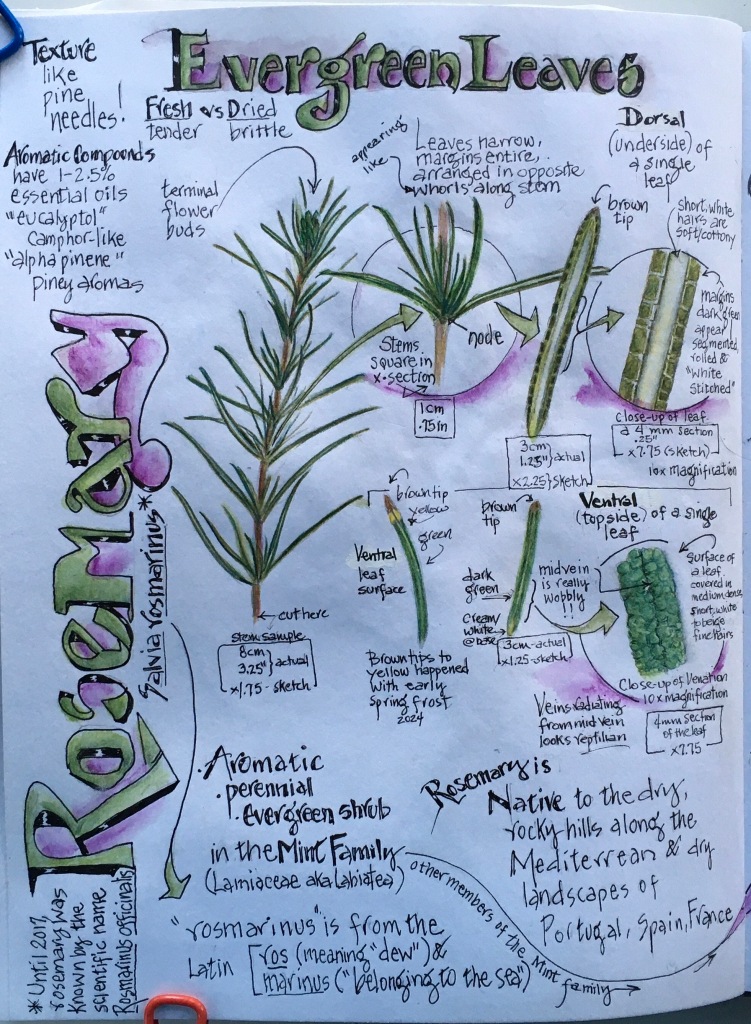
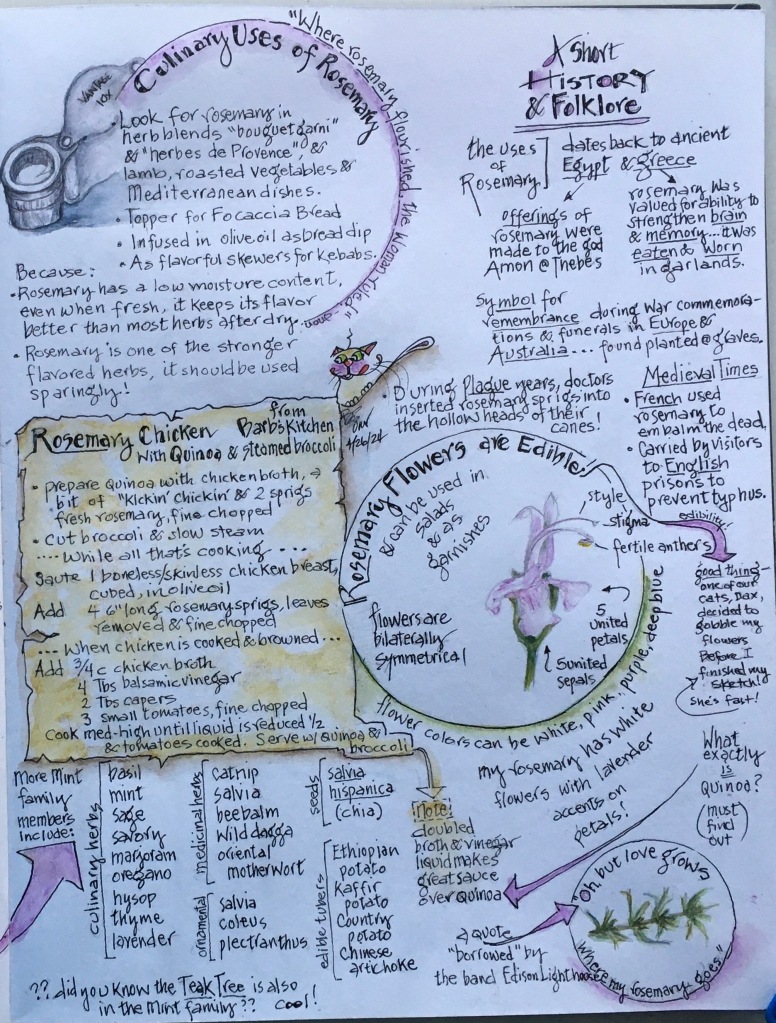
The Rosemary plant (actually a mini shrub) in my yard always invites my attention, and just this week it welcomed spring by coming into full bloom!
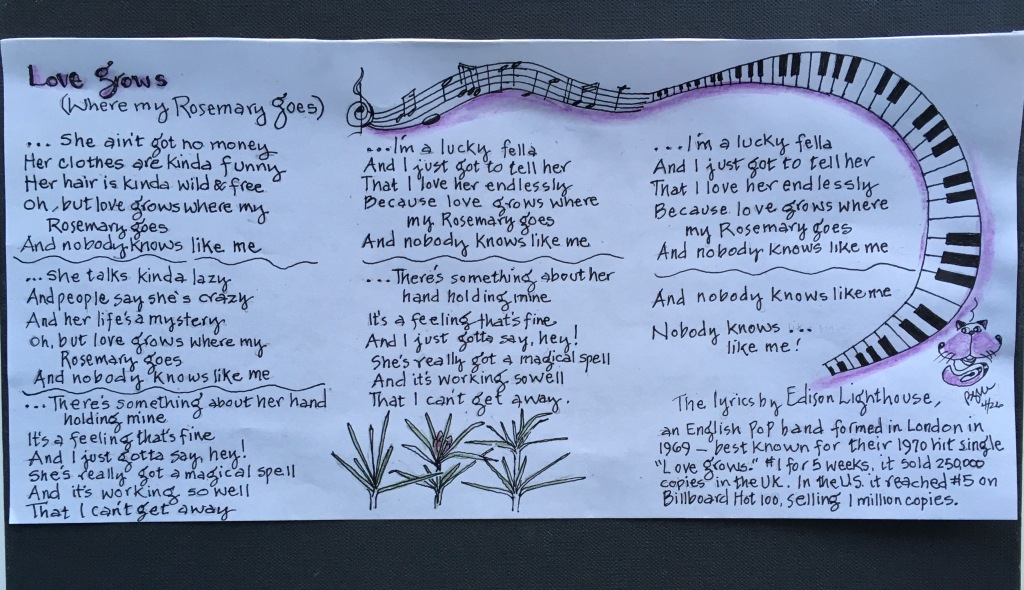
Who remembers this?! Now I can’t get it out of my head!
Do you have a favorite Herb? Why is it special? How do you use it? Please share! And thanks for stopping by!
Honest …. You can’t make up this stuff! You’ve got to wonder what the person or persons who began the National social media movement, “I Hate Coriander” Day, have against an innocent little herb.
“National I Hate Coriander Day, celebrated annually on February 24th, is a social media movement to express disdain for the herb coriander (also known as cilantro) and its taste and smell.”
“Hate” is such a strong word under any circumstances, but to “hate” an herb? … What do these Coriander “Haters” find offensive about the look of this bright green leafy plant? What is it about the taste and/or smell of Cilantro that elicits such a strong reaction? Now I’m not a Coriander (aka Cilantro) addict ….. a bit now and then as garnish or to flavor a fresh salsa is perfectly fine with me. I’ve even grown Coriander in my garden and marveled at the plant’s growth rate, intense leaf and stem coloring, bouquets of delicate flowers and abundance of seed. So my curiosity was definitely piqued when I came across this peculiar National Day. Just what is it that has and keeps these people all riled up over Coriander?
Coriander – The Plant
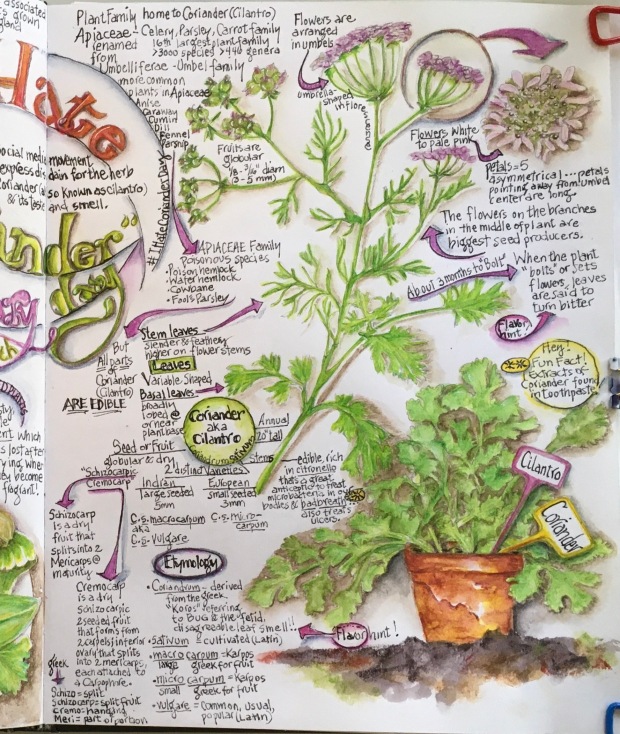
Not to be confusing, but Coriander and Cilantro are actually the same thing, Coriandrumsativum. However, in the U.S. we tend to refer to the leaves and stems as Cilantro; the seeds (whole raw or toasted, or ground) as Coriander. But because the National Day is about hating Coriander, I’ve made a leap in assuming they hate the entire plant, including the roots, stems, leaves, flowers and seeds (all of which are edible; all of which are eaten).
The plant is an annual that grows up to 20” tall. The bright green leaves are variable in shape, broadly lobed at the base of the plant, and slender and feathery higher on the stems. Flowers are arranged in umbels (like a wind blown, inside-out umbrella), are white to pale pinkish-mauve. Each asymmetrical flower has longer petals pointing away from the center of the umbel than those pointing inwards. And each flower produces a dry globular fruit (schizocarpic cremocarp) about 1/8 – 3/16” diameter, which splits when mature into 2 mericarps, each mericarp with a single seed.
Coriander – The Seed
The name, Coriander, is the common name used around the world, for the seed of Coriandrumsativum. There are two cultivated varieties of Coriandrum sativum grown around the world. Although the plants of both varieties appears the same, it’s the seed where the visible differences occur. C. s. var microcarpum is the small-seeded variety found in temperate climates, such as in Europe and the U.S. Its seeds are about 3 mm in diameter, round, and very potent as a spice. C. s. var macrocarpum (aka C. s. var vulgare) is the large-seeded variety found in hot, subtropical areas of Asia and India. It’s seeds are 5 mm in diameter, football shaped and have a very delicate flavor.
If you’ve ever grown Coriander from seed, you probably planted one seed at a time, being careful to follow the spacing instructions on the package. Then when your seeds germinated, sending up those first immature leaves (cotyledons), you noticed that for each seed planted there are 2 little plants! “What the heck?” you say. When you sowed the seeds in each well-spaced spot, you obviously planted an entire globular fruit (both mericarps at once) resulting in the germination of both seeds!
Is There a Consensus of Opinions on Leaf Taste and Aroma?
Nope! Opinions are far from consensual. As a matter of fact, they are frequently polar opposites. Coriander has been described as the “Marmite”*****!!! of herbs; either you love it or hate it. This great analogy reflects how strongly people do feel about flavors of their food.
Opinions on leaf taste and aroma: The good – tart, lemon-lime, fragrant, pleasant, distinctive, spicy hot, peppery, aromatic. The bad – bitter, stinky, unpleasant, nasty, fetid. And the bleh – The leaves smell and taste like dish soap!
Is There a Consensus of Opinions on Seed Taste and Aroma?
Again, Nope! But curiously, most of the opinions about seed taste and aroma were fairly positive, provided the correct variety of C. sativum was properly prepared and used. For example, all seeds contain 1% volatile essential oils, but the quality of oils is different between the two varieties. For some reason the smaller European variety seeds (C. s. var microcarpum) have far superior essential oils resulting in far superior flavor and yield when compared to the larger India variety seed (C. s. var macrocarpum). The larger India variety seeds are preferred as a spice, both whole and ground.
Opinions on taste and aroma of fresh or dried seeds: Spicy, earthy, cumin-like, orange peel, aromatic, dried seeds have full flavor, fresh seeds are undesirable.
Opinions on taste and aroma of toasted seeds++, whole or ground: Fruity, Fruit Loops, lemony, floral, mild perfumy, aromatic, bitingly pungent, delightful bouquet, distinctive flavor.
Now it’s your turn! Where do you stand on the issue of Coriander; it’s taste and smell? Are you celebrating today’s National “I Hate Coriander” Day? Or are you a regular Coriander Connoisseur, savoring the taste, smell and texture in all of your favorite dishes, from sauces and marinades, curries, meats and seafood, stews, to pastries and desserts?
***!!! Marmite! Invented, made and sold in England, this stuff is a sticky, dark brown paste made from fermented yeast. It has a very salty and powerful (understatement) flavor, and is frequently slathered on toasted breads like jam. If you haven’t experienced Marmite, perhaps you’ve dared to taste its equally unappetizing knockoff, “Vegemite,” found all over Australia? If you’ve tasted either or both (wow, you’re tough), what was your reaction? If you’ve never had the culinary pleasure, consider this fair warning! Wonder if there’s a social media group that’s declared “International I Hate Marmite (Vegemite) Day?” I would happily eat a bushel basket of cilantro greens, than dare give these yeasty products another go. (No offense to the marmite and/or vegemite lovers of the world.)
++Toasting Coriander Seed: In a non-stick skillet, over medium-high heat, add the seeds. Keeping the skillet in constant circular motion. When the seed’s aroma is released, toasting is complete! Cool completely and grind with mortar/pestle or in a small electric grinder. Store ground coriander in a cool (refrigerated) location, away from light and moisture. It’s best to toast and grind seeds in small amounts, on an as needed basis, to experience the full flavor.
Sharing my pages from today’s short hike up Cedro Creek, on the fringes of the Manzano Mountains. The water shortage here and all around us has become dire; soils are cracked and dry and beginning to take flight with the barest puff of wind.
Since we last hiked this area (a few days shy of a month ago), the scattered shallow pools of water have either evaporated completely or made a retreat underground, where there may be just enough water to wet the riparian area. All the tender flowering plants have disappeared; many have been able to set seed in hopes of a wetter year to come. With this premature wrap up to the summer season, the birds, bees and butterflies have moved on; hopefully up in elevation where food may still be found.
Our summer monsoon season just didn’t materialize (yet?). But despite the hot and dry conditions, we did manage to find a few leafy green shrubs. The massive cottonwoods appear to be doing well (must still be sufficient groundwater). In the cooler parts of the canyon, there are berries hanging on the 2 species of juniper trees. Acorns have begun to mature on several oak species, even though there are many that have withered; is all of this earlier than usual?
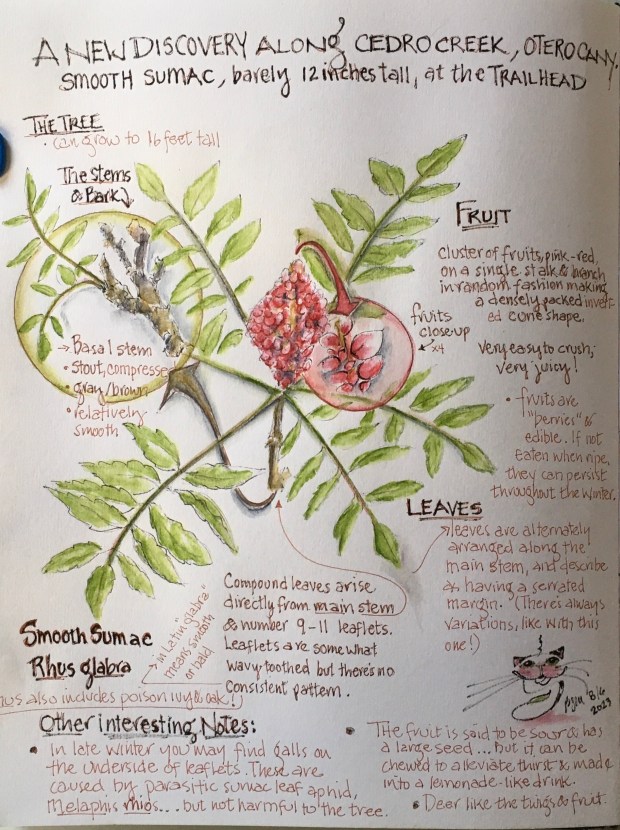
At the trailhead, tucked in a swale where water (when it comes) can collect, I was surprised to see some very stunted smooth sumac. Already showing off their clusters of juicy red berries, the plants are barely a foot tall. This species can rapidly grow to heights of 16 feet. Maybe flowering and fruiting on such short plants is a type of survival mechanism this sumac exhibits when conditions are not favorable? I will be able to watch this little grove over the coming years and maybe answer that question.
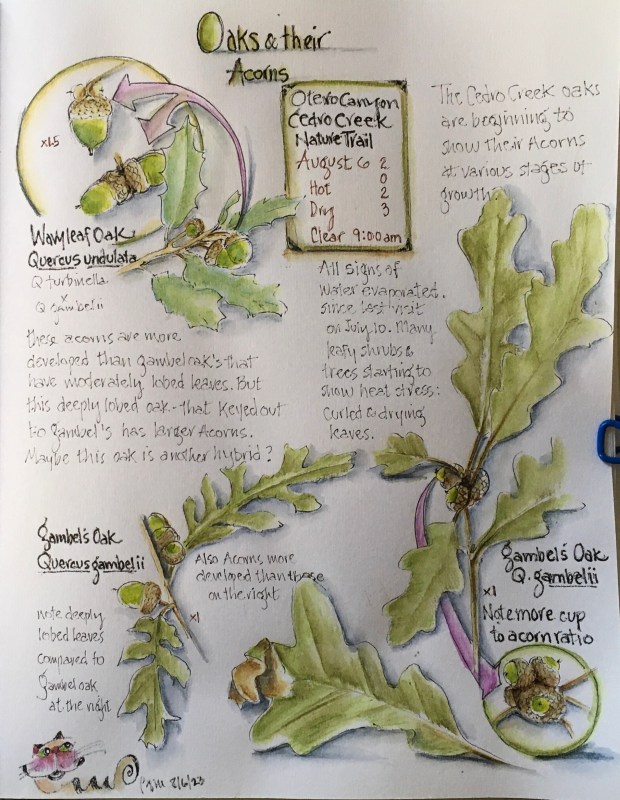
Then further up the canyon, about 20-30 feet above the riparian area, Gambel’s and Wavyleaf oaks are growing their acorns. That’s encouraging news for the squirrels who collect and cache them in overwintering nests.
It’s been a challenging year.
What differences in nature have you been noticing where you live? Do you think our changing climate has played a role in driving the changes? Have you observed not only negative but positive affects? I’d be very interested in knowing!
Learning the deciduous Trees and Shrubs shading Cedro Creek Nature Trail ….. Grab n Go Nature Journaling
The timing and location of our daily hikes are being influenced by the extreme summer temperatures we’re experiencing throughout central New Mexico, and throughout the desert southwest. Whew! Even at 7300-8300’ elevation, 95-100F has become the norm, with no relief (or moisture) in sight. I don’t even want to think about Albuquerque temperatures; over 100F before noon, and soaring.
Because hiking in the Albuquerque foothills, at any time of the day, is out of the question, we’ve begun revisiting some our favorite mountain trails. But even tho these areas are higher in elevation, and shadier, it’s still plenty hot. That means if we set out between 7-8am, we can still manage a few miles before our water, like all the creeks, runs dry.
A few mornings ago, we decided to hike Cedro Creek Nature Trail, a rocky but easy dirt path under the shade of big cottonwoods. Expecting to find some water in the creek (there was none), I was hoping to find some interesting wildflowers (which had all withered and dried). The further along the trail we hiked, my focus quickly changed from wildflowers to other natural elements.
Geology is always interesting in these mountain drainages, and Cedro Creek is no exception. The overlying shales and limestones have long ago eroded to reveal large granite boulders that showed signs of erosion from long ago flowing water. That’s a nice thought!
And then there were so many varieties of deciduous trees and shrubs; their leafy greens not only provided relief from the heat, but became a visual treat as we explored the riparian areas alongside the dry creek bed.
As my curiosity about the diversity of tree and shrub species began to grow, so did the air temperature. Not wanting to become reduced to a sweaty puddle in the middle of the trail, and sensing a swarm of drooling, biting gnats and flies giving me a hungry eye, I resorted to collecting leaf and branch samples using a Grab n Go technique. By the time we got back to the car, I had 3 large ziplocks stuffed with over a dozen species of tree and shrub leaves and some fruits.
Back at home, in the comfort of my cool studio, I began my detailed study of these leaves (and the few bugs that managed to hitch a ride). Three days and several gallons of iced tea later, I had completed the 5 journal pages in this post.
That iced tea was deliciously cool, but not as cool as learning what’s growing overhead along Cedro Creek!
Like my January “Littles” page of the bird species that visit our feeders in winter, here’s another “Littles” to commemorate the not-quite-winter-or-spring month of February ….. Seeds and Seed Pods. As a way to pass the time while waiting for Roy to finish up with a doctor visit, Luna and I conducted a focused scavenger hunt along a 2 mile circuit surrounding a large Albuquerque shopping mall. In no time at all, my collection bag was full. But knowing my pages would need some local flavor and color too, I scavenged a bit longer and turned up a few more curiosities.
Like with January’s page of birds, sketches of the species of seed pod and seeds (if collected) took less than 5 minutes each; my watercolor pencil paintings took about 10 minutes each. The restaurant logo and the frog design took a bit longer, and were done using my photos as reference.
I’m not sure why it took nearly the entire month to decide what to do for my February “Littles.” In hindsight, the decision should have been obvious, because I love seeds and the seemingly unlimited variety of pods. Now I have a record of a few city seeds that will soon germinate, helping change the landscape from brown to spring green!
Let me know what you think! I’m looking forward to March, when wildflower seedlings will be popping up which may appear in a few “Littles” boxes as well!
Thanks to “Made by Fay” for the “Littles” inspiration!
We totally get it! Why Mt. Lemmon is nicknamed “Tucson’s Great Escape.” Why the scenic highway is ”Cool!” From the Lower Sonoran Desert and the Tucson Valley (2,200 feet) to the upper reaches of a Spruce-Fir Forest (topping out at about 9,200 feet), the popular Scenic Highway up Mt. Lemmon offers breathtaking views, plants to discover, geology to learn, recreation opportunities, and temperatures often 30 degrees F lower than the desert below. That means a lot, especially when Tucson’s summer temps are in the triple digits!
But on the day of our driving adventure we found snow ….. on the highway, at scenic overlooks, and on walking trails. The storm hit 4 days earlier forcing closure of much of the highway. But on this day, most of the roads were clear and so was the sky.
So come along and learn what there’s to see along the Mt. Lemmon Scenic Highway.