August 24, 2026
Black-tailed Jackrabbit (Lepus californicus)
—aka—
American Desert Hare, Jackass Rabbit

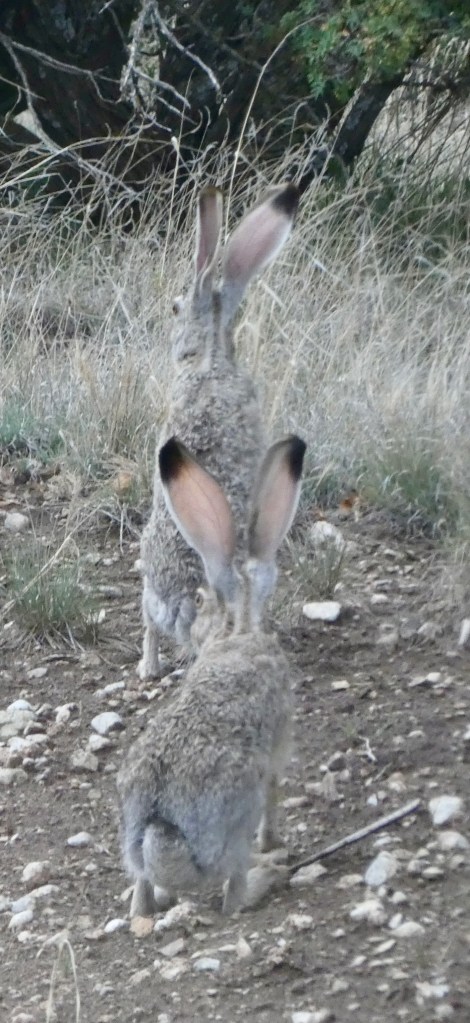
One of the largest hares in North American, the Black-tailed jackrabbit can grow up to 2 feet long and weigh from 3 to 6 pounds. In our neighborhood this is certainly true! We always love when these big hares move around our home, even if Luna is always keen to chase them away! This past spring a litter of four young Black-tailed jackrabbits (called leverets) spent a few weeks of their lives playing tag with each other around our gravel driveway and under the adjacent pinyon, juniper, oak, and mahogany. They seemed oblivious to our gawking and to Luna’s whining. Their comically clumsy antics were so funny to watch; we could count on a great show every day — either early in the morning or just before sunset. Then one day they were gone! For a week afterwards, we’d occasionally see them moving together through the subdivision ….. bounding after each other as they playing hide-n-seek. The last time we spotted them as a group was heading up towards our big community hilltop water tank. I like to think those now grown-up hares still come by the house once in a while to grab a bite to eat and say “Hi.” Who knows, they’re probably making babies of their own!
Here’s some things about Black-tailed jackrabbits you may not have known. All of the following was definitely new to me.
Population densities: The Black-tailed jackrabbit is a very common hare living in the western U.S. and Mexico. Their population densities typically range from fewer than 25 (when habitat conditions are poor) to nearly 500 animals per square mile (/mi2) (during peak years). You can count on numbers fluctuating every 6-10 years due to food supply, weather and disease. The New Mexico State University Extension Service reported when rangelands heavily infested with hundreds of hares/mi2, compete significantly with livestock for forage.
Habitat consisting of a mosaic of mixed-forbs, grasslands and shrubs are occupied by Black-tailed jackrabbits at elevations from sea level up to 10,000 ft. Because they don’t migrate (or hibernate) during winter, these hares use the same habitat within a 0.4–1.2 mi2 area year-round. Preferred habitat provides not only food, but shelter and cover.

Common habitat types include sagebrush, creosote bush and other desert shrub lands; Palouse, shortgrass and mixed-grass prairies; desert grasslands, open-canopy chaparral; oak and pinyon/juniper woodlands; early serial stage low- to mid-elevation coniferous forests. They are also common in and near crop lands — especially alfalfa.
Diet is composed of various shrubs, small trees, grasses, and forbs. Shrubs generally make up the bulk of fall and winter diets; grasses and forbs are eaten in spring and early summer. This pattern and plant species varies with climate.
Breeding, depending on location, typically peaks in spring, but may continue year-round in warm climates. The breeding season is variable depending upon latitude and environmental factors. In the northern part of their range (Idaho), Black-tailed jackrabbits breed from February through May. In Utah, they breed from January through July (over 75% of females are pregnant by April). The Kansas breeding season extends from January to August. Two peak breeding seasons corresponding to rainfall patterns and growth of young vegetation occur in California, Arizona and New Mexico. In Arizona, breeding peaks during winter (January–March) rains and again during June monsoons.
Birth: The female (doe) about to give birth doesn’t prepare an elaborate nest. She drops her young (leverets) in shallow excavations called forms that are no more than a few centimeters deep. The doe may line her form with fur prior to giving birth, but some just use existing depressions on the ground with no further preparation.
Young (leverets) are born fully furred with eyes open; are well camouflaged and mobile within minutes of birth. As all mothers (does) are inattentive (she gives birth and leaves them alone) the ability of leverets to hit-the-ground-running within minutes of delivery works perfectly for her once-a-day nursing schedule! The average litter size is around four, but may be as low as two and as high as eight in warm regions.
Leverets leave their birth form to find their own individual hiding spots just 2-3 days after they are born. They typically sit very still during the day, until it’s time to rejoin their mother and litter mates when she’s ready to nurse (either at dawn or dusk). Nursing occurs over a period of about 4-5 weeks until the leverets are fully weened.
Prey species: Black-tailed jackrabbits are an important prey species for raptors and carnivorous mammals, such as eagles, hawks, owls, coyotes, foxes, and wild cats. Rattlesnakes and bull snakes prey on the young hares, as do raccoons and striped skunks.
Parasites hosted by the hares include fleas, ticks, lice and mites; trematodes, crestodes, nematodes and botfly larvae are also found internally. Diseases affecting Black-tailed jackrabbits in the West are tularemia, equine encephalitis, brucellosis, Q fever and Rocky Mountain spotted fever. Jackrabbits infected with tularemia die very quickly.
A Cautionary Note: The high prevalence of parasites and disease in wild jackrabbits affects human predation. As a result, many hunters will not collect the hares they shoot. Those who do are well-advised to wear gloves if handling carcasses and, if intended as food, should cook the meat thoroughly to avoid contracting tularemia. Most jackrabbit hunting is done for pest control or sport.

Etymology
Scientific name: Lepus californicus, translates directly from the classic Latin word Lepus for “hare” — and californicus, a new Latin suffix and geographic identifier meaning “of or from California”, which indicates the region where the type specimen was first documented.
The Common name: “Black-tailed jackrabbit” is really a misnomer. Even though these plant-eating mammals look similar to true rabbits, taxonomically are actually hares. (This got me wondering what exactly are the differences between rabbits and hares —so I made the following table comparing the two.) …… And now, back to the common name “Black-tailed jackrabbit.”
“Black-tailed” —— named, of course, for their black tail.
“Jackrabbit” —— this name is a more modern version of the mid-19th-century term “jackass rabbit,” given by early settlers who compared the animal’s very long ears to those of a donkey. You’ve got to admit, there is a lot of similarity in ear size!

And that’s all for now, folks!
…………………………………………………………………………………………………
Do you live in a neighborhood with Black-tailed jackrabbits? If so, let me know!
‘Hopping’ you found this interesting!
As always, thanks for bounding by!
References: britannica.com; extension.nmsu.edu; iNaturalist.org; nationalgeographic.com; wikipedia.org


