
Acorn or Gall? 

An Albuquerque Park Mystery #26

September 6, 2026

The date: August 24, 2026 

The time: 8:30 am. 

The forecast: Severe clear; calm winds; 82oF & climbing

The place: The Promenade in Albuquerque  

The destination: el Oso Grande Park (“The Big Bear”)
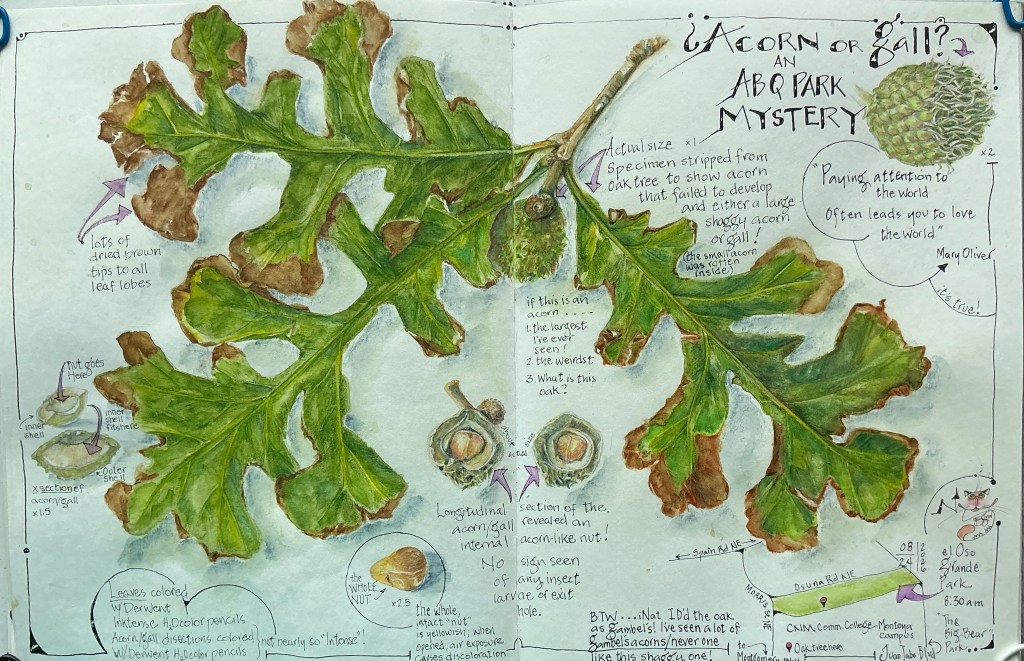
After dropping Roy off for his annual eye exam, Luna and I decided to ‘sniff’ around the neighborhood on our way to nearby el Oso Grande Park. With the chance of rain being “zip,” I was confident walking east along a half-mile stretch of the large cement ditch used to drain storm water from Embudito Canyon. Other than creatively colorful graffiti, the ditch itself had nothing interesting to offer. The hot paved walkway, mostly lined by weedy species, provided perfect habitat for scattered bushy sacred datura plants in full bloom. The many city dwellers living ditch-side allowed landscaping plants to cascade over cinderblock privacy walls — the patches of shade – welcome; sprays of pale pink to magenta desert willow flowers – pretty and fragrant.

A sweaty 20 minutes later and the shady expanse of the Park was a welcome sight. Not one to waste time, Luna anxiously led me to tree trunk #1, circling and sniffing excitedly three times ‘round. Not being able to smell the wonderfully curious aromas capturing her full attention, I spent my time looking up into the leafy canopy of this full grown deciduous tree planted years ago in memory of a once local resident.  

We moved on to tree #2, a robust conifer towering over the well-manicured green lawn, supported by another aromatic trunk recently ‘watered’ by a happy dog walking their human. Before we could check out tree #3, Luna claimed #2 by leaving her ‘calling card.’ 

And on and on we wandered and circled, until ….

…. I realized, based on our exam speed/tree (largely driven by Luna’s satisfaction meter), our Park tour of over 100 trees would take a month of Sundays! So we ramped up our pace, making  decent progress to (hopefully) ensure our timely return to fetch Roy …. then tree #26 happened! 
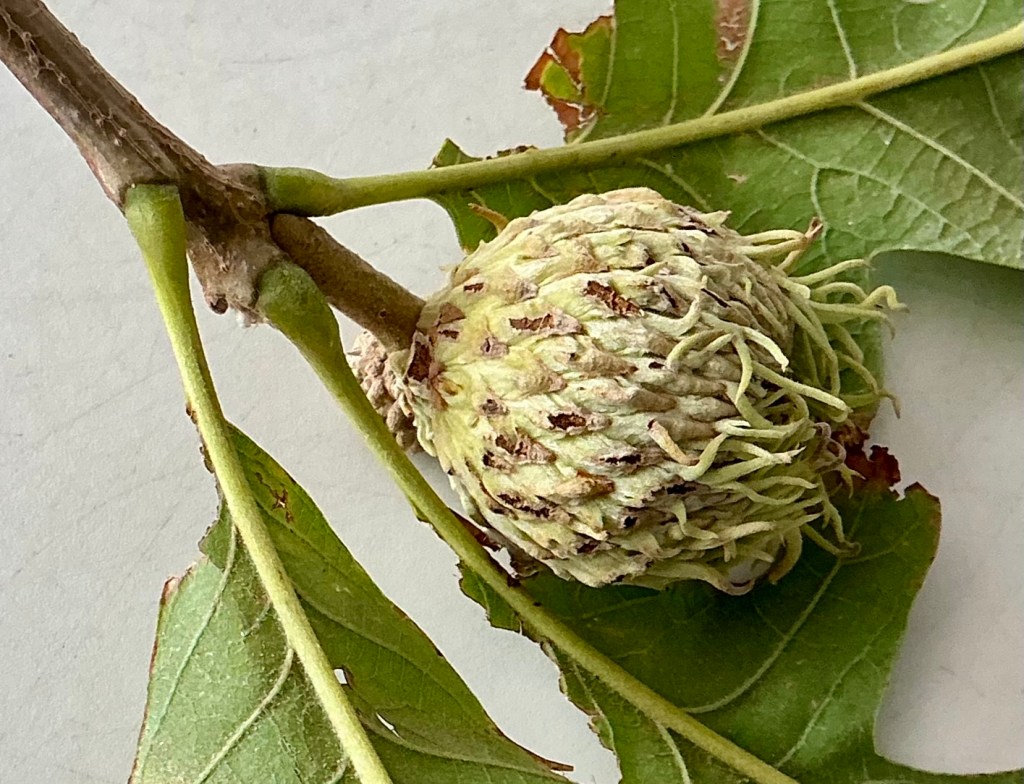
Oh! What was #26? Now it was my turn to encircle a tree, and I couldn’t stop.  In addition to the puzzled look on Luna’s sweet face, several other things were certain: 1– this very large tree was a 2– deciduous 3– dicotyledonous member of the 4– oak genus Quercus. The deeply-lobed leaves were a giveaway, even though most of each leaf’s margins were dried and crinkly. But it wasn’t the leaves catching all of my attention — it was the 1-inch diameter shaggy pale green balls growing from the ends of many leafy branches. This certainly didn’t look like any acorn I’d ever seen before …. besides, right beside this scary-looking tentacled orb was a single mini-acorn that tried but never fully developed — only the dried, withered acorn cup had partially formed before rotting. 
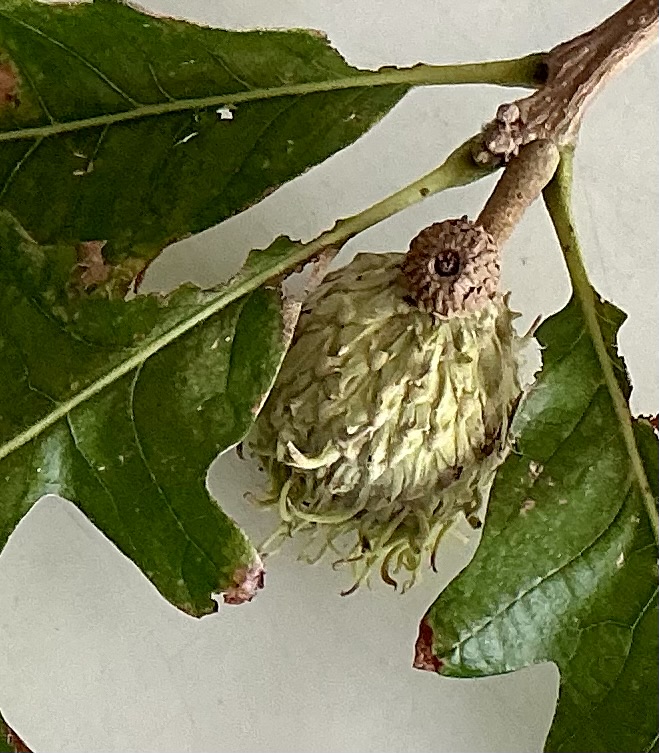
So what was it that sucked the life right out of that tiny failed acorn, and grew into something alien?  If this was some kind of acorn that grows on a non-native oak tree I’ve never seen before, then I had to learn more! If this was a gall, an unusually grotesque, weird and exaggerated growth stimulated by a developing wasp grub living deep inside, then I really had to learn a lot more! 

And then I collected and promptly zip-locked a specimen.

This became (and still is) An Albuquerque Park Mystery hanging like lime green ornaments all over, and also within reach from, tree #26!

P.S.

  • iNaturalist identified the tree as Gambel’s oak 
  • Never have I ever seen a Gambel’s oak acorn look like that!
  • Still waiting for an oak expert to identify the tree leaves and/or acorn/gall-thing
P.S. P.S.

  • So many questions remain
  • Upon arriving home, no wildlife observed inside zip-locked bag
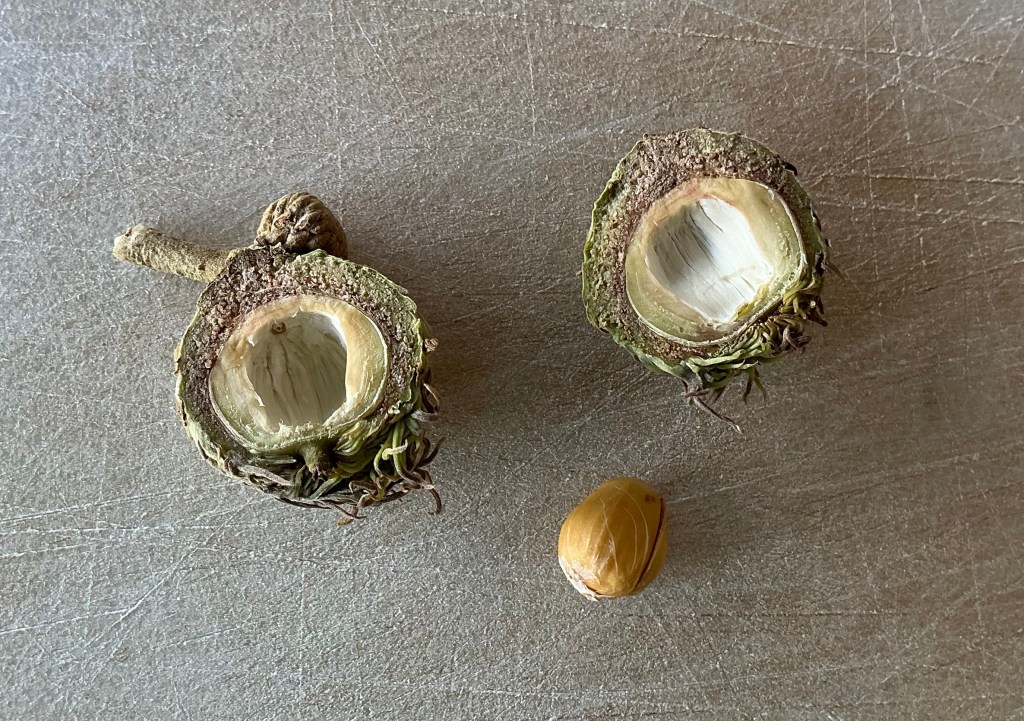
  • I dissected the growth, inside and out — found what looked like an acorn nut 
  • No sign of a grub; no exit holes in the outer or inner shells
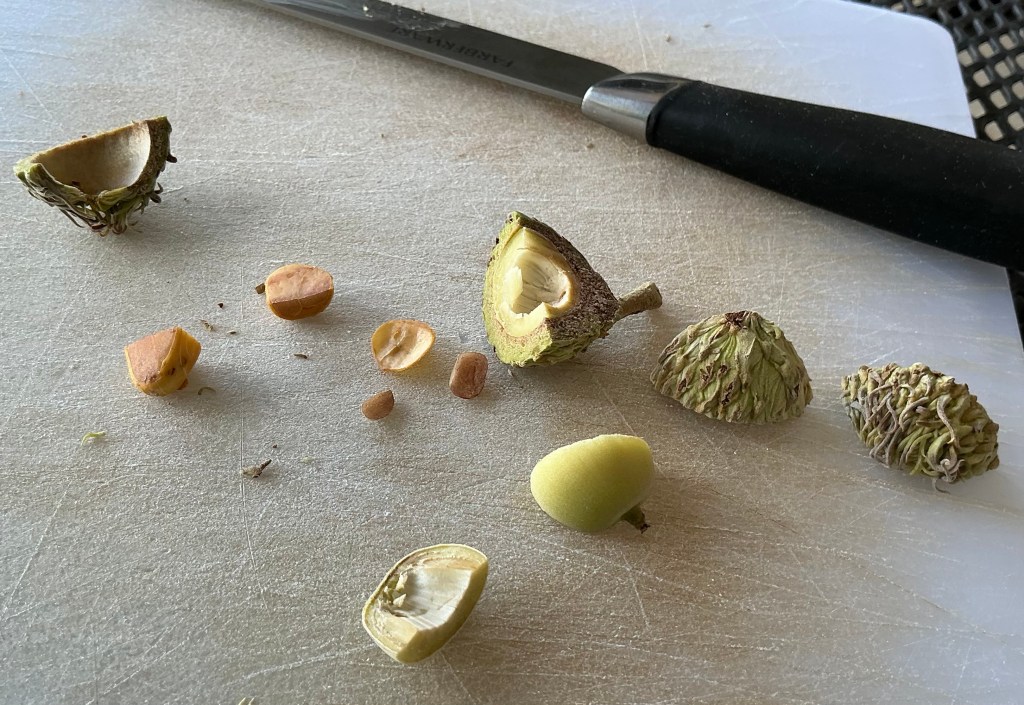
P.S. P.S. P.S.

  • Luna & I practically ran back to the eye doc’s office, arriving minutes before Roy’s exam concluded

……………………………………………………………………………………..

If you’ve seen anything growing on an oak that remotely resembles these mystery green goblins, please let me know what it may be, and what species of oak they come from! 

As always, thanks for stopping by!

P.S. P.S. P.S. P.S.

  • When “An Albuquerque Park Mystery #26” is solved, you’ll be the first to know!

The Life and Times of the Lanceolated Chafer

The Case of a Mysterious Wormy Thing

July 9, 2026

This is the third year in a row that I’ve noticed these seemingly unremarkable-looking brown beetles “hiking” along the rock pile 2-track road. They appear all at once, about mid-June, then vanish after several weeks. This year (2026) these scruffy/fuzzy beetles, know as Lanceolated Chafers (Phyllophaga lanceolata), really caught my attention, especially after finding myself at ground zero of a mass male Flash Mob1 !!! From all directions, determined (and awkwardly) flying male chafers were dodging my legs to land on top of a lone female beetle frantically struggling against an earlier arriving male. His prickly lance-like legs had pinned her to the ground so she was lying on her side unable to use her legs. While she squirmed at my feet, newly landed beetles tried to fling off the original male to claim their rights to the female. Males continued to land until there must’ve been 30 or more, with fights breaking out everywhere, on top of the female and all around my feet. Each male was jousting to be victor. 

Males arriving, fights break out

But a victor of what? Was this some sort of mating ritual? Had the female released highly potent pheromones to attract a mate? If so, how far did her “call” drift on the wind to bring together so many males at one time? Did she intend to call only one male, or was her purpose to entice a stampede? If she anticipated a herd, was her intent to mate with the first one (the fastest?) to arrive? Maybe she hoped for battles and skirmishes to ensue, where the strongest of all males would win her favor(s)? This still remains a mystery, as I couldn’t find anything in the literature to explain this behavior? 

While pondering these questions (and daring not to move my feet for fear of squishing one of the many male pile-ups), I bent over for a better look. It was then I noticed an opaque white, worm-like thing slowly emerging from the female’s abdomen! “What could this be?” ….. 

Was it a larva? Probably not ….. Female chafers don’t give live birth; they lay eggs in the soil beneath their favorite host plants (such as mallows), where they hatch into grubs that remain underground for up to two years before emerging as adult beetles. 

Five males fighting for the female (notice how much larger she is than a male). Bit of a skirmish, left side.

Was it part of or the actual female genitalia? Maybe? I’m still searching for information about that notion.

Was it part of the male genitalia that had somehow broken off inside the female during insemination? Is that even possible? Again, still searching for answers about chafer sex.

Three males with the female (notice the “wormy” thing). One male, lower left, apparently confused?

For another 5 minutes I closely observed the squirming female laying helpless on the ground fighting off numerous suitors while still displaying the wormy “thing.” As more males continued to arrive, crash-landing on other grounded males and adding to the chaos, something changed. Can’t explain what happened, but in a matter of 15 seconds all the males stopped their aggressive fighting and took flight; the female uprighted herself (regaining her dignity?), quickly walking away like the nothing unusual had just happened. I watched her go, noticing she was no longer in possession of the wormy “thing,” and couldn’t find it anywhere at or near the scene! 

The party is over. A male walking away, looking for a mallow to snack on.

After-math

Over the next several days, nary a chafer was found! Had all the males satisfied their natural desires? Had all the females become pregnant, laid their eggs and vanished? “After” doing the “math” on the days following the event, I counted only two beetles walking the 2-track road, one headed north — one headed south. Scouts? ….. Because Lanceolated Chafer adults only live 1-2 months, and because none have been seen since the last two, that may be the end of sightings for this year. While there’s still the occasional pack of ants dragging away a dead beetle to share with their colony, the legacy of adult chafers lives on. Recently-laid eggs will hatch after only 18 days into white or cream colored, C-shaped larvae. Those grubs will munch away on mallow and grass roots for the next 1-3 years until a perfectly warm mid-June day, sometime in the future, the adults emerge from the soil to complete their life cycle. 

Epilogue 

Since most chafer beetles are nocturnal (active at night), if you’ve seen an adult during the day, it may have been the Lanceolated species which are diurnal (active during the day).  And you may have unwittingly encountered any of the chafer species found in North America……. 

An exhausted male, a bit off balance, as he feeds on mallow leaves.

…….. If you’ve ever seen one or more of your carefully-tended, vigorously-growing garden plants up and die overnight, it may have been victimized by root-living chafer grubs.

…….. If you live in the central or eastern U.S., grubs may be feasting on the roots of agricultural crops, like corn, soy, or sunflowers. Headline news is sure to cover the story of devastation and financial ruin brought on by the voracious chafer beetle larvae, complete with video of farmers holding a handful of grubs dug from below the soil surface.

Have you experienced one of these close encounters?

Hope you’ve found the “Life and Times of the Lanceolated Chafer” interesting (or maybe educational, peculiar, or maybe even fascinating!?!). Let me know what you thought.

As always, thanks for stopping by!

1 A flash mob is defined as a large group of people who suddenly assemble in a public place, perform a brief, pre-arranged action (like a synchronized dance), and then quickly disperse. Flash mobs are typically organized online via social media or viral messaging for entertainment or artistic expression. I think this definition nearly perfectly fits the chafer beetle dance I was witness to on that fine mid-June morning somewhere along the 2-track rock pile trail.