A Honey of a Prize!

Meet the Honeydew Gall-Wasp Gall

April 4, 2025

It’s Spring

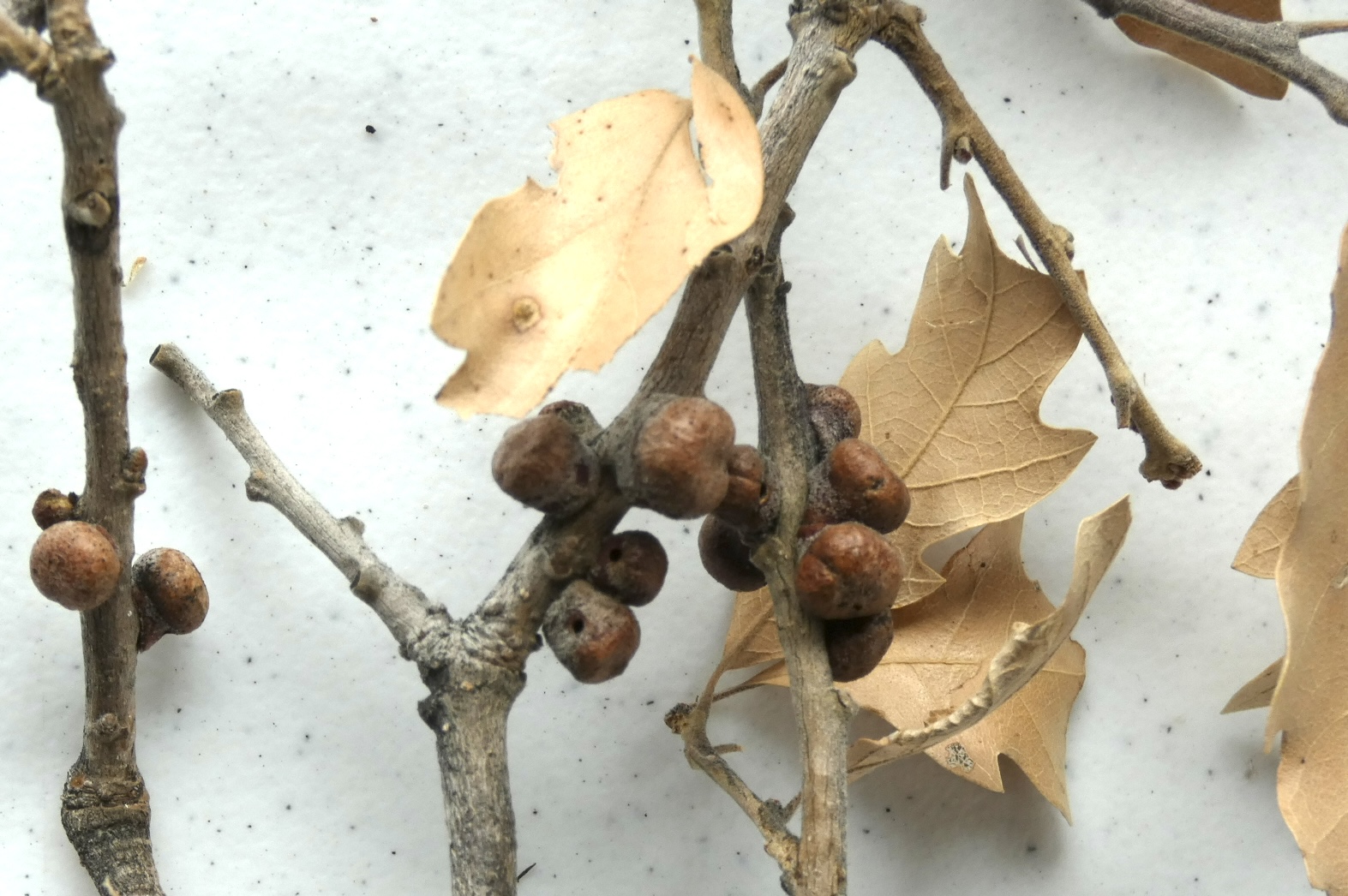
When the urge to nature journal is too hard to resist, but everything around you is still brown, crispy and covered in dust, I begin looking for any curious phenomena suitable for rabbit trailing (even rabbit tracks work!). The other day while hiking a steep hill, I was looking for sign the oaks were close to breaking bud. Spotting a string of little dark red beady objects lining many of the mostly leafless stems of am oak was certainly encouraging. From a distance they appeared to be swelling leaf buds; at least their color seemed right. But an up-close inspection revealed my hopeful find as last December’s vacated “homes” occupied by oak gall wasp larvae. Having never seen this species of stem gall before, naturally this would be a perfect most curious phenomenon to tackle. And that’s just what I did!

The Honeydew Gall-Wasp Gall

Arriving back home with a small collection of oak stems crowded with tightly packed galls (resembling miniature bread loaves), my work began. Assuming the host oak was a Gambel’s (Quercus gambelii), I began my search of stems galls on that species. Carefully scouring the literature the genus appeared to be Disholcaspis, but none of the species seemed a good match. So after many days in quandary, I consulted my favorite oak gall ID specialist, firing off a lot of questions, written descriptions and photos. Patiently awaiting his reply, I continued to find more resources to review. Gall wasps have a complex life cycle, and their galls are a challenge to identify. 

After 2 weeks a welcome reply arrived from the specialist.  Boy did I feel silly, knowing I should’ve known better! The oak host was not a Gambel’s but a cross between Gambel’s and Shrub Live Oak (Q. turbinella) which produces a hybrid called Wavyleaf oak (Quercus x undulata). Correcting my mistake was key to identifying the stem gall! Picky little wasps, huh? Happy the specialist agreed the genus is Disholcaspis, the obvious species responsible for the gall was turned out to be D. spissa; the Honeydew Gall-Wasp ….. making my discovery the Honeydew Gall-Wasp Gall!

Lesson Relearned  

When nature journaling, despite how excited you may be to find answers, it’s always, always best to slow down, breathe, carefully observe, ponder, question, make connections, and enjoy the journey ahead of the destination! 

Some Gall Descriptions and A Prize!

Outside appearance: Young galls of this wasp are yellowish and hairy. Mature galls have beige-brown to weathered grey sides, are black on top, and have a dull matte surface. They can have a round to ovoid to a rectangular ‘bread-loaf’ like shape. Texture appears mealy-granular. Galls sit snugly directly on the stems (sessile), and singly or in clusters of long compact chains that form all around the stems of host oak species. 

Inside the gall and back outside again: Each gall has one thin walled cell or chamber (known as monothalamous) that sits above the bottom of the gall. This is the larval chamber and is imbedded in dense cellular tissue that becomes a pulpy flesh with age. While the larvae are actively feeding and growing, they produce a copious amount of sticky-sweet honeydew that accumulates on the top of the gall. All of this honeydew attracts hordes of hungry ants and yellowjackets. The ecological importance of these secretions is unmistakeable; it provides a high energy food source for the insects. And while the ants and yellowjackets feed, they inadvertently protect the gall, like little bodyguards, from parasites and predators intent on infecting or eating the growing larvae inside. And another interesting ecological thing ….. the reason the tops of the galls are black and not the same color as their sides, has to do with a fungus called black sooty mold. The sugary secretions produced by the larvae accumulate in quantities too irresistible to the sooty mold. Colonies of the fungus develop rapidly on the honeydew giving the gall tops a dusty or powdery black color. So honeydew is the perfect medium for black sooty mold to complete its life cycle.

What about that Prize? Read on to learn more! Close-up inspection of the galls I collected, and there were about 25, revealed all but one had a single exit hole in a side just below its crusty red-black top. I learned the adult wasps emerge from these stem galls by late December; sometimes waiting for warmish temps until mid January. What happened to the adult wasps in the one gall without an exit hole? Because the gall had a sooty top, implying the larvae had been eating, growing and secreting honeydew, maybe the larvae died at some point or failed to develop into an adult? Had to know! Cutting the gall to find out wasn’t easy. The outer crust fell away first, then using steady knife pressure on the punky innards, the gall popped open, like a box of ‘Cracker Jacks!’ And there, near the bottom of the package, was a single sealed chamber. Carefully I was able to tease out the contents with fine pointed tweezers until out blurped the Prize! An intact cream colored gooey looking larvae, followed by a small puddle of viscous liquid. Even though the larvae filled up most of the chamber, there wasn’t any sign it was alive. And after an hour, when there still wasn’t any movement …. well, darn, I felt he must’ve died sometime before morphing into adult form. But peeking inside the gall did answer the question about the absence of an exterior exit hole.

And now an interesting note about these types of cynipid oak gall wasps: On my diagram, I used the term ‘agamic’ which is a formal label included with the genus/species name (i.e. Disholcaspis spissa ‘agamic’). This means these wasps have an asexual all female population that emerges from galls in late fall/early winter to lay fertilized eggs without needing to mate with males. Then a bisexual generation follows where adults emerge from galls in late winter/spring/early summer. This is the typical 2 generation annual life cycle of cynipid gall wasps, where the galls developed from each generation usually look very different and even occur on different parts of the host plant (on stems vs leaves). It’s interesting that nothing is known about the bisexual generation of D. spissa, but the asexual generation is common, well documented and abundant.

Known host oak species for D. spissa: Look for these galls on Shrub live oak (Quercus turbinella), Wavyleaf oak (Quercus x undulata), Mexican blue oak (Q. oblongifolia), Arizona white oak (Q. arizonica), and Shinnery oak (Q. havardi). 

******************************************************************************************

Hope you found my post interesting. Have you ever been curious enough about plant galls to look inside? Recalling the first time I saw a gall, I had no clue what it was and why it was precariously clinging to a plant leaf. It was round and hard, and reminded me of a tiny rusty red ping-pong ball. Was there something inside? Would it be squishy, alive, have teeth and bite, or perhaps whatever it was was dead and oh so smelly? Maybe it was some weird kind of flower bud, or a fruit lost under the leaf? Despite being a bit nervous, I needed to know what, if anything was inside. So I cut it in half, and in the center of the ball, suspended on hundreds of delicate threads, was a tiny, wormy creature twisting and turning and wriggling to music only it could hear! That was over 45 years ago, and to this day I still find galls irresistible!

As always, thanks for stopping by!

A Few References

Russo, Ronald A.: (2021) Plant Galls of the Western United States, section on tree galls; oak galls of the SW, page 173. 

Weld, LH: (1957) New American Cynipid Wasps From Oak Galls https://www.gallformers.org/gall/948

Up Close and Conversational .. ‘Glorieta’ Southwestern Orangetip Butterfly

April 2, 2025

New Mexico Orangetip butterflies

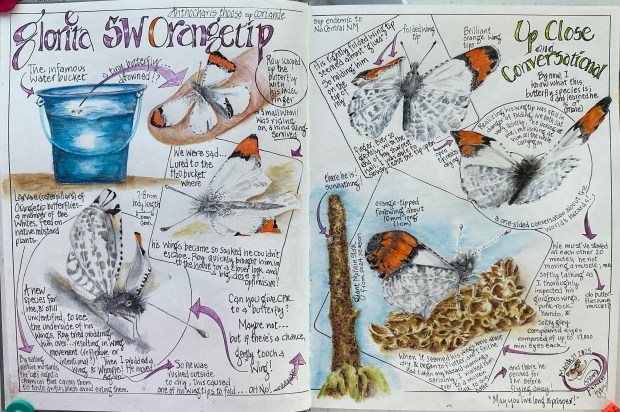
The ‘Glorieta’ Southwestern Orangetip (Anthocharis thoosa ssp coriande), are only known to occur in the central and north central counties of New Mexico. This recently recognized form of A. thoosa was described by M. Fisher and Scott in 2008, from specimens collected near Glorieta Pass southeast of Santa Fe1 (which just northeast of our home).

The Orangetips are classified in the Family Pieridae/Subfamily Pierinae ….. commonly called the Whites. In NM there are 16 known species of Whites, including the non-native European Cabbage White.  After a wet winter, plentiful males compete for hilltop display locations while females search surrounding areas for the choicest of native plants in the mustard family (Brassicaceae) on which to lay their eggs. When the eggs hatch, the larvae (caterpillars) voraciously devour the leaves of their host mustard plants, until they’ve grown to over 1,000 times in size!  Because this family of butterflies is common in desert habitats, to withstand drought conditions some species have the ability to suspend development during their pupal stage (when they are in their chrysalis), a mechanism called pupal diapause. And if winter rains do not cause favorable conditions for their larval hosts (the mustard plants), they can remain in pupal diapause for several years.   

The White’s preference for mustard plants may not be about taste. It’s thought that chemicals contained in these host plants make butterflies in this group unpalatable. Entomologist, “Mike Toliver has witnessed only one attack by a bird on members of this group in more than 60 years of observation.”1

1https://peecnature.org/butterflies-of-new-mexico/whites-pieridae-pierinae/

A Very Close Encounter

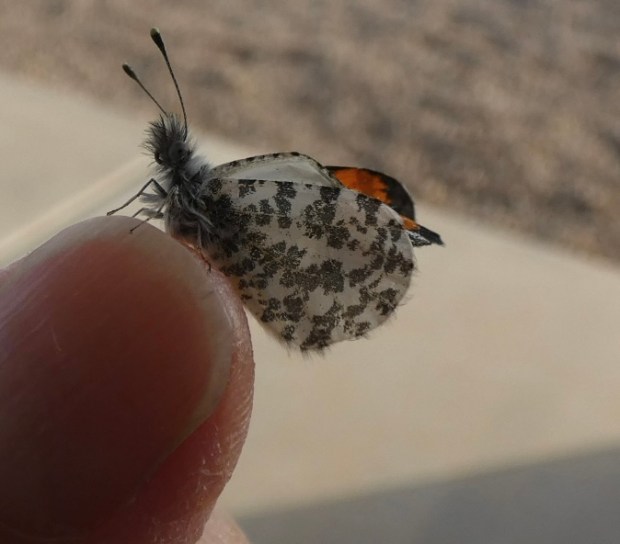
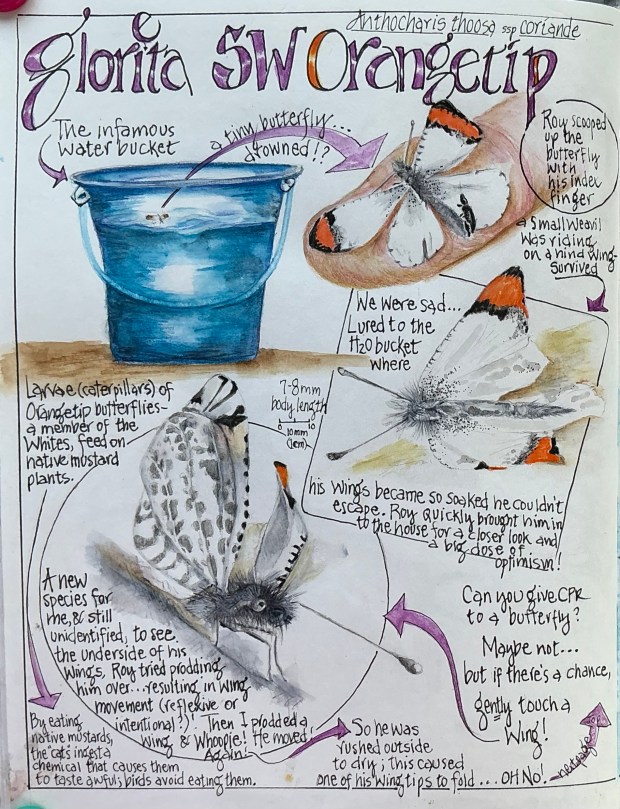
Early one morning (a few days ago), Roy discovered a miniature butterfly afloat, upside down, in a water bucket left outside overnight. Looking very drowned, Roy scooped him up with the tip of his index finger and brought him inside the house for my inspection. Excited and sad all at once, I snapped a few photos, having never seen this species before.  Because this little guy had such striking marks and color, finding him in the online New Mexico butterfly field guide was easy.  This beauty was a ‘Glorieta’ Southwestern Orangetip (Anthocharis thoosa ssp coriande)!

Roy was about to turn him over to take a look at the flip side when one of the wings fluttered a bit. Not believing our eyes, I gently prodded him, and sure enough! He seemed alive! But just how much alive we didn’t know.

Rushing this tiny guy outside where his wings might dry, he slowly became more active. Unfortunately the tip of a still damp forewing folded over and stuck like glue making it impossible to synchronize those wings  …. he didn’t seem remotely interested in taking flight. Not to be defeated, he then crawled up to the tip of my pinky finger, looked me in the eyes, raised one of his six legs politely asking for help. Gathering my courage and willing any clumsiness ‘be gone’ from my fingers, I held my breath while using the edge of my longest fingernail to slowly and carefully separate the fold. Taking my time to tease up the delicate tip millimeter by millimeter, this butterfly never moved a muscle (do butterflies have muscles?). After what seemed like hours the wing unfolded, popping back into alignment without any apparent damage! 

“The Talk”

He didn’t fly tho, so I sat with him for about 20 minutes as he perched on my finger. During my ultra close inspection of his eyes (you know I love eyes, and his were sultry grey and gorgeous), punk-rock style hairdo, and brilliant orange tipped wings, he seemed content while I carried on a lengthy one-sided conversation warning him of the world’s dangers. 

Somewhat convinced he believed and would abide by my every word, I walked him over to a large mullein stalk, where he walked off my finger to enjoy a sunbath (hopefully to prepare to take wing). He wasn’t in much of a hurry tho. About an hour later and checking to see if the coast was clear, off he flew.  That beautiful Glorieta Southwestern Orangetip butterfly was free!

All-in-all, it was an exciting encounter! 

What exciting encounters are you experiencing during this change of seasons? 

As always, thanks for stopping by!

From Seed to Tree: The Irresistible Urge to Grow

A Pinyon Pine/Piñon Seed Update

February 7, 2025

Give a seed the right conditions ……. enough water, sunlight, the perfect temperature ….. and this small package cannot resist emerging from its protective coat to grow into a full grown plant.

Seeds are tiny marvels of nature. 

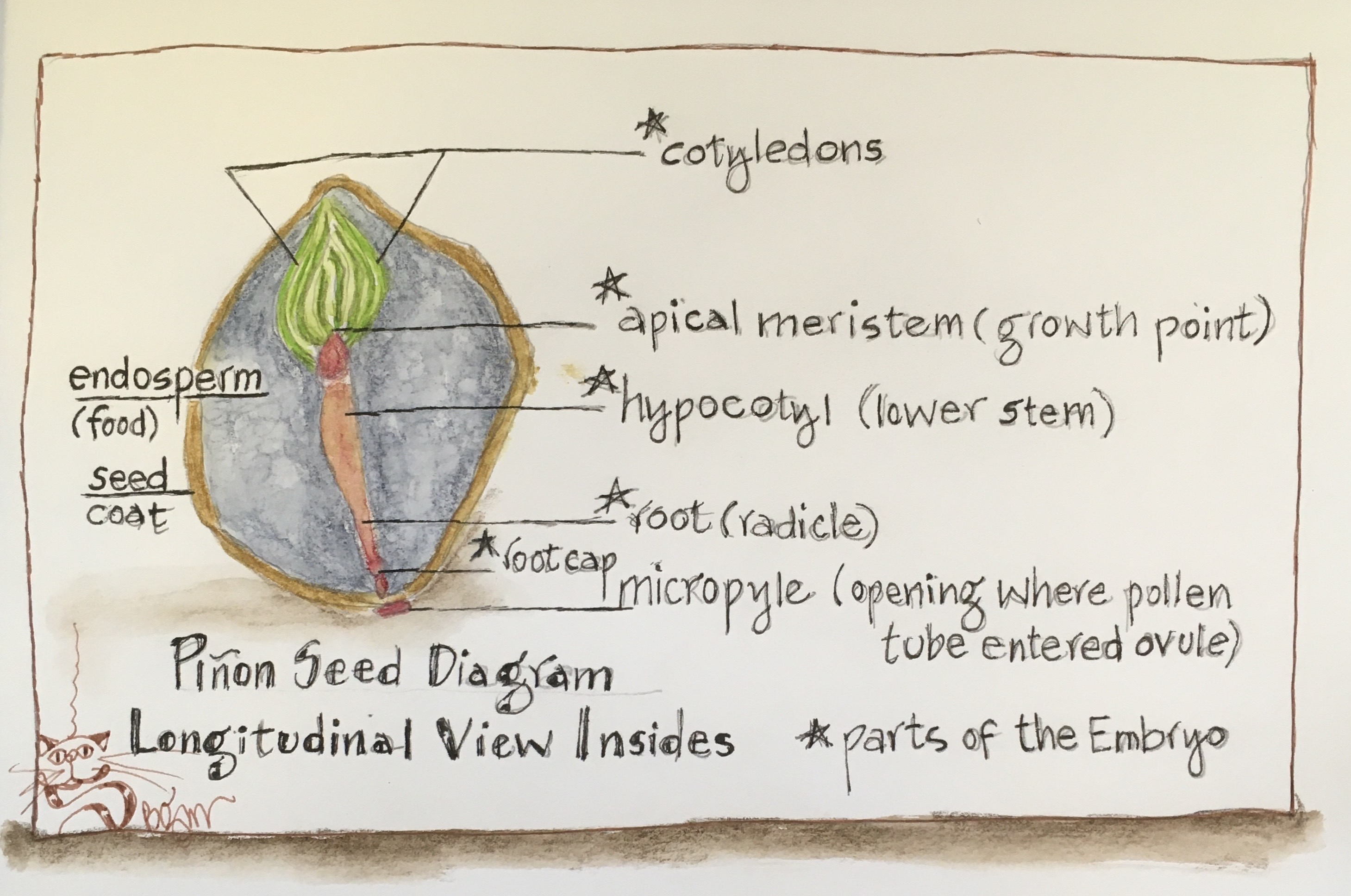
Looking inside the seed reveals a miniature pine tree!

Think about it ……. a seed is really a living baby plant (the embryo) surrounded by a cozy blanket (the endosperm) that cradles and nourishes the embryo while tucked inside the seed coat. When the coat unzips, freeing the “baby” as it begins to grow, it continues to be nourished by the endosperm until the first true leaves appear. Witnessing the process is so cool!

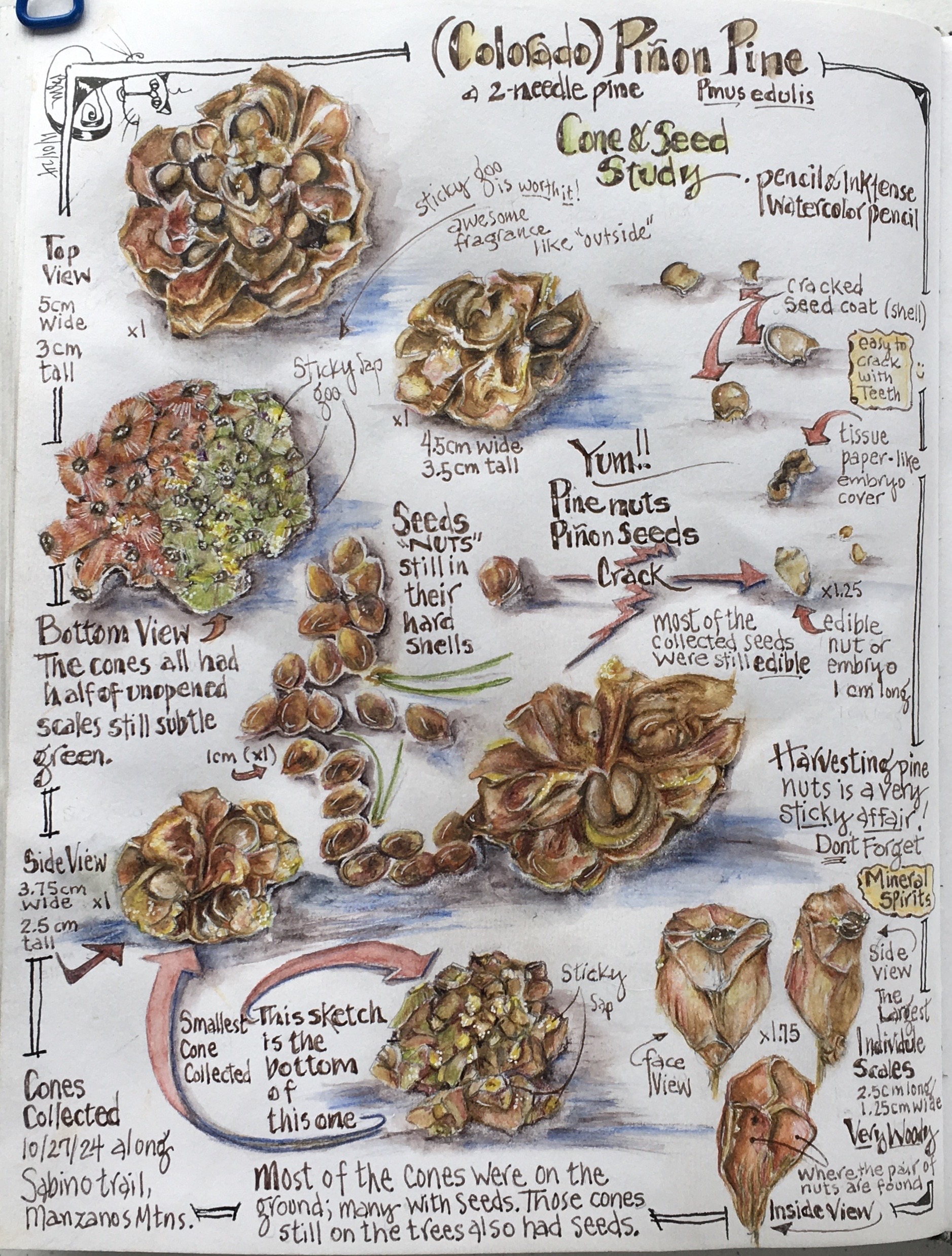
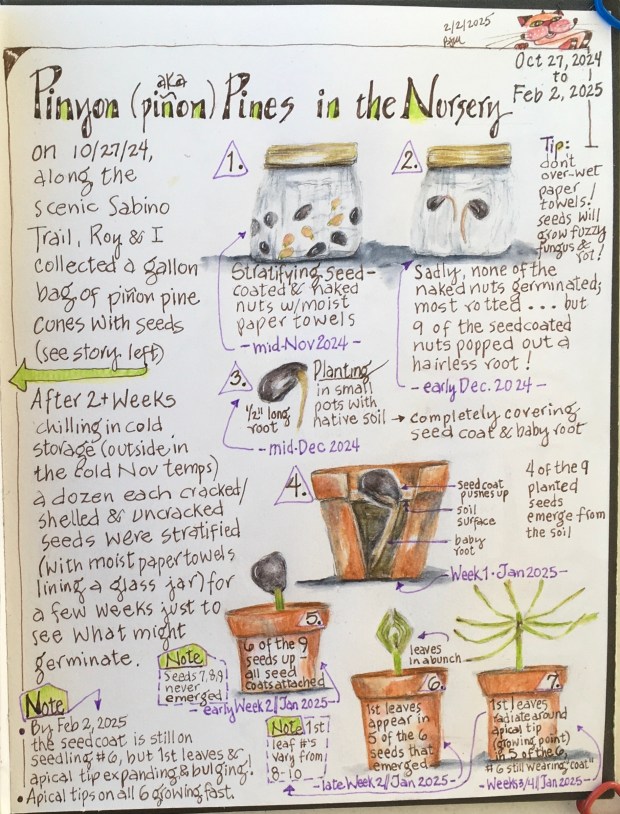
After collecting piñon seeds from last November’s foraging expedition, (Piñon or Pinyon, Piñon Seed or Pine Nut), we decided to treat a dozen or so to conditions just right to stimulate germination. But first the seeds required a short period of stratification (moisture) to help soften and crack the seed coats. Introducing moisture was done by lining a clear glass jar with damp paper towels and placing the seeds between the towels and glass to watch the action.

Post from November 2024 Seed Foraging Expedition

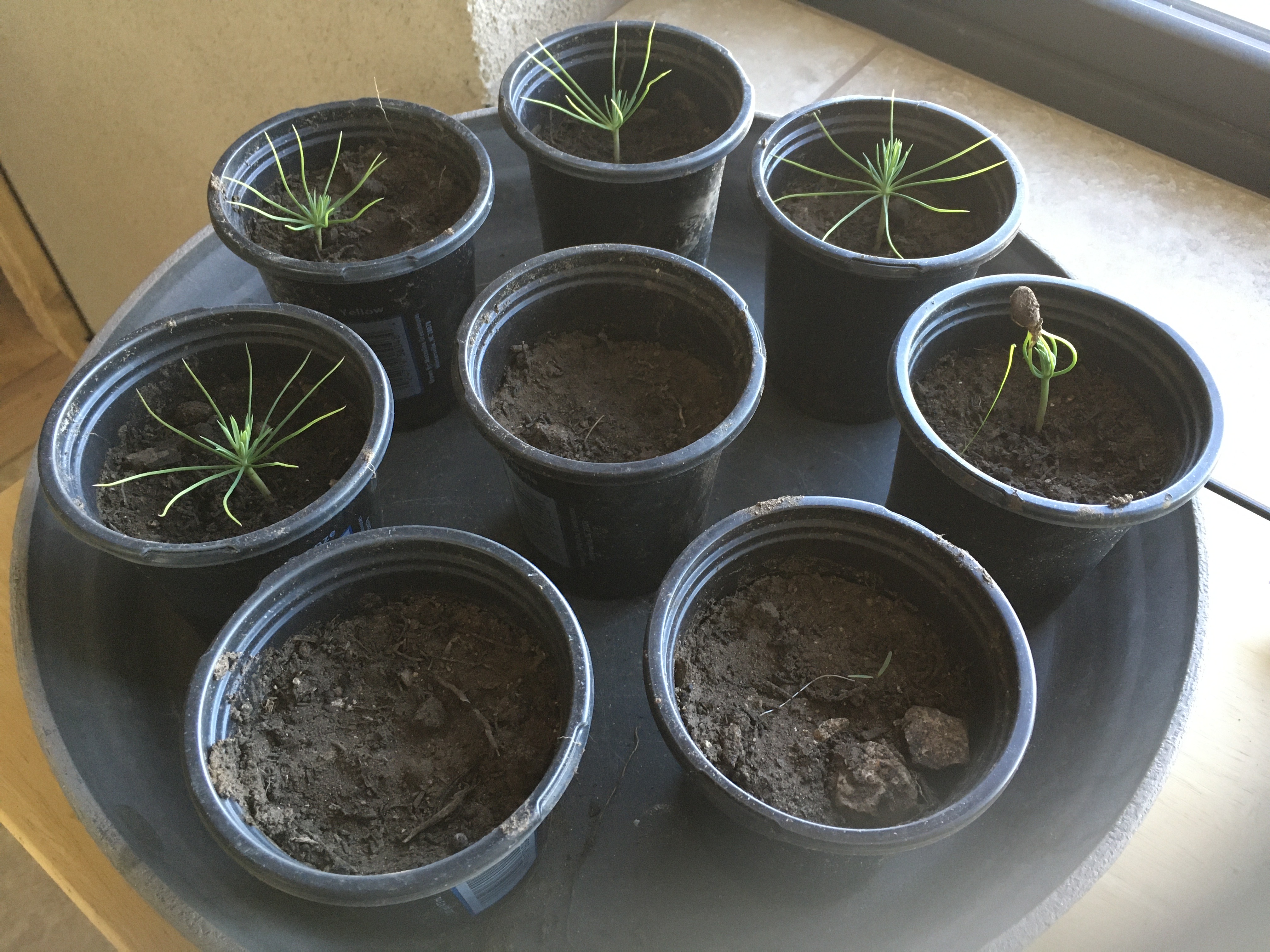
Soon embryonic roots (the radicles) successfully cracked the seed coats of nine seeds and began growing downward, as roots tend to do. In a week or so, before the embryonic leaves (cotyledons) appeared, all of the germinating embryos were planted. Six of the nine then sprouted their whorled cotyledons, followed by a growth spurt of the first true leaves, initiating the process of food manufacturing (photosynthesis). 

Steps to Germination

All of the germination and seedling development details of these piñon seeds, to date, can be found in my update illustrations. 

Seed germination is a fascinating process, and like the seed itself, is also a marvel of nature. Have you ever tried to germinate a seed? If not, give it a go.  It’s fun, educational, and imagination provoking ….. from such a small seed comes a full-grown flowering plant!

The evidence!

As always, thanks for stopping by!

Winter Botany: Horsetail Milkweed

February 1, 2025

Wandering about the neighborhood one warm summer morning in 2018, I noticed a dense stand of plants lining a 20 foot section of road. What caught my eye were the umbrella-like clusters of pearly white flowers topping each slender stem. From a distance these plants resembled our native white-flowering yarrow. But I soon realized the narrow dark green leaves were not fuzzy; the tiny exotic-looking flowers were not daisy shaped. Unmistakably, this plant was a species of milkweed! And the flowers of more than 50 individual plants in this population were a-flutter and a-buzz and a-crawling with hungry insects!

What was this milkweed species?

This is the Winter Botany portion of this post. All that remains of last summer’s Horsetail Milkweed are stems and mostly empty seed pods clinging to short branches. But some of the seed pods still hold silky tailed seeds clinging to their open pods. Hundreds of seed pods line the roadways in our neighborhood.

It didn’t take long to confirm this plant as Horsetail Milkweed (Asclepias subverticillata), a species commonly found along roadsides in pinyon-juniper woodlands. Knowing what to look for on future walks, over the next several years I was excited to find 30+ more populations of various sizes along neighborhood roadways! From 2018 until early summer 2024, I continued to monitor these seemingly abundant populations. The small numbers of seeds I collected in the Fall were planted in our yard, and every year I checked for the presence, variety and numbers of insects busy feeding on nectar as they pollinated the flowers.  

During June 2024, when we moved only a few miles to the northeast, I was happy to see Horsetail Milkweed grew abundantly in our new subdivision. This prompted me to dig deeper into researching this species. Its been exciting to discover how important this milkweed is to native insects, including monarch and queen butterflies.

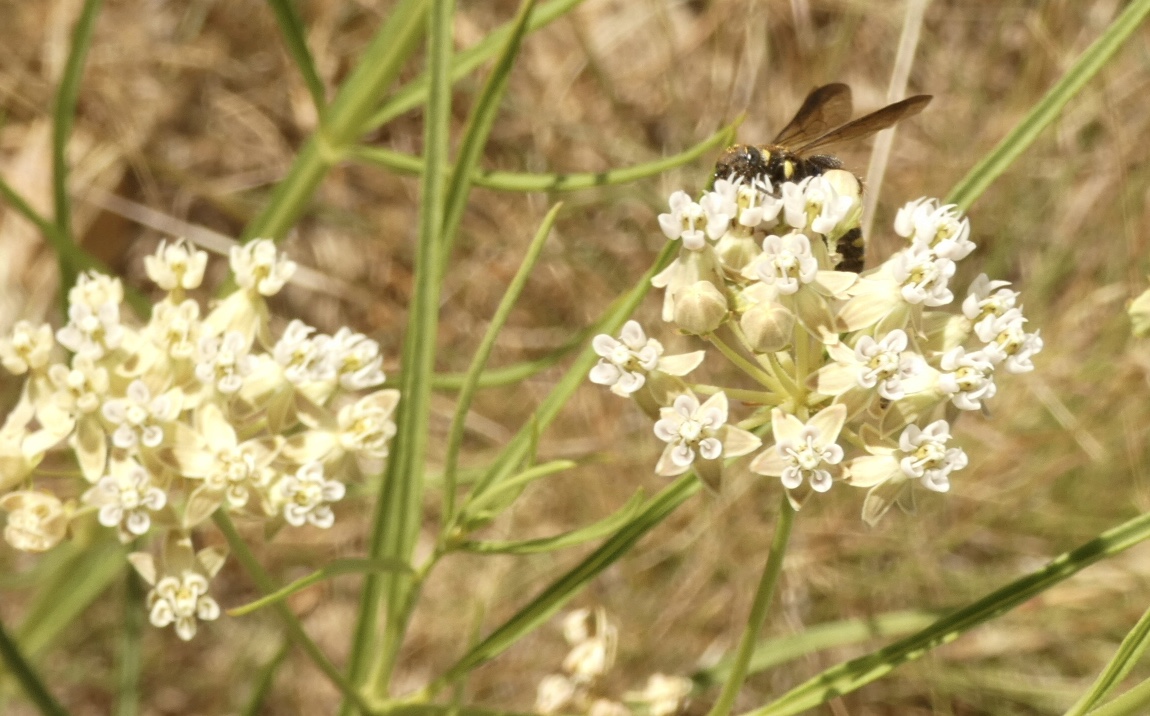
Photo (mine) taken in July 2022 of a blooming Horsetail Milkweed being enjoyed by a feeding wasp.

According to pollination ecologists, Horsetail Milkweed is especially valuable to large numbers of native bees. This plant species also supports conservation biological control by attracting predatory or parasitoid insects that prey upon pest insects. 

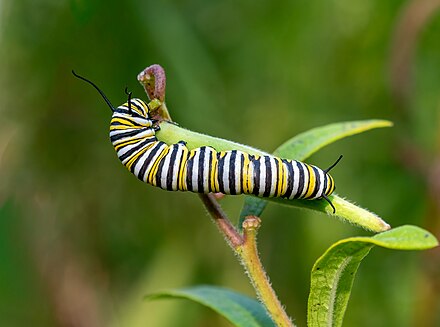
And Horsetail Milkweed is one of the favorite host plants for monarch and queen butterflies, all because it’s toxic!  Producing an especially nasty tasting and potent neurotoxin strong enough to kill livestock, the caterpillars of these two butterflies have evolved to benefit from such a poisonous substance. Voraciously ingesting a diet of only milkweed leaves, obviously tasty to the larvae, makes them unpalatable to would-be predators, such as birds. The toxin from milkweed leaves has become their primary means of defense; definitely a benefit for such chubby, slow little caterpillars.

Monarch caterpillar (source: open commons)

Although central New Mexico isn’t in any of the major migratory routes of these butterflies, I have observed both species in our previous neighborhood. Since learning more about Horsetail Milkweed and it’s favored roadside habitat close to home, my hope is to provide actively growing plants throughout the summer (a safe distance away from roadside easements) for both the monarch and queen adult butterflies and their caterpillars ……. especially important when governing covenants of our previous and new subdivisions require the roadways be groomed (mowed down like a butch haircut!) on a monthly basis by subdivision landscape crews. 

Because milkweeds are among my favorite of all plant species, mainly due to their complex flowers and the clever trickery they’ve developed to ensure pollination, I wrote about and illustrated two in-depth blog posts on this subject. Believe me when I say,  “It’s overboard fascinating!”

Check out the following posts …..

Surprise! A vine-y, twine-y desert milkweed discovery from July 2024, where I revisit milkweed flower structure and pollination and learn about a new-to-me genus, Funastrum.

Summer Botany: Meet the Milkweeds from July 2022. This is my first comprehensive look at milkweed flower structure, how pollination takes place, and the genus Asclepias.

Read on to learn more botanical information about Horsetail Milkweed AND how to find out if you live in Spring and/or the Fall Migration routes of the monarch butterfly AND where queen butterflies migrate to and from. 

Characteristics and habitat requirements of Horsetail Milkweed

Horsetail Milkweed is a perennial species with a stout, woody rootstock. Plants readily spread by rhizomes (underground stems) producing dense communities. Cold-hardy to at least 0℉, this milkweed bounces right back in the Spring. Plants are also drought-tolerant once established, thriving in well-drained, sandy soil under full to partial sun.

Able to thrive in a variety of habitats and plant communities from 2500 – 8000 feet in elevation, Horsetail Milkweed grows among grasses, on sandy or rocky flats, on slopes, roadsides, and along trails in Chaparral, Semidesert Grasslands, Pinyon-Juniper Woodlands, Montane Conifer Forests, and in disturbed areas.

All of these characteristics and its adaptability to a wide range of habitats make Horsetail Milkweed one of the easiest milkweed species to grow.

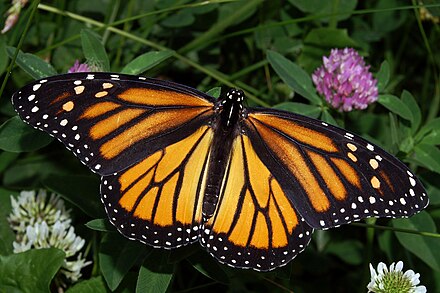
Monarch butterfly (source: open commons)

Monarch Butterfly

To learn if you live within the path of or close to spring and/or fall monarch butterfly migration routes, you can view a map or these route here:

https://www.monarchwatch.org/

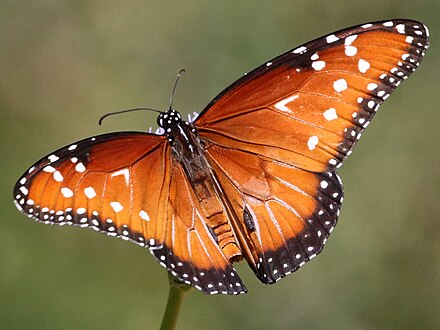
Queen butterfly (source: open commons)

Queen Butterfly

The queen is chiefly a tropical species. In the US, it is usually confined to the southern portion of the country. It can be found regularly in peninsular Florida and southern Georgia, as well as in the southern portions of Texas, New Mexico, Arizona, and California. Occasionally, the subspecies of the queen can be found somewhat north, in Kansas, Colorado and Utah. 

Queen butterflies do not migrate as dramatically as monarch butterflies, but they do move short distances in tropical regions with dry seasons to higher elevations.

Queen caterpillar (source: open commons)

As always, thanks for stopping by!

Pick Me! Pick Me!

January 20, 2025

Winter can be challenging for nature journalers. Getting outside when it’s cold and windy, cloudy and dreary, snowy, icy or wet, are not ideal weather under any circumstances.  And when everything looks brown and crispy and pretty much the same, the challenge to nature journal in the great outdoors grows exponentially. While these conditions make it difficult for spontaneous observing, I try to remember there’s always something remarkable to be discovered in nature, even in winter.

 Who knew a little whack on the head would be just the thing to reawaken my curiosity?

Bundled in layers, leash in hand, Luna led me on her early morning walk around suburban Albuquerque. Having been along this route before, we’ve both made some interesting discoveries in the past.  And as usual, this time was no exception for Luna. For me though, everything appeared brown, crispy and familiar. But I was inspired by  and enjoying Luna’s sense of curiosity, and her encouraging tug on the leash. 

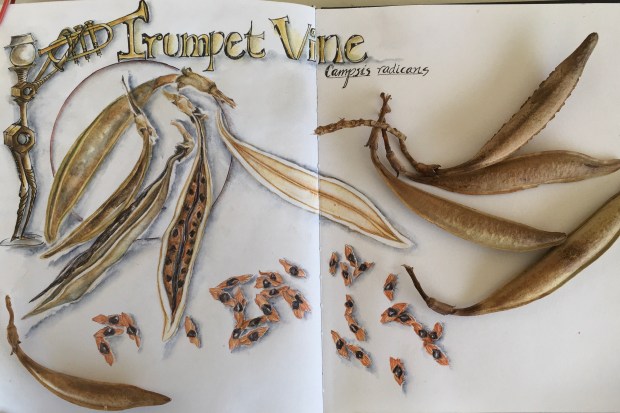
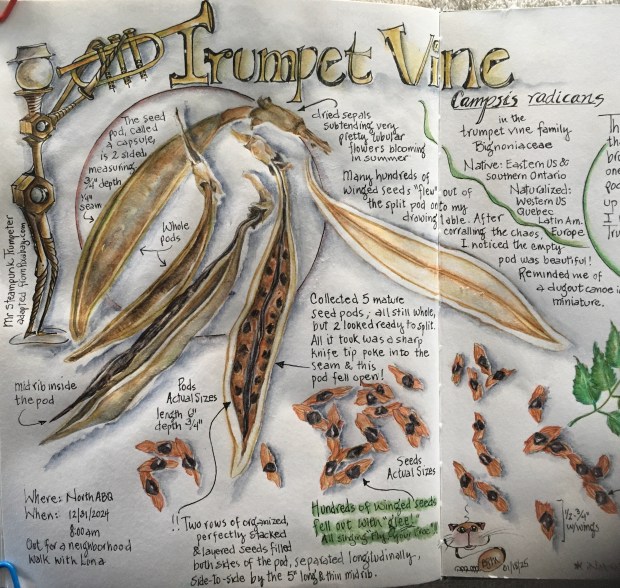
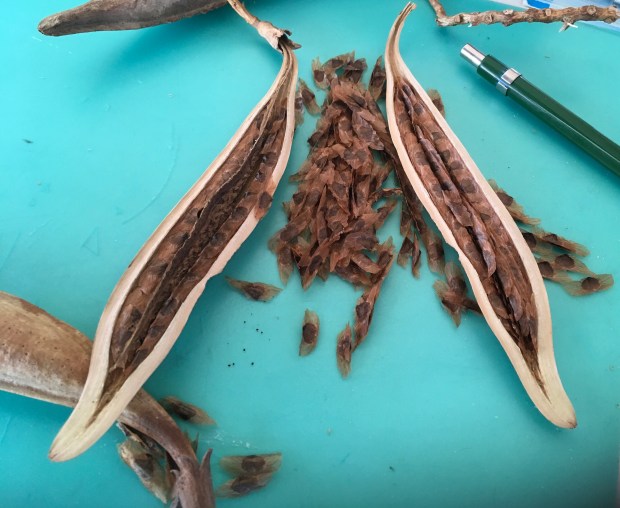
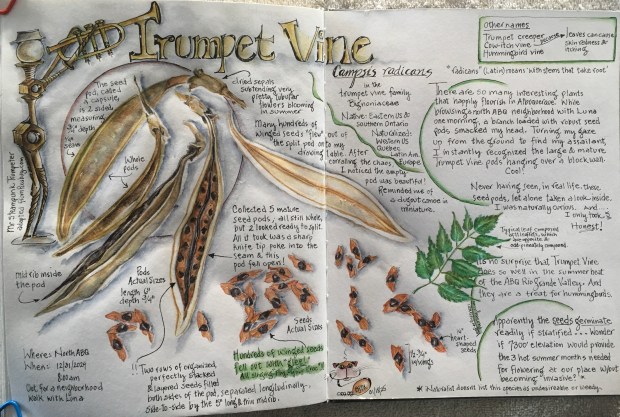
Nearing the end of our 2-1/2 mile walk, and mightily concerned I’d go home empty handed, we turned our last corner. It wasn’t 100 feet down the cement block-lined sidewalk that I abruptly stopped in my tracks. Something had lightly whacked me in the head! While the sound of rhythmic clacking rang out, I looked up, and to my surprise spotted the accidental assailant. Draped over the 6 foot wall, suspended from a hearty Trumpet Vine (Campsis radicans) growing in the hidden yard beyond was a string of pods resembling brown green beans. Long and plump and full of seeds, one of these pods had reached down low enough to make contact with to my head. (I say “reached” because that’s what my imagination said had happened.) Quickly awaking my sleepwalking brain, the effort made by the seed pod to get my attention paid off too. Silently whispering, “Pick me! Pick me!” it was as if the seed pod and its adjacent buddies either wanted to be harvested, or wanted to be featured in my nature journal (or both). 

So I did ………… both!

I loved learning about and sketching these fascinating Trumpet Vine seed pods, while my mind was filled with the muffled notes of a trumpet. Tooo-too-too-toooooom!

Hope you enjoyed reading this story and browsing around my journal pages.

As always, thanks for stopping by!
The Whimsy of Redefining Heartwood

January 10, 2025

After an unseasonably warm, almost spring-like December in the mountains of central New Mexico, January clearly has something else in mind. Winter! Windy days have resulted in bitter cold as they brought us cloud-cover and a few mini-snowstorms. 

The change in weather and absence of wildlife, combined with an abundance of dried vegetation is making it challenging to find nature journaling subjects. So a few days ago, I followed Luna around to see what was capturing her attention. Turns out burrowing rodents expanding their underground tunnels are leaving behind fresh mounds of soil with fascinating odors (to Luna, at least; I couldn’t smell a thing). 

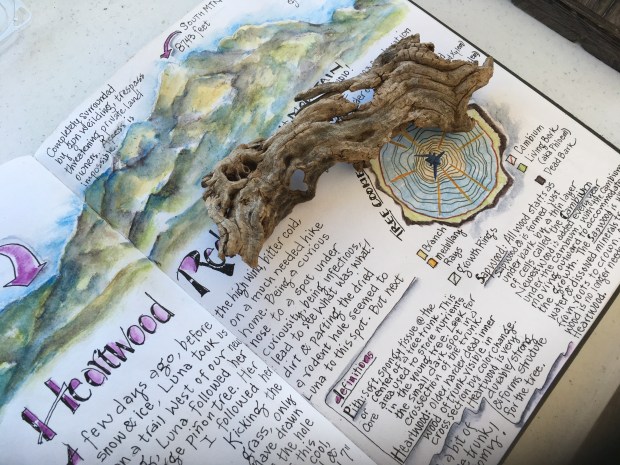
When one of her explorations led me under a good sized pinyon tree, I noticed a very interesting piece of bark lying on the ground. Turning the piece over and over, examining all the beautiful patterns in the wood, the colors, old bug holes, and woodpecker drillings, I was surprised and delighted to see a good-sized hole in the shape of a perfect Heart! Eureka! 

The 7” piece of pinyon bark …. Can you find the Heart?

Many things crossed my mind in that moment …… but the one word that stuck was “Heartwood!!” Could this small piece of bark redefine the meaning of heartwood? Could this tree have been wearing it’s true emotions on its bark in the form of a heart-shaped window?  

After a refresher on basic tree anatomy, and reconfirming that heartwood surrounds the core of the trunk, my imagination went wild.  Could that heart-shaped hole in the bark been the opening of a mysterious pathway through the inner workings of the tree?!!! If I could’ve returned the piece of bark to the exact place from where it fell, could the heartbeat of the tree be heard? 

My finished pages mostly about Redefining Heartwood, but also featuring the view of South Mountain (to the NE) as seen from our new home (including my studio) and the trail where the “Heartwood” bark was found.

While sketching the piece of bark with its perfectly-shaped heart, I wondered if peering at the inner workings of a tree through this window would make a fun children’s picture book? ….. Where the layers of a trunk and how they work would be experienced first hand by a child walking down the pathway?

After you stop laughing from all this nonsense, let me know what you think?

As always, thanks for stopping by (on my magic carpet ride!)

Meet an “Extreme” Creative!

April 8, 2024

After years of on-line and email chats, I was delighted when my friend Robin Atkins decided it was finally time we met in person! Bravo!

Robin and her travel buddy Lunnette, drove over 1,800 miles to Tucson to teach a Spirit Doll class to a local beading group. Then after spending 5+ days exploring Tucson and before driving home to Friday Harbor on San Juan Island, WA, they took a “short” scenic 450 mile detour …… to Tijeras, NM. This out-of-the way drive would bring them to our doorstep, and our first face-to-face meeting! While in Tijeras, we were able to spend an evening and full day getting to know each other and spent time hiking, nature sketching, and sharing each other’s art.

Robin snapped this photo of me sketching out at Golden Open Space. The beautiful wind sculpted juniper trees growing along the precipices of the windy observation areas are absolutely captivating (and tough). Luna thinks they’re tasty!
Meet Robin

Robin, whom I’ve always thought of as an “extreme creative,” is a fascinating, energetic, curious, passionate and bright-eyed adventurer in her early 80s. Her many interests and skills, in addition to creating uniquely designed, hand sewn and beaded Spirit Dolls, include: quilting (many with bead embellishments), thread embroidery, book making, watercolor painting, Zentangle art, nature journaling, making decorative papers, poetry, weaving, collage, crochet, felting and book author. And she shares her skills and techniques by teaching. 

This isn’t an exhaustive list by any means! As someone who seems to thrive on learning and developing new skills, Robin never stops seeking artistic challenges to take on. 
Check out Robin’s beautiful webpage and blog (http://robinatkins.com) where you can find photos and posts highlighting her current and past creative projects. 

A Short-but-Sweet Visit

We had a wonderful time getting to know each other, and what a delight to have also met Robin’s long-time friend and travel buddy, Lunnette. A retired firefighter in her mid 70s, Lunnette is also a nature journaler, calligrapher, quilter, and according to Robin, “she’s a terrific navigator, who always uses her keen sense of direction and map reading skills to keep us on the “right road,” (in both the literal and figurative sense).”

This is my finished graphite drawing of the twisted juniper I spent 5 minutes sketching.

Parting company was hard, but Robin and Lunnette needed to return home. Along their route they visited both Mesa Verde National Park and Arches National Park, soaking in more of the desert southwest sun and culture before taking on the 1,200 mile journey for Friday Harbor.

Memories!

Featured Artist and Budding Nature Journaler, Alivia Rapp!

September 1, 2023

Welcome back to my nature journaling blog! Today I’m excited to introduce my grandniece, Alivia Rapp. Livi, who is a very creative 15 year old, and the daughter of one of my brother’s daughters, came to visit for 3-1/2 days with “Grandpa Bob” (that’s my brother). 

Livi with her new love …. A Greater Short-horned Lizard

During the past year, Livi and I have been chatting online about her art, her storytelling skills and her keen imagination in character development which she has honed through many years of daily practice. Then last year, enrolled in a beginning art class where she quickly demonstrated her artistic skills, her teacher bumped her into the advanced class. It was obvious Livi was in her element! She excelled in all of her art assignments which included still life and nature studies, portraits and perspective drawing, using a wide variety of tools such as pencil, pen, watercolor, acrylic, and colored pencil. Her first love of Anime and fantasy storytelling showed in her work too, and one of her creations was awarded a ribbon at her local spring fair. Congratulations Livi!

Now back to nature journaling. Every morning, Livi and I (equipped with sketchbooks and pens), Bob and Roy (carrying daypacks with water), set out for a bit of hiking and sketching nature discoveries along 3 different trails. Roy and I picked trails at different elevations with different habitat zones and views, knowing we’d have a variety of sketchable subjects. We weren’t disappointed! 

My brother, Bob and granddaughter Livi on the Sandia Mountain Crest Trail

Hike #1 took us to the top of Sandia Mountain (10,679’) where we enjoyed many spectacular views of Albuquerque and the Rio Grande Valley a mile below, as we passed through a high elevation conifer forest on our way to the Kiwanis cabin. So many sketching opportunities ….. we each tackled the cabin, and Livi added a few of the 50+ lady beetles she discovered, then created a page with a raven, painted lady butterfly, a red paintbrush flower and aspen leaf.  I chose a view, some wildflowers and the charming “Snack bar” marker (haha). Back at home we completed our sketches, adding watercolor pencil, with Livi being careful to note the names of my supplies she tried out. 

The Kiwanis Cabin and CCC construction plaque; a few of the lady beetles Livi discovered near the trailhead
Livi and Barb hard at work sketching the Kiwanis Cabin
Livi’s wildlife composition along the Sandia Mountain Creat Trail

Hike #2 and we all hiked the upper loop trail at Golden Open Space which sits at about 6300’. The scenery and views were some of Bob’s favorites, so Livi and I spent about 5 minutes sketching one of the prettiest looking East towards the Ortiz and San Pedro Mountains and South Mountain. Then a great surprise discovery along the trail ….. an Eastern Collared Lizard! That was the first collared lizard Roy and I had ever seen at Golden, and after a few photos he decided to rise up on his tippy-toes and run like the wind! Then our second surprise …. we nearly stumbled over a beautifully ornate Greater short-horned lizard ….the lizard referred to by many as a “horny toad.” Before he could get away, Roy was able to snatch him up, roll him over on his back so he could get a belly rub that put the lizard to sleep. Sort of. Then after being entertained by a few erratically running fire engine red velvet ants, we had our 3rd great surprise, thanks to Livi’s eagle eye! A baby greater short-horned lizard that was trying to escape our view was also snatched up by Roy, and also became very sleepy. So cute. Livi was so glad we didn’t encounter any tarantulas, but declared that she loves the horned lizards!  Back at home we finished our landscape sketches, and created pages illustrating the lizards. As an exercise in comparison, Livi dissected then sketched a few prickly pear “tunas” (the fruit) and a dried fruit from one of the chollas. She also cut into a large banana yucca fruit ….. which reminded her of a cucumber. Very interesting and fun!

Livi’s sketch of the San Pedro Mountains, colored with pan pastels
Golden Open Space was full of surprises! Livi’s journal page illustrating just a few!
Livi holding the baby greater short-horned lizard she found.

Hike #3 and we were back up Sandia Mountain and hiked the out-and-back 2.5 mile Tecolote Trail which sits at about 8500’ elevation. We had more beautiful views of the valleys below and the Sandia Mountain ski slope (which we sketched), and identified quite a few wildflowers, trees and shrubs. On the way down the trail we were surprised by a lovely mule deer doe as she quietly and carefully picked her way through the forest. Back at home we completed our sketches which included a wildflower drawing of a buckwheat plant, the seed and a leaf of an alder leaf mahogany shrub, and several sketches of oak leaves which we each tried as a blind contour drawing and a contiguous line drawing.  Hey, they looked pretty good too! Back at home we rested, exhausted by our artistic efforts. But after Livi returned to her home near Seattle, she completed all of her pages and shared them with me.

Livi and Bob about to embark on the Tecolote Trail
Livi’s journal page with on location sketching exercises

Roy and I had fun sharing our love of New Mexico with Bob and Livi.  And I especially loved getting to know Livi and sharing my love of nature journaling with her! Livi and I will definitely be staying in touch throughout the school year as she begins grade 10 and a new session of the advanced art class. I can’t wait to see shat she learns and creates! 

Thanks for wanting to come visit and sketch, Livi …. and thanks to Grandpa Bob for bringing you along. It was awesome!

Here’s my sketches from the 3-1/2 days. I loved every minute!

Until next time ……. Take a friend nature journaling!

Spring Has Arrived! Part 5: Blanket Flower

There are some flowers, no matter how common, that always make me happy! So when the trails are decorated with sunflowers of any variety, it’s hard not to smile from cheek to cheek!

Yellow Blanket Flower fills this bill …… a what a lovely burst of sunshine popping up today!

Continue reading “Spring Has Arrived! Part 5: Blanket Flower”

Spring Has Arrived! Part 4: A New Mexican Sycamore

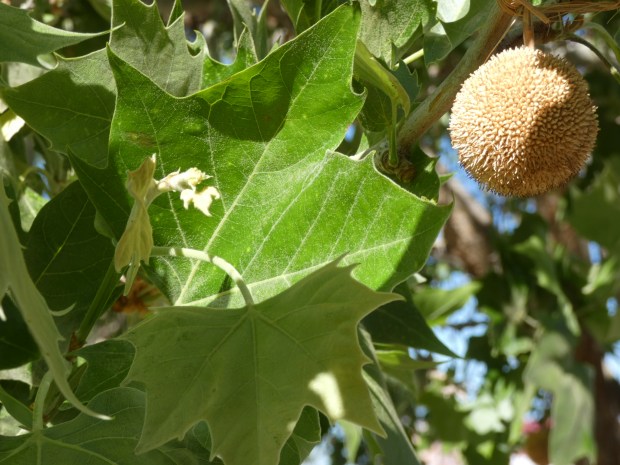
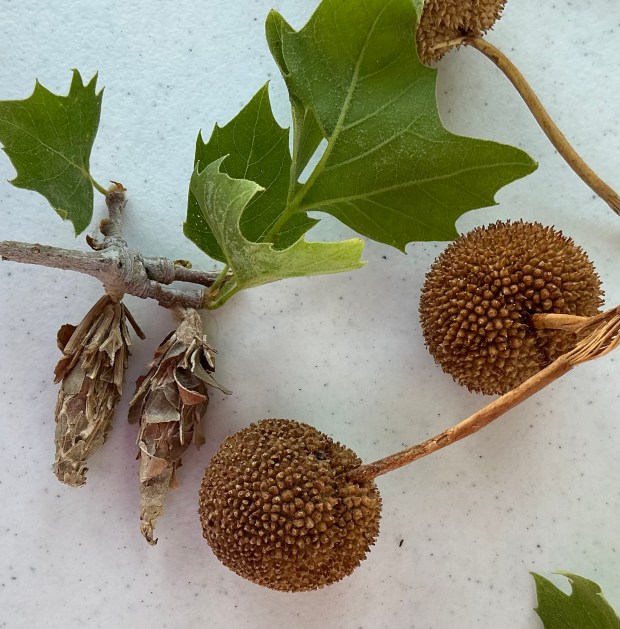
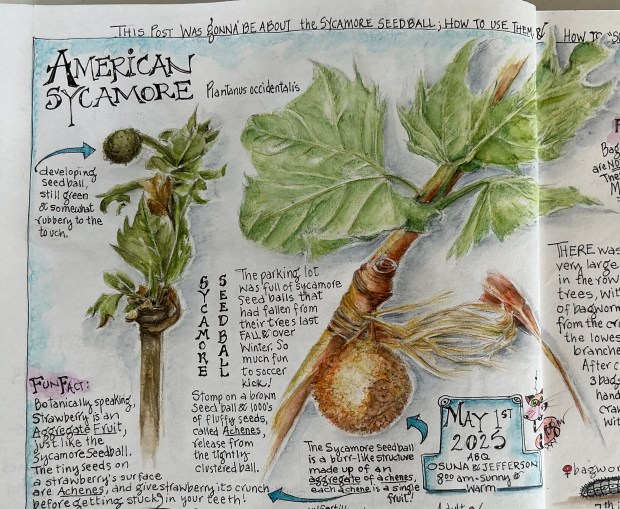
Strolling through a pretty north Albuquerque neighborhood a few days ago, I nearly stumbled over a pile of little brown golfballs. Huh? Not a single putting green in sight, I instantly deduced these carelessly cast-away orbs must be none other than last year’s sycamore fruit balls!

Sure enough, a quick glance upward confirmed my suspicion. I was standing in the shade of a huge, patchy-barked sycamore with draping branches over a stucco wall, approaching full leaf stage, and sporting hundreds of spring green fruit balls each with hundreds of immature arrow-shaped seeds.

Continue reading “Spring Has Arrived! Part 4: A New Mexican Sycamore”