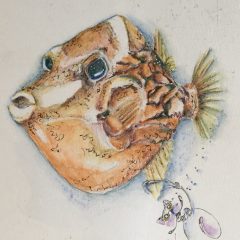
Under Siege! 

A Battle of Wits

Conflict of Interest

November 24, 2025
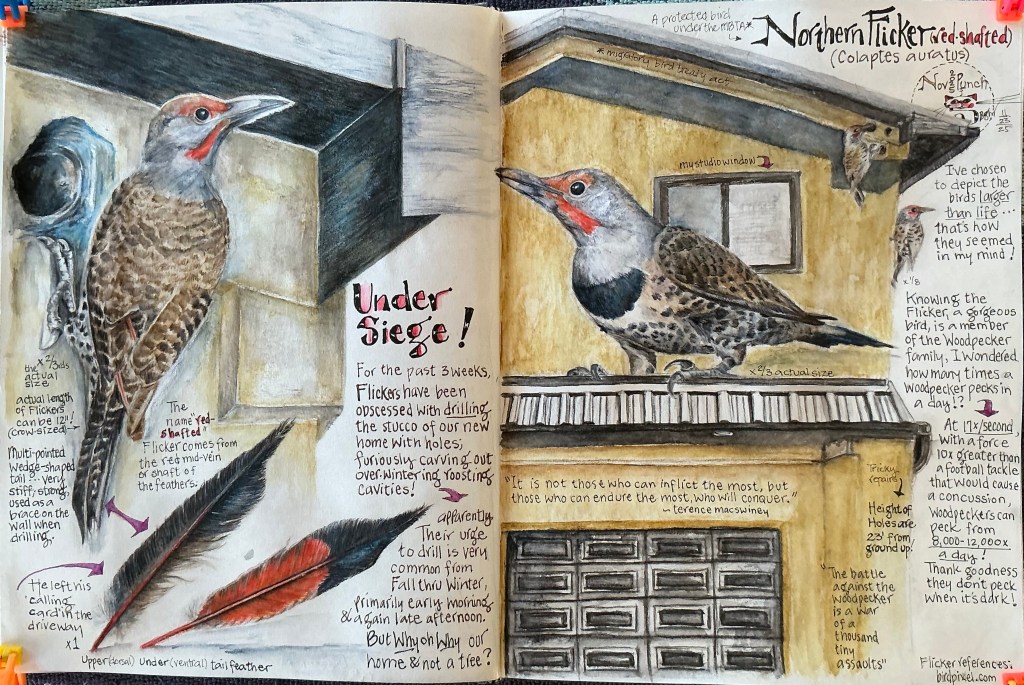
Were you ever so challenged by something so clever, while at the same time so frustrated with something so beautiful? No, no, wait….. that question may be more complicated than need be. Let me put it this way …… 

Were you ever at your wit’s end finding a solution to a seemingly simple problem that you thought was obviously and repeatedly staring you right in the face?

My reply? Yes!

It’s All About the Genes

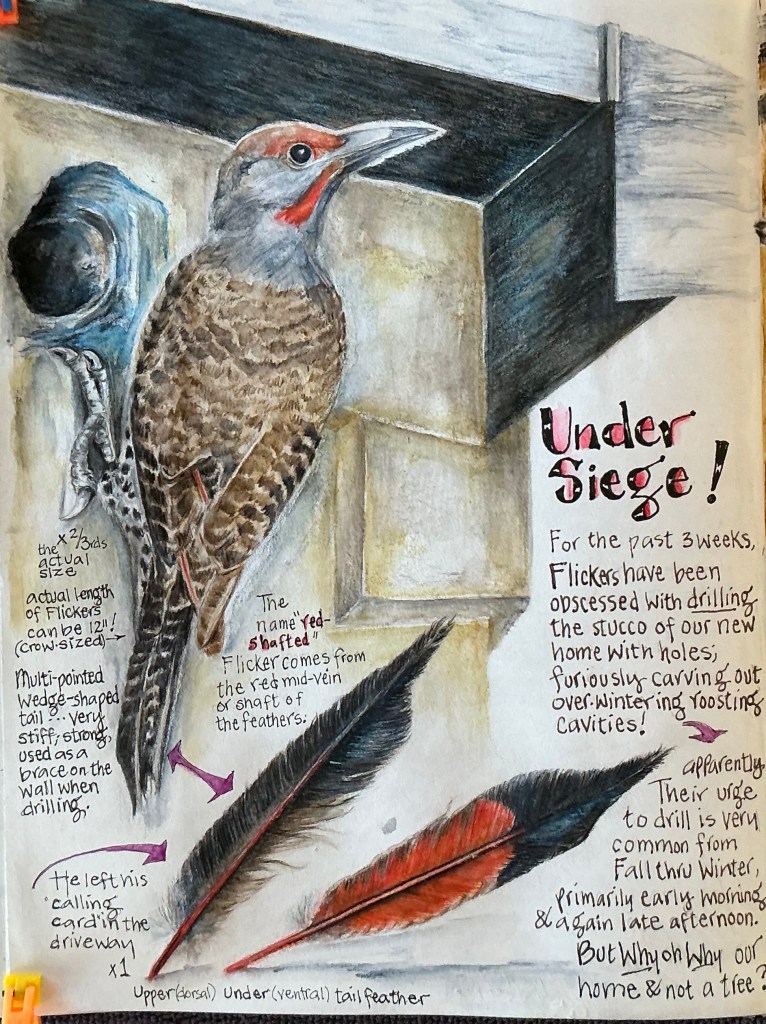
Meet the Northern Flicker (Colaptes auratus) … or more specifically, the Western red-shafted flicker (C. auratus ssp. cafer)*, a gorgeously flamboyant and noisy member of the Woodpecker family, that’s common throughout its western range.**  And as woodpeckers do so well, they peck and peck and hammer and drill with the determination and force of a jackhammer*** on nearly any vertical (preferably wooden) surface. They’re single-minded, from start to finish, when it comes to creating a cozy nesting or roosting cavity, whether in a tree trunk or into your home.  (More about that in a bit.)

Flicker ID – 101

How do you know a Flicker has laid claim to your place? Well, he’s a big, heavy-bodied bird, and when flying overhead, your first thought might be “Crow!” At 12-14” long, with a wingspan of 18”-21”, the size is right. But as he flashes a large showy white rump patch bookended by reddish-orange underwings, you realize he’s not black. Anything but! As his flight slows and dips you notice his brown back is marked with narrow black bars. In preparation for landing, with wings open wide, he vertically aligns his body and feet with the wall, exposing a pale gray belly with bold black spots and a chest-wide black patch. Two strong clawed-toes up, two down (zygodactyl), and a stiff wedge-shaped tail adjusted as a brace, he taps out a few test spots, drawing your attention to his long and heavy bill, on a slate gray head broken by a buff-brown crown, a bright red whisker (male), and light gray cheeks. 
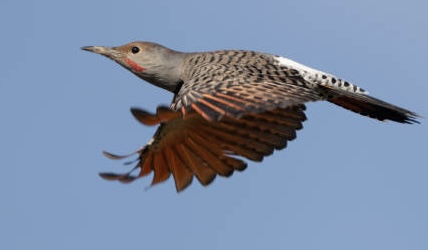
Male Western red-shafted flicker in flight. Note white rump patch (unsplash.com)

On a crisp cool Autumn morning, as you watch in horror …… 

Before you can declare, “It’s a Male Flicker!” ……

This bigger-than-life bird has landed, tested, and pecked away at his chosen spot  170 times in 10 seconds! He’s created an entry hole about 3” wide, right through the stucco and foam sub layer. This determined Flicker knows winter is coming and he intends to drill into our home, making a cozy roosting cavity in which to hunker down until Spring!  

Oh no, No, NO!

We love Flickers and have no wish to harm this beautiful bird.**** But he’s already caused enough damage (23 feet high on the wall) that needs immediate repair. So I clap my hands and holler loudly (something unintelligible), and off he flys to a nearby snag to see how serious my noise-making was.

That’s the story of Flicker hole #1 

Oh Not Again, and Again, and Again!

Since early November, our resident Flicker (I call him Jack), has continued to return many times, usually between sunrise and 10am. Sometimes he’ll make a fly-by before sunset. Often his quiet arrival escapes our notice; either we’ve been running errands, we’re out hiking with Luna, or enjoying a short roadtrip. These are the times he’s been able to drill six 3”-wide holes on the initial wall, and another 3”x6” hole just around the corner which was so deep, he almost penetrated the interior of Roy’s woodshop! This gives a whole new meaning to the term “Airbnb!”

After a few weeks up and down our fully-extended extension ladder to make a 2-step/2-day repair job/hole, we were making ZERO headway. Jack, unable to resist the need to drill him a roost cavity, was always one hole ahead of us. And because he didn’t hesitate to redrill newly repaired holes, was there something we were doing wrong?
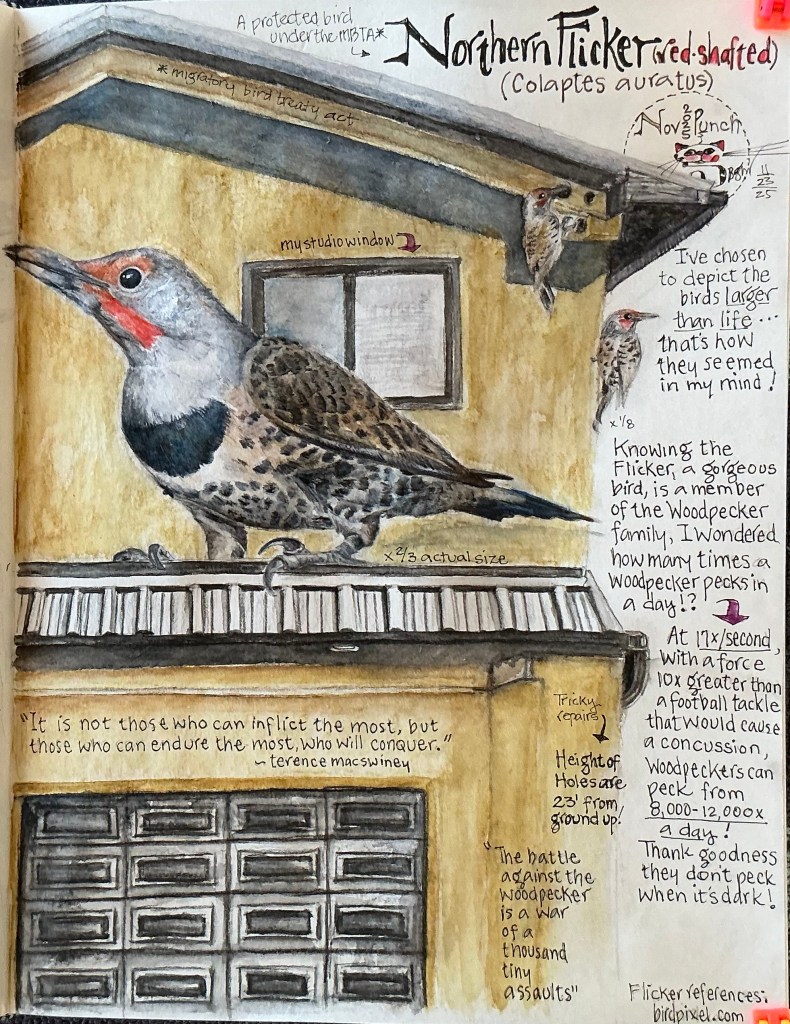
All Flicker painting are larger than life, because that’s how they seemed to me!

It’s an Education in Biology and Patience

So we learned to listen for his noisy “kerrreee” scream-like call announcing his presence from one of Jack’s many favored perches around the house. Unless we missed it, his territorial call would put us on high alert, ready for action. We also listened for his series of warm-up test pecks that usually sounded inside the house. This “alarm” would catapult one or both of us from a comfy chair and run outside yelling and clapping our hands. 

Between listening, running, clapping and yelling (and wondering what the neighbors might be thinking), I discovered a few interesting things on-line…..

  1. Woodpeckers can’t resist drilling holes in synthetic stucco. This product provides the perfect surface for woodpeckers to hammer. When they begin tap pecking, it creates a hollow sound because the synthetic stucco includes a foam layer. The woodpeckers peck through the hard outer surface into the foam where it is easier to create a larger cavity to nest. 

#1 …. Our entire home happens to be covered with synthetic stucco! While this might explain Jack’s insatiable desire to drill his roosting cavity into our home and not into one of the surrounding hardwood piñon pines, we’re not going to replace  the stucco. 

  1. Basil, mint, cinnamon and/or lavender are suggested as natural, non-toxic deterrents for woodpeckers, who dislike strong aromas. The scent of basil, in particular, can be overwhelming and confusing to woodpeckers. Crushing one or a mix of these herbs with adding a bit of water, creates a green slurry that can be filtered and applied with a spray bottle to the affected area(s).

#2 …. This idea was worth a try, especially since there’s still have basil and mint growing in the garden. After collecting several handfuls of each, I popped the mix into the food processor with a bit of water and flipped the on switch. Gathering the resulting slurry, I filtered it through paper towels and collected the liquid for a spray bottle. That was several weeks ago, and with every hole repair, Roy’s been thoroughly soaking first the patch job then follow-up stucco coating with the basil/mint spray. It’s hard to know if it’s actually working, but the initial drilling sites haven’t been redrilled in the past week. It could also be that Jack is gone; pushed out with one of our heavy rainstorms.  Or he’s begun drilling more recent holes over the RV garage door. With each repair, Roy continues to spray the basil/mint mix.

  1. The Federal Migratory Bird Treaty Act*** provides protection for Flickers (and all woodpeckers), making it illegal to harm or kill them. But when warranted, migratory birds can be killed under a depredation permit issued by the Law Enforcement Division of the USDI-Fish and Wildlife Service (USFWS). Authorization by the relevant state wildlife agency also may be required before lethal control methods are initiated. Sound justification must be present for the issuance of depredation permits.

#3 …. Applying for a depredation permit may be our last resort, if Jack and his cohorts threaten to turn our brand new home into Swiss cheese. 

AGAIN!

That’s the story, almost. This clear Conflict of Interest; an obvious Battle of Wits, continues. Just yesterday, one of the holes Roy patched above the RV garage door was redrilled this morning!

Oh Good Grief!

 It’s already been repatched and resprayed, and while writing this story in my studio with window cracked and a clear view of the patched hole, I’m sure to hear and see that gorgeously determined Flicker if he returns to jackhammer away, once again, into a side of our home!

I’d love to know if you or anyone you know has a proven solution to this natural dilemma. Meanwhile ….. 

Thanks for stopping by, and Happy Thanksgiving!
……………………………………………………………………………………………………………

*Northern Flickers are divided into 2 subspecies, the Western red-shafted flicker (C. auratus ssp. cafer) and the Eastern yellow-shafted Flicker (C. auratus ssp. auratus). The red-shafted subspecies is found throughout Mexico, western and west-central U.S. (where it is common all year long), and British Columbia, Canada. The closely related yellow-shafted subspecies, which is highly migratory, is found in eastern and east-central U.S., the Canadian provinces and Territories (except B.C.), and far north into AK. 

**Where the range for both subspecies overlaps (in the ‘lower 48’), a lot of hybridization occurs. It’s common to see a red-shafted flicker with more orange feather shafts and/or shades of yellow-orange on the underside of their flight feathers. The same holds true for the yellow-shafted hybrid. Otherwise, appearances differ notably between both subspecies of the Northern Flicker, primarily where the malar (mustache), nape pattern (back of the head below the crown), face color, and tail and flight feathers are concerned. See the table below for non-hybrid subspecies characteristics. For hybrids, any color and pattern variation(s) and combination(s) you can imagine have probably been found! 

Northern Flicker subspeciesRed-shafted Yellow-shafted
Face colorGrayBuffy to warm, light brown
Malar colorMale: red Female: brownMale: black Female: brown
Nape color & patternGray, unpatternedMale: Red crescent on gray Female: gray, unpatterned
Feather shaft/under flight feathersPinkish to reddish to redYellow

***A woodpecker can peck wood 17x/second, and from 8,000-12,000x/day! Really! And they can drill into wood at a force 10x greater than a football tackle that would cause a concussion. On the November 17, 2025 episode of the Science Friday (SciFri) podcast, biologist Nick Antonson stated that woodpeckers can peck 20-30x their body weight. Now that’s amazing for a Flicker that weighs about 6 ounces! 

****Because we had no desire to harm the Flicker(s) drilling into our new home, even when we reached our point of extreme frustration, we wanted to ensure our deterrent efforts aligned with wildlife regulations; especially with the Federal Migratory Bird Treaty Act (Act). Flickers (and all woodpeckers) are considered a migratory non-game bird species, and protected under the Act. It’s illegal, punishable by fine and/or imprisonment, to harm or kill them. 
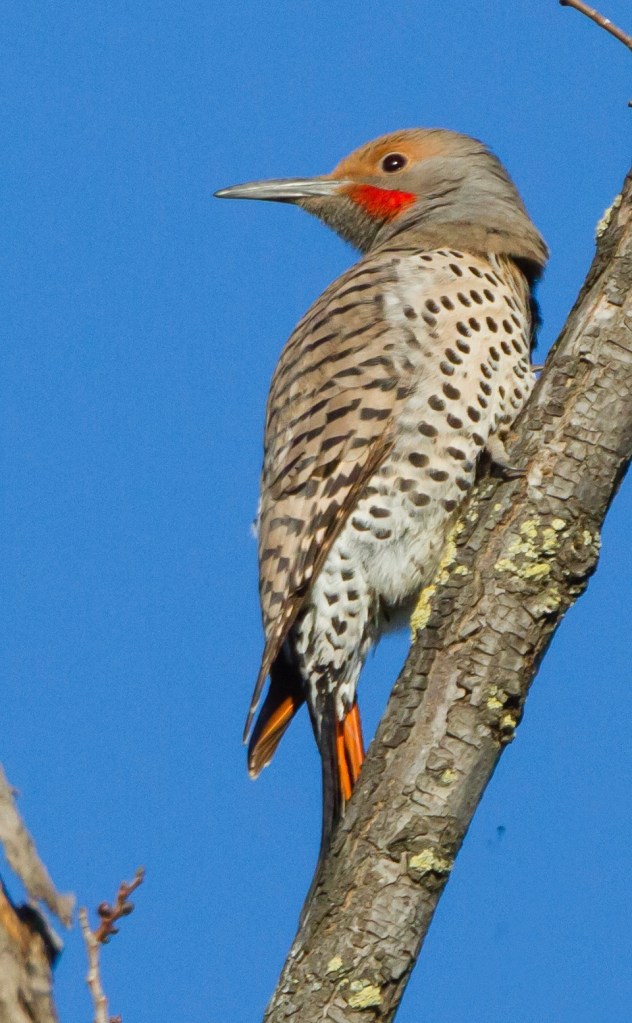
Male Western red-shafted woodpecker with his tail braced against the branch(bird pixels.com)

EggTober 2025 ….. the Full Four Submissions + Bonuses

November 15, 2025

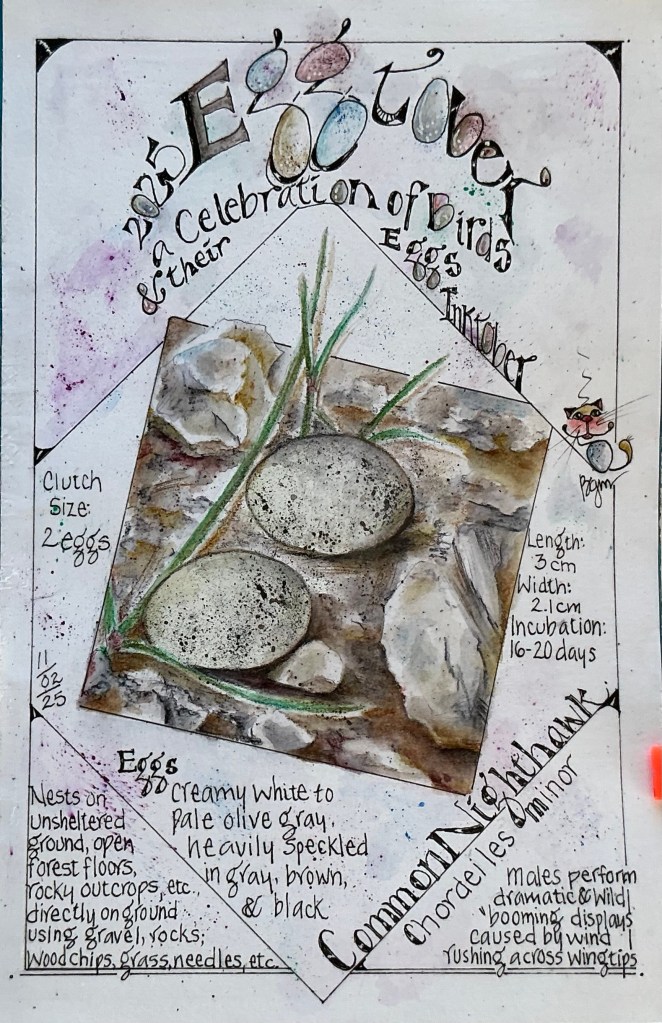
It’s a wrap! EggTober 2025 – the Full Four Submissions- all in one place!

My 3 minute YouTube video (see link below) features all 32 annotated bird egg paintings submitted for Inktober2025, along with several bonuses you won’t want to miss!

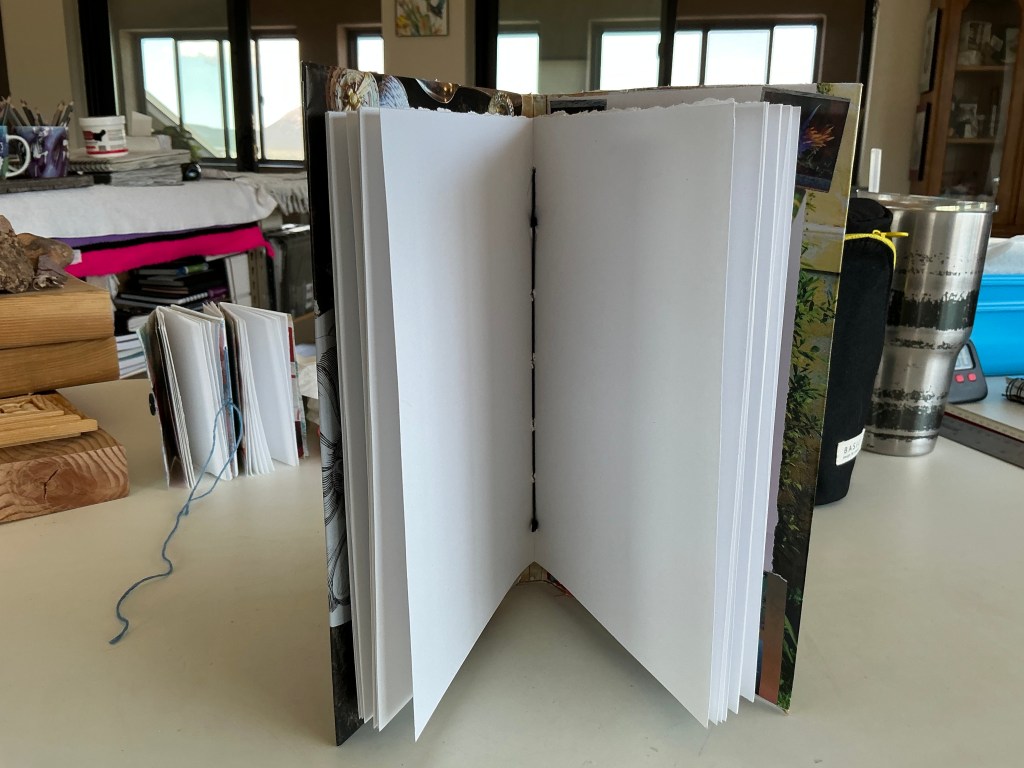
1) a pair of never-seen-before annotated Common Nighthawk eggs painted for the cover of my 6”x9” handmade journal ………

2) an index, by common name and date of appearance, of the 32 bird eggs painted and annotated between October 1 and November 1, 2025 ………

3) an accordion book attached to the inside back cover that has all the fascinating details about each of the 8 layers of an avian eggshell

YouTube Video Link

For some reason, I’m unable to embed my YouTube video directly into this post. This is rather inconvenient, huh! So until I can troubleshoot the player issue, I’d love for you to click on the link below to view the video on my YouTube channel!

https://www.youtube.com/watch?v=keiOCtFwASo


And That’s All Folks!
Thanks so much for joining me on this fun educational adventure.

P.S. If for some reason you’re unable to view the video, please let me know.

EggTober 2025/Submission Four ….. Days 25 – 31

It’s All in a Day’s Work! 

November 3, 2025

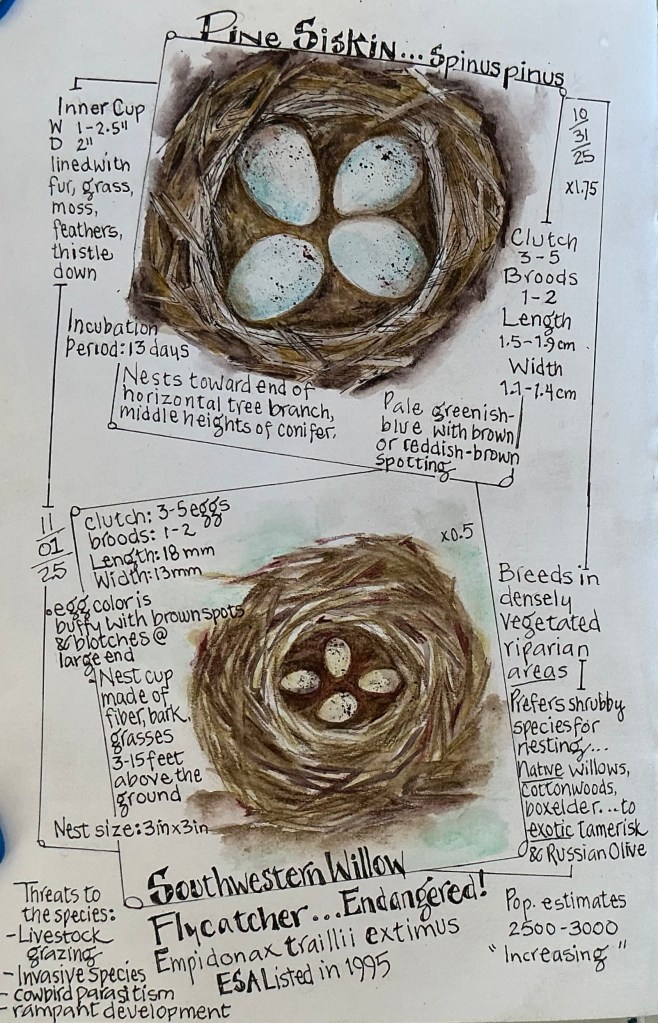
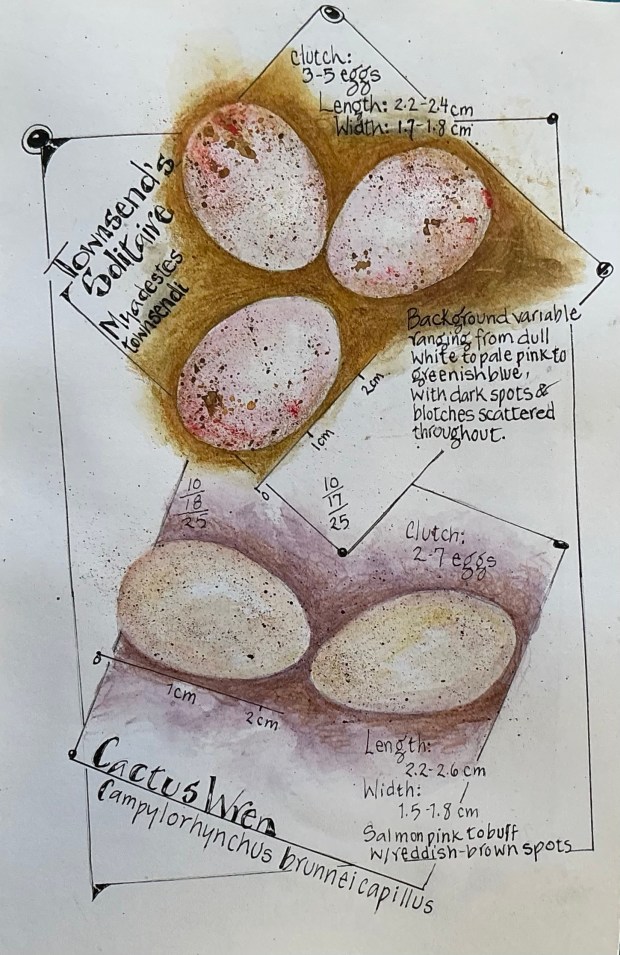
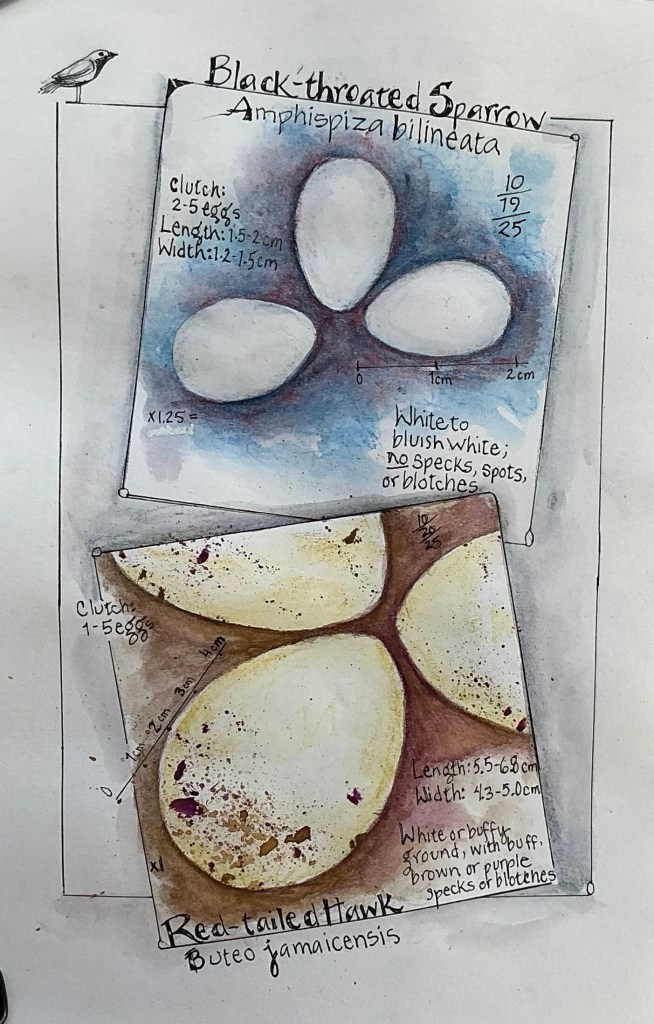
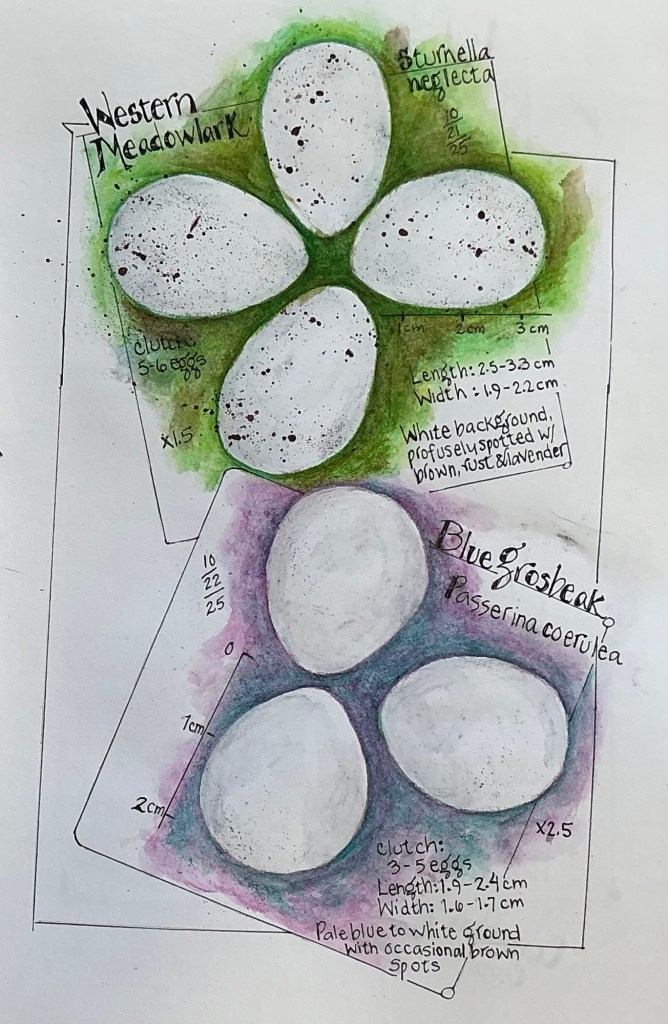
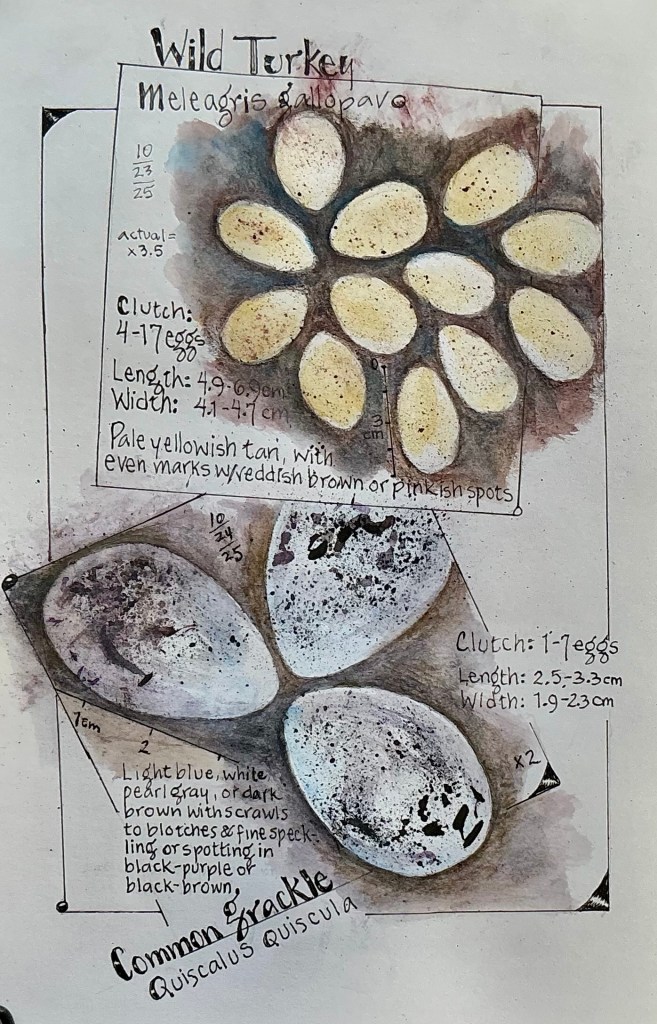
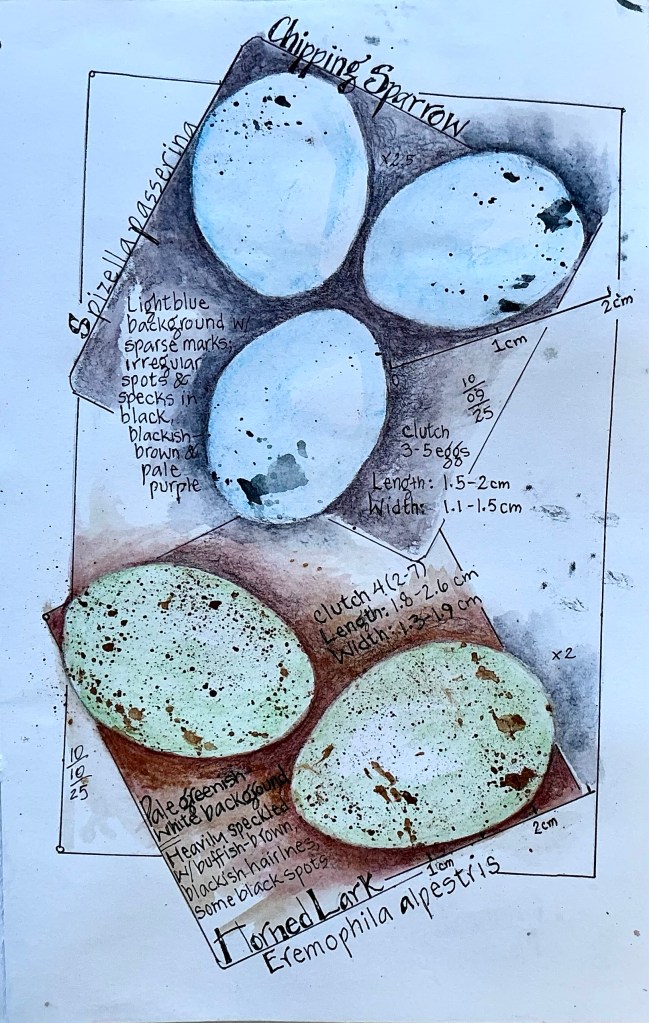
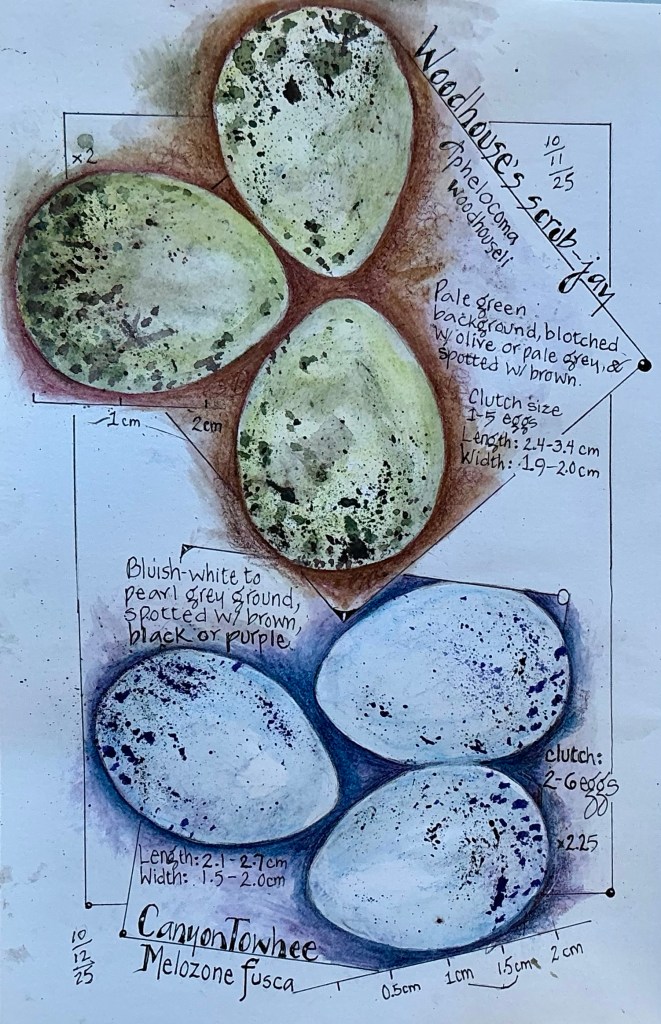
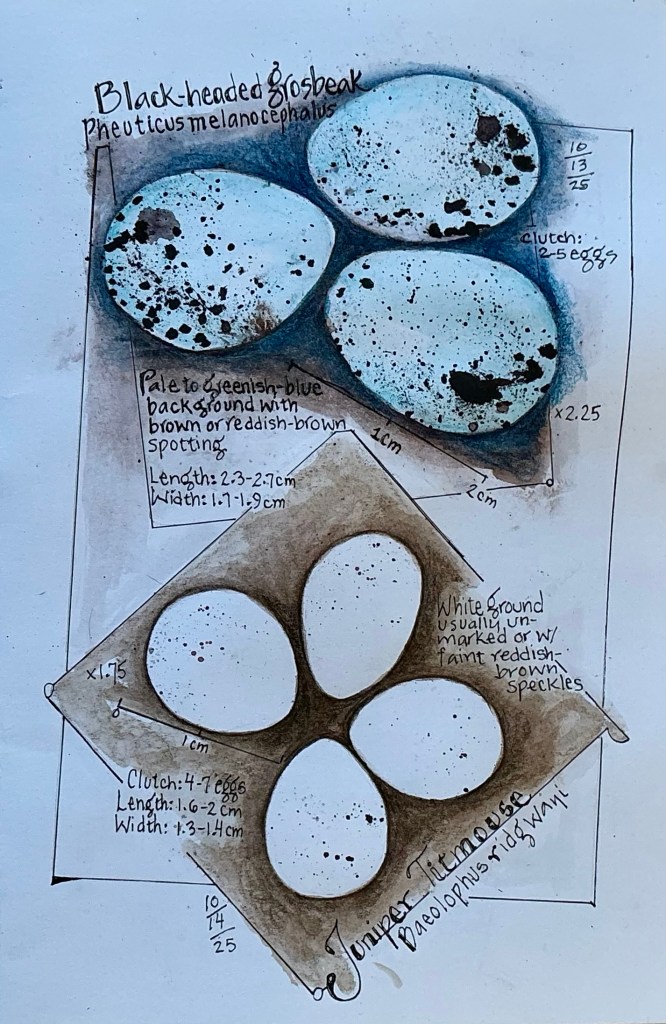
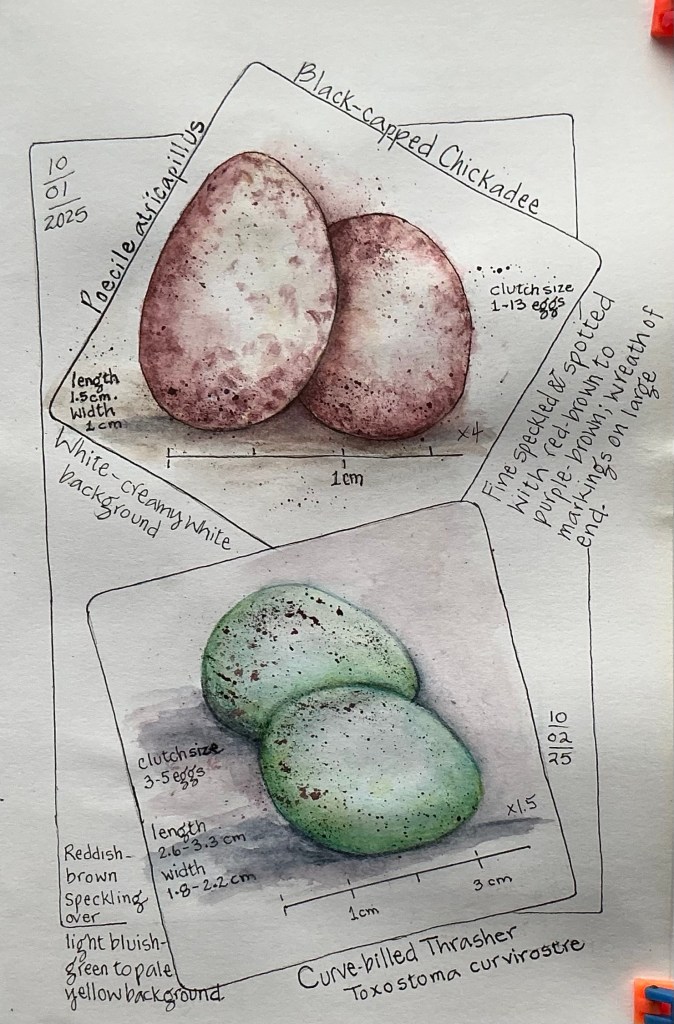
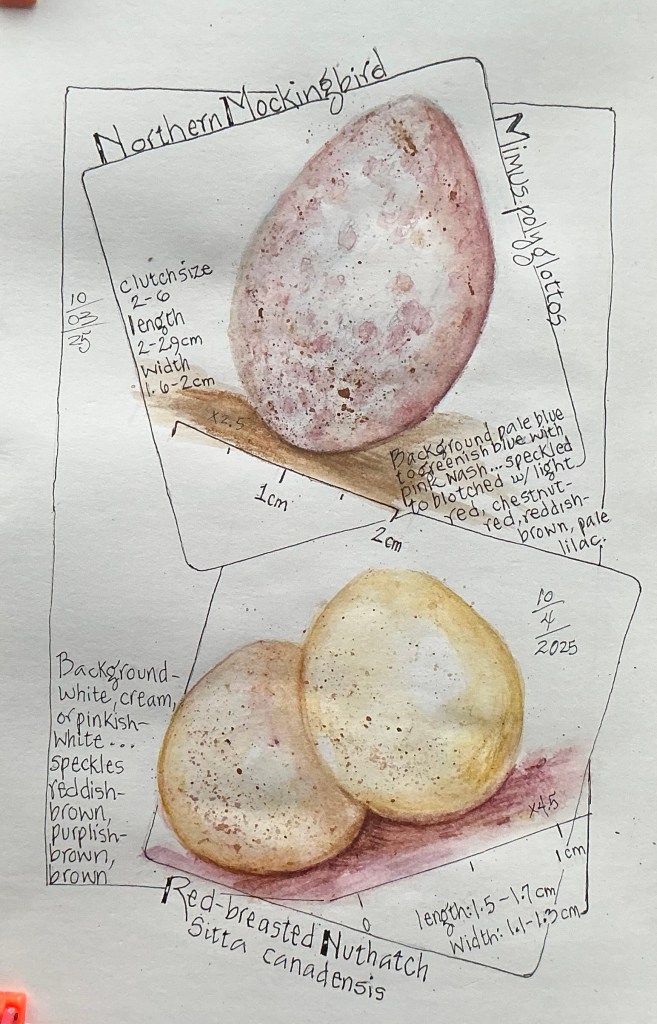
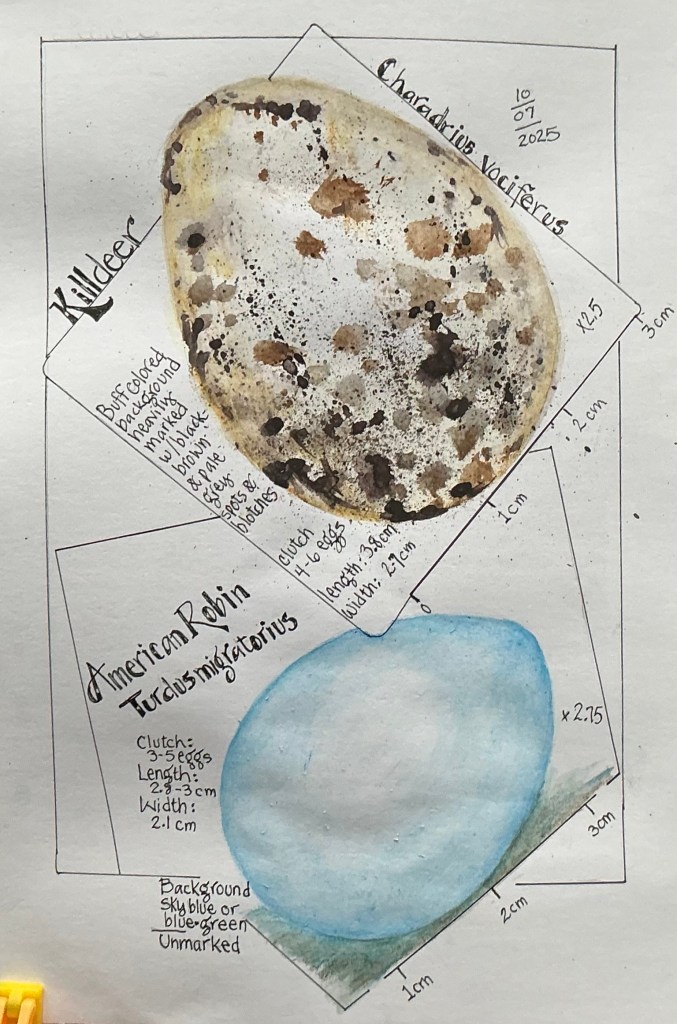
EggTober 2025 has officially ended! And Wow … I’m so eggs-cited to share Submission Four, the finale, with all-y’all!  The eggs showcased for Days 25-31 +1 (yes, another random bird flew in and laid a bonus clutch on the last page) are all snug in their New Mexico nests. Also, you’ll notice a bit more text surrounding those nests.   

Following Submission Three, where my narrative focused on the different layers of the eggshell membrane, I was curious about how avian eggshells are constructed. Then I wanted to know more about the entire reproductive system of birds, from ovulation to fertilization, to egg laying. And Then I couldn’t rest without knowing about the embryo, the yolk, the egg white, and all the bits and pieces you see when cracking open an egg! I didn’t know any of this, and if you don’t know, you’re head is about to explode in wonder!

October 25 and 26

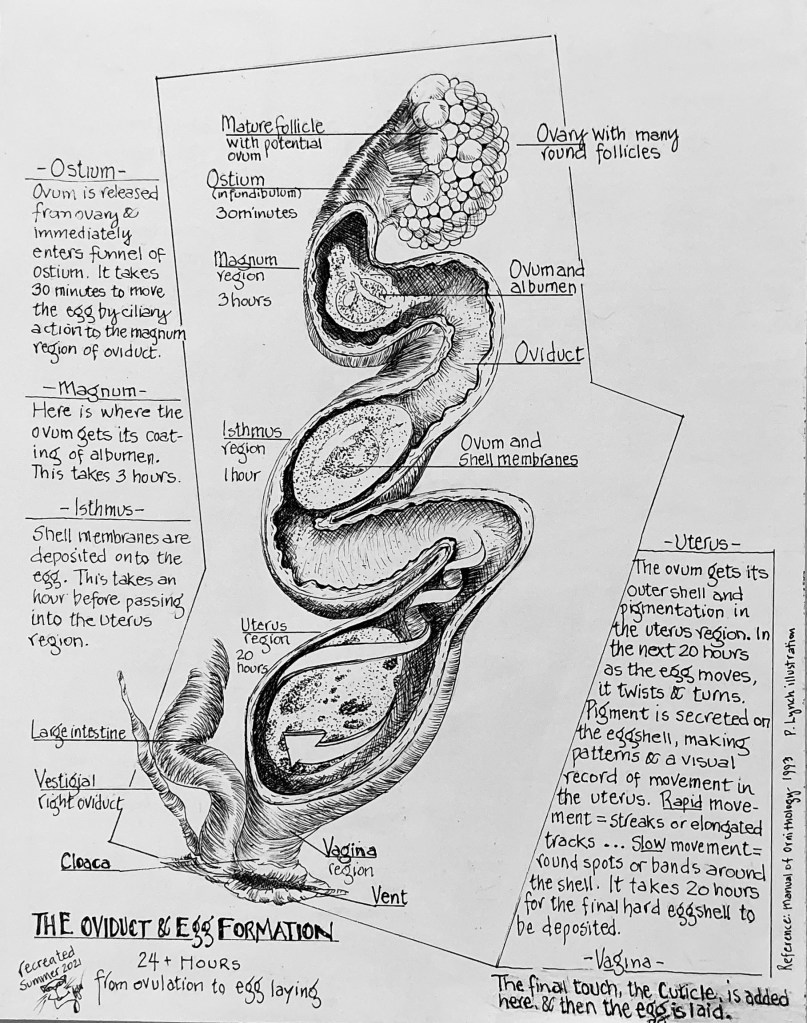
The Avian Oviduct and Egg Formation

It takes about one day to build an egg. But to prepare for the journey, about 7 to 9 days before the egg will be laid, the Yolk must be formed. Here’s the story of …..

The Yolk …..

….. formed in one of the many Follicles of the Ovary, the vitellus or Yolk begins as an immature Ovum that is stimulated to enlarge over several days by receiving deposits of yolk material. Once growth is initiated, over the next 7 to 9 days the Yolk’s formation intensifies as 99% of its nutrient-rich layers are deposited until it’s fully formed. Now mature, the Follicle ruptures and the Yolk is released in a process called Ovulation.

And this is where the Journey through the Oviduct begins! Over the next 24 hours, the developing embryo acquires the many layers it needs for nourishment, respiration, and protection until it’s formed into a perfect egg ready for laying. The entire journey takes place in the Oviduct …..

….. which can be divided into several regions: the Infundibulum, Magnum, Isthmus, Uterus, and Vagina. What happens in each of these regions is nothing short of fascinating!

The Regions of the avian oviduct

Infundibulum – After Ovulation, the Yolk immediately enters the funnel of the Infundibulum (the Ostium) where the Ovum is fertilized and the Chalazae is formed. With the help of ciliary action, it takes 30 minutes for the Ovum to move through this region of the Oviduct to the next, the Magnum

Magnum It’s this region where the Yolk, together with the now developing embryo and the Chalazae, gets a protective coating of protein-rich Albumen, a process that takes about 3 hours to complete, before moving along to the Isthmus.

Isthmus – The Inner and Outer Shell Membrane Layers and the Nucleation Sites are formed in this region of the Oviduct. This takes about an hour before the package is delivered to the Uterus

Uterus This is where five of the six layers of the outer Eggshell are formed. They are the Mammillary Layer and Mammillary Bodies, Organic Matrix Layer, Crystalline Palisade Layer, Vertical Crystal Layer, and Shell Pigment Layer. Also, as much as one-third of the protein in an egg is added while in the Uterus. 

It takes about 20 hours for the egg to move through the Uterus while these layers are deposited. And as the egg moves, it twists and turns. When it’s time to add pigment, the rate of rotation adjusts to ‘paint’ the species-specific patterns we see on the eggshell, leaving a visual record of the egg’s movement in the Uterus. For example, if streaks or elongated tracks on the shell are required, movement is more rapid than when creating round spots, blotches, speckles, or bands. After pigment is added to the outer shell structure, the layers of background color and any markings are enclosed in calcite crystals. 

Vagina – The last region of the Oviduct where the Cuticle (the Bloom) is added to the shell just before the egg is laid. 

The egg is now complete. The entire process, beginning with the release of the mature Yolk and Ovum from its Follicle until the egg’s final touches, takes 24 hours! And the timing ensures the egg is always laid sometime during the day.

………………………………………………………………………………………………………………

Glossary and Other Interesting Things

Albumen – refers to the “white” of the egg. The Albumen is an effective barrier against microbes that might cross over and cause disease in the developing embryo. Albumen contains over a hundred antimicrobial proteins.

October 27 and 28

Chalazae – two spiral bands of white, stringy tissue that suspend and hold the Yolk in the center of the Albumen.

Crystalline Palisade Layer – A  tough, mineralized structure of calcium carbonate crystals that grow into dense columnar units above the Mammillary Bodies (the mineralized base of the crystalline eggshell). The amount of shell deposited is determined by the time spent in the Uterus.

Eggshell – Depending on species, the eggshell represents from 9-15% of the total weight of the egg. 

Eggshell Formation – The Crystalline Palisade Layer is essential to the process of eggshell formation which takes place in the Uterus. 

  • Nucleation: The process begins at the Nucleation Sites, located on the External Shell Membrane, which are the specific places where the mineralization of calcium carbonate begins. 
  • Initial growth: As calcium salts are deposited and crystallize, inorganic calcium carbonate crystals grow around and outward from the Nucleation Sites, forming the cone-shaped Mammillary Bodies; the first, innermost calcified layer of the eggshell, anchored to the External Shell Membrane. This base of mineralized shell provides mechanical strength, and serves as the main source of calcium for the developing embryo’s skeleton.
  • Maturation – The calcium carbonate crystals continue to grow into the dense columnar units that form the Crystalline Palisade Layer, creating a tough, mineralized structure that protects the embryo. The amount of shell deposited is determined by the time spent in the Uterus. 

Follicle – an enclosed cavity in the Ovary

Labile Medullary Bone  a temporary, highly porous, and woven bone tissue that forms, driven by hormonal changes in female birds, in her medullary (marrow) cavities in the period leading up to and during egg-laying. As a highly porous, woven bone, medullary bone has no significant mechanical function or structural strength. Its role is strictly metabolic.

The word labile means the bone is unstable and readily undergoes rapid and frequent change. Once the egg-laying period is complete, hormones change and medullary bone is reabsorbed. 

Labile Medullary Bone Formation and Calcium Requirements  – It’s interesting to note that an egg-laying hen requires 10% of her the total body calcium reserves during each 24-hour period she is producing eggs. To meet this calcium requirement, primarily for eggshell formation, it’s necessary that her plasma (blood) calcium levels triple during egg formation. This calcium is mainly obtained from increased intestinal absorption and a highly labile reservoir found in the medullary bone. In other words, to meet the calcium requirement, the hen’s body naturally produces it as medullary bone.   

Eggshell Layers

Mammillary Bodies – The first, innermost calcified layer of the eggshell, anchored to the External Shell Membrane. These cone-shaped Mammillary Bodies form the  base of mineralized calcium carbonate which provides mechanical strength to the shell, and serves as the main source of calcium for the developing embryo’s skeleton.

Nucleation Sites (aka Organic Cores) form in the Isthmus region of the Oviduct, and are found on the External Shell Membrane. Composed primarily of organic material (proteins, proteoglycans, collagens), they are the specific locations where the mineralization of the calcium carbonate shell begins. In other words, the Nucleation Sites provide the initial template or “seed” for calcium carbonate crystals to start forming. 

Oviduct – the tube that transports the developing egg with embryo from the Ovary to the Vagina.

Oviduct … Only One? – Yup! Most bird species have only one Ovary and adjoining Oviduct, the other having degenerated when the hen was, herself, a developing embryo. This evolutionary modification probably resulted because egg production from two ovaries would deplete the female’s body of calcium to excess. As has been demonstrated in chickens that are on a calcium deficient diet, egg production ceases.

Ovulation – The process in which the mature Yolk and Ovum is released from its Follicle in the Ovary and is received into the Oviduct through the Infundibulum.
Ovulation Rate – Within 1 hour after a hen has laid an egg, the next mature Follicle in the Ovary ruptures (aka ovulates), releasing the mature Yolk and Ovum.
Ovum – an unfertilized egg

October 29 and 30

Pigment or Not? – Whether an eggshell is white, or decorated with a background color and/or markings, it’s appearance is influenced first by the species of bird, then by lifestyle and nest location. The specific color of an egg is an adaptation to its environment. This is where camouflage and/or thermal regulation may be required.

  • Thermal regulation is still being studied, but where camouflage is beneficial, egg color depends strongly on nest locations:
    • White eggs – prevalent among birds like pigeons, doves, swans, many seabirds, etc. These birds often build concealed nests where camouflage isn’t necessary, or inconspicuous locations are chosen for nesting where white coloring helps camouflage the eggs, reducing the risk of drawing attention.
    • Blue or green eggs – Bluebirds, robins, sparrows, parrots and other birds that lay pale to bright blue, blue-green or green eggs blend in with the sky or the foliage of nesting sites, providing natural camouflage. 
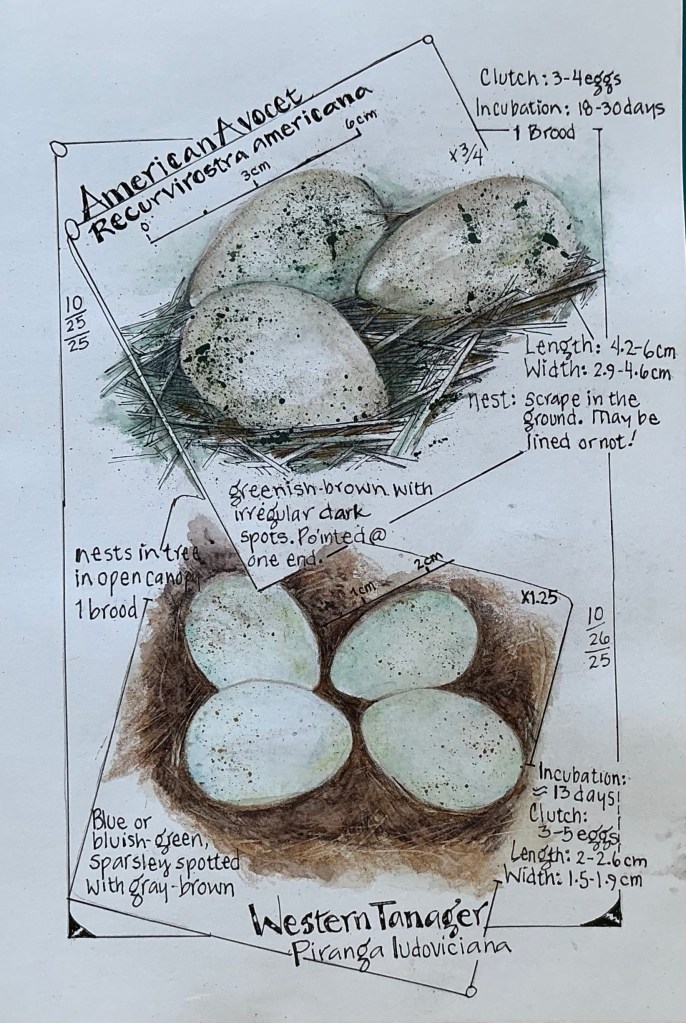
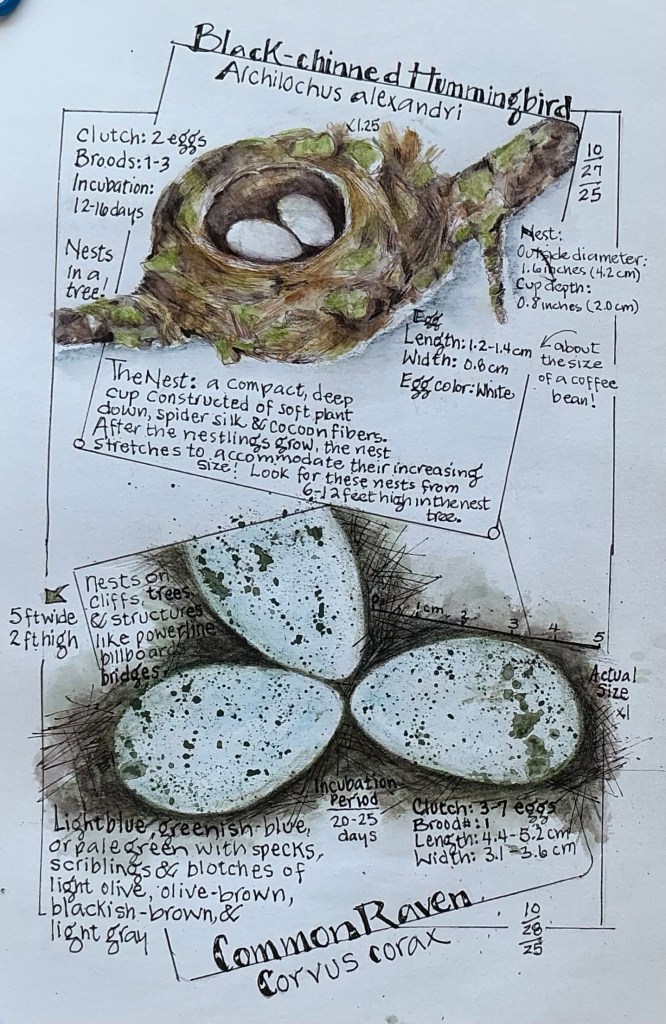
    • Brown or speckled eggs – Brown or highly marked eggs with speckles, spots, blotches, or scribbles provide excellent camouflage for ground-nesting birds like quail, avocets and killdeer. The mottled appearance of these eggs blend well against rock, sand, soil, foliage and branches. The eggs’ colorations are camouflaged well in nests woven from a variety of materials to nests that may be nothing more than a scrape or depression in the ground.

Shell Pigment Layer – Pigment granules are deposited on the outer shell structure, forming color layers which are then enclosed in calcite crystals.

Sperm Storage – a female bird need mate only once for the sequential formation of her eggs to be fertilized. In other words, each newly ovulated egg that arrives at the Infundibulum, which occurs every 24 hours (more-or-less), becomes fertilized from a single mating. That’s because female birds can actually store sperm in Sperm Storage Tubules (SSTs). SSTS are tubular “invaginations” in the Infundibulum where sperm can be kept alive for 2 to 15 weeks (depending on the species), and can be released after Ovulation.

Uterus – the Shell Gland

Yolk – The nutrient-bearing portion of the egg containing most of its fat, minerals, and many of its proteins and blood vessels.

Yolk Behavior – The Yolk always rotates so the developing embryo floats to the top, regardless of the egg’s position

Zygote – the fertilized Ovum

Wow, gosh! I’m egg’s-hausted ….. how about you!?! But wasn’t that a fascinating journey through a bird’s oviduct? A literal look behind the scenes! 

October 31 and November 1 (bonus)

And that concludes my Inktober/EggTober 2025. Researching so much information not only took me down some fascinating rabbit trails, but everything I learned in the month of October blew my mind! And everything I uncovered had to be shared with you all. The bounty was voluminous, resulting in each Submission eggs-panding to accommodate nearly everything. Yes, you read that right ….. I nearly got everything shared, and there’s still so much more to learn about past, present and future bird eggs and all eggs in general. Maybe once my notes are gather and organized, and I pursue answers to countless questions on the when’s, why’s and what-for’s, it will be time for EggTober 2026! 

Did you participate in this year’s Inktober? Maybe my four submissions gave you ideas for Inktober 2026? Share your thoughts and ideas.  Meanwhile ….. That’s all for now, yolks!

As always, thanks for stopping by!

P.S. in case you missed any of my previous EggTober 2025 Submissions, you can catch up with the following links:  Submission One, Submission Two, and/or Submission Three! Enjoy!

EggTober 2025/Submission Three ….. Days 17 – 24

October 25, 2025

October is ‘flying” by! It seems amazing how quickly my Inktober 2025 sketchbook is filling up with daily EggTober watercolor paintings of bird eggs. Week three is now complete, and the eggs of eight more breeding birds of New Mexico can be viewed below. As with Submissions One and Two, included are a few fascinating facts about bird eggs, this time with a focus on the eggshell. 

In case you missed my first and/or second EggTober posts, and would like to catch up, click the following link(s) to read Submission One, and/or Submission Two.

October 17th & 18th

A Bird’s Eggshell 

At first glance, you may think all bird eggs are covered in a hard, solid shell. You would be right about the shell being hard, but have you ever taken a close look at the shell surface? The outer shell appears to have dimples, a bit like a golf ball. Those dimples are pores in the eggshell. Bird eggs are considered “amniotic” which means their eggs not only have a hard shell; they have a porous membrane to allow for oxygen and carbon dioxide exchange. Also, an important characteristic of amniotic eggs is they resist dehydration, which is why birds can lay them on dry land. So, is the porous membrane sandwiched between the eggshell and the ‘egg white’ (albumen), and why?

In Submission Two, I noted that the typically oval-shaped bird egg is able to withstand the weight of the incubating parent(s); the shell having the strength and resilience to withstand external pressures which minimizes the chances of the developing embryo becoming deformed or suffering bone fractures. So, just how thick must an eggshell be, yet still allow the developing embryo to breathe? 

What are the main functions of the eggshell?

The shell of an egg contributes to successful formation and development of the embryo, by providing protection, respiration and water exchange. The eggshell is also the major source of calcium for the development of high-calcium consuming organs, like the skeleton, muscles and brain. 

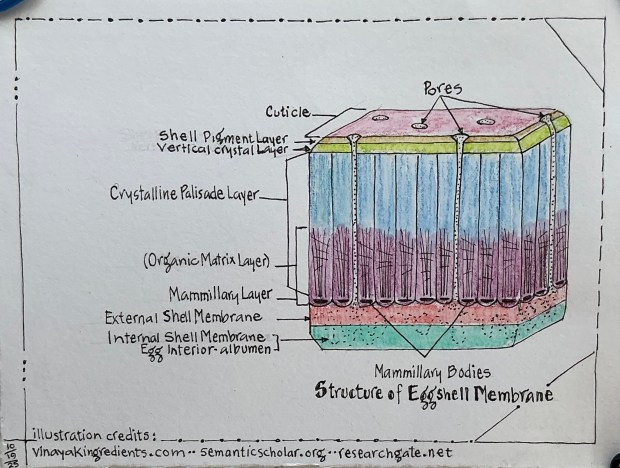
But what we think of as the eggshell, is actually Eight Separate Layers (!) that stack together from the outside of the egg to the inside where layer eight meets the albumen. It’s through these layers that the embryo breathes. 

These layers, from the outside in, are the Cuticle layer with Pores, Shell Pigment layer, Vertical Crystal layer, Crystalline Palisade layer, Organic Matrix layer, Mammillary layer with Mammillary Bodies, External Shell Membrane layer, and Internal Shell Membrane layer. These will be summarized below. I’m also compiling a more complete description of each layer and detailing their importance, which should be complete and posted before the end of the month.

But before taking a brief ‘look’ at the eight eggshell layers, I wanted to share a snapshot about their thickness ….. because, quite frankly, I couldn’t imagine how all those eight layers manage to fit!

Eggshell Thickness

Most bird eggshells must be thin enough for the chick to peck through when it hatches, but at the same time it must be thick enough to bear the weight of the growing embryo inside, and the weight of the parents incubating it.  The thickness of eggshells varies among species and individual birds, but also among individual eggs laid in a clutch. Eggshell thickness is also influenced by factors like the bird’s age, diet, and where the measurement is taken on the egg. In general, bird eggshells are usually 5% thicker at the mid-section of the egg (the area called the equator) than the ‘bottom’ (the sharp egg pole) and ‘top’ (the blunt egg pole) ends.

To ‘illustrate’ how thickness varies by a few species, the egg of a Blue-tailed Emerald (a species of hummingbird that lays an egg with one of the thinnest recorded eggshells among all bird species) has a shell that’s 0.029 mm (0.0011 inch) thick. Compare that with an Ostrich egg, the largest egg with the thickest eggshell in the world, measures in at 1.92 mm (0.08 inch) thick. For many common species, like the Mallard, shell thickness is around 0.337 mm (0.013 inch); a domestic chicken eggshell varies from 0.33 – 0.36 mm (0.013 – 0.014 inch) thick. 

It may be helpful to relate these small sizes in eggshell thickness to an average human hair, which can be anywhere from 0.06 mm (0.0024 inch), to 0.10 mm (0.004 inch) thick. I’m still amazed how an eight-layered eggshell happens!

October 19th & 20th

Structure and function of eggshell layers: Cuticle layer and the Pores, Shell Pigment layer, Vertical Crystal layer, Crystalline Palisade layer

Cuticle (aka Bloom)

The Cuticle’s primary functions are to act as a physical and chemical barrier against invading microbes, protect the eggshell pores, and regulate the exchange of gas (Oxygen and Carbon Dioxide) and moisture (water vapor).  The Cuticle also affects the egg’s wettability, which helps prevent water and bacteria from entering, and fine-tunes the eggshell’s appearance, including ultraviolet (UV) reflectance. 

Eggshell Pores

The texture of the outer eggshell is due to the Pores that form openings in the Cuticle. Depending on species, there can be anywhere from 7,500 to 17,000 Pores covering an eggshell, most located at the blunt end of the egg (the top end where the air cell is located). Each Pore is connected to a Vertical Pore Canal that penetrates the next five eggshell layers, down to the External Shell Membrane. The shells of most bird eggs have simple, straight pore canals that widen slightly toward the openings through the Cuticle. The exceptions are found in swans and the ratites (the group with ostriches and emus), where their Vertical Pore Canals are highly branched. Covering the exterior opening of the Pores of all bird species (except pigeons and doves [hmmmm ….. wonder why]) are tiny plugs or caps, which may act as pressure-sensitive valves. 

The Pores and their canals provide a critical passageway for gas and moisture exchange between the inside and outside world. This exchange allows the developing embryo to breathe by taking in oxygen and releasing carbon dioxide and water vapor.

Shell Pigment Layer

The Shell Pigment Layer serves multiple critical functions, including camouflage, thermoregulation, and protection for the developing embryo. The colors and patterns come from two main pigments, protoporphyrin (brown/red) and biliverdin (blue/green), and their function varies depending on the bird’s environment and nesting behavior. 

Vertical Crystal Layer 

The Vertical Crystal Layer provides mechanical strength and structural integrity.  Its tightly packed, vertically oriented crystals form a dense, outer layer that protects the embryo from physical shocks, while also being integrated with the Palisade Layer (below) to form a tough, ceramic-like structure. This outer layer’s density and arrangement make it resistant to impact.

Crystalline Palisade Layer

The Crystalline Palisade Layer serves two primary functions: providing mechanical strength and regulating gas exchange for the developing embryo. This is a thick, mineralized layer, that forms a dense matrix of calcium carbonate crystals, and is critical for protecting the egg’s contents while also aiding metabolic processes (i.e. all the chemical reactions within the embryo that are essential for life).

October 21st & 22nd

Structure and function of eggshell layers: Organic Matrix layer, Mammillary layer with Mammillary Bodies, External Shell Membrane layer, and Internal Shell Membrane layer

Organic Matrix Layer

The Organic Matrix Layer plays a crucial role in controlling biomineralization, forming the shell’s microstructure, and providing antimicrobial defense. Consisting of proteins, glycoproteins, and proteoglycans, this layer acts as a scaffold that controls the eggshell’s strength and protective properties. 

Mammillary Layer and Mammillary Bodies

The Mammillary Layer and Mammillary Bodies form the foundation for the rest of the eggshell. Their primary function is to provide the calcium for the embryo’s skeletal development. This inner layer is composed of calcite microcrystals that dissolve easily, allowing the embryo to extract about 80% of its calcium needs before hatching. 

This layer also helps during the “pipping” process because its globular texture makes it easy to crack and break through the shell from the inside. Pipping is the,process where the chick breaks through its eggshell to hatch. There are two phases during pipping:  internal and external. Internal pipping is when the chick breaks through the Inner Shell Membrane Layer (see below) to reach the air cell and take its first breath followed by chirping! This first phase not visible from the outside and can take 12-24 hours. External pipping is when the chick uses its egg tooth to peck a visible hole or holes in the eggshell, a process that can take a few hours to a few days, requiring the chick to rest frequently… those outer layers of shell are hard. The long time due to the chick needing to rest This can take anywhere from a few hours to a couple of days. The final step is “zipping,” where the chick turns in the egg, cracking the shell into two halves to fully hatch.

External Shell Membrane Layer

The External Shell Membrane Layer functions primarily as a barrier to protect the egg’s contents from bacterial invasion and to prevent moisture loss. This membrane is made of proteins and acts as the first line of defense after the Cuticle, preventing microorganisms from entering the egg. 

Internal Shell Membrane Layer

The Internal Shell Membrane’s primary functions are to provide a barrier against bacterial invasion and to support the formation of the hard eggshell. It also helps prevent excessive moisture loss while allowing gases to pass through, a process that becomes more significant when the External and Internal Shell Membrane Layers separate to form an air cell. 

October 23rd & 24th

Summary

Eggshells! I never knew they are such complex structures with many unique features.  And eggshells are unfathomably critical to the development and survival of the embryo right up until the moment they “Pip” their way into the world. Without their bioceramic characteristics, microscopic pores, front-line bacterial defense systems, color patterns, and their surprising strength despite the shell’s thinness. birds might be something completely different or perhaps might not ‘be’ at all. Something worth pondering!

Hope you have enjoyed Submission Three of EggTober! If so, please leave me a comment.  And as always, thanks for popping in! 

p.s. Stay tuned for Submission Four, landing in your in-basket next week!

EggTober 2025/Submission Two ….. Days 9 – 16

October 16, 2025

EggTober progress continued, with zeal, as I worked my way through week two. See for yourself! Check out the bird eggs that randomly popped up from my list of nesting birds of New Mexico. As with Submission One, included are a few fascinating facts about the shape of bird eggs to go along with week two birds. 

If you missed Submission One of my EggTober post and would like to catch up, click here.

Egg Shape

The typical oval-shaped bird egg isn’t coincidental. Evolution, influenced by factors such as bird genetics and environmental influences, produced a “smart egg;” a perfectly shaped package just right for survival …….. 

October 9th and 10th

1. Structural Strength

The oval shape provides greater strength and resilience, reducing the likelihood of breakage during incubation. It withstands external pressure more effectively, minimizing deformation or fractures in the developing embryo.

October 11th and 12th

2. Optimal Space

The oval shape maximizes the volume available for the embryo, ensuring proper development and sufficient reserves of nutrients, including proteins.

October 13th and 14th

3. Temperature Distribution

The oval shape promotes the even distribution of heat. When a female bird incubates the egg, her body heat is utilized to maintain warmth. The egg’s oval shape aids in evenly disseminating her body heat, ensuring a consistent temperature for the embryo throughout the incubation process.

October 15th and 16th

4. Prevents Rolling

The blunt, flat end of the oval egg shape helps prevent rolling within the nest. This stability safeguards the eggs, preventing them from accidentally falling from the nest or assuming an improper position.

Summary

While most bird eggs exhibit an oval shape, slight variations in shape do occur among different species. These variations are influenced by the birds’ lifestyles and specific incubation requirements. Overall, the oval shape plays a vital role in the reproductive ecology and physiological adaptations of birds.

Hope you have enjoyed Submission Two of EggTober! If so, please leave me a comment.  And as always, thanks for popping in! 

p.s. Stay tuned for Submission Three, landing in your in-basket next week!

EggTober 2025/Submission One ….. The First 8 Days 

October 8, 2025

Having participated in the Inktober for years by creating a daily drawing or painting throughout the month of October, I’ve found the challenge fun, rewarding, and motivating. However, rarely sticking to “ink only” creations and/or following the official prompts, I’ve shamelessly adopted a variety of approaches shared by others, have different media, or made up my own prompts. For me, this has added an elevated level of complexity that’s so appealing and somewhat wild!

In the past, my “Inktober” art has been about themes, like using a new Zentangle pattern a day that has a name beginning with “Q” or “Z” or “M” ……. or picking different botanical patterns. I’ve played with mixed media, watercolor, watercolor pencils, colored pencils, graphite, and (yes) ink to create a flower a day, rocks, mushrooms, candy, modes of transportation, the alphabet, fonts, portraits of famous people, etc. I’ve found the challenge is a great way to loosen up and try subjects I’m not comfortable or familiar with, while not worry about silly mistakes. 

So, each year I look forward to Inktober, and this year was no exception. 

This year I went way “out on a limb” and switched it up a bit.

This year I’ve named my personal 31-day challenge EggTober! And in keeping true with my love of nature, nature journaling and curiosity, each morning I’ll be randomly pick from a list of birds that nest in my home state of New Mexico and will draw one or several of of their eggs. 🥚 

Here’s my progress so far and a few fascinating facts about bird eggs.  At the end of my post, you can read about my process and materials used.  

Did you know that two pigments are responsible for most eggshell colors: biliverdins, which make blue-green hues; and, protoporphyrins, which make the background hues of rusty yellows, reds and browns.  

Eggshells that have markings like spots, blotches, speckles, or lines, have more protoporphyrins. These markings help camouflage eggs, especially those laid by ground-nesting birds.

The largest known bird egg belonged to the extinct elephant bird. This flightless bird, which stood about 10 feet (3 meters) tall and lived in Madagascar until the 18th century, laid eggs about 11 inches (28 centimeters) long. That’s about the size of an American football!

Bird eggs can be oval, to round, to pear-shaped, depending on the species of bird laying the eggs and where. Many sea birds nesting on cliffs tend to lay more pear-shaped eggs which helps keep them from rolling off steep ledges. It’s said that pushing one of those eggs, because it’s so heavy at one end, will cause it to spin in a circle.

Eggshells are largely made of calcium carbonate, and if hatched without their final ‘spray-paint’ of color, will look pure white to the human eye.  But some white eggshells contain ultraviolet colors visible to birds. (Wonder why?)

Process and Materials

Of course, given that it’s Autumn, and impossible to find any active bird nests housing unhatched eggs, I’ve formulated Plan B. For my references I’ll be relying on digital natural history museum egg collections, on-line bird identification resources, fascinating facts about bird eggs, several key references from my personal library, and other sources, to learn and satisfy my long held love of birds, their incredible eggs, and the egg-laying process. 

Staying as true to real life as possible, approximate egg shapes will be colored with Derwent Inktense watercolor pencils. For consistency, basic information specific to each individual bird species’ typical egg (clutch size, length and width, background (ground) color(s) and marking color(s) and patterns) will be included. For future reference, I’ve handmade a small booklet that will hold two species’ eggs/page. At the end of October, I’ll then add a title page, table of contents, and a list of references.  

And finally, for now, it’s entirely possible that my process and materials may be changed on a whim! So stay tuned as EggTober unfurls!

If you are an Inktober participant, or have never heard of this month-long creative event, please let me know!

As always, thanks for stopping by!

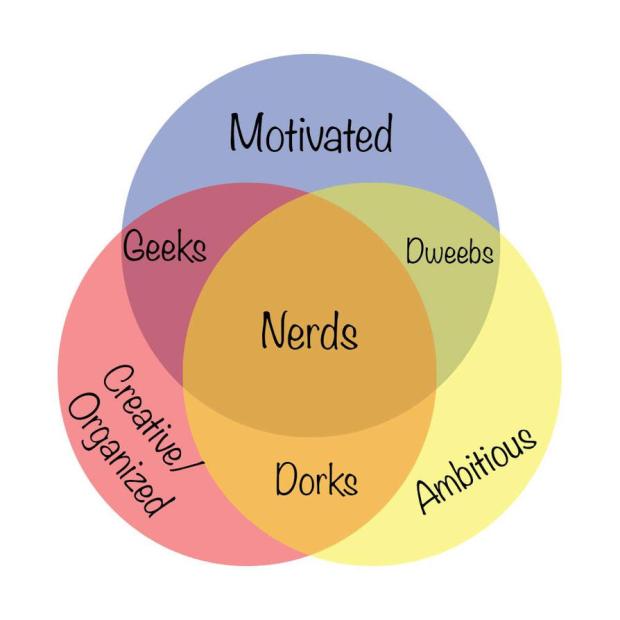
National Find Your Inner Nerd Day 

You Might Be A Nerd If ………

August 23, 2025

Zentangle patterns: Flukes, laced, TunnelVizion, Furrballs, Paradox, Sppedwayxtra, Shattuck, 

Today’s the Day! Embrace your Inner Nerd, and set her free.

Back in the 1950s, the term “Nerd” was frequently heard to describe someone in a negative sense: “He’s not attractive;” “She’s awkward at socializing;” “What dorky glasses he’s wearing;” “She’s so shy.”  Before that time, “Geek” was the popular word in play. However, many of today’s Nerds and Geeks have proudly broken free of those decades-old definitions by tossing them aside and rewriting dictionaries.

Where do you fit?

While the terms “Nerd” and “Geek” are often used interchangeably, some dictionaries are splitters. You can find Nerds described as people typically associated with intellectual pursuits and academic achievement, often focusing on mastering skills and knowledge, where Geeks are known for their intense enthusiasm of specific hobbies or interests, particularly in areas like technology, science fiction, or gaming.

Not to nit-pick an officially-designated celebration, it appears National Find Your Inner Nerd Day has merged Nerd with Geek, matching a 2024 dictionary definition….. and I paraphrase: “Nerd” is someone who’s extremely enthusiastic and wise about a subject or something they’re passionate about, and who excitedly and obsessively talks about it while paying extraordinary attention to details. 

Are you an Inner Nerd? 

Deep down inside do you identify with parts or even all of those words and phrases that attempt to describe a Nerdy you? You do? Awesome!            Still not sure (or “On the Fence” and)/or not willing to admit to your Inner Nerdiness? Being someone who’s a self-identified Nerd, having recognized and accepted my quirkiness for decades, let me help! 

You might be an Inner Nerd if:

-you’re an academic, a book-worm, into classic movies, or a Trekkie;

-you knit holiday clothes every year for your dog, all your friend’s dogs, the neighbor’s dogs, and the humane society;

-you collect Pez dispensers, antique buttons, bars of soap, or banana labels;

-you collect Adventure Labs, GeoArt, EarthCaches, TravelBugs, and Geocoins;

-your house is full of stuffed toys from around the world; you ask friends to bring you a skein of yarn every time they travel somewhere new; the closet in your craft room holds more bolts of fabric than Hancock’s of Paducah, because you ‘never know;’

-you’re passionate about learning as much as you can about anything new and then sharing everything with everyone you meet;

-you’re obsessed about your daily creative practice in the fine arts (drawing, painting, music, song, dancing, acting), or creative writing (poetry, prose, essays, short stories), or in the culinary arts; 

-you have a rock from every state in the U.S., a pressed leaf from every deciduous tree in your county, a photo of front doors from all your neighbors’ homes, and neighboring neighbors’ homes;

-you’re obsessed about scrapbooking, making botanical inks, filling journal after journal with nature sketches, storytelling, song writing;

-your collection of art supplies rivals Jerry’s Artarama; your own more ukuleles than Jake Shimabukuro;

-and on and on and on! 

Being a Nerd is about embracing what you love and sharing all of your nerdy habits, collections, hobbies, and passions. Being a Nerd is about wanting to inspire others to embrace their inner nerdiness, too!  Isn’t it time to show the world how amazing your differences are? Isn’t it time to embrace your quirkiness and  share what you love?

And if you need more convincing, have no fear!  Nerds are some of the coolest people in the world, if not the world’s most creative and successful. They’re always up for learning new things and love to share what they have learned with others. National Find Your Inner Nerd Day gives permission for everyone to explore their inner nerd, because everyone has a little inner nerdiness inside ready to be set free! Nerds aren’t weird, Nerds are wonderfully unique!  So let’s celebrate our quirky nature and love ourselves for who we really are. 

Let’s Celebrate Our Inner Nerd 

  1. If you’re a collector of things, take the day to share your treasures with other people. Give them a glimpse inside your mind and share your enthusiasm about your collection. 
  2. Join a local club that offers similar interests to yours. Book clubs, art clubs, bird watching clubs, nature clubs, car clubs, astronomy clubs, cooking clubs , and stamp collecting clubs can always be found. The best way to meet people like you is to find people like you. 
  3. Attend a convention, such as Comicon, Star Trek, Anime, QuiltCon, National Narrow Gauge, and  Association of Speciality Cut Flowers, and see how fun and enthusiastic Nerds really are! Start by searching in your local area to find something that interests you. 

And lastly ……. Are you a self proclaimed Inner Nerd? Are you ready to finally submit to your Inner Nerdiness? What are you obsessed about; passionate about? Do you have an insatiable curiosity about one thing; lots of things? Are you a collector (of what); a dedicated and driven learner? Please share your uniqueness with family, friends, and me! Oh how I’d love to know!

I hope this post was fun! As always, thanks for dropping by!

P.S. I’ve been a self-proclaimed Inner Nerd for most of my life (and that’s a lot of years!). It’s been an ever changing, non-stop circular journey of obsessions and passions involving art, music, science and nature. Right now I’m passionate about nature journaling on a daily basis, and the joy of non-stop learning and sharing the limitless diversity of our natural world. Oh, and I’m crazy about my daily connections with art, Flambé, and storytelling through Zentangle.

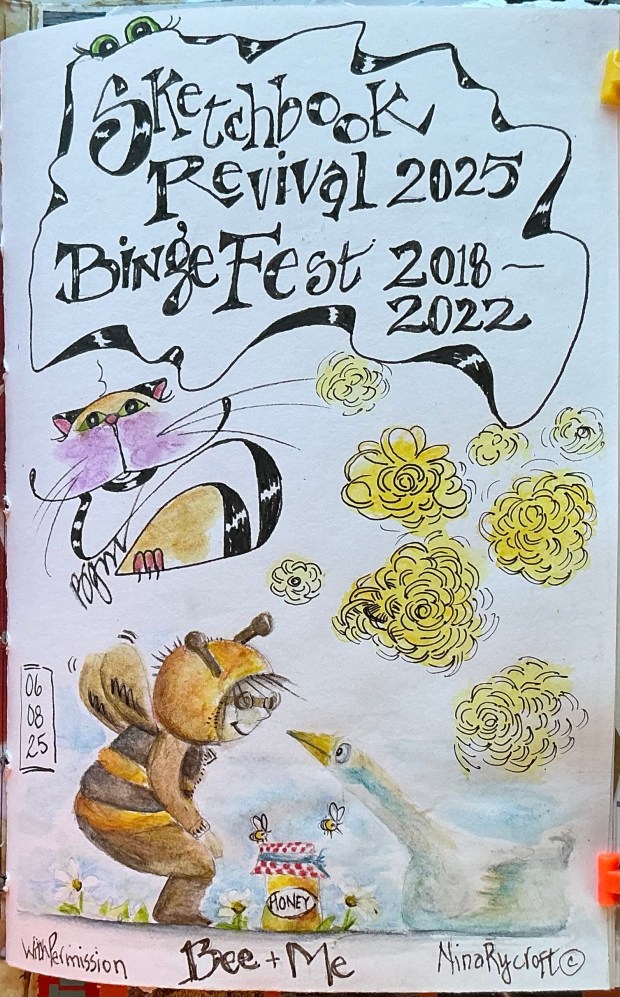
Sketchbook Revival 2025 ….. Binge Fest Extravaganza!

June 16, 2025

What a whirlwind celebration! Sketchbook Revival (SR) 2025 Binge Fest was so much fun. And Wow! Two jam packed weeks of creativity was over in the blink of an eye! 

Karen Abend, SR creator, host extraordinaire, and wonderful artist, came up with a brilliant idea for the SR 2025 session. I would swear the creative gears inside her head were spinning with delight as she declared, “Yureka! I’ve got it!”

Beginning on May 27th thru June 9th, Karen generously opened up the SR historic vault and set free all of the workshops conducted the first 5 years of SR (2018-2022)! That unbelievable offering came to more than 130 one-hour-long workshops of inspiring, hands-on, and creative  play time all instructed by well-known experts in artistic fields associated with Sketchbook Journaling.  

Challenge presented ……. Challenge accepted.

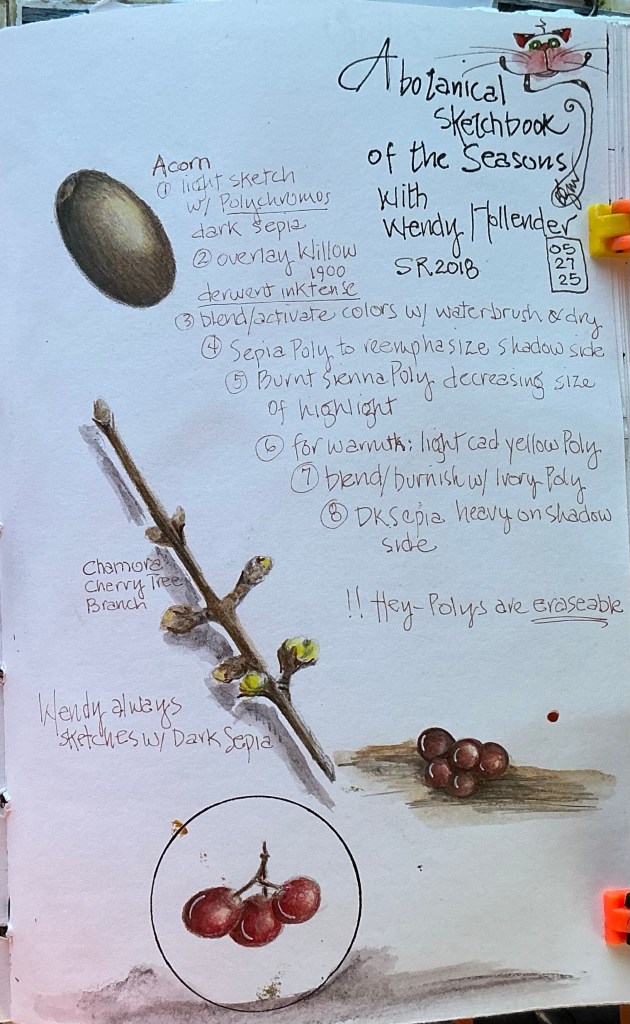
Since I’ve been participating in SR each year since 2018, and attended most of these workshops in the past, my goals and strategies to tackle the challenge were these: 

  1. Complete a minimum of 4 workshops daily;
  2. Two workshops should involve a project outside of my comfort zone, such as portrait drawing, fantasy, word play, collage, and properly stitching my own SR sketchbook so it wouldn’t fall apart during the 2-week challenge, etc.;
  3. Two workshops should involve projects within my comfort zone, such nature subjects, urban sketching, whimsey, and lettering, and those using watercolor pencils, graphite, and ink;
  4. Develop fresh, interesting, and imaginative sketches during the workshops;
  5. Allow Flambé to play along;
  6. Slow down, breathe, and enjoy the 2-week marathon without becoming overwhelmed;
  7. Recognize and gather take-away tips and techniques to bring into my Nature Journaling practice and Zentangle storytelling. 
  8. Keep sketching and sharing.

After two weeks of play, I was able to fill up my handmade and successfully stitched SR 2025 sketchbook! With a total of 46 pages completed (doubling up workshop projects on a handful of pages), including several pockets with inserts, I was pretty happy (and a bit exhausted). 

If you’ve participated in SR in the past, or maybe took on the 2025 challenge as your first time, you know how intense (in an exhilarating way) it can become.   If not, and would like to learn more, check out this link 

This link will take you to Karen Abend’s website where you can ask for more information about Sketchbook Revival. https://karenabend.com

Hope my collection made you smile and laugh! I certainly got a kick out of the experience.

Well, until Sketchbook Revival next year, thanks for coming along! 

High on the Views: Camping Above the Rio Grande

June 6, 2025

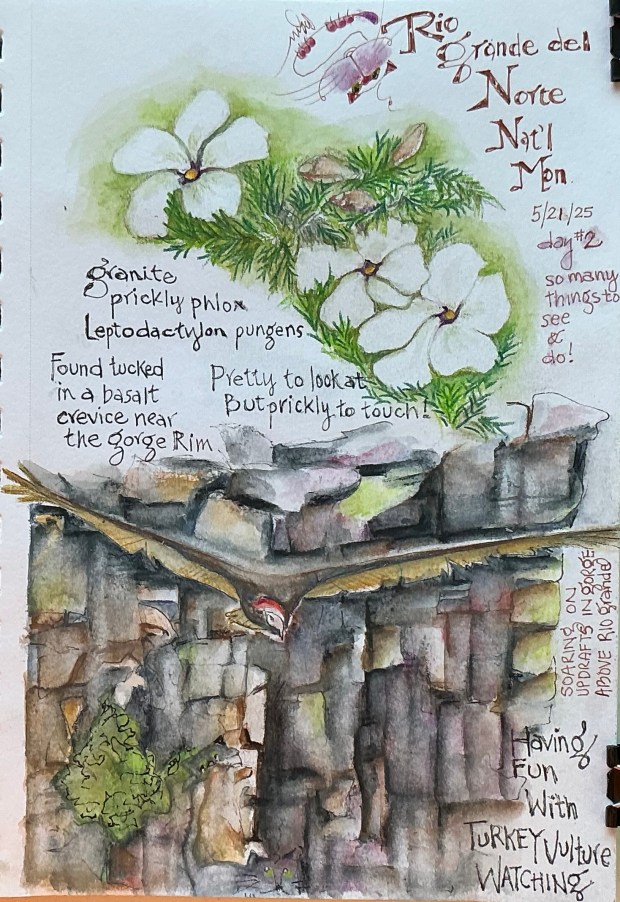
Such an awesome-inspiring place to spend a Spring week in New Mexico!

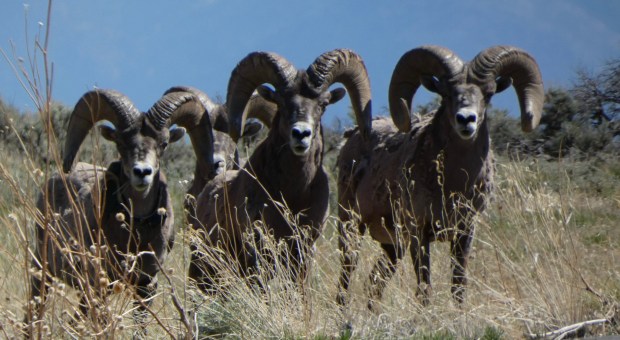
Three of the five big boys! Rocky Mountain Big Horn Sheep.

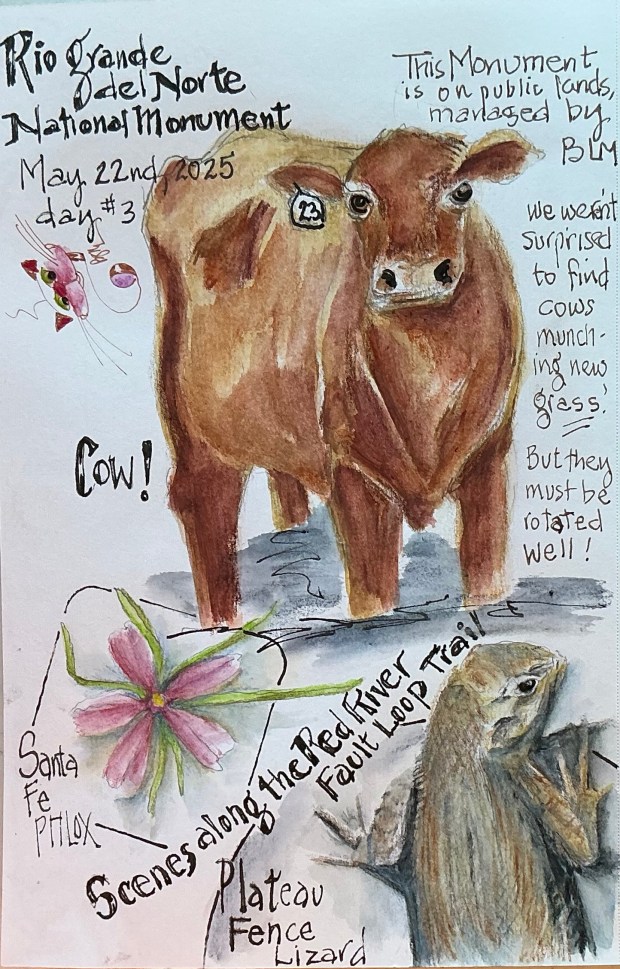
Rio Grande del Norte National Monument ….. 

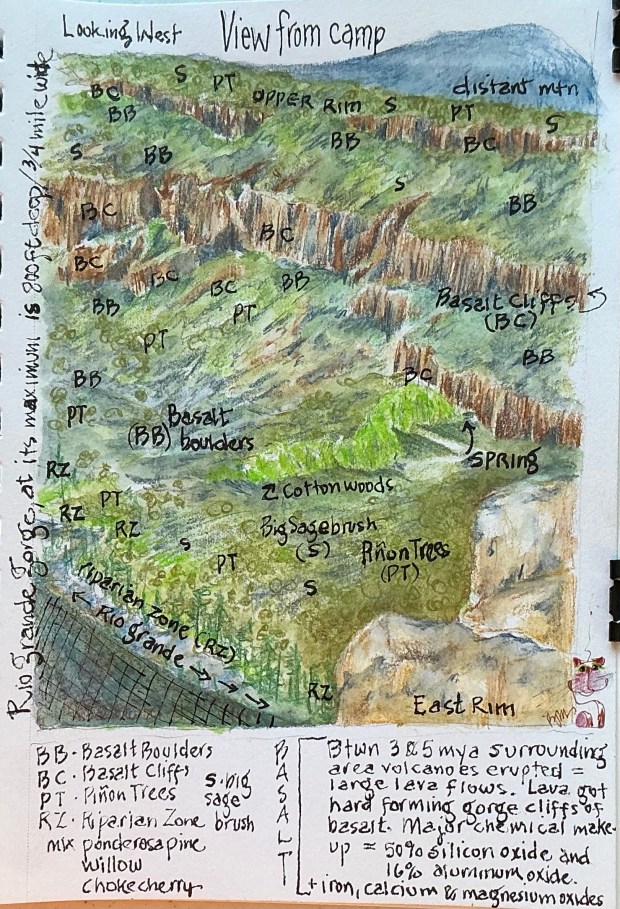
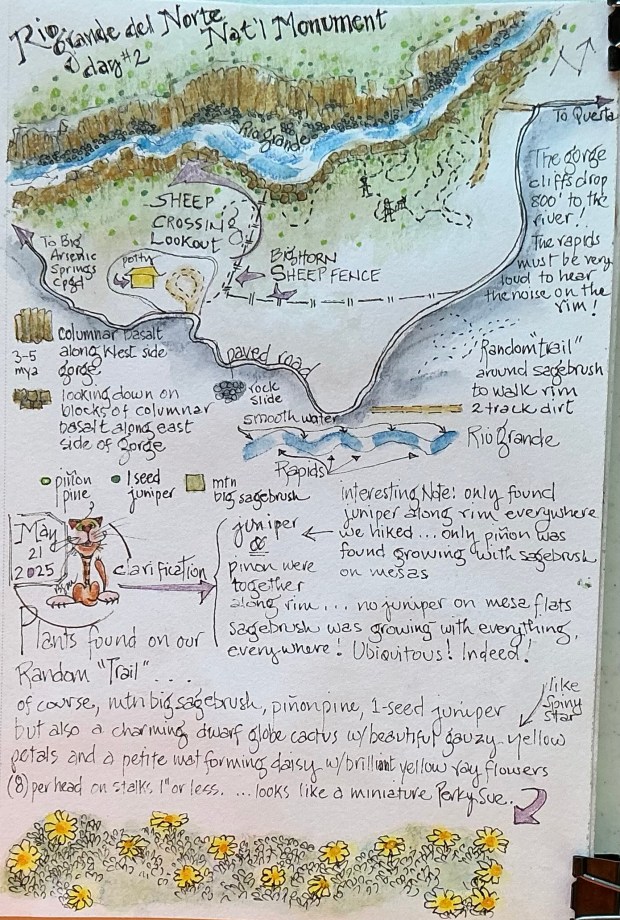
comprises a breathtaking 245,000 acre area of the northern Rio Grande rift valley in north central New Mexico.  Established as a Bureau of Land Management (BLM) national monument in 2013, the rugged wide-open plains average 7,000 feet in elevation before dropping into steep narrow canyons carved into the landscape by rivers that have been flowing for millennia.  

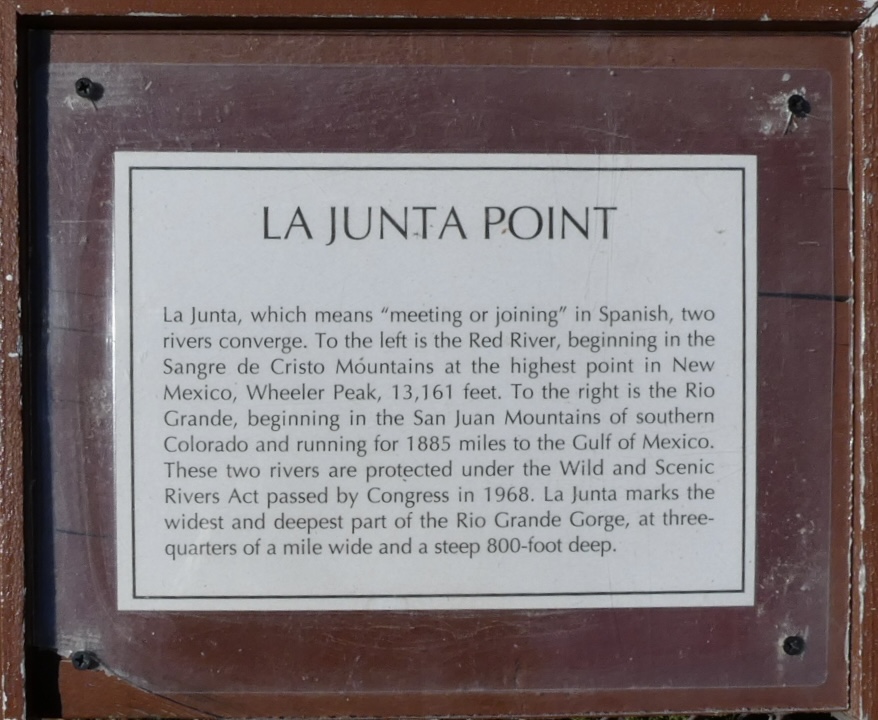
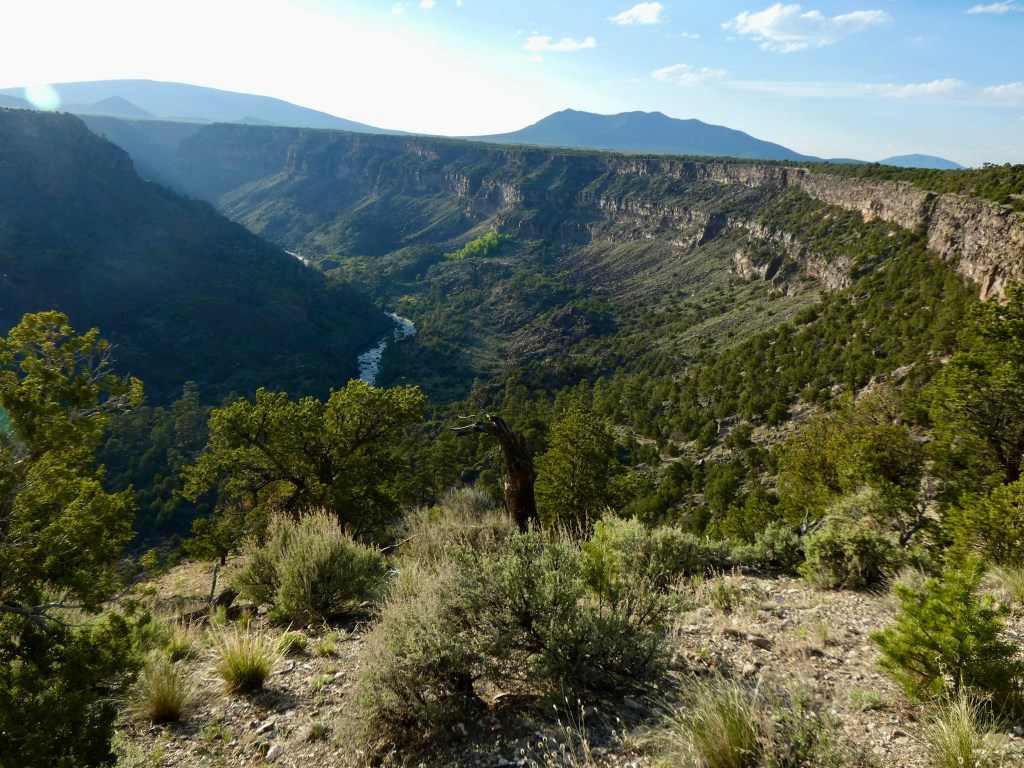
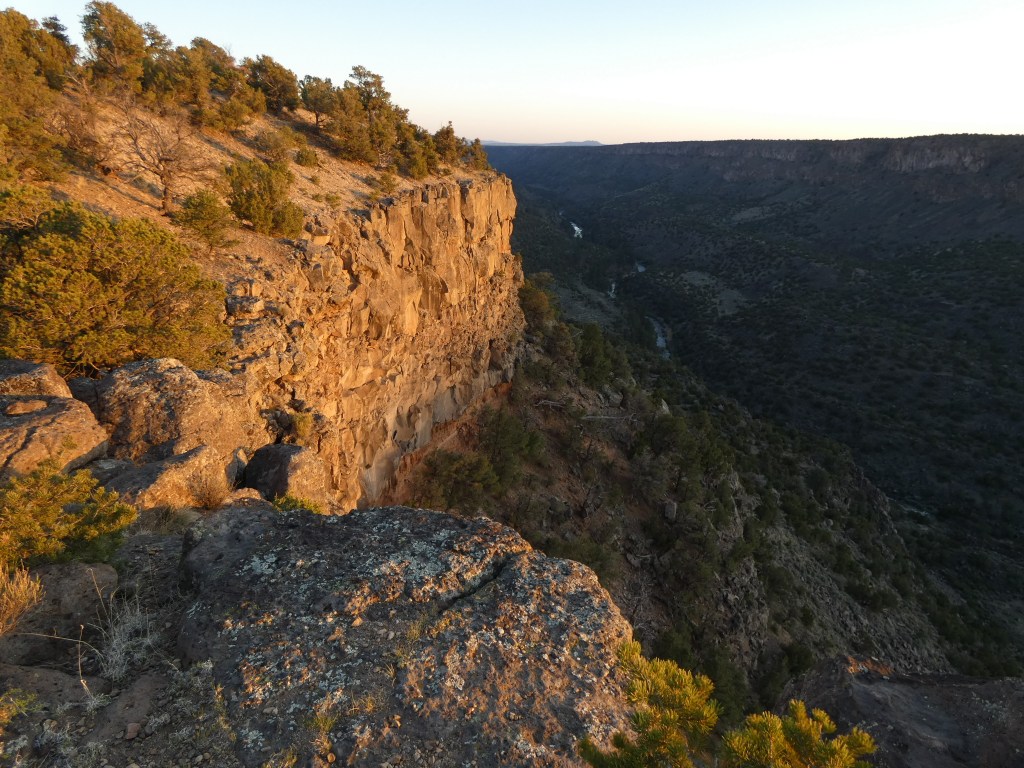
The confluence of two of these rivers, the Rio Grande and the Red River, occurs in the northern Wild Rivers area of the Monument. It’s at this confluence where the gorge is its deepest at 800 feet, and its widest from rim to rim measuring 3/4 mile. It’s an impressive view from the la Junta (“the Meeting”) Overlook. All of the views from anywhere along the rim are impressive.

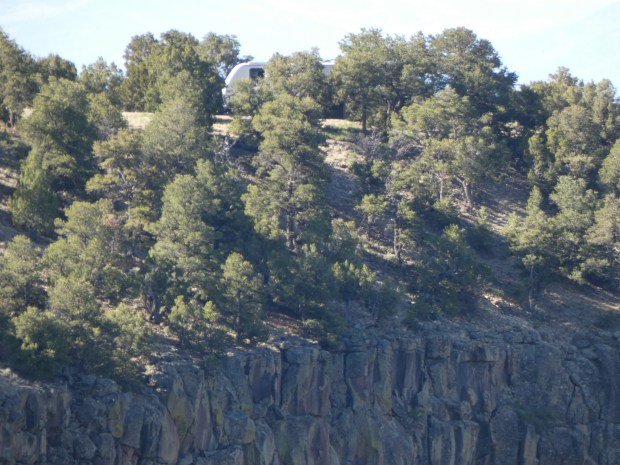
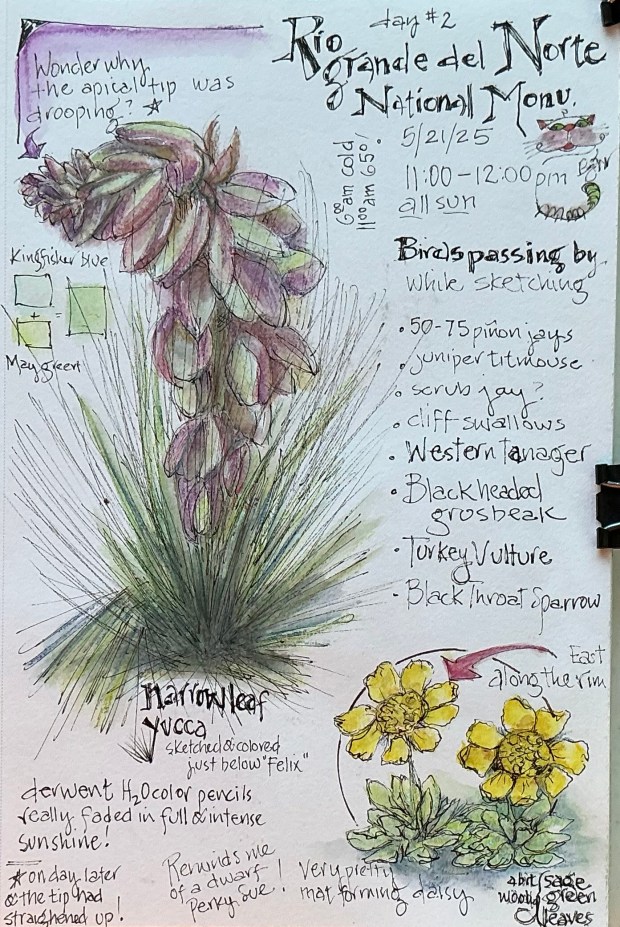
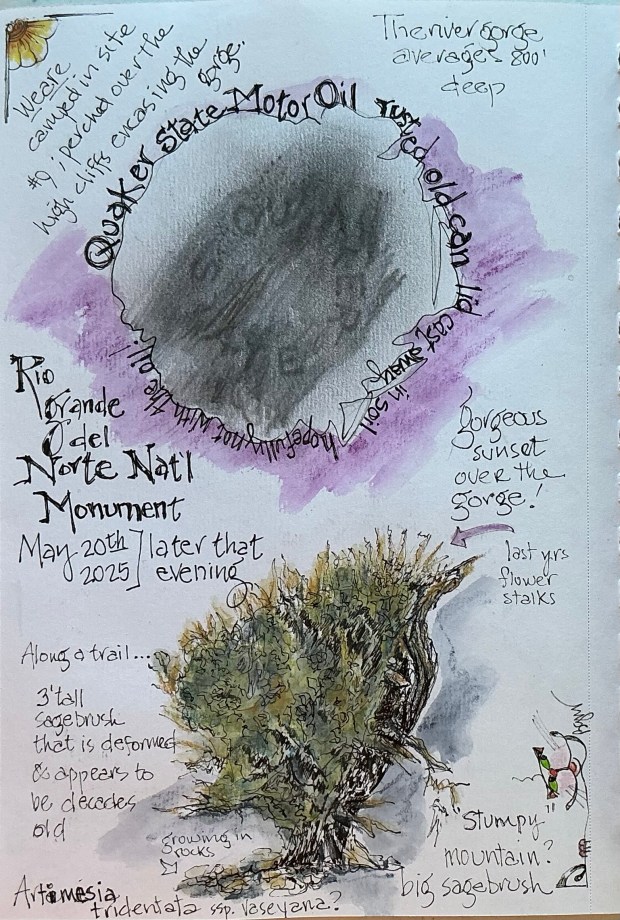
We backed our RV (‘Felix’) into what must’ve been the best designated camping site ever ….. #9 on the southern loop in Big Arsenic Springs Campground. After setting up, we discovered that Felix rested only a few steps west was the rim and the long plunge down to the Rio Grande!  But immediately south of us, the rim formed a small peninsula where nearly every afternoon I could be found sketching the plants growing from the basalt cliffs, or the swifts and turkey vultures soaring along the cliffs and over the river aided by the canyon’s updrafts. This skinny little peninsula quickly became my favorite sit spot; then late one morning it became priceless …….

Can you spot our RV? We were precariously perched above the Rio Grande, right on the rim of the gorge!

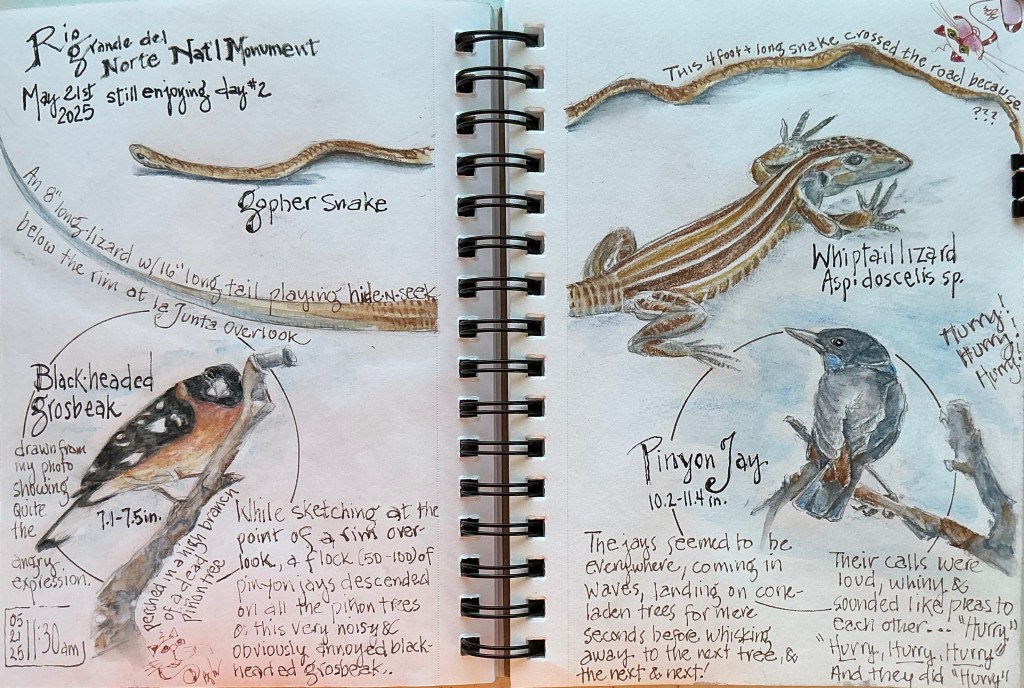
I could hear them approaching, like a swarm of bees. In a matter of seconds I was  witnessing a cacophonous chorus of 100’s of pinyon jays. These noisy birds quickly moved in and onward while descending, like they were famished, on this year’s piñon pine cone-laden trees in large erratic groups, all the while screaming, “Hurry, Hurry, Hurry, Hurry!” Where exactly they came from or where they went remains a mystery. All I know was the spectacle must’ve lasted a good 10 minutes or more, as I watched wave after wave of these birds pass by. I still get goosebumps (jaybumps?) recalling those exciting moments.

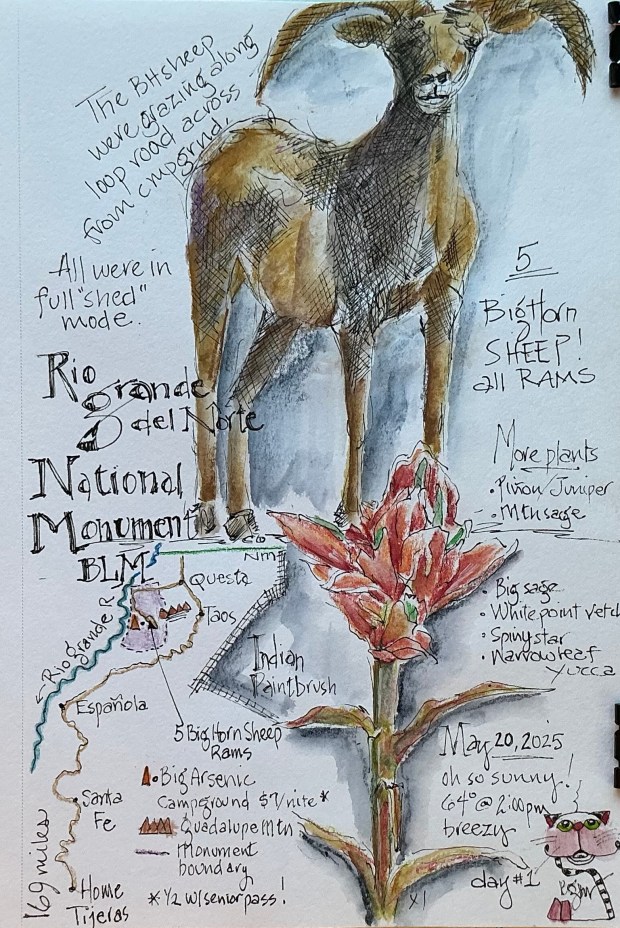
We had planned to spend only one day camping in the Monument, but every morning we decided to stay at least another and then another day. We hiked every rim and interior trail (sometimes more than once), spent hours at all of the Overlooks getting ‘High on the Views,” were thrilled with our chance encounters of five (5) Rocky Mountain Big Horn Sheep rams (twice in one day), and marveled at how the forces of nature* collaborated to carve the narrow and steep 800 foot deep gorge within the Monument.

But alas, it became time to pack up our home away from home. Even tho a string of completely clear days allowed sun to shine on our solar panels from sunup to sundown, keeping Felix’s battery purring happily our entire stay, it did nothing to recharge our potable water tank. So the morning we found the water indicator light teetering on ‘Empty,’ was the day we headed for home (after enjoying a farewell hike, of course) with my nature journal full of sketches and memories for a lifetime!

Do you have an especially special place where you can spend time in nature? Please share your discovery and what makes it so awesome!

As always, thanks for stopping by!

*Geology 101

From the overlooks throughout the Monument, we could see stacks and stacks of basalt and ash lining the narrow canyon walls of the Rio Grande Gorge. It’s hard to imagine the volume of material deposited during two very active periods of volcanic activity that occurred 5 and 3 million years ago. Soon after these events, water moving through the major drainage in the area (today’s Red River) began eroding pathways into these deposits as it flowed downstream into the 10-16 million year old rift valley. Geologists refer to the ancient Red River drainage as the ‘original Rio Grande’ because the still-closed San Luis Basin to the north (in south central Colorado) would not overflow for a few million years. Then 400,000 years ago, coinciding with a change in climate resulting in an overabundance of snow and rain, the San Luis Basin filled and spilled. As water does so well, this new and powerful river, today’s Rio Grande, moved ‘downhill’ towards the ‘original Rio Grande’, cutting through everything in its path (including the ancient volcanic deposits). When it converged with the ‘original Rio Grande,’ the erosive force of both rivers became enough to eventually carve out an 800-foot deep gorge in the Rift.  

A Fiery Hot Hummer!

May 14, 2025

Nope …. that’s not a title typo! 

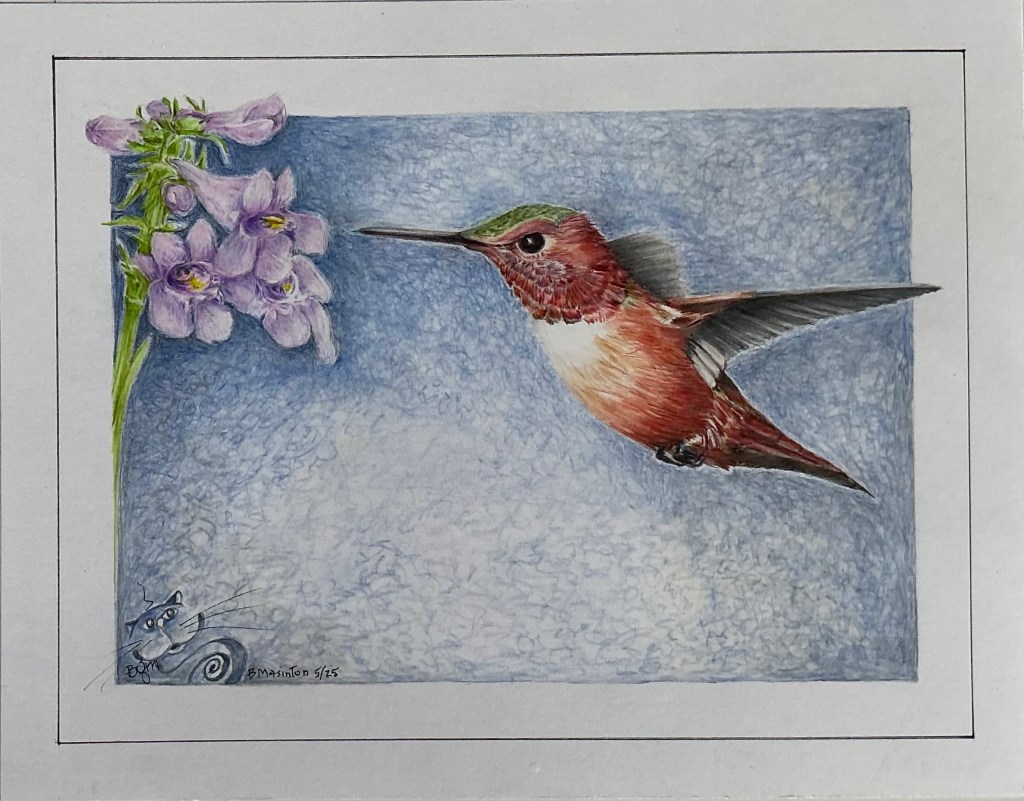
Rufous Hummingbird and penstemon

Of all the hummingbirds migrating through central New Mexico, the male Rufous ‘hummer’ (Selasphorus rufous) is the most spectacular. Showing up when our hot Summer temps begin to soar, he has two things on his mind ……. #1. find the best patch of nectar-rich tubular flowers, and #2. keeping that patch all to himself to refuel before completing his 4,000 mile migration from southern Mexico to southern Alaska. Upon arriving from Mexico, the flashy 2-1/2” long Rufous, garbed in a feathery cloak of flame colored oranges and reds, quickly lays claim to an area of sweetly blooming flowers that may include penstemon, columbine, scarlet gilia, Indian paintbrush, mint, lily, fireweed, larkspur, currant, and heath. Determined to defend his patch against all invaders, he performs a quick flower flyover. If satisfied the coast is clear (for now), he takes up a strategic observational post by perching on a nearby tree branch to watch for rival hummers. 

Ever alert and constantly in motion, his perch gives him a great vantage point to scan the area by looking right and left/up and down, all the while making quiet chittering and chipping noises. If another hummer, and especially a male Rufous dares to enter his territory and sip from his flowers, oh no! Becoming highly agitated, the perched bird spreads his tail while flashing his colorful gorget (throat feathers) seconds before dive bombing his competitor, loudly screaming his alert call while attempting scare off the thief. If this tactic doesn’t work, i.e. the rival is determined to hold his piece of air space, a duel is declared. 

Rufous hummers are well known for their aerial acrobatics. Perhaps you’ve witnessed their display, which likely put you in awe of this little powerhouse. If not, what you’ve missed is their incredible speed of initial attack, their precision, the cacophony of noise coming from such a tiny blur of a bird, the maneuverability of numerous aerial loop-de-loops and J-pattern sky displays allowing them to dive repeatedly at their foe, and their tireless determination in defending their rights to their flowers.  It’s a spectacle you have to see to believe! 

The Rufous will attack not only males and females of their species, but hummingbirds of all species, and even large insects, all with the audacity to steal precious nectar from his prized flowers.

And never, ever sit near or below a hummingbird feeder when there’s a Rufous in the neighborhood. I learned the hard way after being attacked over and over again by a surprisingly intimidating Rufous hummer. Despite being thankful I chose to wear a hat that afternoon, a large dose of common sense had me backing away from his feeder for fear he might have a stroke before drawing blood. My heart still races when recalling this thrilling yet scary encounter.

While reading about the Rufous, I learned that all ages and both sexes of this species are aggressive, even during their brief 1-2 week migration stopovers. This is certainly very good information to know about, having only witnessed males launch themselves at intruders, myself included!

Can’t wait for Rufous migration season!

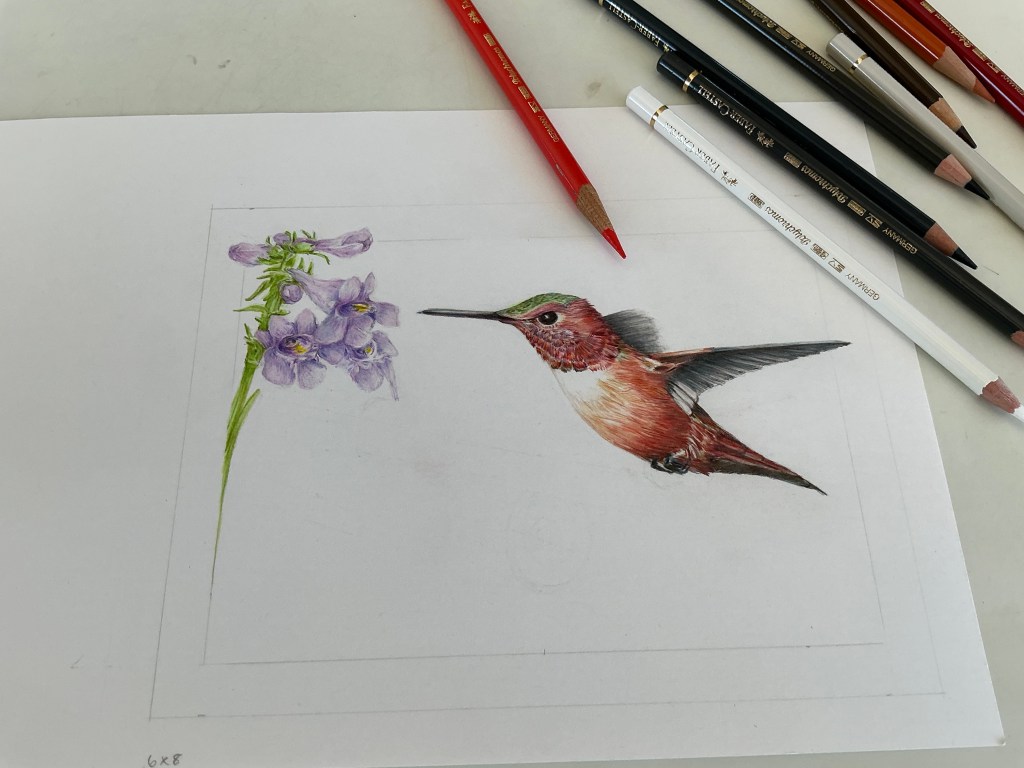
Have you learned something new about this wildly fascinating and fiery hot hummer of southern Mexico, the Western US, Canada and southern Alaska? If you have a Rufous or any hummingbird story to share, please do! Oh, I also hope you’ve enjoyed my colored pencil artwork of a male Rufous about to sip nectar from a freshly blooming penstemon.  

Work in Progress …… showing an almost completed composition on smooth Bristol paper and a few of the Faber-Castell Polychromos colored pencils used in creating this Rufous hummer and penstemon.

As always, thanks for stopping by!