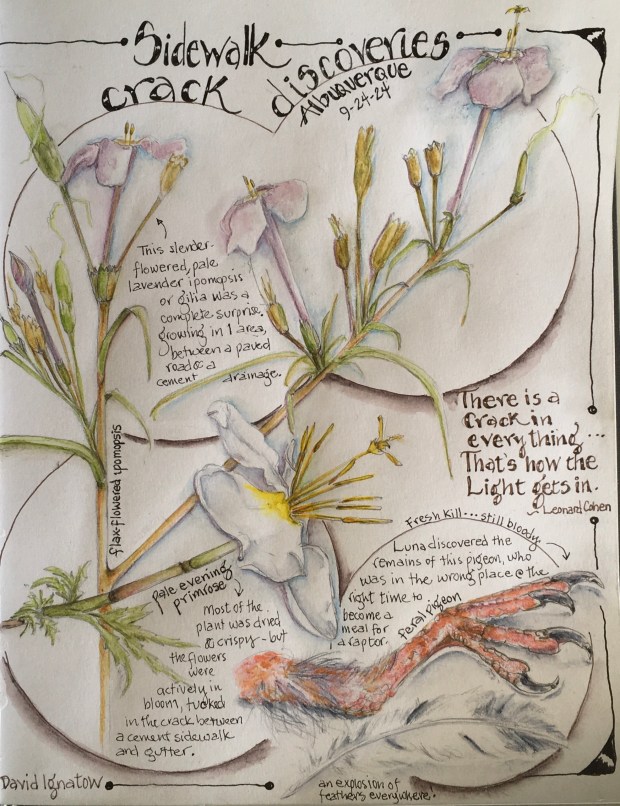
Roy had a doctor’s appointment one morning in late September, at an office right off busy I-25, near the ABQ airport. Instead of hanging out in the sterile waiting room, Luna and I spent our time exploring the areas surrounding the office, just to see if there was anything worth observing.
For 2 miles, we wandered about the not quite urban/suburban/industrial/residential neighborhood ….. me looking for a sketchbook entry; Luna sniffing out messages left just for her by visiting dogs, squirrels, or bunnies.
Interesting discoveries seemed lacking, until Luna caught whiff of something irresistible. Tugging hard on her end of the leash, she urged me to run with her as she zeroed in on the source of the smell.
By a parking lot light, on the pavement next to a cement curb was an explosion of feathers, but Luna kept leading me on to something better. There! Lying on the curb was a still wet and bloody bird foot barely connected to what remained of the thigh. All clues pointed to the very recent drama, where a raptor (possibly a red-tailed hawk) had swooped in and nabbed the hapless victim (a feral pigeon), killed and then ate his prey from the platform atop the parking lot light. The inedible remains fell to the ground as a group of 2 dozen “relieved-it-wasn’t-me” pigeon friends looked on.
Quickly solving most of this puzzle in the time it took to pry the pigeon foot from Luna’s mouth, gave me the idea of sketching not only the foot, but to look for other unlikely nature discoveries in this urban/suburban/industrial/residential neighborhood setting.
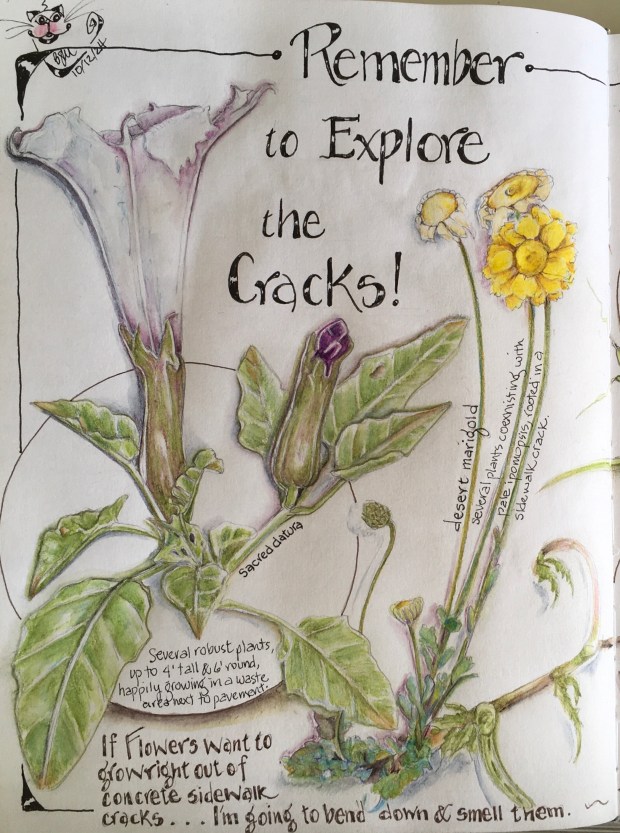
Mentally armed with a keener power of observation and purpose, we retraced our earlier route with excitement! Now it was obvious an abundance of interesting and beautiful plants were growing from every sidewalk crack and along crumbled pavement edges throughout the ‘hood. How had I missed seeing these beauties?
And that’s how my idea for this 2-page layout was born, along with a reminder that finding bits of nature doesn’t have to occur at a botanical garden, wildlife preserve or national park. Nature is everywhere. If you just slow down and really look, even in the most unlikely places like sidewalk cracks, there’s always something to discover. So Remember to Explore the Cracks too and let me know what you find!
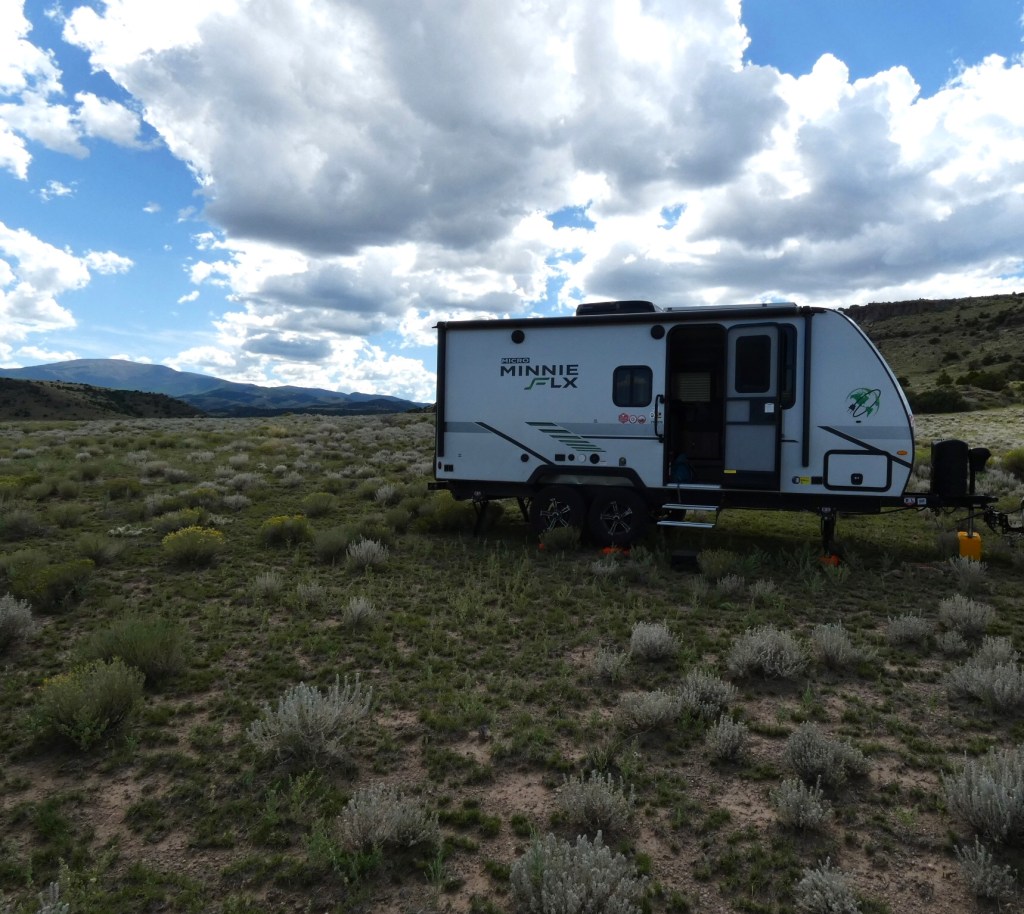
Felix parked along the Old Spanish Trail route, south central Colorado
With no defined route or objective, we decided it was high time we hitch up the trailer (Felix) and tote it north just to see what’s going on in south central Colorado this time of year. As we made our way through the San Luis Valley, we found acres of lush greenery topping almost-ready-to-harvest potatoes. Alfalfa was nearing its second cutting. Carrots had already been shipped to market. The wildlife refuges were patiently awaiting the arrival of migratory birds. And the last of the summer tourists were excitedly boarding the Cumbres and Toltec Scenic Railroad in Antonito, for the 64 mile steam engine journey to Chama, NM.
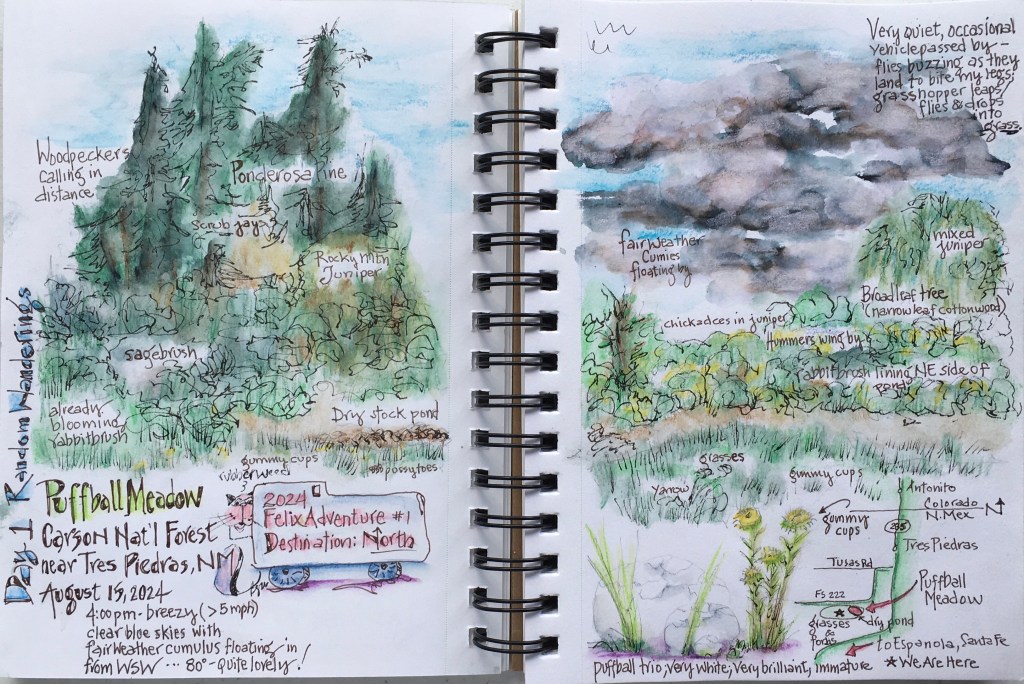
Day 1. Our first stop was in northern New Mexico, just south of Tres Piedras, Carson NF. An unlikely dispersed camping spot that I nicknamed “Puffball Meadow.” A nice level spot adjacent to a dry stock pond. The meadow was full of fist sized puffball fungi, and a coyote paid us a visit during the night.
We enjoy boondocking on our public lands managed by the US Forest Service and Bureau of Land Management. Having a trailer that’s self-contained, we can easily find lovely off-the-grid areas to set up camp. And thanks to our solar panels (and lots of sunny days) and large water tank, we can stay out for up to 5 days without needing refills. This allows us to explore lesser visited areas, which suits our tastes beautifully!
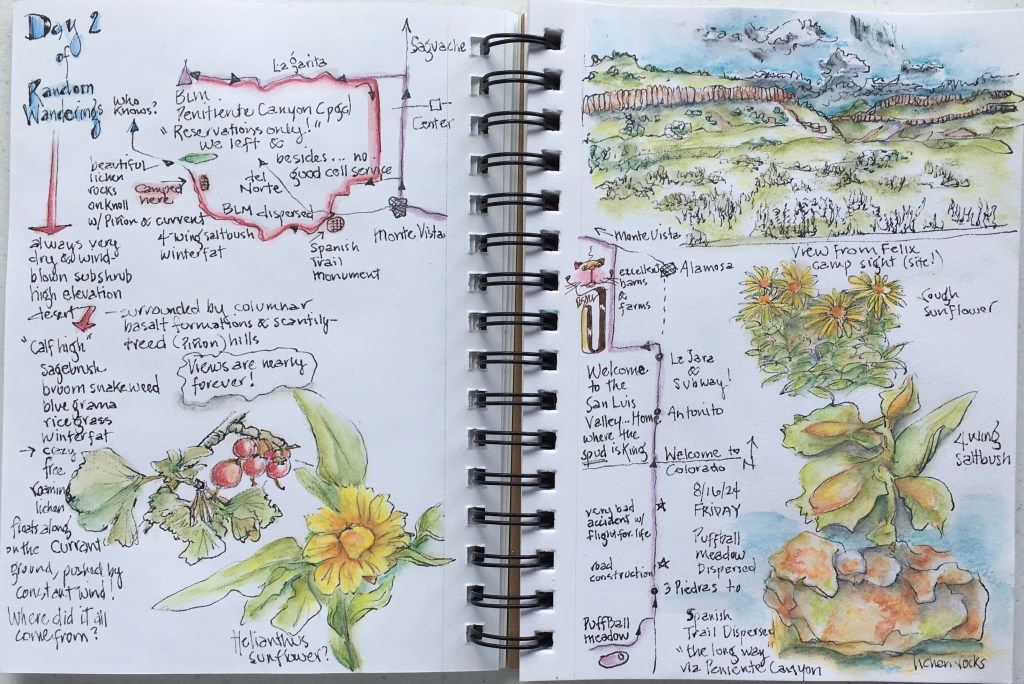
Day 2. Made it to the San Luis Valley, Colorado. Wandered around until we found a wide open area of dispersed camping in the vicinity of the Old Spanish Trail. Lots of wildflowers blooming, and plenty of hiking opportunities.
But I think one of the best things about random travel is the spare time …… we drive for 3-4 hours, find a place to camp ….. then the rest of the day involves hiking, wildlife watching, nature journaling, collecting drawable items, photography, more sketching, identifying the unknowns, reading, napping, and a bit of ukulele strumming! Perfection!
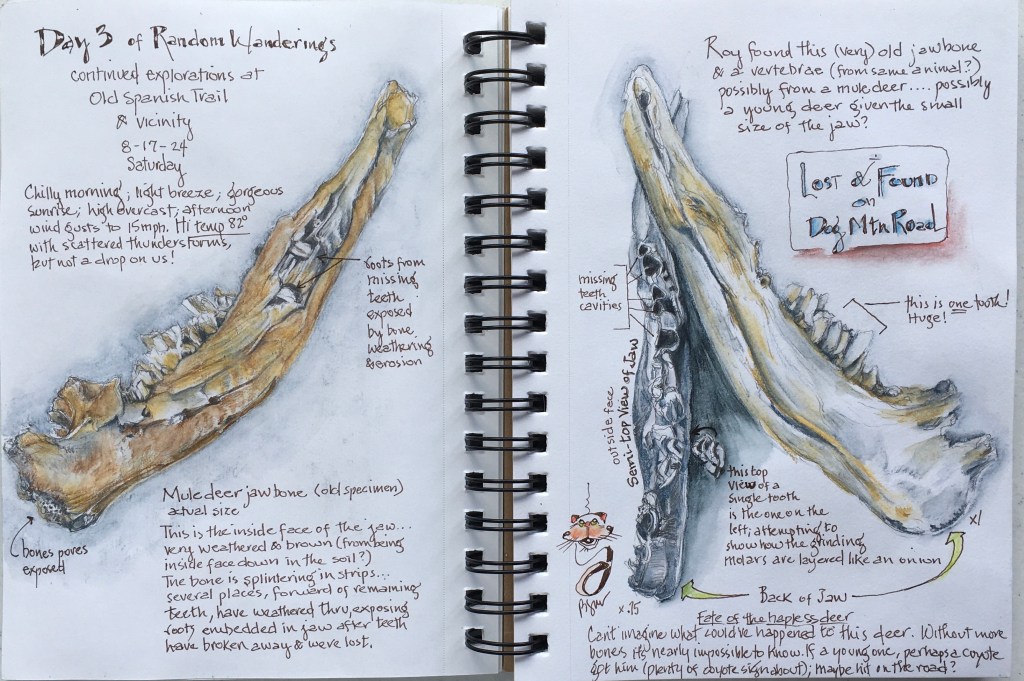
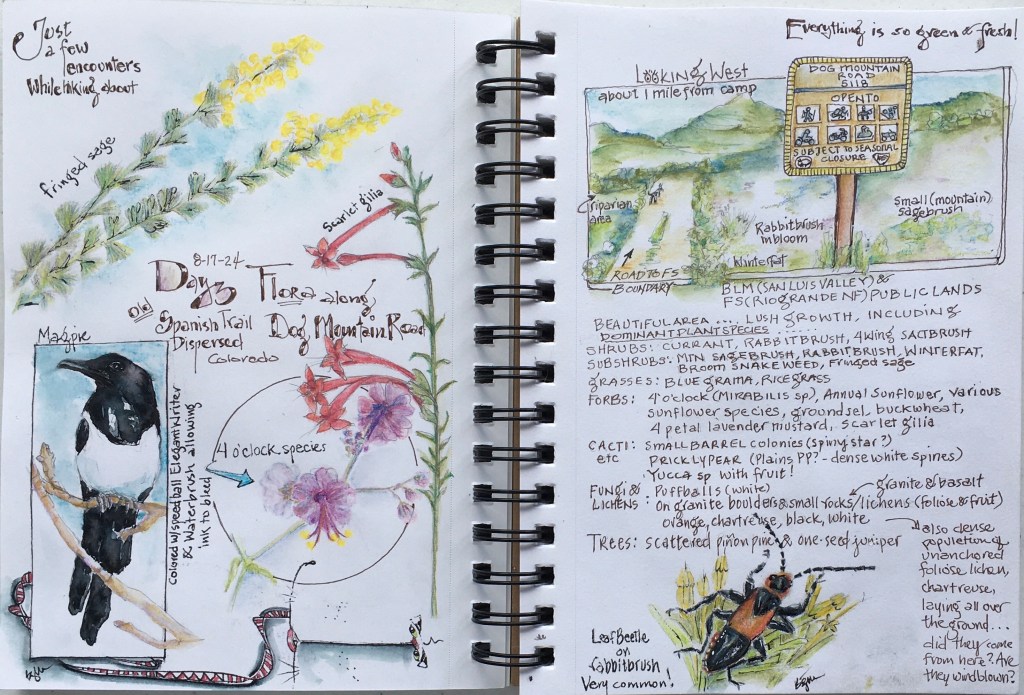
Day 3. We enjoyed the area so much, Roy suggested we stay for another day! And then he found this weathered mule deer jaw bone. Day 3, continued. Magpies! Can’t understand why these gorgeous birds don’t come south at least as far as Albuquerque and East Mountains.
Although the 6-day trip wasn’t remarkable, it was good to get away. Scattered about this post are my journal pages highlighting Days 1 to 5.
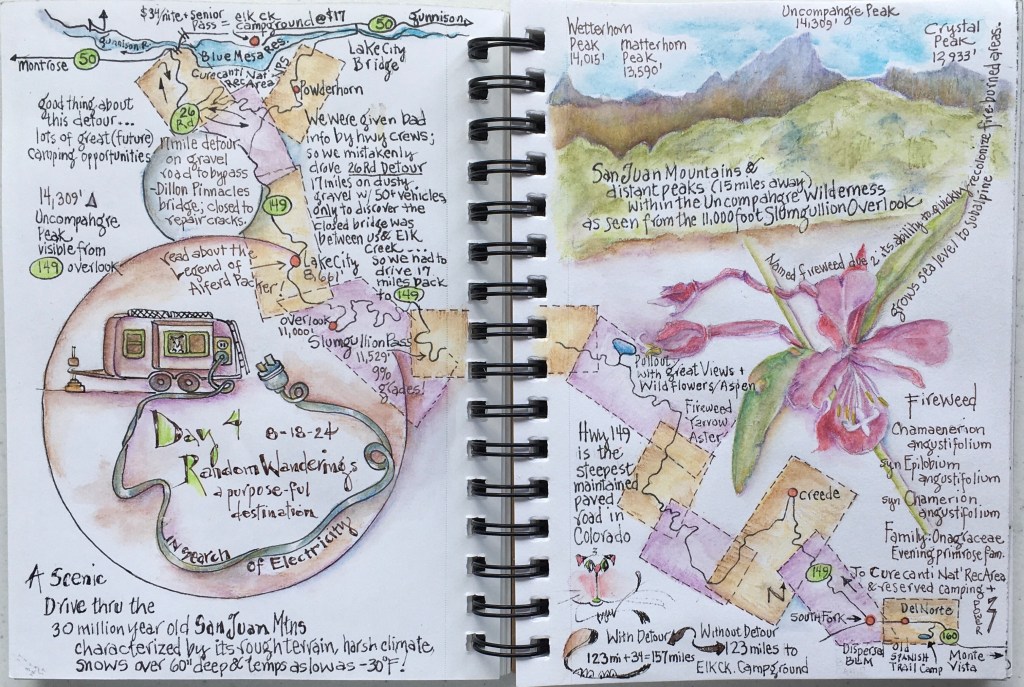
Day 4. Our travel route as we made our way to a campground to charge our battery and top off our water tank. An inconvenient, unplanned for detour led to future camping possibilities.
On Day 4, we decided to make our way up and over Slumgullion Pass (11,530 ft) on our way towards Gunnison Country. Not having been this way in years, we really enjoyed the crisp mountain air and spectacular views up and over the Pass. The villages of Creede and Lake City have grown swollen with tourist amenities and summer cabins dotting the once open meadows. As we got closer and closer to Lake City, we couldn’t help recall the story of Colorado’s notorious cannibal, Alferd Packer. Wanting to reread the tale as we passed near Cannibal Plateau and Deadman’s Gulch, the crime scenes, here’s what I found:
BriefBackground: Alfred Packer (newspaper misspelling as “Alferd” Packer, which stuck) (1842-1909) was a prospector who set out for Colorado gold fields in 1873. By the winter of 1874, he reached the rugged San Juan Mountains with a party of five men where they became lost and stranded during one of the worst winters on record. The men, with only had 3-4 days provisions quickly consumed and no firearms, were forced to cook their rawhide moccasins. Places where “snow had blown away from patches of wild rose bushes,” ….. they “were gathering buds from these bushes, stewing them and eating them.”
When the snow finally crusted over, Packer, the only man to survive the ill-fated trip, walked out of the mountains after 60 days. He told a story about the demise of his fellow prospectors, and how he managed to survive by eating them. His story involving cannibalism became legend, and continues to be passed down to today! (Whether the story is true or not will never be known, but it makes for colorful history.)
Based on historical records and news reports, Alferd Packer was tried several times for murder and cannibalism (even though the act of cannibalism wasn’t considered illegal in the US). Convicted of these heinous crimes, Judge M.B. Gerry supposedly uttered this famous quote while handing down the sentence in Packer’s first trial ……
“Stand up yah voracious man-eatin’ sonofabitch and receive yir sintince. When yah came to Hinsdale County, there was siven Dimmycrats. But you, yah et five of ’em, goddam yah. I sintince yah t’ be hanged by th’ neck ontil yer dead, dead, dead, as a warnin’ in reducin’ th’ Dimmycratic populayshun of this county. Packer, you Republican cannibal, I would sintince ya ta hell but the statutes forbid it.”
This is the quote I’d grown up hearing many times, over and over and over! It makes for good reporting, but is a ways from the actual sentence and what Judge Gerry sounded like while reading it (nope, he didn’t talk like Yosemite Sam!). Here’s what the record shows:
“Alfred Packer, the judgment of this court is that you be removed from hence to the jail of Hinsdale County and there confined until the 19th day of May, A.D. 1883, and that on said 19th day of May, 1883, you be taken from thence by the sheriff of Hinsdale County to a place of execution prepared for this purpose, at some point within the corporate limits of the town of Lake City, in the said country of Hinsdale, and between the hours of 10 A.M. and 3 P.M. of said day, you, then and there, by said sheriff, be hung by the neck until you are dead, dead, dead, and may God have mercy upon your soul.”
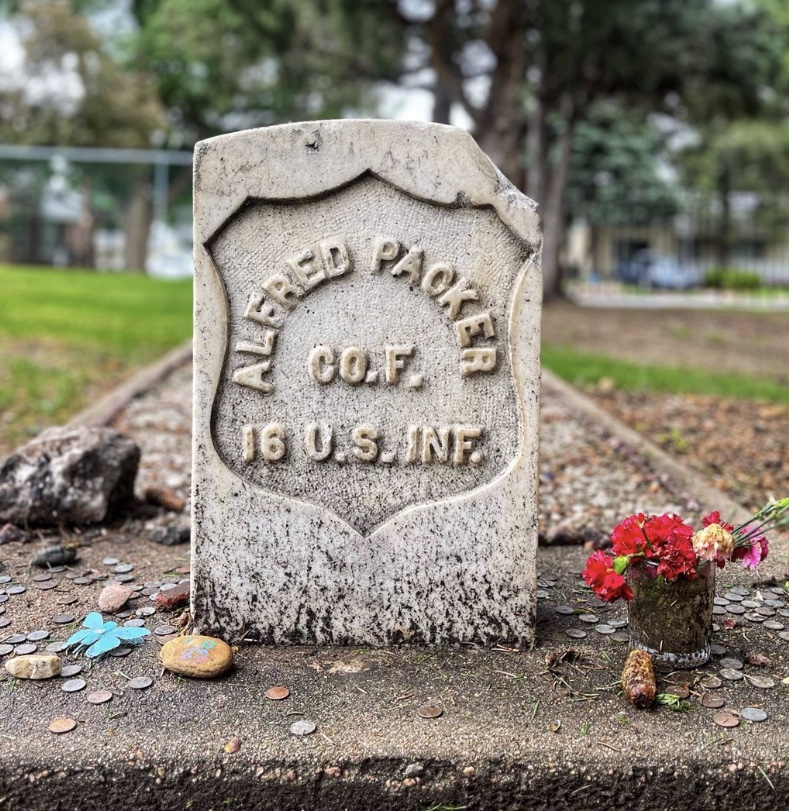
Alfred Packer tombstone in Littleton Cemetery where he was originally buried in 1909. Today, he now lies back in Hinsdale County, near Lake City.
Alferd Packer never did hang. It’s quite a detailed story following his first trial, including a jail escape, nine years on-the-lam, and recapture. There was a second trial in 1885 where he was charged for only one murder; after serving only 16 years of his 40-year sentence, he was released and died peacefully one year later at the age of 60. He was buried in Littleton, Colorado where his tombstone properly reads Alfred Packer.
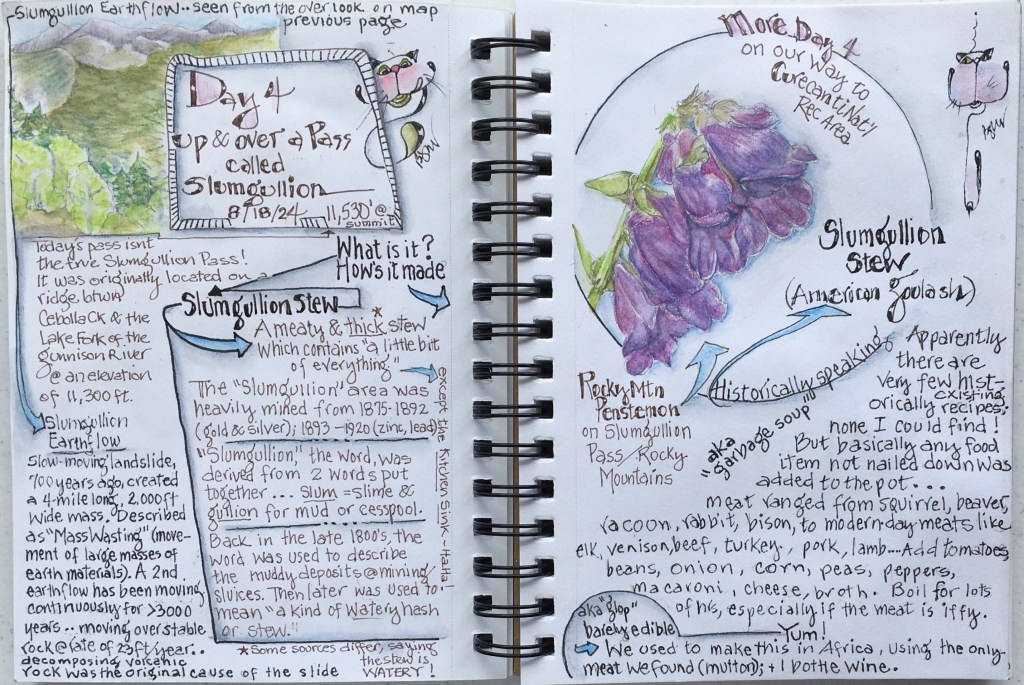
Day 4. Supplemental information about that strange name “Slumgullion.” Is it a stew? Is it a drink? Is it the sludge that puddles below an 1870 sluice box? Day 5, on our way back to Old Spanish Trail (because we liked it so much). Discovered a new-to-me plant; after a bit of checking with iNaturalist, learned it was Black Henbane, but not before handling all parts of this very poisonous noxious weed!
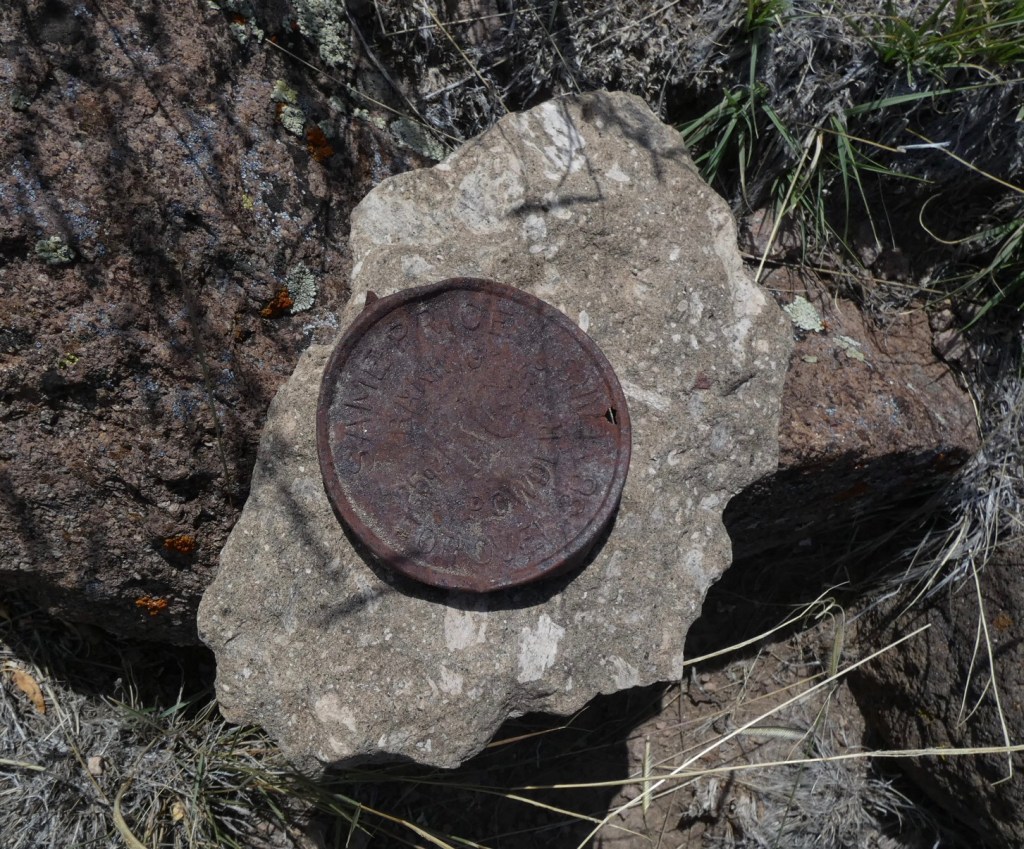
A short comment on the KG Baking Powder tin lid we found near our trailer. It was old and rusted, but very readable. The tin and its contents were probably long gone. Tried to find any information on the KG brand; sure curious about the age of the lid. If you’ve heard of this brand, please let me know.
KG Baking Powder tin lid we found near Old Spanish Trail.
Day 6. Headed for home. Hope you enjoyed my travel journal.
San Juan Mountains …… up and over Slumgullion Pass. The view of the 700 year old earth flow.
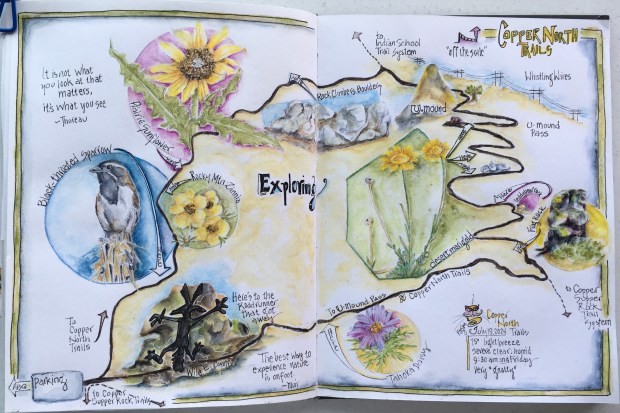
Hiking and rehiking familiar areas always turns up new discoveries. This may be because my eyes skim over the most commonly seen phenomena, allowing me to actively search for anything new or anything out of place. Rarely am I disappointed.
A few days ago, we explored one of our favorite hiking areas. Because birds tend to be more secretive this time of year, the best surprise was to hear a black-throated sparrow sweetly singing from his perch atop a cholla skeleton.
Because it’s monsoon season, many plants that bloomed late spring are making a comeback, and are happily spreading throughout the area. So to keep track of how ranges are expanding, I made note of their locations and transferred this information to a simple trail map. I also noted that the most commonly seen flowers were from the composite family …. the sunflowers.
Oh! Couldn’t resist capturing the silhouette of Wile E. Coyote glued to the back end of a dented vehicle in the parking area. That’s was a perfect discovery for the resident roadrunners!
Do you enjoy exploring familiar areas? What surprises have you discovered?
There are a number of different woodpecker and closely related species (sapsuckers and flickers) that frequent our Piñon-Juniper woodlands in the East Mountains of central New Mexico. These include the downy, hairy, Lewis’s, red-naped, Northern flicker, and Williamson’s sapsucker. They are always such a joy to observe, unless they’re drilling a hole in the side of the house. Their stiff tails allow them to ‘walk’ up and down tree trunks and other vertical surfaces that house insects or exude sticky sap. Their sharp bills are ideal for creating nest holes and sapwells in tree trunks. Their sharp calls, drumming, and stiff-winged flight make them easy to recognize as a member of the woodpecker group of birds.
Until mid-March we’ve never seen a Williamson’s sapsucker. Then one morning Roy was trying to catch a glimpse of a strange woodpecker on one of our old growth piñon pines. Immediately recognizing the markings of this bird were unlike any we’ve seen before, he excitedly fetched me from my studio to have a look.
Sure enough! Realizing this was likely a life list sighting for us both, the markings looked just like those illustrated in our numerous field guides. Indubitably, dear Watson! This was a Williamson’s Sapsucker (Sphyrapicusthyroideus) and he was treating us to a visit. We watched him (definitely a male, as females look completely different than the males, which is unusual for woodpecker species) working his way up and down the tree trunk. As he walked and hopped up and down the tree, he would circle the trunk and pause to lick up actively flowing tree sap from rows and rows of sapwells! Why had we never noticed so many sapwells on this tree before? Did this or other Williamson’s sapsuckers drill these shallow sapwells? Maybe another woodpecker species created them and the Williamson’s was stealing the nutritious sap? Are these new sapwells or have woodpeckers been drilling this tree for many years? Countless questions, but this handsome fellow wasn’t giving up his secrets. So we enjoyed his antics for about 30 minutes until he flew off, maybe to another piñon to lap its sap?
The next day, as we were about to pull into the garage, we spotted the Williamson’s again …… again working the sapwells up and down the piñon tree. We sat in the car and watched him while mulling over new questions, like “isn’t this the same time he was here yesterday?” “Why yes!” We closely observed his feeding pattern, beginning at about 5 feet above the ground, walking and hopping up the tree while circling the trunk, and when he reached the needled branches about 25 feet high, he would make a diving flight back down to the 5 foot height and again work his way up. This went on repeatedly for about 5 times before he flew away. Hmmmm! Why did he stop when he did? Had he licked up all the available sap for the day, and had to wait until the sap began flowing again? (I showed up later to see if he returned ….. he didn’t. Maybe my timing was off? Maybe the sap flow still wasn’t worth his trip?).Day 3, and same time/same place. This hungry bird was back lapping sap! Same up and down behaviors; same departure time.
Day 3, and same time/same place. This hungry bird was back lapping sap! Same up and down behaviors; same departure time.
Day 4, ditto
Day 5, ditto
Day 6 ……. We arrived at the same mid-morning time, and waited. And waited. And waited. The Williamson’s sapsucker was a no show. And we haven’t seen him since.
Was he only migrating through, just long enough to stock up on high energy meals? Apparently this species is widespread and fairly common throughout the Rocky Mountain West, but their breeding range begins just north of us and extends into Canada. However, we are well within the Williamson’s sapsucker’s winter range. Hope he returns again next year!
Meanwhile we’ll be watching that old growth piñon to see if the sapwells draw in other hungry birds!
Now, a few fun facts about the Williamson’s sapsucker and sapsuckers in general.
While the male Williamson’s sapsucker is silky black with a cherry-red throat, a brilliant lemon-yellow belly and bright white wing patches, the female looks totally different. This is very unusual for birds in the woodpecker group. The female has a mousy brown head, banded back and small patches of black and yellow on the belly.
The difference is so striking between the male and female, they were originally thought to be different species entirely. It wasn’t until 1873 that ornithologists realized they were the same species. Naturalist Henry Henshaw located a pair at their nest in Colorado and published his observations, thus putting an end to the confusion.
Sapsuckers get their name from their habit of drilling rows of shallow holes in tree bark. The birds come back to these holes to lick the sap that flows from these holes and to eat insects that have become caught in the sticky residue.
Early ornithologists in the West reported seeing Williamson’s Sapsuckers at sapwells in aspen trees; however, in the past 100 years, observers have seen their sapwells only in conifers, never in deciduous trees. The early reports might have been of Williamson’s stealing sap from wells made by Red-naped Sapsuckers.
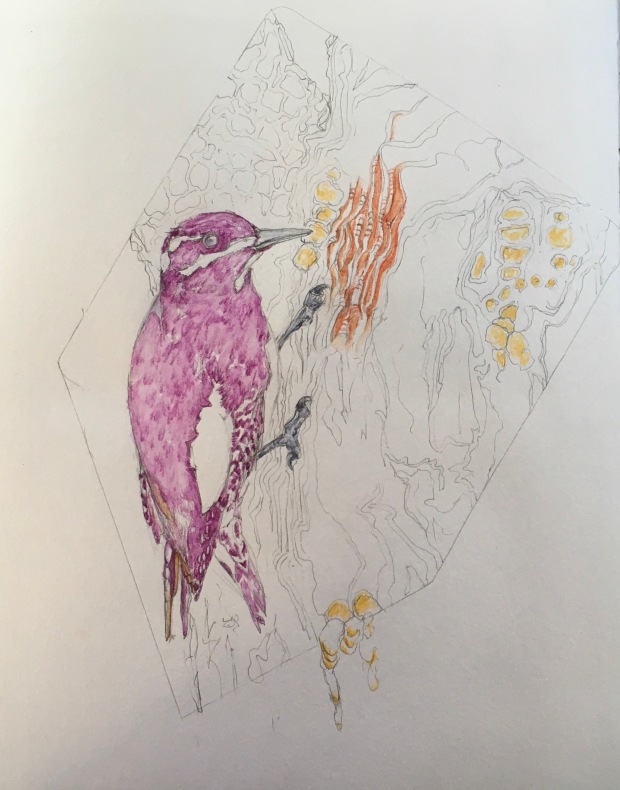
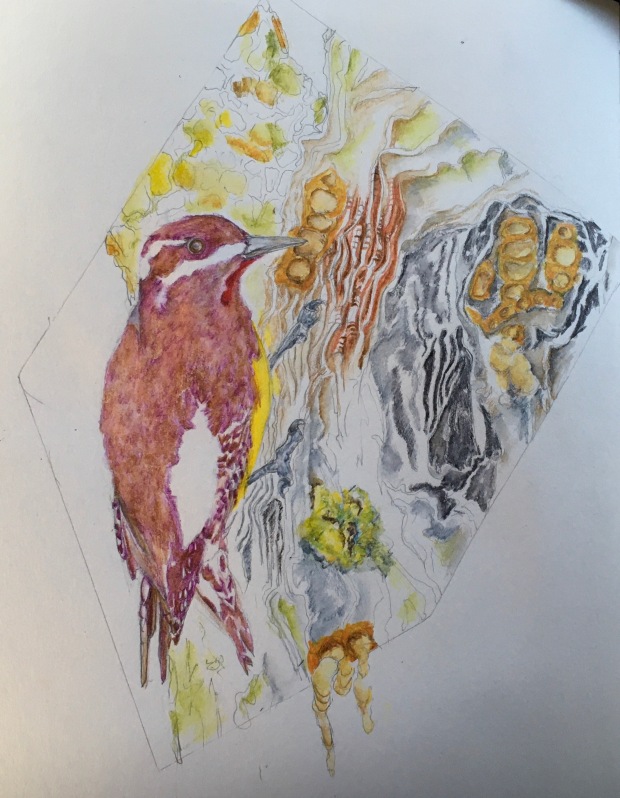
Here’s a few progress shots I remembered to capture while creating the Williamson’s clinging to the tree
Earliest coloring stages …. Laying down base colors to build up to the Williamson’s silky black back
Adding more base colors, sapwell and tree bark furrowing details
Close to final image. The black was achieved by using purples, browns, blues and greens to achieve the iridescence of his black coloring.
It’s been a few days now, and the scene continues to replay over and over in my mind’s eye. Somehow my sketch of these two birds …. one the victor, the other the victim ….. came easily and quickly, much like the time it took for the event to unfold.
Returning to our house after photographing snow scenes created by an overnight winter storm, I paused at the door, turning to admire the beautiful white landscape. Faster than an eye blink and just as quiet, a sharp-shinned hawk soared by at top speed, obviously intent on capturing one of our feeder birds!
I’ve seen this small hawk fly by a few times over the past several weeks, but the smaller juncos, finches and titmice always managed to duck for cover in the nick of time, foiling the “sharpy’s” chances of a meal. But the hawk, perhaps better skilled in his timing and approach after some practice runs, wasn’t about to miss on this day.
The spotted towhee must’ve been so focused on scratching for buried seeds that all obvious warning calls eluded him. Out in the open eating seed under one of our feeders, the towhee must’ve been too hard to resist for the sharp-shinned hawk, and fell victim to the expert predator.
Having camera already in hand, I was able to take a half dozen photos after the sharpy snatched the towhee with his long piercing talons, pinning him securely to our brick patio. As sad as it was to watch the towhee struggle against the hawk’s sure grip, it was all over for the towhee in 30-45 seconds. Then as fast as the sharp-shinned hawk had attacked, he regripped the lifeless towhee, lifting him effortlessly and flew away into the trees.
The circle of life.
“You can’t imagine anything like nature as we know it without predators.”
-Dale Jamieson
“Every living creature, big or small, plays such an important role in our ecosystem.”
-Mufasa’s memorable speech to Simba (from The Lion King)
Did you know?! Today, and every year January 5th rolls around, is National Bird Day! Whoo! Hoo! Or should I say “Tweet!” Have you hugged a bird today?
“National Bird Day, celebrated on January 5th, is a day dedicated to the conservation, preservation, and appreciation of birds. It aims to raise awareness about the importance of birds and their habitats, and encourage people to take action to protect them.”
Back Story
(or Why this seemingly random information nugget has popped into this blog post, and what happened to those fascinating Full Moon stories?)
Since my Full Moon project came to a close in November, I’ve been pondering over my list of ideas that might become a fun project. With elbows propped on my drawing table and chin cupped between the palms of my hands, my eyes and mind began slowly drifting outside to a winter scene where patches and drifts of snow had collected from our last storm. Readjusting my focus to the bird feeder right outside my studio window, I watched as 15-20 dark-eyed juncos engaged in minor skirmishes, competing for seed. Birds on the feeder and the ground ravenously plucked and scratched for tasty morsels before they were stolen by another hungry junco.
That’s when it hit me …… the constant activity at the feeder, every day, brought to mind the number of holidays, events and sometimes solemn to whacky occasions we the people have designated to commemorate and celebrate. The published lists (official? who knows) are long, cover every day of the year, and often include a dozen (more or less) International, National, State and Local happenings/day!
The topics are boundless; some familiar (Valentine’s Day), some hilarious (National Pass Gas Day), some educational (Learn Your Name in Morse Code Day); some raise awareness about a cause (National Save the Eagles Day), while some satisfy your appetite (National Curried Chicken Day) ….. your thirst (National Green Juice Day) …. your sense of play (National Fruitcake Toss Day) … your sense of self (Measure Your Feet Day).
Apparently, if you can think it, there’s a “Day.”
So here goes ….. I’ll be tackling a “Day” a month during 2024, that is likely to make a good fit for my Nature Journal. Then Flambé, not to be left behind dog paddling in a sea of flounder, has agreed to play too. Kat will pick a “Day” each month where the event is more light-hearted, laughable, fantastical.
And there you have it! Scattered among my regular nature journal pages and Flambés Misadventures will be our interpretations of a few dozen of the hundreds of notable events we think are worthy of recognizing this and in future years!
Enjoy! What’s your favorite (backyard) bird? Oh and please share how you celebrated National Bird Day!
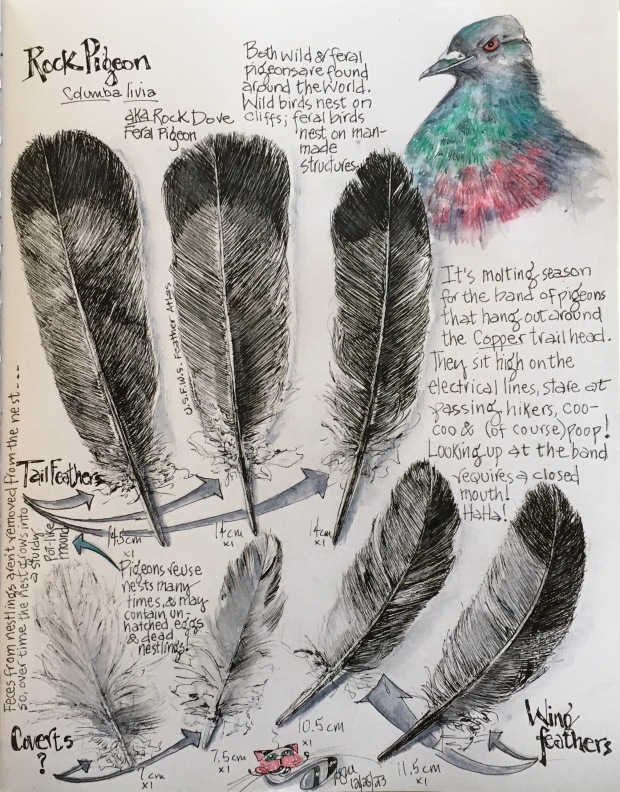
What comes to mind when you see a group of pigeons perched on electrical wires high above your head, or when a large flock or band of these birds suddenly flushes from under a highway overpass to escape a winged predator, or when you’re walking through a grocery store parking lot full of discarded food scraps and must shoo away pigeons to avoid stepping on them?
click the link below for the entire post, and learn if you believe this large bird is a pest or a prize
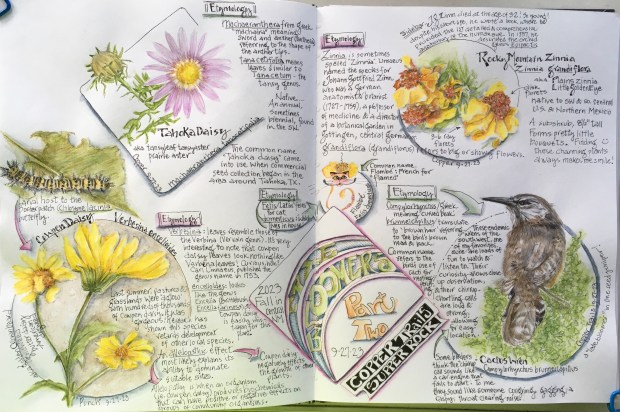
It’s hard now to imagine how extremely hot and dry the summer was this year. Without even a spittle of rain, the 100+ degree temps for weeks effectively suppressed the usual mid-season bloomers in and around the Albuquerque foothills/East Mountains. Even invasive plants, like goathead and tumbleweed, remained dormant or failed to germinate all together. It looked like winter browns had arrived early.
Then in less than a week, a small rain followed by several long downpours flooded the parched landscape, transforming browns to greens. You’ve heard this from me in a few earlier posts, but it was magical, and a reminder about the resiliency of desert vegetation.
Here’s a few pages highlighting a handful of the Late Bloomers I recorded in only 2 days. More than 2 dozen species had sprung back to life, setting flowers at all stages of accelerated vegetative growth. The landscape seemed wide awake. If plants could talk, I imagined them laughing while excitedly chanting, “hurry, hurry, hurry!” Only their roots prevented them from dancing!
In addition to the species on these journal pages, there are many (more) composites, native grasses, shrubs and sub shrubs, small forbs from Spring and early Summer actively growing and blooming right now, and (of course) the weedy invasives are growing and blooming with wild abandon.
Random thoughts and wonderings ….. are pollinators still hanging around …… or ….. how many of today’s bloomers are self fertile …… are local birds, insects, reptiles and mammals that depend on earlier summer pollen and/or fruit and seed production stressed with this timing change/availability of food sources … will there be noticeable shifts in species composition, including plants, insects, reptiles and animals (including birds) ….. what species can and will adapt to changes, and how quickly ….. etc. The answers to these and many more questions are probably best answered in coming years, if it’s even possible to answer them at all.
Have you observed vegetation anomalies that may be influenced by changes in climate? If so, please share your observations and where these changes are taking place. Meanwhile, keep your eyes wide open.
“Closing your eyes isn’t going to change anything. Nothing’s going to disappear just because you can’t see what’s going on. ……….. Closing your eyes and plugging up your ears won’t make time stand still.” – Haruki Murakami.
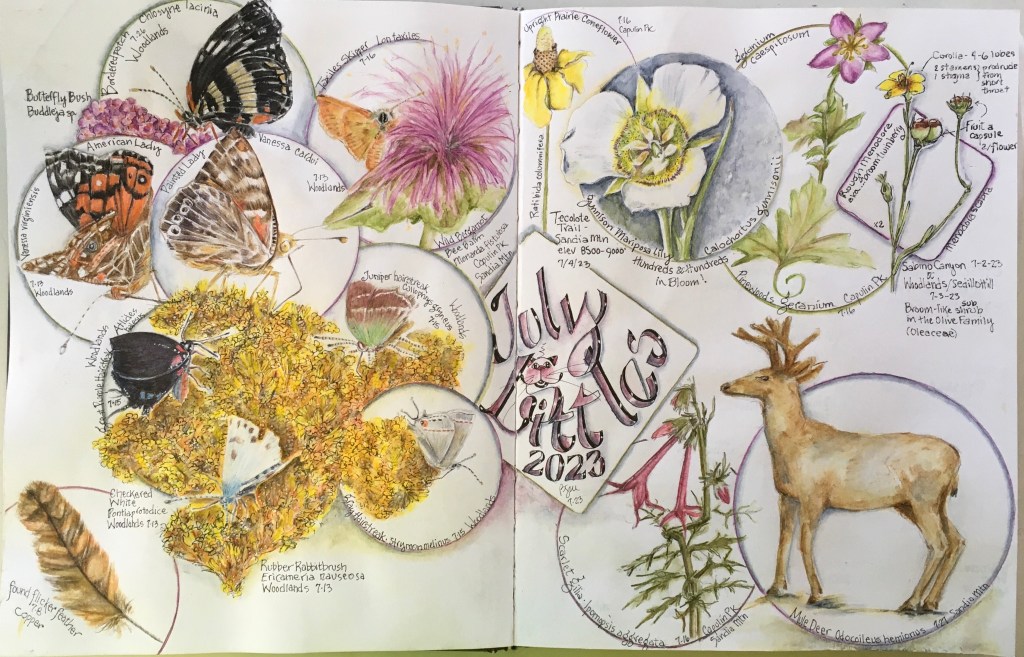
June’s hot, dry weather slipped stealthily into July as we became mired in one of those infamous heat domes for weeks. Our rabbitbrush shrubs, usually late summer bloomers, burst into piles of brilliant yellow flowers a full month before normal, and for the first week of their premature bloom, not a single pollinator was in sight. I was so concerned the over abundance of nectar would dry up, pollen would blow haphazardly away, and seeds wouldn’t form. Then one morning I woke to find hundreds of butterflies, weevils, flies and bees flitting, crawling and buzzing about, nearly covering the shrubs completely in a pollination frenzy! How did they know? Where did they come from? What a relief for me, but it must’ve been an unimaginable relief for all of those pollinators that happened upon our oasis in the desert.
And so it went, all month…. bursts of early blooms rapidly completing their floral life cycles, thanks to urgently feeding pollinators.
This is how I remember July, with everything in bloom at once, the air full of pollen and pollinators. It was quite a sight!
Once again, a big shout-out to “Made by Fay” for the inspiring “Littles” idea! Stay tuned for the next installment of “Littles.”
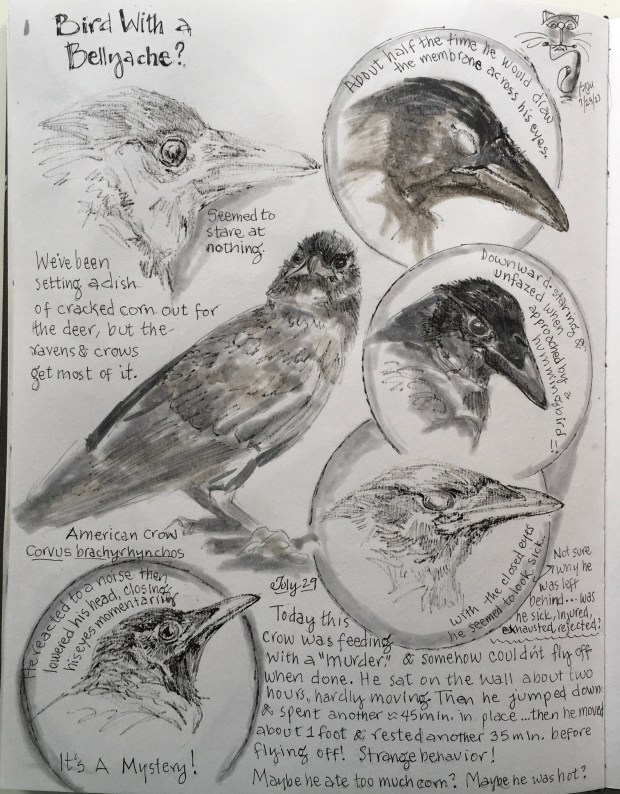
Do birds get bellyaches? I wonder? This is a puzzling yet happy little story about an American crow (Corvusbrachyrhynchos) who paid us a visit and stayed for hours.
We’ve gotten in the habit of placing a dish of cracked corn just over our courtyard wall within view of a few windows. The corn was intended as a supplemental food source for the mule deer that occasionally wander by our house. The deer really haven’t been showing up much and we almost decided to remove the dish, but …………… Something was obviously eating the corn.
So we readjusted our thinking and began to look for critters smaller than deer, like squirrels. Yep, the rock squirrels were gobbling up huge quantities, stashing as much corn as possible into both cheeks, and merrily running off to their cache with their stash! It was quite funny and always drove Luna crazy when they were around (that was our clue).
Some quick sketches of the crow as he “recovered” from some mysterious affliction.
But in addition to the hungry squirrels, there were regular visits from crows, lots of crows (aka “murders” of crows). As they feasted, there was much noisy squabbling amongst them, and definitely a pecking order would form where the older birds (?) would eat their fill, fly away, and then the younger birds would eat and leave. This had been going on for a few weeks, when yesterday Roy noticed a lone bird sitting on the wall long after all his friends had “eaten and run.”
The hummingbird perched over the crow, just watching with curiosity!
For a few hours he sat very still, hardly moving a feather, and didn’t appear well at all. Maybe he had eaten too much corn and couldn’t fly? Maybe he had come to blows with one of his friends and suffered some kind of injury? Maybe an opportunistic rattlesnake, lying in wait by the corn dish, struck and bit the unwary bird?
After a few hours, he jumped down to the ground about a foot away from the wall, and again remained stock still, except for slight reactions to an occasional jay or towhee flyby. He would open his eyes, cock his head, have a look, then resume his stoic stance. There was even a hummingbird that perched just over his head and watched the crow for a few minutes, curious perhaps about why this big black bird wasn’t with his clan?
Another 45 minutes went by where the crow spent most of this time with his head down and eyes closed; the rest of the time with head slightly raised while repeatedly “blinking” his nictitating eye membranes (the opaque eyelids). All of this behavior gave him an even more distressed, sorrowful look.
And then, with noticeable effort, he moved a foot across the ground, coming to rest for another 30+ minutes. We were discussing options to rescue this crow, when all of a sudden, he came to life and flew away! Poof! Just like that!
I think his friends must’ve given him a time out for hogging too much corn, and when he completed his banishment period, he was permitted to rejoin the murder? There haven’t been any crows around since.








 a curious nature