Meet an “Extreme” Creative!

April 8, 2024

After years of on-line and email chats, I was delighted when my friend Robin Atkins decided it was finally time we met in person! Bravo!

Robin and her travel buddy Lunnette, drove over 1,800 miles to Tucson to teach a Spirit Doll class to a local beading group. Then after spending 5+ days exploring Tucson and before driving home to Friday Harbor on San Juan Island, WA, they took a “short” scenic 450 mile detour …… to Tijeras, NM. This out-of-the way drive would bring them to our doorstep, and our first face-to-face meeting! While in Tijeras, we were able to spend an evening and full day getting to know each other and spent time hiking, nature sketching, and sharing each other’s art.

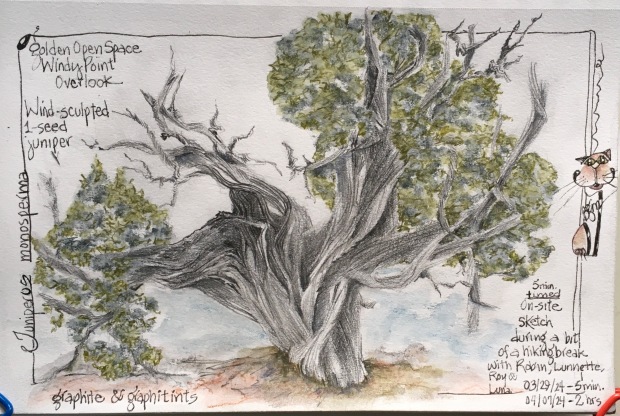
Robin snapped this photo of me sketching out at Golden Open Space. The beautiful wind sculpted juniper trees growing along the precipices of the windy observation areas are absolutely captivating (and tough). Luna thinks they’re tasty!

Meet Robin

Robin, whom I’ve always thought of as an “extreme creative,” is a fascinating, energetic, curious, passionate and bright-eyed adventurer in her early 80s. Her many interests and skills, in addition to creating uniquely designed, hand sewn and beaded Spirit Dolls, include: quilting (many with bead embellishments), thread embroidery, book making, watercolor painting, Zentangle art, nature journaling, making decorative papers, poetry, weaving, collage, crochet, felting and book author. And she shares her skills and techniques by teaching. 

This isn’t an exhaustive list by any means! As someone who seems to thrive on learning and developing new skills, Robin never stops seeking artistic challenges to take on. 

Check out Robin’s beautiful webpage and blog (http://robinatkins.com) where you can find photos and posts highlighting her current and past creative projects. 

A Short-but-Sweet Visit

We had a wonderful time getting to know each other, and what a delight to have also met Robin’s long-time friend and travel buddy, Lunnette. A retired firefighter in her mid 70s, Lunnette is also a nature journaler, calligrapher, quilter, and according to Robin, “she’s a terrific navigator, who always uses her keen sense of direction and map reading skills to keep us on the “right road,” (in both the literal and figurative sense).”

This is my finished graphite drawing of the twisted juniper I spent 5 minutes sketching.

Parting company was hard, but Robin and Lunnette needed to return home. Along their route they visited both Mesa Verde National Park and Arches National Park, soaking in more of the desert southwest sun and culture before taking on the 1,200 mile journey for Friday Harbor.

Memories!

November Littles: Seeds, Pods, Silk, and Wings

December 14, 2023

As the Fall season rapidly came and went, and the first snows blanketed the landscape, I focused my hiking time (and some of my drawing hours) on collecting local native seeds. Always careful that plenty of seeds remained available for overwintering birds, I still managed to harvest hundreds from about 25 plant species.  All sorted and packaged in separate pill containers, my collection is now stored in the refrigerator at 40 degrees, until growing conditions are optimal for planting.  This treatment method is referred to as stratification.**

Why collect native seeds? All throughout the Spring, Summer and Fall, a diverse assortment of pollinators visited our locally blooming wildflowers and shrubs. Along with these butterflies, moths, bees, wasps, beetles and flies, were the insects, spiders, and birds that prey on unwary pollinators. Such an amazing show; a kaleidoscope of colors and shapes! The air was a buzz with activity. My goal is to mimic the native banquet in hopes of attracting these pollinators and predators. 

Also, seeds are absolutely fascinating. I like to think of them as gift-wrapped, living plants-to-be. Tucked neatly inside of the seed coat are food stores enough to feed the makings of a complex root system; flowers, leaves, stems, branches and even a trunk. Seeds can be tiny, some microscopic and some as large as a softball. Seeds come in a variety of shapes, colors, textures and decor both inside and out. Some seeds have “wings” to fly; some have silky or puffy “feathers” to float; some are like “lead,” heavy enough to intentionally sink under water.

So I pulled out my 10x hand lens to investigate, drawing most of the seed species in my collection. It was very cool to compare seeds of different species that are in the same family (like the composites of the Aster family and the penstemons of the Plantain family). Until creating this journal page, I’d never held the seeds of 3 different species of yucca in one hand at the same time. Observing the similarities and differences, I finally confirmed in my mind that the genus Herperaloe and Yucca are indeed in the Agave family. And then I found examples of seeds from completely different families that evolved similar dispersal mechanisms (convergent evolution). This phenomenon was visually obvious in the delicate feathery, silky, and poofy hairs or bristles attached to grass, aster, and milkweed seeds, facilitating seed dispersal by wind. 

Finally, I felt the need to draw the seeds in case they happened to spill into one big jumble while being planted! Yes, I would be clumsy enough to create chaos out of order. Should that happen, I’ll be able to sort the mess by species by referring to my field guide page.

** Seed-producing plants pass along to their seeds the specific requirements(s) necessary to break dormancy and germinate. These genetic codes determine if optimal conditions exist for seeds to sprout and hopefully grow to maturity. But key to successful germination depends on seed ripeness (in most cases). Knowing the plant species from which a seed is produced; whether the plant is an annual, biennial or perennial; habitat, moisture needs and the type of  “treatment” method(s) are all important bits of information tied to successful germination. 

I’ll have to create a future post describing the variety of treatment methods (germination patterns) inherent in the seeds.  

Are you a seed collector? If so, share your why’s and how’s!
Nature Sleuthing Resumes ….. Sunflowers and Fibonacci; Natural Spirals

November 26, 2023

After a well deserved rest from Inktober and from my self-imposed pressure to create something every day from a list of random prompts, I’m happy to be out again nature sleuthing. Curiosities in nature sometimes stare us in the face. But more often than not making discoveries require keen observational skills, noticing something new to you, and an ability to look for clues to a mystery with wide open eyes.  

Double page post with an extra add on; all art work done with Graphgear 1000 loaded with 0.3mm 2B lead and all inked lettering done with Faber-Castell Pitt Artist Pen Fineliner, 0.3mm.

It was during a hike on an unseasonably warm day that I paused to admire the dried flower heads from one of the late blooming sunflowers. Have you ever noticed how they look like another kind of sunflower? Papery textured “petals” circle a central disk where a few weeks ago it was crammed full of puffy parachute-topped seeds. After the seeds become airborne, all that’s usually left is a slicked off surface punctuated with dots arranged in spirals radiating out from the center.

Click the link below to read more ………

Continue reading “Nature Sleuthing Resumes ….. Sunflowers and Fibonacci; Natural Spirals”

No Small Galls this Fall! Oak galls, then and now, the sequel…..

September 16, 2023

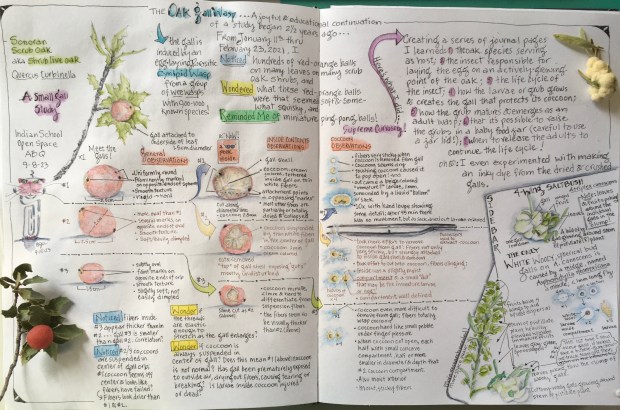
This is a little story about a fascinating discovery I made over 2-1/2 years ago, when in the second winter of the pandemic and in dire need of a belly laugh, our usually drab brown landscape appeared dotted with little reddish colored orbs. An insatiable curiosity sprinkled with a smidge of fantasy led me to some surprising answers to many questions, which continue to pop up to this day.

Open my full blog post and take a small detour with me into the recent past.  Learn how observations, connections and similarities in nature ensure there’s always dots to connect and mysteries to solve, no matter how many times you travel the same path.

Continue reading “No Small Galls this Fall! Oak galls, then and now, the sequel…..”

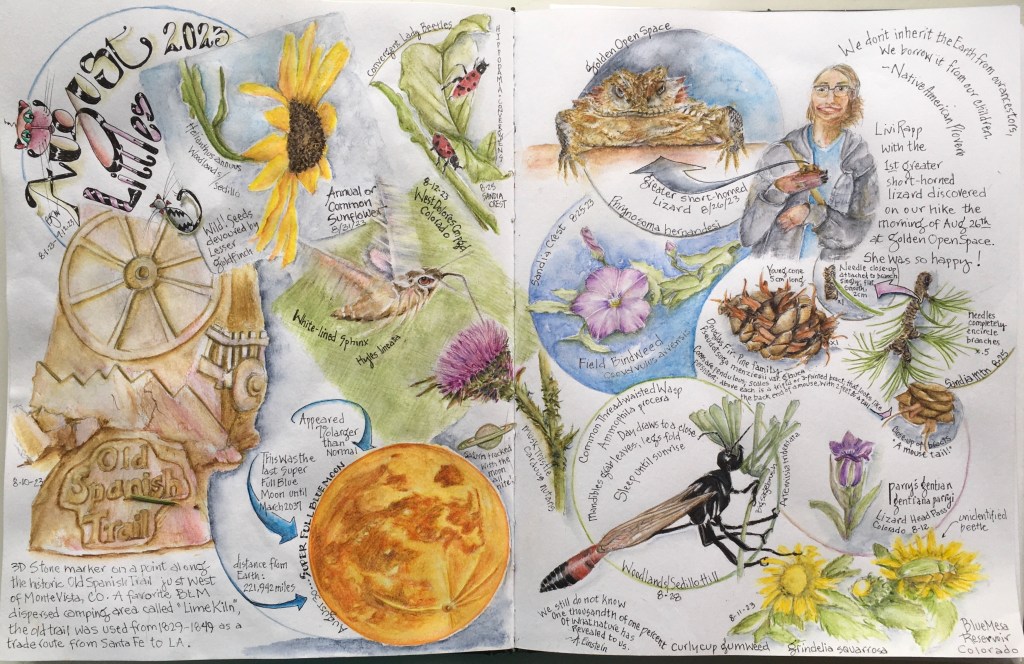
August “Littles” …. Horned lizards and Sphinx moths, a sleepy wasp under the Super Full Blue Moon, and nature through the eyes of a 15 year old!

Two-page spread for August Littles

August was a busy month, filled with high elevation camping in Colorado, and a lot of cool mountain hiking back home. Even though the lower elevations took on a hot and parched look, at 9,000 feet and higher the wildflower season was far from over as evidenced along roadways and trails, where fresh, colorful blooms could still be found.

The highlight of the month was a 3-1/2 day visit from my brother Bob and grandniece Livi. At 15 years of age, Livi is already a fine artist, and took to nature journaling like a pro! It was great fun discovering and sketching nature on our daily hikes. She even got a chance to hold one of the adult ornate short-horned lizards we see frequently along various trails, and then found a baby lizard on her own, hiding nearly motionless under a small plant. Her smiles were priceless!

Despite the high temps, it was a month of good days and nights, ending perfectly with the rising of a rare Super Full Blue Moon! If you missed it, there’s plenty of time to prepare for the next …… which occurs in March 2037.

Once again, a big shout-out to “Made by Fay” for the inspiring “Littles” idea! These pages are fun to create, and remind me of monthly highlights as I revisit my previous “Littles” posts. Hope you’re enjoying them too, along with the ending days of the season.
Stay tuned for the next installment of “Littles.” 

September 14, 2023

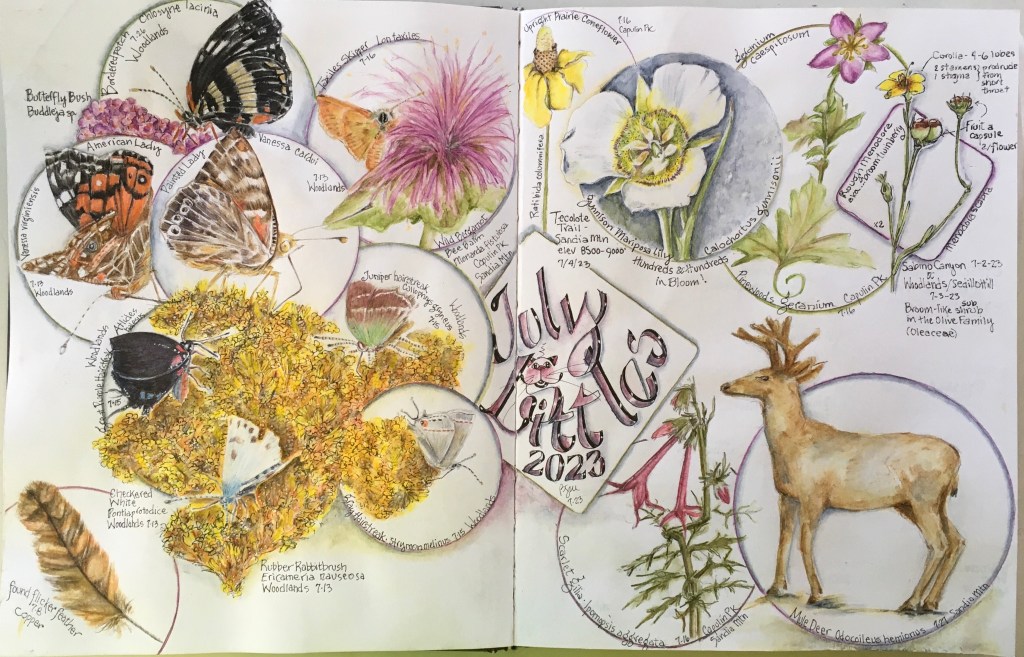
July “Littles” ….. Blooming flowers attract famished butterflies

Two-page spread for July Littles

June’s hot, dry weather slipped stealthily into July as we became mired in one of those infamous heat domes for weeks. Our rabbitbrush shrubs, usually late summer bloomers, burst into piles of brilliant yellow flowers a full month before normal, and for the first week of their premature bloom, not a single pollinator was in sight. I was so concerned the over abundance of nectar would dry up, pollen would blow haphazardly away, and seeds wouldn’t form. Then one morning I woke to find hundreds of butterflies, weevils, flies and bees flitting, crawling and buzzing about, nearly covering the shrubs completely in a pollination frenzy! How did they know? Where did they come from? What a relief for me, but it must’ve been an unimaginable relief for all of those pollinators that happened upon our oasis in the desert.

And so it went, all month…. bursts of early blooms rapidly completing their floral life cycles, thanks to urgently feeding pollinators.

This is how I remember July, with everything in bloom at once, the air full of pollen and pollinators. It was quite a sight!

Once again, a big shout-out to “Made by Fay” for the inspiring “Littles” idea!  Stay tuned for the next installment of “Littles.” 

September 4, 2023

The Forecast: Scattered Green Mixed With Dry Brown Dust

August 6, 2023

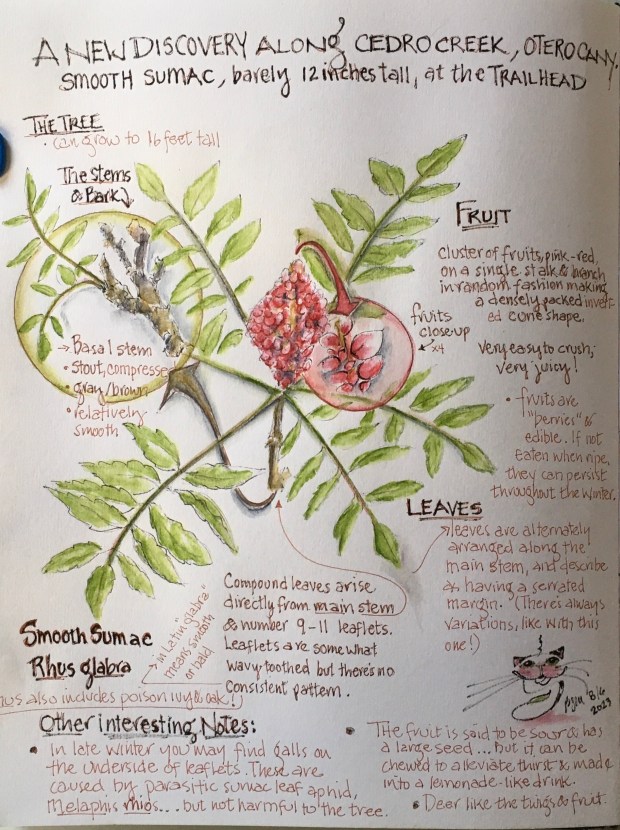
Sharing my pages from today’s short hike up Cedro Creek, on the fringes of the Manzano Mountains. The water shortage here and all around us has become dire; soils are cracked and dry and beginning to take flight with the barest puff of wind. 

Since we last hiked this area (a few days shy of a month ago), the scattered shallow pools of water have either evaporated completely or made a retreat underground, where there may be just enough water to wet the riparian area. All the tender flowering plants have disappeared; many have been able to set seed in hopes of a wetter year to come. With this premature wrap up to the summer season, the birds, bees and butterflies have moved on; hopefully up in elevation where food may still be found.

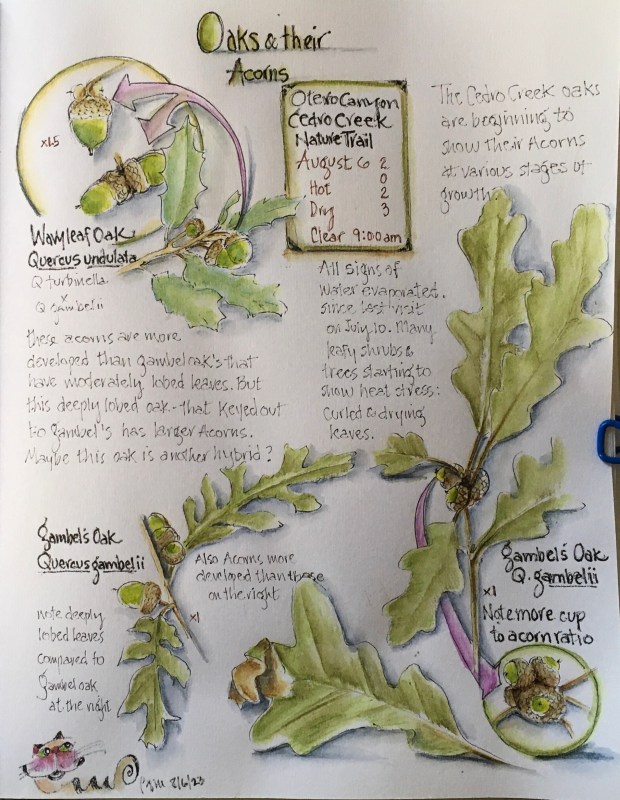
Our summer monsoon season just didn’t materialize (yet?). But despite the hot and dry conditions, we did manage to find a few leafy green shrubs. The massive cottonwoods appear to be doing well (must still be sufficient groundwater). In the cooler parts of the canyon, there are berries hanging on the 2 species of juniper trees. Acorns have begun to mature on several oak species, even though there are many that have withered; is all of this earlier than usual? 

At the trailhead, tucked in a swale where water (when it comes) can collect, I was surprised to see some very stunted smooth sumac. Already showing off their clusters of juicy red berries, the plants are barely a foot tall. This species can rapidly grow to heights of 16 feet. Maybe flowering and fruiting on such short plants is a type of survival mechanism this sumac exhibits when conditions are not favorable? I will be able to watch this little grove over the coming years and maybe answer that question.

Then further up the canyon, about 20-30 feet above the riparian area, Gambel’s and Wavyleaf oaks are growing their acorns. That’s encouraging news for the squirrels who collect and cache them in overwintering nests.

It’s been a challenging year. 

What differences in nature have you been noticing where you live? Do you think our changing climate has played a role in driving the changes? Have you observed not only negative but positive affects? I’d be very interested in knowing!

As always, thanks for following!

June “Littles” ….. a buzzy, buggy, snake-y month

June was hot, Hot, HOT

Two-page spread with 14 June Littles + Flambé

June was dry, Dry, DRY

Close-up

June was the month of bugs (from the big tarantula hawk wasps, to the microscopic gnats), withering flowers, disappearing birds, and snakes! We seemed to encounter an extraordinary number of snakes this month, including gopher (bull) snakes, diamondback rattlesnakes, patch nose snakes, garter snakes, and one very scary prairie rattlesnake. Read on for that story.

Another close-up

Luna and the Prairie Rattler! Our scariest encounter was with a 3-foot prairie rattlesnake right in our front courtyard. One day he had crawled out from the shade of a blue spruce to warm up in the morning sun. It was Luna that had changed his demeanor from placid to pissed off. Prairie rattlers don’t typically alert trespassers; that’s the secret to their hunting success, and Luna didn’t recognize the danger. She began sniffing around and unintentionally violated his personal space. The snake responded by instantly coiling and violently rattling his tail. The noise seemed deafening and was definitely alarming. As I came running to Luna’s rescue, Roy noticed the commotion and quickly arrived with snake stick and bucket in hand. By this time the snake had backed into a corner, furiously rattling, but was relatively easy to capture. Snake temporarily out of the way, we then carefully checked Luna for signs of snake bite (none detected! Lucky Luna).

Another close-up
Another close-up

Now back to the snake in bucket. It had taken less than 30 seconds for Roy to capture and slip him into the 5 gallon bucket. It was then that I was able to take my first photos, from a respectable distance just in case the snake decided to leap clear of the bucket!. If looks could kill, well ………….. About 15-20 photos later, the bucket lid was secured in place, and we took the snake for a little ride about a mile from home where he was carefully released in an uninhabited area, unharmed.

After release

Again, a big shout-out to “Made by Fay” for the inspiring “Littles” idea!   Stay tuned for the next installment of “Littles.” 

July 27, 2023

Fading Flowers Reveal Leafy Greens ….. Cedro Creek

July 14, 2023

Learning the deciduous Trees and Shrubs shading Cedro Creek Nature Trail ….. Grab n Go Nature Journaling

The timing and location of our daily hikes are being influenced by the extreme summer temperatures we’re experiencing throughout central New Mexico, and throughout the desert southwest. Whew! Even at 7300-8300’ elevation, 95-100F has become the norm, with no relief (or moisture) in sight.  I don’t even want to think about Albuquerque temperatures; over 100F before noon, and soaring. 

Because hiking in the Albuquerque foothills, at any time of the day, is out of the question, we’ve begun revisiting some our favorite mountain trails. But even tho these areas are higher in elevation, and shadier, it’s still plenty hot. That means if we set out between 7-8am, we can still manage a few miles before our water, like all the creeks, runs dry. 

A few mornings ago, we decided to hike Cedro Creek Nature Trail, a rocky but easy dirt path under the shade of big cottonwoods. Expecting to find some water in the creek (there was none), I was hoping to find some interesting wildflowers (which had all withered and dried). The further along the trail we hiked, my focus quickly changed from wildflowers to other natural elements. 

Geology is always interesting in these mountain drainages, and Cedro Creek is no exception. The overlying shales and limestones have long ago eroded to reveal large granite boulders that showed signs of erosion from long ago flowing water. That’s a nice thought!

And then there were so many varieties of deciduous trees and shrubs; their leafy greens not only provided relief from the heat, but became a visual treat as we explored the riparian areas alongside the dry creek bed. 

As my curiosity about the diversity of tree and shrub species began to grow, so did the air temperature. Not wanting to become reduced to a sweaty puddle in the middle of the trail, and sensing a swarm of drooling, biting gnats and flies giving me a hungry eye, I resorted to collecting leaf and branch samples using a Grab n Go technique. By the time we got back to the car, I had 3 large ziplocks stuffed with over a dozen species of tree and shrub leaves and some fruits.  

Back at home, in the comfort of my cool studio, I began my detailed study of these leaves (and the few bugs that managed to hitch a ride). Three days and several gallons of iced tea later, I had completed the 5 journal pages in this post.  

That iced tea was deliciously cool, but not as cool as learning what’s growing overhead along Cedro Creek!

Until next time ……. be curious

Cypsela! The Sunflower Seed

July 9, 2023

Buckle in …… 

In my last blog post, Fascinating Fasciations, I shared my discovery of an extremely malformed Rush Skeletonplant. While researching this much branched and dainty member of the plant family, Asteraceae (which includes asters, sunflowers and daisies), I became entangled in the winding and seemingly never-ending number of rabbit trails on my journey, until finding myself on a surprising detour. Totally absorbed in the subject of plant malformations, and learning a lot of cool stuff about Rush Skeletonplant along the way …….

The weirdly wild fasciated Rush Skeletonplant

………. I tripped and fell flat on my face (only figuratively!). One of the published research papers appeared to be in error …… regarding the seed (aka fruit) name of this plant. Known to me for decades by the name “Achene,” the researchers had labeled the seed “Cypsela.” And not only did they call seed of Rush Skeletonplant a “Cypsela,” but they used this name when referring to all the seeds of the Aster family! 

What! No Way! Who was responsible for this name change? When did this happen? Why oh Why

Continue reading “Cypsela! The Sunflower Seed”