
of Filaments, Fragments, and Flambé


November 25, 2024
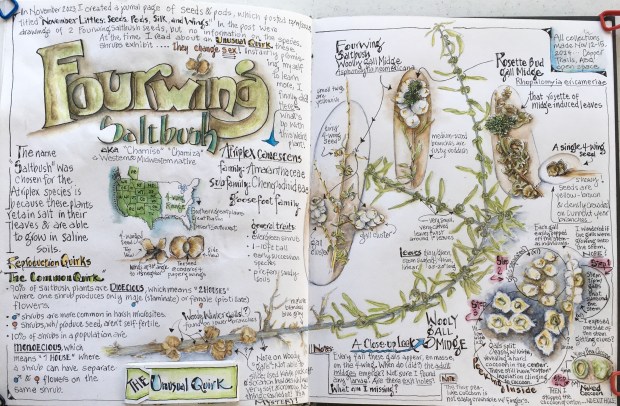
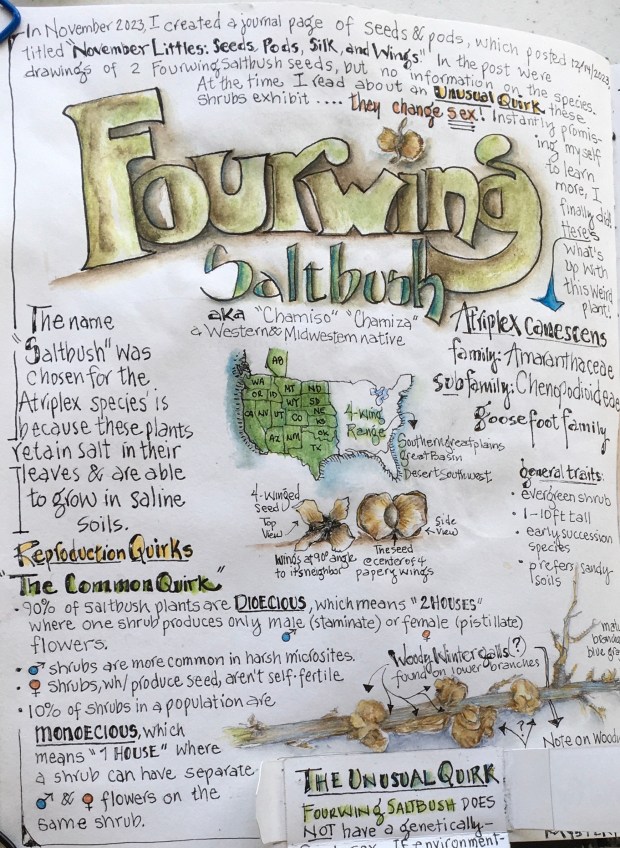
In November 2023, I created a journal page of seeds and seed pods, which posted on 12/14/2023, under the title November Littles: Seeds, Pods, Silk, and Wings. On that page was a small drawing of two Fourwing Saltbush seeds, absent any information about this plant species, Atriplex canescens. At that time I remember finding a wealth of articles and research documents about this widespread shrub, but what really stuck in my mind was a very unusual quirk exhibited by this plant. Finally, a year later and WOW! I discovered Fourwing Saltbush has a reproductive superpower …… this species has the ability to change sex!

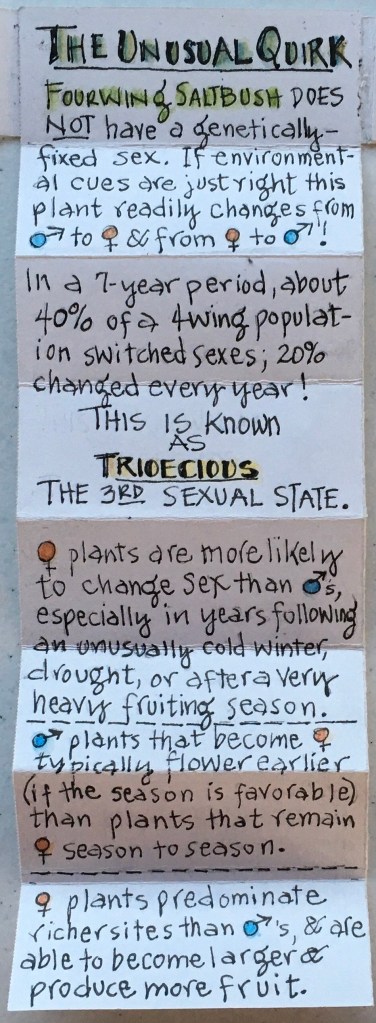
An Unusual Quirk
My first dive into the literature revealed that within a 7-year period of time, 40% of a Fourwing population switches sexes with 20% of a population changing sex every year. Botanically, this is known as Trioecious, or the 3rd Sexual State.
But clearly a bit of back peddling is needed ……. if Trioecious is the 3rd Sexual State in plants, what about the 1st and 2nd sexual states, huh? Yes, they exist …….. but before explaining them, which requires comparison with the more common sexual state in plants, I must describe this sexual norm.

And now for a little Botany 101 ……..
The Sexual Norm …… Plants with Perfect or Complete Flowers
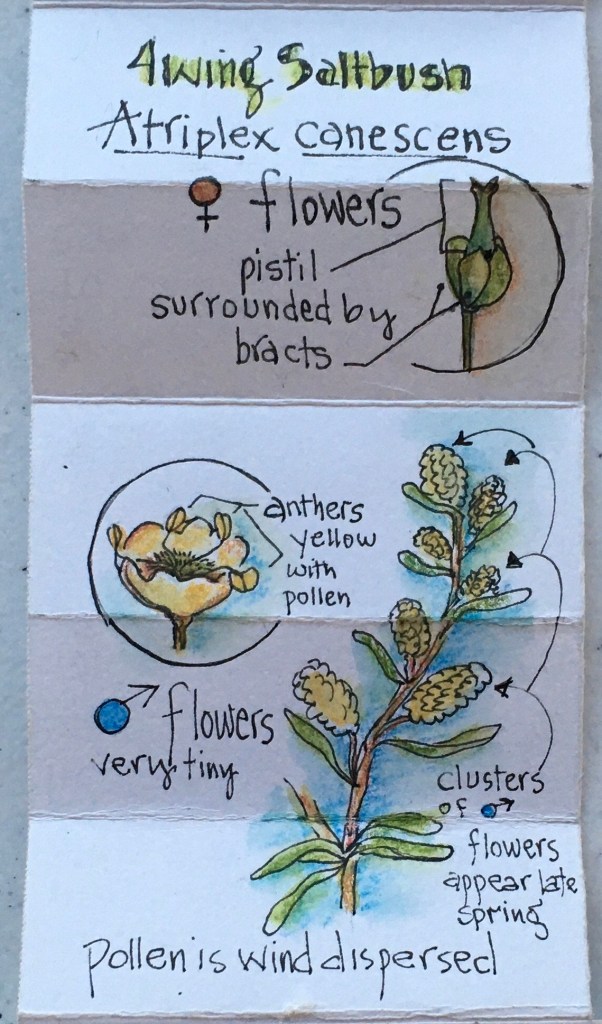
You are likely familiar with plants like roses, tulips, lilies, garden strawberries, beans, peas and cabbage. If you’ve closely examined their flowers while inhaling their fragrant aromas, you may have noticed their centers have both female and male parts. These are known as plants with Perfect or Complete flowers (aka hermaphroditic or bisexual) defined by each individual flower having a fully functional pistil (the female part) and stamens (the male parts). Worldwide, about 90% of flowering plants have Perfect or Complete flowers.
Monoecious ….. the 1st Sexual State
Here again you are likely familiar with many plant species described as Monoecious (moh-NEE-shuhs). These include corn, all of the plants in the gourd family (i.e. cucumber, squash, watermelon), oak, birch, pine, spruce and dogwood. Monoecious, which means “one house” in Greek, describes plants having separate female and male flowers in different places on the same plant, often blooming at different times. Visualize corn growing in a field; the tassels are the male (staminate) flowers, and the corn kernels you eat are the female (pistillate) flowers. Around 10% of all flowering plant species worldwide are Monoecious.
Not to confuse the matter, but sometimes botanical experts refer to Monoecious species as Perfect or Complete because they have both male and female flowers on the same plant, even though these flowers are separate and considered sexually Incomplete (aka unisexual) by themselves.
Dioecious ….. the 2nd Sexual State
A plant species with individual plants in a population having only female flowers, and individual plants of the same species in the same population with only male flowers is called Dioecious (dahy-EE-shuhs). This Greek word meaning “two houses,” describes plants such as spinach, asparagus, sumac, currant, box elder, willow, holly, ginkgo, juniper and aspen. Only 5% of all flowering plant species worldwide are Dioecious.
Another confusing matter once again. There are botanical experts that refer to plant species with Perfect or Complete flowers as Dioecious because they require cross-pollination to produce seeds (fruit). Tree fruit species such as apples, pears, cherries and plums are common examples.
Trioecious ….. the 3rd Sexual State
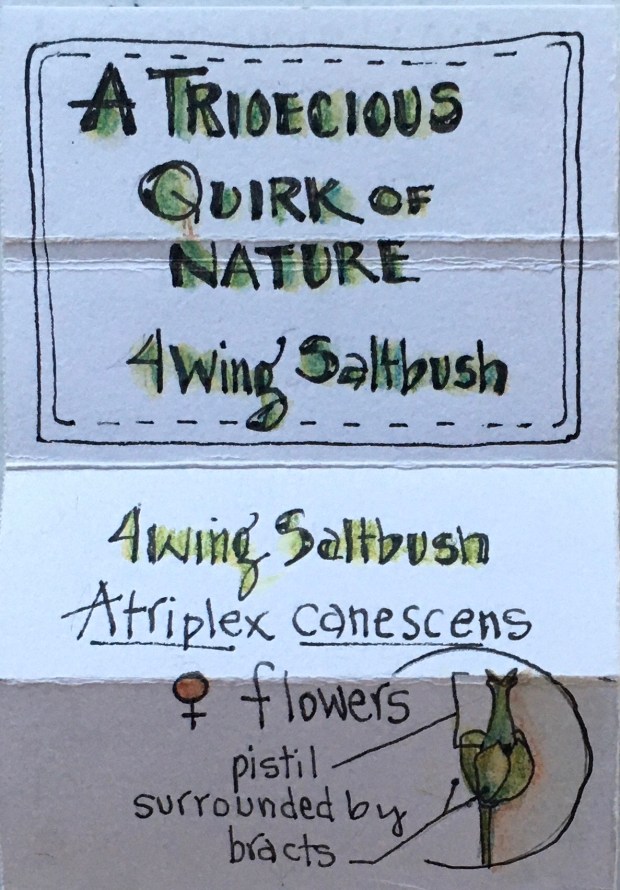
An extremely rare reproductive strategy among flowering plants, Trioecious (aka trimonoecious or “three houses”), is characterized by a species that can have Incomplete (unisexual) male, Incomplete (unisexual) female, and Perfect or Complete (bisexual or hermaphroditic) male/female flowers on separate plants in a population or even all on the same plant! Just over 3% flowering plant species worldwide are Trioecious (trahy-EE-shuhs).
This is where Fourwing Saltbush (Atriplex canescens) enters the story
Primarily a Dioecious species, some Fourwing Saltbush populations have a Monoecious component ranging from entirely male (staminate) or female (pistillate) individuals to those that are Perfect or Complete (hermaphroditic or bisexual). And in this Dioecious–Monoecious–Hermaphroditic gender system, referred to as Trioecy, switching sexes occurs. To reiterate from an earlier paragraph, on average, in a 7-year period, about 40% of a Fourwing Saltbush population switches sexes with 20% changing from male to female or from female to male every year.

Reasons Behind and Benefits of Fourwing’s Sex Change Phenomenon
Fourwing Saltbush has evolved to be one of the most adaptable plant species found throughout central and the western US. It grows from sea level to 8500 feet elevation, and in a multitude habitats within a wide range of plant communities, no matter the successional stage. Fourwing can adapt to all soil textures, soil depths and all but the wettest of soil conditions. The species is able to tolerate hot (+100F) and dry (6” precipitation annually) summers, and bitter cold (-50F) and dry winters.

The ability of the species to adapt to such a wide range of physical and climatic conditions is, in part, due to this sex change phenomenon. Environmental stressors seem to be the major triggers resulting in Fourwing plants switching sexes. Female plants are more likely to change sex than male plants, especially following a drought, an extremely cold winter, or after a heavy fruiting season. Because fourwing is so tasty as range forage, overgrazing can also trigger a sex change, with male plants tending to dominate regularly grazed sites. Male plants that change to female typically flower earlier than plants that remain female season after season. And female plants dominate richer sites than do male plants, becoming larger and producing more seed.

Undoubtably there’s more environmental stressors, such as wildfire and other climate change-induced factors, that may result in Fourwing Saltbush to switch sex. I’ll be curious to learn what they are and how these triggers influence the adaptability and survivability of this robust species. And I’m excited get busy marking this season’s female and male plants that we see nearly every day, and will begin more closely observing these populations for gender changes and possible stressors that may have triggered these switches.
A Retrospective and Thoughts on Prospective Studies
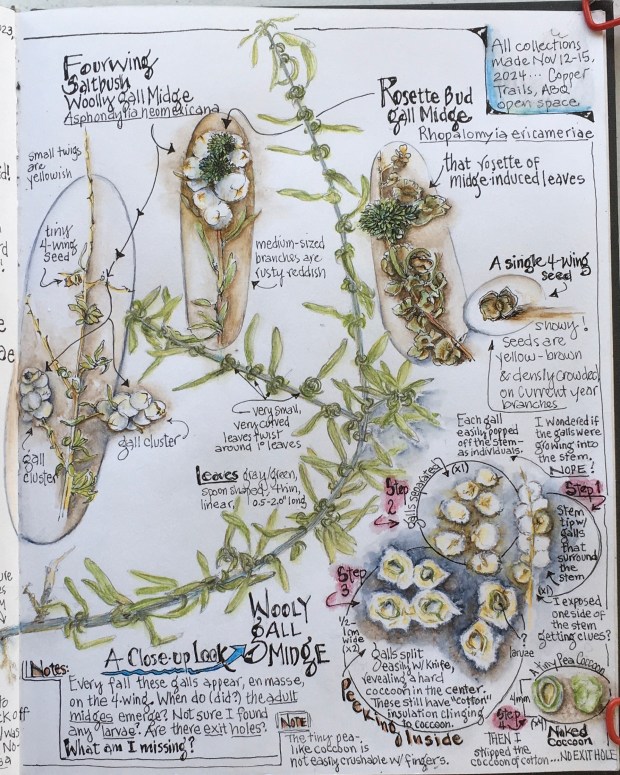
There’s so much to learn about Fourwing Saltbush that it seemed logical to tackle one characteristic at a time. Originally I had planned to discuss both the plant’s reproductive quirk and several of its common galls, but found there would be too much information for one post. While deciphering the complexities of the Fourwing’s sex change abilities, I found it necessary to describe certain key botanical terms in my buildup to the crucial piece of the puzzle ….. the Trioecious reproductive strategy. So this post focused on the first of my two journal pages; my beginning exploration into this plant. The galls illustrated on my second journal page, that could not be easily chopped away from the first page, serve as a preview of a future post about the fascinating Fourwing Saltbush.

And Finally ……….
For a shrub I used to describe as a messy tangle of branches haphazardly cloaked with unremarkable features like dusty little grey-green leaves, nearly invisible flowers, shreddy dull grey trunks and a chaotic canopy, Fourwing Saltbush has captured my imagination, respect, and love as an almost invincible survivor of our changing world!
Hopefully you found this interesting and informative. Bet you never look at flowering plants in casual ways again. Let me know if you are familiar with Fourwing Saltbush. Where does it grow? Have you ever marveled at the thousands of winged seeds densely crowded at the tops of these shrubs? And then satisfied an irresistible urge to strip dozens of skinny branches of those ripe seeds, tossing them in the air like confetti? If so, please share.
As always, thanks for stopping by!
November 12, 2024
It’s late October, mid-Fall in the Manzano Mountains, perhaps a week before the first snow of the season. The Gambel Oak covering hillsides and mountains somehow sense a change in the air. Seemingly overnight every leaf on every oak shrub and tree magically transformed from their summer greens to royal rusty reds, gleaming golden yellows, and shocking sunset oranges. As I look across the landscape and marvel at the sight, I can’t help wondering, “How do they know?”
The spectacle is short lived. Over the next few weeks, these gorgeously painted leaves slowly change to crispy beige brown, fooling the observer into believing they can’t face another winter; that every single oak shrub and tree just gave up and died! Thinking that was the case my first winter in central New Mexico, I was fooled. But since then I’ve learned a lot about the life cycle of Gambel Oak, and have come to appreciate the persistence of all those crispy browns covering up the otherwise barren nakedness of chaotically jumbled branches.
There’s a lot that can be said about Gambel Oak (Quercus gambelii), but this post focuses on
The Leaves of Quercus gambelii

The most interesting thing about this oak species’ leaves is no two are alike. Even though each leaf looks different from its neighbor, they do all have common characteristics that distinguish its leaves from other oak species. For example, All Gambel Oak Leaves …….
Every Fall I observe and collect Gambel Oak leaves. They make great subjects for my nature journal! Because every leaf looks different, the easiest way to depict the various shapes is to trace their outlines directly onto my journal pages. Then with leaves in hand, I can use my Inktense watercolor pencils to paint within the outlines, spending most of my effort on their beautiful colors.
I hope you’ve enjoyed my page of Gambel Oak leaves. Do you share nature with oaks? If so, which species, and are their leaves all the same or different somehow? Do you record your observations in a nature journal too? I’d love to know!
As always, thanks for stopping by!
November 11, 2024

Pine Nuts Come From Where?
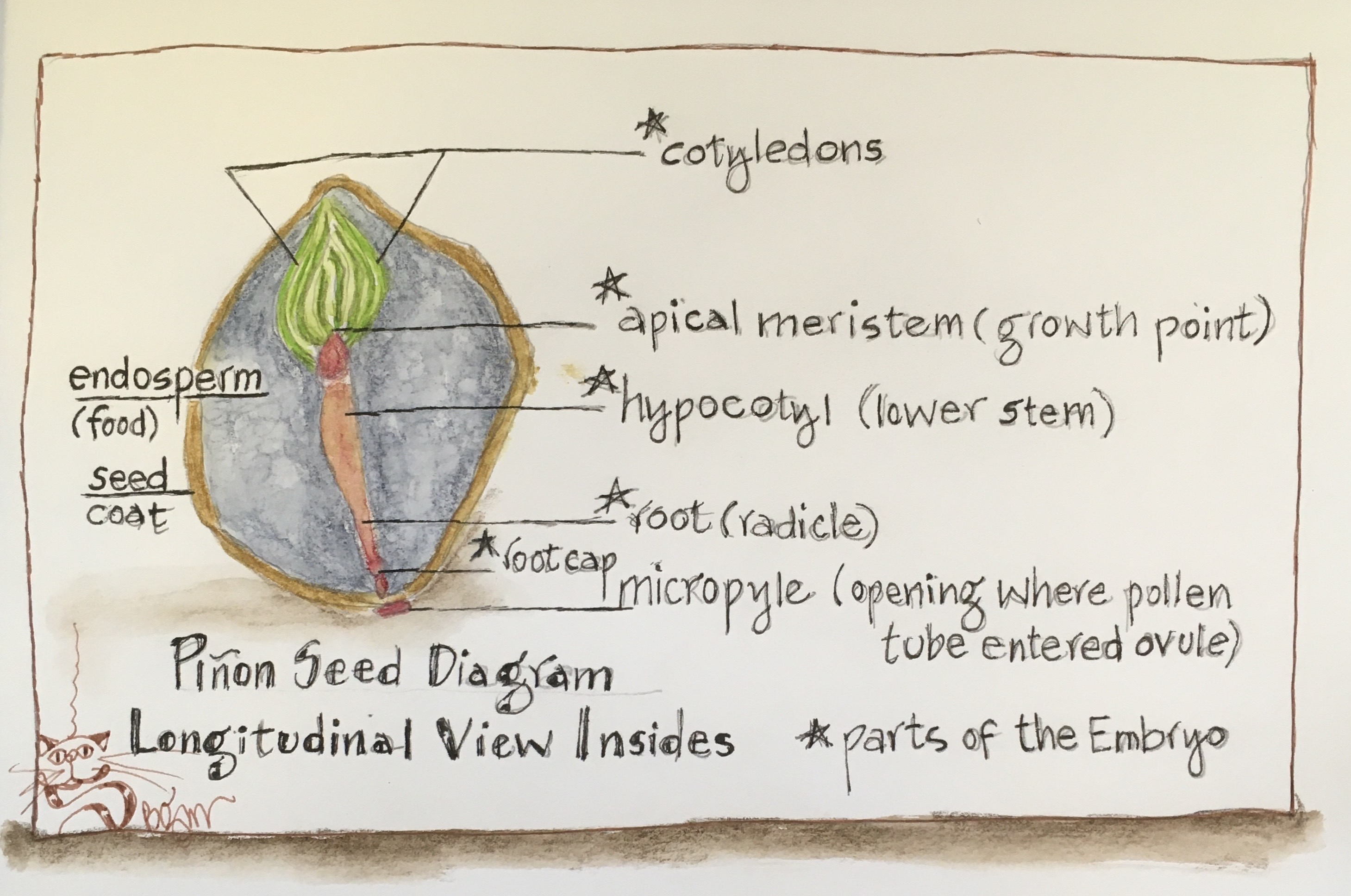
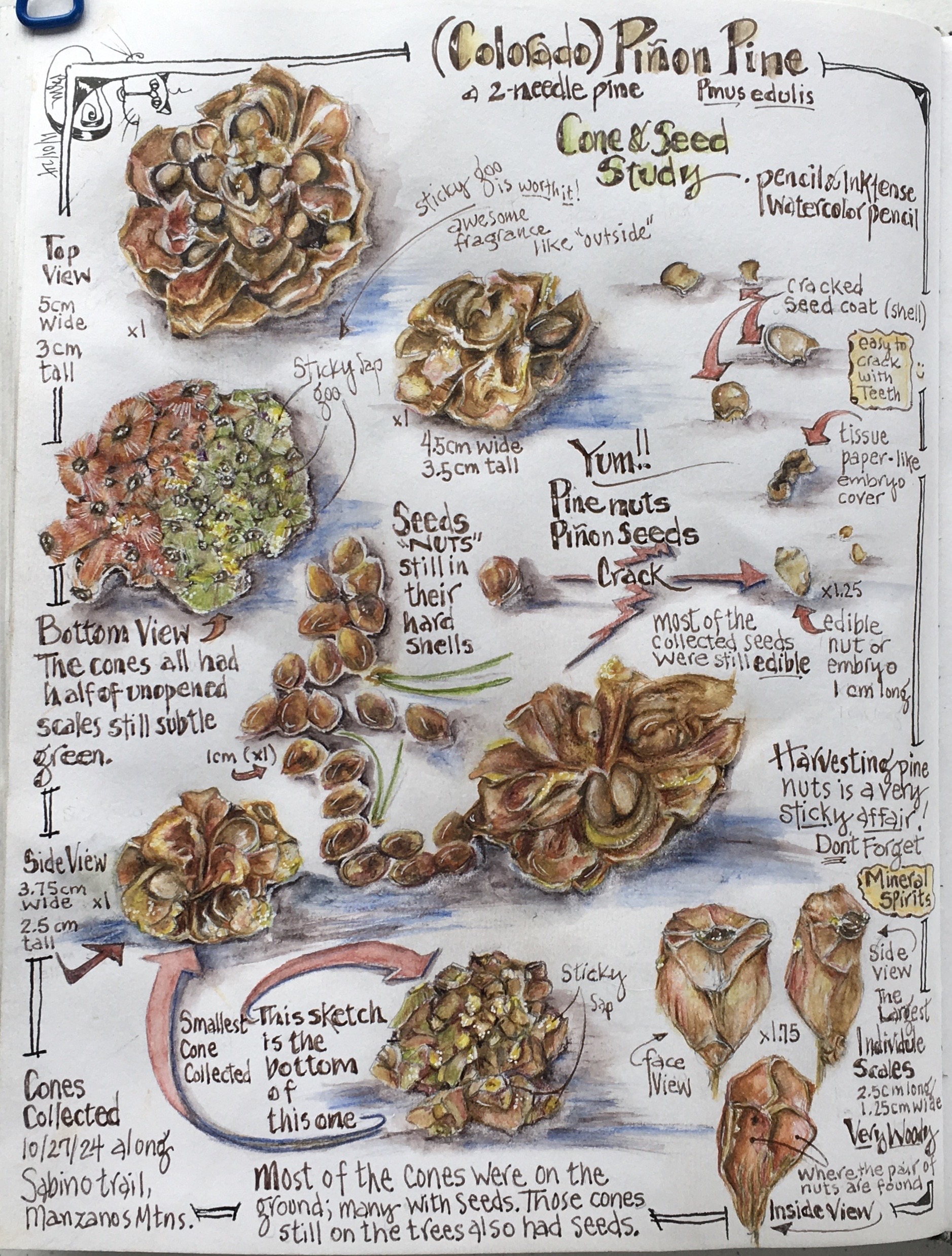
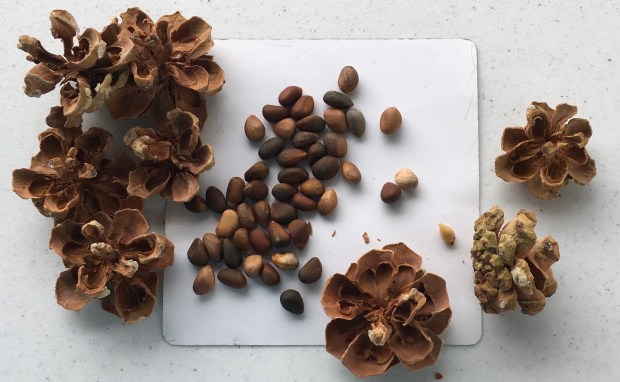
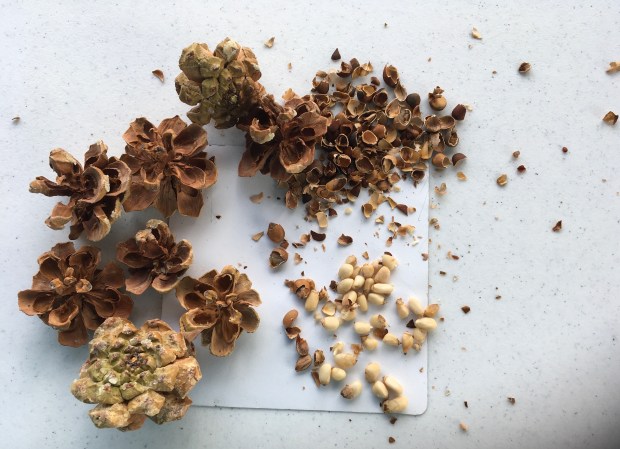
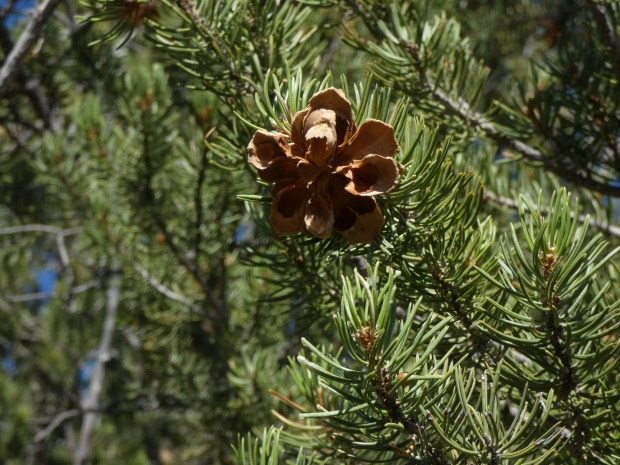
Many years ago, maybe about 45 of them, Roy and I, his sister and her husband, set off on a pine nut safari in the mountains of south central Colorado. They knew of a large stand of a specific pine tree, called Pinyon (Piñon**) heavy with cones and ready to harvest. This was my first encounter with the Colorado Pinyon Pine (Pinus edulis), and my first taste of the buttery rich tear-drop shaped seeds produced by these trees. I was hooked! After 4-5 hours collecting wide open seed stuffed cones from low hanging branches and off the ground, we had to stop. Our fingers were impossibly stuck together from the cones’ copious coating of resin, definitely stickier than Super Glue! Without a solvent to dissolve this adhesive pine tar, we were in danger of losing our fingerprints.
Having made a less-than-minor dent in the harvestable nuts, ample quantities of this energy rich bounty remained for foraging wildlife, such as migrating birds like pinyon jays, deer and squirrels.
For the past 45 years I truly believed pine nuts (which are, botanically speaking, not true nuts but the edible seeds of pinyon pines) only came from stands of Colorado Pinyon Pine. When the popularity of pesto skyrocketed, I thought “wow, you couldn’t pay me enough to harvest the amount of pine nuts necessary to make even one batch!” I honestly thought that was the reason the seeds were so expensive ….. harvesting is such a tedious and labor intensive job. Alas, we never returned to harvest pine nuts, and I never made pesto until years later.

While studying a few dozen pine cones for my sketches, the seeds kept falling out and bouncing across my drawing table. This got me thinking about pine nuts and wondering how the Colorado Pinyon Pine could possibly fill the insatiable global demand! Of course by now I was well aware that this tree species is endemic in the southwest, but still ?…….
News to Me ….
Of the 126 different species of pine in the world, 29 are considered edible; 20 of which have seeds large enough to be marketed. The biggest producers and exporters are China, Russia, Mongolia, Turkey, and Pakistan, in that order. I found it interesting that China is also the largest importer of pine nuts, who’s marketing goal is to export 60% of the world’s demand.
What about the US? The pine nuts harvested from Colorado Pinyon Pine (Pinus edulis) is rated the best tasting in the world, with those produced by the One Leaf Pine (Pinus monophylla), harvested primarily from these California trees, comes in a close second. Yet, the US is a major importer of shelled pine nuts, primarily from China. But if China is the largest importer and the largest exporter of shelled pine nuts, then the pine nuts on the shelves of Trader Joe’s and Costco, labeled as imported from China, probably came from a variety of pinyon species from a combination of suppliers importing seeds to China?!
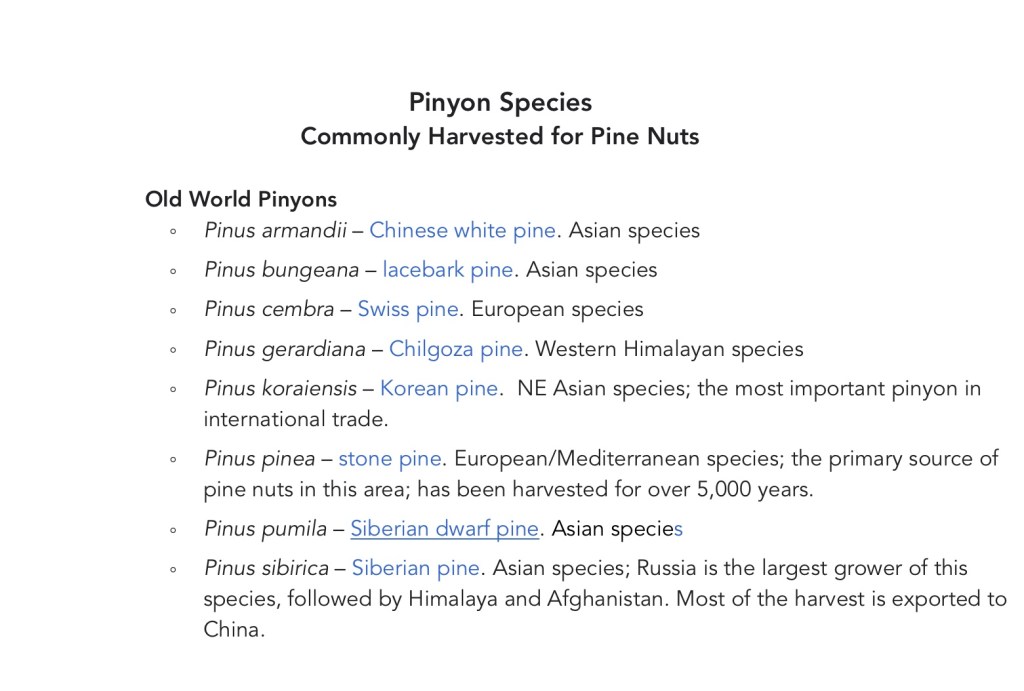
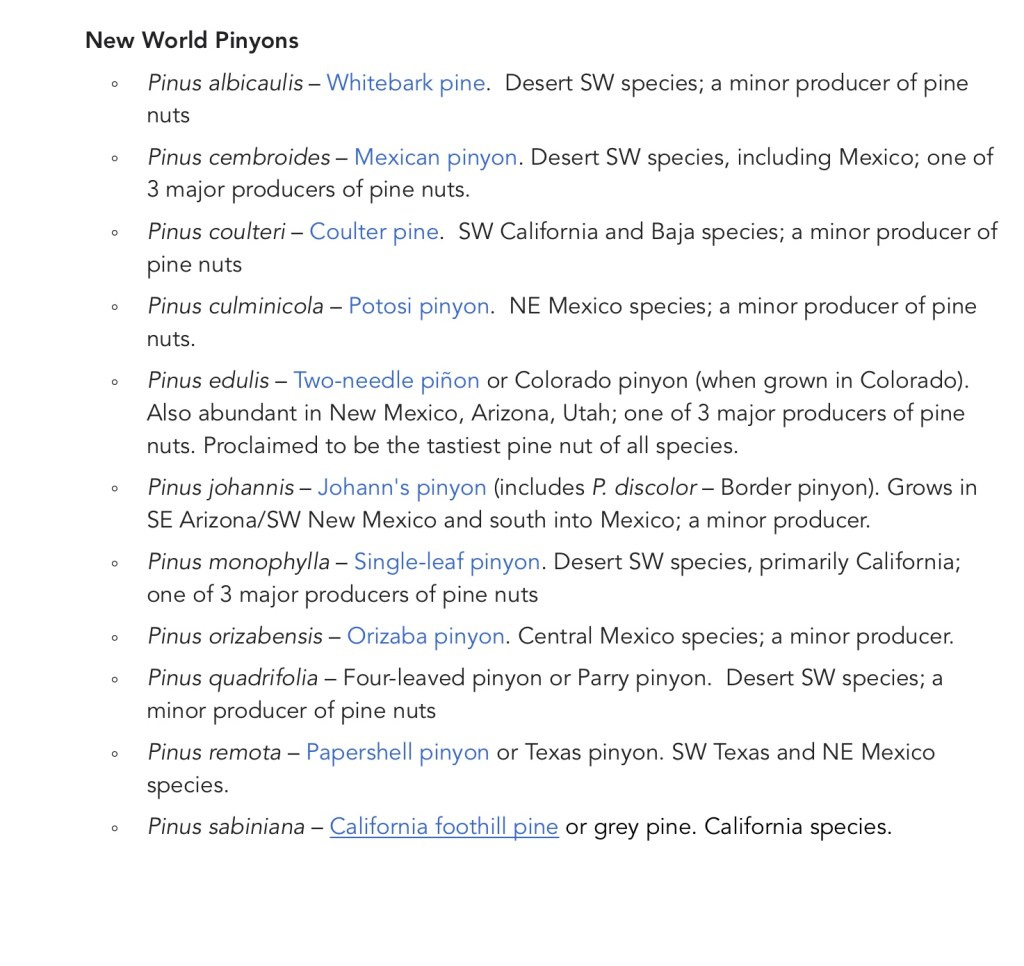
Being naturally curious about the Pinyon species that grow in various countries around the world, I included a list of 16 of the most commonly harvested trees the end of this post.
What’s the Real Reason Pine Nuts are so Expensive?
It’s said that “pine nuts are the most expensive seeds we would never buy!” (**** Check out this footnote for the 2024 costs/pound and my random calculations per serving and for a batch of pesto). Pine nuts are the second most expensive “nut” in the world, second only to the macadamia nut. But why? While it’s true the seemingly exorbitant price of shelled pine nuts is directly influenced by labor costs, compounded by the annoying sticky factor, other challenges exist.
Harvesting Pine Cones
Cones are harvested by hand, directly gathering those that have fallen on the ground, and from tree branches (where the densest number congregate in the upper 1/4th of 30 foot tall trees). Another common harvesting technique is to whack the branches (which reportedly does not injure the trees [hmmmmm?]). But a faster method used in many countries is to cut off branches with cones, resulting in a number of detrimental effects to the trees (open entry points for insects and pathogens; stunted growth; stalled production; tree death).

Pine Nuts
Once the seeds are taken out of the cones, their hard shells (seed coats) must be removed without damaging the soft edible kernels inside, the “pine nuts.” (And not every seed is viable ….. more about that below.) The shelled pine nuts must now be handled quickly and properly due to their short shelf life. It only takes a few weeks or even days in warm and humid conditions for shelled pine nuts to lose flavor, turn rancid, and completely deteriorate. Until they can be marketed for export, pine nuts must be kept frozen. Ideally, shelled pine nuts should remain frozen during export/import and until consumer purchase and consumption.

Tree Characteristics
Slow growing trees and inconsistent production are several more reasons pine nuts are so expensive. Pinyon pines are notoriously slow to grow, mature (10 years) and produce a harvestable crop of cones with viable seeds (75-100 years). But pinyon pines typically live an average 350 years, and have the potential to produce tons of harvestable seeds. However, all pinyons exhibit a common characteristic called “masting,” where they may produce a bumper (harvestable) crop only once in as many as every eleven years. Good years are not predictable either, as many factors influence growth and production, with local droughts and a changing climate having the biggest impact.
Gifford Pinchot (1909), U.S. Forest Service Chief said: “Seasons of especially abundant production occur, as a rule, at intervals of from five to seven years, although heavy crops are sometimes produced for two or three consecutive years, and heavy seed years are not the same throughout the range of the tree.”

______________________________________________________________
A Few Footnotes
**Piñon or Pinyon?
The most common common name for Pinus edulis is “Colorado” Pinyon Pine, even though the species is widespread in New Mexico, Utah and Arizona as well as Colorado. The words pinyon and piñon are usually considered interchangeable. Use of the word “piñon” (Spanish for pine nut) is tied to the seed (i.e. piñon seed or pine nut seed) and the tree (i.e. piñon pine or pine nut pine) particularly used by Native Americans in the southwest US. Because references consulted during my research were not consistent in their use of common names for Pinus edulis, to avoid (my) confusion I’ve opted to call the piñon seed (pine nut seed) a “pine nut” and the pine trees with edible seeds “pinyons.”
**** The 2024 retail market cost (shelled raw or roasted seeds) averages $40/pound
Number Play
Obviously, a professional pine nut cracker is far more efficient than I was, using some form of mechanization to crack the seed coats (requiring more research on my part).

§ Pesto ……. most pesto recipes I found call for the addition of 1 cup of shelled pine nuts, or 668 seeds. At 1.5 cents/seed, you’d be adding $10 of pine nuts to make one batch of pesto. Enjoy slowly!
______________________________________________________________
Living in the East Mountains of central New Mexico ensures daily appreciation of hundreds and hundreds of Piñon Pines (Pinus edulis). This iconic pine, the state tree of New Mexico, has been a source of nutrient rich seeds for wildlife and indigenous peoples for millennia. It was fun learning more about this tree and the many Pinyon species that grow around the world.
As always, thanks for stopping by!
______________________________________________________________


November 9, 2024
Chaos Never Dies Day is an annual holiday observed on November 9th that reminds us that chaos and disorder are natural and inevitable parts of life. The day encourages us to embrace the chaos and find humor, creativity, and resilience in the face of uncertainty and unpredictability. It’s a time to let go of perfectionism, embrace imperfection, and enjoy the ride.
Flowing from Flambé’s depiction of the chaotic world that lives between her pointy ears, emerges 16 simple continuous line shapes. Can you find them all?

(If you’d like a little help finding these shapes, the answers can be found at the end of this post. But only peek after you’ve given the illustration a thorough looking over.)
Of course, Kat has embedded herself within the chaos; her discovery makes for 17 total shapes.
Flambé’s thoughts on Chaos to Creativity OR an attempt to interpret her scratched lines on paper, in the above illustration.

A few of my elementary thoughts about Chaos and Chaos Theory
Now that Flambé has delighted and (most likely) confused you on the Nature of Chaos, allow me to reflect on my first exploration into the fascinatingly mind bending subject of Chaos Theory. Having never given much thought to the Theory, per se, I’ve always pictured “chaos” as something hectic and uncontrollable. A state of unruliness, mayhem, or disarray liken to natural disasters, mob pandemonium, mass shootings. Sound familiar? We’ve all likely been witness to an unfathomable situation and declared our world to be in “complete and utter chaos!” But there’s more, a lot more to Chaos Theory, where it is encountered and how it affects us.
When my reference list of lesser known Annual Days revealed November 9th is celebrated every year as “Chaos Never Dies” day, I was appalled. I mean, really; who wants to live in a world of ever-present and everlasting chaos?
But from the description of this Day, it appeared there was a positive side to chaos, piquing my curiosity. Anything that can make us laugh and inspire creativity has to be awesome! So began my last few weeks of intense study and pouring over countless YouTube videos to learn about Chaos Theory.
The more I read and viewed educational videos proclaiming to explain Chaos Theory in easy-to-understand language, the more confusing it seemed. The language was English, but the concepts seemed abstract to me …….. well, they were just plain chaotic! (This caused me to laugh!). It would be easy to spend a lifetime trying to “get it.” I’ll just have to keep learning!
So far, I learned about many familiar and new terms associated with Chaos Theory. These include the Butterfly Effect (highly central to Chaos Theory) which shows the connection between disorderly and highly organized things, like how the flap of a butterfly’s wings can lead to a string of events that can form a hurricane! It’s complex, but emphasizes (among many things) that we can’t know the consequences of seemingly simple systems due to unpredictable variables. That leads to Heisenberg’s Uncertainty Principle, Feedback Loops, Fractals, Probabilistic and Deterministic modes, etc.
Are you still with me?
In a nutshell, Chaos Theory “provides a scientifically quantifiable but simultaneously poetically suggestive way of looking at how almost everything in life is connected to everything else.”
We live in a “chaotic” world, and how we react and/or adapt to its unpredictability and complexities matters. But as someone (?) once said, “Embracing unpredictability sparks creativity.”
What does Chaos spark in you?

As always, thanks for stopping by!
November 4, 2024
Searching for a theme to follow during Inktober 2024, I was delighted to learn one of my favorite podcasters and nature journal educators, Bethan Burton, shared her original list of 31 prompts. Named “Inktober in the Garden,” she cleverly chose each word to represent a different phase or activity encountered while gardening. To quote Bethan, the prompts are “aimed to get us thinking in different ways about the beauty of our cultivated space.”

Living in Brisbane, Queensland, Australia, where it’s now Spring, Bethan’s garden theme was very timely for her. However, October in central New Mexico where I live, is smack dab in the middle of Fall, so I relied on past gardening experience to create my daily ink drawings.
I hope you enjoy my 31 Inktober2024 tiles, inspired by Bethan Burton’s “Inktober in the Garden” prompts. I decided to only complete one tile/day; in the morning while sipping a cup of tea, I’d sketch a drawing with only ink (using a Pilot Varsity nib pen). Then later in the evening I added the color coaxing pigment from my limited number of Venus Spectracolor colored pencils (the remains of a 40+ year old set which constantly break and refuse to blend).

A big thanks to Bethan for sharing her Inktober2024 prompt list, and for being a constant inspiration through her podcast Journaling with Nature, and for bringing the world-wide nature journaling community together for her annual International Nature Journaling Week, where we can explore, share and celebrate a passion for nature. To learn more about Bethan and nature journaling through her podcast, participating in future International Nature Journaling Week, sign up for her Blog and Newsletter, follow her YouTube Channel and Instagram account, visit her website at: https://www.journalingwithnature.com

Here’s a bit more about this thing called Inktober
Inktober was originally created by Jake Parker in 2009, and since then has been deemed an annual event that takes place throughout the month of October. The rules devised for participants were, and still are, pretty simple …… Every day 1) make a drawing in ink; 2) post or share it; 3) hashtag it with #inktober; and 4) repeat.

Since 2009, there’s been an official prompt list shared every year by Jake and his Inktober group (https://inktober.com). But there are also many alternate lists generated, which participants can follow if they wish, or they can choose to work from their own prompts. Also since 2009, participants have not only worked in only ink, but have created colored drawings. Actually any media is fair game (wonder if anyone uses collage?), as bending the simple rules seems to be the norm. As Jake notes on the Inktober webpage, “you can do it [Inktober] daily, or go the half-marathon route and post every other day, or just do the 5K and post once a week. What ever you decide, just” remember “Inktober is about growing and improving and forming positive habits, so the more you’re consistent the better.”

And if you’re interested in participating in future Inktober events, just do it! Find a prompt list or create your own, and join the month-long party beginning each year in October!
This concludes my 9th year of Inktober!
As always, thanks for stopping by!
October 28, 2024
September 22nd was a morning full of new-to-me discoveries in nature. That was more than a month ago; a time when temperatures were still in the upper 80’s and flowers in full bloom.

But plenty of hints of what was to come ….. the inevitable change in seasons ….. existed. There were seeds of spring and summer bloomers blowing in the wind; squirrels stockpiling pine nuts from recently shed cones; darkling beetles mating and laying eggs in the ground to hatch next year’s population; caterpillars feasting on energy-packed flower petals needed to spin their cocoons; the chortling chatter of sandhill cranes high overhead migrating to Bosque del Apache for the winter.

Still it is hard to believe that today, a little more than a month later, everything has turned brown, and our first hard frost is forecasted for tomorrow morning!

In an effort to cling to a not-so-long ago summer, this small selection of the botanical and entomological happenings on the cusp of Fall, is now a part of my nature journal. Enjoy!
As always, thanks for stopping by!
Sidewalk Crack Discoveries
October 12, 2024
Roy had a doctor’s appointment one morning in late September, at an office right off busy I-25, near the ABQ airport. Instead of hanging out in the sterile waiting room, Luna and I spent our time exploring the areas surrounding the office, just to see if there was anything worth observing.
For 2 miles, we wandered about the not quite urban/suburban/industrial/residential neighborhood ….. me looking for a sketchbook entry; Luna sniffing out messages left just for her by visiting dogs, squirrels, or bunnies.

Interesting discoveries seemed lacking, until Luna caught whiff of something irresistible. Tugging hard on her end of the leash, she urged me to run with her as she zeroed in on the source of the smell.

By a parking lot light, on the pavement next to a cement curb was an explosion of feathers, but Luna kept leading me on to something better. There! Lying on the curb was a still wet and bloody bird foot barely connected to what remained of the thigh. All clues pointed to the very recent drama, where a raptor (possibly a red-tailed hawk) had swooped in and nabbed the hapless victim (a feral pigeon), killed and then ate his prey from the platform atop the parking lot light. The inedible remains fell to the ground as a group of 2 dozen “relieved-it-wasn’t-me” pigeon friends looked on.
Quickly solving most of this puzzle in the time it took to pry the pigeon foot from Luna’s mouth, gave me the idea of sketching not only the foot, but to look for other unlikely nature discoveries in this urban/suburban/industrial/residential neighborhood setting.
Mentally armed with a keener power of observation and purpose, we retraced our earlier route with excitement! Now it was obvious an abundance of interesting and beautiful plants were growing from every sidewalk crack and along crumbled pavement edges throughout the ‘hood. How had I missed seeing these beauties?

And that’s how my idea for this 2-page layout was born, along with a reminder that finding bits of nature doesn’t have to occur at a botanical garden, wildlife preserve or national park. Nature is everywhere. If you just slow down and really look, even in the most unlikely places like sidewalk cracks, there’s always something to discover. So Remember to Explore the Cracks too and let me know what you find!
As always, thanks for stopping by!
September 15-17, 2024
Sometimes short adventures become the most memorable.
After pouring over our NM map, looking for new places to camp, based on a recommendation from good friends we decided to visit Charette Lakes. Located within the grasslands of NE New Mexico, this would be our kind of country. About time to check out the Shortgrass Prairie.
Planning to be gone 4-5 days, and as long as we were headed to Charette, why not also visit Clayton Lake State Park and Kiowa National Grasslands! The weather certainly looked good for a week, allowing easy access on backcountry 2-track dirt roads.

Charette Lakes
Arriving at Charette Lakes mid-day allowed plenty of time to set up camp with a view of the Lower (larger) lake, before heading off, on foot, to wander these lush grasslands. It seemed like Spring ….. so many wildflowers in bloom! Late afternoon saw a mass exodus of fisherpeople, and by 5:30 pm we pretty much had the entire area to ourselves! Hiking about some more, we encountered a small group of pronghorn, gazed skyward as hungry migratory ducks and Canada geese flew in to Upper Charette Lake, observed a number of beautiful kestrels, and enjoyed the antics of a coot flotilla on the lower lake.

By 6:00 pm we got caught in a downpour! Wait! This wasn’t supposed to happen! But the rain and gusty winds persisted until morning, as heavy gray clouds continued to roll by.

After rechecking the weather forecast, it seemed like this storm was headed north, well out of the area we planned to visit next ….. Clayton Lake State Park, in the extreme NE corner of NM, bordering TX.
We shook out our rain gear, toweled off the dog, packed up Felix and headed out, dropping down the basalt escarpment we ascended yesterday, thankful this section of steep decline was paved.
Clayton Lake State Park
Excited to see more of the grasslands and the famous Dinosaur Trackways, a historic landmark site managed by the State Park, we approached from Raton, NM, very close to the Colorado border. Traveling about 50+/- miles SE (leaving the rain behind), the surrounding shortgrass prairie was dotted with a number of resting volcanoes, including Capulin (managed by the National Park Service).

Arriving at Clayton Lake SP about noon, we quickly parked Felix, then walked the 1/4 mile to the Dino Trackways! Very, very cool. It’s hard to imagine that 100 million years ago this area of NM/TX was a beach along the western side of a great inland sea! Paleontologists believe the dinosaur tracks were made by both plant and meat eaters that migrated north and south along this sandy beach. The tracks showed the plant eaters likely moved about in herds as they foraged for food. There were also foot long tube worm tunnels and some pretty interesting mud cracks preserved in today’s hard sandstone.

Dinner time and it began raining (what!), varying from drizzle to deluge, we started to have second thoughts about tomorrow’s access into Mills Canyon on the Kiowa National Grasslands. But the radar showed this area wasn’t getting rain, and we felt it was worth a try (as long as we were so close!).

Clayton Lake to Mills Canyon (Kiowa NG)
Early morning sunrise was gorgeous, then from who-knows-where, storm clouds rumbled in, and kept coming nearly the entire way to the Kiowa. But nearing our arrival, the clouds cleared out and things looked promising; so much so that we agreed to try our luck.

The Grasslands boundary was six miles off the pavement, on dirt and gravel ranch roads. Once on the Grasslands 2-track access to the campground our luck nearly ran out. Down down down the road went, saturated with the last several days of pouring rain. But we didn’t really know this, and began the descent. It wasn’t 200 slippery yards later, Roy’s executive decision to reverse course probably saved us being stranded somewhere for days! As he began backing Felix up the sloppy slick road, conditions somehow felt worse. Felix had a mind of his own and began weaving all over the place, half the time getting stuck in the ruts we made during our descent.

Finally after 30 minutes of careful maneuvering, Roy managed to coax the RV back to the Grasslands boundary. Our relief to be back on somewhat solid ground overshadowed our disappointment in not being able to visit this dramatic canyon area. But we were safe even though both the truck and Felix were coated above the axles with 6-8 inches of mucky sticky clay.
So, with this area and any other likely destinations soaking wet, and only being 3 hours from home, we agreed to end this crazy camping trip, promising ourselves to return another day. Turns out the decision was wise, as we drove through one downpour after another on the way home! (The rain was so hard at times, visibility was zip! But the good news was it rained so hard that most of that mucky sticky clay got washed away.)
The End…..
And that was the ending to a short, yet memorable trip. Of course by the time we got home, the clouds had cleared totally, and we haven’t had a drop of rain since! Go figure!

As always, thanks for stopping by!
October 4, 2024
World Smile Day is an annual celebration of the simple yet powerful act of smiling and spreading joy to others. It was created by commercial artist Harvey Ball in 1999 to honor the iconic smiley face he created in 1963. On this day, people are encouraged to perform acts of kindness and make others smile, both in person and through social media. World Smile Day is celebrated on the first Friday in October.


As always, thanks for stopping by!